
Chapter 5 The Laws of Motion Sir Isaac
- Slides: 57
Chapter 5 The Laws of Motion
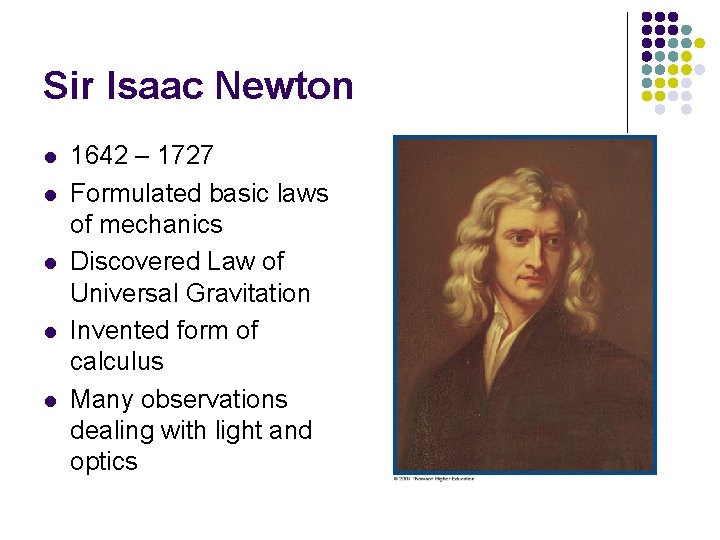
Sir Isaac Newton l l l 1642 – 1727 Formulated basic laws of mechanics Discovered Law of Universal Gravitation Invented form of calculus Many observations dealing with light and optics
Force l Forces are what cause any change in the velocity of an object l l Newton’s definition A force is that which causes an acceleration
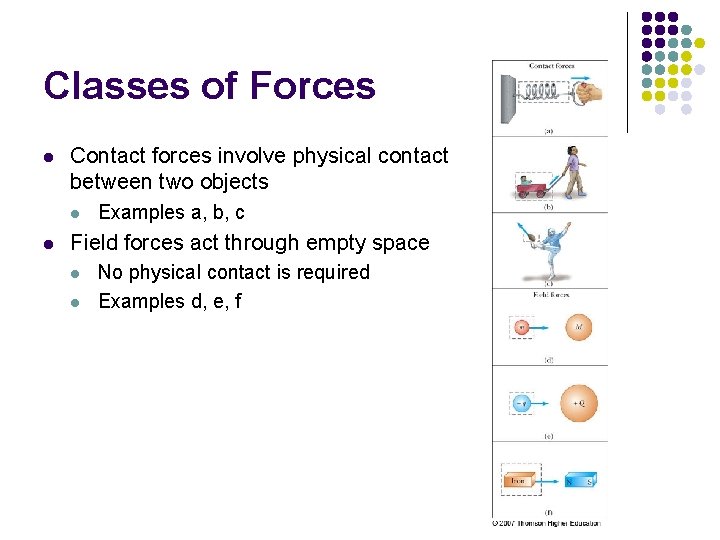
Classes of Forces l Contact forces involve physical contact between two objects l l Examples a, b, c Field forces act through empty space l l No physical contact is required Examples d, e, f
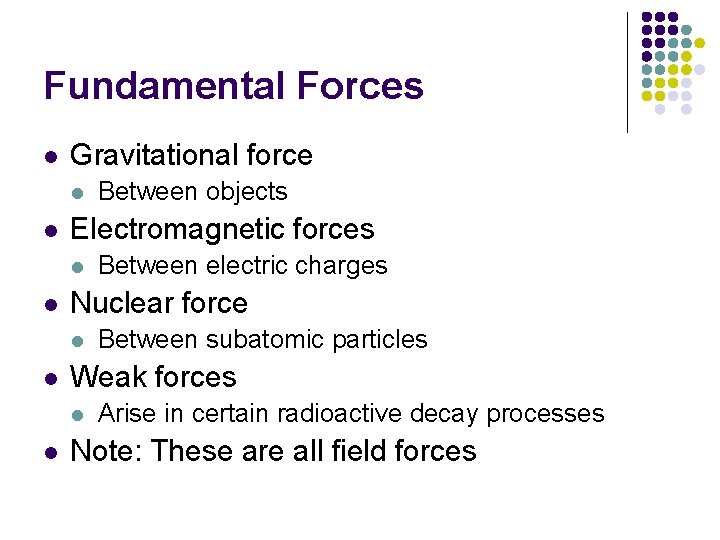
Fundamental Forces l Gravitational force l l Electromagnetic forces l l Between subatomic particles Weak forces l l Between electric charges Nuclear force l l Between objects Arise in certain radioactive decay processes Note: These are all field forces
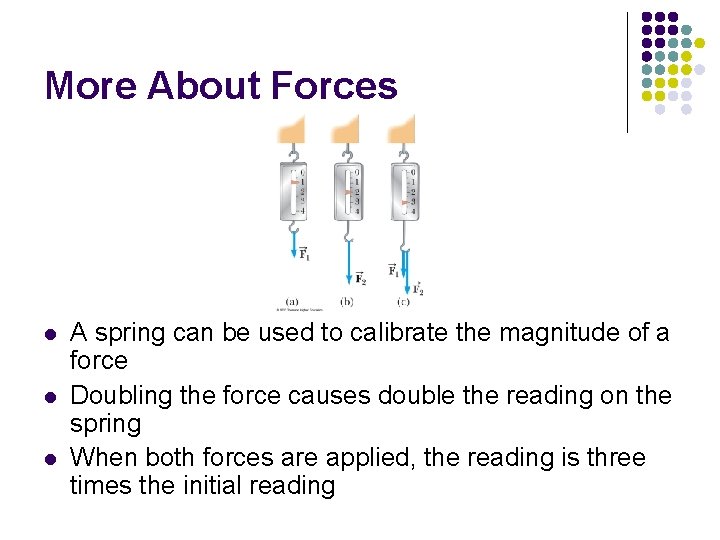
More About Forces l l l A spring can be used to calibrate the magnitude of a force Doubling the force causes double the reading on the spring When both forces are applied, the reading is three times the initial reading
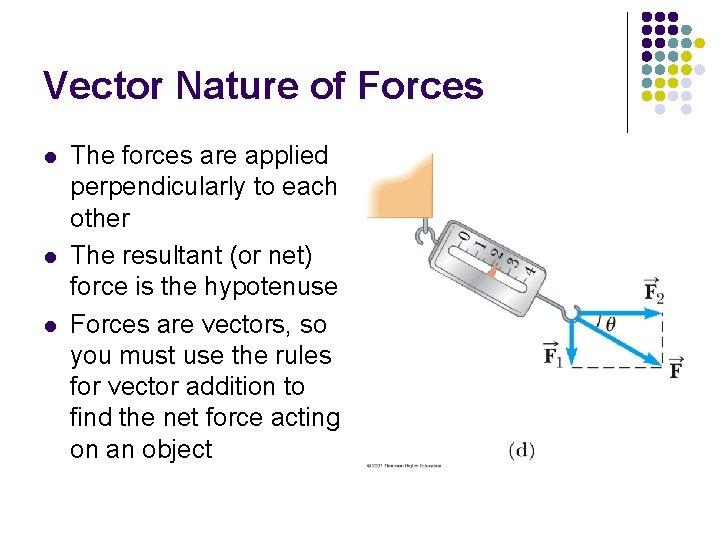
Vector Nature of Forces l l l The forces are applied perpendicularly to each other The resultant (or net) force is the hypotenuse Forces are vectors, so you must use the rules for vector addition to find the net force acting on an object
Newton’s First Law l If an object does not interact with other objects, it is possible to identify a reference frame in which the object has zero acceleration l l This is also called the law of inertia It defines a special set of reference frames called inertial frames l We call this an inertial frame of reference
Inertial Frames l l Any reference frame that moves with constant velocity relative to an inertial frame is itself an inertial frame A reference frame that moves with constant velocity relative to the distant stars is the best approximation of an inertial frame l We can consider the Earth to be such an inertial frame, although it has a small centripetal acceleration associated with its motion
Newton’s First Law – Alternative Statement l In the absence of external forces, when viewed from an inertial reference frame, an object at rest remains at rest and an object in motion continues in motion with a constant velocity l l Newton’s First Law describes what happens in the absence of a force l Does not describe zero net force Also tells us that when no force acts on an object, the acceleration of the object is zero
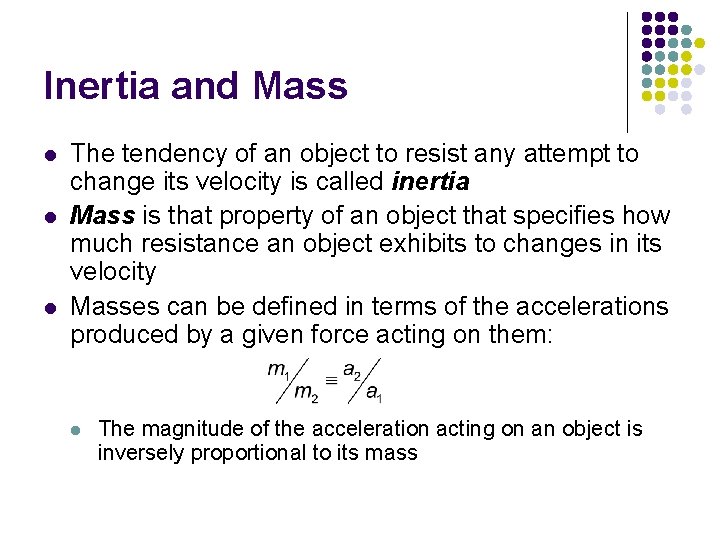
Inertia and Mass l l l The tendency of an object to resist any attempt to change its velocity is called inertia Mass is that property of an object that specifies how much resistance an object exhibits to changes in its velocity Masses can be defined in terms of the accelerations produced by a given force acting on them: l The magnitude of the acceleration acting on an object is inversely proportional to its mass
More About Mass l l l Mass is an inherent property of an object Mass is independent of the object’s surroundings Mass is independent of the method used to measure it Mass is a scalar quantity The SI unit of mass is kg
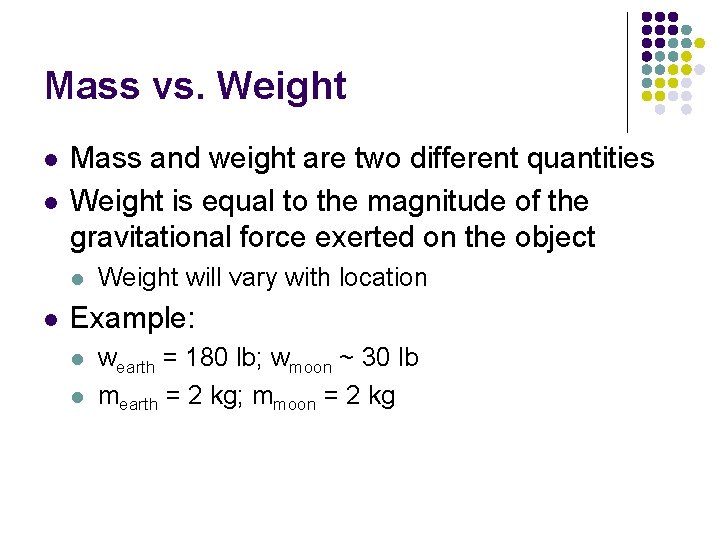
Mass vs. Weight l l Mass and weight are two different quantities Weight is equal to the magnitude of the gravitational force exerted on the object l l Weight will vary with location Example: l l wearth = 180 lb; wmoon ~ 30 lb mearth = 2 kg; mmoon = 2 kg
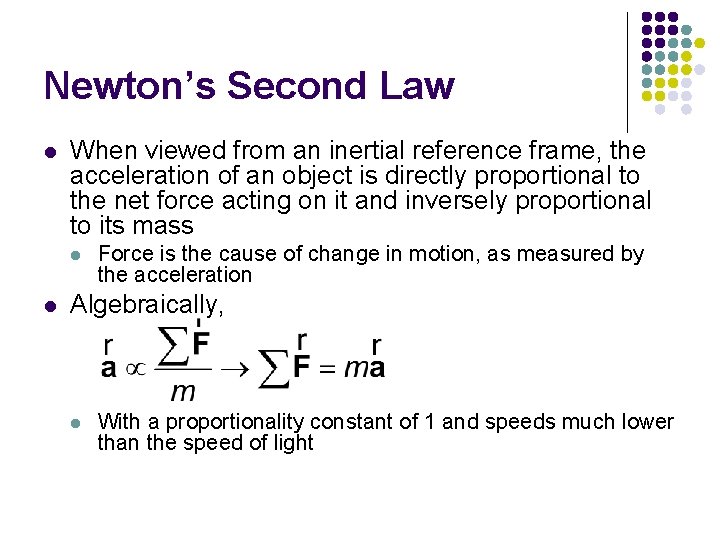
Newton’s Second Law l When viewed from an inertial reference frame, the acceleration of an object is directly proportional to the net force acting on it and inversely proportional to its mass l l Force is the cause of change in motion, as measured by the acceleration Algebraically, l With a proportionality constant of 1 and speeds much lower than the speed of light
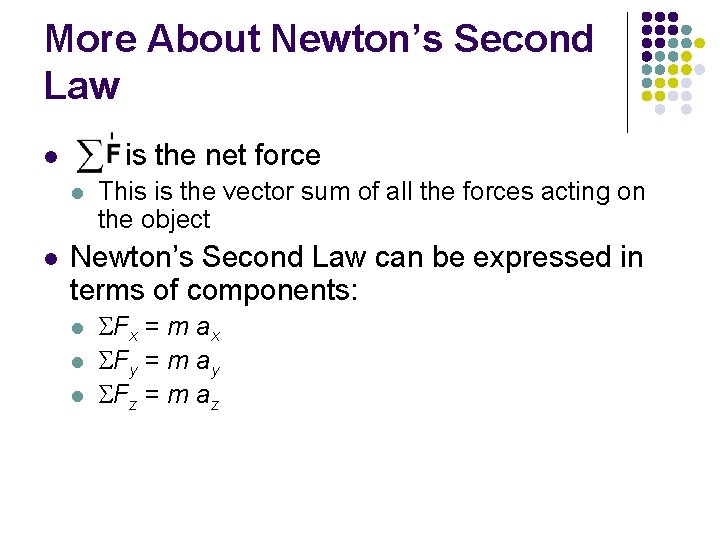
More About Newton’s Second Law is the net force l l l This is the vector sum of all the forces acting on the object Newton’s Second Law can be expressed in terms of components: l l l SFx = m ax SFy = m ay SFz = m az
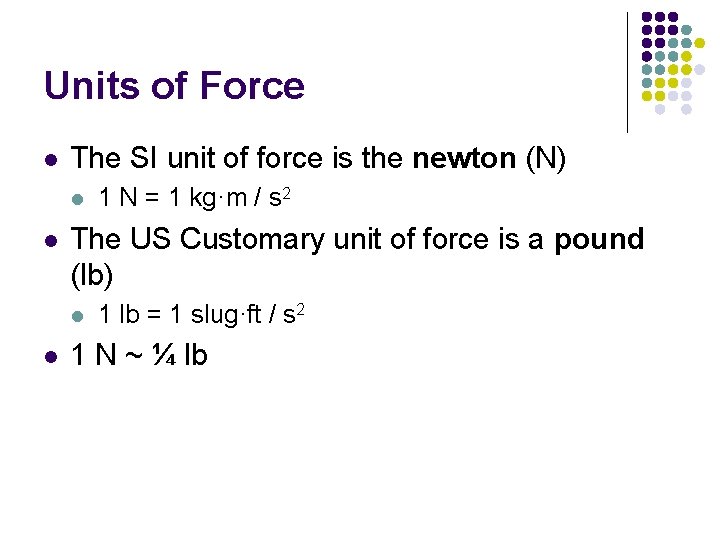
Units of Force l The SI unit of force is the newton (N) l l The US Customary unit of force is a pound (lb) l l 1 N = 1 kg·m / s 2 1 lb = 1 slug·ft / s 2 1 N ~ ¼ lb
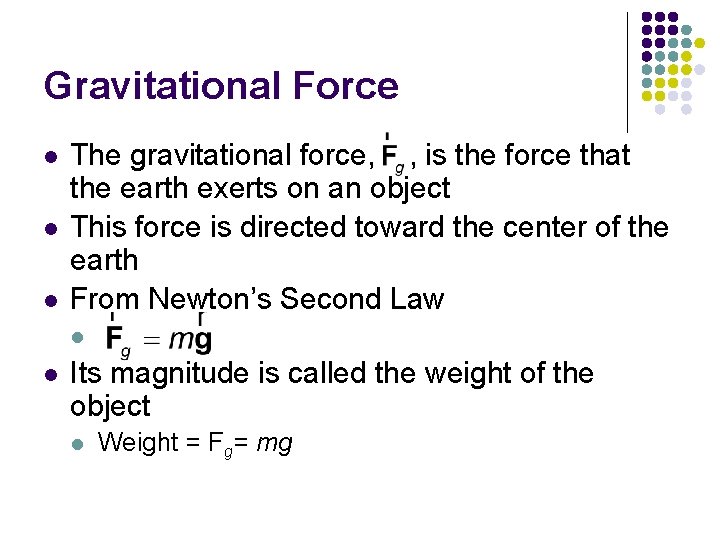
Gravitational Force l l l The gravitational force, , is the force that the earth exerts on an object This force is directed toward the center of the earth From Newton’s Second Law l l Its magnitude is called the weight of the object l Weight = Fg= mg
More About Weight l Because it is dependent on g, the weight varies with location l l l g, and therefore the weight, is less at higher altitudes This can be extended to other planets, but the value of g varies from planet to planet, so the object’s weight will vary from planet to planet Weight is not an inherent property of the object
Gravitational Mass vs. Inertial Mass l l l In Newton’s Laws, the mass is the inertial mass and measures the resistance to a change in the object’s motion In the gravitational force, the mass is determining the gravitational attraction between the object and the Earth Experiments show that gravitational mass and inertial mass have the same value
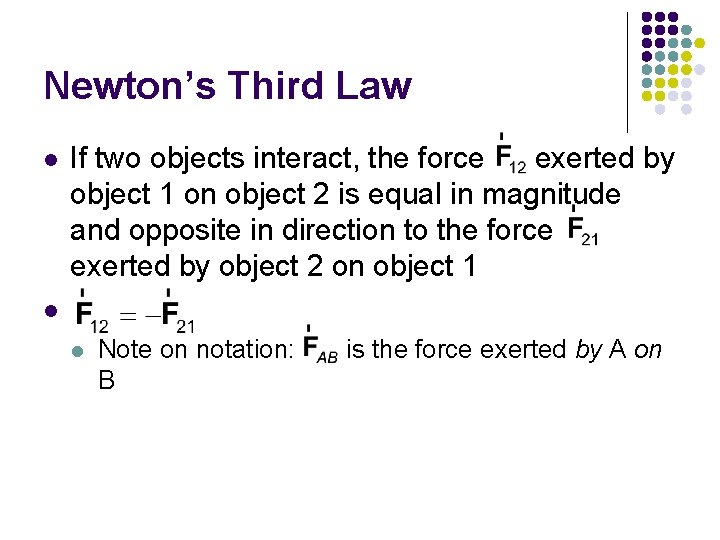
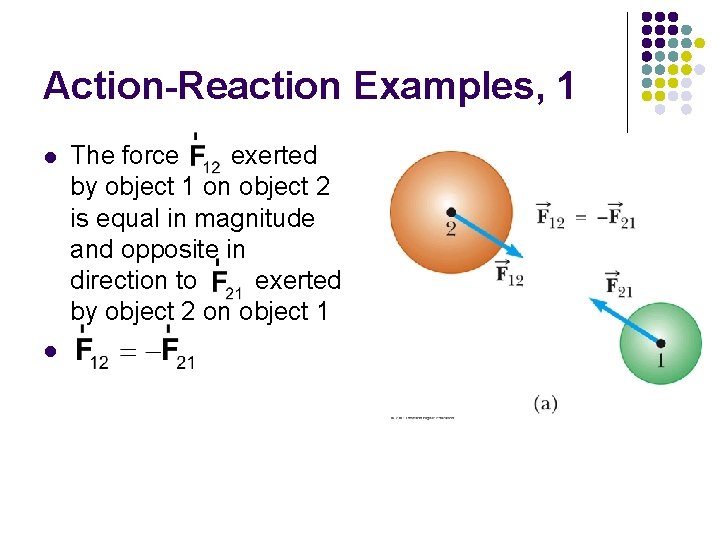
Newton’s Third Law l If two objects interact, the force exerted by object 1 on object 2 is equal in magnitude and opposite in direction to the force exerted by object 2 on object 1 l l Note on notation: B is the force exerted by A on
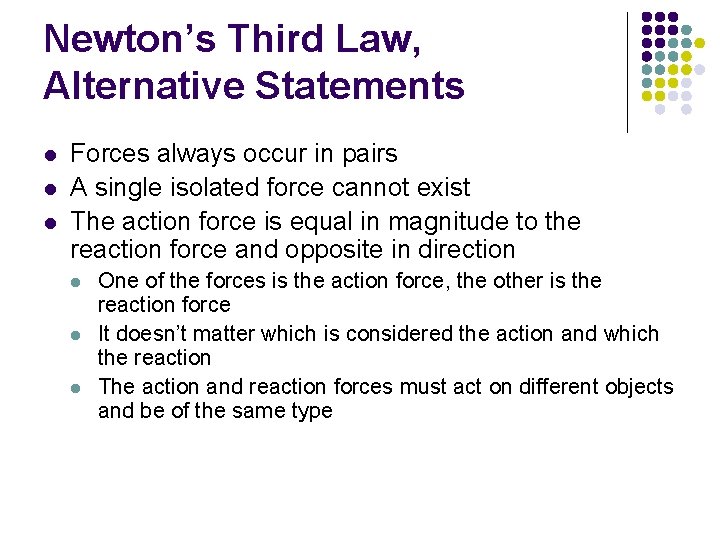
Newton’s Third Law, Alternative Statements l l l Forces always occur in pairs A single isolated force cannot exist The action force is equal in magnitude to the reaction force and opposite in direction l l l One of the forces is the action force, the other is the reaction force It doesn’t matter which is considered the action and which the reaction The action and reaction forces must act on different objects and be of the same type
Action-Reaction Examples, 1 l l The force exerted by object 1 on object 2 is equal in magnitude and opposite in direction to exerted by object 2 on object 1
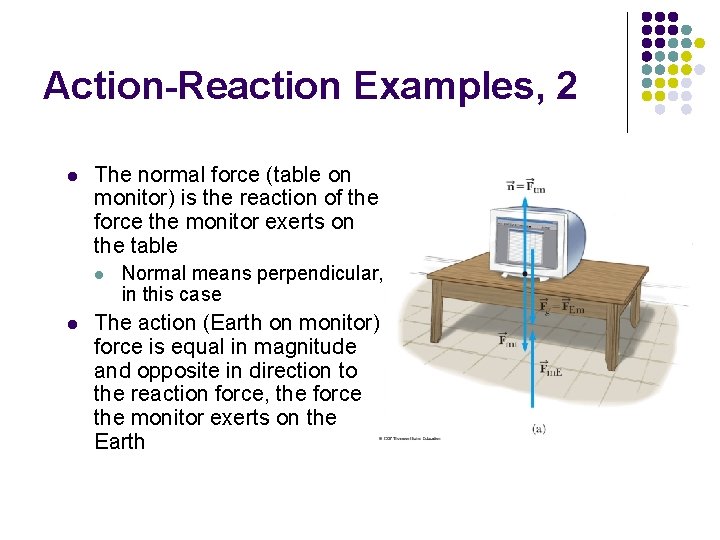
Action-Reaction Examples, 2 l The normal force (table on monitor) is the reaction of the force the monitor exerts on the table l l Normal means perpendicular, in this case The action (Earth on monitor) force is equal in magnitude and opposite in direction to the reaction force, the force the monitor exerts on the Earth
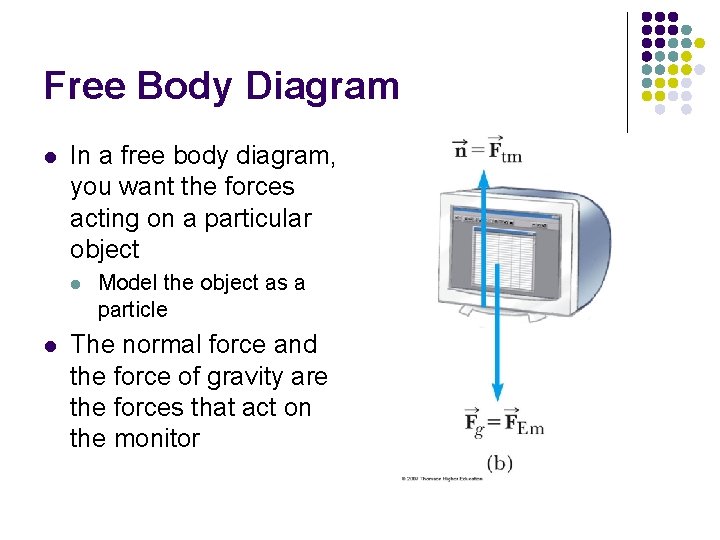
Free Body Diagram l In a free body diagram, you want the forces acting on a particular object l l Model the object as a particle The normal force and the force of gravity are the forces that act on the monitor
Free Body Diagram, cont. l l The most important step in solving problems involving Newton’s Laws is to draw the free body diagram Be sure to include only the forces acting on the object of interest Include any field forces acting on the object Do not assume the normal force equals the weight
Applications of Newton’s Law l Assumptions l l Objects can be modeled as particles Interested only in the external forces acting on the object l l l can neglect reaction forces Initially dealing with frictionless surfaces Masses of strings or ropes are negligible l l The force the rope exerts is away from the object and parallel to the rope When a rope attached to an object is pulling it, the magnitude of that force is the tension in the rope
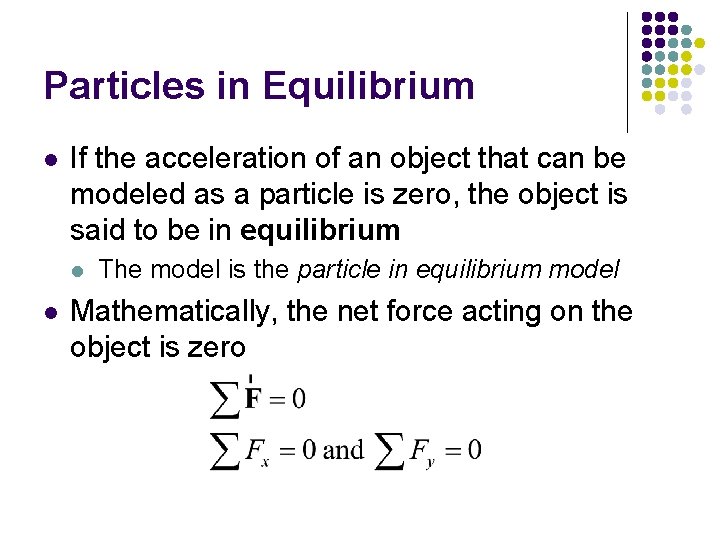
Particles in Equilibrium l If the acceleration of an object that can be modeled as a particle is zero, the object is said to be in equilibrium l l The model is the particle in equilibrium model Mathematically, the net force acting on the object is zero
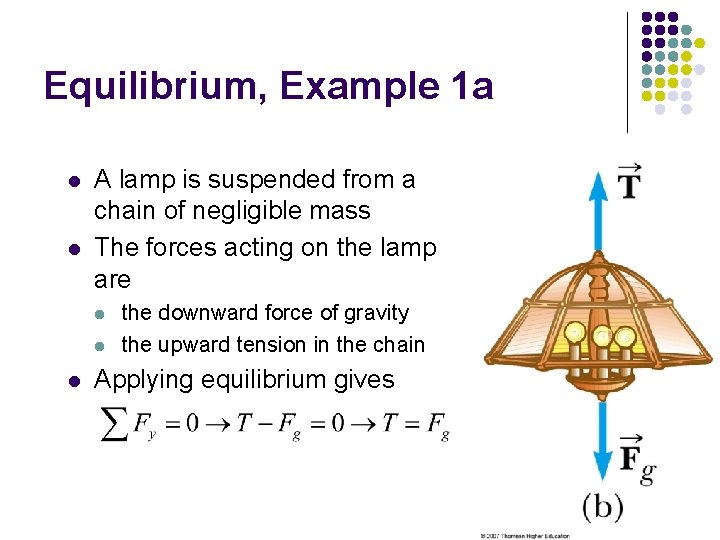
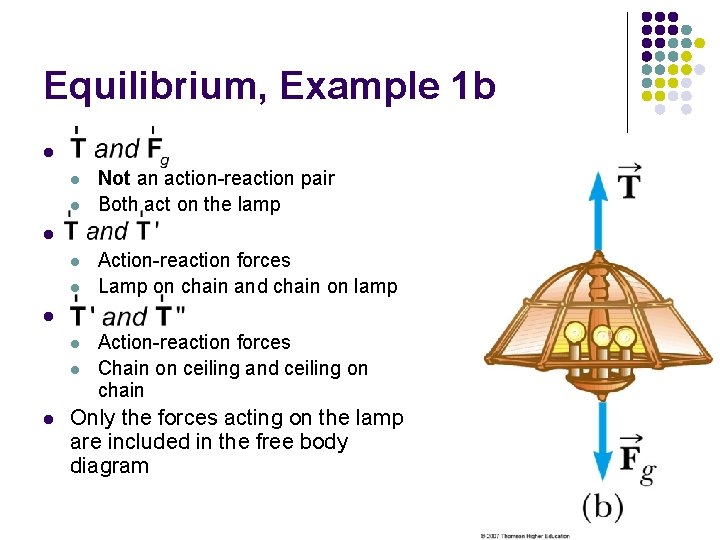
Equilibrium, Example 1 a l l A lamp is suspended from a chain of negligible mass The forces acting on the lamp are l l l the downward force of gravity the upward tension in the chain Applying equilibrium gives
Equilibrium, Example 1 b l l l Not an action-reaction pair Both act on the lamp l l l Action-reaction forces Lamp on chain and chain on lamp l l Action-reaction forces Chain on ceiling and ceiling on chain Only the forces acting on the lamp are included in the free body diagram
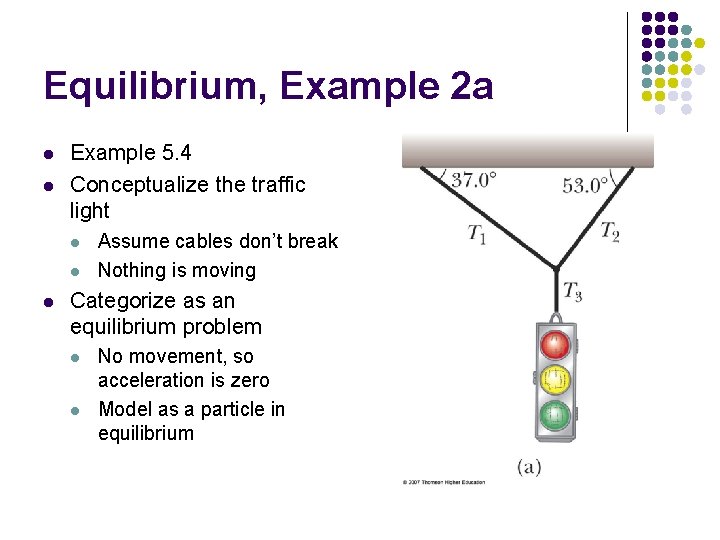
Equilibrium, Example 2 a l l Example 5. 4 Conceptualize the traffic light l l l Assume cables don’t break Nothing is moving Categorize as an equilibrium problem l l No movement, so acceleration is zero Model as a particle in equilibrium
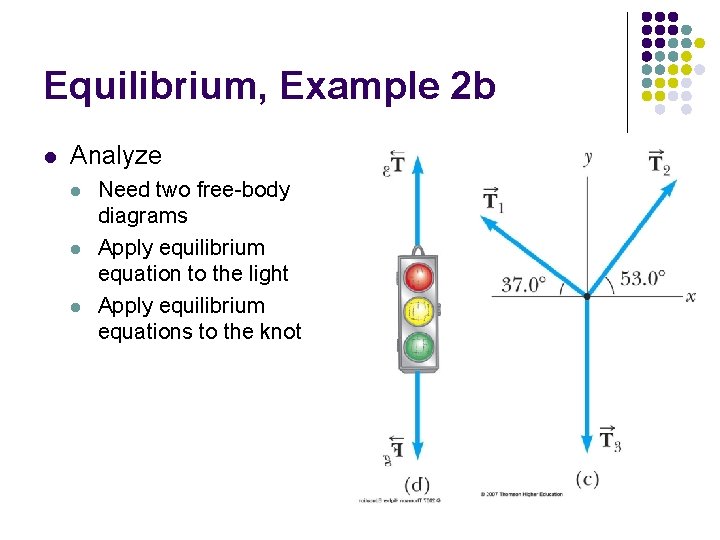
Equilibrium, Example 2 b l Analyze l l l Need two free-body diagrams Apply equilibrium equation to the light Apply equilibrium equations to the knot
Equilibrium, Example 2 c l Analyze, cont. l l l Find T 3 from applying equilibrium in the y-direction to the light Find T 1 and T 2 from applying equilibrium in the xand y-directions to the knot Finalize l Think about different situations and see if the results are reasonable
Particles Under a Net Force l If an object that can be modeled as a particle experiences an acceleration, there must be a nonzero net force acting on it l l l Model is particle under a net force model Draw a free-body diagram Apply Newton’s Second Law in component form
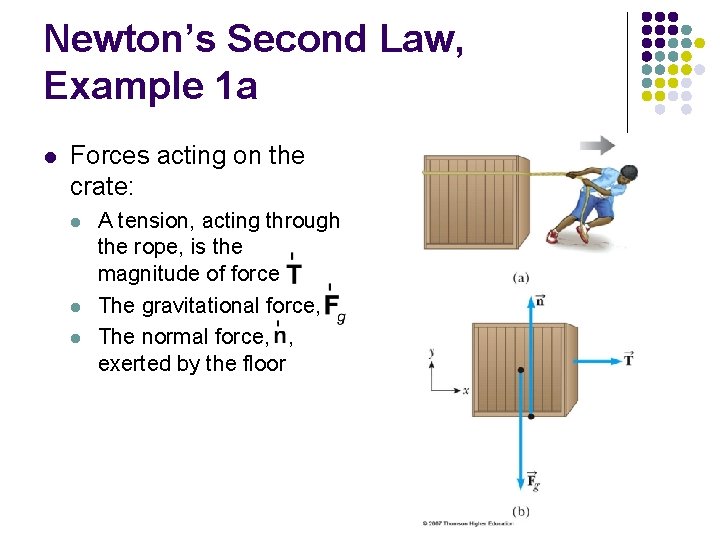
Newton’s Second Law, Example 1 a l Forces acting on the crate: l l l A tension, acting through the rope, is the magnitude of force The gravitational force, The normal force, , exerted by the floor
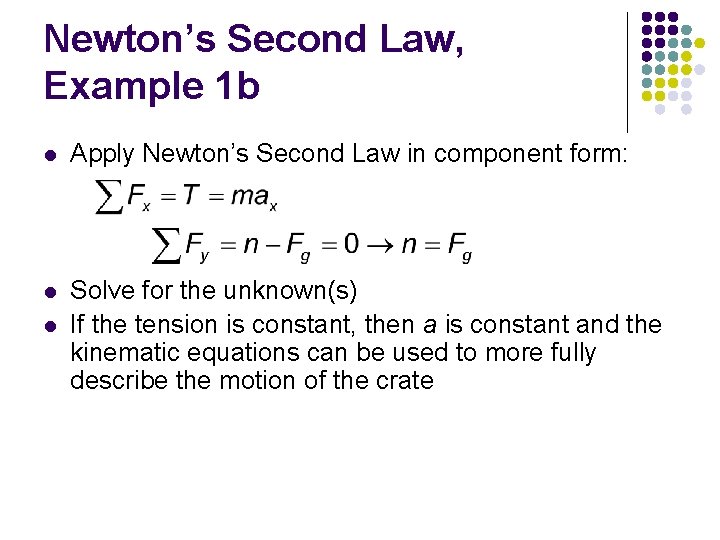
Newton’s Second Law, Example 1 b l Apply Newton’s Second Law in component form: l Solve for the unknown(s) If the tension is constant, then a is constant and the kinematic equations can be used to more fully describe the motion of the crate l
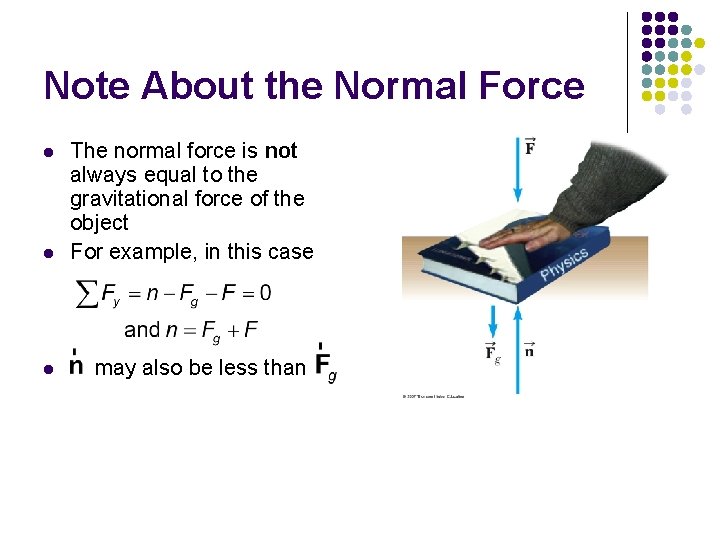
Note About the Normal Force l l l The normal force is not always equal to the gravitational force of the object For example, in this case may also be less than
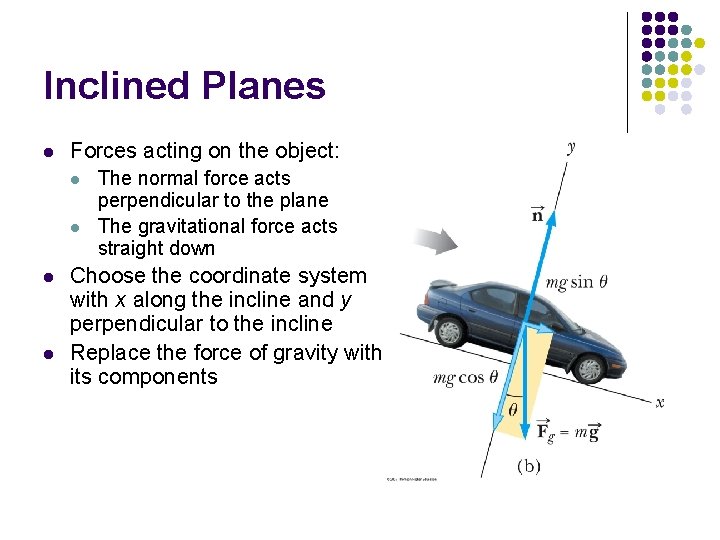
Inclined Planes l Forces acting on the object: l l The normal force acts perpendicular to the plane The gravitational force acts straight down Choose the coordinate system with x along the incline and y perpendicular to the incline Replace the force of gravity with its components
Multiple Objects l l When two or more objects are connected or in contact, Newton’s laws may be applied to the system as a whole and/or to each individual object Whichever you use to solve the problem, the other approach can be used as a check
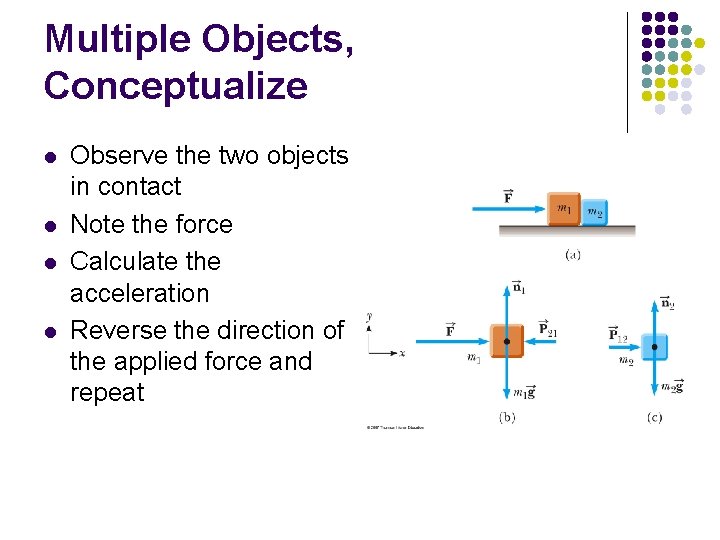
Multiple Objects, Conceptualize l l Observe the two objects in contact Note the force Calculate the acceleration Reverse the direction of the applied force and repeat
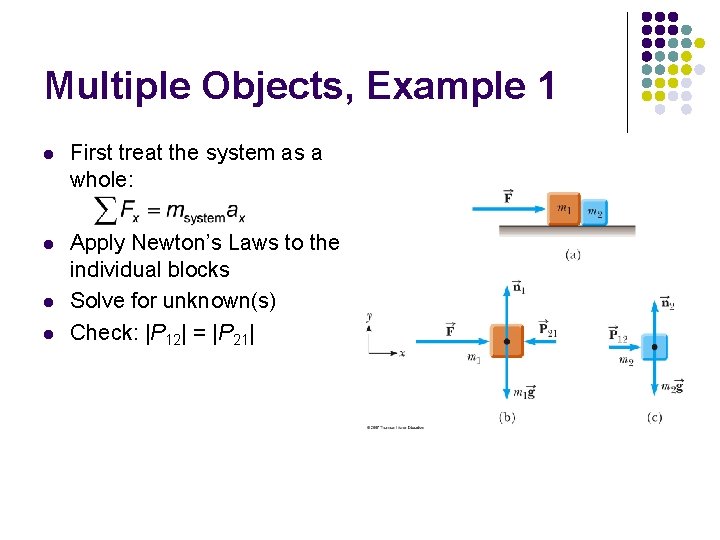
Multiple Objects, Example 1 l First treat the system as a whole: l Apply Newton’s Laws to the individual blocks Solve for unknown(s) Check: |P 12| = |P 21| l l
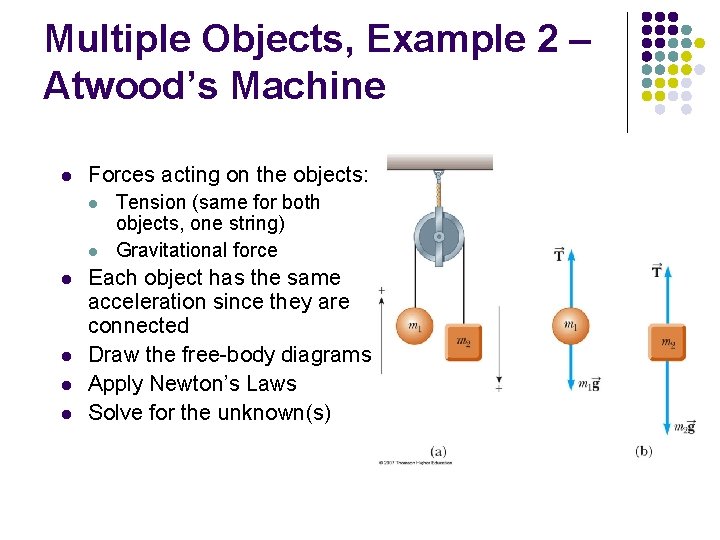
Multiple Objects, Example 2 – Atwood’s Machine l Forces acting on the objects: l l l Tension (same for both objects, one string) Gravitational force Each object has the same acceleration since they are connected Draw the free-body diagrams Apply Newton’s Laws Solve for the unknown(s)
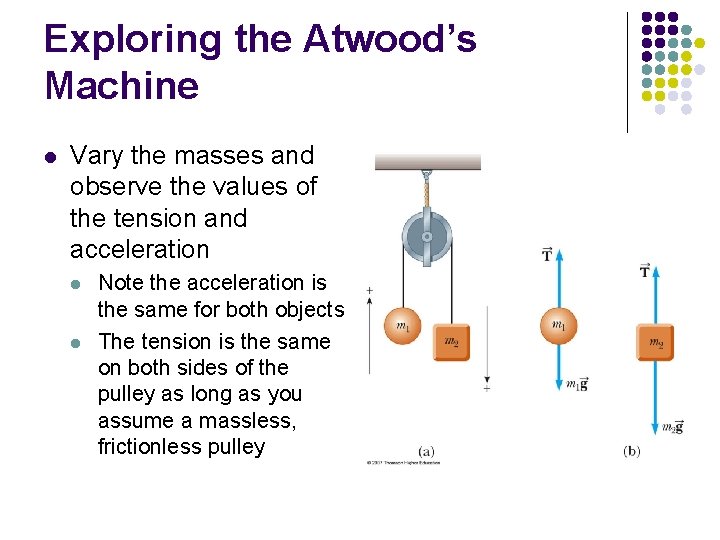
Exploring the Atwood’s Machine l Vary the masses and observe the values of the tension and acceleration l l Note the acceleration is the same for both objects The tension is the same on both sides of the pulley as long as you assume a massless, frictionless pulley
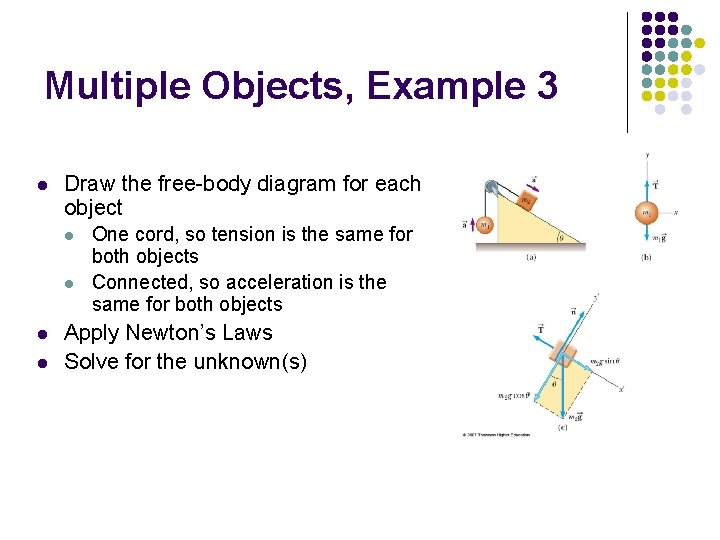
Multiple Objects, Example 3 l Draw the free-body diagram for each object l l One cord, so tension is the same for both objects Connected, so acceleration is the same for both objects Apply Newton’s Laws Solve for the unknown(s)
Problem-Solving Hints Newton’s Laws l Conceptualize l l l Draw a diagram Choose a convenient coordinate system for each object Categorize l Is the model a particle in equilibrium? l l If so, SF = 0 Is the model a particle under a net force? l If so, SF = m a
Problem-Solving Hints Newton’s Laws, cont l Analyze l l l l Draw free-body diagrams for each object Include only forces acting on the object Find components along the coordinate axes Be sure units are consistent Apply the appropriate equation(s) in component form Solve for the unknown(s) Finalize l l Check your results for consistency with your free-body diagram Check extreme values
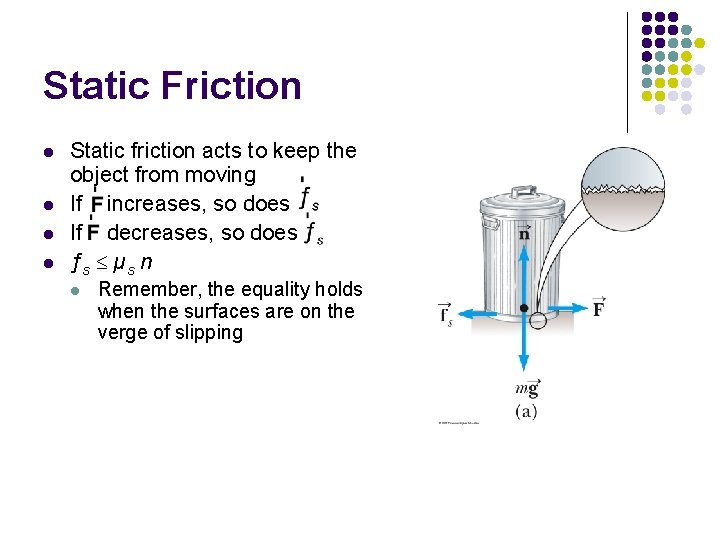
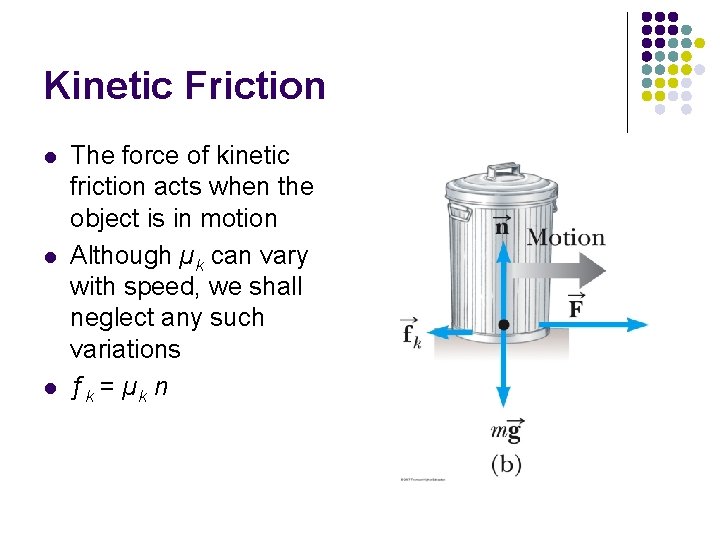
Forces of Friction l When an object is in motion on a surface or through a viscous medium, there will be a resistance to the motion l l This is due to the interactions between the object and its environment This resistance is called the force of friction
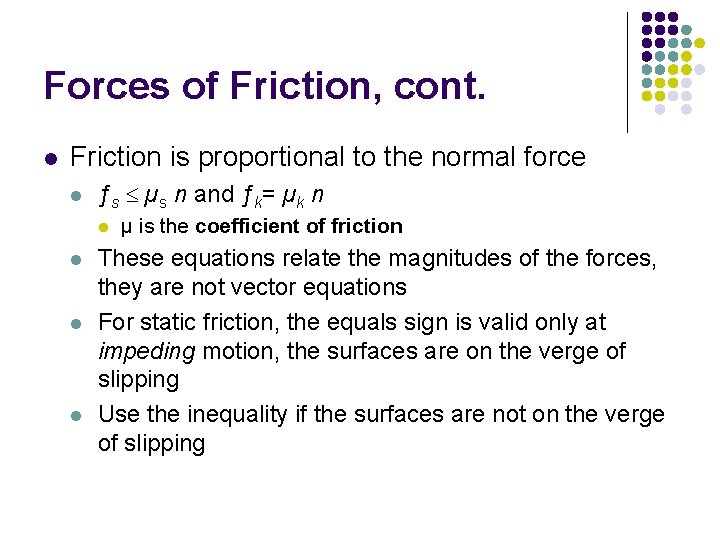
Forces of Friction, cont. l Friction is proportional to the normal force l ƒs µs n and ƒk= µk n l l μ is the coefficient of friction These equations relate the magnitudes of the forces, they are not vector equations For static friction, the equals sign is valid only at impeding motion, the surfaces are on the verge of slipping Use the inequality if the surfaces are not on the verge of slipping
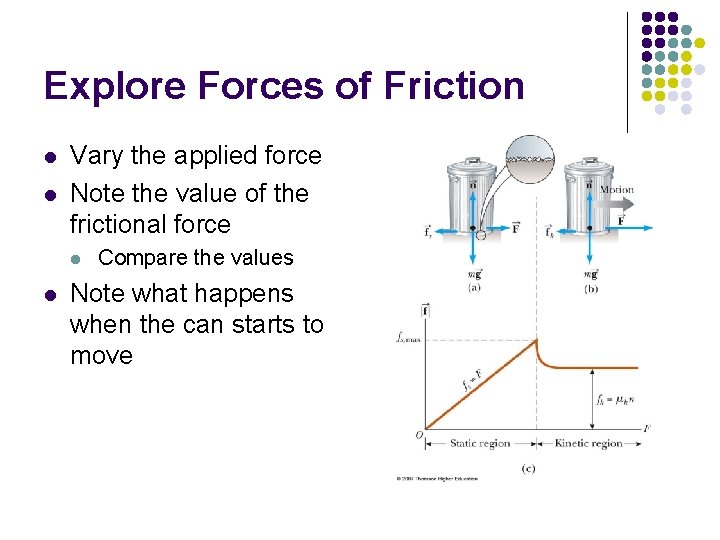
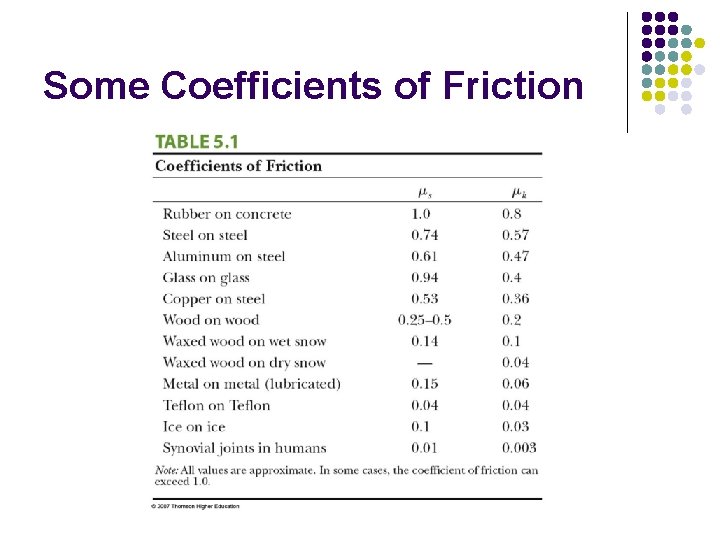
Forces of Friction, final l l The coefficient of friction depends on the surfaces in contact The force of static friction is generally greater than the force of kinetic friction The direction of the frictional force is opposite the direction of motion and parallel to the surfaces in contact The coefficients of friction are nearly independent of the area of contact
Static Friction l l Static friction acts to keep the object from moving If increases, so does If decreases, so does ƒs µs n l Remember, the equality holds when the surfaces are on the verge of slipping
Kinetic Friction l l l The force of kinetic friction acts when the object is in motion Although µk can vary with speed, we shall neglect any such variations ƒk = µk n
Explore Forces of Friction l l Vary the applied force Note the value of the frictional force l l Compare the values Note what happens when the can starts to move
Some Coefficients of Friction
Friction in Newton’s Laws Problems l l Friction is a force, so it simply is included in the in Newton’s Laws The rules of friction allow you to determine the direction and magnitude of the force of friction
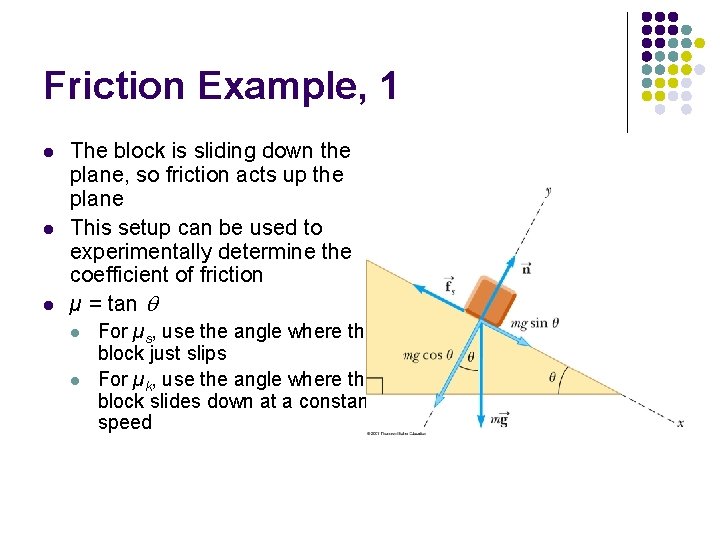
Friction Example, 1 l l l The block is sliding down the plane, so friction acts up the plane This setup can be used to experimentally determine the coefficient of friction µ = tan q l l For µs, use the angle where the block just slips For µk, use the angle where the block slides down at a constant speed
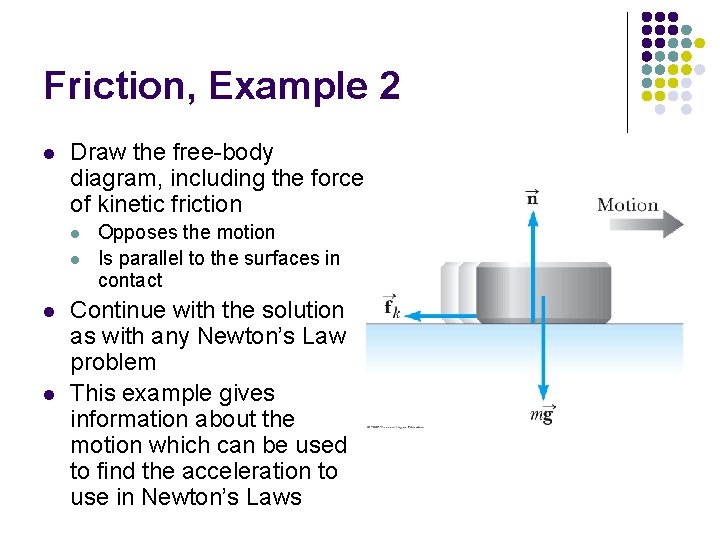
Friction, Example 2 l Draw the free-body diagram, including the force of kinetic friction l l Opposes the motion Is parallel to the surfaces in contact Continue with the solution as with any Newton’s Law problem This example gives information about the motion which can be used to find the acceleration to use in Newton’s Laws
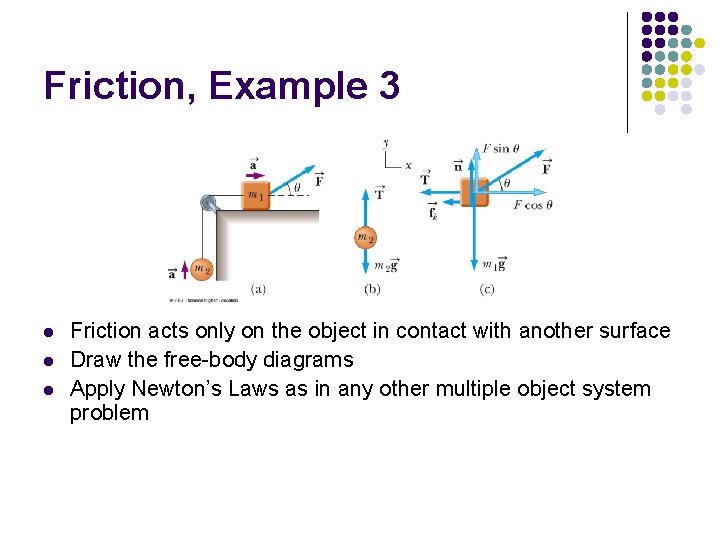
Friction, Example 3 l l l Friction acts only on the object in contact with another surface Draw the free-body diagrams Apply Newton’s Laws as in any other multiple object system problem
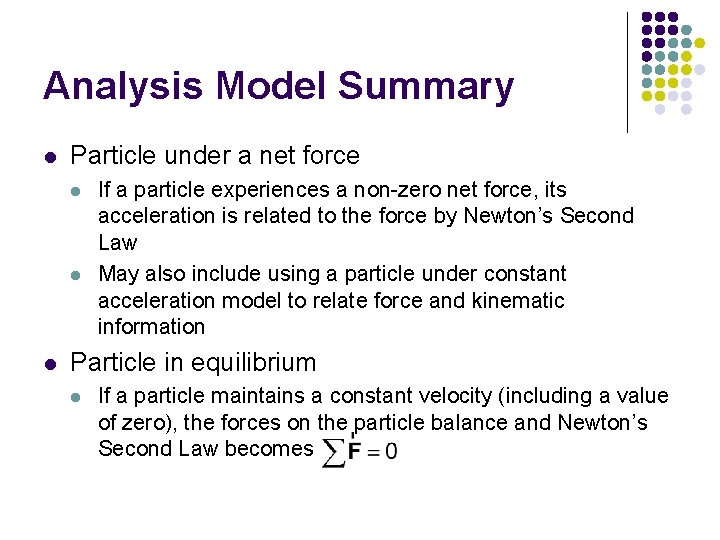
Analysis Model Summary l Particle under a net force l l l If a particle experiences a non-zero net force, its acceleration is related to the force by Newton’s Second Law May also include using a particle under constant acceleration model to relate force and kinematic information Particle in equilibrium l If a particle maintains a constant velocity (including a value of zero), the forces on the particle balance and Newton’s Second Law becomes