
Chapter 5 The Integumentary System Skin and its













- Slides: 43
Chapter 5 The Integumentary System • Skin and its accessory structures – – – structure function growth and repair development aging disorders 1
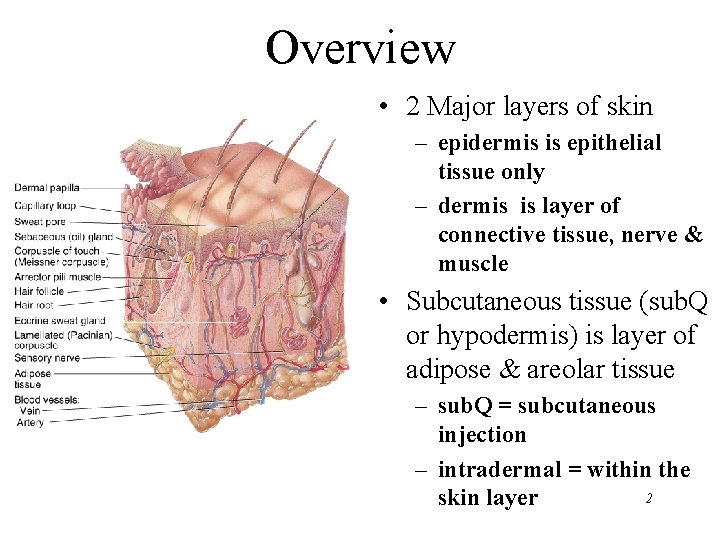
Overview • 2 Major layers of skin – epidermis is epithelial tissue only – dermis is layer of connective tissue, nerve & muscle • Subcutaneous tissue (sub. Q or hypodermis) is layer of adipose & areolar tissue – sub. Q = subcutaneous injection – intradermal = within the 2 skin layer
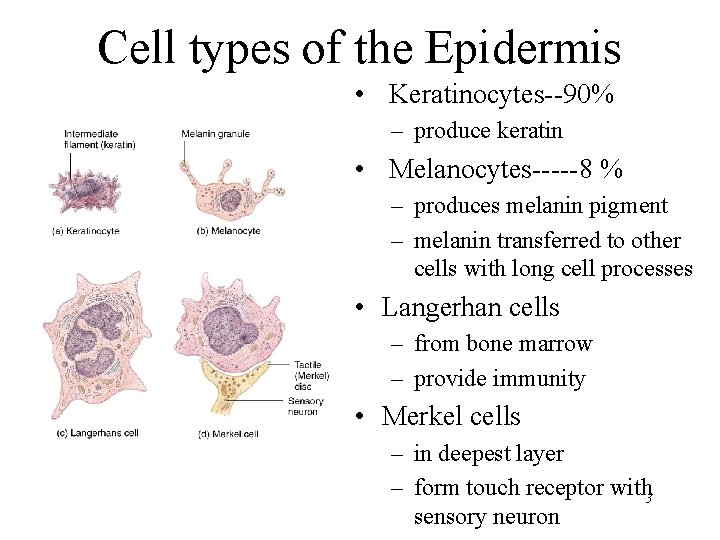
Cell types of the Epidermis • Keratinocytes--90% – produce keratin • Melanocytes-----8 % – produces melanin pigment – melanin transferred to other cells with long cell processes • Langerhan cells – from bone marrow – provide immunity • Merkel cells – in deepest layer – form touch receptor with 3 sensory neuron
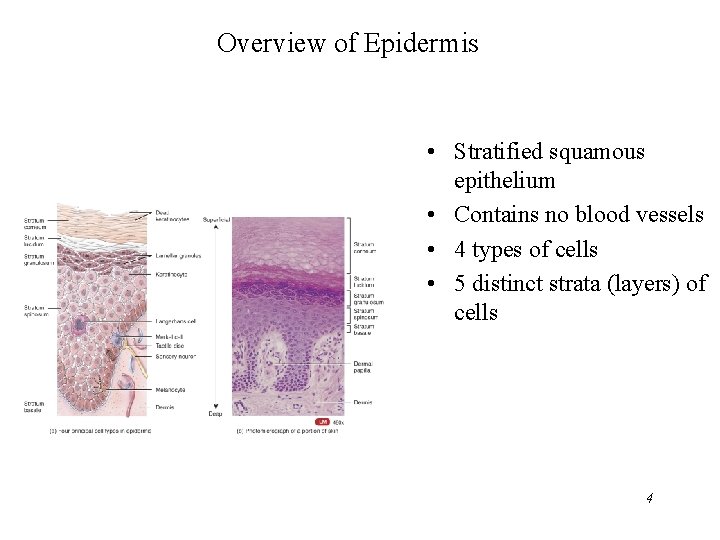
Overview of Epidermis • Stratified squamous epithelium • Contains no blood vessels • 4 types of cells • 5 distinct strata (layers) of cells 4
Layers (Strata) of the Epidermis • • • Stratum corneum Stratum lucidum Stratum granulosum Stratum spinosum Stratum basale 5
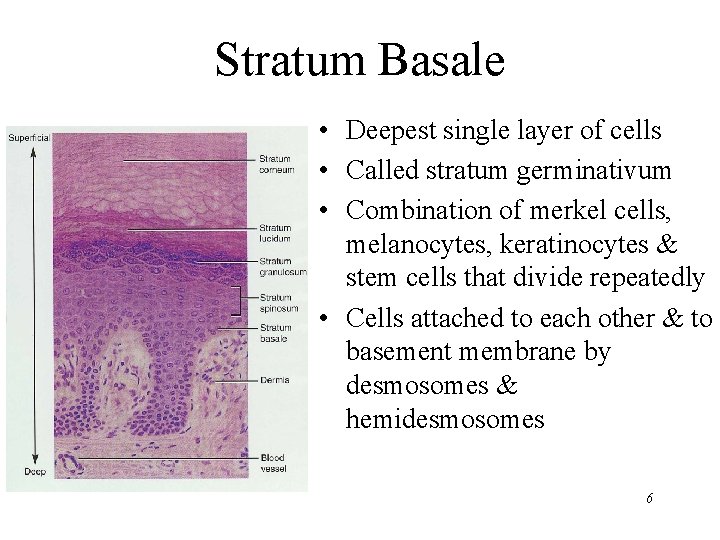
Stratum Basale • Deepest single layer of cells • Called stratum germinativum • Combination of merkel cells, melanocytes, keratinocytes & stem cells that divide repeatedly • Cells attached to each other & to basement membrane by desmosomes & hemidesmosomes 6
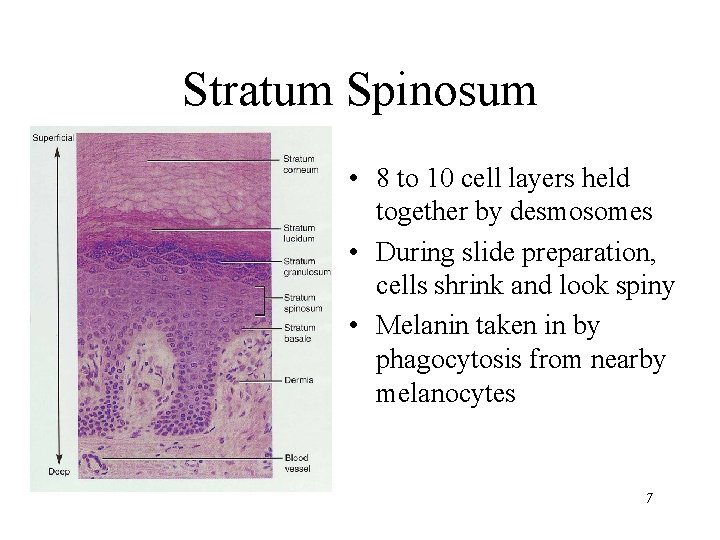
Stratum Spinosum • 8 to 10 cell layers held together by desmosomes • During slide preparation, cells shrink and look spiny • Melanin taken in by phagocytosis from nearby melanocytes 7
Stratum Granulosum • 3 - 5 layers of flat dying cells • Show nuclear degeneration • Contain dark-staining keratohyalin granules • Contain lamellar granules that release lipid that repels water 8
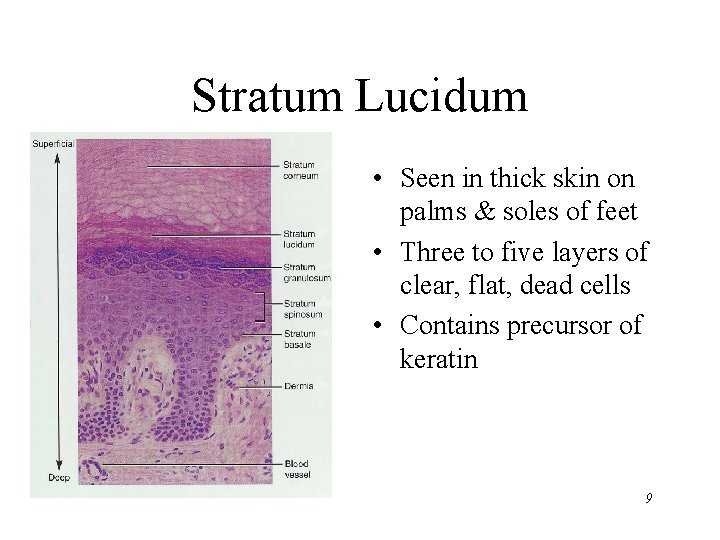
Stratum Lucidum • Seen in thick skin on palms & soles of feet • Three to five layers of clear, flat, dead cells • Contains precursor of keratin 9
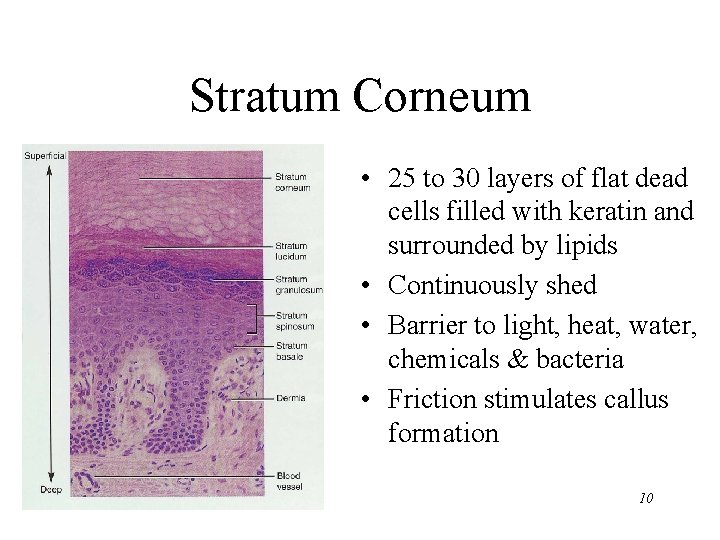
Stratum Corneum • 25 to 30 layers of flat dead cells filled with keratin and surrounded by lipids • Continuously shed • Barrier to light, heat, water, chemicals & bacteria • Friction stimulates callus formation 10
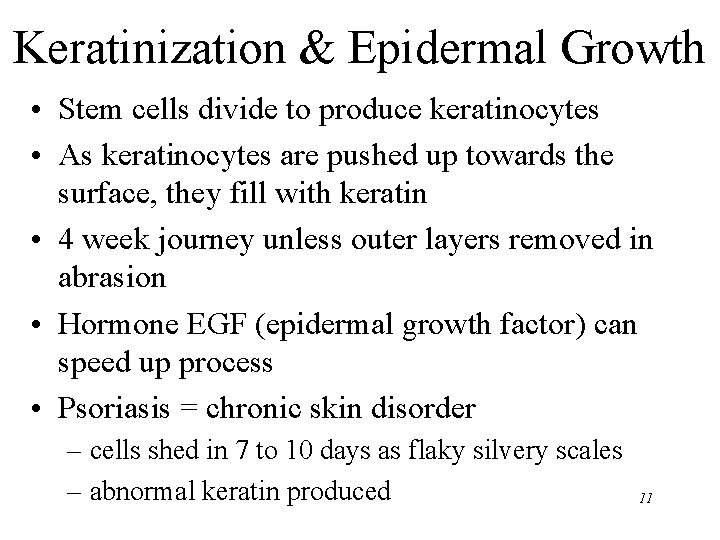
Keratinization & Epidermal Growth • Stem cells divide to produce keratinocytes • As keratinocytes are pushed up towards the surface, they fill with keratin • 4 week journey unless outer layers removed in abrasion • Hormone EGF (epidermal growth factor) can speed up process • Psoriasis = chronic skin disorder – cells shed in 7 to 10 days as flaky silvery scales – abnormal keratin produced 11
Dermis • Connective tissue layer composed of collagen & elastic fibers, fibroblasts, macrophages & fat cells • Contains hair follicles, glands, nerves & blood vessels • Major regions of dermis – papillary region – reticular region 12
Papillary Region • • Top 20% of dermis Composed of loose CT & elastic fibers Finger like projections called dermal papillae Functions – anchors epidermis to dermis – contains capillaries that feed epidermis – contains Meissner’s corpuscles (touch) & free nerve endings (pain and temperature) 13
Reticular Region • Dense irregular connective tissue • Contains interlacing collagen and elastic fibers • Packed with oil glands, sweat gland ducts, fat & hair follicles • Provides strength, extensibility & elasticity to skin – stretch marks are dermal tears from extreme stretching • Epidermal ridges form in fetus as epidermis conforms to dermal papillae – fingerprints are left by sweat glands open on ridges 14 – increase grip of hand
Accessory Structures of Skin • Epidermal derivatives • Cells sink inward during development to form: – – hair oil glands sweat glands nails 15
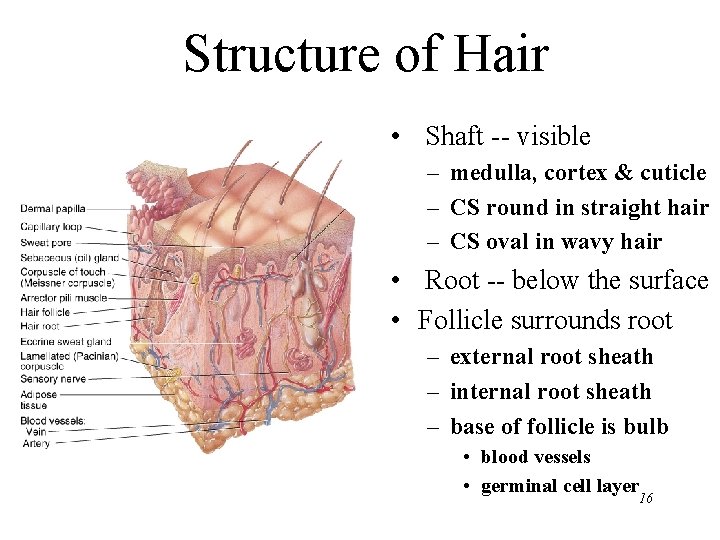
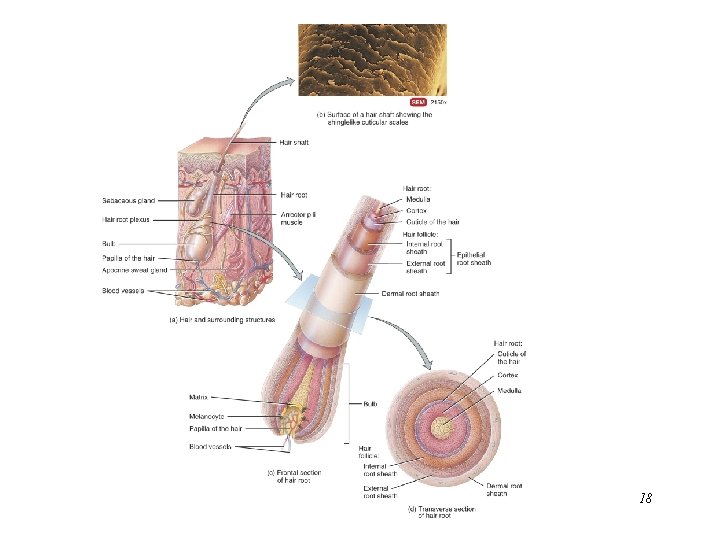
Structure of Hair • Shaft -- visible – medulla, cortex & cuticle – CS round in straight hair – CS oval in wavy hair • Root -- below the surface • Follicle surrounds root – external root sheath – internal root sheath – base of follicle is bulb • blood vessels • germinal cell layer 16
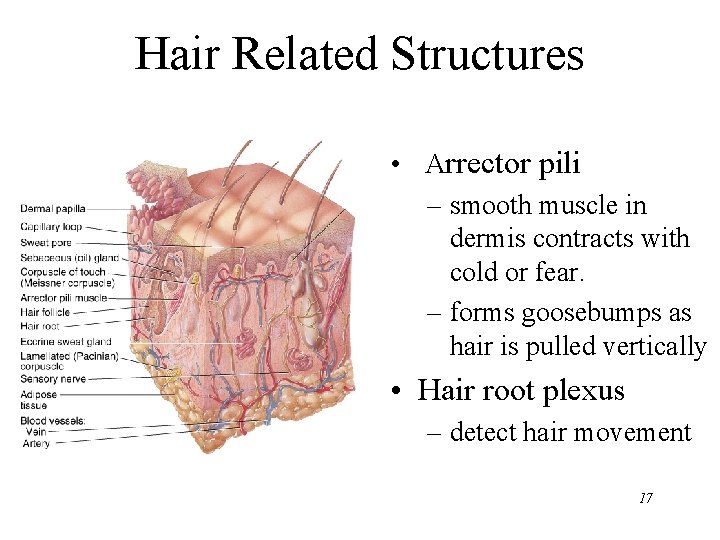
Hair Related Structures • Arrector pili – smooth muscle in dermis contracts with cold or fear. – forms goosebumps as hair is pulled vertically • Hair root plexus – detect hair movement 17
18
Glands of the Skin • • • Specialized exocrine glands found in dermis Sebaceous (oil) glands Sudiferous (sweat) glands Ceruminous (wax) glands Mammary (milk) glands 19
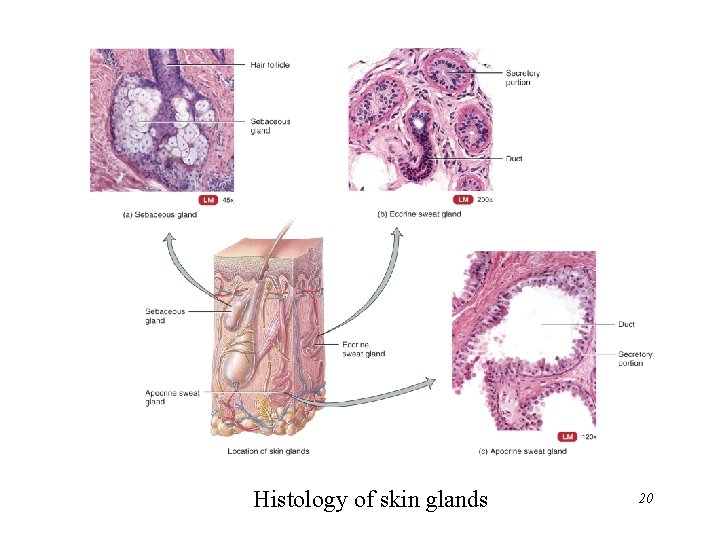
Histology of skin glands 20
Sebaceous (oil) glands • Secretory portion in the dermis • Most open onto hair shafts • Sebum – combination of cholesterol, proteins, fats & salts – keeps hair and skin from soft & pliable – inhibits growth of bacteria & fungi(ringworm) • Acne – bacterial inflammation of glands – secretions stimulated by hormones at puberty 21
Sudoriferous (sweat) glands • Eccrine (sweat) glands – most areas of skin – secretory portion in dermis with duct to surface – regulate body temperature with perspiration • Apocrine (sweat) glands – armpit and pubic region – secretory portion in dermis with duct that opens onto hair follicle – secretions more viscous 22
Ceruminous glands • Modified sweat glands produce waxy secretion in ear canal • Cerumin contains secretions of oil and wax glands • Helps form barrier for entrance of foreign bodies • Impacted cerumen may reduce hearing 23
Nails • Tightly packed, keratinized cells • Nail body is pink due to underlying capillaries • Lunula appears white due to thickened stratum basale in that area • Cuticle (eponychium) is stratum corneum • Nail matrix deep to the nail root is the region from which the nail growth occurs • Growth is 1 mm per week--faster in summer & on most-used hand 24
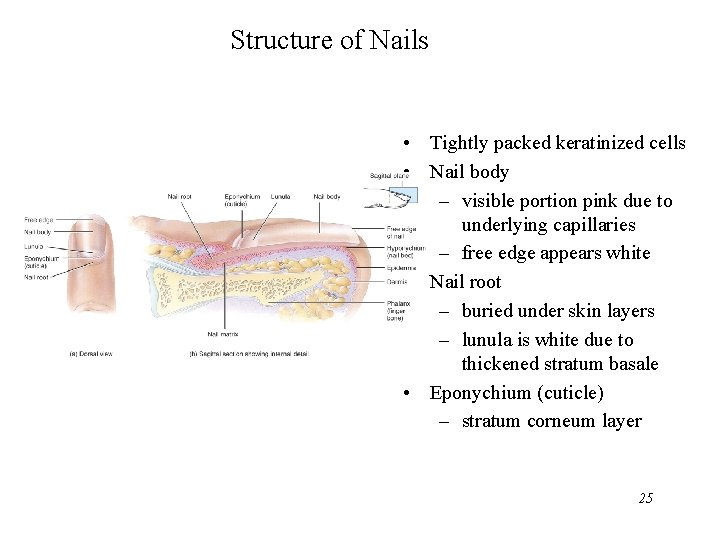
Structure of Nails • Tightly packed keratinized cells • Nail body – visible portion pink due to underlying capillaries – free edge appears white • Nail root – buried under skin layers – lunula is white due to thickened stratum basale • Eponychium (cuticle) – stratum corneum layer 25
Types of Skin • Thin skin – covers most of body – thin epidermis (. 1 to. 15 mm. ) that lacks stratum lucidum – lacks epidermal ridges, has fewer sweat glands and sensory receptors • Thick skin – only on palms and soles – thick epidermis (. 6 to 4. 5 mm. ) with distinct stratum lucidum & thick stratum corneum 26 – lacks hair follicles and sebaceous glands
General Functions of the Skin • • • Regulation of body temperature Protection as physical barrier Sensory receptors Excretion and absorption Synthesis of vitamin 27
Thermoregulation • Releasing of sweat onto the skin – perspiration & its evaporation lowers body temperature • Adjusting flow of blood to the body surface – in moderate exercise, more blood brought to surface helps lower temperature – with extreme exercise, blood is shunted to muscles and body temperature rises • Shivering and constriction of surface vessels – raise internal body temperature as needed 28
Protection • Physical, chemical and biological barrier – tight cell junctions prevent bacterial invasion – lipids released retard evaporation – pigment protects somewhat against UV light – langerhans cells alert immune system 29
Cutaneous Sensations • Touch, temperature, pressure, vibration, tickling and some pain sensations arise from the skin. 30
Excretion and Absorption • Only a minor role is played by the skin • 400 m. L of water evaporates from it daily • Small amounts salt, CO 2, ammonia and urea are excreted • Lipid soluble substances can be absorbed through the skin – vitamins A, D, E and K, Oxygen and CO 2 – acetone and dry-cleaning fluid, lead, mercury, arsenic, poisons in poison ivy and oak 31
Synthesis of Vitamin D • Sunlight activates a precursor to vitamin D • Enzymes in the liver and kidneys transform that molecule into calcitriol (most active form of vitamin D) • Necessary vitamin for absorption of calcium from food in the gastrointestinal tract 32
33
Epidermal Wound Healing • • • Abrasion or minor burn Basal cells migrate across the wound Contact inhibition with other cells stops migration Epidermal growth factor stimulates cell division Full thickness of epidermis results from further cell division 34
Deep Wound Healing • If an injury reaches dermis, healing occurs in 4 phases – inflammatory phase has clot unite wound edges and WBCs arrive from dilated and more permeable blood vessels – migratory phase begins the regrowth of epithelial cells and the formation of scar tissue by the fibroblasts – proliferative phase is a completion of tissue formation – maturation phase sees the scab fall off • Scar formation – hypertrophic scar remains within the boundaries of the original wound – keloid scar extends into previously normal tissue • collagen fibers are very dense and fewer blood vessels are present so the tissue is lighter in color 35
Phases of Deep Wound Healing Which phases have been left out of this illustration? 36
Development of the Skin • Epidermis develops from ectodermal germ layer • Dermis develops from mesodermal germ layer – at 8 weeks, fetal “skin” is simple cuboidal epithelium – nails begin to form at 10 weeks, but do not reach the fingertip until the 9 th month – dermis forms from mesoderm by 11 weeks – by 16 weeks, all layers of the epidermis are present – oil and sweat glands form in 4 th and 5 th month – by 6 th months, delicate fetal hair (lanugo) has formed • Slippery coating of oil and sloughed off skin called vernix caseosa is present at birth 37
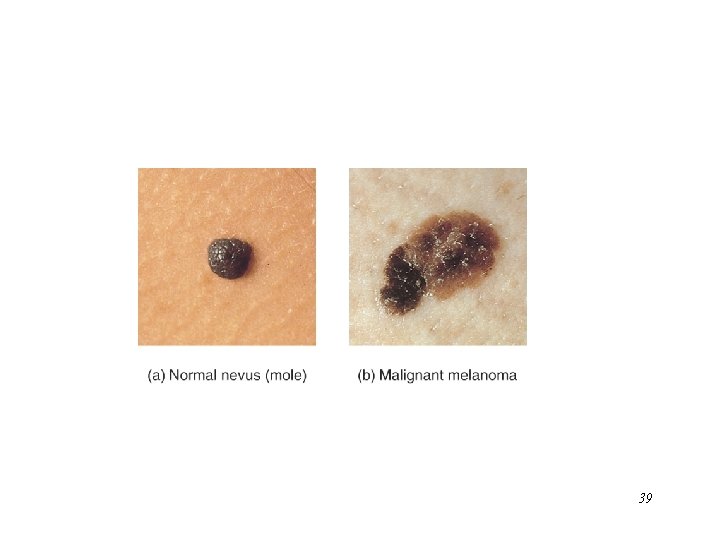
Skin Cancer • 1 million cases diagnosed per year • 3 common forms of skin cancer – basal cell carcinoma (rarely metastasize) – squamous cell carcinoma (may metastasize) – malignant melanomas (metastasize rapidly) • most common cancer in young women • arise from melanocytes ----life threatening • key to treatment is early detection watch for changes in symmetry, border, color and size • risks factors include-- skin color, sun exposure, family 38 history, age and immunological status
39
Burns • Destruction of proteins of the skin – chemicals, electricity, heat • Problems that result – shock due to water, plasma and plasma protein loss – circulatory & kidney problems from loss of plasma – bacterial infection 40
Types of Burns • First-degree – only epidermis (sunburn) • Second-degree burn – destroys entire epidermis & part of dermis – fluid-filled blisters separate epidermis & dermis – epidermal derivatives are not damaged – heals without grafting in 3 to 4 weeks & may scar • Third-degree or full-thickness – destroy epidermis, dermis & epidermal derivatives – damaged area is numb due to loss of sensory nerves 41
42
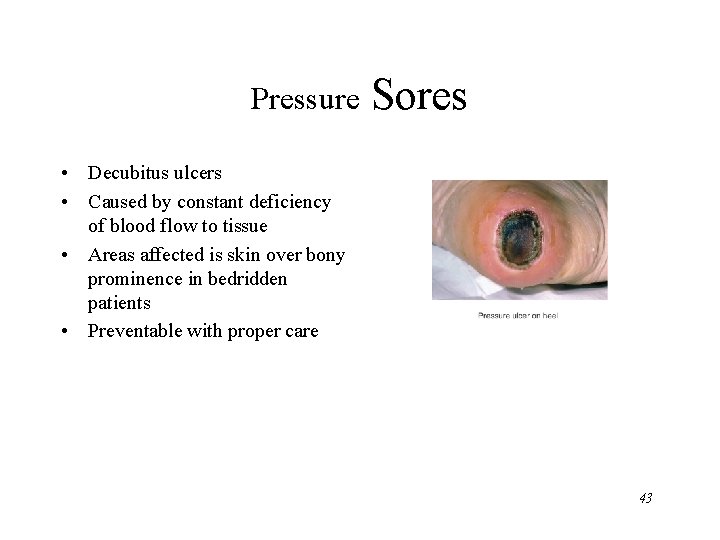
Pressure Sores • Decubitus ulcers • Caused by constant deficiency of blood flow to tissue • Areas affected is skin over bony prominence in bedridden patients • Preventable with proper care 43