
Chapter 5 The Information Approach to Decision Usefulness



- Slides: 26
Chapter 5 The Information Approach to Decision Usefulness Copyright © 2009 by Pearson Education Canada 5 -1
Chapter 5 The Information Approach to Decision Usefulness Copyright © 2009 by Pearson Education Canada 5 -2
The Information Approach • Assumes securities market efficiency • Investors responsible for predicting future firm performance – Role of financial reporting to provide useful information for this purpose • Usefulness of financial information evaluated by magnitude of security price response to that information Copyright © 2009 by Pearson Education Canada 3
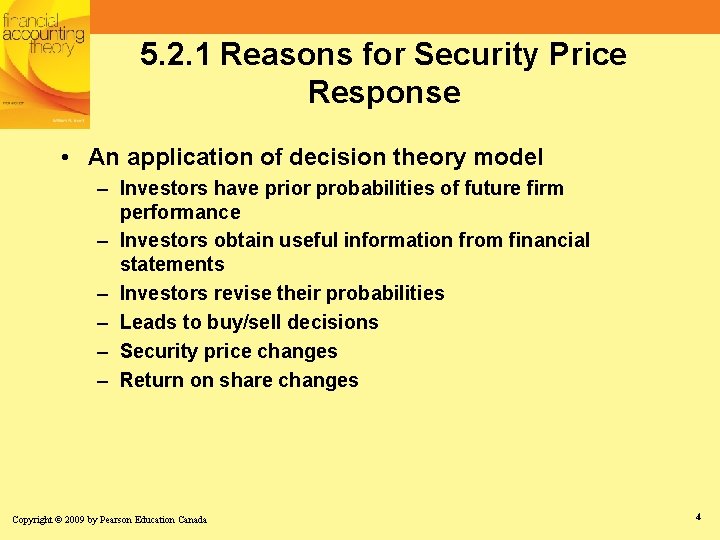
5. 2. 1 Reasons for Security Price Response • An application of decision theory model – Investors have prior probabilities of future firm performance – Investors obtain useful information from financial statements – Investors revise their probabilities – Leads to buy/sell decisions – Security price changes – Return on share changes Copyright © 2009 by Pearson Education Canada 4
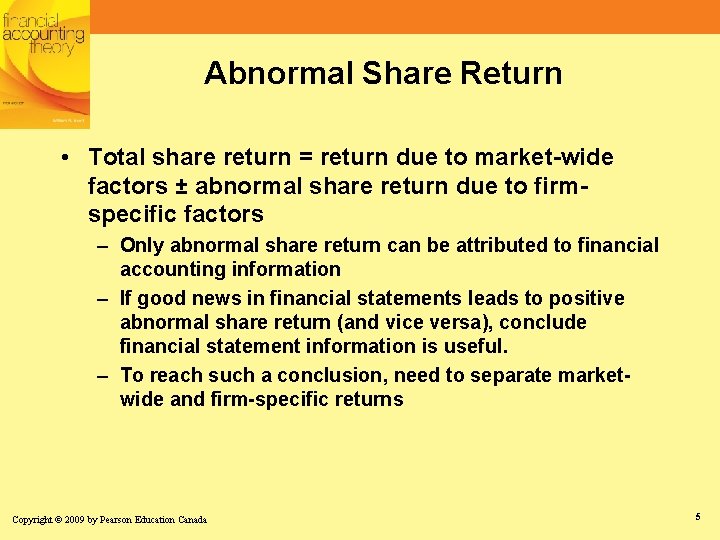
Abnormal Share Return • Total share return = return due to market-wide factors ± abnormal share return due to firmspecific factors – Only abnormal share return can be attributed to financial accounting information – If good news in financial statements leads to positive abnormal share return (and vice versa), conclude financial statement information is useful. – To reach such a conclusion, need to separate marketwide and firm-specific returns Copyright © 2009 by Pearson Education Canada 5
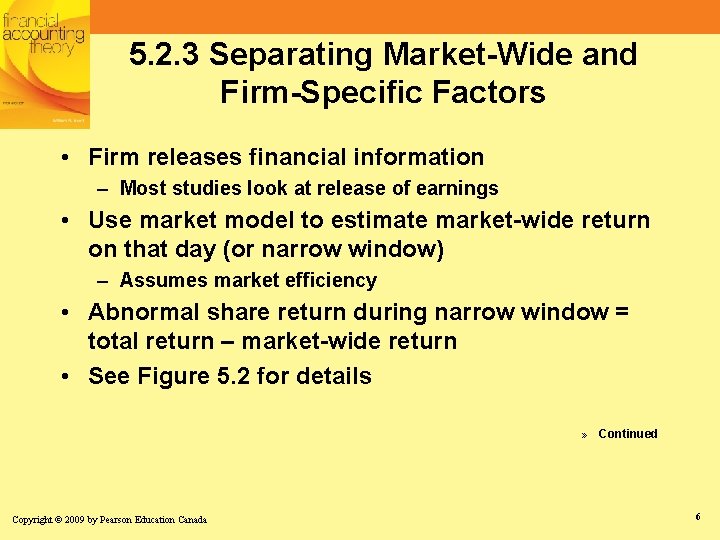
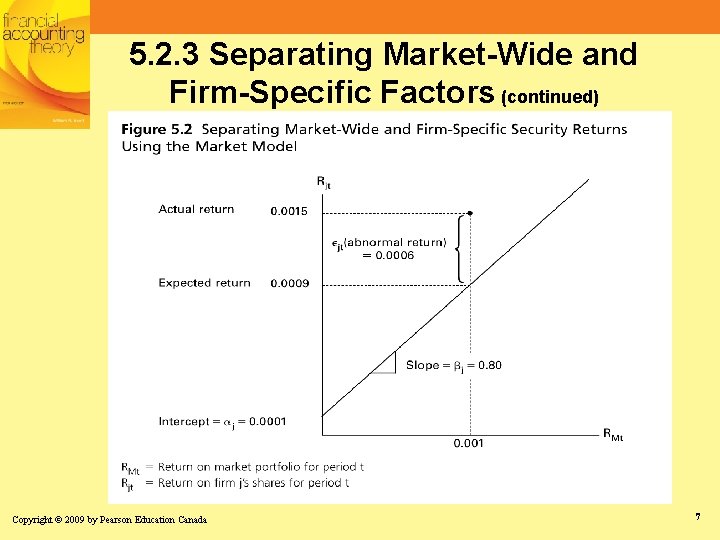
5. 2. 3 Separating Market-Wide and Firm-Specific Factors • Firm releases financial information – Most studies look at release of earnings • Use market model to estimate market-wide return on that day (or narrow window) – Assumes market efficiency • Abnormal share return during narrow window = total return – market-wide return • See Figure 5. 2 for details » Continued Copyright © 2009 by Pearson Education Canada 6
5. 2. 3 Separating Market-Wide and Firm-Specific Factors (continued) Copyright © 2009 by Pearson Education Canada 7
Unexpected Earnings • Investors have expectations of current earnings • Investors’ expectations are built into share price prior to release of current earnings – Assumes market efficiency • Investors will react only to unexpected earnings • Investors’ earnings expectations unobservable – How to separate expected and unexpected earnings? Copyright © 2009 by Pearson Education Canada 8
Estimation of Investors’ Earnings Expectations • Time series approach – Based on earnings in prior years • Analysts’ forecasts – Available for most large firms – Now the most common approach Copyright © 2009 by Pearson Education Canada 9
5. 3 The Ball and Brown Study • The First Study to Document Statistically a Share Price Response to Reported Net Income (1968) • Methodology Still in Use Today Copyright © 2009 by Pearson Education Canada 10
B&B Methodology • For Each Sample Firm: – Estimate investors’ earnings expectations (proxied by last year’s actual) – Classify each firm as GN (actual earnings > expected earnings) or BN (vice versa) – Estimate abnormal share return for month of release of earnings (month 0), using procedure of Figure 5. 1 » Continued Copyright © 2009 by Pearson Education Canada 11
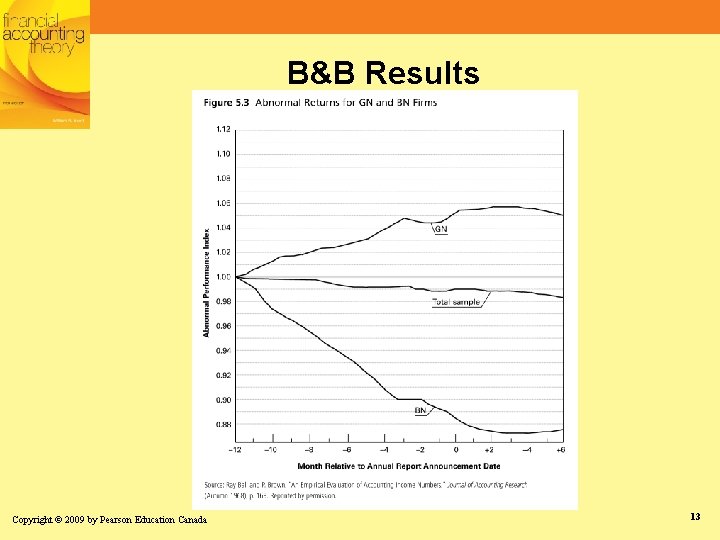
B&B Methodology (continued) • Calculate Average Abnormal Share Return for GN Firms for Month 0 • Ditto for BN Firms • Repeat for Months -1, -2, …, -11, and Months +1, +2, …, +6 • Plot Results – See Fig. 5. 3, next slide Copyright © 2009 by Pearson Education Canada 12
B&B Results Copyright © 2009 by Pearson Education Canada 13
B&B Conclusion • Stock Market Reacts to Accounting Information, but Begins to Anticipate the GN or BN in Earnings 12 Months Prior to Month of Earnings Announcement – Consistent with securities market efficiency and underlying rational decision theory Copyright © 2009 by Pearson Education Canada 14
5. 3. 2 Causation v. Association • Narrow Window Studies – Evidence that financial statement information causes security price change • Wide Window Studies – Evidence that financial statement information is associated with security price change • Narrow window studies more consistent with decision usefulness Copyright © 2009 by Pearson Education Canada 15
5. 3. 3 Research in Years Following Ball & Brown • Does Amount of Abnormal Share Price Change Correlate With Amount of GN/BN? Yes • With Quarterly Earnings Reports? Yes • On Other Stock Markets? Yes • Response to Balance Sheet Information? Hard to Find Copyright © 2009 by Pearson Education Canada 16
5. 4 A Different Question • Earnings Response Coefficients (ERC) – Do characteristics of unexpected earnings affect magnitude of abnormal share return? Yes Copyright © 2009 by Pearson Education Canada 17
5. 4. 1 Factors Affecting ERC • Risk (ß): higher ß lower ERC • Capital structure: higher D/E lower ERC • Earnings quality: higher quality higher ERC – Earnings persistence: higher persistence higher ERC » Continued Copyright © 2009 by Pearson Education Canada 18
5. 4. 1 Factors Affecting ERC (continued) • Growth opportunities: higher opportunities, higher ERC • Similarity of investor expectations: more similar, higher ERC • Informativeness of price: more informative, lower ERC? Copyright © 2009 by Pearson Education Canada 19
More On Earnings Quality • How to Measure? – Conceptual: main diag. probs. of info. system – Earnings persistence: higher persistence → higher quality • Line-by-line evaluation (Ramakrishnan & Thomas (1991)) – Accruals quality (De. Chow & Dichev (2002)): higher accruals quality → higher earnings quality Copyright © 2009 by Pearson Education Canada 20
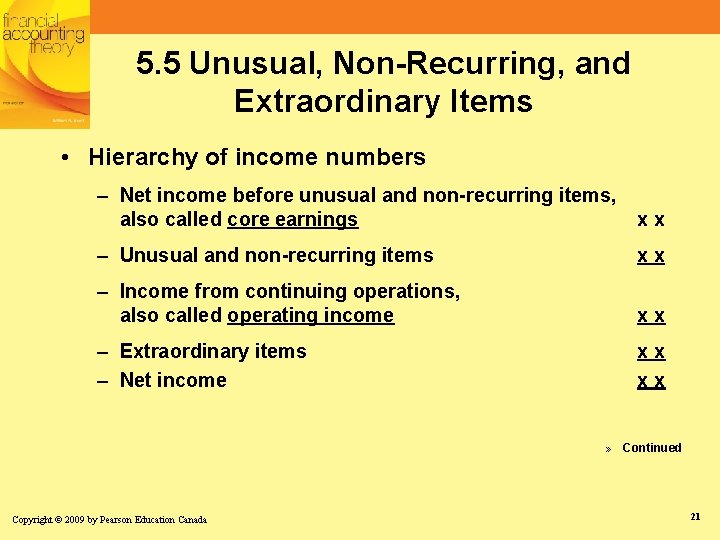
5. 5 Unusual, Non-Recurring, and Extraordinary Items • Hierarchy of income numbers – Net income before unusual and non-recurring items, also called core earnings xx – Unusual and non-recurring items xx – Income from continuing operations, also called operating income xx – Extraordinary items – Net income xx xx » Continued Copyright © 2009 by Pearson Education Canada 21
5. 5 Unusual, Non-Recurring, and Extraordinary Items (continued) • Definition of extraordinary item – Infrequent – Not typical – Do not depend primarily on decisions of managers or owners • If item is not extraordinary, it is part of operating income Copyright © 2009 by Pearson Education Canada 22
A Financial Reporting Problem • Manager motivation to put core earnings “in the bank” by overstating unusual, non-recurring, and extraordinary writeoffs • Overstating writeoffs overstates future core earnings – Effect is to overstate earnings persistence, thereby misleading investors – See Theory in Practice 11. 1 re: Nortel Copyright © 2009 by Pearson Education Canada 23
5. 6 Accounting Information as a Public Good • A public good is a good such that use by one person does not destroy it for use by another person • Accounting information has public good characteristics – Use by one person does not prevent its reuse by others • Thus firm cannot charge users for accounting information » Continued Copyright © 2009 by Pearson Education Canada 24
5. 6 Accounting Information as a Public Good (continued) • Investors who do not pay for accounting information will demand more of it than socially desirable • Implication is that standard setters cannot be sure that an accounting policy that has a higher ERC than another is socially better. • Complicates standard setting • Still true, though, that an accounting policy with higher ERC is more useful to investors Copyright © 2009 by Pearson Education Canada 25
Conclusion • Security market response to accounting information supports rational decision theory and efficient securities market theory Copyright © 2009 by Pearson Education Canada 26