
Chapter 5 The Infectious Process and Environmental Control
- Slides: 12
Chapter 5 The Infectious Process and Environmental Control © 2012 Cengage Learning. All Rights Reserved.
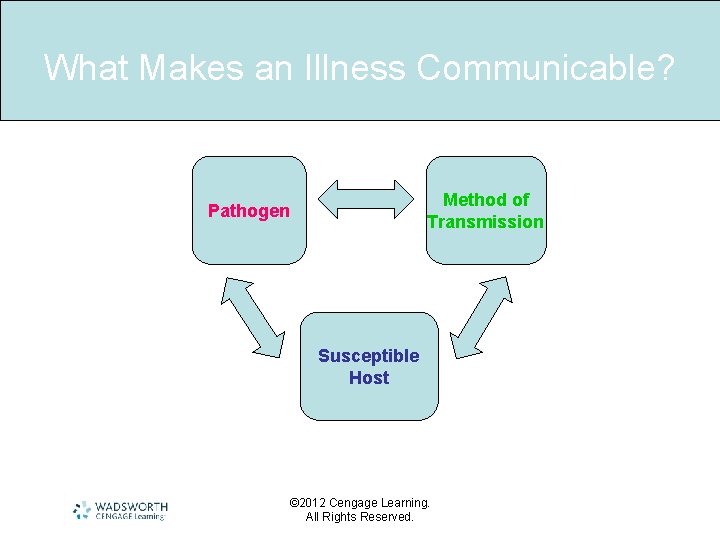
What Makes an Illness Communicable? • Three components are required for an illness to be communicable: – Pathogen – Susceptible host or individual – Method of transmission © 2012 Cengage Learning. All Rights Reserved.
What Makes an Illness Communicable? Method of Transmission Pathogen Susceptible Host © 2012 Cengage Learning. All Rights Reserved.
How are Illnesses Transmitted? • Pathogens or organisms (e. g. , viruses, parasites, bacteria, fungi) can be transmitted in several ways: – Airborne – Fecal-oral – Direct contact – Indirect contact • Give an example of an illness that is transmitted by each of these methods. © 2012 Cengage Learning. All Rights Reserved.
Stages of an Infectious Illness Describe what typically occurs during each of these stages: – Incubation – Prodromal – Acute – Convalescence © 2012 Cengage Learning. All Rights Reserved.
Controlling Infectious Illness…. . • Understanding the communicable process provides the most effective means for limiting the spread of infectious illnesses. • Teachers have an ethical and professional responsibility to protect the wellness of all children in a group setting. © 2012 Cengage Learning. All Rights Reserved.
Infection Control Measures • Ongoing teacher observations provide early clues about a child’s changing state of health. • Policies should be in place and address a variety of protective measures such as exclusion guidelines, cleaning procedures, diapering procedures, food preparation, hand washing, and sanitation. © 2012 Cengage Learning. All Rights Reserved.
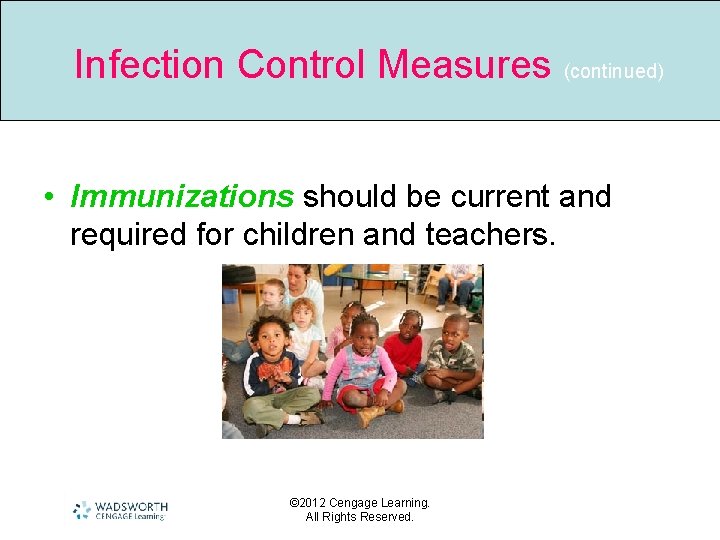
Infection Control Measures (continued) • Immunizations should be current and required for children and teachers. © 2012 Cengage Learning. All Rights Reserved.
Infection Control Measures (continued) • Environmental measures must be implemented and include: – Universal infection control precautions for handling body fluids (e. g. blood, feces, vomited matter) and disinfection (Table 5 -2) – Using proper hand washing technique and washing at appropriate times (Tables 5 -3) • Click on link and watch the CDC’s “Hands Together” video on hand washing: http: //www. cdc. gov/CDCTV/Hands. Together/index. html © 2012 Cengage Learning. All Rights Reserved.
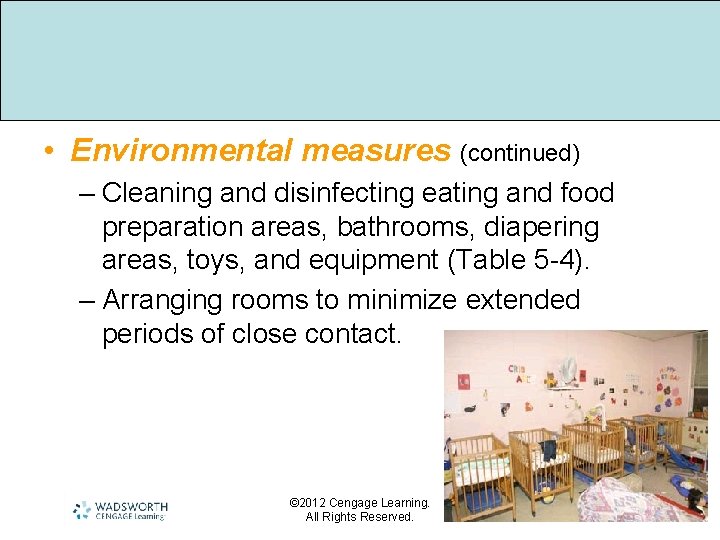
• Environmental measures (continued) – Cleaning and disinfecting eating and food preparation areas, bathrooms, diapering areas, toys, and equipment (Table 5 -4). – Arranging rooms to minimize extended periods of close contact. © 2012 Cengage Learning. All Rights Reserved.
• Environmental measures (continued) – Maintaining comfortable room temperatures; opening doors and windows for fresh air. – Taking special precautions with sandboxes, pools, and water tables. • Teaching children, teachers, and families about infectious illness and effective control measures. © 2012 Cengage Learning. All Rights Reserved.
Caring for Mildly Ill Children • Factors to consider – Is the illness highly contagious? – Will other children be placed at risk? – Does the child feel well enough to participate? – Does the child’s illness place them at greater risk of catching something else? – Can teachers meet the child’s needs as well as those of the other children in attendance? © 2012 Cengage Learning. All Rights Reserved.