
Chapter 5 THE IMPORTANCE OF SCALE AND TIMING
- Slides: 22
Chapter 5 THE IMPORTANCE OF SCALE AND TIMING IN PROJECT APPRAISAL
Why is scale important? n n Too large or too small can destroy a good project One of the most important decision that a project analyst is to make is the "scale" of the investment. This is mostly thought as a technical issue but it has a financial and economic dimension as well. Right scale should be chosen to maximize NPV. In evaluating a project to determine its best scale, the most important principle is to treat each incremental change in its size as a project in itself
Why is scale important? (Cont’d) n By comparing the present value of the incremental benefits with the present value of the incremental costs, scale is increased until NPV of the incremental net benefits is negative. (incremental NPV is called Marginal Net Present Value (MNPV) n We must first make sure that the NPV of the overall project is positive. Secondly, the net present value of the last addition must also be greater than or equal to zero.
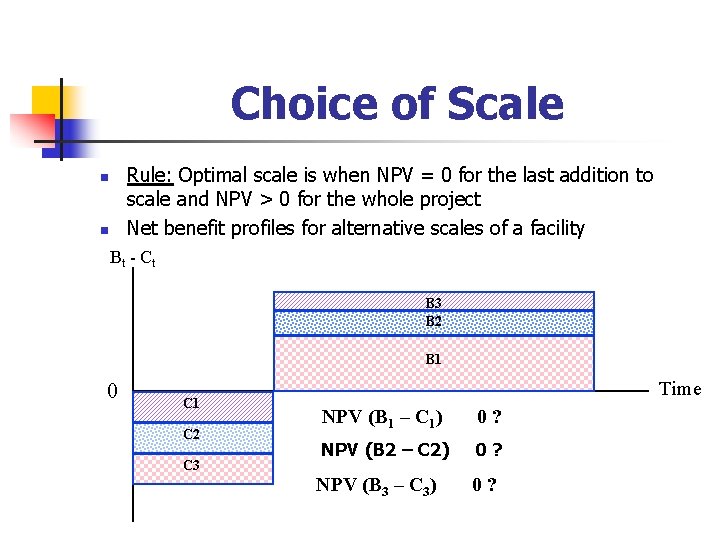
Choice of Scale Rule: Optimal scale is when NPV = 0 for the last addition to scale and NPV > 0 for the whole project Net benefit profiles for alternative scales of a facility n n Bt - Ct B 3 B 2 B 1 0 C 1 C 2 C 3 Time NPV (B 1 – C 1) 0? NPV (B 2 – C 2) 0? NPV (B 3 – C 3) 0?
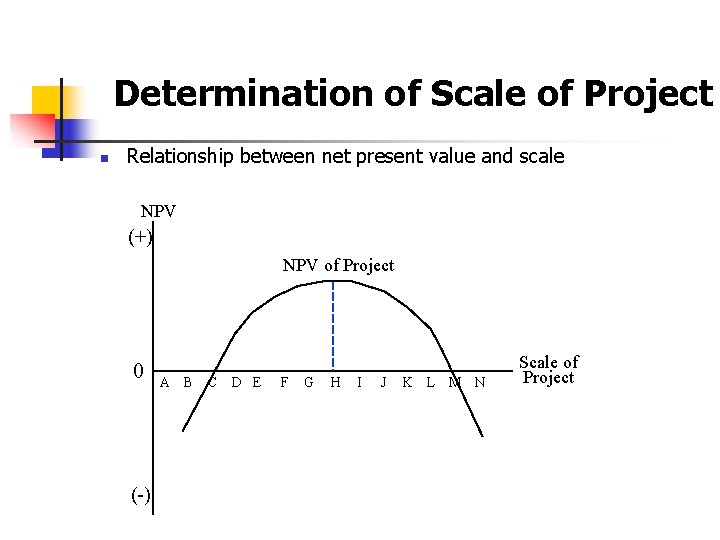
Determination of Scale of Project n Relationship between net present value and scale NPV (+) NPV of Project 0 (-) A B C D E F G H I J K L M N Scale of Project
Internal Rate of Return (IRR) Criterion n The optimal scale of a project can also be determined by the use of the IRR. Here it is assumed that each successive increment of investment has a unique IRR. n Incremental investment is made as long as the MIRR is above or equal to the discount rate.
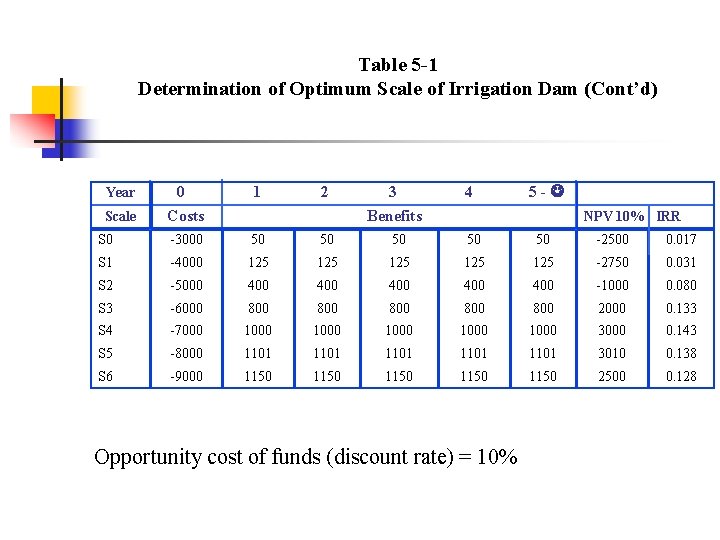
Table 5 -1 Determination of Optimum Scale of Irrigation Dam (Cont’d) Year Scale 0 1 2 Costs 3 4 5 - Benefits NPV 10% IRR S 0 -3000 50 50 50 -2500 0. 017 S 1 -4000 125 125 125 -2750 0. 031 S 2 -5000 400 400 400 -1000 0. 080 S 3 -6000 800 800 800 2000 0. 133 S 4 -7000 1000 1000 3000 0. 143 S 5 -8000 1101 1101 3010 0. 138 S 6 -9000 1150 1150 2500 0. 128 Opportunity cost of funds (discount rate) = 10%
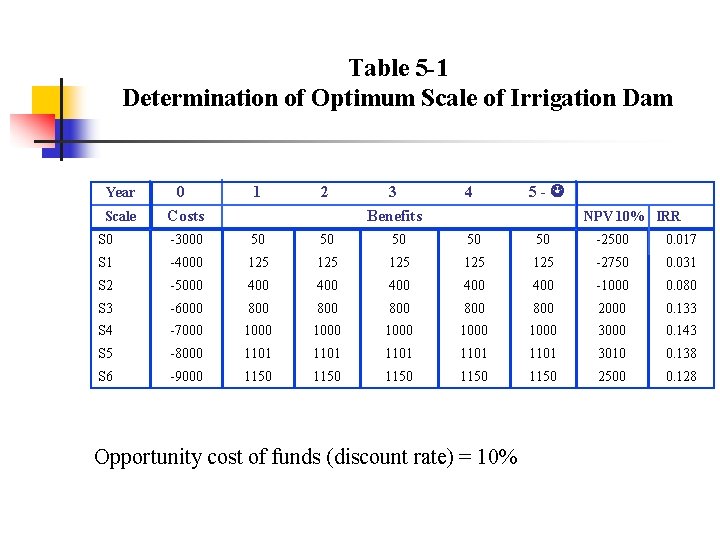
Table 5 -1 Determination of Optimum Scale of Irrigation Dam Year Scale 0 1 2 Costs 3 4 5 - Benefits NPV 10% IRR S 0 -3000 50 50 50 -2500 0. 017 S 1 -4000 125 125 125 -2750 0. 031 S 2 -5000 400 400 400 -1000 0. 080 S 3 -6000 800 800 800 2000 0. 133 S 4 -7000 1000 1000 3000 0. 143 S 5 -8000 1101 1101 3010 0. 138 S 6 -9000 1150 1150 2500 0. 128 Opportunity cost of funds (discount rate) = 10%
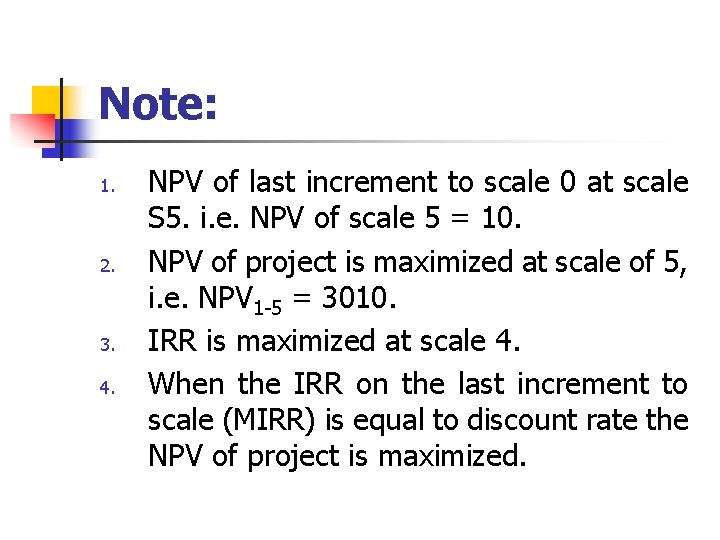
Note: 1. 2. 3. 4. NPV of last increment to scale 0 at scale S 5. i. e. NPV of scale 5 = 10. NPV of project is maximized at scale of 5, i. e. NPV 1 -5 = 3010. IRR is maximized at scale 4. When the IRR on the last increment to scale (MIRR) is equal to discount rate the NPV of project is maximized.
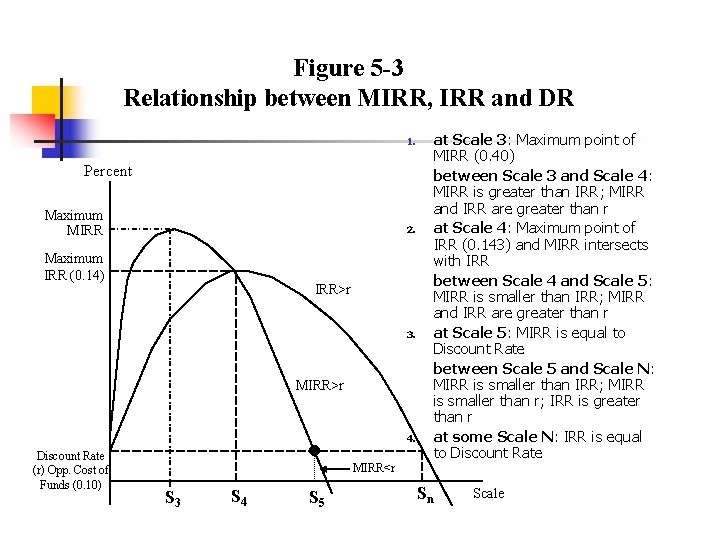
Figure 5 -3 Relationship between MIRR, IRR and DR at Scale 3: Maximum point of MIRR (0. 40) between Scale 3 and Scale 4: MIRR is greater than IRR; MIRR and IRR are greater than r at Scale 4: Maximum point of IRR (0. 143) and MIRR intersects with IRR between Scale 4 and Scale 5: MIRR is smaller than IRR; MIRR and IRR are greater than r at Scale 5: MIRR is equal to Discount Rate between Scale 5 and Scale N: MIRR is smaller than IRR; MIRR is smaller than r; IRR is greater than r at some Scale N: IRR is equal to Discount Rate 1. Percent Maximum MIRR 2. Maximum IRR (0. 14) IRR>r 3. MIRR>r Discount Rate (r) Opp. Cost of Funds (0. 10) S 3 S 4 S 5 4. MIRR<r Sn Scale
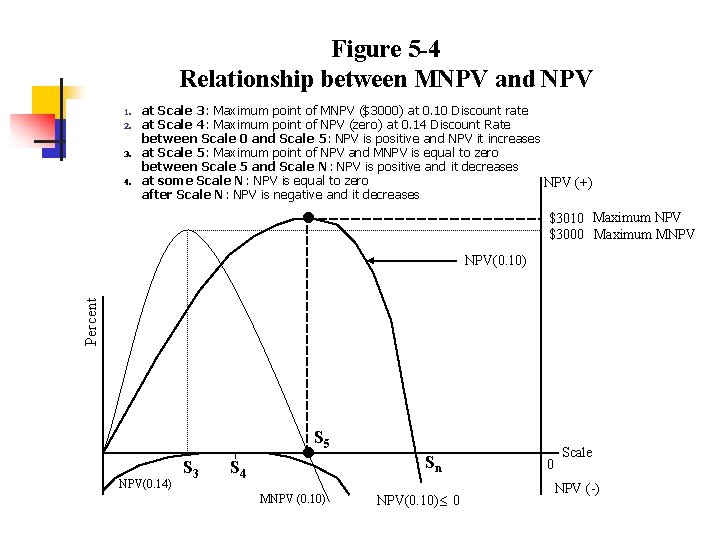
Figure 5 -4 Relationship between MNPV and NPV 1. 2. 3. 4. at Scale 3: Maximum point of MNPV ($3000) at 0. 10 Discount rate at Scale 4: Maximum point of NPV (zero) at 0. 14 Discount Rate between Scale 0 and Scale 5: NPV is positive and NPV it increases at Scale 5: Maximum point of NPV and MNPV is equal to zero between Scale 5 and Scale N: NPV is positive and it decreases at some Scale N: NPV is equal to zero NPV (+) after Scale N: NPV is negative and it decreases $3010 Maximum NPV $3000 Maximum MNPV Percent NPV(0. 10) S 5 NPV(0. 14) S 3 S 4 MNPV (0. 10) Sn NPV(0. 10) 0 0 Scale NPV (-)
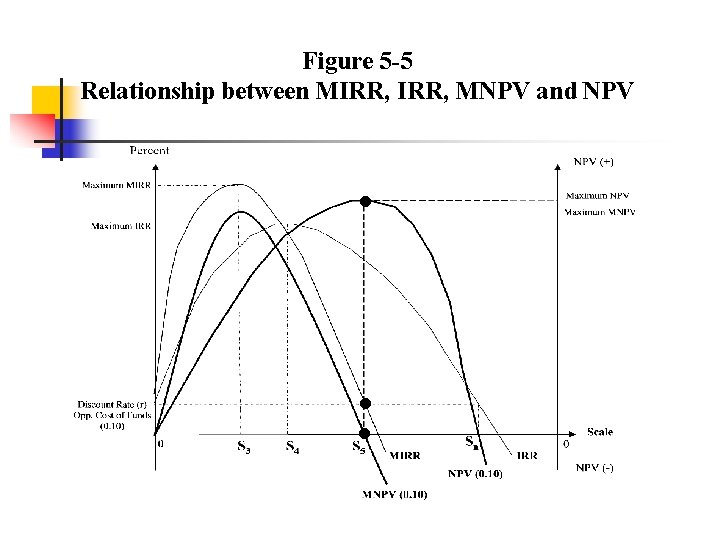
Figure 5 -5 Relationship between MIRR, MNPV and NPV
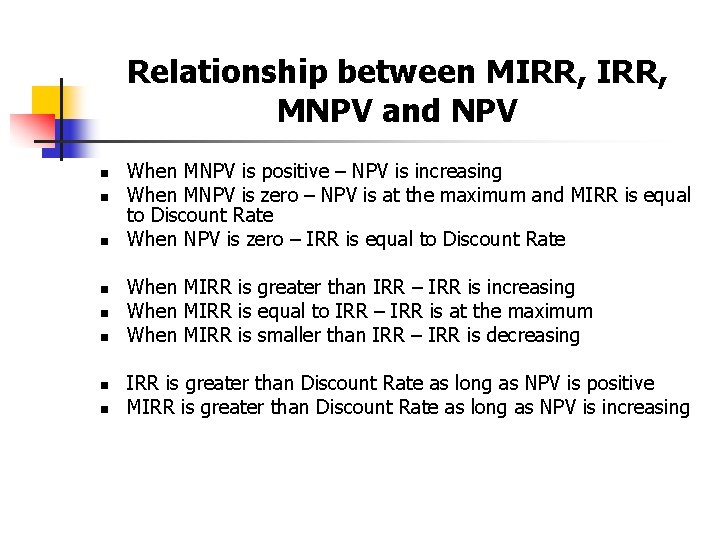
Relationship between MIRR, MNPV and NPV n n n n When MNPV is positive – NPV is increasing When MNPV is zero – NPV is at the maximum and MIRR is equal to Discount Rate When NPV is zero – IRR is equal to Discount Rate When MIRR is greater than IRR – IRR is increasing When MIRR is equal to IRR – IRR is at the maximum When MIRR is smaller than IRR – IRR is decreasing IRR is greater than Discount Rate as long as NPV is positive MIRR is greater than Discount Rate as long as NPV is increasing
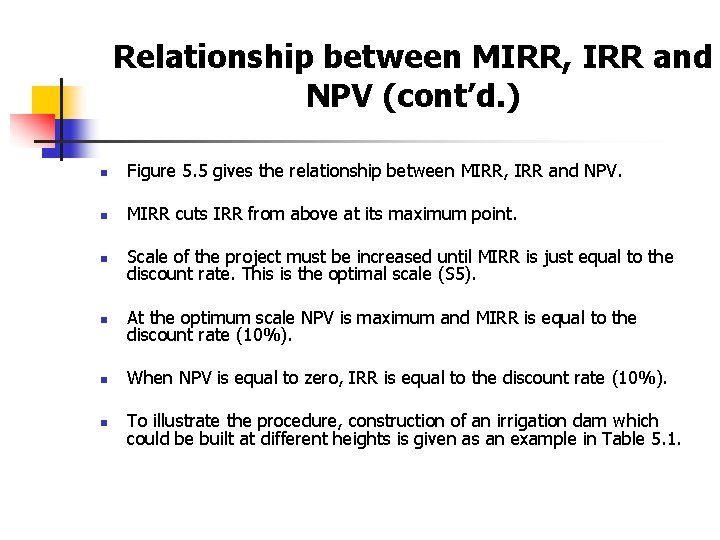
Relationship between MIRR, IRR and NPV (cont’d. ) n Figure 5. 5 gives the relationship between MIRR, IRR and NPV. n MIRR cuts IRR from above at its maximum point. n Scale of the project must be increased until MIRR is just equal to the discount rate. This is the optimal scale (S 5). n At the optimum scale NPV is maximum and MIRR is equal to the discount rate (10%). n When NPV is equal to zero, IRR is equal to the discount rate (10%). n To illustrate the procedure, construction of an irrigation dam which could be built at different heights is given as an example in Table 5. 1.
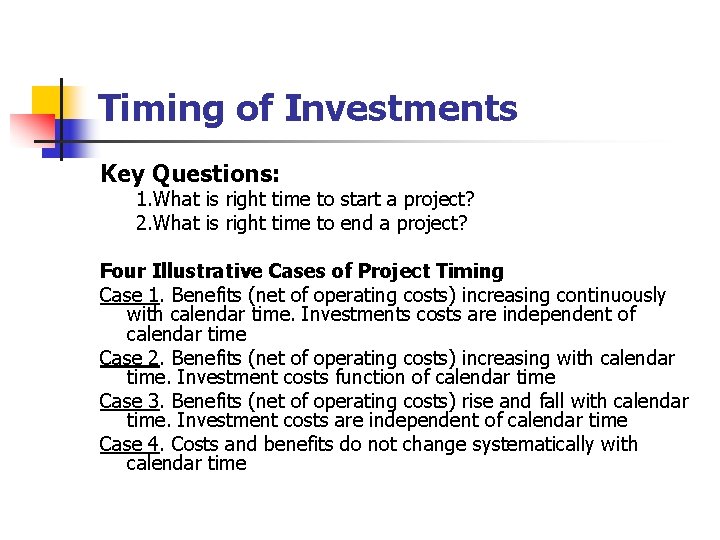
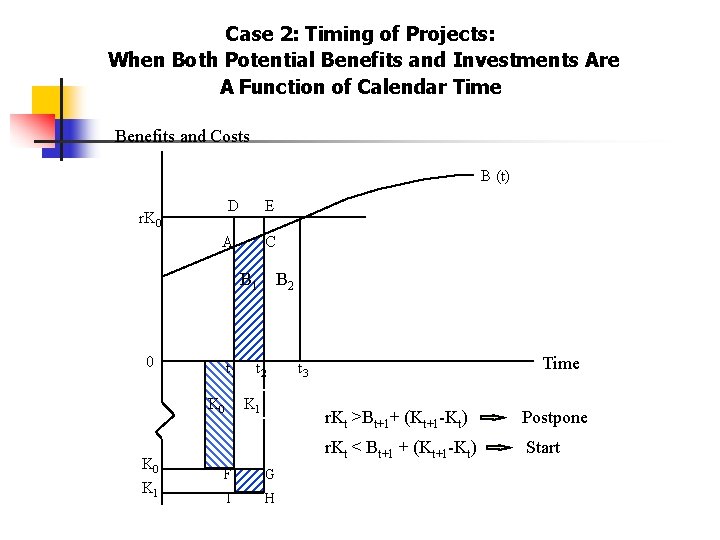
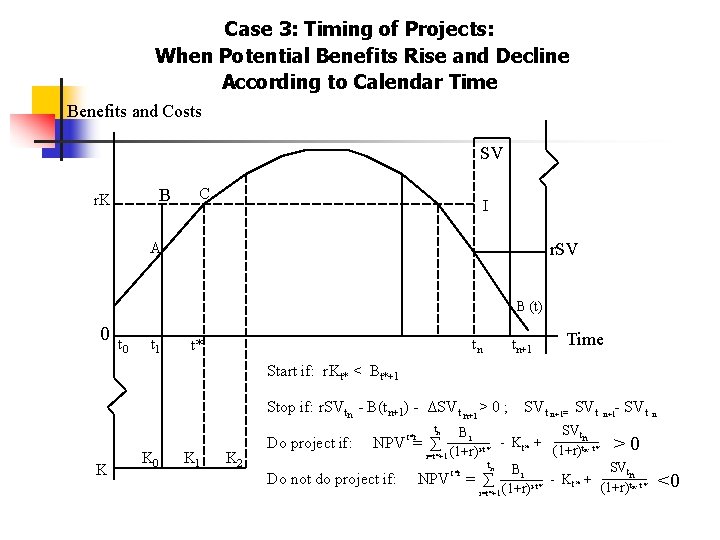
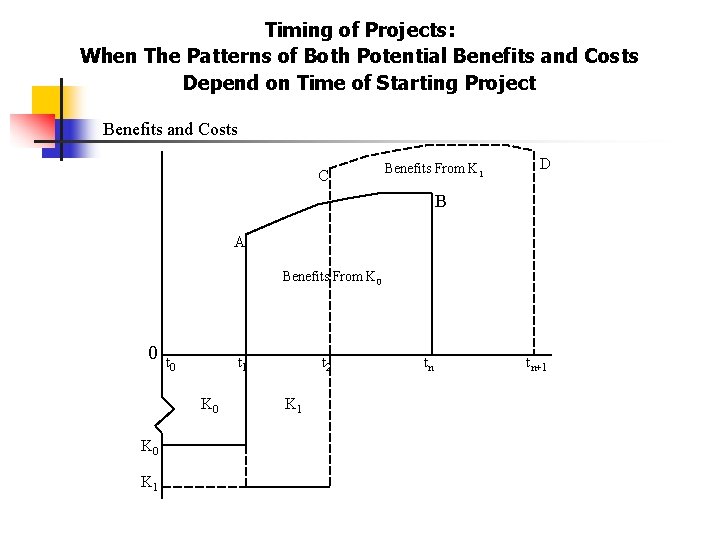
Timing of Investments Key Questions: 1. What is right time to start a project? 2. What is right time to end a project? Four Illustrative Cases of Project Timing Case 1. Benefits (net of operating costs) increasing continuously with calendar time. Investments costs are independent of calendar time Case 2. Benefits (net of operating costs) increasing with calendar time. Investment costs function of calendar time Case 3. Benefits (net of operating costs) rise and fall with calendar time. Investment costs are independent of calendar time Case 4. Costs and benefits do not change systematically with calendar time
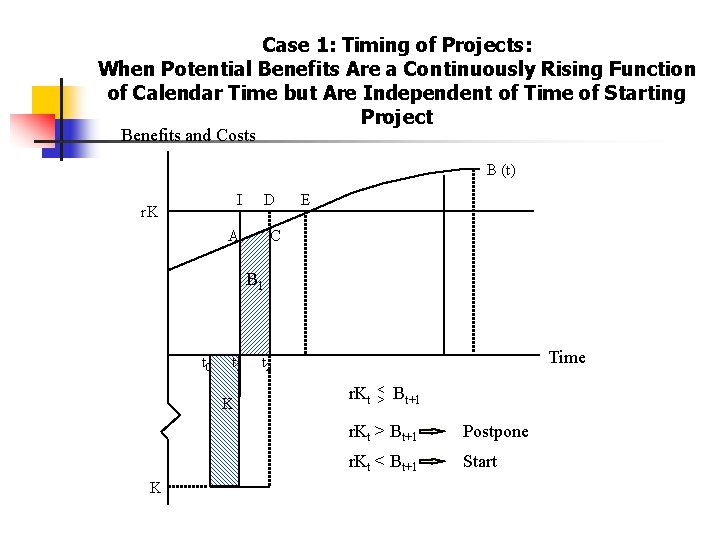
Case 1: Timing of Projects: When Potential Benefits Are a Continuously Rising Function of Calendar Time but Are Independent of Time of Starting Project Benefits and Costs B (t) I r. K D A E C B 1 t 0 t 1 K K Time t 2 r. Kt < > Bt+1 r. Kt > Bt+1 Postpone r. Kt < Bt+1 Start
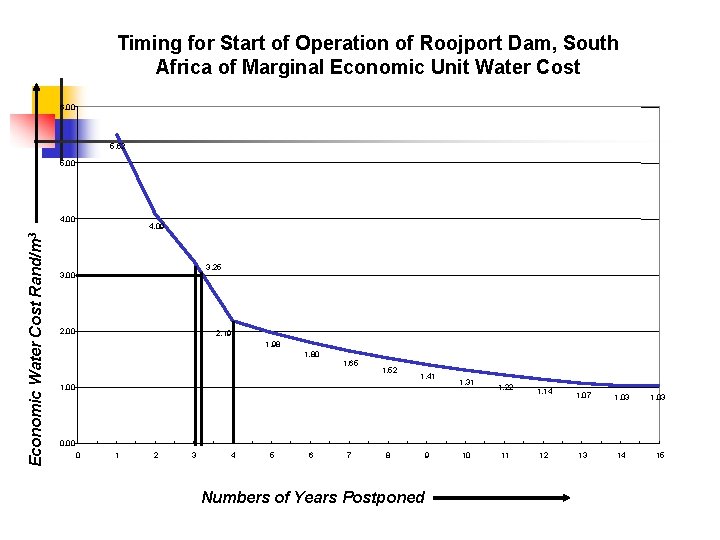
Timing for Start of Operation of Roojport Dam, South Africa of Marginal Economic Unit Water Cost 6. 00 5. 52 5. 00 Economic Water Cost Rand/m 3 4. 00 4. 09 3. 25 3. 00 2. 19 1. 98 1. 80 1. 65 1. 52 1. 41 1. 00 1. 31 1. 22 1. 14 1. 07 1. 03 12 13 14 15 0. 00 0 1 2 3 4 5 6 7 8 Numbers of Years Postponed 9 10 11
Case 2: Timing of Projects: When Both Potential Benefits and Investments Are A Function of Calendar Time Benefits and Costs B (t) D r. K 0 E A C B 1 0 t 1 K 0 K 1 B 2 t 2 K 1 F G I H Time t 3 r. Kt >Bt+1+ (Kt+1 -Kt) Postpone r. Kt < Bt+1 + (Kt+1 -Kt) Start
Case 3: Timing of Projects: When Potential Benefits Rise and Decline According to Calendar Time Benefits and Costs SV B r. K C I A r. SV B (t) 0 t 1 tn t* tn+1 Time Start if: r. Kt* < Bt*+1 Stop if: r. SVt n - B(tn+1) - ΔSVt n+1 > 0 ; SVt n+1= SVt n+1 - SVtn Bi K + Do project if: NPV = ∑ (1+r)i-t* t* (1+r)t n- t* > 0 i=t*+1 tn SVtn Bi t*r K + Do not do project if: NPV = ∑ t* i-t* (1+r)t n- t* i=t*+1 (1+r) t*r K K 0 K 1 K 2 n tn <0
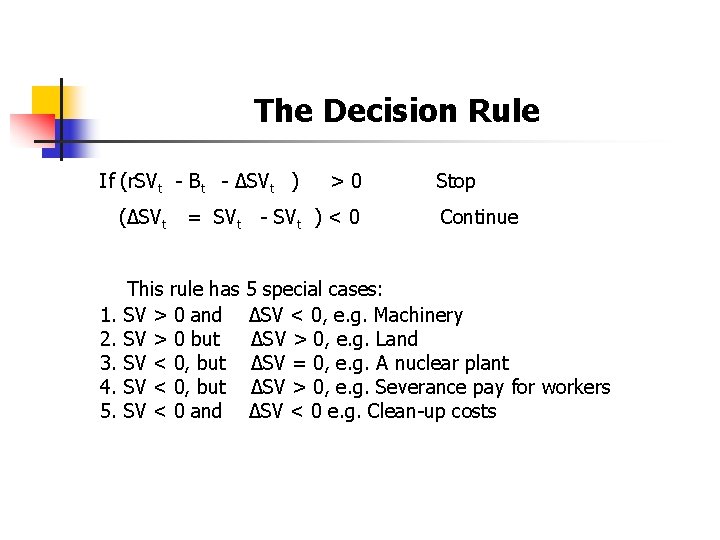
The Decision Rule If (r. SVt - Bt - ΔSVt ) (ΔSVt 1. 2. 3. 4. 5. >0 = SVt - SVt ) < 0 This rule has SV > 0 and SV > 0 but SV < 0, but SV < 0 and Stop Continue 5 special cases: ΔSV < 0, e. g. Machinery ΔSV > 0, e. g. Land ΔSV = 0, e. g. A nuclear plant ΔSV > 0, e. g. Severance pay for workers ΔSV < 0 e. g. Clean-up costs
Timing of Projects: When The Patterns of Both Potential Benefits and Costs Depend on Time of Starting Project Benefits and Costs C Benefits From K 1 D B A Benefits From K 0 0 t 1 K 0 K 1 t 2 K 1 tn tn+1