
Chapter 5 The Five Generic Competitive Strategies Screen








- Slides: 22
Chapter 5 The Five Generic Competitive Strategies Screen graphics created by: Jana F. Kuzmicki, Ph. D. Troy State University-Florida and Western Region 5 -1
Chapter Roadmap u Five Competitive Strategies u Low-Cost Provider Strategies u Differentiation Strategies u Best-Cost Provider Strategies u Focused (or Market Niche) Strategies u The Contrasting Features of the Five Generic Competitive Strategies: A Summary 5 -2
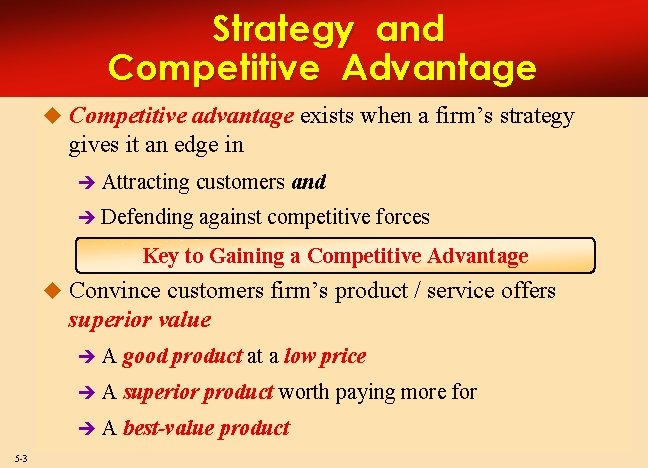
Strategy and Competitive Advantage u Competitive advantage exists when a firm’s strategy gives it an edge in è Attracting customers and è Defending against competitive forces Key to Gaining a Competitive Advantage u Convince customers firm’s product / service offers superior value 5 -3 èA good product at a low price èA superior product worth paying more for èA best-value product
What Is “Competitive Strategy”? u Deals exclusively with a company’s business plans to compete successfully è Specific efforts to please customers è Offensive and defensive moves to counter maneuvers of rivals è Responses to prevailing market conditions è Initiatives to strengthen its market position u Narrower in scope than business strategy 5 -4
Fig. 5. 1: The Five Generic Competitive Strategies 5 -5
Low-Cost Provider Strategies Keys to Success u Make achievement of meaningful lower costs than rivals theme of firm’s strategy u Include features and services in product offering that buyers consider essential u Find approaches to achieve a cost advantage in ways difficult for rivals to copy or match Low-cost leadership means low overall costs, not just low manufacturing or production costs! 5 -6
When Does a Low-Cost Strategy Work Best? u Price competition is vigorous u Product is standardized or readily available from many suppliers u There are few ways to achieve differentiation that have value to buyers u Most buyers use product in same ways u Buyers incur low switching costs u Buyers are large and have significant bargaining power u Industry newcomers use introductory low prices to attract buyers and build customer base 5 -7
Pitfalls of Low-Cost Strategies u Being overly aggressive in cutting price u Low cost methods are easily imitated by rivals u Becoming too fixated on reducing costs and ignoring è Buyer interest in additional features è Declining è Changes buyer sensitivity to price in how the product is used u Technological breakthroughs open up cost reductions for rivals 5 -8
Differentiation Strategies Objective u Incorporate differentiating features that cause buyers to prefer firm’s product or service over brands of rivals Keys to Success u Find ways to differentiate that create value for buyers and are not easily matched or cheaply copied by rivals u Not spending more to achieve differentiation than the price premium that can be charged 5 -9
Benefits of Successful Differentiation A product / service with unique, appealing attributes allows a firm to è Command è Increase è Build a premium price and/or unit sales and/or brand loyalty Which hat is unique? = Competitive Advantage 5 -10
Signaling Value as Well as Delivering Value u Incomplete knowledge of buyers causes them to judge value based on such signals as è Price è Attractive packaging è Extensive ad campaigns è Ad content and image è Characteristics of seller n Facilities n Customers n Professionalism and personality of employees u Signals of value may be as important as actual value when è è 5 -11 Nature of differentiation is hard to quantify Buyers are making first-time purchases Repurchase is infrequent Buyers are unsophisticated
When Does a Differentiation Strategy Work Best? u There are many ways to differentiate a product that have value and please customers u Buyer needs and uses are diverse u Few rivals are following a similar differentiation approach u Technological change and product innovation are fast-paced 5 -12
When Does a Differentiation Strategy Work Best? u There are many ways to differentiate a product that have value and please customers u Buyer needs and uses are diverse u Few rivals are following a similar differentiation approach u Technological change and product innovation are fast-paced 5 -13
Pitfalls of Differentiation Strategies u Buyers see little value in unique attributes of product u Appealing product features are easily copied by rivals u Differentiating on a feature buyers do not perceive as lowering their cost or enhancing their well-being u Over-differentiating such that product features exceed buyers’ needs u Charging a price premium buyers perceive is too high u Not striving to open up meaningful gaps in quality, service, or performance features vis-à-vis rivals’ products 5 -14
Best-Cost Provider Strategies u Combine a strategic emphasis on low-cost with a strategic emphasis on differentiation è Make an upscale product at a lower cost è Give customers more value for the money Objectives u Deliver superior value by meeting or exceeding buyer expectations on product attributes and beating their price expectations u Be the low-cost provider of a product with good-toexcellent product attributes, then use cost advantage to underprice comparable brands 5 -15
Competitive Strength of a Best-Cost Provider Strategy u A best-cost provider’s competitive advantage comes from matching close rivals on key product attributes and beating them on price u Success depends on having the skills and capabilities to provide attractive performance and features at a lower cost than rivals u A best-cost producer can often out-compete both a low-cost provider and a differentiator when è Standardized features/attributes won’t meet diverse needs of buyers è Many buyers are price and value sensitive 5 -16
Risk of a Best-Cost Provider Strategy u A best-cost provider may get squeezed between strategies of firms using low-cost and differentiation strategies è Low-cost leaders may be able to siphon customers away with a lower price è High-end differentiators may be able to steal customers away with better product attributes 5 -17
Focus / Niche Strategies u Involve concentrated attention on a narrow piece of the total market Objective Serve niche buyers better than rivals Keys to Success u Choose a market niche where buyers have distinctive preferences, special requirements, or unique needs u Develop unique capabilities to serve needs of target buyer segment 5 -18
What Makes a Niche Attractive for Focusing? u Big enough to be profitable and offers good growth potential u Not crucial to success of industry leaders u Costly or difficult for multi-segment competitors to meet specialized needs of niche members u Focuser has resources and capabilities to effectively serve an attractive niche u Few other rivals are specializing in same niche u Focuser can defend against challengers via superior ability to serve niche members 5 -19
Risks of a Focus Strategy u Competitors find effective ways to match a focuser’s capabilities in serving niche u Niche buyers’ preferences shift towards product attributes desired by majority of buyers – niche becomes part of overall market u Segment becomes so attractive it becomes crowded with rivals, causing segment profits to be splintered 5 -20
Deciding Which Generic Competitive Strategy to Use u Each positions a company differently in its market u Each establishes a central theme for how a company will endeavor to outcompete rivals u Each creates some boundaries for maneuvering as market circumstances unfold u Each points to different ways of experimenting with the basics of the strategy u Each entails differences in product line, production emphasis, marketing emphasis, and means to sustain the strategy The big risk – Selecting a “stuck in the middle” strategy! This rarely produces a sustainable competitive advantage or a distinctive competitive position. 5 -21
5 -22