
Chapter 5 The First Four Stages of Development

- Slides: 30
Chapter 5: The First Four Stages of Development: What Level Thinker Are You? Hisham Imran 201800163 Mohammed Aseem 201800046 Zuhair Kanwal 201701338
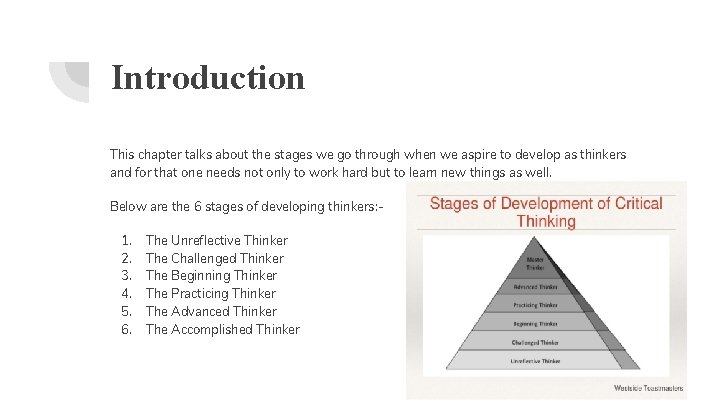
Introduction This chapter talks about the stages we go through when we aspire to develop as thinkers and for that one needs not only to work hard but to learn new things as well. Below are the 6 stages of developing thinkers: 1. 2. 3. 4. 5. 6. The Unreflective Thinker The Challenged Thinker The Beginning Thinker The Practicing Thinker The Advanced Thinker The Accomplished Thinker
Stage 1: The Unreflective Thinker. ➢ What is meant by unreflective thinker. ➢ Examples of unreflective thinker. ➢ What are the problems of being unreflective thinker. ➢ Are you an unreflective thinker ?
Who are unreflective thinker? Is when we don't notice that we are continually making assumptions, forming concepts and opinion, drawing conclusion and thinking point of view.
Examples of unreflective thinkers ❖ Continually making assumptions. ❖ Thinking point of view. ❖ Forming concepts.
Problems of being unreflective thinkers ❖ ❖ ❖ We think our belief as truth. We think our decision as sound. We lack intellectual traits (but are not aware we lack them). We unconsciously deceive yourself in many ways. We judge other people whether they are good or bad.
Can you describe the role that thinking is playing in your life ?
Stage 2: The Challenged Thinker ➢ ➢ What is meant by challenged thinker. Examples of challenged thinker. What are the problem for challenged thinker. Are you challenged thinker ?
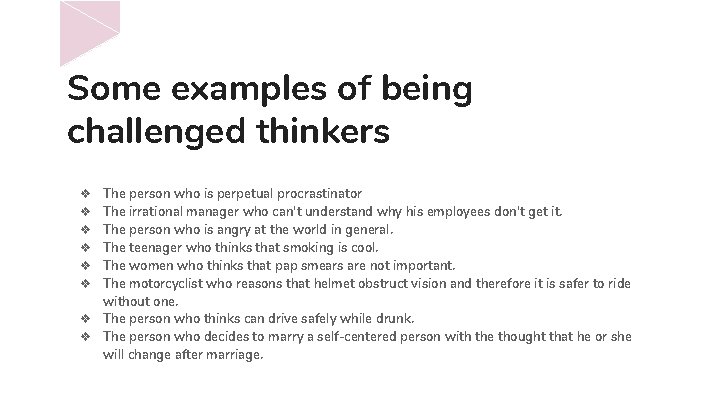
Some examples of being challenged thinkers The person who is perpetual procrastinator The irrational manager who can't understand why his employees don't get it. The person who is angry at the world in general. The teenager who thinks that smoking is cool. The women who thinks that pap smears are not important. The motorcyclist who reasons that helmet obstruct vision and therefore it is safer to ride without one. ❖ The person who thinks can drive safely while drunk. ❖ The person who decides to marry a self-centered person with the thought that he or she will change after marriage. ❖ ❖ ❖
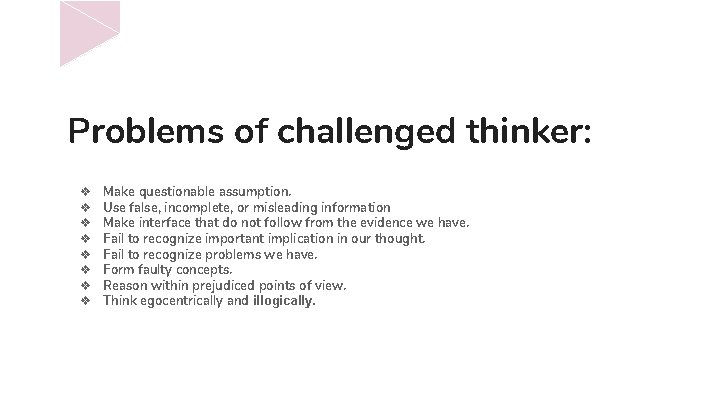
Problems of challenged thinker: ❖ ❖ ❖ ❖ Make questionable assumption. Use false, incomplete, or misleading information Make interface that do not follow from the evidence we have. Fail to recognize important implication in our thought. Fail to recognize problems we have. Form faulty concepts. Reason within prejudiced points of view. Think egocentrically and illogically.
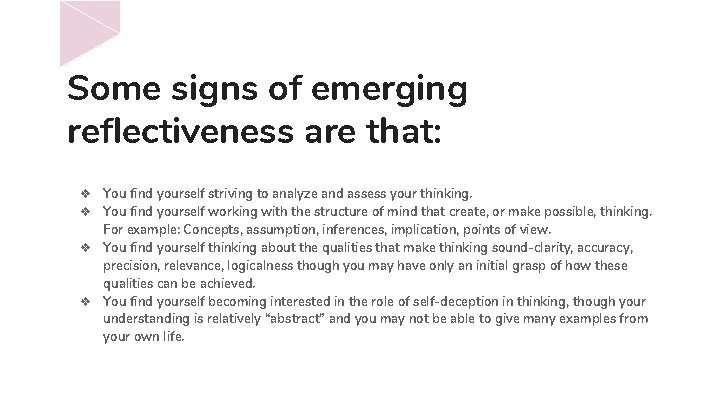
Some signs of emerging reflectiveness are that: ❖ You find yourself striving to analyze and assess your thinking. ❖ You find yourself working with the structure of mind that create, or make possible, thinking. For example: Concepts, assumption, inferences, implication, points of view. ❖ You find yourself thinking about the qualities that make thinking sound-clarity, accuracy, precision, relevance, logicalness though you may have only an initial grasp of how these qualities can be achieved. ❖ You find yourself becoming interested in the role of self-deception in thinking, though your understanding is relatively “abstract” and you may not be able to give many examples from your own life.
From the previous list of emerging reflectiveness. Do you find detect any of these signs in your own thinking ?
Stage 3: The Beginning Thinker ❖ Main aspect to be a critical objective thinker is - open mindedness. ❖ Evolve with changing world. ❖ Realising your weaknesses.
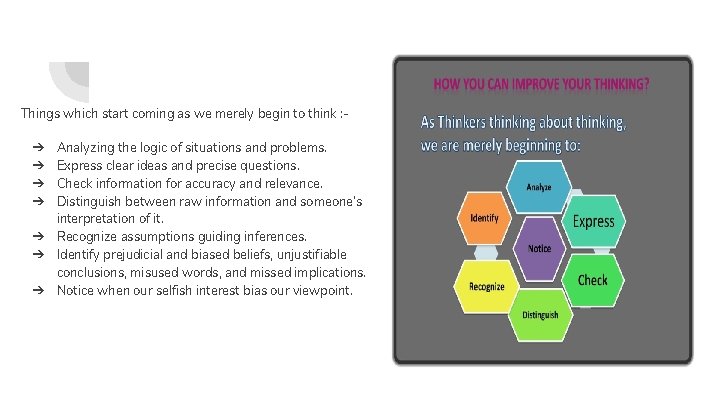
Things which start coming as we merely begin to think : Analyzing the logic of situations and problems. Express clear ideas and precise questions. Check information for accuracy and relevance. Distinguish between raw information and someone’s interpretation of it. ➔ Recognize assumptions guiding inferences. ➔ Identify prejudicial and biased beliefs, unjustifiable conclusions, misused words, and missed implications. ➔ Notice when our selfish interest bias our viewpoint. ➔ ➔
“We cannot solve problems with the same thinking we used when we created them” - Albert Einstein
Which of the aspects in your life reflect your way of thinking?
Prejudices takes us away from thinking critically! ❖ Our parents/ relatives - adjusting with today’s generation. ❖ Our colleagues - the way they spend their money. ❖ Our culture/ beliefs - towards other cultures or beliefs ❖ The place where we live/ where we come from towards people of other lands.
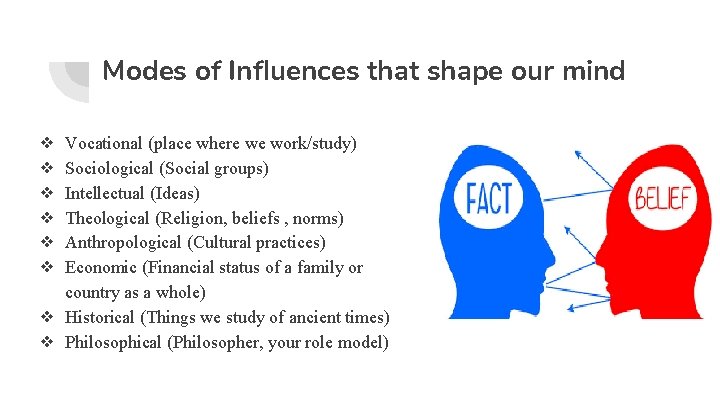
Modes of Influences that shape our mind Vocational (place where we work/study) Sociological (Social groups) Intellectual (Ideas) Theological (Religion, beliefs , norms) Anthropological (Cultural practices) Economic (Financial status of a family or country as a whole) ❖ Historical (Things we study of ancient times) ❖ Philosophical (Philosopher, your role model) ❖ ❖ ❖
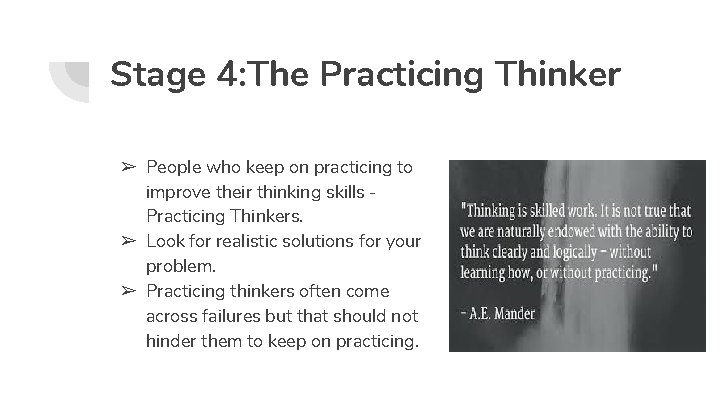
Stage 4: The Practicing Thinker ➢ People who keep on practicing to improve their thinking skills Practicing Thinkers. ➢ Look for realistic solutions for your problem. ➢ Practicing thinkers often come across failures but that should not hinder them to keep on practicing.
What are some of the means to improve one’s thinking skills?
A “Game Plan” for Improvement ➢ Work on the areas of thinking where you find yourself weak. ➢ Start focusing on the fundamentals gradually - oneby-one. ➢ Choose your point of attack.
Devising A Game Plan Use “wasted” time Handle a problem a day Internalize intellectual standards Keep an intellectual journal Reshape your character
Use “Wasted” Time All human waste some time. We all fail to use all of our time productively or even pleasurably. Sometimes we jump from one diversion to another without enjoying them. Sometimes we make ourselves irritated about matters beyond our control. Sometimes we just stare off blankly into space
Handle A Problem A Day At the beginning of each day, choose a problem to work on when you have free moments. Figure out the logic of the problem by identifying its elements. Systematically think through the questions: What exactly is the problem? How can i put it into the form of a question?
Internalize Intellectual Standards Each week develop a heightened awareness of one of the intellectual Standards. “The Standards for Thinking” focus on one week clarity, the next on accuracy and so on. When you are reading, notice whether you are clear about what you are reading. When you write an email, ask yourself whether you are clear about what you are trying to say and in conveying your thoughts in writing.
Keep An Intellectual Journal ❖ Each week, write out a certain numbers of journal entries. The steps are to ❖ Describe only situations that are emotionally significant to you ❖ Describe only one situation at a time ❖ Tell what you did in response to that situation
Analyze what you have written: what precisely was going on in the situation Assess the implication of your analysis: What did you learn about yourself? What would you do differently if you could relieve the situation?
Reshape Your Character Choose one intellectual trait to strive for each month, focusing on how you can develop that trait in yourself. Notice when you refuse to admit are wrong even in the face of glaring evidence that you are in fact wrong. Notice when you become defensive when another person tries to point out a deficiency in your work or your thinking. Notice when your arrogance keeps you from learning, when you say to yourself.
Conclusion: ❖ Stage 1: We are unaware of significant problems in our thinking. ❖ Stage 2: We become aware of problems in our thinking. ❖ Stage 3: We try to improve but without regular practice. ❖ Stage 4: we recognize the necessity of regular practice.
THANK YOU FOR LISTENING!!!