
Chapter 5 The Banking System What Is the
Chapter 5 The Banking System
What Is the Purpose of a Checking Account? • A checking account is a demand deposit account on which checks are drawn. • Why do people have checking accounts? • A check is a written order to a bank to pay a person or business. 5 -1 Checking Accounts Slide 2
What Is the Purpose of a Checking Account? • To open a checking account, the account holder will need some money. • Usually it only takes 50 to 100 to open an account. • To open an account you will need to give up some personal information such as your social security number • A bank account be individual or joint 5 -1 Checking Accounts Slide 3

Checkbook Register • Account holders should verify all amounts deducted • A checkbook register is a tool that can be used to tracking checking account transactions • This register tracks both deposits and withdrawals. • A deposit is adding money to a checking or savings account.
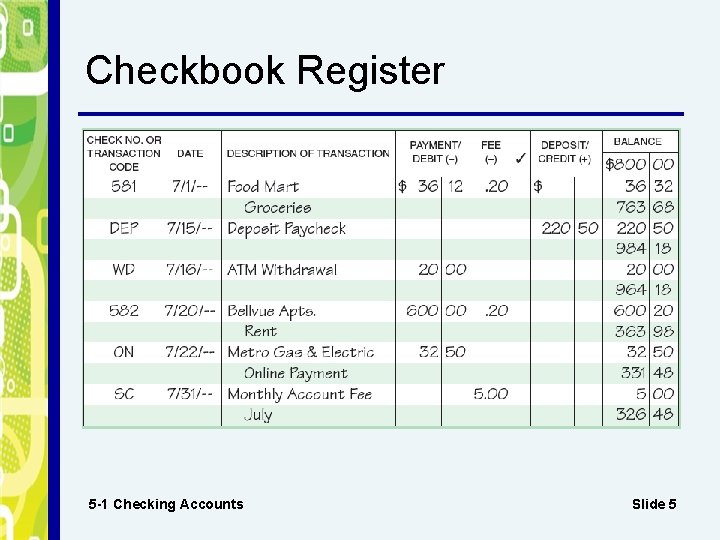
Checkbook Register 5 -1 Checking Accounts Slide 5
Making Withdrawals and Deposits • A withdrawal involves taking money from your account. o Automatic withdrawals o Writing checks o Using debit and ATM cards 5 -1 Checking Accounts Slide 6
Writing Checks • Checks are legal transfers of money. • Postdated checks are checks written with a date that will occur in the future. – Banks usually will not hold the check until the future and will process them without regard to the date • Debit card: used to withdraw money from your checking account • It allows you to make purchases by swiping the card through a point of sale terminal at the stores counter • Debit card and credit cards do not have the same protection. – Credit cards allow you to reverse and dispute charges. – If a debit card is stolen, funds can be withdrawn from your account. • Check fraud and forgery
Making Withdrawals and Deposits • A deposit of money can be made to your account. o o Endorsement: signature o Blank: signature of payee is written on back o Restrictive: restricts or limits use of check o Special: transfers the rights to cash the check to someone else Direct deposit: wages or benefits are automatically deposited into a bank account o An electronic funds transfer uses a computer based system to move money from the drawers account to the payees account 5 -1 Checking Accounts Slide 8
How Do You Reconcile a Bank Statement? • Bank reconciliation is the process of adjusting the checkbook register and bank statement so they agree. • The bank statement lists checks, withdrawals, deposits, service charges, interest, and fees. • Consider deposits in transit, outstanding checks, and transposition errors. 5 -1 Checking Accounts Slide 9
Fees • When a paper check is transformed into a digital image it is considered truncated. • Fees can include monthly service fees (5 to 20) and transaction fees (20 cents)
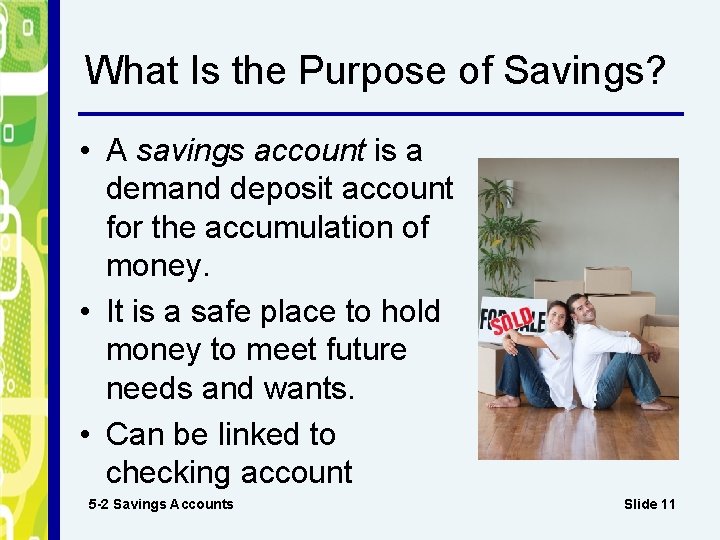
What Is the Purpose of Savings? • A savings account is a demand deposit account for the accumulation of money. • It is a safe place to hold money to meet future needs and wants. • Can be linked to checking account 5 -2 Savings Accounts Slide 11
How Can You Grow Your Savings? • Principal is the money set aside on which interest is paid. • Simple interest is computed once during a time period. • Compound interest is earned on both principal and interest earned previously. 5 -2 Savings Accounts Slide 12
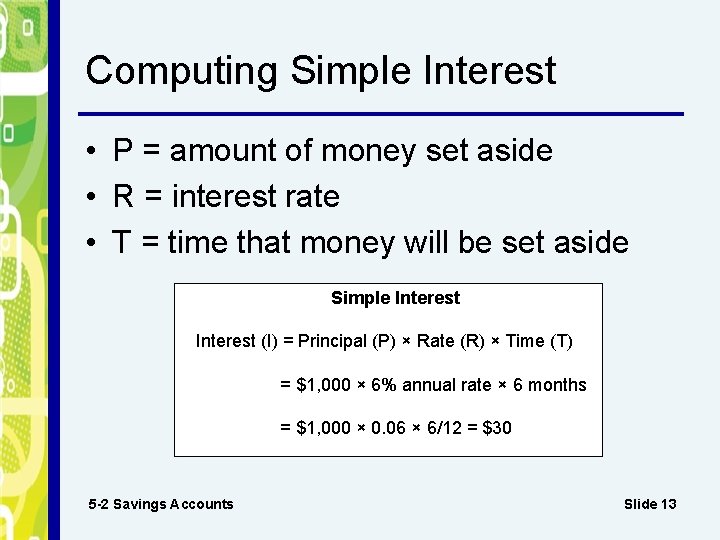
Computing Simple Interest • P = amount of money set aside • R = interest rate • T = time that money will be set aside Simple Interest (I) = Principal (P) × Rate (R) × Time (T) = $1, 000 × 6% annual rate × 6 months = $1, 000 × 0. 06 × 6/12 = $30 5 -2 Savings Accounts Slide 13
The Future Value of Money • Saving a single sum – Saving a lump sum for a period of time • Saving on a regular basis – Setting aside money regularly – Annuity: when you set aside a fixed amount on a regular basis over time • Rule of 72 – How long will it take my investment to double? – Divide the annual interest rate into 72 – Invest $50 at 6% – It will double in 12 years (72/6=12) Slide 14
Computing Compound Interest Quarterly Compounding Annual Interest Rate 6% Year Beginning Balance Rate 6% Ending Balance Quarter 1 2 3 4 1 $100. 00 0. 015 $1. 50 $1. 52 $1. 55 $1. 57 $106. 14 2 $106. 14 0. 015 $1. 59 $1. 62 $1. 64 $1. 66 $112. 65 3 $112. 65 0. 015 $1. 69 $1. 72 $1. 74 $1. 77 $119. 57 5 -2 Savings Accounts Slide 15
What Are Your Savings Options? • Money market accounts earn the market rate of interest. • Certificates of deposit (CDs) pay a fixed interest rate for a time period. • U. S. savings bonds pay a guaranteed minimum interest rate. • Individual retirement accounts (IRAs) help you save for retirement. 5 -2 Savings Accounts Slide 16
Places To Save Your Money • Online only banks: banks placed solely online. – Not always FDIC insured • Brokerage Firms: generally pay higher on savings accounts – Not always FDIC insured • International banks: Will become more commonplace as we get older and wont be so scary. Slide 17
Focus On. . . The FDIC • Protects depositors of insured U. S. banks against loss if the bank fails • Covers all types of deposits • Covers principal and accrued interest • Does not insure some items o Examples: stocks, bonds, valuables • Insures deposits in different banks separately 5 -2 Savings Accounts Slide 18
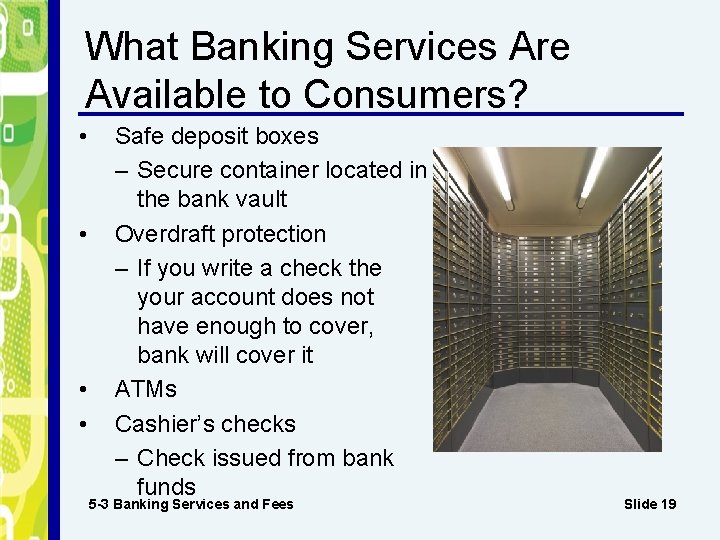
What Banking Services Are Available to Consumers? • • Safe deposit boxes – Secure container located in the bank vault Overdraft protection – If you write a check the your account does not have enough to cover, bank will cover it ATMs Cashier’s checks – Check issued from bank funds 5 -3 Banking Services and Fees Slide 19
What Banking Services Are Available to Consumers? • Money Order – Type of check used to pay bills or make payments for which money is guaranteed • • Financial advising Loans Internet banking Bank cards 5 -3 Banking Services and Fees Slide 20
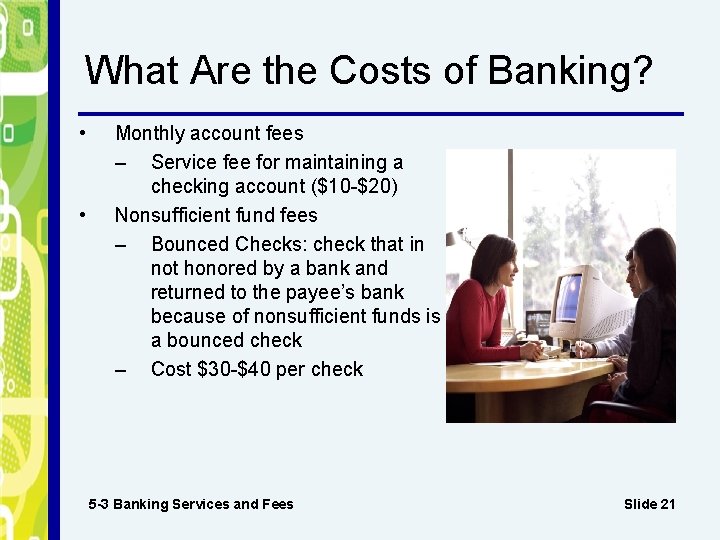
What Are the Costs of Banking? • • Monthly account fees – Service fee for maintaining a checking account ($10 -$20) Nonsufficient fund fees – Bounced Checks: check that in not honored by a bank and returned to the payee’s bank because of nonsufficient funds is a bounced check – Cost $30 -$40 per check 5 -3 Banking Services and Fees Slide 21
What Are the Costs of Banking? • • • Special service fees o Examples: stop payment, cashier’s check, money order ATM fees – Fee from another bank to withdraw money – $2 -$7 Inactive account fees – Does not meet minimum account usage requirements – $5 -$15 5 -3 Banking Services and Fees Slide 22
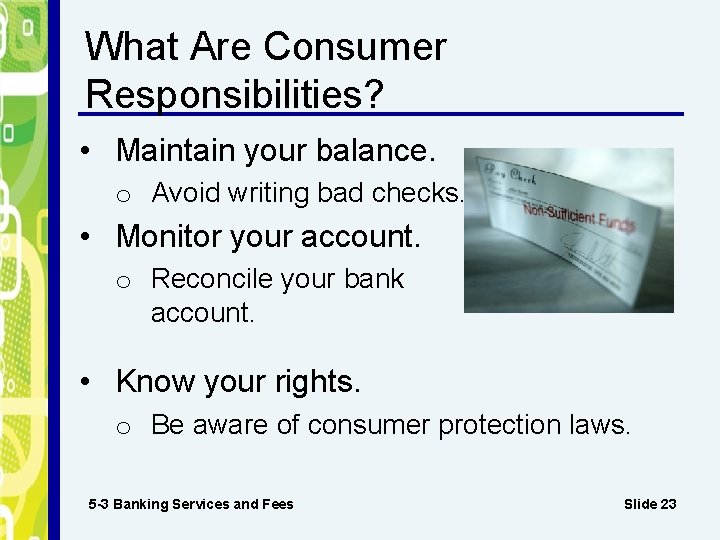
What Are Consumer Responsibilities? • Maintain your balance. o Avoid writing bad checks. • Monitor your account. o Reconcile your bank account. • Know your rights. o Be aware of consumer protection laws. 5 -3 Banking Services and Fees Slide 23
Success Skills Negotiating It is the process of reaching an agreement that benefits both parties. • • Understand your position. Understand the other party’s position. Create a proposed solution. Identify what is important and what you are willing to give up. 5 -3 Banking Services and Fees Slide 24
- Slides: 24