
CHAPTER 5 TEACHING EDUCATION CLASSROOM INTERACTIONS THE PROBLEMS

CHAPTER 5: TEACHING EDUCATION & CLASSROOM INTERACTIONS
THE PROBLEMS WITH TEACHER EDUCATION PROGRAMS • They are established in university settings where change does not always occur quickly due to bureaucratic procedures. • The curriculum of teacher education programs is often defined by government departments of education. This factor makes teacher education programs a product of the prevalent educational ideology, which is determined by the political ideology of the state. • Education and nation building (Green 1990) (background)
“Teacher education has generally been seen as apolitical because teacher education institutions separate the teaching experience from the existence and reproduction of inequalities in society in general, and within the school in particular” (133).
“‘In many teacher education programs, culture gets treated as a taxonomy and is used as a checklist to mark the characteristics of a people’…It is unsurprising, then, that superficial approaches to multicultural education have led to alienation for both majorityand minority-group students” (127).
THE ROLES OF TEACHERS • ‘Multicultural pedagogy does not require teachers to have an expertise of all cultures; this is because its purpose it not to teach about cultures per se, but rather to promote students’ awareness and appreciation of difference and other perspectives. Teachers must strive to expose their students to the full spectrum of difference, in its varied and multi-faceted forms’ (p. 124).
“the exploration for a different kind of teacher education…needs to contest the idea that there are methods, strategies, or approaches to teaching that work anytime, anywhere” (129).
WHY REFORM IS SLOW IN TEACHER EDUCATION PROGRAMS • Government departments of education define curriculum • Equity/multicultural policies have not been incorporated into teacher education programs • Universities settings stipulate bureaucratic procedures • It is assumed that teachers will simply pick up the necessary skills and attitudes to make them successful teachers in diverse classrooms without direct instruction or planned experience • Perceptions of the teacher’s role must be redefined
“The attitude still exists that intercultural education is for culturally different students only, not for all students. This argument is flawed because it equates cultural difference with deficiency” (128).
CULTURAL CAPITAL • Viewing culture in the same sense as economic capital (assets) • Culture is both a lived experience, a set of relations, as well as a commodity that is accumulated • Students who are different do not have the cultural capital that schools use a currency—and thus are at a disadvantage • Explains why it is more difficult for those students to achieve by the standards set out by the educational system
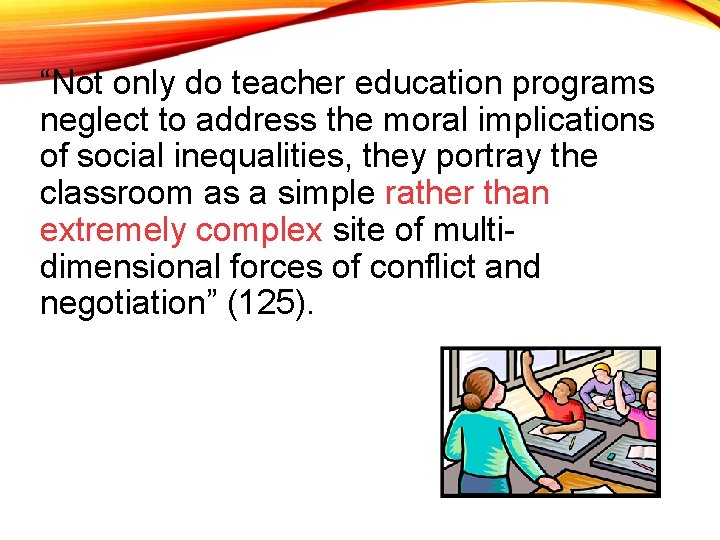
“Not only do teacher education programs neglect to address the moral implications of social inequalities, they portray the classroom as a simple rather than extremely complex site of multidimensional forces of conflict and negotiation” (125).
“At the heart of the educational endeavor is the individual teacher, whose sensitivity and skills as a professional enable children of various capabilities and cultures to achieve their maximum potential, or, alternatively, whose inability may (often inadvertently) lead to student failure” (124).
ESSENTIALS FOR MULTICULTURAL TEACHER EDUCATION • Theoretical clarification of multicultural education and its objectives • Opportunity for student teachers to master ways to meet these objectives • Establishment of a broad framework for curriculum planning—that recognizes teaching as a moral enterprise with immense social consequences • Focus on emancipatory aspects of teaching • Pre-service programs for student teachers, as well as inservice programs for practicing teachers
“Teaching is not an isolated act detached from social obligations. Teachers must help students ‘connect’ their lives with the larger world, develop conceptual schemes, and not merely accumulate information” (133).
“Teachers are necessarily confronted with the question of difference because student groups are heterogeneous—in experiences, cultures, and lifestyles as well as in terms of gender, ethnicity, and race. How they respond to this question is important because of the influence that difference has on how children learn and how they see themselves and others” (133 -134).
“When teachers do not share common experiences and beliefs with students of different backgrounds, their understanding of the world is conflicting. This can lead to misunderstanding because of the inability to recognize cultural meanings in interactions” (135).
“Studies show that motivators, learning styles, behaviour patterns, and aspirations vary among cultural groups. Failure to recognize this is to perpetuate a system of inequalities” (134).
“The components of a redefined multicultural teacher education program are derived from an understanding of the kind of teacher we want to produce” (124).
“To be able to foster the conditions for student self-empowerment, teachers must themselves be empowered” (131).
MODELLING MULTICULTURAL EDUCATION PRACTICE • Have a sense of mission and moral purpose • Recognize that student performance is linked to teacher expectations • Redefine standards and norms for a diverse student population • Diversify teaching methods • Practice effective communication—involving verbal and nonverbal cues
“Since knowledge is constructed by the one who learns, teaching means providing the opportunity to learn” (137).
“Learning through technology, including social media, offers the potential for meeting some objectives of multicultural teaching because teacher and students learn together and can be involved in the process of creating and developing a sense of control and mastery” (130).
“Multicultural education is a state of mind; it is an attitude, an ideology that permeates every discipline. It is concerned with the objective world of knowledge as well as with the subjective world of feelings and values —the cognitive, affective, and ethical domains” (126).
- Slides: 22