
Chapter 5 Strategy Formulation Situation Analysis and Business
Chapter 5 Strategy Formulation: Situation Analysis and Business Strategy Dr. Vijaya Kumar Skyline College 1
Situational Analysis Strategy formulation: – Strategic planning or long-range planning • Develops mission, objectives, strategies and policies 2
Situational Analysis: – Process of finding a strategic fit between external opportunities and internal strengths while working around external threats and internal weaknesses. 3
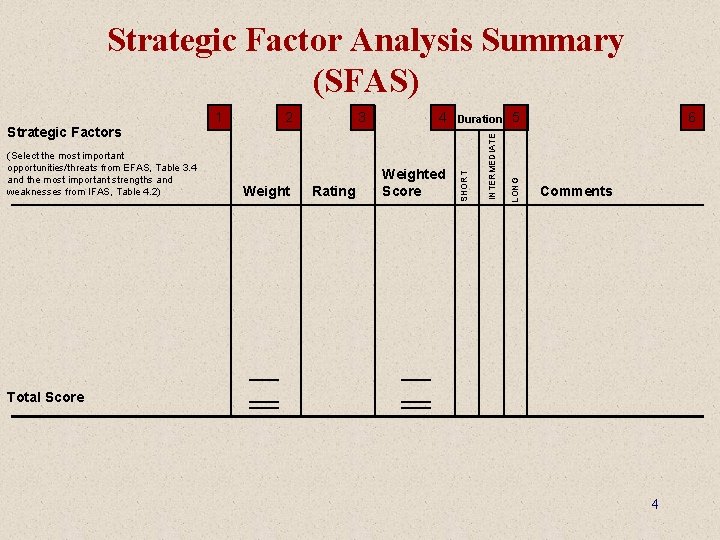
Strategic Factor Analysis Summary (SFAS) Rating 4 Weighted Score Duration 5 LONG Weight 3 INTERMEDIATE (Select the most important opportunities/threats from EFAS, Table 3. 4 and the most important strengths and weaknesses from IFAS, Table 4. 2) 2 SHORT Strategic Factors 1 6 Comments Total Score 4

Strategic Factor Analysis Summary (SFAS): Maytag as Example S 1 S 3 Quality Maytag culture (S) Hoover’s international orientation (S) Weight. 10 Rating 5 3 Weighted Score. 50 LONG (Select the most important opportunities/threats from EFAS, Table 3. 4 and the most important strengths and weaknesses from IFAS, Table 4. 2) SHORT Strategic Factors INTERMEDIATE Duration Comments X Quality key to success . 30 X Name recognition X High debt W 3 Financial position (W) . 10 2 . 20 W 4 Global positioning (W) . 15 2 . 30 . 10 4 . 40 Only in N. A. , U. K. , and Australia O 1 Economic integration of European Community (O) O 2 Demographics favor quality (O) . 10 5 X . 50 O 5 Trend to super stores (O + T) . 10 2 . 20 X T 3 Whirlpool and Electrolux (T) . 15 3 . 45 X T 5 Japanese appliance companies (T) . 10 2 . 20 Total Score 1. 00 X Acquisition of Hoover X Maytag quality X Weak in this channel Dominate industry Asian presence 3. 05 5
Situational Analysis Niche: – A need in the marketplace that is currently unsatisfied. Goal for the Corporation – Find a propitious niche • An extremely favorable niche – Strategic window • Unique market opportunity available for a limited time 6
Situational Analysis SWOT analysis: – Internal • Strengths • Weaknesses – External • Opportunities • Threats 7
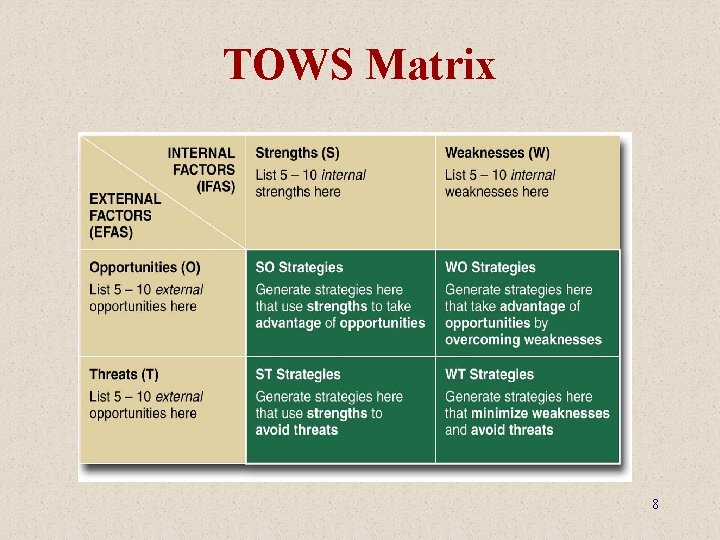
TOWS Matrix 8
Resource-Based Approach Resource: An asset, competency, process, skill, or knowledge controlled by the corporation. 9
Business Strategies Business Strategy: Focuses on improving the competitive position of a company’s or business unit’s products or services within the specific industry or market segment that the firm serves. 10
Porter’s Competitive Strategies Competitive Strategy: – Low cost? – Differentiation? – Compete head to head in large market? – Focus on niche? 11
Porter’s Competitive Strategies Generic Competitive Strategies: – Lower cost strategy • Design, produce, market more efficiently than competitors – Differentiation strategy • Unique and superior value in terms of product quality, features, service 12
Porter’s Competitive Strategies Competitive Advantage: – Determined by Competitive Scope • Breadth of the company’s target market 13
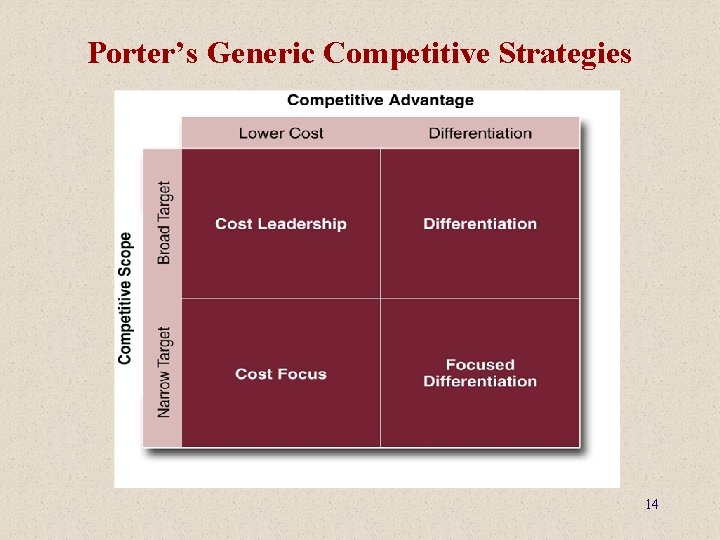
Porter’s Generic Competitive Strategies 14
Porter’s Competitive Strategies Cost Leadership: – Low-cost competitive strategy – Aimed at broad mass market – Aggressive construction of efficientscale facilities – Cost reductions – Cost minimization 15
Porter’s Competitive Strategies Differentiation: – Broad mass market – Unique product or service – Charge premiums – Lower customer sensitivity to price 16
Porter’s Competitive Strategies Cost focus: – Low cost competitive strategy – Focus on particular buyer group or market – Niche focused – Seek cost advantage in target market 17
Porter’s Competitive Strategies Differentiation focus: – Focus on particular group or geographic market – Seek differentiation in targeted market segment – Serve special needs of narrow target market 18
Porter’s Competitive Strategies Stuck in the middle: – No competitive advantage – Below-average performance 19
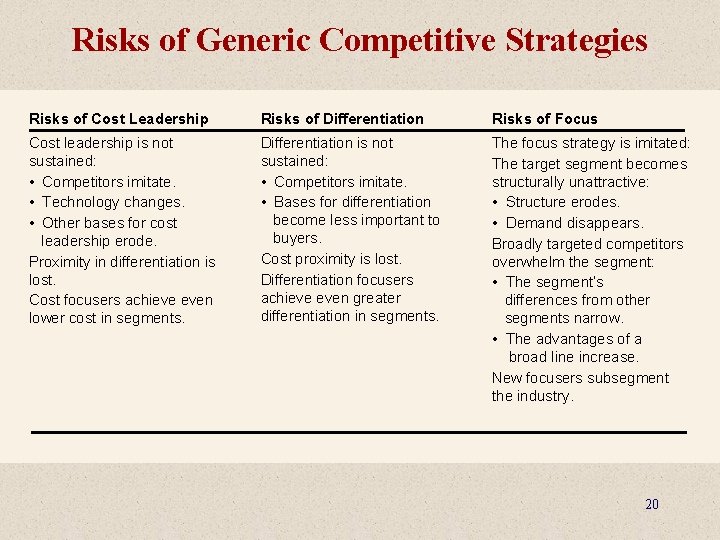
Risks of Generic Competitive Strategies Risks of Cost Leadership Risks of Differentiation Risks of Focus Cost leadership is not sustained: • Competitors imitate. • Technology changes. • Other bases for cost leadership erode. Proximity in differentiation is lost. Cost focusers achieve even lower cost in segments. Differentiation is not sustained: • Competitors imitate. • Bases for differentiation become less important to buyers. Cost proximity is lost. Differentiation focusers achieve even greater differentiation in segments. The focus strategy is imitated: The target segment becomes structurally unattractive: • Structure erodes. • Demand disappears. Broadly targeted competitors overwhelm the segment: • The segment’s differences from other segments narrow. • The advantages of a broad line increase. New focusers subsegment the industry. 20
Competitive Strategy Industry Structure: – Fragmented Industry • Many small and medium-sized local companies compete for small shares of total market – Focus strategies predominate 21
Competitive Strategy Industry Structure: – Consolidated industry • Mature industry dominated by a few large companies – Cost Leadership or Differentiation predominate 22
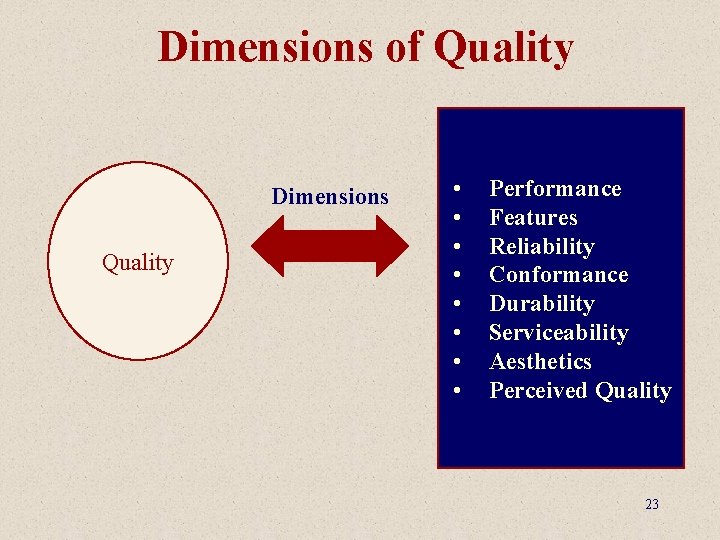
Dimensions of Quality Dimensions Quality • • Performance Features Reliability Conformance Durability Serviceability Aesthetics Perceived Quality 23
Competitive Strategy Strategic rollup: – Quickly consolidate fragmented industry – Money from venture capital – Entrepreneur acquires hundreds of owner-operated firms – Creates large firm with economies of scale 24
Competitive Strategy Strategic rollup: – Differ from Conventional M&A’s • Large number of firms • Owner-operated firms • Goal to reinvent entire industry 25
Competitive Tactics Tactic: – Specific operating plan detailing how a strategy is to be implemented in terms of when and where it is to be put into action. • Timing tactics • Market location tactics 26
Competitive Tactics Timing Tactics: – First mover (pioneer) • Reputation as industry leader • High profits • Sets standards for subsequent products in the industry – Late mover • Able to imitate technological advances of others – Keeps R&D costs down – Keeps risks down 27
Competitive Tactics Market Location Tactics: – Offensive Tactics • • • Frontal assault Flanking maneuver Bypass attack Encirclement Guerrilla warfare 28
Competitive Tactics Market Location Tactics: – Defensive Tactics • Raise structural barriers • Increase expected retaliation • Lower the inducement for attack 29
Cooperative Strategies: – Collusion • Active cooperation of firms to reduce output and raise prices – Explicit – Tacit 30
Cooperative Strategies: – Strategic Alliance: – Partnership of two or more corporations or business units to achieve strategically significant objectives that are mutually beneficial. 31
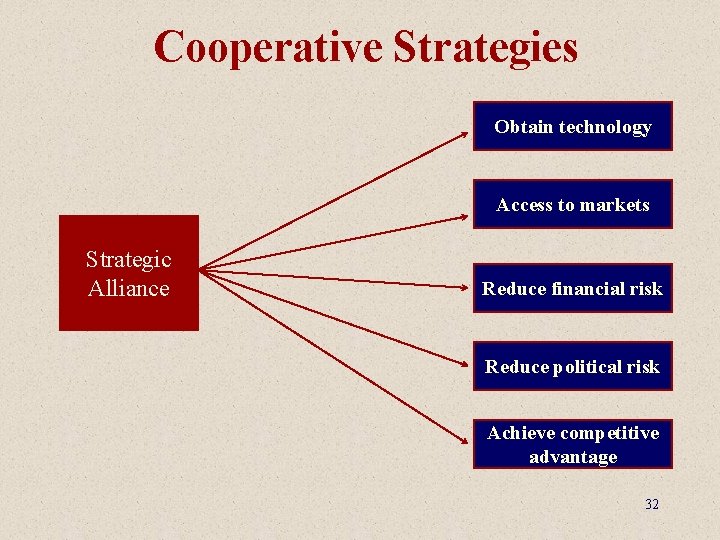
Cooperative Strategies Obtain technology Access to markets Strategic Alliance Reduce financial risk Reduce political risk Achieve competitive advantage 32
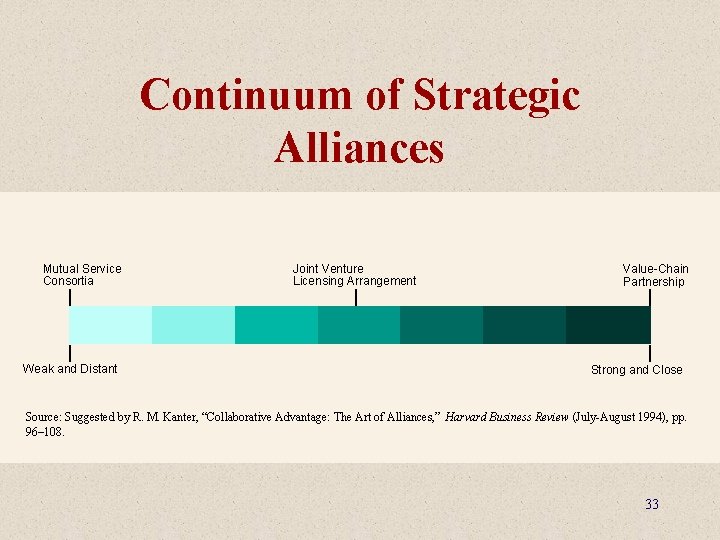
Continuum of Strategic Alliances Mutual Service Consortia Weak and Distant Joint Venture Licensing Arrangement Value-Chain Partnership Strong and Close Source: Suggested by R. M. Kanter, “Collaborative Advantage: The Art of Alliances, ” Harvard Business Review (July-August 1994), pp. 96– 108. 33
- Slides: 33