
Chapter 5 Strategy Formulation Situation Analysis and Business
Chapter 5 Strategy Formulation: Situation Analysis and Business Strategy Prentice Hall, 2002 Chapter 5 Wheelen/Hunger 1
Situational Analysis Strategy formulation: – Strategic planning or long-range planning • Develops mission, objectives, strategies and policies Prentice Hall, 2002 Chapter 5 Wheelen/Hunger 2
Situational Analysis: – Process of finding a strategic fit between external opportunities and internal strengths while working around external threats and internal weaknesses. Prentice Hall, 2002 Chapter 5 Wheelen/Hunger 3
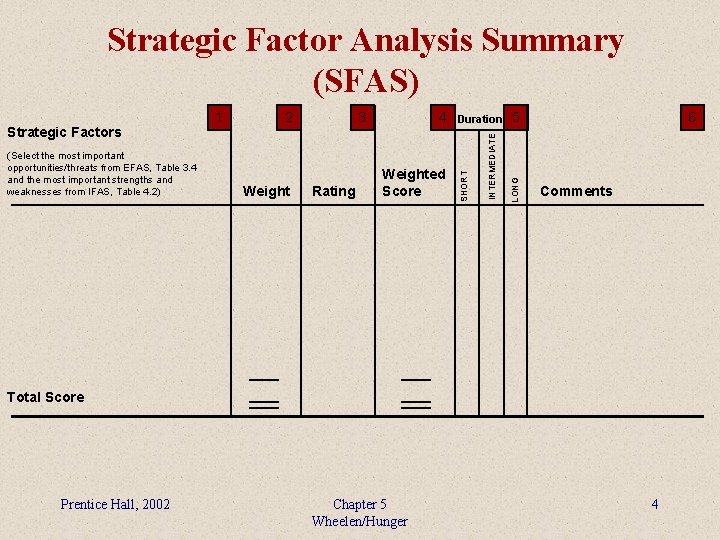
Strategic Factor Analysis Summary (SFAS) Rating 4 Weighted Score Duration 5 LONG Weight 3 INTERMEDIATE (Select the most important opportunities/threats from EFAS, Table 3. 4 and the most important strengths and weaknesses from IFAS, Table 4. 2) 2 SHORT Strategic Factors 1 6 Comments Total Score Prentice Hall, 2002 Chapter 5 Wheelen/Hunger 4
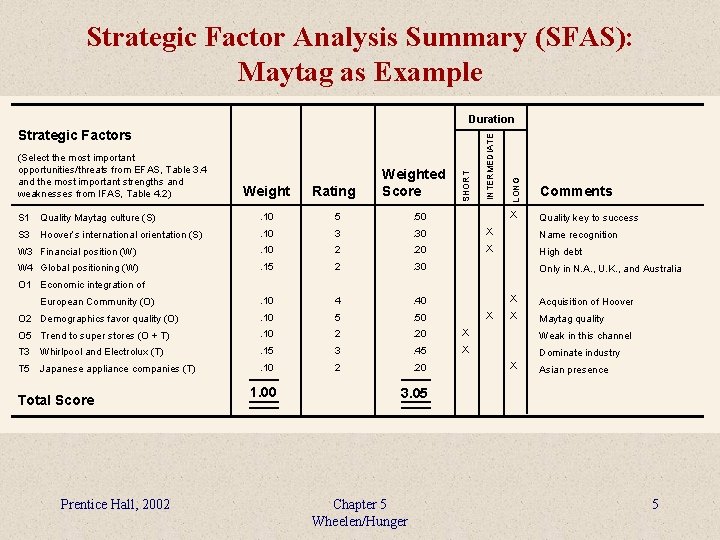
Strategic Factor Analysis Summary (SFAS): Maytag as Example S 1 S 3 Quality Maytag culture (S) Hoover’s international orientation (S) Weight. 10 Rating Weighted Score 5 . 50 3 LONG (Select the most important opportunities/threats from EFAS, Table 3. 4 and the most important strengths and weaknesses from IFAS, Table 4. 2) SHORT Strategic Factors INTERMEDIATE Duration Comments X Quality key to success . 30 X Name recognition X High debt W 3 Financial position (W) . 10 2 . 20 W 4 Global positioning (W) . 15 2 . 30 . 10 4 . 40 Only in N. A. , U. K. , and Australia O 1 Economic integration of European Community (O) O 2 Demographics favor quality (O) . 10 5 X . 50 O 5 Trend to super stores (O + T) . 10 2 . 20 X T 3 Whirlpool and Electrolux (T) . 15 3 . 45 X T 5 Japanese appliance companies (T) . 10 2 . 20 Total Score Prentice Hall, 2002 1. 00 X Acquisition of Hoover X Maytag quality X Weak in this channel Dominate industry Asian presence 3. 05 Chapter 5 Wheelen/Hunger 5
Situational Analysis Niche: – A need in the marketplace that is currently unsatisfied. Goal for the Corporation – Find a propitious niche • An extremely favorable niche – Strategic window • Unique market opportunity available for a limited time Prentice Hall, 2002 Chapter 5 Wheelen/Hunger 6
Situational Analysis SWOT analysis: – Internal • Strengths • Weaknesses – External • Opportunities • Threats Prentice Hall, 2002 Chapter 5 Wheelen/Hunger 7
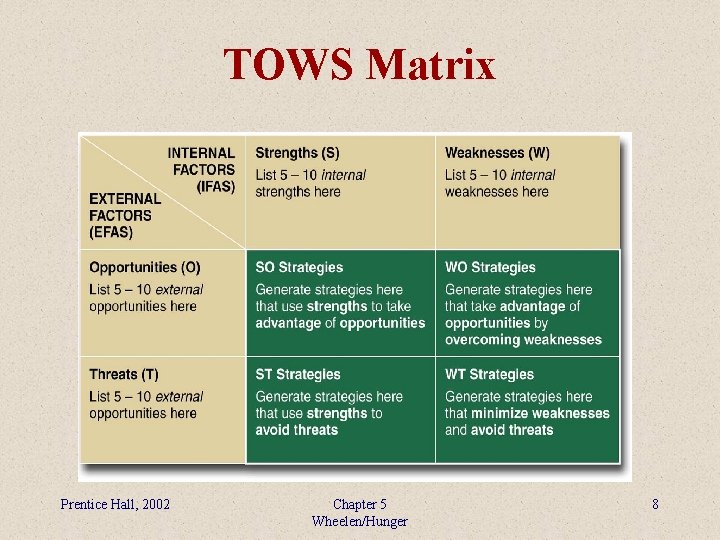
TOWS Matrix Prentice Hall, 2002 Chapter 5 Wheelen/Hunger 8
Resource-Based Approach Resource: An asset, competency, process, skill, or knowledge controlled by the corporation. Prentice Hall, 2002 Chapter 5 Wheelen/Hunger 9
Business Strategies Business Strategy: Focuses on improving the competitive position of a company’s or business unit’s products or services within the specific industry or market segment that the firm serves. Prentice Hall, 2002 Chapter 5 Wheelen/Hunger 10
Porter’s Competitive Strategies Competitive Strategy: – Low cost? – Differentiation? – Compete head to head in large market? – Focus on niche? Prentice Hall, 2002 Chapter 5 Wheelen/Hunger 11
Porter’s Competitive Strategies Generic Competitive Strategies: – Lower cost strategy • Design, produce, market more efficiently than competitors – Differentiation strategy • Unique and superior value in terms of product quality, features, service Prentice Hall, 2002 Chapter 5 Wheelen/Hunger 12
Porter’s Competitive Strategies Competitive Advantage: – Determined by Competitive Scope • Breadth of the company’s target market Prentice Hall, 2002 Chapter 5 Wheelen/Hunger 13
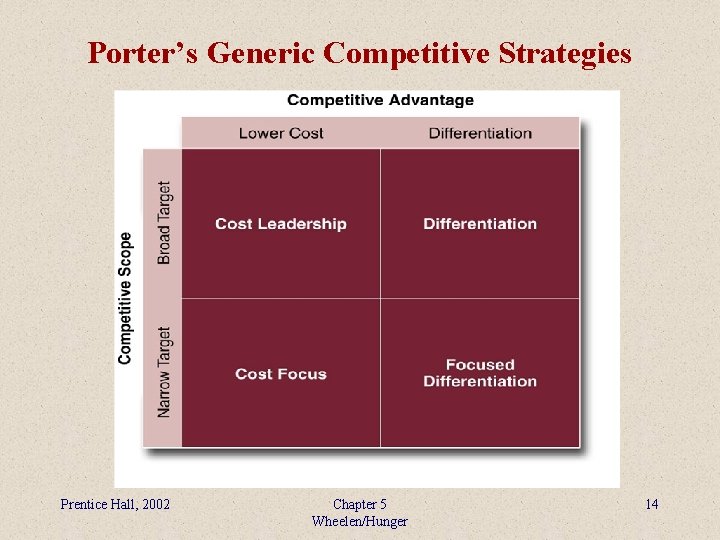
Porter’s Generic Competitive Strategies Prentice Hall, 2002 Chapter 5 Wheelen/Hunger 14
Porter’s Competitive Strategies Cost Leadership: – Low-cost competitive strategy – Aimed at broad mass market – Aggressive construction of efficientscale facilities – Cost reductions – Cost minimization Prentice Hall, 2002 Chapter 5 Wheelen/Hunger 15
Porter’s Competitive Strategies Differentiation: – Broad mass market – Unique product or service – Charge premiums – Lower customer sensitivity to price Prentice Hall, 2002 Chapter 5 Wheelen/Hunger 16
Porter’s Competitive Strategies Cost focus: – Low cost competitive strategy – Focus on particular buyer group or market – Niche focused – Seek cost advantage in target market Prentice Hall, 2002 Chapter 5 Wheelen/Hunger 17
Porter’s Competitive Strategies Differentiation focus: – Focus on particular group or geographic market – Seek differentiation in targeted market segment – Serve special needs of narrow target market Prentice Hall, 2002 Chapter 5 Wheelen/Hunger 18
Porter’s Competitive Strategies Stuck in the middle: – No competitive advantage – Below-average performance Prentice Hall, 2002 Chapter 5 Wheelen/Hunger 19
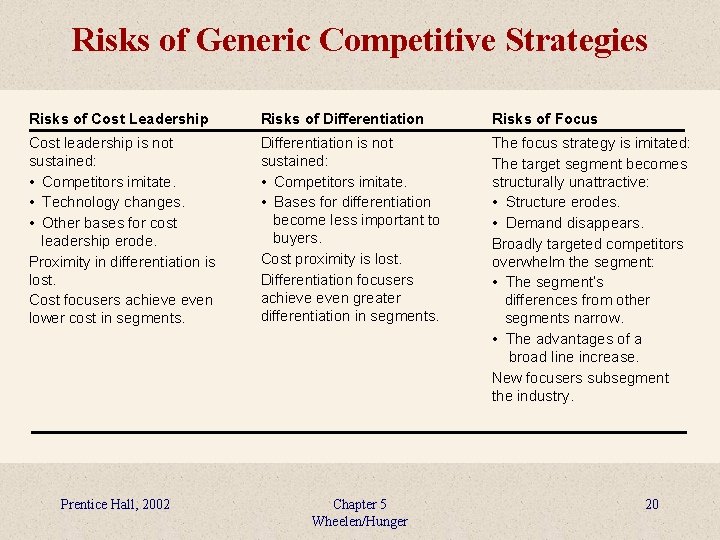
Risks of Generic Competitive Strategies Risks of Cost Leadership Risks of Differentiation Risks of Focus Cost leadership is not sustained: • Competitors imitate. • Technology changes. • Other bases for cost leadership erode. Proximity in differentiation is lost. Cost focusers achieve even lower cost in segments. Differentiation is not sustained: • Competitors imitate. • Bases for differentiation become less important to buyers. Cost proximity is lost. Differentiation focusers achieve even greater differentiation in segments. The focus strategy is imitated: The target segment becomes structurally unattractive: • Structure erodes. • Demand disappears. Broadly targeted competitors overwhelm the segment: • The segment’s differences from other segments narrow. • The advantages of a broad line increase. New focusers subsegment the industry. Prentice Hall, 2002 Chapter 5 Wheelen/Hunger 20
Competitive Strategy Industry Structure: – Fragmented Industry • Many small and medium-sized local companies compete for small shares of total market – Focus strategies predominate Prentice Hall, 2002 Chapter 5 Wheelen/Hunger 21
Competitive Strategy Industry Structure: – Consolidated industry • Mature industry dominated by a few large companies – Cost Leadership or Differentiation predominate Prentice Hall, 2002 Chapter 5 Wheelen/Hunger 22
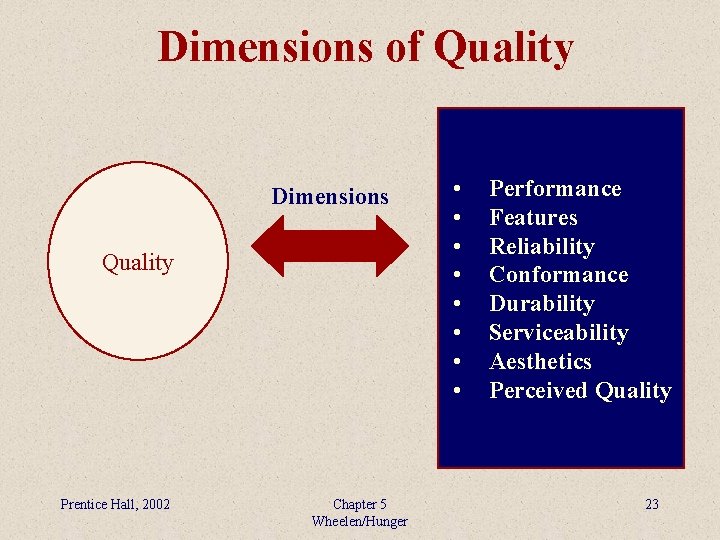
Dimensions of Quality Dimensions Quality Prentice Hall, 2002 Chapter 5 Wheelen/Hunger • • Performance Features Reliability Conformance Durability Serviceability Aesthetics Perceived Quality 23
Competitive Strategy Strategic rollup: – Quickly consolidate fragmented industry – Money from venture capital – Entrepreneur acquires hundreds of owner-operated firms – Creates large firm with economies of scale Prentice Hall, 2002 Chapter 5 Wheelen/Hunger 24
Competitive Strategy Strategic rollup: – Differ from Conventional M&A’s • Large number of firms • Owner-operated firms • Goal to reinvent entire industry Prentice Hall, 2002 Chapter 5 Wheelen/Hunger 25
Competitive Tactics Tactic: – Specific operating plan detailing how a strategy is to be implemented in terms of when and where it is to be put into action. • Timing tactics • Market location tactics Prentice Hall, 2002 Chapter 5 Wheelen/Hunger 26
Competitive Tactics Timing Tactics: – First mover (pioneer) • Reputation as industry leader • High profits • Sets standards for subsequent products in the industry – Late mover • Able to imitate technological advances of others – Keeps R&D costs down – Keeps risks down Prentice Hall, 2002 Chapter 5 Wheelen/Hunger 27
Competitive Tactics Market Location Tactics: – Offensive Tactics • • • Frontal assault Flanking maneuver Bypass attack Encirclement Guerrilla warfare Prentice Hall, 2002 Chapter 5 Wheelen/Hunger 28

Competitive Tactics Market Location Tactics: – Defensive Tactics • Raise structural barriers • Increase expected retaliation • Lower the inducement for attack Prentice Hall, 2002 Chapter 5 Wheelen/Hunger 29
Cooperative Strategies: – Collusion • Active cooperation of firms to reduce output and raise prices – Explicit – Tacit Prentice Hall, 2002 Chapter 5 Wheelen/Hunger 30
Cooperative Strategies: – Strategic Alliance: – Partnership of two or more corporations or business units to achieve strategically significant objectives that are mutually beneficial. Prentice Hall, 2002 Chapter 5 Wheelen/Hunger 31
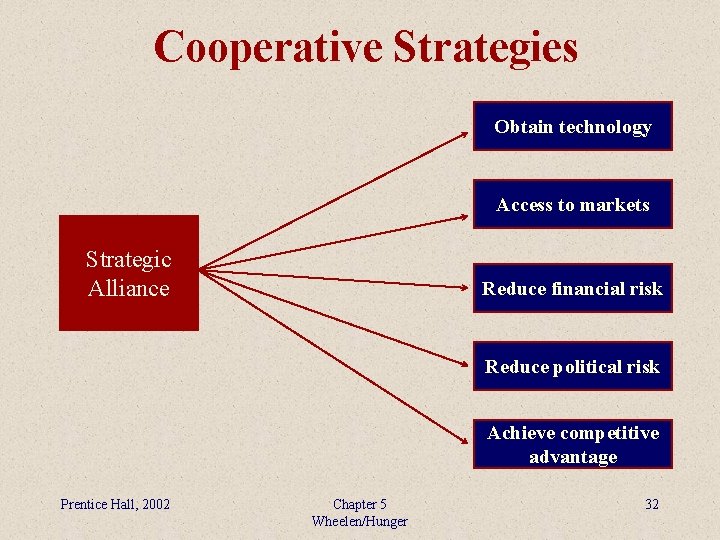
Cooperative Strategies Obtain technology Access to markets Strategic Alliance Reduce financial risk Reduce political risk Achieve competitive advantage Prentice Hall, 2002 Chapter 5 Wheelen/Hunger 32
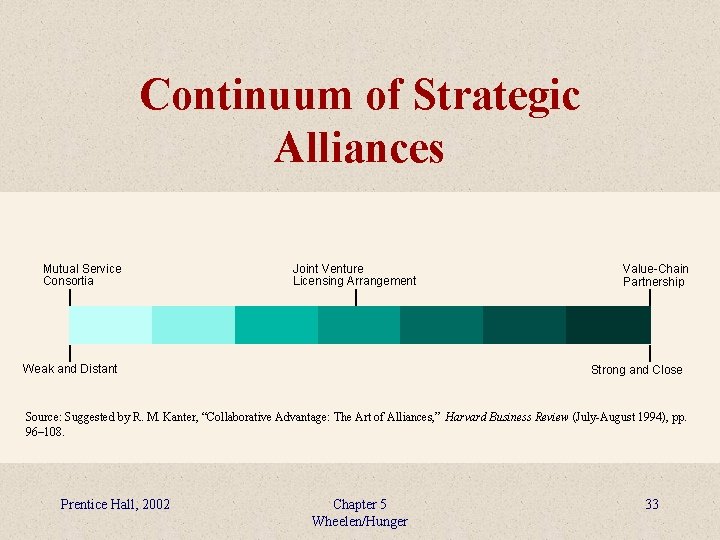
Continuum of Strategic Alliances Mutual Service Consortia Joint Venture Licensing Arrangement Weak and Distant Value-Chain Partnership Strong and Close Source: Suggested by R. M. Kanter, “Collaborative Advantage: The Art of Alliances, ” Harvard Business Review (July-August 1994), pp. 96– 108. Prentice Hall, 2002 Chapter 5 Wheelen/Hunger 33
- Slides: 33