
CHAPTER 5 STRATEGIC CAPACITY MANAGEMENT LO 5 1



- Slides: 27
CHAPTER 5: STRATEGIC CAPACITY MANAGEMENT LO 5– 1: Explain what capacity management is and why it is strategically important. LO 5– 2: Exemplify how to plan capacity. LO 5– 3: Evaluate capacity alternatives using decision trees. LO 5– 4: Compare capacity planning in services to capacity planning in manufacturing. Mc. Graw-Hill/Irwin Copyright © 2017 Mc. Graw-Hill Education. All rights reserved.
Economies of Scale Made of Steel • The Economics of Very Big Ships • Economy of Container Ships • Allows a T-shirt made in China to be sent to the Netherlands for just 2. 5 cents • The Eleonora Maersk and the other seven ships in her class are among the largest ever built • Almost 400 m long, or the length of four soccer fields, and another half-field across • The ships can carry 7, 500 or so 40 -foot containers, each of which can hold 70, 000 T-shirts • On this voyage, the Eleonora was carrying supplies for Europe’s New Year celebrations: 1, 850 tons of fireworks, including 30 tons of gunpowder Copyright © 2017 Mc. Graw-Hill Education. All rights reserved. 5 -2
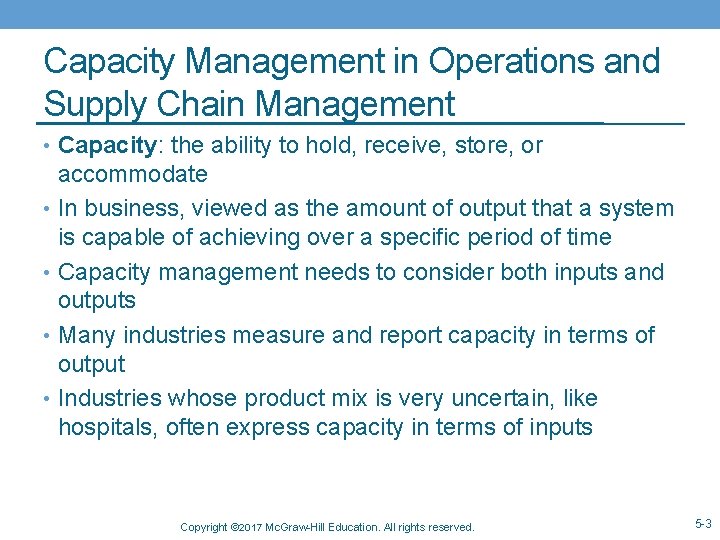
Capacity Management in Operations and Supply Chain Management • Capacity: the ability to hold, receive, store, or accommodate • In business, viewed as the amount of output that a system is capable of achieving over a specific period of time • Capacity management needs to consider both inputs and outputs • Many industries measure and report capacity in terms of output • Industries whose product mix is very uncertain, like hospitals, often express capacity in terms of inputs Copyright © 2017 Mc. Graw-Hill Education. All rights reserved. 5 -3
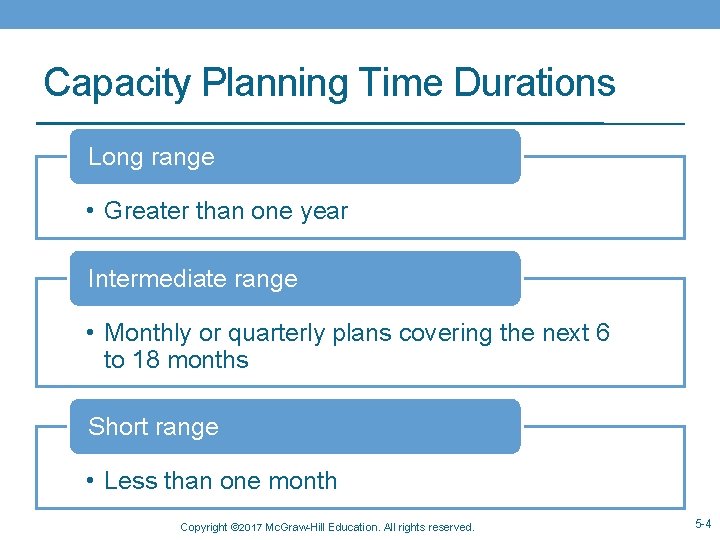
Capacity Planning Time Durations Long range • Greater than one year Intermediate range • Monthly or quarterly plans covering the next 6 to 18 months Short range • Less than one month Copyright © 2017 Mc. Graw-Hill Education. All rights reserved. 5 -4
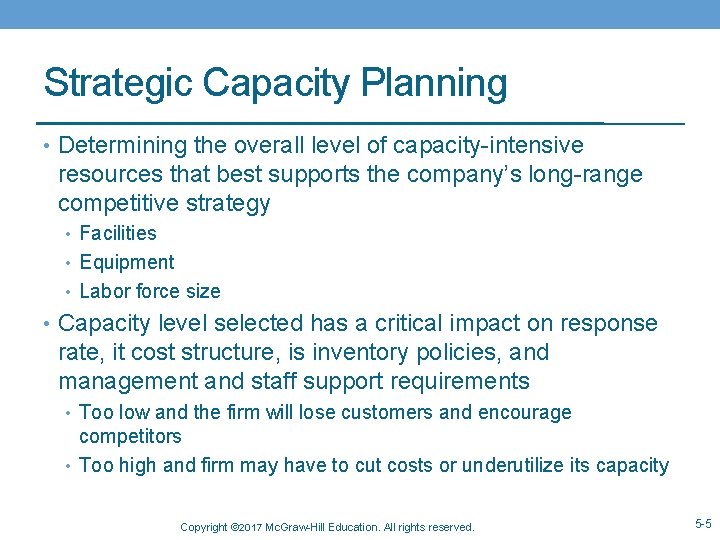
Strategic Capacity Planning • Determining the overall level of capacity-intensive resources that best supports the company’s long-range competitive strategy • Facilities • Equipment • Labor force size • Capacity level selected has a critical impact on response rate, it cost structure, is inventory policies, and management and staff support requirements • Too low and the firm will lose customers and encourage competitors • Too high and firm may have to cut costs or underutilize its capacity Copyright © 2017 Mc. Graw-Hill Education. All rights reserved. 5 -5
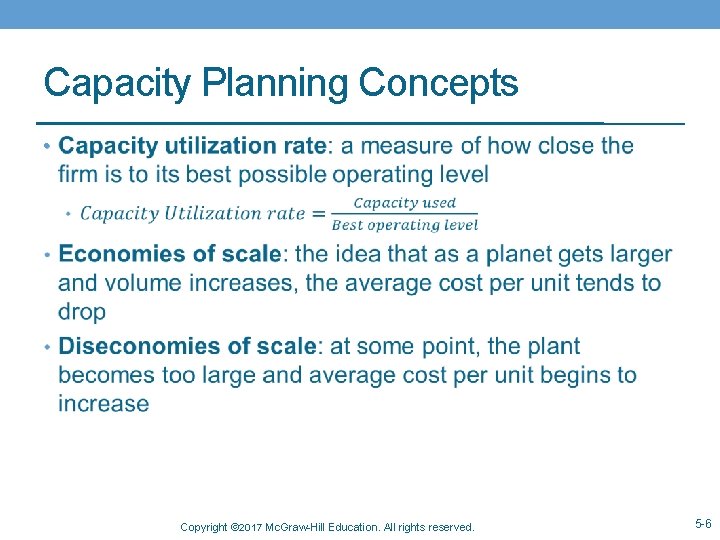
Capacity Planning Concepts • Copyright © 2017 Mc. Graw-Hill Education. All rights reserved. 5 -6
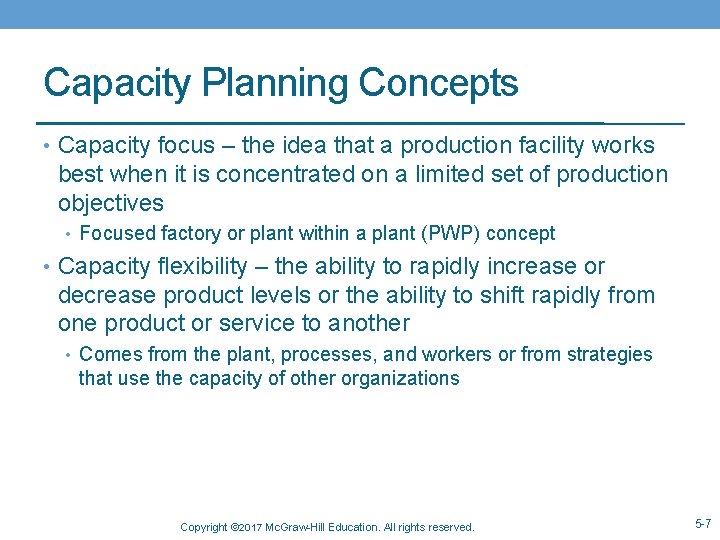
Capacity Planning Concepts • Capacity focus – the idea that a production facility works best when it is concentrated on a limited set of production objectives • Focused factory or plant within a plant (PWP) concept • Capacity flexibility – the ability to rapidly increase or decrease product levels or the ability to shift rapidly from one product or service to another • Comes from the plant, processes, and workers or from strategies that use the capacity of other organizations Copyright © 2017 Mc. Graw-Hill Education. All rights reserved. 5 -7
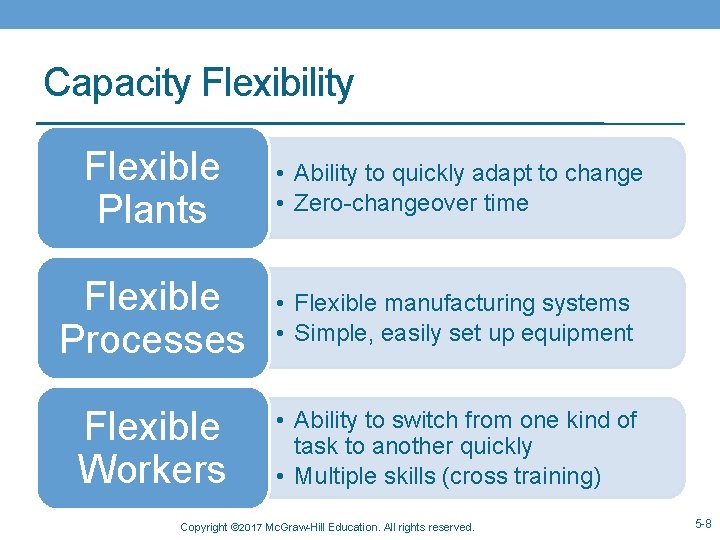
Capacity Flexibility Flexible Plants • Ability to quickly adapt to change • Zero-changeover time Flexible Processes • Flexible manufacturing systems • Simple, easily set up equipment Flexible Workers • Ability to switch from one kind of task to another quickly • Multiple skills (cross training) Copyright © 2017 Mc. Graw-Hill Education. All rights reserved. 5 -8
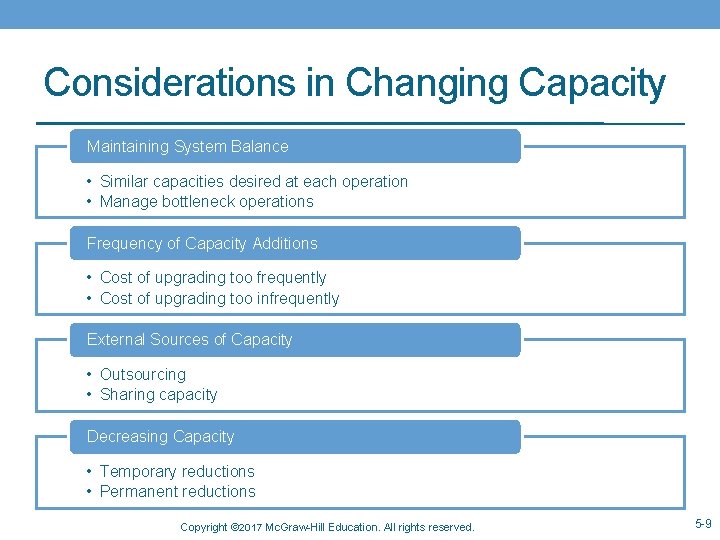
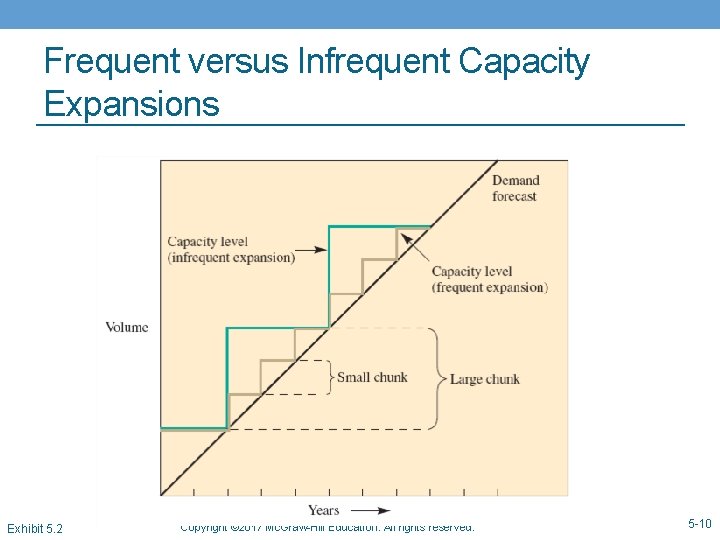
Considerations in Changing Capacity Maintaining System Balance • Similar capacities desired at each operation • Manage bottleneck operations Frequency of Capacity Additions • Cost of upgrading too frequently • Cost of upgrading too infrequently External Sources of Capacity • Outsourcing • Sharing capacity Decreasing Capacity • Temporary reductions • Permanent reductions Copyright © 2017 Mc. Graw-Hill Education. All rights reserved. 5 -9
Frequent versus Infrequent Capacity Expansions Exhibit 5. 2 Copyright © 2017 Mc. Graw-Hill Education. All rights reserved. 5 -10
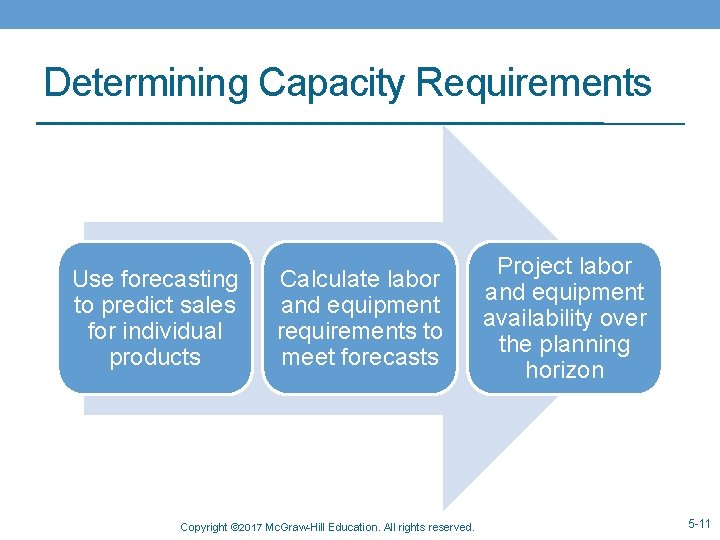
Determining Capacity Requirements Use forecasting to predict sales for individual products Calculate labor and equipment requirements to meet forecasts Copyright © 2017 Mc. Graw-Hill Education. All rights reserved. Project labor and equipment availability over the planning horizon 5 -11
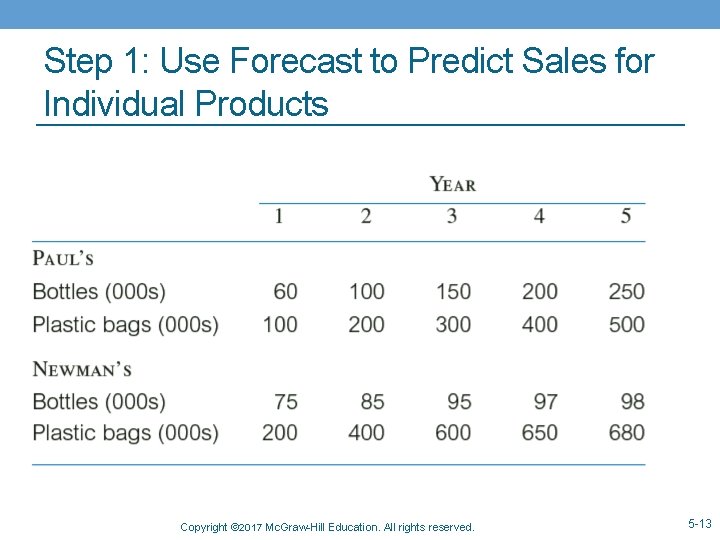
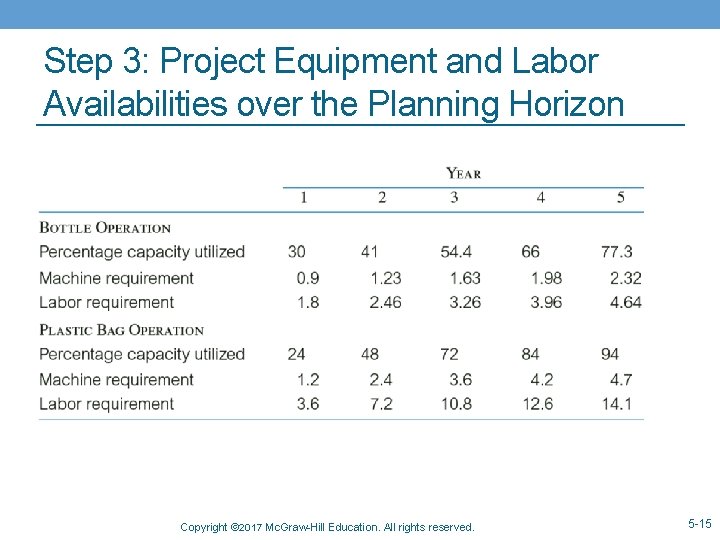
Example 5. 1—Determining Capacity Requirements • Stewart Company produces two flavors of salad dressing • Paul’s and Newman’s • Each is available in bottles and single-serving bags • Have three machines that can package 150, 000 bottles each year • Each machine requires two operators • Have five machines that can package 250, 000 plastic bags per year • Each machine requires three operators • What are the capacity and labor requirements for the next five years? Copyright © 2017 Mc. Graw-Hill Education. All rights reserved. 5 -12
Step 1: Use Forecast to Predict Sales for Individual Products Copyright © 2017 Mc. Graw-Hill Education. All rights reserved. 5 -13
Step 2: Calculate Equipment and Labor Requirements • • Copyright © 2017 Mc. Graw-Hill Education. All rights reserved. 5 -14
Step 3: Project Equipment and Labor Availabilities over the Planning Horizon Copyright © 2017 Mc. Graw-Hill Education. All rights reserved. 5 -15
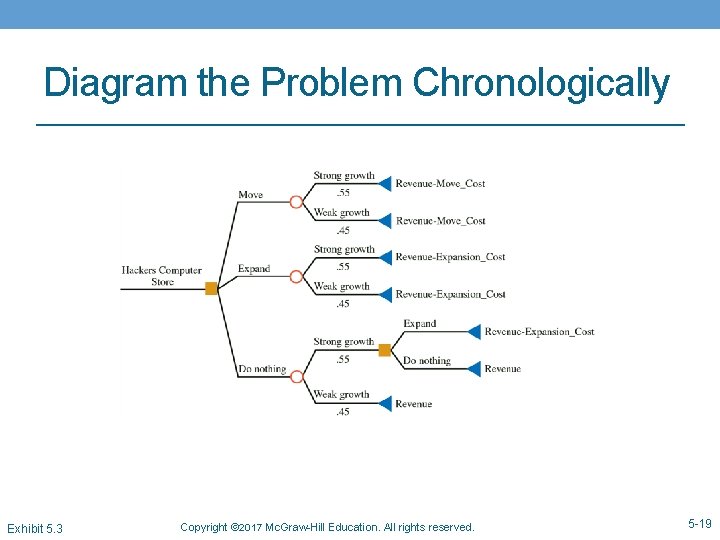
Using Decision Trees to Evaluate Capacity Alternatives • A decision tree is a schematic model of the sequence of steps in a problem – including the conditions and consequences of each step • Decision trees help analysts understand the problem and assist in identifying the best solution • Decision tree components include the following: • Decision nodes – represented with squares • Chance nodes – represented with circles • Paths – links between nodes • Work from the end of the tree backwards to the start of the tree • Calculate expected values at each step Copyright © 2017 Mc. Graw-Hill Education. All rights reserved. 5 -16
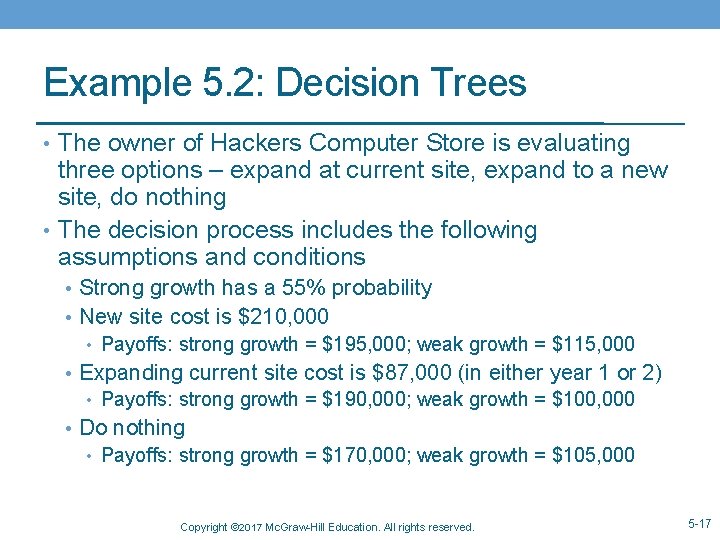
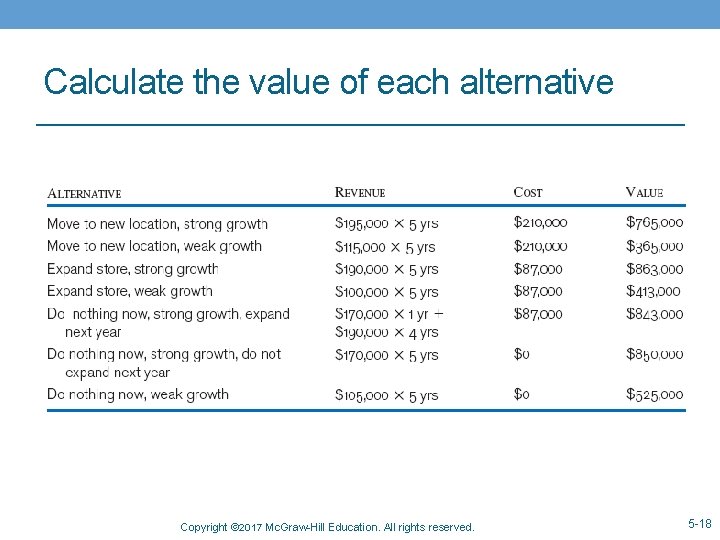
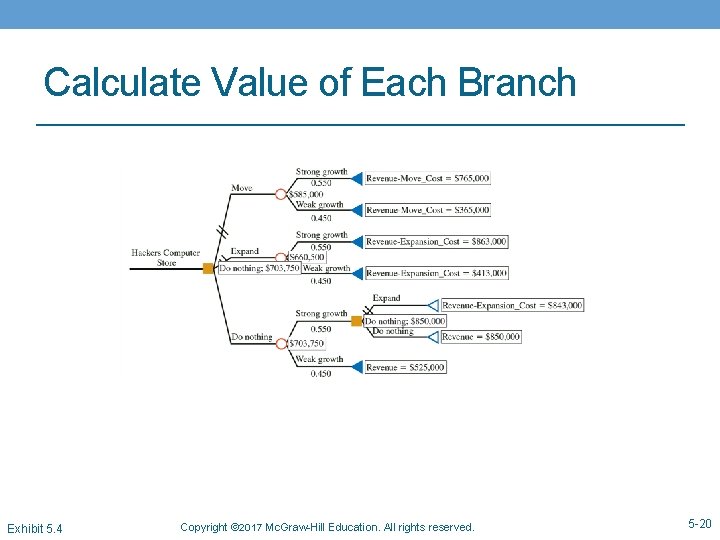
Example 5. 2: Decision Trees • The owner of Hackers Computer Store is evaluating three options – expand at current site, expand to a new site, do nothing • The decision process includes the following assumptions and conditions • Strong growth has a 55% probability • New site cost is $210, 000 • Payoffs: strong growth = $195, 000; weak growth = $115, 000 • Expanding current site cost is $87, 000 (in either year 1 or 2) • Payoffs: strong growth = $190, 000; weak growth = $100, 000 • Do nothing • Payoffs: strong growth = $170, 000; weak growth = $105, 000 Copyright © 2017 Mc. Graw-Hill Education. All rights reserved. 5 -17
Calculate the value of each alternative Copyright © 2017 Mc. Graw-Hill Education. All rights reserved. 5 -18
Diagram the Problem Chronologically Exhibit 5. 3 Copyright © 2017 Mc. Graw-Hill Education. All rights reserved. 5 -19
Calculate Value of Each Branch Exhibit 5. 4 Copyright © 2017 Mc. Graw-Hill Education. All rights reserved. 5 -20
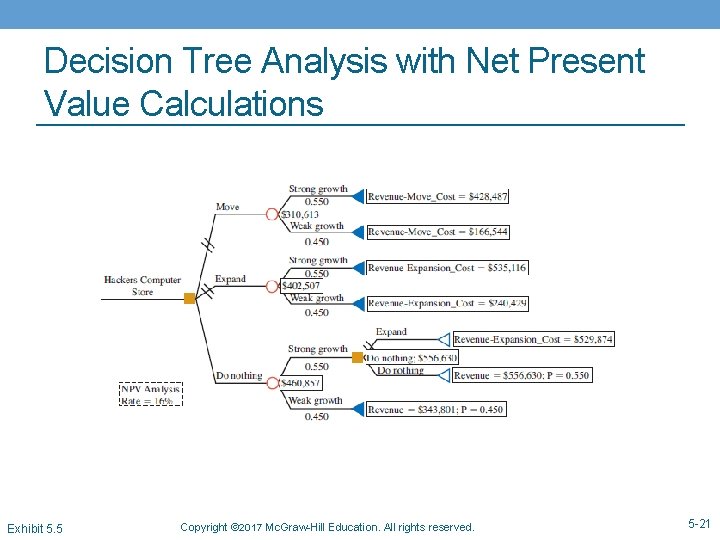
Decision Tree Analysis with Net Present Value Calculations Exhibit 5. 5 Copyright © 2017 Mc. Graw-Hill Education. All rights reserved. 5 -21
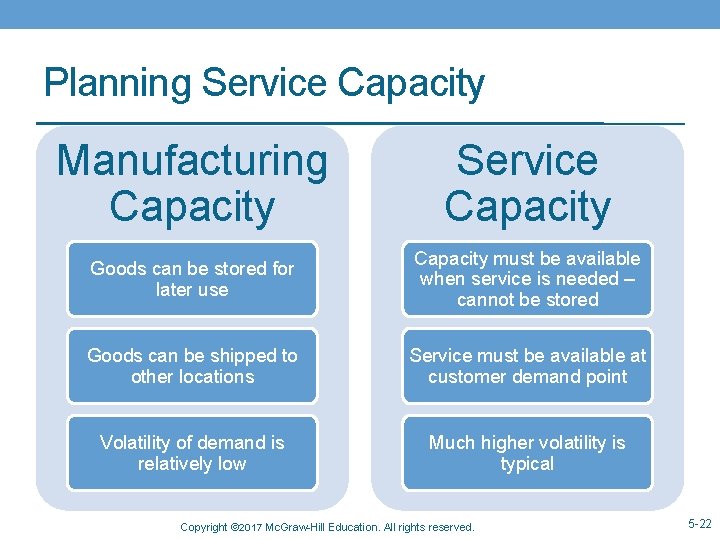
Planning Service Capacity Manufacturing Capacity Service Capacity Goods can be stored for later use Capacity must be available when service is needed – cannot be stored Goods can be shipped to other locations Service must be available at customer demand point Volatility of demand is relatively low Much higher volatility is typical Copyright © 2017 Mc. Graw-Hill Education. All rights reserved. 5 -22
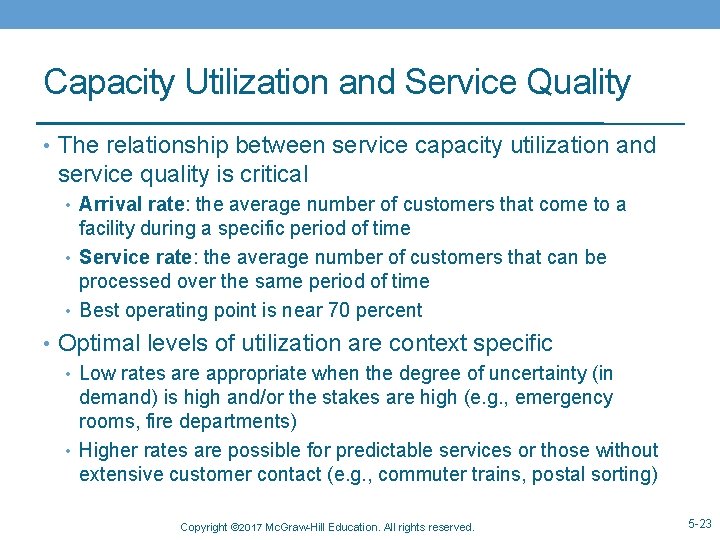
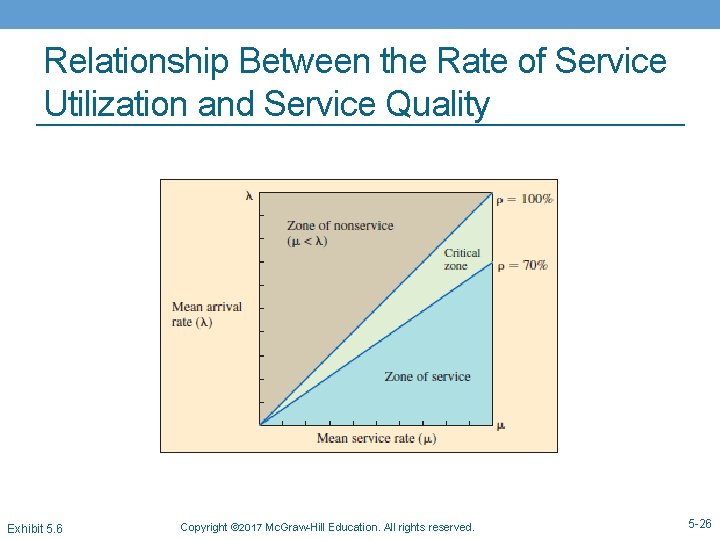
Capacity Utilization and Service Quality • The relationship between service capacity utilization and service quality is critical • Arrival rate: the average number of customers that come to a facility during a specific period of time • Service rate: the average number of customers that can be processed over the same period of time • Best operating point is near 70 percent • Optimal levels of utilization are context specific • Low rates are appropriate when the degree of uncertainty (in demand) is high and/or the stakes are high (e. g. , emergency rooms, fire departments) • Higher rates are possible for predictable services or those without extensive customer contact (e. g. , commuter trains, postal sorting) Copyright © 2017 Mc. Graw-Hill Education. All rights reserved. 5 -23
Relationship Between the Rate of Service Utilization and Service Quality Exhibit 5. 6 Copyright © 2017 Mc. Graw-Hill Education. All rights reserved. 5 -26
Summary • An operations and supply chain management view of capacity emphasizes the time dimension of capacity • Long range, intermediate range, and short range • Best operating level is the rate that is sustainable by the system • With economies of scale, as volume increases, average cost per unit drops • Focused manufacturing plants are designed to produce multiple products using a concept called plant within a plant • From a strategic, long-term view, capacity additions or reductions come in chunks Copyright © 2017 Mc. Graw-Hill Education. All rights reserved. 5 -25
Summary Continued • A useful technique for analyzing capacity problems is the decision tree • With this format, the sequences of decisions are organized like branches in a tree • The potential consequences of the decisions are enumerated based on their probability of occurrence and corresponding expected value • Often, services require that capacity be available immediately and that it be near where the customer resides • Firms that offer services often need to deal with dramatic changes in customer demand over time Copyright © 2017 Mc. Graw-Hill Education. All rights reserved. 5 -26
Practice Exam 1. 2. 3. 4. 5. 6. The level of capacity for which a process was designed and at which it operates at minimum cost The concept that relates to gaining efficiency through the full utilization of dedicated resources, such as people and equipment A facility that limits production to a single product or a set of very similar products When multiple (usually similar) products can be produced in a facility less expensively than a single product The ability to serve more customers than expected In a service process such as the checkout counter in a discount store, what is a good target percent for capacity utilization Copyright © 2017 Mc. Graw-Hill Education. All rights reserved. 5 -27