
Chapter 5 Social Responsibility and Managerial Ethics n
Chapter 5 – Social Responsibility and Managerial Ethics n n n n n Two contrasting views of social responsibility To whom is management responsible? Levels of responsibility Social responsibility and economic performance The “greening” of management Values-based management Four views of managerial ethics Factors that affect employee ethics Six determinants of issue intensity Improving ethical behavior 1
Your Company’s Value Statement If you owned and ran your own company, what would your “key values” be? 2
Social Responsibility – Classical View n n Management’s only social responsibility is to maximize profits (create a financial return) by operating the business in the best interests of the stockholders (owners of the corporation). Expending the firm’s resources on doing “social good” unjustifiably increases costs that lower profits to the owners and raises prices to consumers. 3
Social Responsibility – Socioeconomic View n n Management’s social responsibility goes beyond making profits to include protecting and improving society’s welfare. Corporations are not independent entities responsible only to stockholders. Firms have a moral responsibility to larger society to become involved in social, legal, and political issues. “To do the right thing” 4
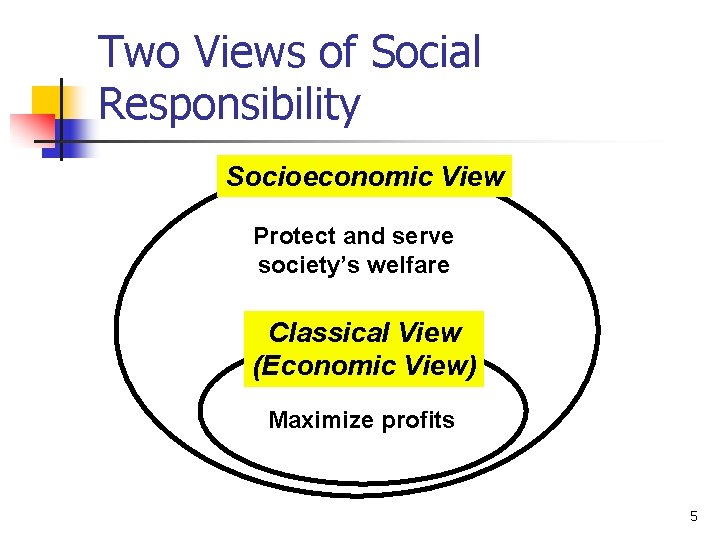
Two Views of Social Responsibility Socioeconomic View Protect and serve society’s welfare Classical View (Economic View) Maximize profits 5
The Debate n Mc. Donalds has been criticized for making food unhealthy (e. g. , “Supersize Me”), not telling people what’s in it. Should Mc. Donalds become SR by: n n Making foods healthier (e. g. , smaller portions, leaner beef, canola oil vs, lard) Advertise what’s in food 6
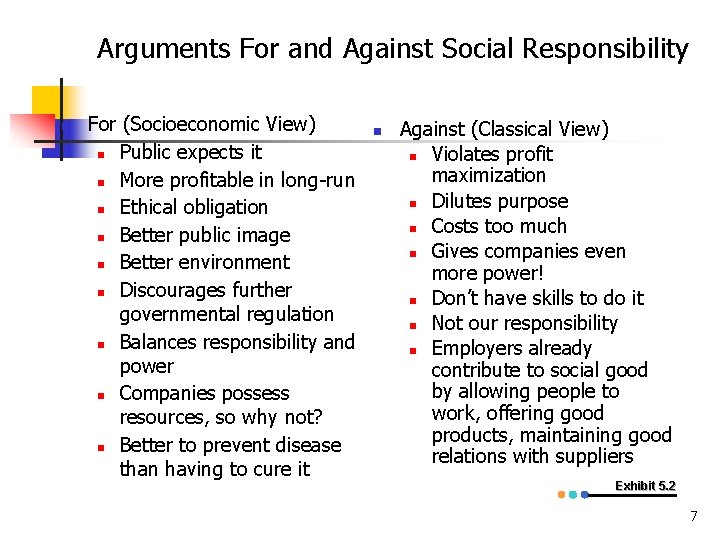
Arguments For and Against Social Responsibility n For (Socioeconomic View) n Public expects it n More profitable in long-run n Ethical obligation n Better public image n Better environment n Discourages further governmental regulation n Balances responsibility and power n Companies possess resources, so why not? n Better to prevent disease than having to cure it n Against (Classical View) n Violates profit maximization n Dilutes purpose n Costs too much n Gives companies even more power! n Don’t have skills to do it n Not our responsibility n Employers already contribute to social good by allowing people to work, offering good products, maintaining good relations with suppliers Exhibit 5. 2 7
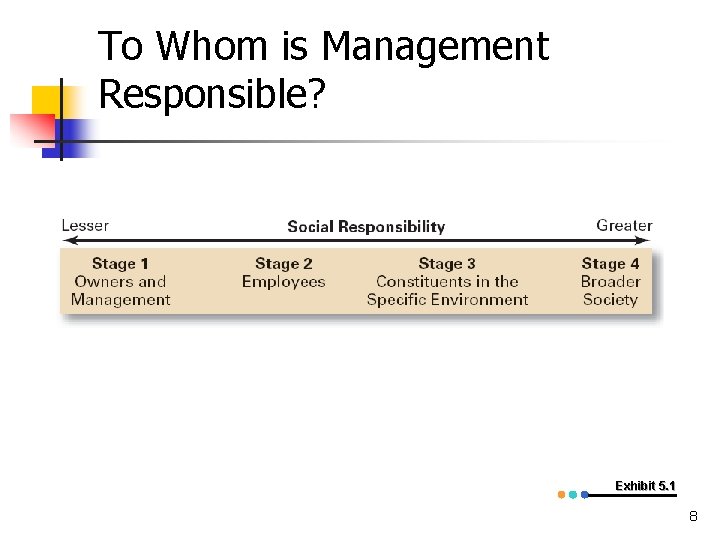
To Whom is Management Responsible? Exhibit 5. 1 8
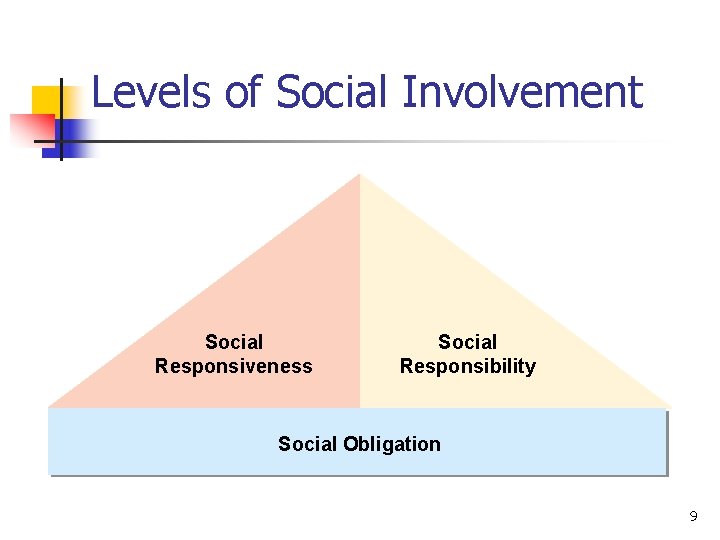
Levels of Social Involvement Social Responsiveness Social Responsibility Social Obligation 9
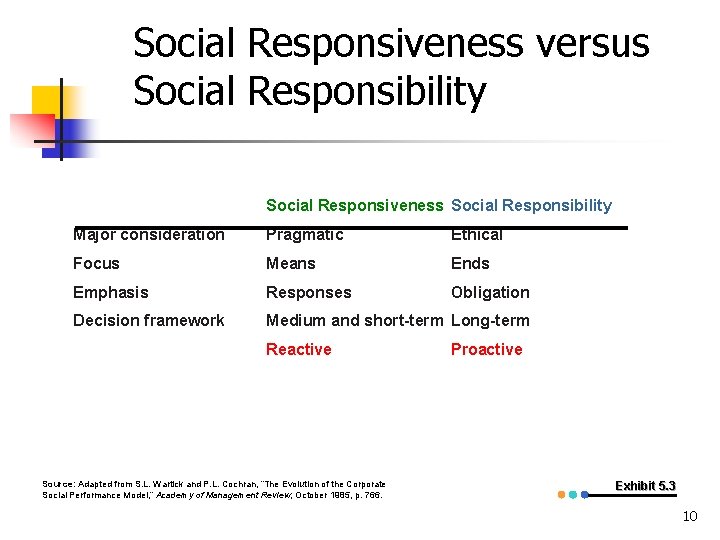
Social Responsiveness versus Social Responsibility Social Responsiveness Social Responsibility Major consideration Pragmatic Ethical Focus Means Ends Emphasis Responses Obligation Decision framework Medium and short-term Long-term Reactive Source: Adapted from S. L. Wartick and P. L. Cochran, “The Evolution of the Corporate Social Performance Model, ” Academy of Management Review, October 1985, p. 766. Proactive Exhibit 5. 3 10
Does Social Responsibility Pay? n n Studies appear to show a positive relationship between social involvement and the economic performance of firms. n But hard to define and measure “social responsibility” n Can take years for SR to pay off n Causality problem – which comes first? A general conclusion is that a firm’s social actions do not harm its long-term performance. 11
Example: HP’s Corporate Objectives l l l l Profit Customers Fields of interest Growth Our people Management Citizenship l “The company strives to honor its obligations to society by being an economic, intellectual, and social asset to each nation and each community in which it operates. The company pledges to make sure that the communities in which it operates are better for its presence. ” 12
The Greening of Management n The recognition of the close link between an organization’s decision and activities and its impact on the natural environment. n Global environmental problems facing managers: n n n Air, water, and soil pollution from toxic wastes Global warming from greenhouse gas emissions Natural resource depletion 13
Values-Based Management n n The Purposes of Shared Values n n n An approach to managing in which managers establish and uphold an organization’s shared values. Serving as guideposts for managerial decisions Shaping employee behavior Influencing the direction of marketing efforts Building team spirit The Bottom Line on Shared Corporate Values n An organization’s values are reflected in the decisions and actions of its employees. 14
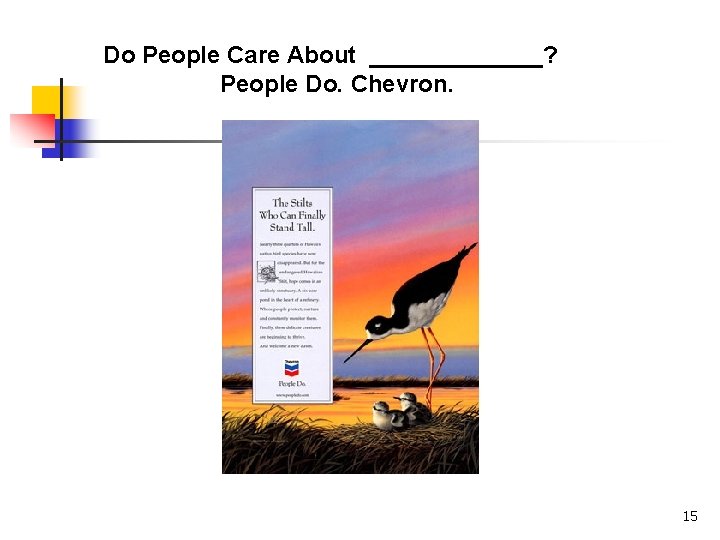
Do People Care About _______? People Do. Chevron. 15
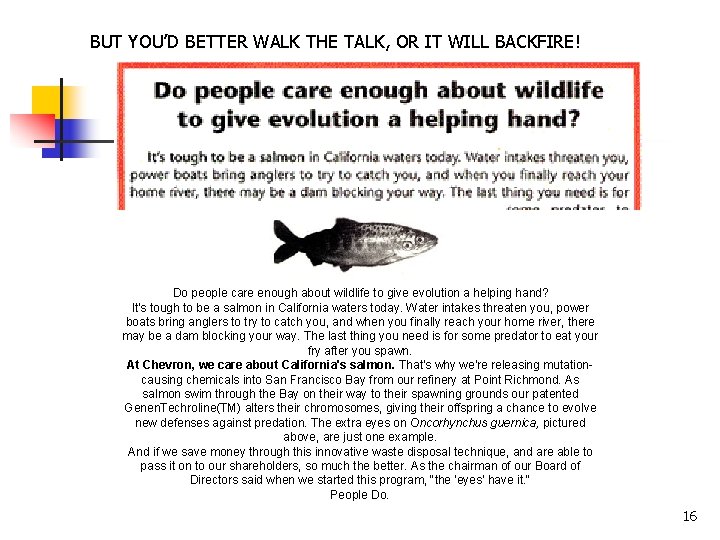
BUT YOU’D BETTER WALK THE TALK, OR IT WILL BACKFIRE! Do people care enough about wildlife to give evolution a helping hand? It's tough to be a salmon in California waters today. Water intakes threaten you, power boats bring anglers to try to catch you, and when you finally reach your home river, there may be a dam blocking your way. The last thing you need is for some predator to eat your fry after you spawn. At Chevron, we care about California's salmon. That's why we're releasing mutationcausing chemicals into San Francisco Bay from our refinery at Point Richmond. As salmon swim through the Bay on their way to their spawning grounds our patented Genen. Techroline(TM) alters their chromosomes, giving their offspring a chance to evolve new defenses against predation. The extra eyes on Oncorhynchus guernica, pictured above, are just one example. And if we save money through this innovative waste disposal technique, and are able to pass it on to our shareholders, so much the better. As the chairman of our Board of Directors said when we started this program, "the 'eyes' have it. " People Do. 16
Suggestions for Creating a Good Corporate Values Statement n n Involve the whole company Let individual departments customize values Expect and accept employee resistance Keep it short and avoid trivialities n Leave out religious references n Challenge it and live it 17
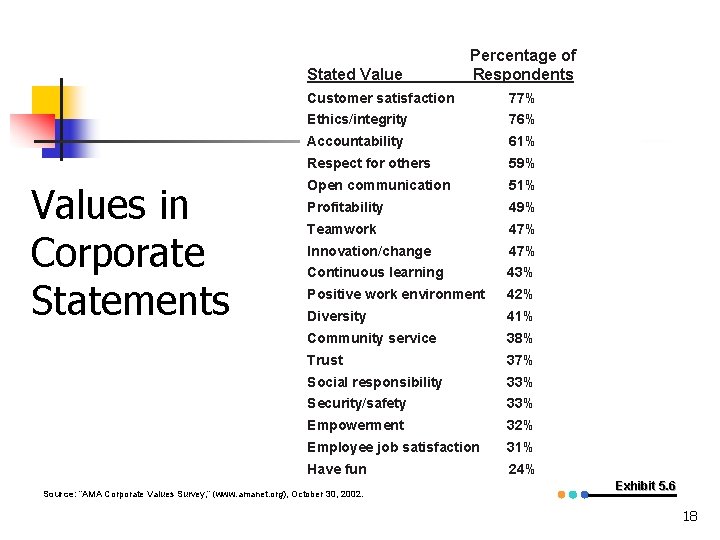
Stated Values in Corporate Statements Percentage of Respondents Customer satisfaction 77% Ethics/integrity 76% Accountability 61% Respect for others 59% Open communication 51% Profitability 49% Teamwork 47% Innovation/change 47% Continuous learning 43% Positive work environment 42% Diversity 41% Community service 38% Trust 37% Social responsibility 33% Security/safety 33% Empowerment 32% Employee job satisfaction 31% Have fun 24% Source: “AMA Corporate Values Survey, ” (www. amanet. org), October 30, 2002. Exhibit 5. 6 18
Managerial Ethics n Ethics Defined n n The rules and principles that define right and wrong conduct. Four Views of Ethics n n The The utilitarian view rights view theory of justice view integrative social contracts theory 19
Utilitarian View n Ethical decisions are made solely on the basis of their outcomes or consequences such that the greatest good is provided for the greatest number (for the company involved). n Encourages efficiency and productivity and is consistent with the goal of profit maximization. 20
Rights View n Concerned with respecting and protecting individual liberties and privacy n Seeks to protect individual rights of conscience, free speech, life and safety, and due process 21
Theory of Justice View n Organizational rules are enforced fairly and impartially and follow all legal rules and regulations n Protects the interests of underrepresented stakeholders and the rights of employees 22
Integrative Social Contracts Theory n Ethical decisions should be based on existing ethical norms in industries and communities in order to determine what constitutes right and wrong. n Based on integration of the general social contract and the specific contract between community members. 23
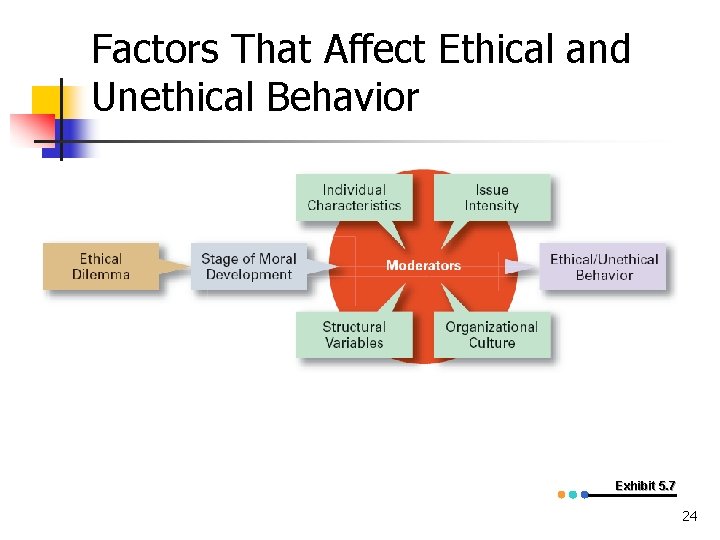
Factors That Affect Ethical and Unethical Behavior Exhibit 5. 7 24
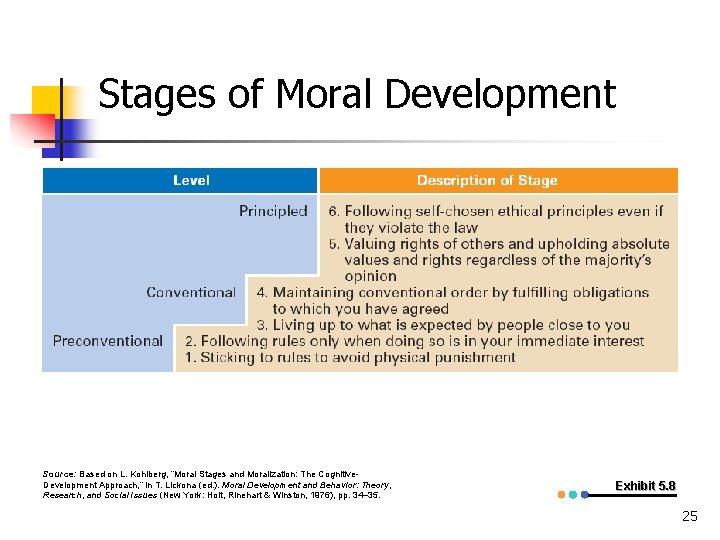
Stages of Moral Development Source: Based on L. Kohlberg, “Moral Stages and Moralization: The Cognitive. Development Approach, ” in T. Lickona (ed. ). Moral Development and Behavior: Theory, Research, and Social Issues (New York: Holt, Rinehart & Winston, 1976), pp. 34– 35. Exhibit 5. 8 25
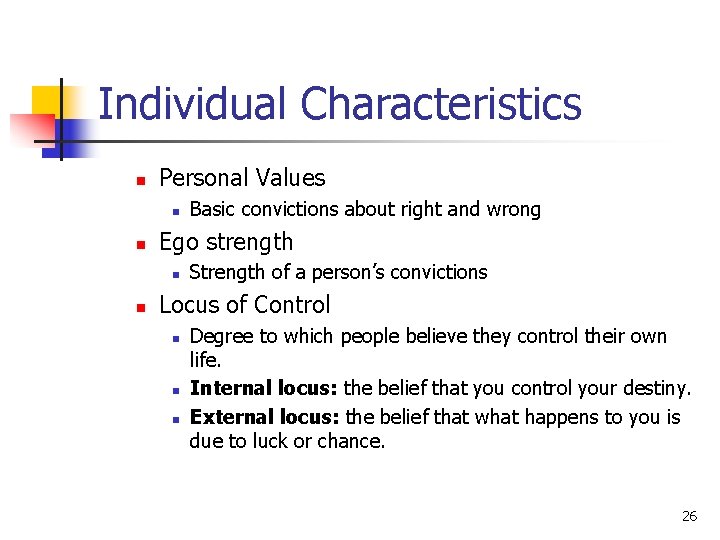
Individual Characteristics n Personal Values n n Ego strength n n Basic convictions about right and wrong Strength of a person’s convictions Locus of Control n n n Degree to which people believe they control their own life. Internal locus: the belief that you control your destiny. External locus: the belief that what happens to you is due to luck or chance. 26
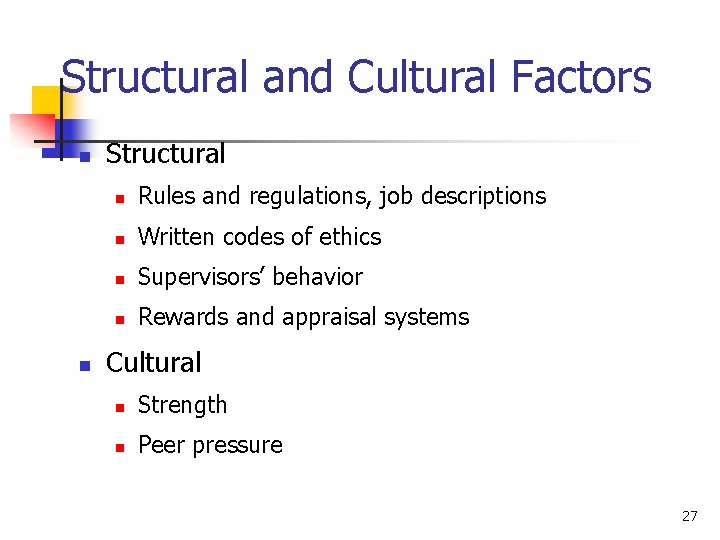
Structural and Cultural Factors n n Structural n Rules and regulations, job descriptions n Written codes of ethics n Supervisors’ behavior n Rewards and appraisal systems Cultural n Strength n Peer pressure 27
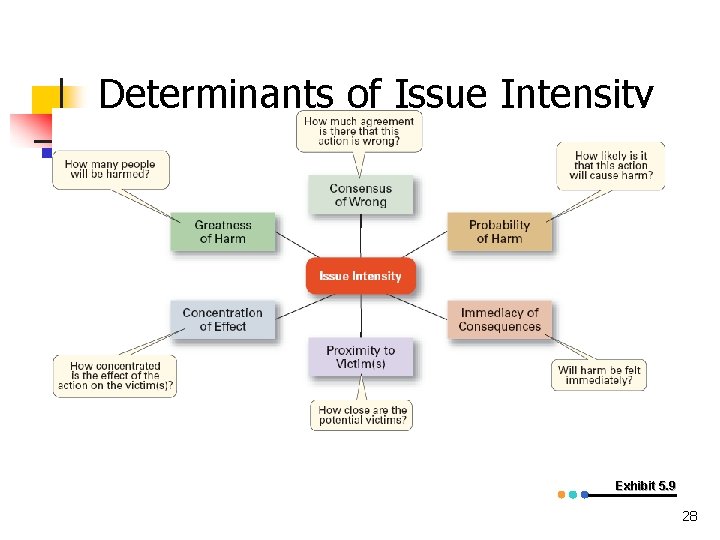
Determinants of Issue Intensity Exhibit 5. 9 28
- Slides: 28