
Chapter 5 Social Contexts of Second Language Acquisition
- Slides: 36
+ Chapter #5: “Social Contexts of Second Language Acquisition” By: Mahlee Laird & Vicente Almazan Jr.
+ Discussing (SLA) Through Social and Cultural Learning The relationship of (SLA) to social and cultural learning differs greatly with circumstances. n What is being learned in the process of (SLA) from a social perspective n How it is being learned n Why some learners are more successful than others.
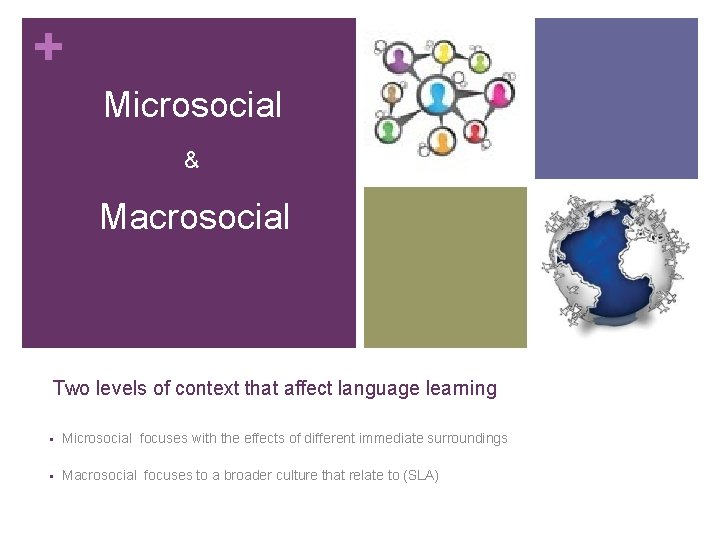
+ §Microsocial §& § Macrosocial Two levels of context that affect language learning § Microsocial focuses with the effects of different immediate surroundings § Macrosocial focuses to a broader culture that relate to (SLA)
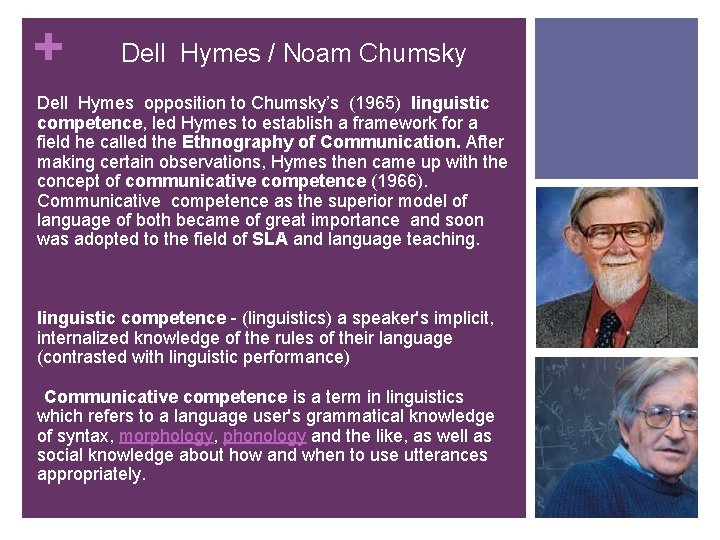
+ Dell Hymes / Noam Chumsky Dell Hymes opposition to Chumsky’s (1965) linguistic competence, led Hymes to establish a framework for a field he called the Ethnography of Communication. After making certain observations, Hymes then came up with the concept of communicative competence (1966). Communicative competence as the superior model of language of both became of great importance and soon was adopted to the field of SLA and language teaching. linguistic competence - (linguistics) a speaker's implicit, internalized knowledge of the rules of their language (contrasted with linguistic performance) §Communicative competence is a term in linguistics which refers to a language user's grammatical knowledge of syntax, morphology, phonology and the like, as well as social knowledge about how and when to use utterances appropriately.
+ Communicative Competence n Communicative competence is, “…what a speaker needs to know to communicate appropriately within a particular language community…”(Saville-Troike, 2012, p. 106). n It’s Involving the social and cultural knowledge, speakers are presumed to have, which enables them to use and interpret linguistic forms. n Success in attaining that knowledge, depend on the social context within which he or she learns and is using the language.
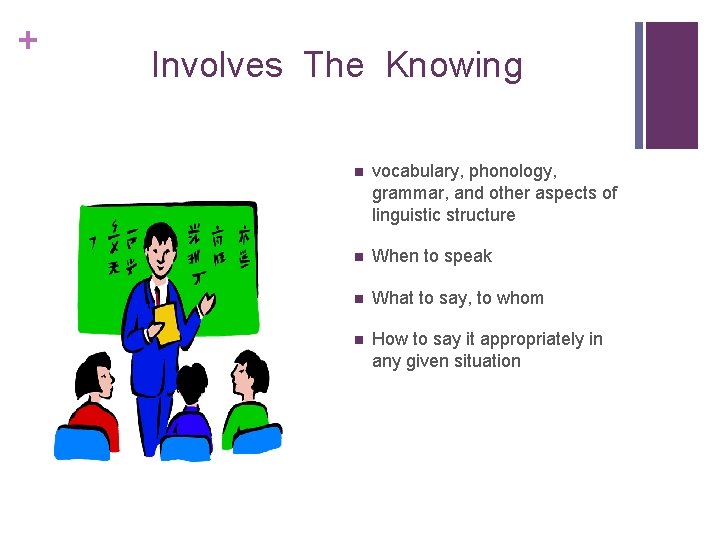
+ Involves The Knowing n vocabulary, phonology, grammar, and other aspects of linguistic structure n When to speak n What to say, to whom n How to say it appropriately in any given situation
+ Learning of Language (Communicative Competence) (SL) n Often requires considerable knowledge of the larger community’s culture and social structure n Learners may be selective in deciding which elements they want to adopt as part of their own identity (FL) n Learn language within the context of their own native language n Less interaction with members of the language community n Have little opportunity (or need) to participate in the (FL) society (AL) n Learned in a context where it will function for political, or technical purposes, limited to these type of social domains n Usually for face to face interaction (examples: use in international trades, political meetings, economic conferences
+ Language Community A group of people who share knowledge of a common language at least to some extent. Multilingual / Monolingual Non Native / Native Speaker (Communicative Competence)
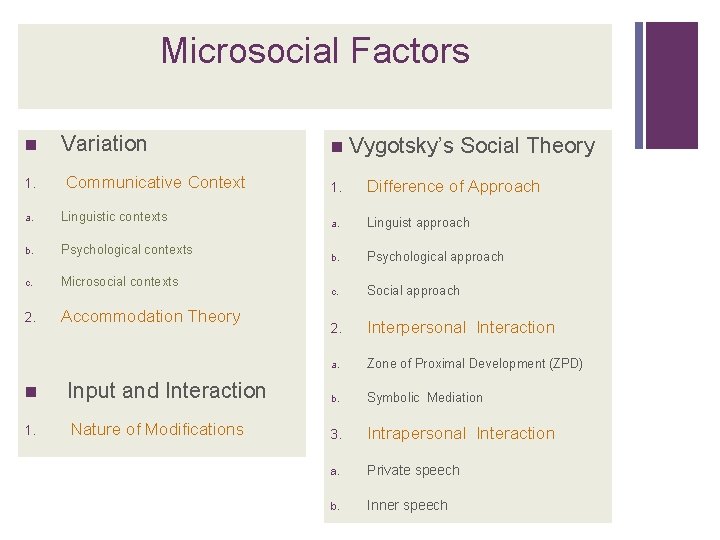
+ n 1. Microsocial Factors Variation Communicative Context a. Linguistic contexts b. Psychological contexts c. Microsocial contexts 2. Accommodation Theory n Input and Interaction 1. Nature of Modifications n Vygotsky’s Social Theory 1. Difference of Approach a. Linguist approach b. Psychological approach c. Social approach 2. Interpersonal Interaction a. Zone of Proximal Development (ZPD) b. Symbolic Mediation 3. Intrapersonal Interaction a. Private speech b. Inner speech
+ Variation – In Learner Language n Being able to use variable features : Multiple linguistic forms which are systematically or predictably used by different speakers of a language, or by the same speakers at different times, with the same meaning or function.
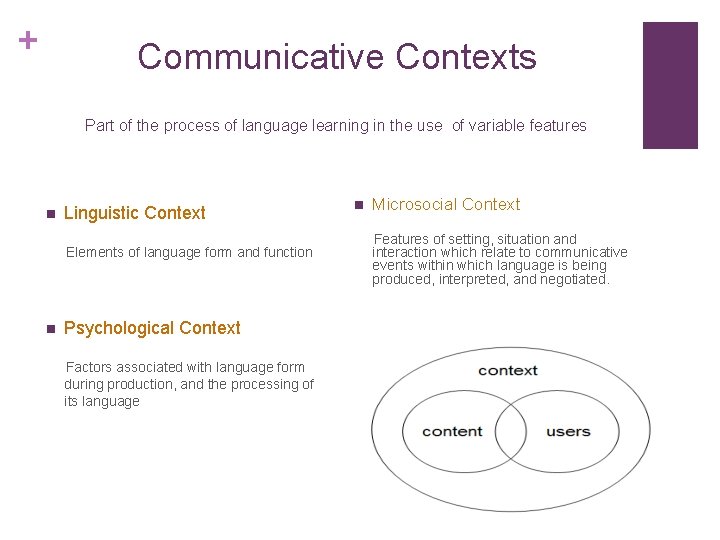
+ Communicative Contexts Part of the process of language learning in the use of variable features n Linguistic Context Elements of language form and function n Psychological Context Factors associated with language form during production, and the processing of its language n Microsocial Context Features of setting, situation and interaction which relate to communicative events within which language is being produced, interpreted, and negotiated.
+ Accommodation Theory A framework of study based on the effect of microsocial context n Speakers (usually unconsciously) change their pronunciation, grammatical complexity of sentences they use to sound more like whomever they are talking to. n Sociophonetics, studies of the social significance of variation in pronunciation
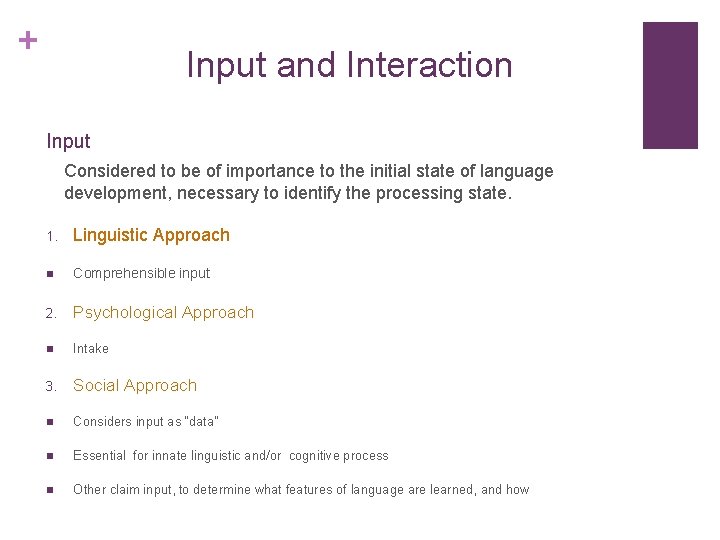
+ Input and Interaction Input Considered to be of importance to the initial state of language development, necessary to identify the processing state. 1. Linguistic Approach n Comprehensible input 2. Psychological Approach n Intake 3. Social Approach n Considers input as “data” n Essential for innate linguistic and/or cognitive process n Other claim input, to determine what features of language are learned, and how
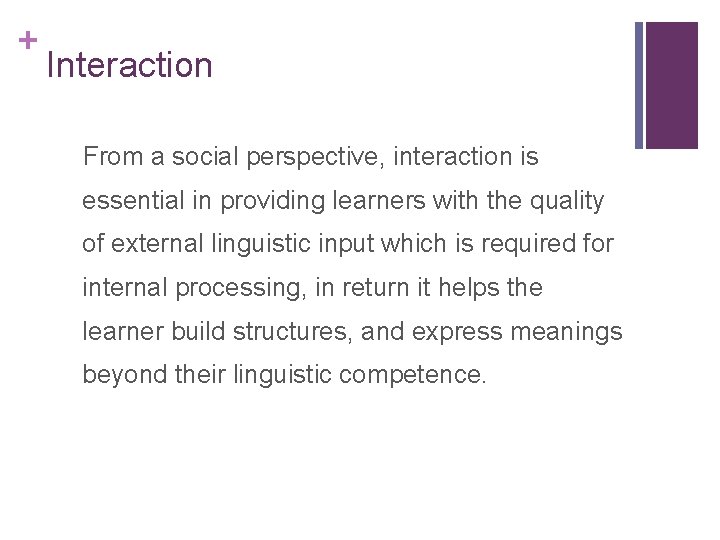
+ Interaction From a social perspective, interaction is essential in providing learners with the quality of external linguistic input which is required for internal processing, in return it helps the learner build structures, and express meanings beyond their linguistic competence.
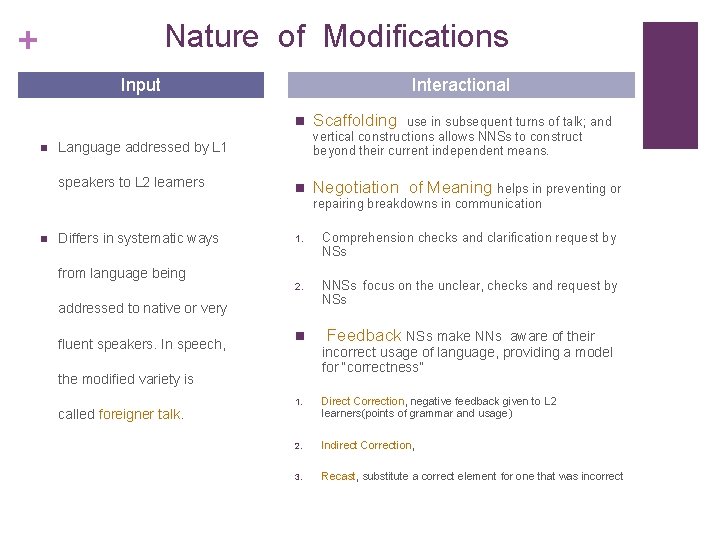
Nature of Modifications + Input n Interactional n Scaffolding n Negotiation of Meaning helps in preventing or Language addressed by L 1 speakers to L 2 learners use in subsequent turns of talk; and vertical constructions allows NNSs to construct beyond their current independent means. repairing breakdowns in communication n Differs in systematic ways from language being 1. Comprehension checks and clarification request by NSs 2. NNSs focus on the unclear, checks and request by NSs addressed to native or very fluent speakers. In speech, n incorrect usage of language, providing a model for “correctness” the modified variety is called foreigner talk. Feedback NSs make NNs aware of their 1. Direct Correction, negative feedback given to L 2 learners(points of grammar and usage) 2. Indirect Correction, 3. Recast, substitute a correct element for one that was incorrect
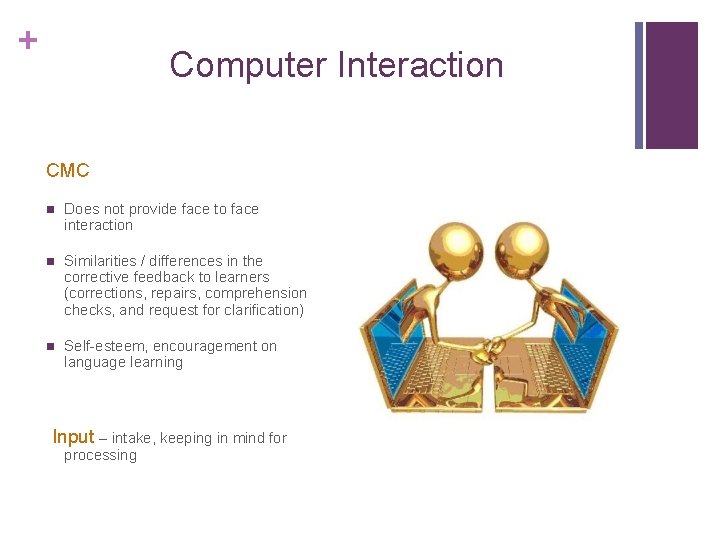
+ Computer Interaction CMC n Does not provide face to face interaction n Similarities / differences in the corrective feedback to learners (corrections, repairs, comprehension checks, and request for clarification) n Self-esteem, encouragement on language learning Input – intake, keeping in mind for processing
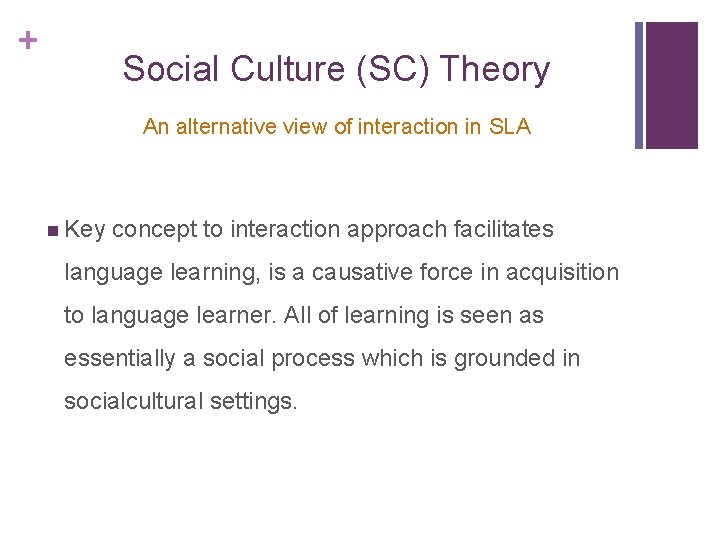
+ Social Culture (SC) Theory An alternative view of interaction in SLA n Key concept to interaction approach facilitates language learning, is a causative force in acquisition to language learner. All of learning is seen as essentially a social process which is grounded in socialcultural settings.
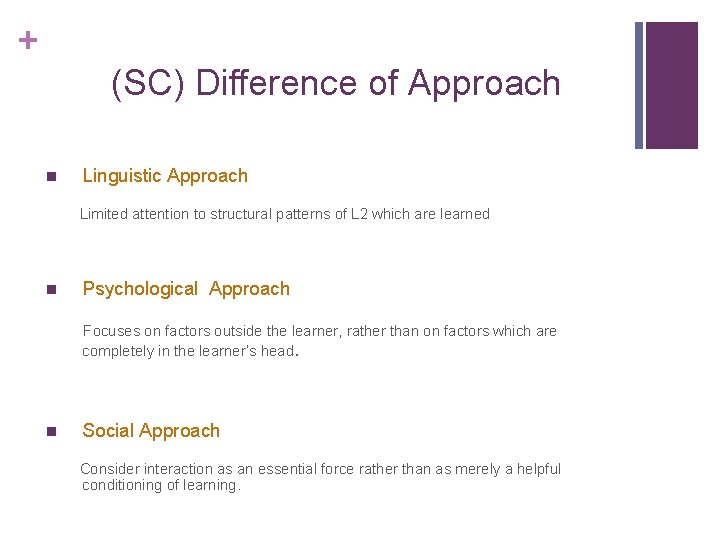
+ (SC) Difference of Approach n Linguistic Approach Limited attention to structural patterns of L 2 which are learned n Psychological Approach Focuses on factors outside the learner, rather than on factors which are completely in the learner’s head. n Social Approach Consider interaction as an essential force rather than as merely a helpful conditioning of learning.
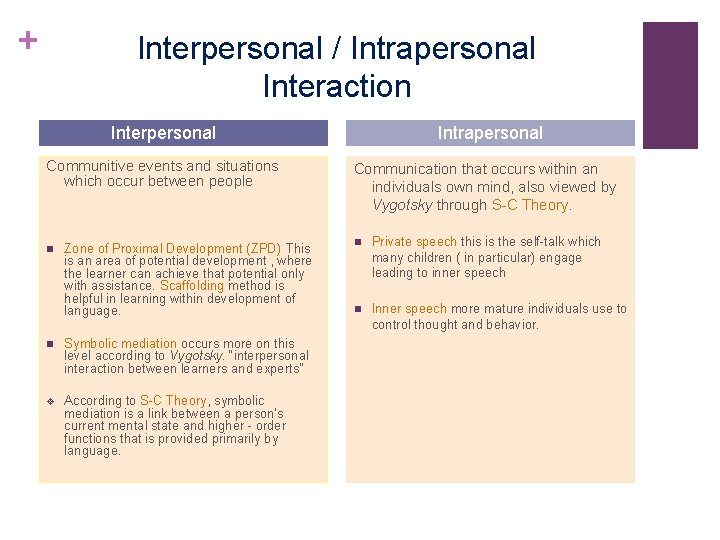
+ Interpersonal / Intrapersonal Interaction Interpersonal Communitive events and situations which occur between people n Zone of Proximal Development (ZPD) This is an area of potential development , where the learner can achieve that potential only with assistance. Scaffolding method is helpful in learning within development of language. n Symbolic mediation occurs more on this level according to Vygotsky. “interpersonal interaction between learners and experts” v According to S-C Theory, symbolic mediation is a link between a person’s current mental state and higher - order functions that is provided primarily by language. Intrapersonal Communication that occurs within an individuals own mind, also viewed by Vygotsky through S-C Theory. n Private speech this is the self-talk which many children ( in particular) engage leading to inner speech n Inner speech more mature individuals use to control thought and behavior.
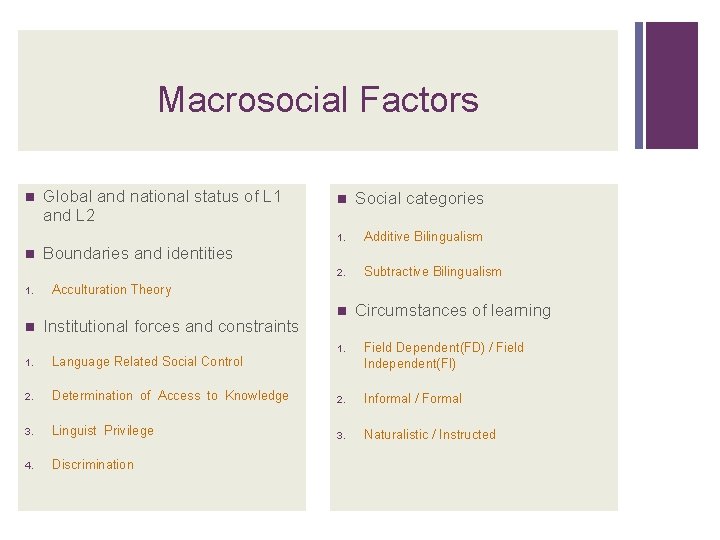
+ Macrosocial Factors n n 1. n Global and national status of L 1 and L 2 n Social categories 1. Additive Bilingualism 2. Subtractive Bilingualism Boundaries and identities Acculturation Theory Institutional forces and constraints n Circumstances of learning 1. Field Dependent(FD) / Field Independent(FI) Determination of Access to Knowledge 2. Informal / Formal 3. Linguist Privilege 3. Naturalistic / Instructed 4. Discrimination 1. Language Related Social Control 2.
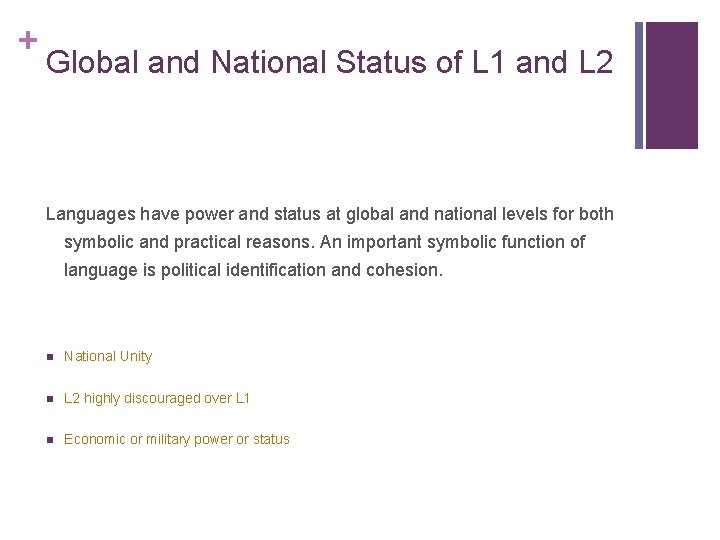
+ Global and National Status of L 1 and L 2 Languages have power and status at global and national levels for both symbolic and practical reasons. An important symbolic function of language is political identification and cohesion. n National Unity n L 2 highly discouraged over L 1 n Economic or military power or status
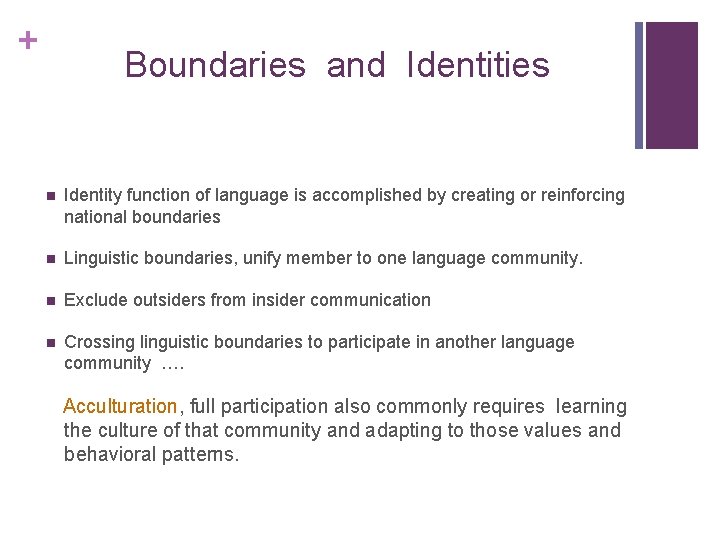
+ Boundaries and Identities n Identity function of language is accomplished by creating or reinforcing national boundaries n Linguistic boundaries, unify member to one language community. n Exclude outsiders from insider communication n Crossing linguistic boundaries to participate in another language community …. Acculturation, full participation also commonly requires learning the culture of that community and adapting to those values and behavioral patterns.
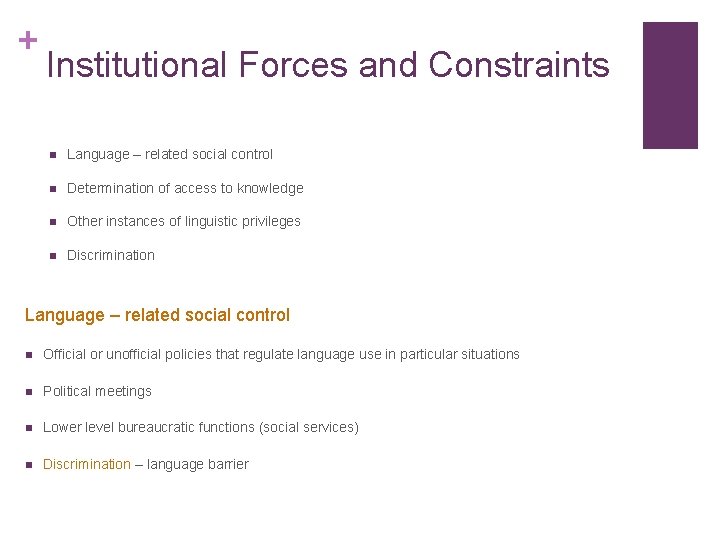
+ Institutional Forces and Constraints n Language – related social control n Determination of access to knowledge n Other instances of linguistic privileges n Discrimination Language – related social control n Official or unofficial policies that regulate language use in particular situations n Political meetings n Lower level bureaucratic functions (social services) n Discrimination – language barrier
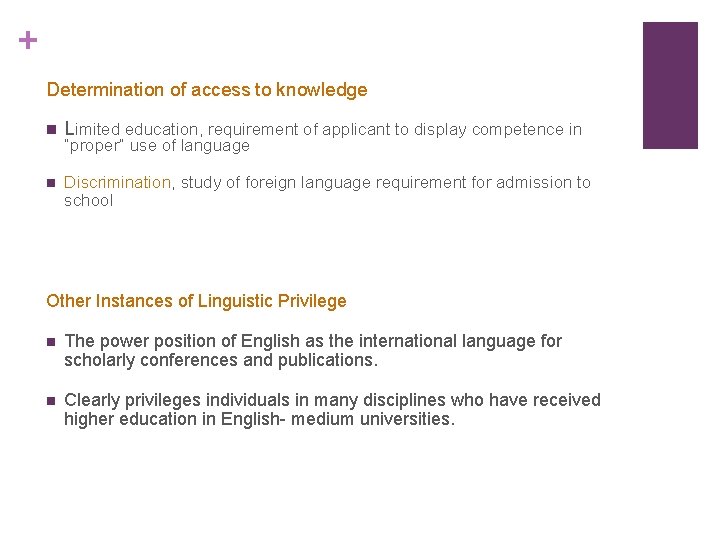
+ Determination of access to knowledge n Limited education, requirement of applicant to display competence in n Discrimination, study of foreign language requirement for admission to school “proper” use of language Other Instances of Linguistic Privilege n The power position of English as the international language for scholarly conferences and publications. n Clearly privileges individuals in many disciplines who have received higher education in English- medium universities.
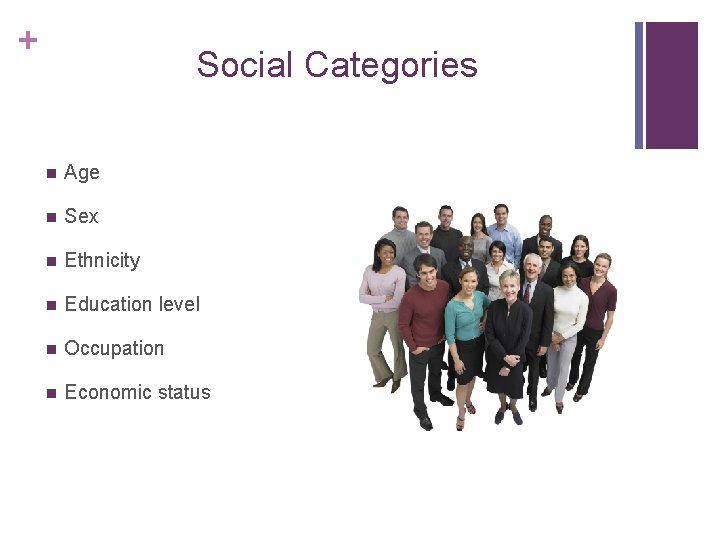
+ Social Categories n Age n Sex n Ethnicity n Education level n Occupation n Economic status
+ Circumstances of Learning n Field – Dependent (FD) / Field Independent (FI) n Informal / Formal n Naturalistic / Instructed Field – Dependent (FD) / Field Independent (FI) n Field – Dependent (FD) style appearance to be related to a more cooperative settings of rural residence (related to lower economic categories) n Field – Independent (FI) more competitive urban circumstances(more affluent economic categories)
+ Informal / Naturalistic n Learning generally takes place in settings where people contact and need to interact with speakers of another language n May be because they live in a multilingual society n Circle of family and friends is multilingual n Life style involves international travel and residence for business or pleasure Formal / Instructed n Learning generally takes place in schools, social institutions that are established in accord with the needs, beliefs, values and customs of their cultural settings. n L 2 learners who majority are L 1 speakers often have access only to foreign language programs which offer the L 2 as an academic subject and give little opportunity for students to develop full communicative competence.
+ Computer Mediated Communication (CMC) n A computer based virtual community, provides an artificial environment to L 2 learners. Communication Complexities § Language Community § Language Function § Language Form
+ Language Community n Limited to students, all being learners in a common L 2, all being multilingual to some degree n Members may differ greatly in L 1 identity, and level of L 2 proficiency n Category of expert membership, usually teachers and native L 2 speakers supporting and making observation of language performance
+ Language Function n Uses a virtual setting always having some metalinguistic element (using language to learn language) n Express opinions n Share information n Collaboration on construction of texts n An increase solidarity with other learners Teacher Use § To enrich and diversify learning experiences § Evaluate student progress § Adjust level and focus of classroom instruction
+ Language Form n It may be oral or written n Involve synchronous or delay interaction n Call for colloquial or varieties of target language
+ Questions to Chapter Five 1. Name the social functions of L 1 and L 2 learning, explain how they differ. 2. According to the S-C Theory, through our intrapersonal interactions we tend to use inner speech, give an example of inner speech and how would it be of an advantage or disadvantage in your own opinion.
+ Key Terms n Communicative competence: A basic tenet of sociolinguistics defined as “what a speaker needs to know to communicate appropriately within a particular language community” (Saville-Troike 2003). n Language community: A group of people who share knowledge of a common language at least to some extent. n Foreigner talk: Speech from L 1 speakers addressed to L 2 learners that differs in systematic ways from language addressed to native or very fluent speakers. n Direct correction: Explicit statements about incorrect language use. n Indirect correction: Implicit feedback about inappropriate language use, such as clarification requests when the listener has actually understood an utterance. n Interaction Hypothesis: The claim that modifications and collaborative efforts which take place in social interaction facilitate SLA because they contribute to the accessibility of input for mental processing.
+ Key Terms Continued… n Symbolic mediation: A link between a person’s current mental state and higher order functions that is provided primarily by language; considered the usual route to learning (of language, and of learning in general). Part of Vygotsky’s Sociocultural Theory. n Interpersonal interaction: Communicative events and situations that occur between people. n Zone of Proximal Development (ZPD): An area of potential development where the learner can only achieve that potential with assistance. Part of Vygotsky’s Sociocultural Theory. n Scaffolding: Verbal guidance which an expert provides to help a learner perform any specific task, or the verbal collaboration of peers to perform a task which would be to difficult for any one of them in individual performance. n Intrapersonal interaction: Communication that occurs within an individual’s own mind, viewed by Vygotsky as a sociocultural phenomenon.
+ Key Terms Continued… n Acculturation: Learning the culture of the L 2 community and adapting to those values and behavior patterns. n Additive bilingualism: The result of SLA in social contexts where members of a dominant group learn the language of a minority without threat to their L 1 competence or to their ethnic identity. n Subtractive bilingualism: The result of SLA in social contexts where members of a minority group learn the dominant language as L 2 and are more likely to experience some loss of ethnic identity and attrition of L 1 skills.
+ Reference n Saville-Troike, M. (2012). Introducing second language acquisition. (2 nd ed. , pp. 105 -140). New York, NY: Cambridge University Press.