
Chapter 5 Sinusoidal Input 1 Chapter 5 Processes
- Slides: 44
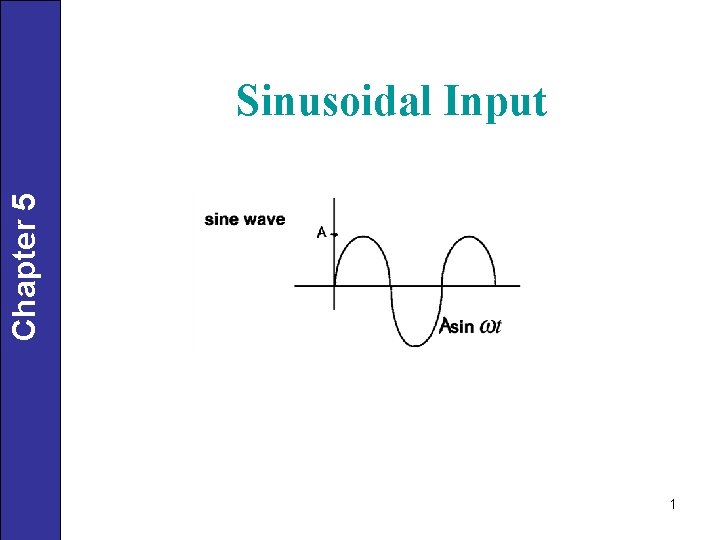
Chapter 5 Sinusoidal Input 1
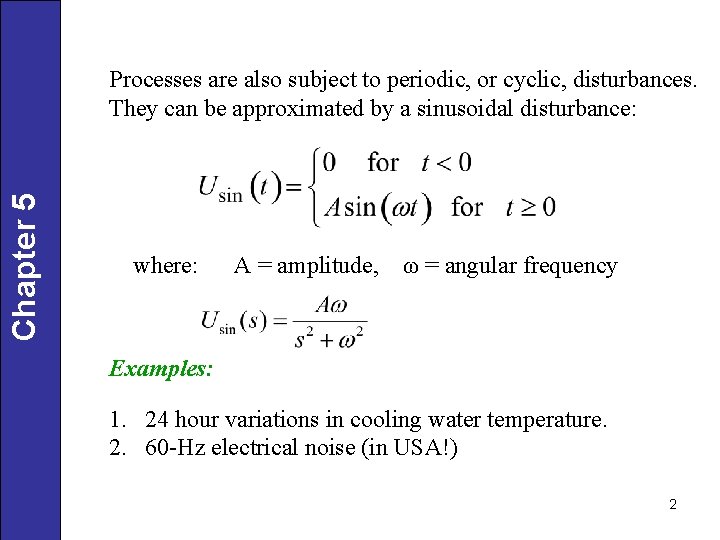
Chapter 5 Processes are also subject to periodic, or cyclic, disturbances. They can be approximated by a sinusoidal disturbance: where: A = amplitude, ω = angular frequency Examples: 1. 24 hour variations in cooling water temperature. 2. 60 -Hz electrical noise (in USA!) 2
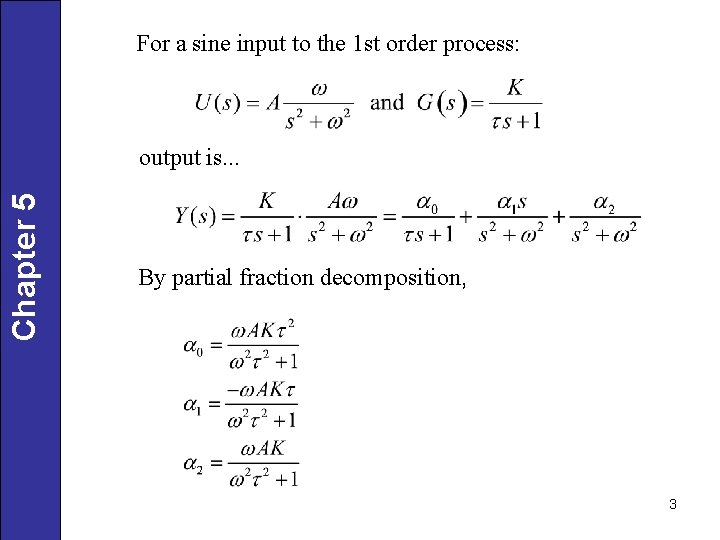
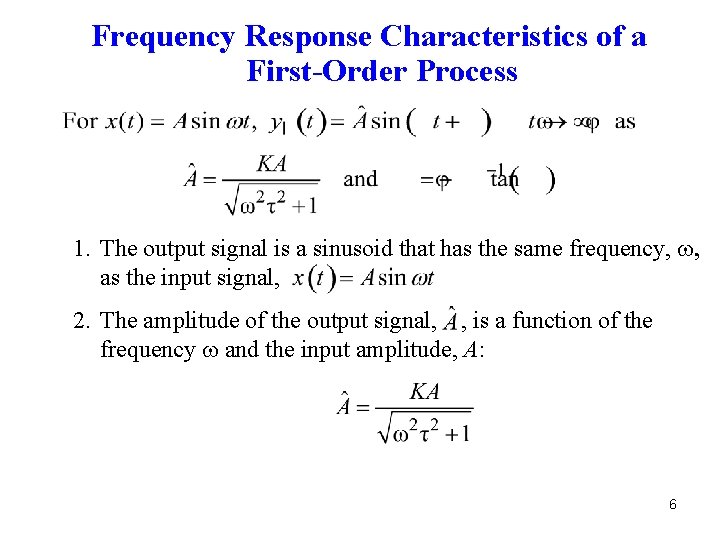
For a sine input to the 1 st order process: Chapter 5 output is. . . By partial fraction decomposition, 3
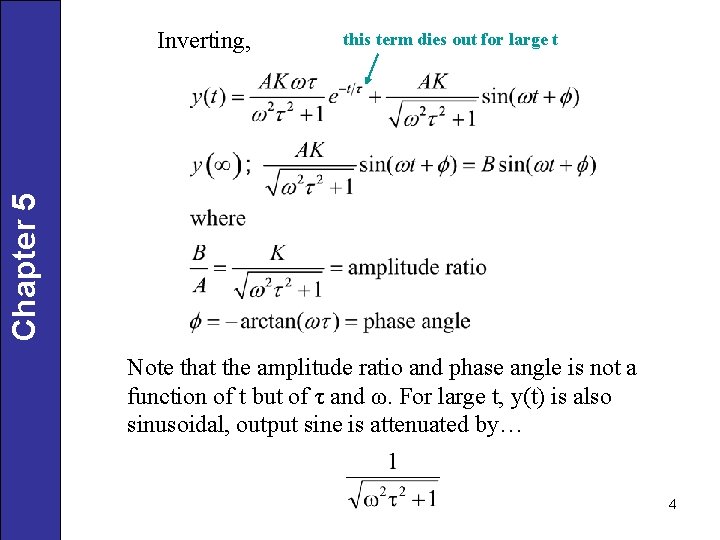
this term dies out for large t Chapter 5 Inverting, Note that the amplitude ratio and phase angle is not a function of t but of τ and ω. For large t, y(t) is also sinusoidal, output sine is attenuated by… 4
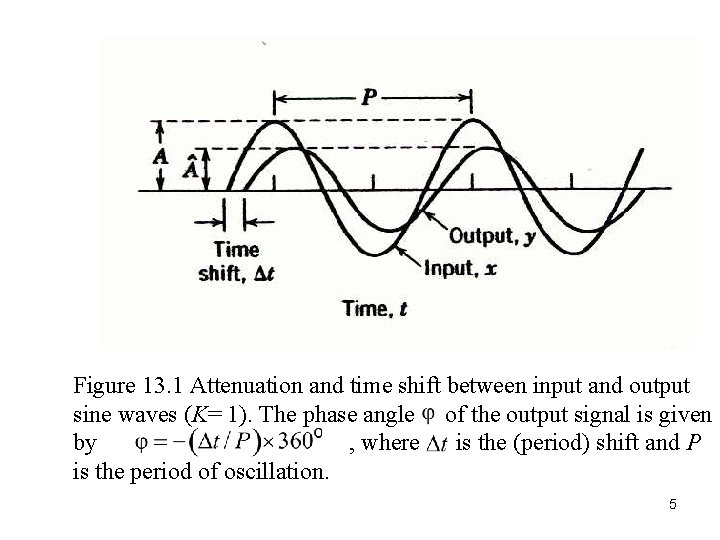
Figure 13. 1 Attenuation and time shift between input and output sine waves (K= 1). The phase angle of the output signal is given by , where is the (period) shift and P is the period of oscillation. 5
Frequency Response Characteristics of a First-Order Process 1. The output signal is a sinusoid that has the same frequency, w, as the input signal, 2. The amplitude of the output signal, , is a function of the frequency w and the input amplitude, A: 6
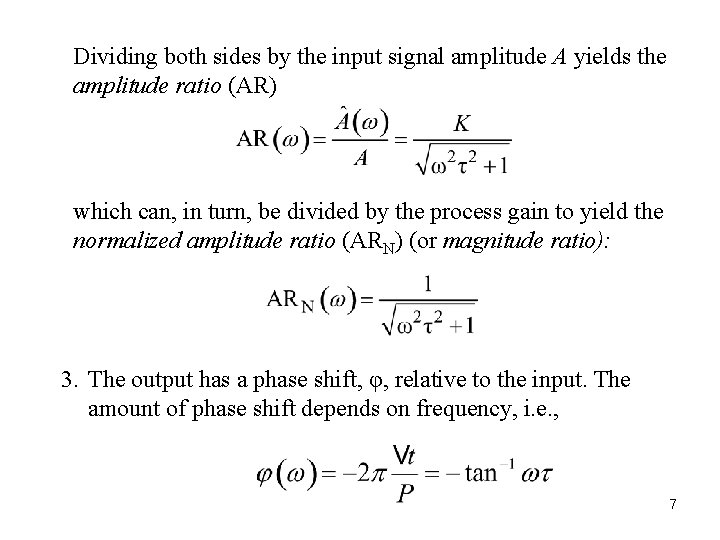
Dividing both sides by the input signal amplitude A yields the amplitude ratio (AR) which can, in turn, be divided by the process gain to yield the normalized amplitude ratio (ARN) (or magnitude ratio): 3. The output has a phase shift, φ, relative to the input. The amount of phase shift depends on frequency, i. e. , 7
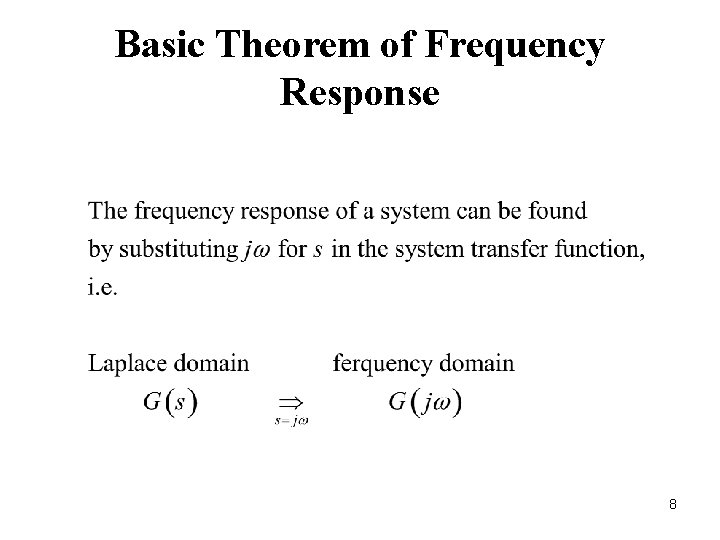
Basic Theorem of Frequency Response 8
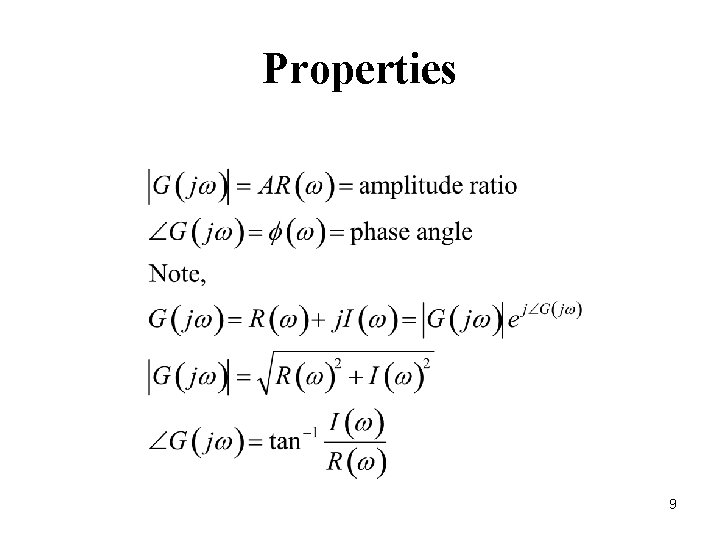
Properties 9
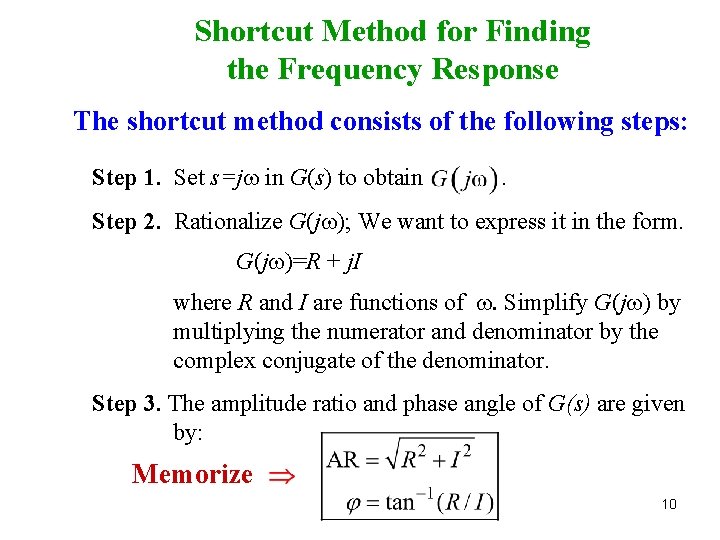
Shortcut Method for Finding the Frequency Response The shortcut method consists of the following steps: Step 1. Set s=jw in G(s) to obtain . Step 2. Rationalize G(jw); We want to express it in the form. G(jw)=R + j. I where R and I are functions of w. Simplify G(jw) by multiplying the numerator and denominator by the complex conjugate of the denominator. Step 3. The amplitude ratio and phase angle of G(s) are given by: Memorize 10
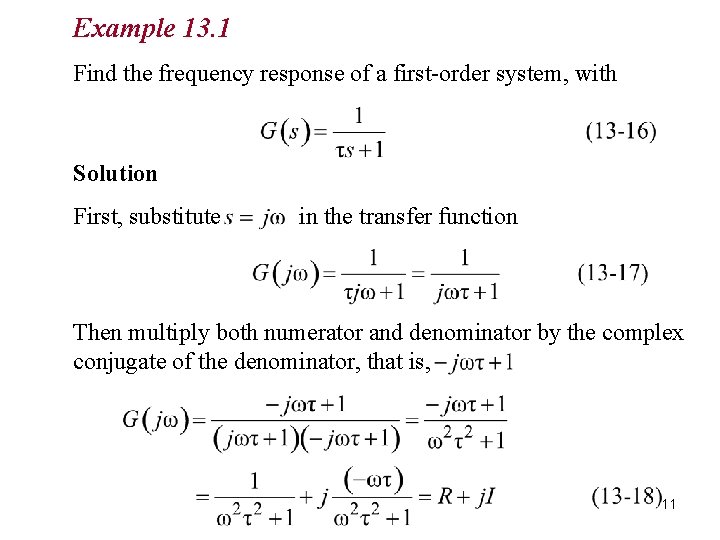
Example 13. 1 Find the frequency response of a first-order system, with Solution First, substitute in the transfer function Then multiply both numerator and denominator by the complex conjugate of the denominator, that is, 11
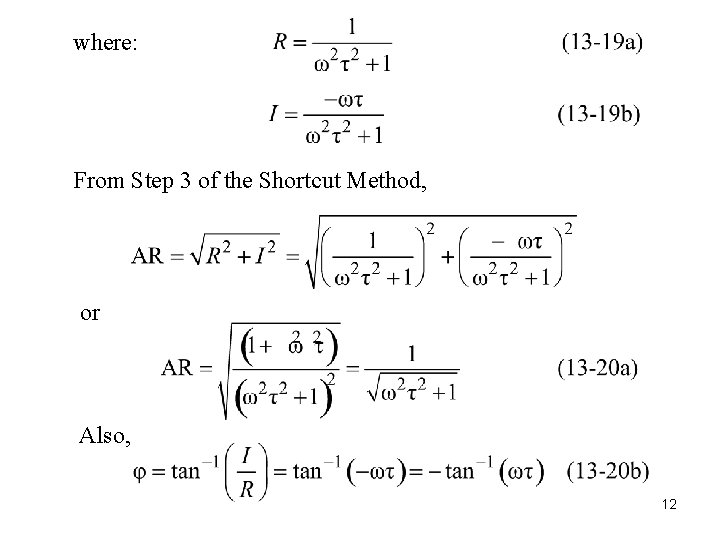
where: From Step 3 of the Shortcut Method, or Also, 12
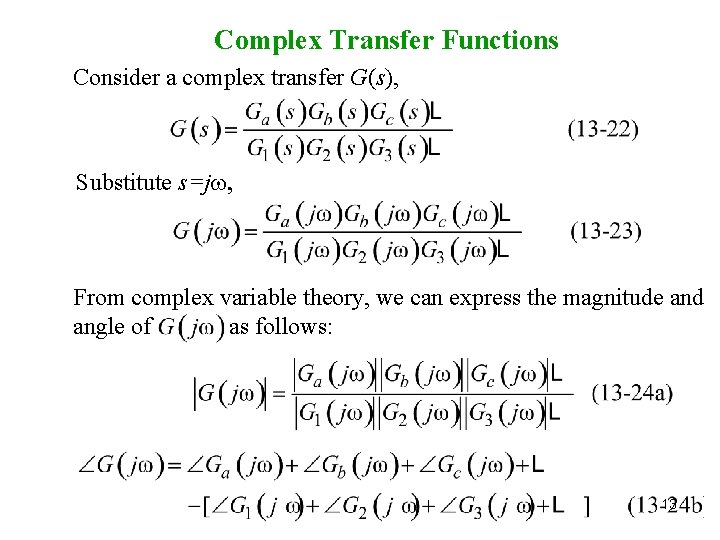
Complex Transfer Functions Consider a complex transfer G(s), Substitute s=jw, From complex variable theory, we can express the magnitude and angle of as follows: 13
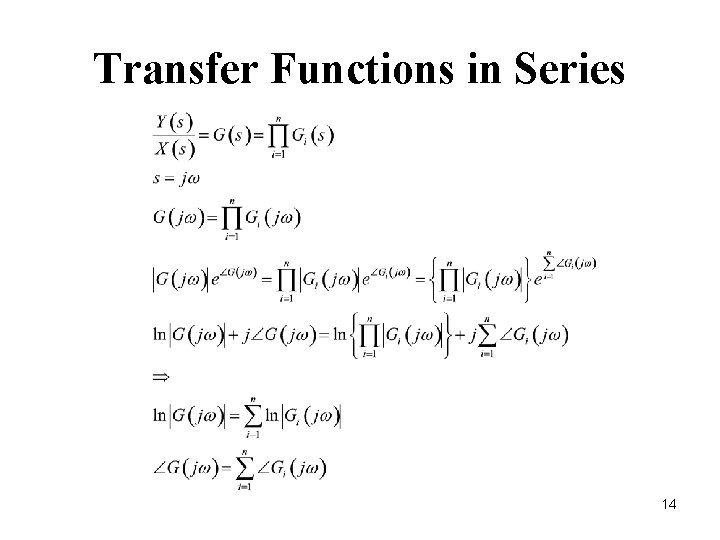
Transfer Functions in Series 14
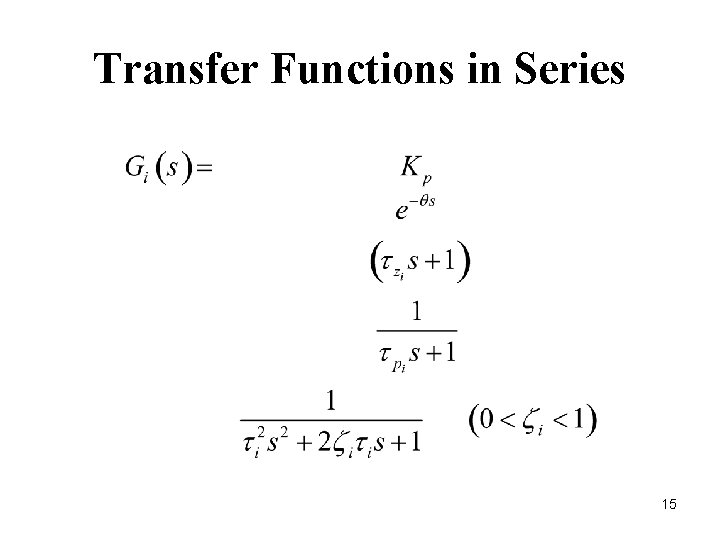
Transfer Functions in Series 15
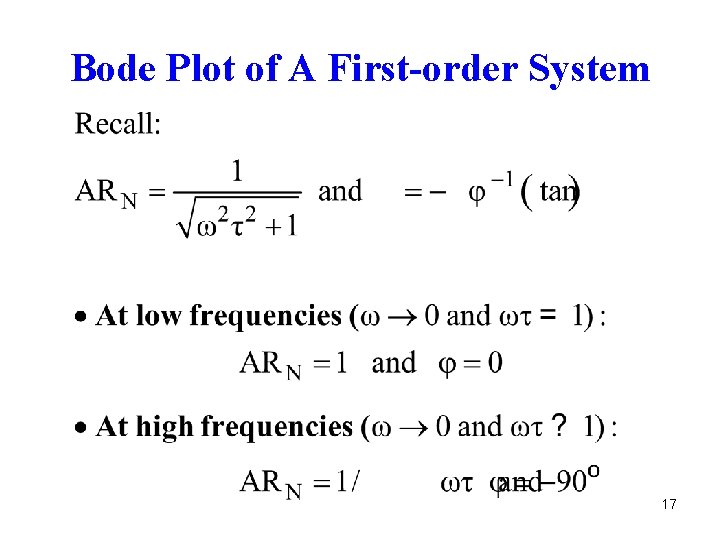
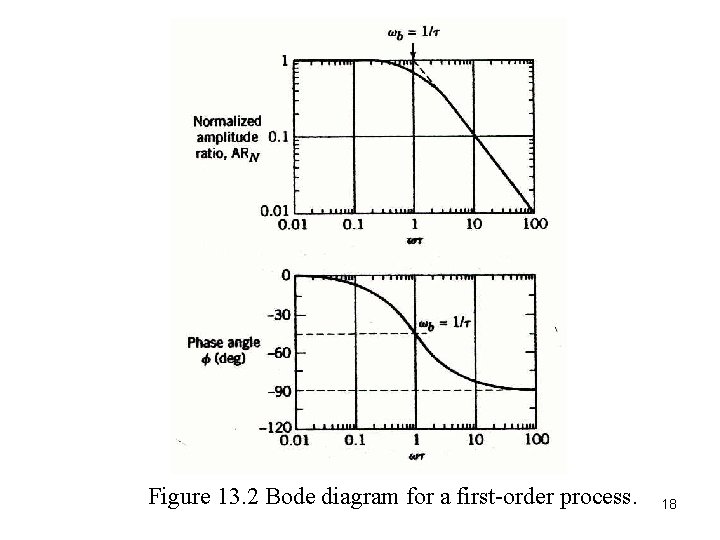
Bode Diagrams • A special graph, called the Bode diagram or Bode plot, provides a convenient display of the frequency response characteristics of a transfer function model. It consists of plots of AR and phase angle as a function of frequency. • Ordinarily, frequency is expressed in units of radians/time. 16
Bode Plot of A First-order System 17
Figure 13. 2 Bode diagram for a first-order process. 18
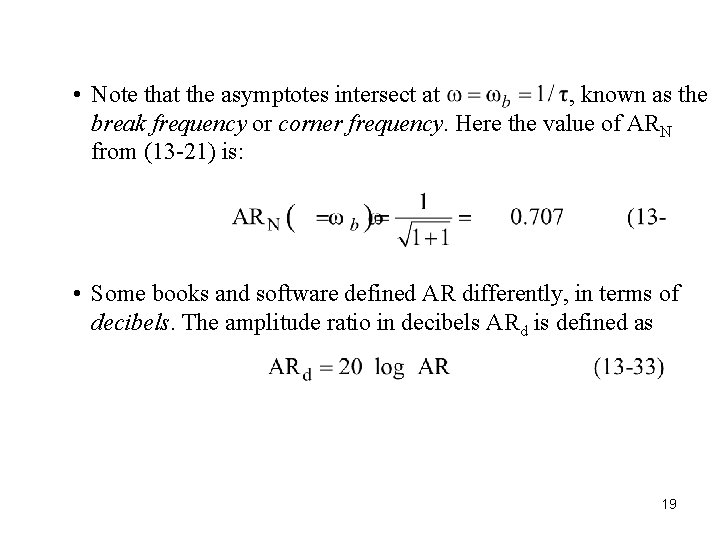
• Note that the asymptotes intersect at , known as the break frequency or corner frequency. Here the value of ARN from (13 -21) is: • Some books and software defined AR differently, in terms of decibels. The amplitude ratio in decibels ARd is defined as 19
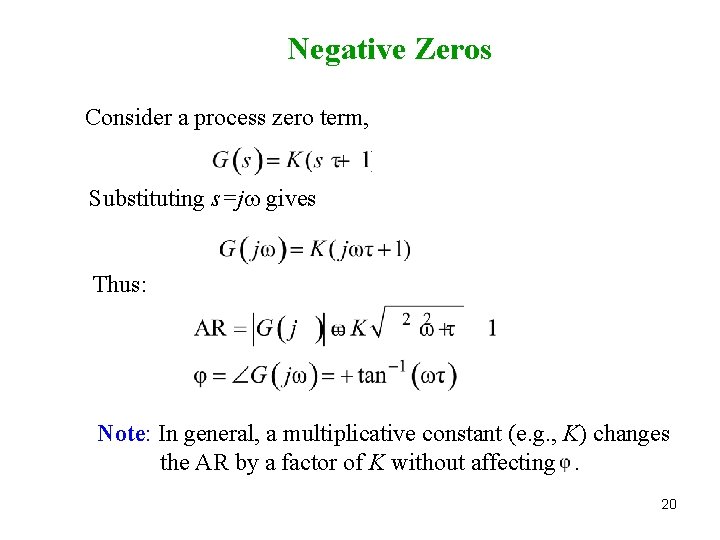
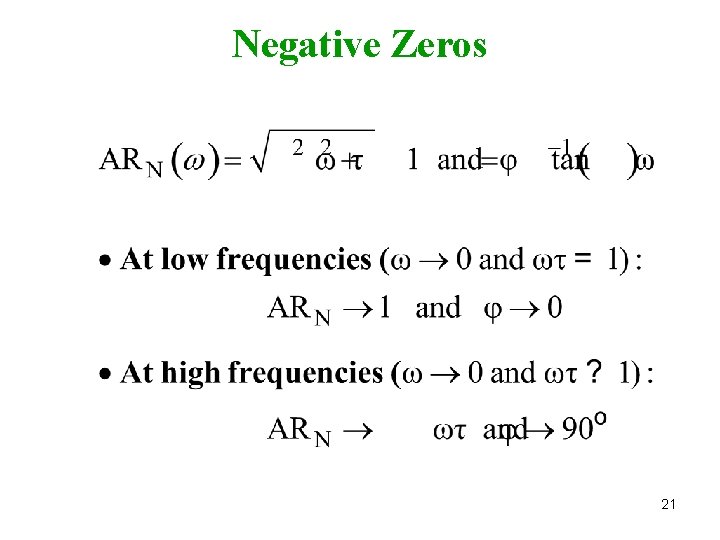
Negative Zeros Consider a process zero term, Substituting s=jw gives Thus: Note: In general, a multiplicative constant (e. g. , K) changes the AR by a factor of K without affecting. 20
Negative Zeros 21
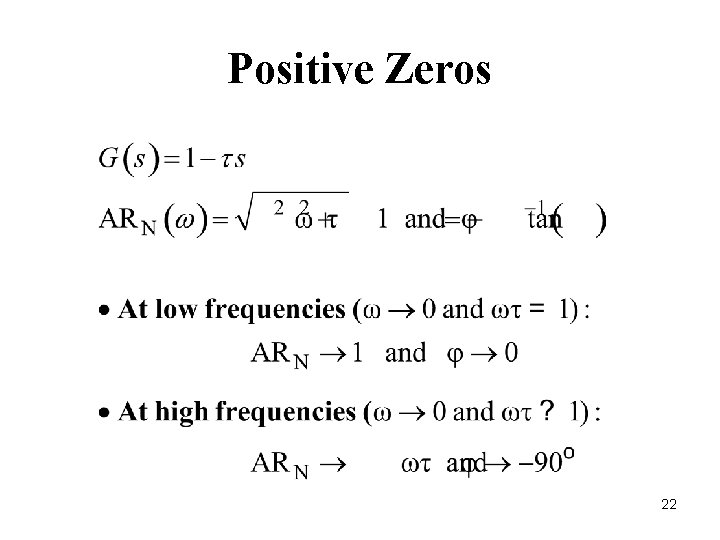
Positive Zeros 22
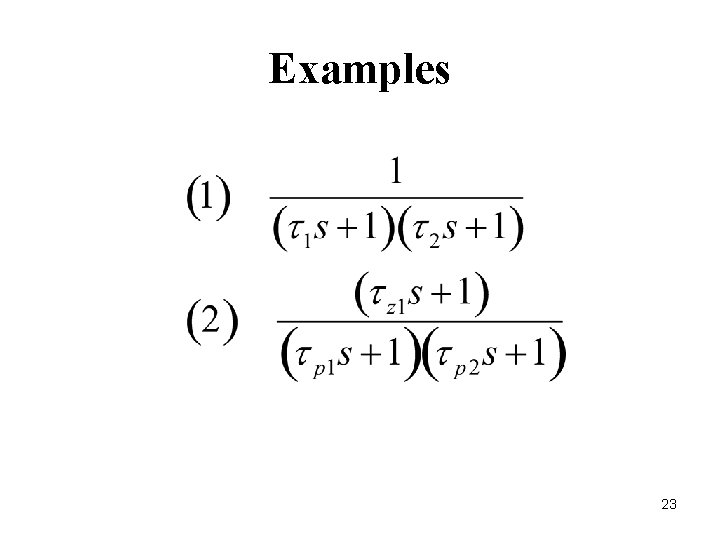
Examples 23
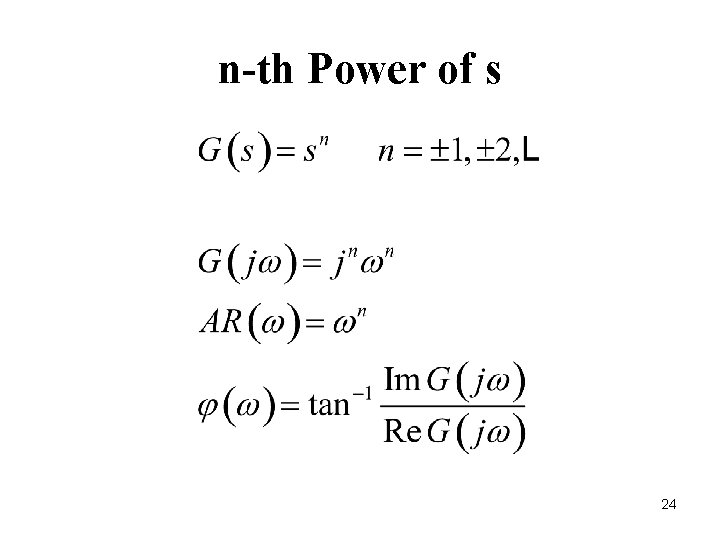
n-th Power of s 24
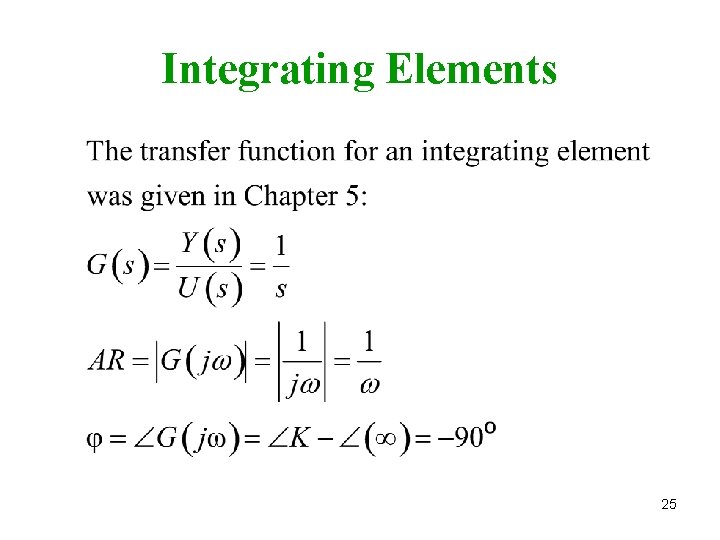
Integrating Elements 25
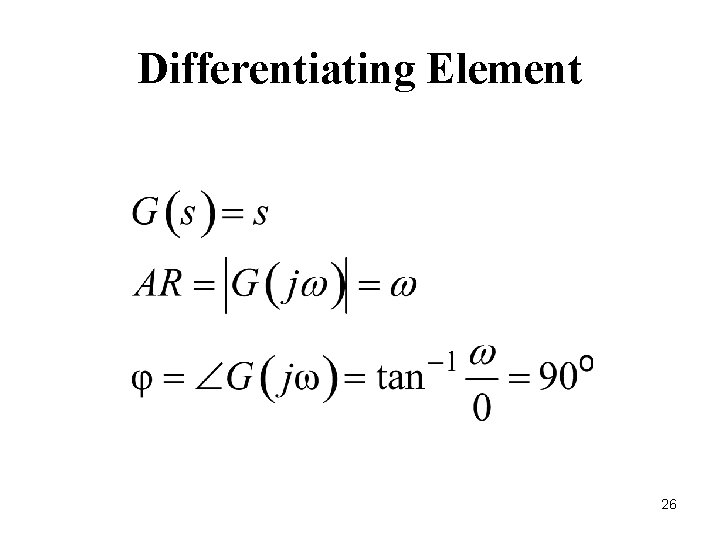
Differentiating Element 26
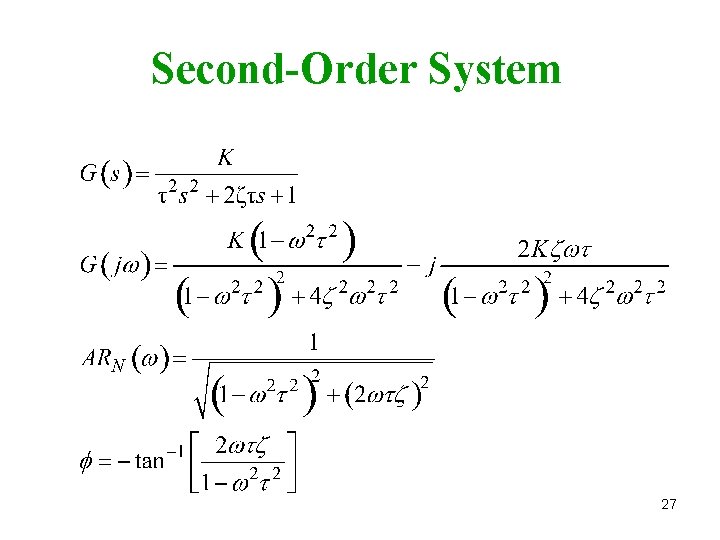
Second-Order System 27
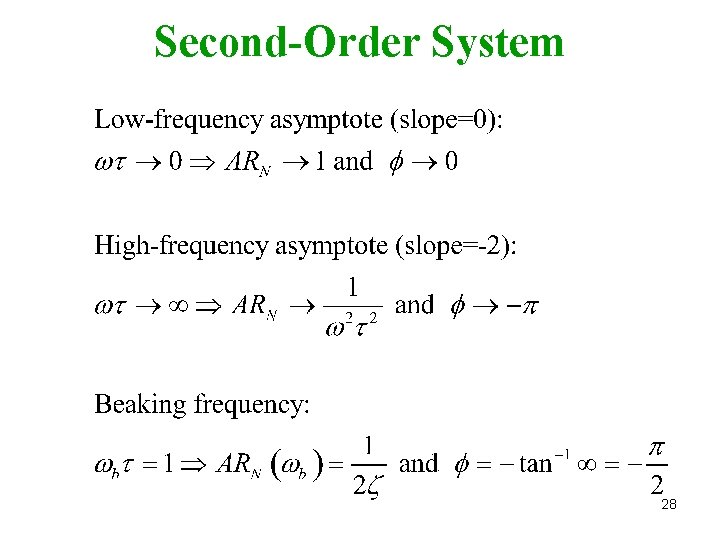
Second-Order System 28
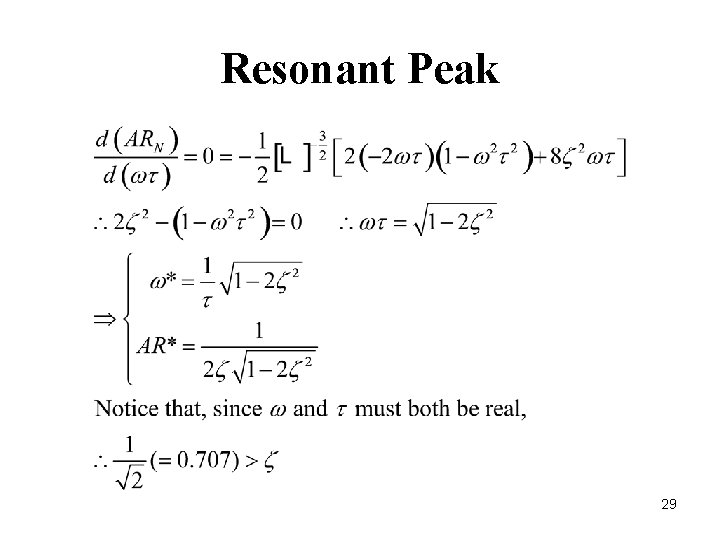
Resonant Peak 29
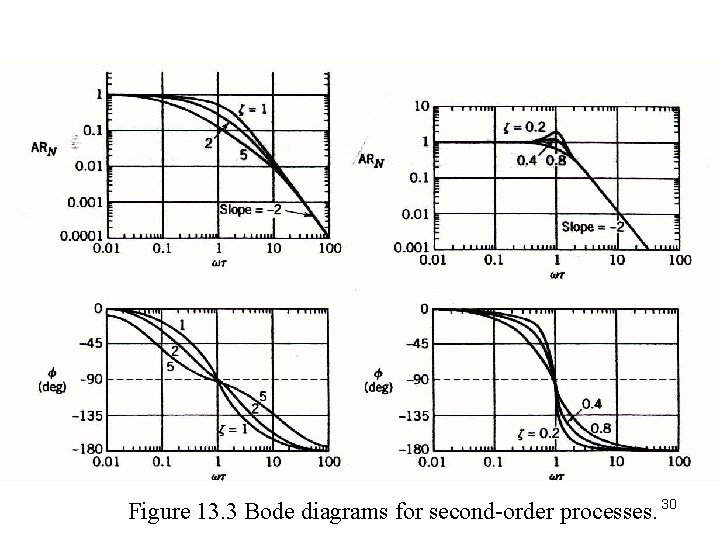
Figure 13. 3 Bode diagrams for second-order processes. 30
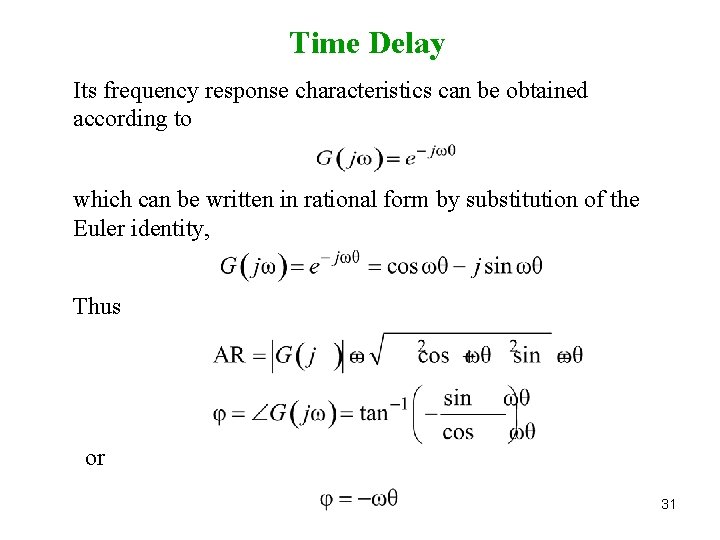
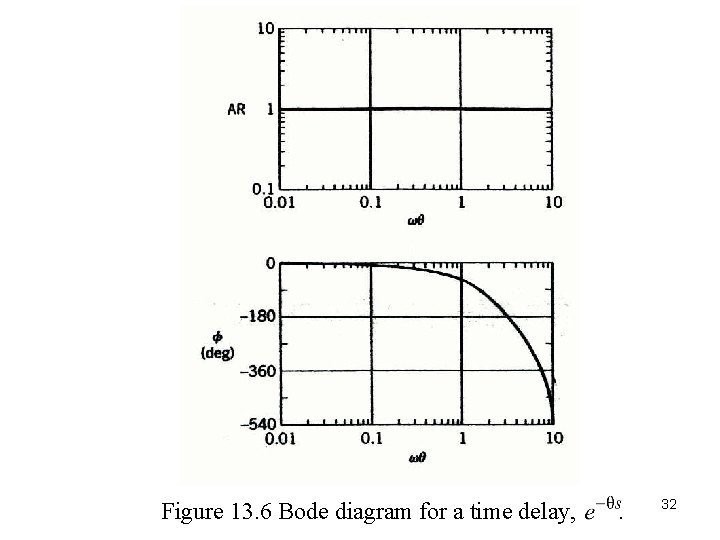
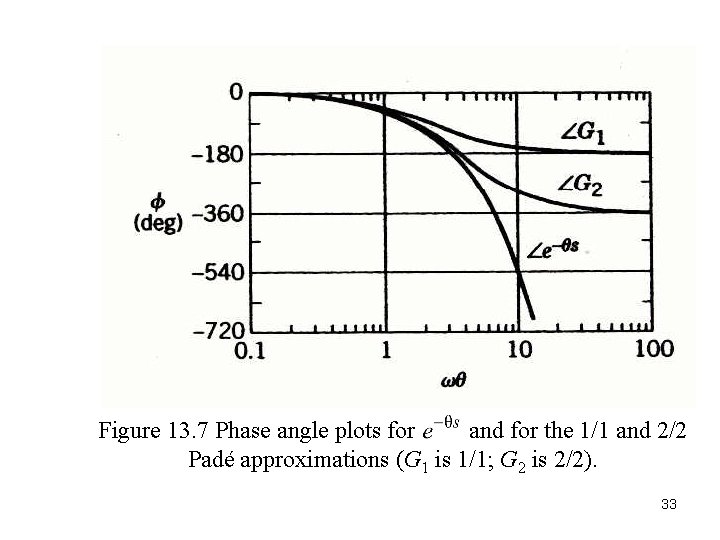
Time Delay Its frequency response characteristics can be obtained according to which can be written in rational form by substitution of the Euler identity, Thus or 31
Figure 13. 6 Bode diagram for a time delay, . 32
Figure 13. 7 Phase angle plots for and for the 1/1 and 2/2 Padé approximations (G 1 is 1/1; G 2 is 2/2). 33
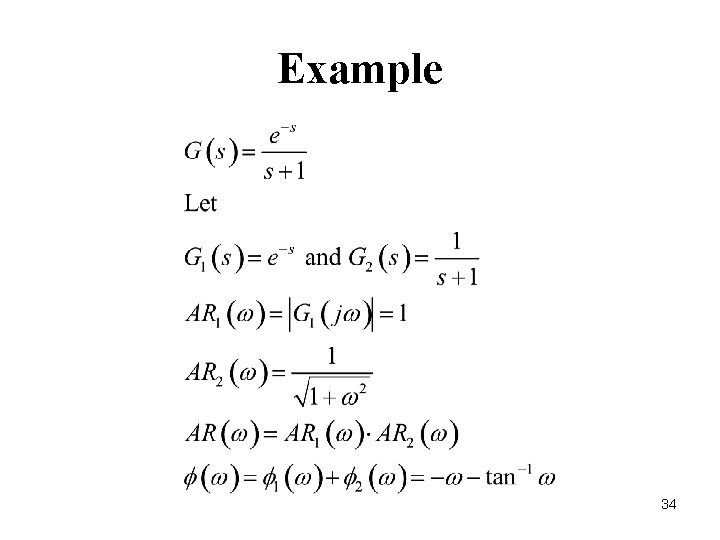
Example 34
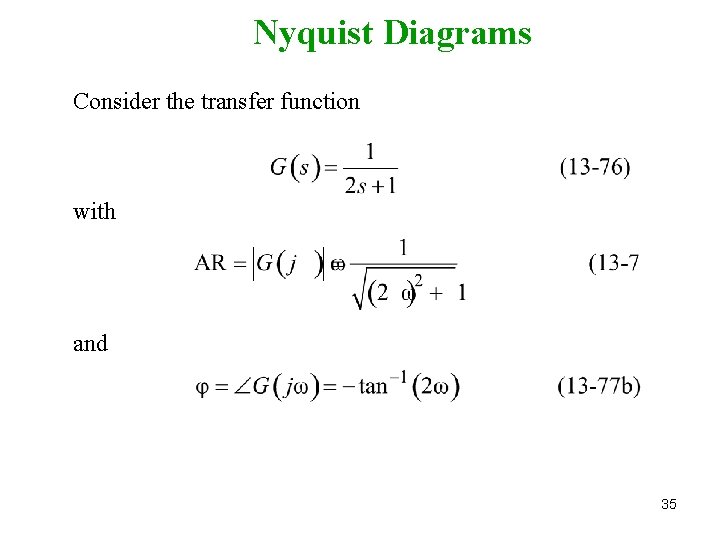
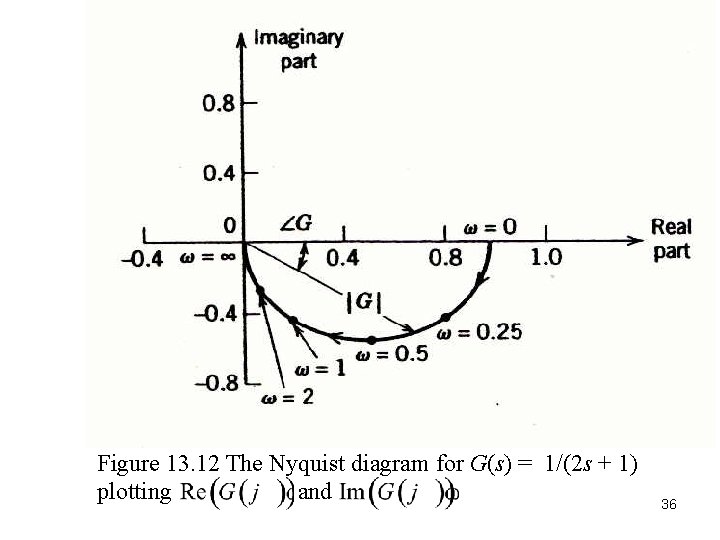
Nyquist Diagrams Consider the transfer function with and 35
Figure 13. 12 The Nyquist diagram for G(s) = 1/(2 s + 1) plotting and 36
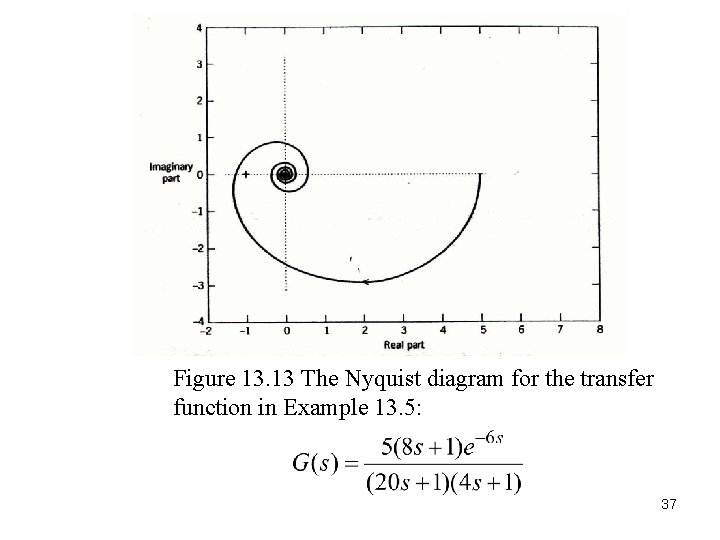
Figure 13. 13 The Nyquist diagram for the transfer function in Example 13. 5: 37
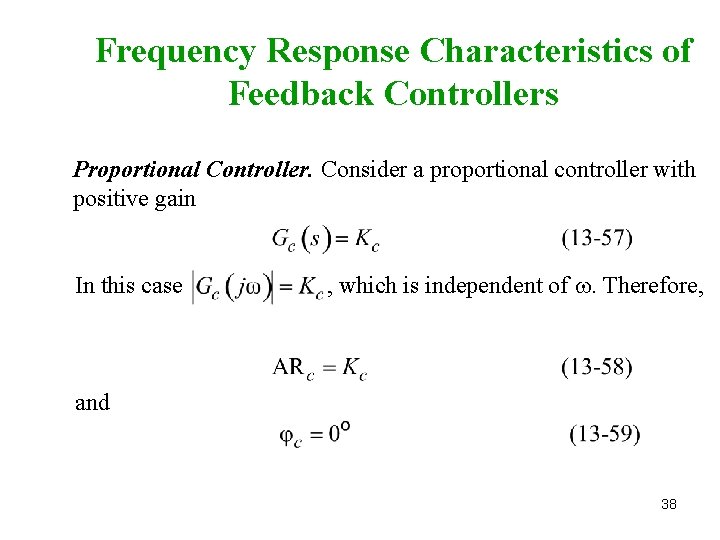
Frequency Response Characteristics of Feedback Controllers Proportional Controller. Consider a proportional controller with positive gain In this case , which is independent of w. Therefore, and 38
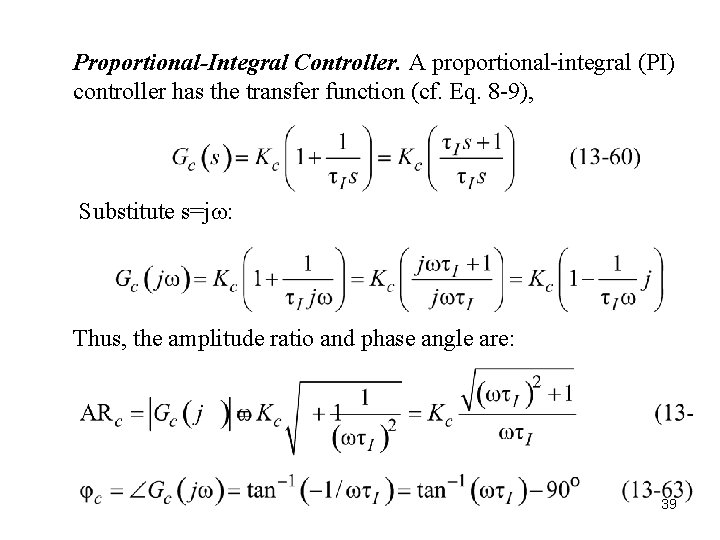
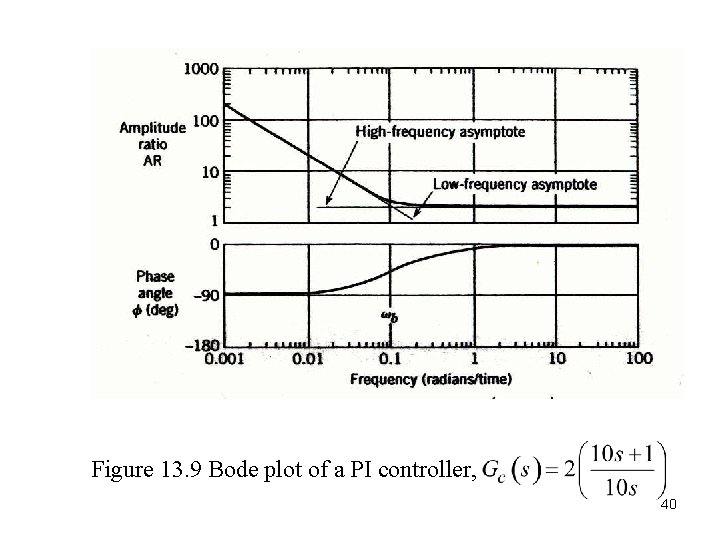
Proportional-Integral Controller. A proportional-integral (PI) controller has the transfer function (cf. Eq. 8 -9), Substitute s=jw: Thus, the amplitude ratio and phase angle are: 39
Figure 13. 9 Bode plot of a PI controller, 40
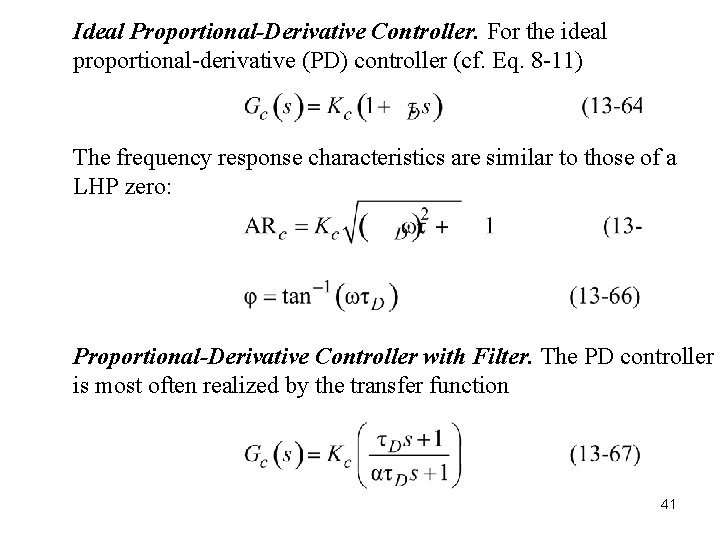
Ideal Proportional-Derivative Controller. For the ideal proportional-derivative (PD) controller (cf. Eq. 8 -11) The frequency response characteristics are similar to those of a LHP zero: Proportional-Derivative Controller with Filter. The PD controller is most often realized by the transfer function 41
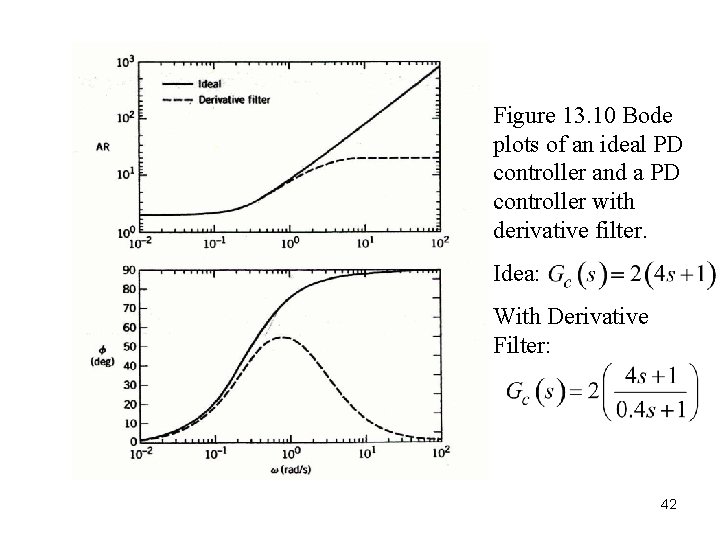
Figure 13. 10 Bode plots of an ideal PD controller and a PD controller with derivative filter. Idea: With Derivative Filter: 42
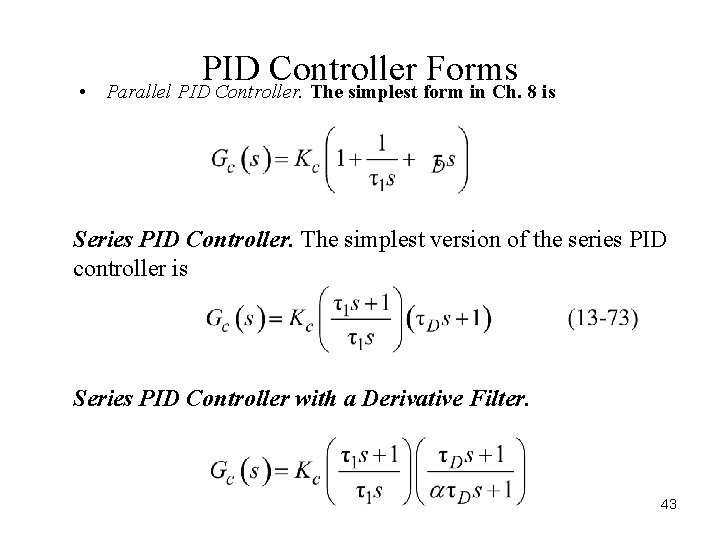
PID Controller Forms • Parallel PID Controller. The simplest form in Ch. 8 is Series PID Controller. The simplest version of the series PID controller is Series PID Controller with a Derivative Filter. 43
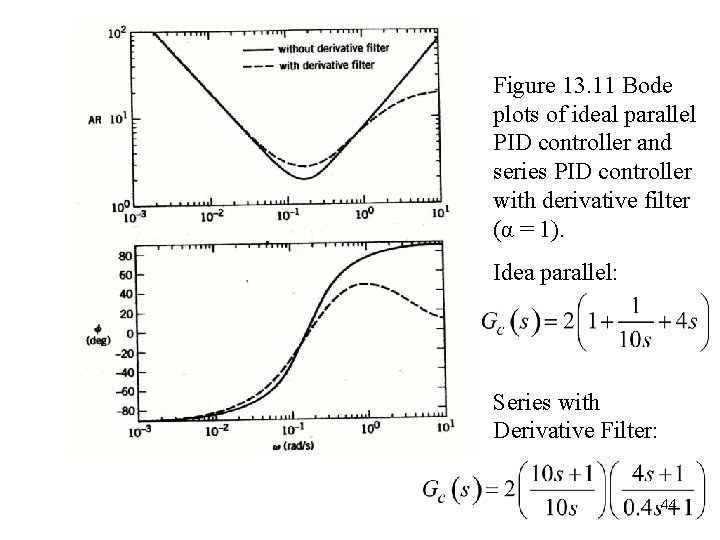
Figure 13. 11 Bode plots of ideal parallel PID controller and series PID controller with derivative filter (α = 1). Idea parallel: Series with Derivative Filter: 44