
Chapter 5 Service Design Russell and Taylor Operations




- Slides: 53
Chapter 5 Service Design Russell and Taylor Operations and Supply Chain Management, 8 th Edition 5 -
© 2014 John Wiley & Sons, Inc. - Russell and Taylor 8 e 5 -2
© 2014 John Wiley & Sons, Inc. - Russell and Taylor 8 e 5 -3
© 2014 John Wiley & Sons, Inc. - Russell and Taylor 8 e 5 -4
© 2014 John Wiley & Sons, Inc. - Russell and Taylor 8 e 5 -5
Lecture Outline • • • Service Economy Characteristics of Services Service Design Process Tools for Service Design Waiting Line Analysis for Service Improvement © 2014 John Wiley & Sons, Inc. - Russell and Taylor 8 e 5 -6
Learning Objectives • Evaluate the impact of services on jobs and the economy • Appreciate and articulate the differences between products and services • Utilize tools for envisioning and designing quality services • Map out service processes and suggest process improvements • Model waiting lines and evaluate their performance for service improvement © 2014 John Wiley & Sons, Inc. - Russell and Taylor 8 e 5 -7
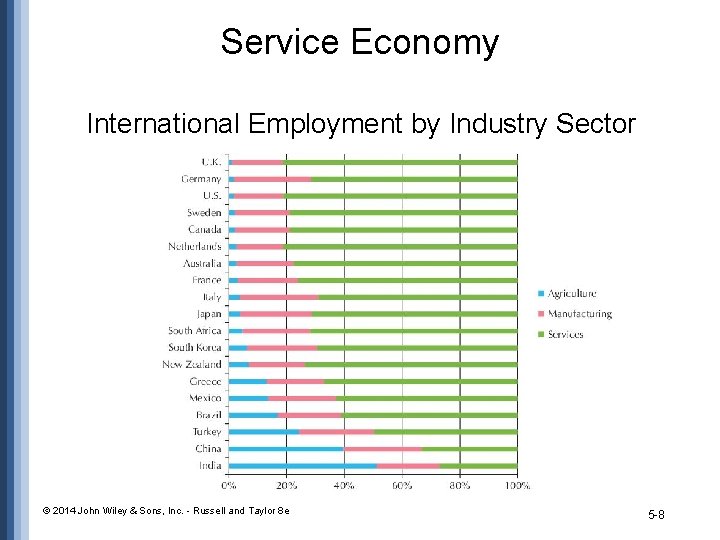
Service Economy International Employment by Industry Sector © 2014 John Wiley & Sons, Inc. - Russell and Taylor 8 e 5 -8
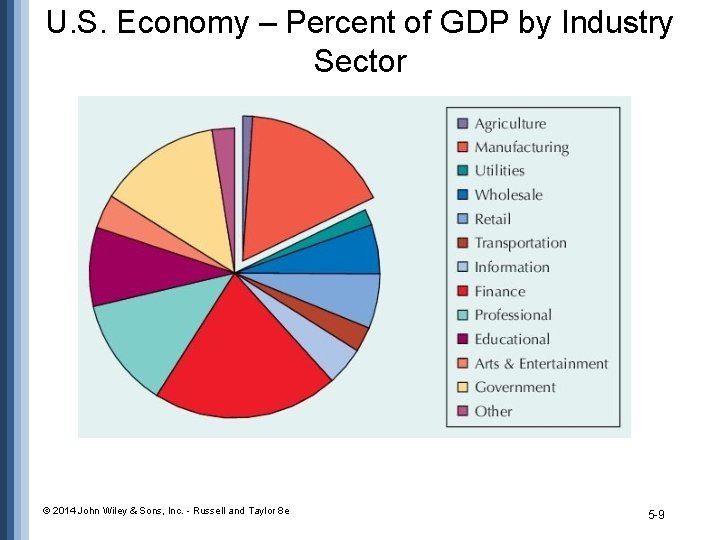
U. S. Economy – Percent of GDP by Industry Sector © 2014 John Wiley & Sons, Inc. - Russell and Taylor 8 e 5 -9
Characteristics of Services • acts, deeds, or performances • Goods • tangible objects • Facilitating services • accompany almost all purchases of goods • Facilitating goods • accompany almost all service purchases © 2014 John Wiley & Sons, Inc. - Russell and Taylor 8 e 5 -10
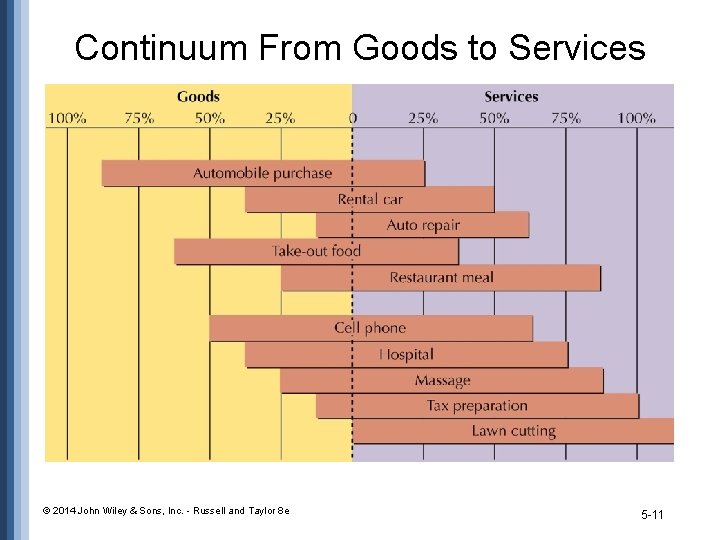
Continuum From Goods to Services © 2014 John Wiley & Sons, Inc. - Russell and Taylor 8 e 5 -11
Characteristics of Services • • • Services are intangible Service output is variable Services have higher customer contact Services are perishable The service and the service delivery are inseparable Services tend to be decentralized and geographically dispersed • Services are consumed more often than products • Services can be easily emulated © 2014 John Wiley & Sons, Inc. - Russell and Taylor 8 e 5 -12
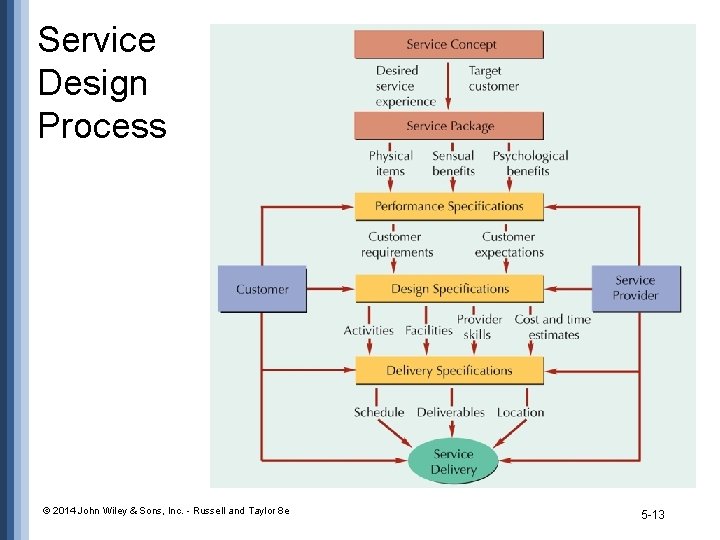
Service Design Process © 2014 John Wiley & Sons, Inc. - Russell and Taylor 8 e 5 -13
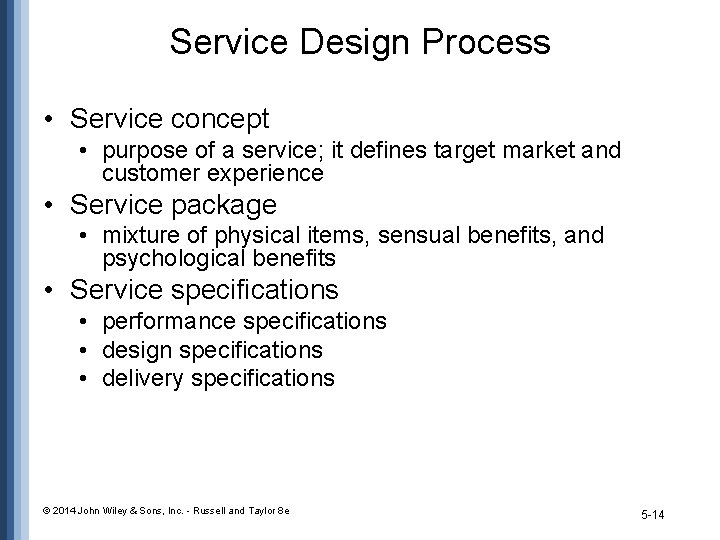
Service Design Process • Service concept • purpose of a service; it defines target market and customer experience • Service package • mixture of physical items, sensual benefits, and psychological benefits • Service specifications • performance specifications • design specifications • delivery specifications © 2014 John Wiley & Sons, Inc. - Russell and Taylor 8 e 5 -14
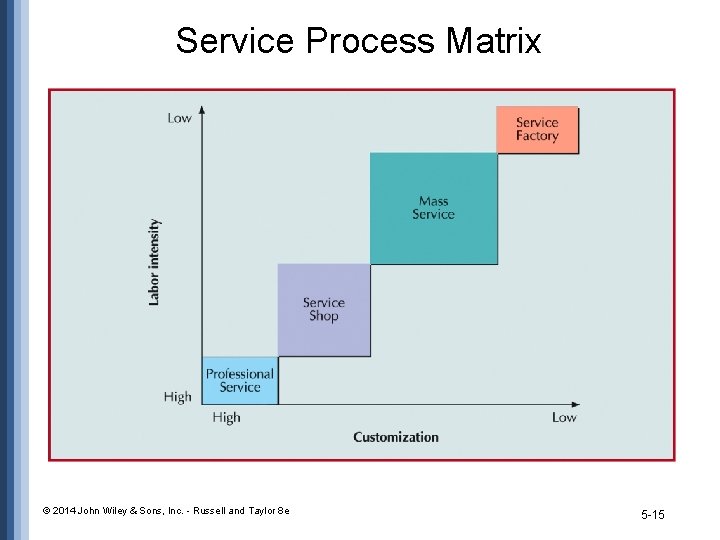
Service Process Matrix © 2014 John Wiley & Sons, Inc. - Russell and Taylor 8 e 5 -15
High vs. Low Contact Services Design Decision High-Contact Service Low-Contact Service § Facility § Convenient to location customer § Facility layout § Near labor or transportation source § Must look presentable, § Designed for accommodate efficiency customer needs, and facilitate interaction with customer © 2014 John Wiley & Sons, Inc. - Russell and Taylor 8 e 5 -16
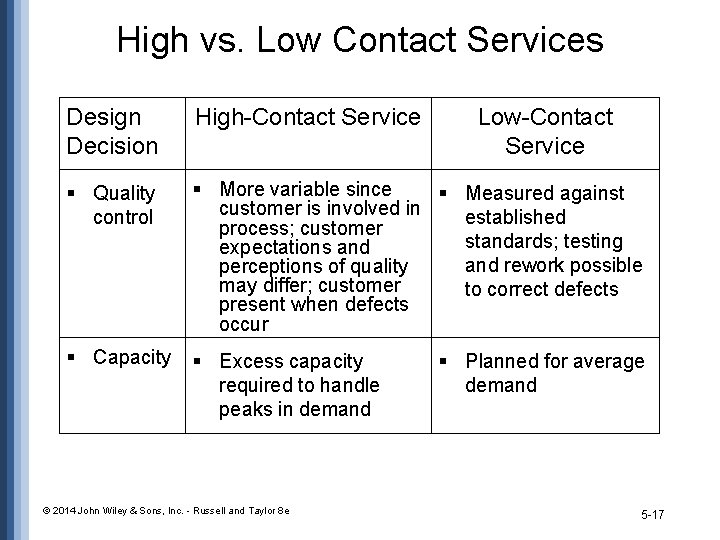
High vs. Low Contact Services Design Decision High-Contact Service § Quality control § More variable since § Measured against customer is involved in established process; customer standards; testing expectations and rework possible perceptions of quality may differ; customer to correct defects present when defects occur § Capacity § Excess capacity required to handle peaks in demand © 2014 John Wiley & Sons, Inc. - Russell and Taylor 8 e Low-Contact Service § Planned for average demand 5 -17
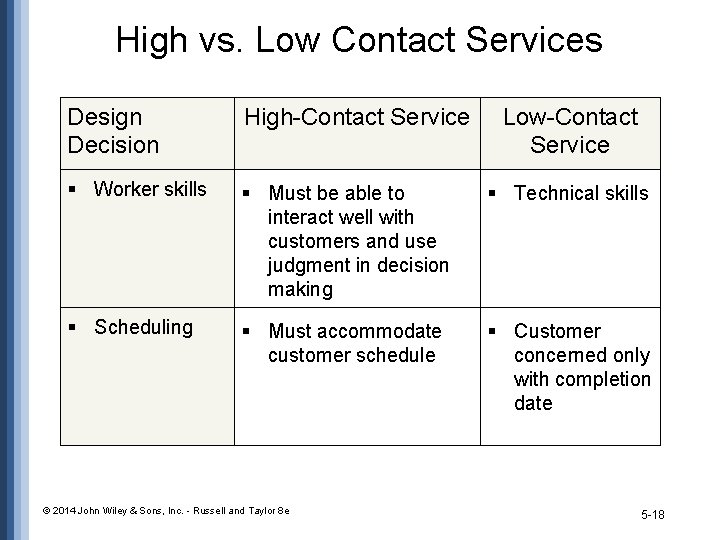
High vs. Low Contact Services Design Decision High-Contact Service § Worker skills § Must be able to interact well with customers and use judgment in decision making § Technical skills § Scheduling § Must accommodate customer schedule § Customer concerned only with completion date © 2014 John Wiley & Sons, Inc. - Russell and Taylor 8 e Low-Contact Service 5 -18
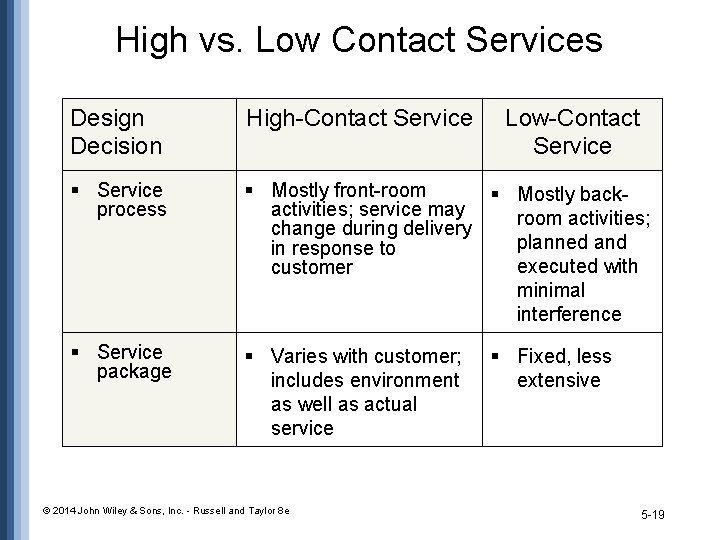
High vs. Low Contact Services Design Decision High-Contact Service § Service process § Mostly front-room § Mostly backactivities; service may room activities; change during delivery planned and in response to executed with customer minimal interference § Service package § Varies with customer; includes environment as well as actual service © 2014 John Wiley & Sons, Inc. - Russell and Taylor 8 e Low-Contact Service § Fixed, less extensive 5 -19
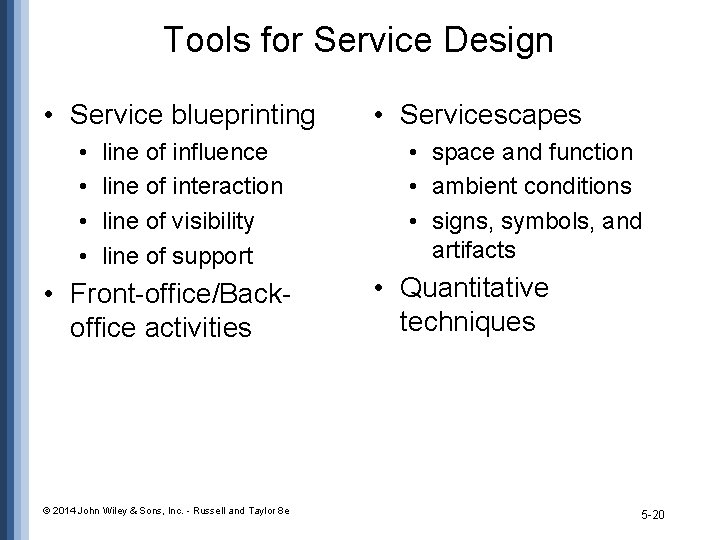
Tools for Service Design • Service blueprinting • • line of influence line of interaction line of visibility line of support • Front-office/Backoffice activities © 2014 John Wiley & Sons, Inc. - Russell and Taylor 8 e • Servicescapes • space and function • ambient conditions • signs, symbols, and artifacts • Quantitative techniques 5 -20
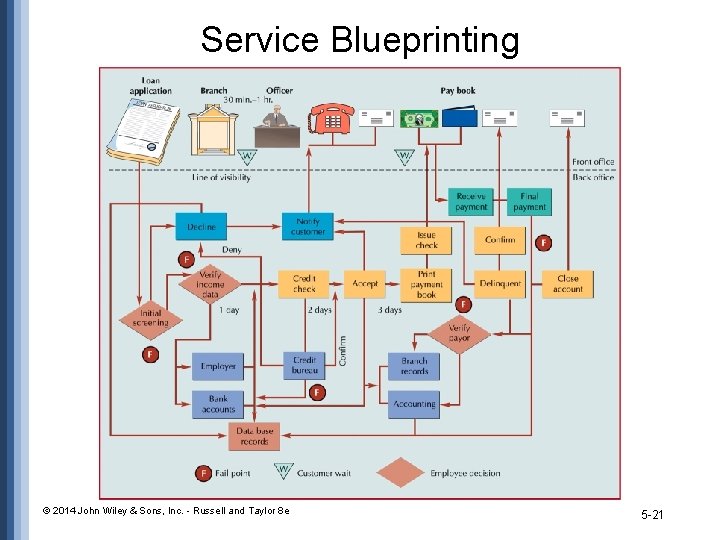
Service Blueprinting © 2014 John Wiley & Sons, Inc. - Russell and Taylor 8 e 5 -21
Service Blueprinting © 2014 John Wiley & Sons, Inc. - Russell and Taylor 8 e 5 -22
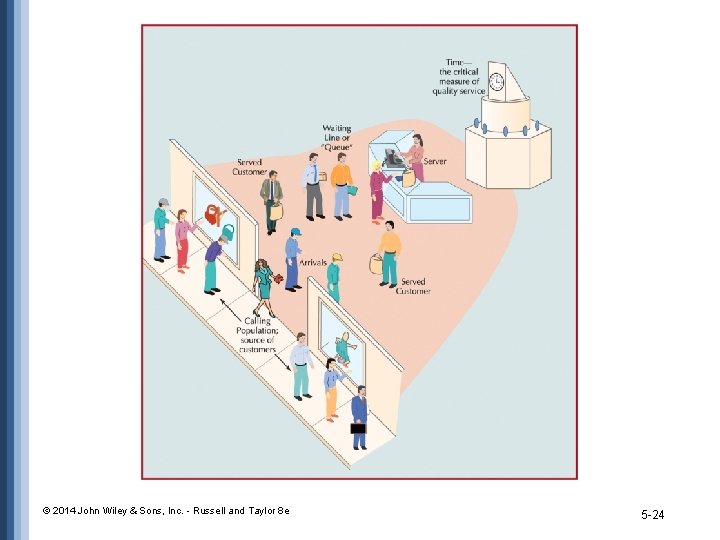
Elements of Waiting Line Analysis • Operating characteristics • average values for characteristics that describe performance of waiting line system • Queue • a single waiting line • Waiting line system • consists of arrivals, servers, and waiting line structure • Calling population • source of customers; infinite or finite © 2014 John Wiley & Sons, Inc. - Russell and Taylor 8 e 5 -23
© 2014 John Wiley & Sons, Inc. - Russell and Taylor 8 e 5 -24
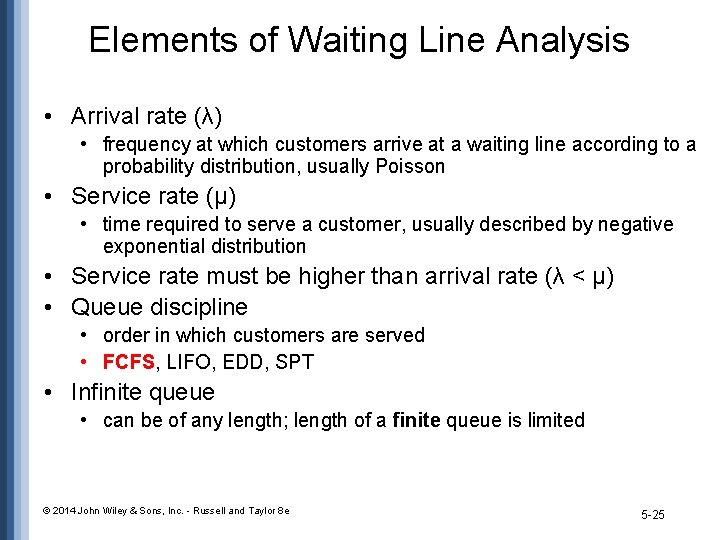
Elements of Waiting Line Analysis • Arrival rate (λ) • frequency at which customers arrive at a waiting line according to a probability distribution, usually Poisson • Service rate (μ) • time required to serve a customer, usually described by negative exponential distribution • Service rate must be higher than arrival rate (λ < μ) • Queue discipline • order in which customers are served • FCFS, LIFO, EDD, SPT • Infinite queue • can be of any length; length of a finite queue is limited © 2014 John Wiley & Sons, Inc. - Russell and Taylor 8 e 5 -25
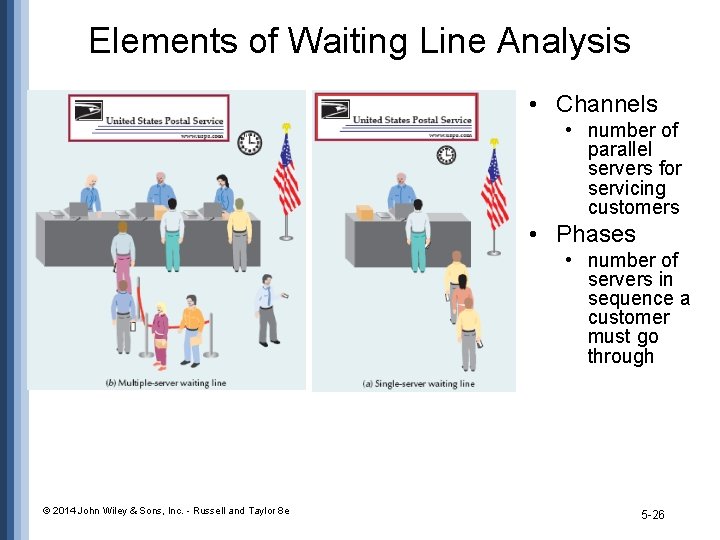
Elements of Waiting Line Analysis • Channels • number of parallel servers for servicing customers • Phases • number of servers in sequence a customer must go through © 2014 John Wiley & Sons, Inc. - Russell and Taylor 8 e 5 -26
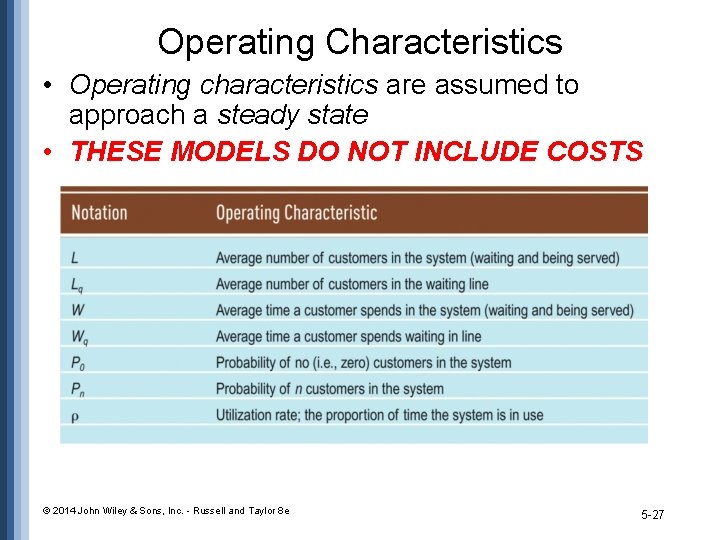
Operating Characteristics • Operating characteristics are assumed to approach a steady state • THESE MODELS DO NOT INCLUDE COSTS © 2014 John Wiley & Sons, Inc. - Russell and Taylor 8 e 5 -27
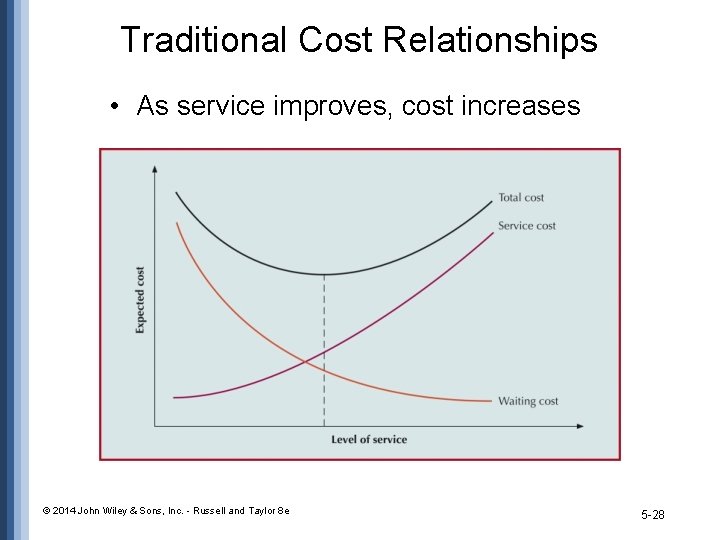
Traditional Cost Relationships • As service improves, cost increases © 2014 John Wiley & Sons, Inc. - Russell and Taylor 8 e 5 -28
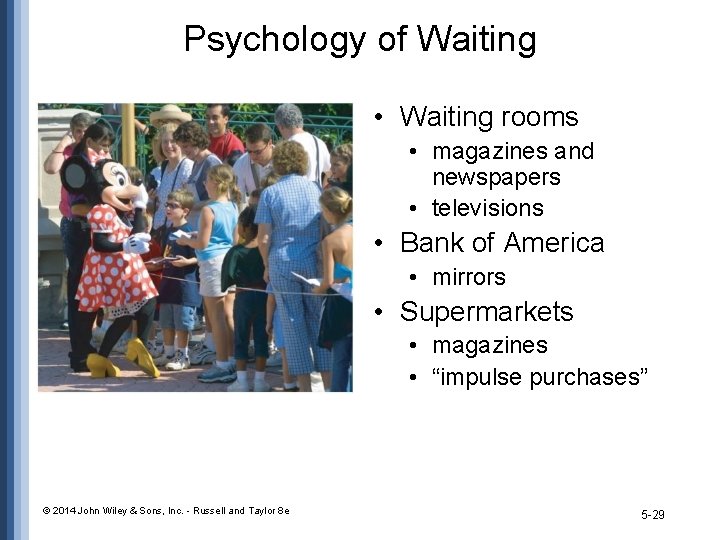
Psychology of Waiting • Waiting rooms • magazines and newspapers • televisions • Bank of America • mirrors • Supermarkets • magazines • “impulse purchases” © 2014 John Wiley & Sons, Inc. - Russell and Taylor 8 e 5 -29
Psychology of Waiting • Preferential treatment • Grocery stores: express lanes for customers with few purchases • Airlines/Car rental agencies: special cards available to frequent-users or for an additional fee • Phone retailers: route calls to more or less experienced salespeople based on customer’s sales history • Critical service providers • services of police department, fire department, etc. • waiting is unacceptable; cost is not important © 2014 John Wiley & Sons, Inc. - Russell and Taylor 8 e 5 -30
Waiting Line Models • Single-server model • • • simplest, most basic waiting line structure exponential service times Poisson arrivals One waiting line and one server Infinite queue length Infinite calling population • Frequent variations (all with Poisson arrival rate) • • general (unknown) distribution of service times constant service times exponential service times with finite queue exponential service times with finite calling population © 2014 John Wiley & Sons, Inc. - Russell and Taylor 8 e 5 -31
Basic Single-Server Model • Assumptions • Poisson arrival rate • exponential service times • first-come, first-served queue discipline • infinite queue length • infinite calling population © 2014 John Wiley & Sons, Inc. - Russell and Taylor 8 e • Computations • λ = mean arrival rate • μ = mean service rate • n = number of customers in line 5 -32
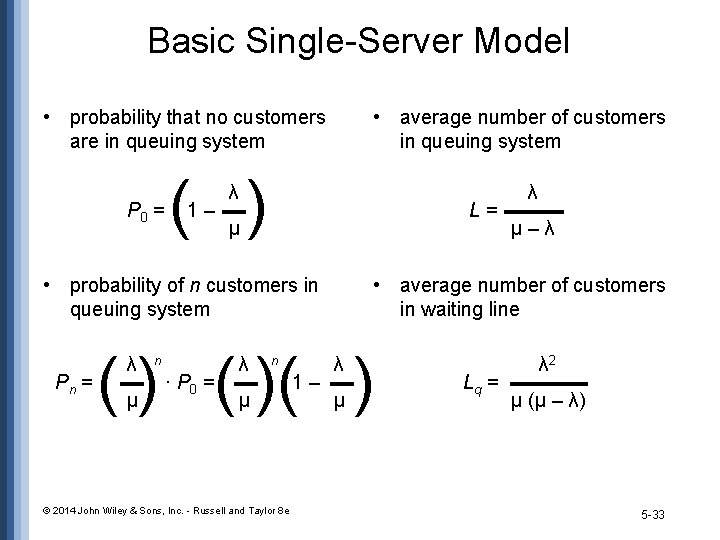
Basic Single-Server Model • average number of customers in queuing system • probability that no customers are in queuing system P 0 = ( ) 1– λ L= μ Pn = ( )( ) μ n ∙ P 0 = λ n μ © 2014 John Wiley & Sons, Inc. - Russell and Taylor 8 e 1– μ–λ • average number of customers in waiting line • probability of n customers in queuing system λ λ λ μ Lq = λ 2 μ (μ – λ) 5 -33
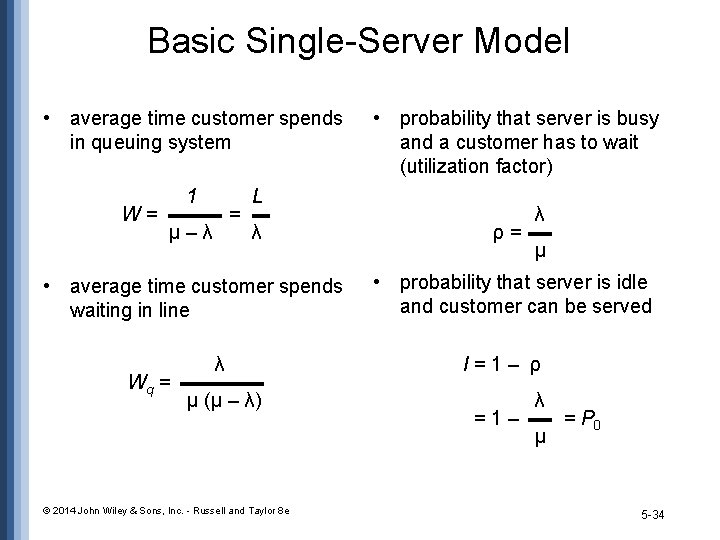
Basic Single-Server Model • average time customer spends in queuing system W= 1 = μ–λ L λ • average time customer spends waiting in line Wq = • probability that server is busy and a customer has to wait (utilization factor) λ μ (μ – λ) © 2014 John Wiley & Sons, Inc. - Russell and Taylor 8 e ρ= λ μ • probability that server is idle and customer can be served I=1– ρ =1– λ μ = P 0 5 -34
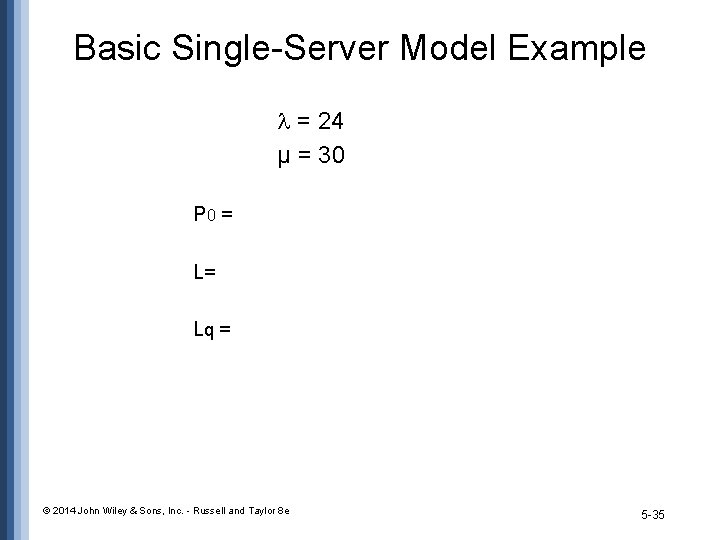
Basic Single-Server Model Example l = 24 µ = 30 P 0 = L= Lq = © 2014 John Wiley & Sons, Inc. - Russell and Taylor 8 e 5 -35
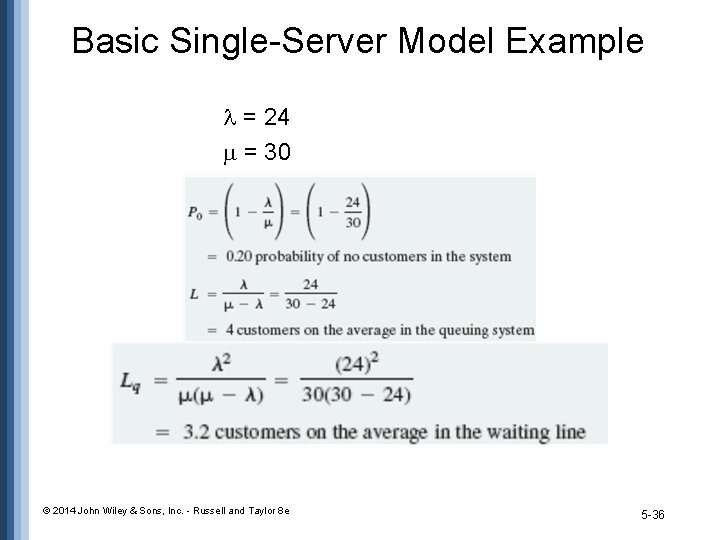
Basic Single-Server Model Example l = 24 m = 30 © 2014 John Wiley & Sons, Inc. - Russell and Taylor 8 e 5 -36
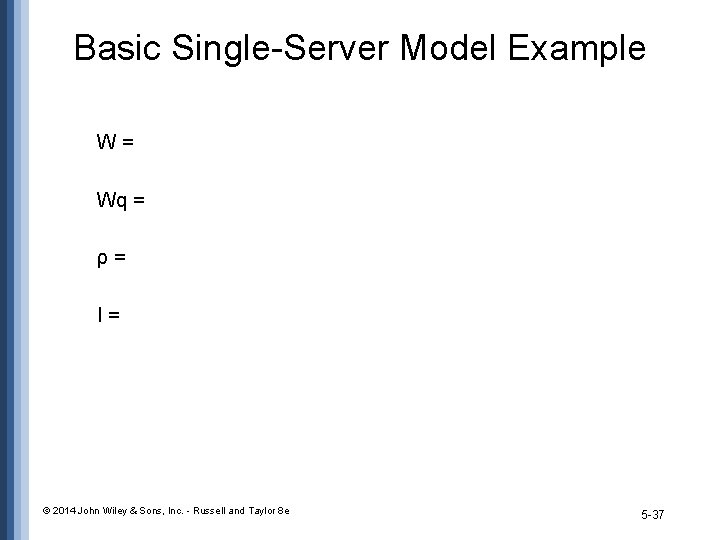
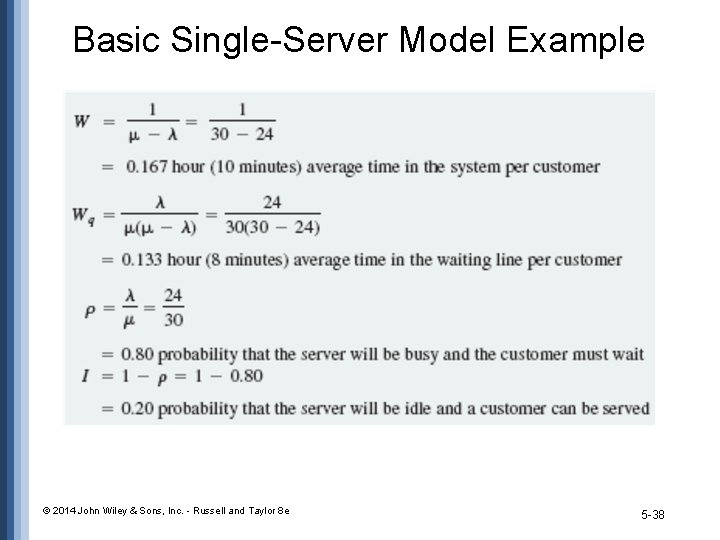
Basic Single-Server Model Example W= Wq = ρ= I= © 2014 John Wiley & Sons, Inc. - Russell and Taylor 8 e 5 -37
Basic Single-Server Model Example © 2014 John Wiley & Sons, Inc. - Russell and Taylor 8 e 5 -38
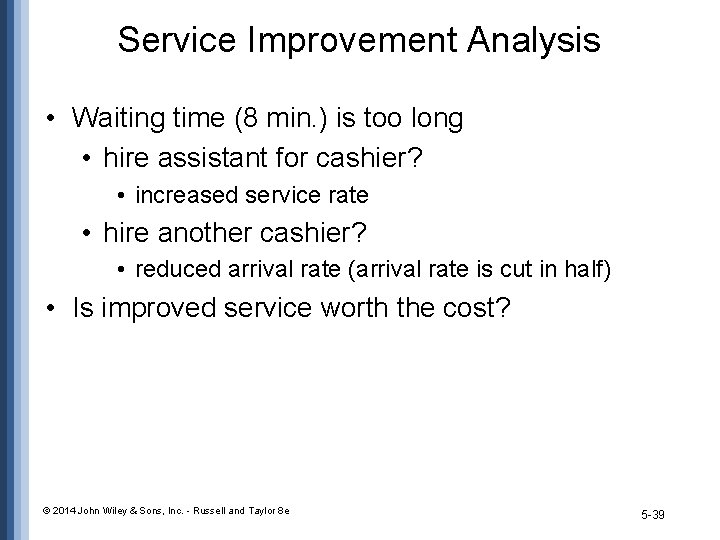
Service Improvement Analysis • Waiting time (8 min. ) is too long • hire assistant for cashier? • increased service rate • hire another cashier? • reduced arrival rate (arrival rate is cut in half) • Is improved service worth the cost? © 2014 John Wiley & Sons, Inc. - Russell and Taylor 8 e 5 -39
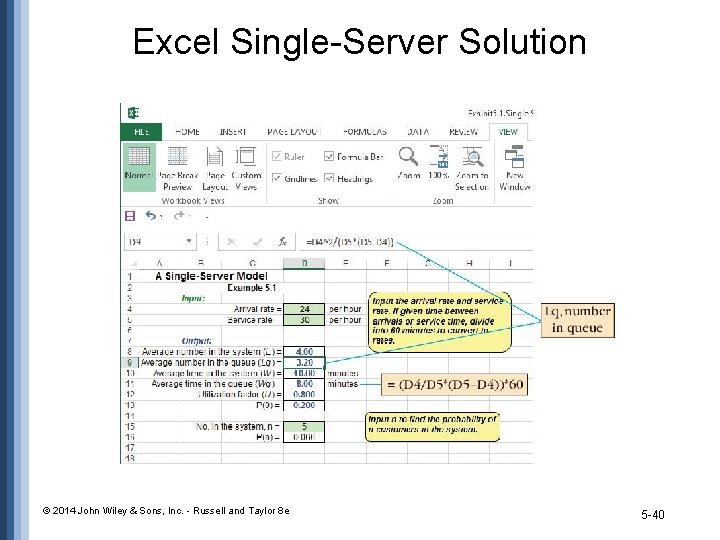
Excel Single-Server Solution © 2014 John Wiley & Sons, Inc. - Russell and Taylor 8 e 5 -40
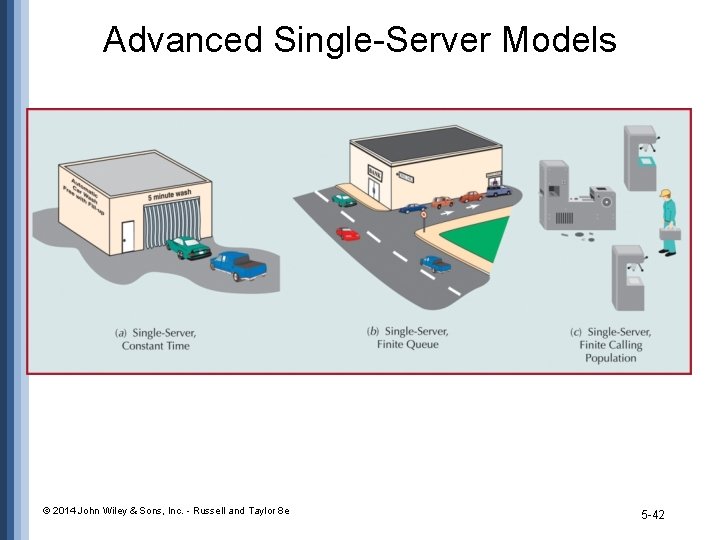
Advanced Single-Server Models • Constant service times • occur most often when automated equipment or machinery performs service • Finite queue lengths • occur when there is a physical limitation to length of waiting line • Finite calling population • number of “customers” that can arrive is limited © 2014 John Wiley & Sons, Inc. - Russell and Taylor 8 e 5 -41
Advanced Single-Server Models © 2014 John Wiley & Sons, Inc. - Russell and Taylor 8 e 5 -42
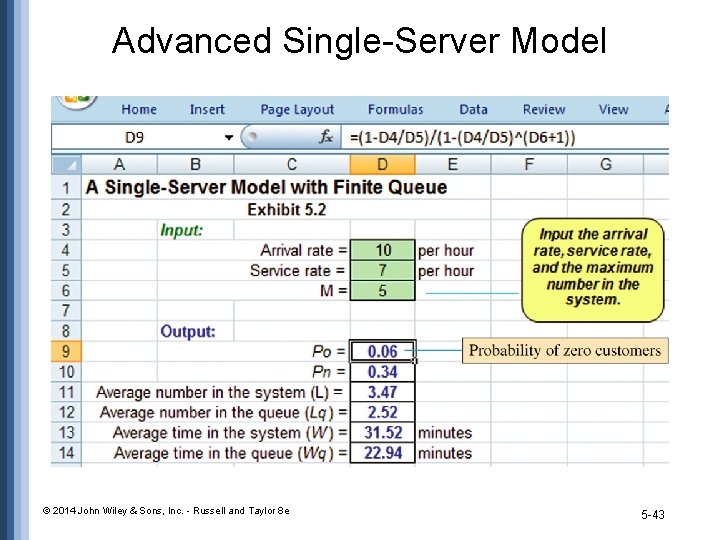
Advanced Single-Server Model © 2014 John Wiley & Sons, Inc. - Russell and Taylor 8 e 5 -43
Basic Multiple-Server Model • Single waiting line and service facility with several independent servers in parallel • Same assumptions as single-server model • sμ > λ • s = number of servers • servers must be able to serve customers faster than they arrive © 2014 John Wiley & Sons, Inc. - Russell and Taylor 8 e 5 -44
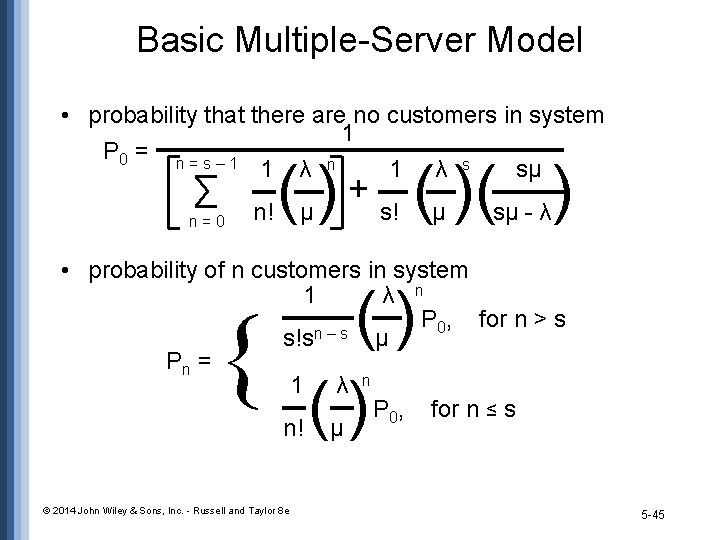
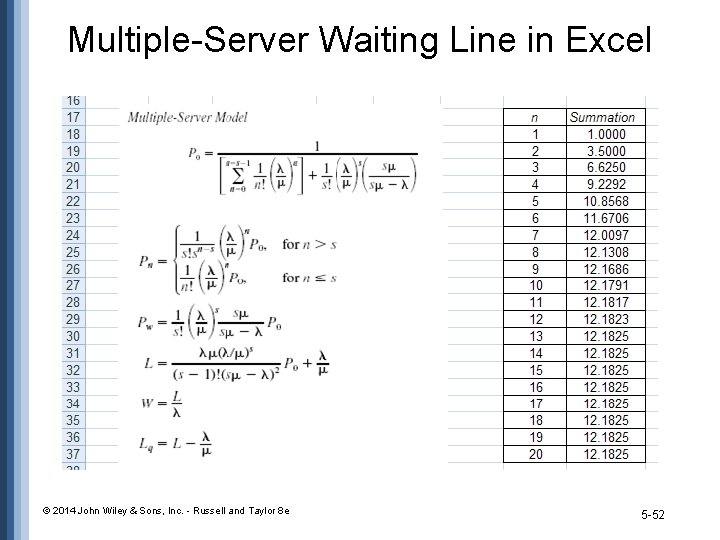
Basic Multiple-Server Model • probability that there are no customers in system 1 P 0 = n = s – 1 1 λ n 1 λ s sμ ∑ n=0 n! ( ) + ( )( ) μ s! μ sμ - λ • probability of n customers in system 1 λ n P 0, for n > s n – s s!s μ Pn = 1 λ n P 0, for n ≤ s n! μ { © 2014 John Wiley & Sons, Inc. - Russell and Taylor 8 e () () 5 -45
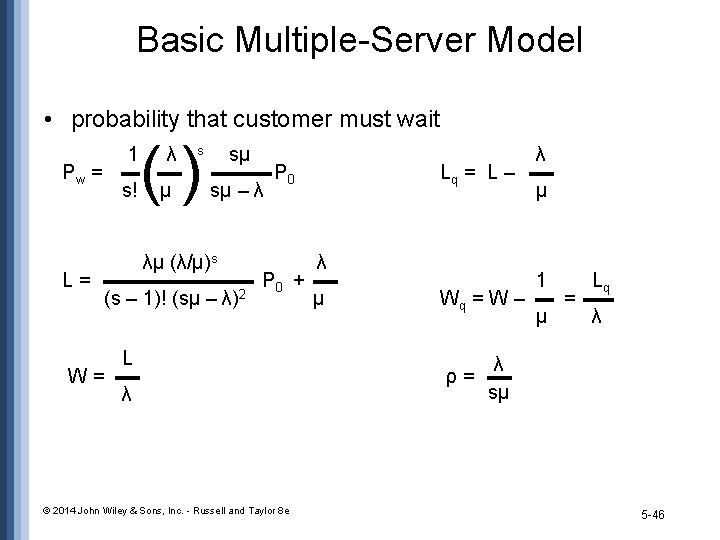
Basic Multiple-Server Model • probability that customer must wait 1 Pw = L= s! () λ μ sμ s sμ – λ λμ (λ/μ)s (s – 1)! (sμ – W= λ)2 Lq = L – P 0 + L λ © 2014 John Wiley & Sons, Inc. - Russell and Taylor 8 e λ μ Wq = W – ρ= λ μ 1 μ = Lq λ λ sμ 5 -46
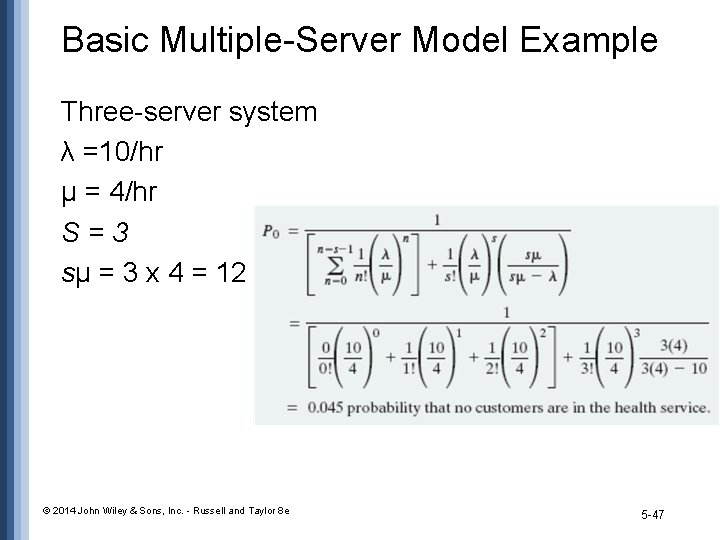
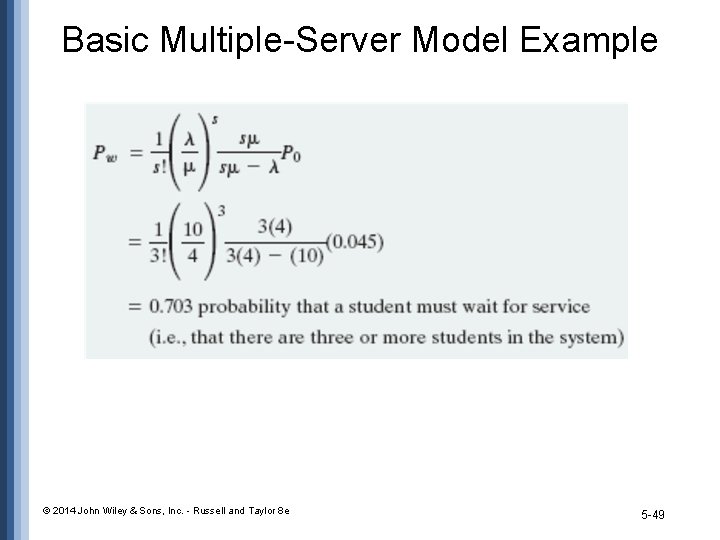
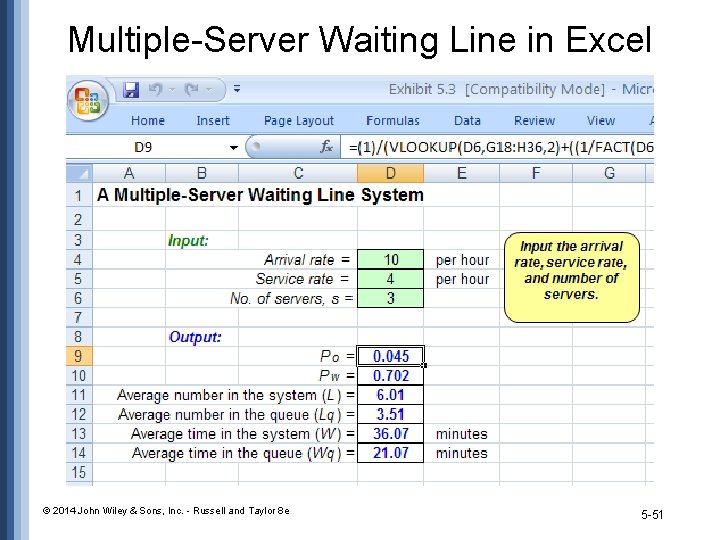
Basic Multiple-Server Model Example Three-server system λ =10/hr μ = 4/hr S=3 sμ = 3 x 4 = 12 © 2014 John Wiley & Sons, Inc. - Russell and Taylor 8 e 5 -47
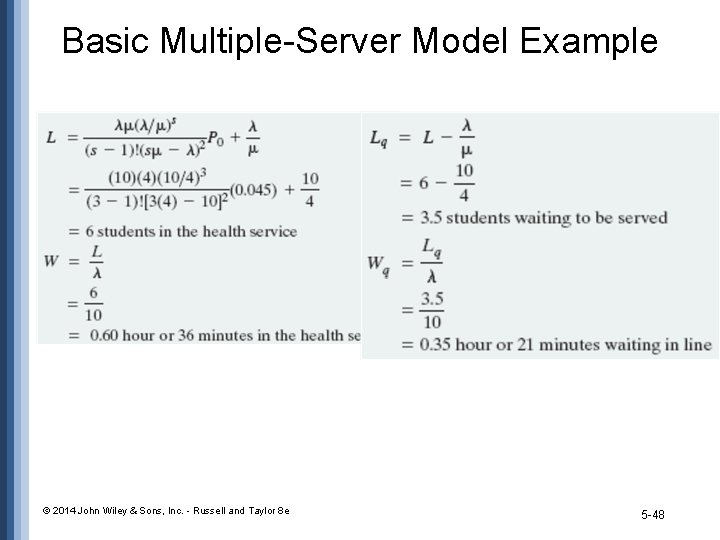
Basic Multiple-Server Model Example © 2014 John Wiley & Sons, Inc. - Russell and Taylor 8 e 5 -48
Basic Multiple-Server Model Example © 2014 John Wiley & Sons, Inc. - Russell and Taylor 8 e 5 -49
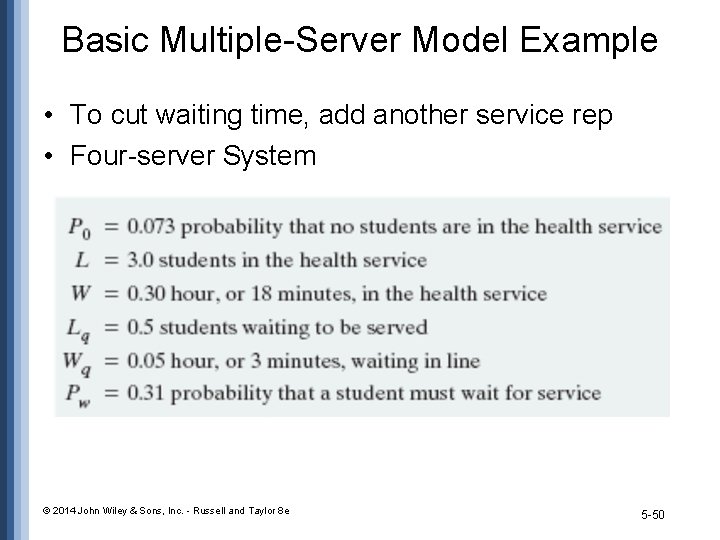
Basic Multiple-Server Model Example • To cut waiting time, add another service rep • Four-server System © 2014 John Wiley & Sons, Inc. - Russell and Taylor 8 e 5 -50
Multiple-Server Waiting Line in Excel © 2014 John Wiley & Sons, Inc. - Russell and Taylor 8 e 5 -51
Multiple-Server Waiting Line in Excel © 2014 John Wiley & Sons, Inc. - Russell and Taylor 8 e 5 -52
Copyright 2014 John Wiley & Sons, Inc. All rights reserved. Reproduction or translation of this work beyond that permitted in section 117 of the 1976 United States Copyright Act without express permission of the copyright owner is unlawful. Request for further information should be addressed to the Permission Department, John Wiley & Sons, Inc. The purchaser may make back-up copies for his/her own use only and not for distribution or resale. The Publisher assumes no responsibility for errors, omissions, or damages caused by the use of these programs or from the use of the information herein. © 2014 John Wiley & Sons, Inc. - Russell and Taylor 8 e 5 -53