
Chapter 5 Savings Section 5 1 SAVINGS PLANS




- Slides: 28
Chapter 5 Savings
Section 5. 1 SAVINGS PLANS
Objectives • Define personal savings goals. • List and describe various types of savings instruments that are available from financial institutions. • Compare and contrast the different types of savings products. © Goodheart-Willcox Co. , Inc. Permission granted to reproduce for educational use only.
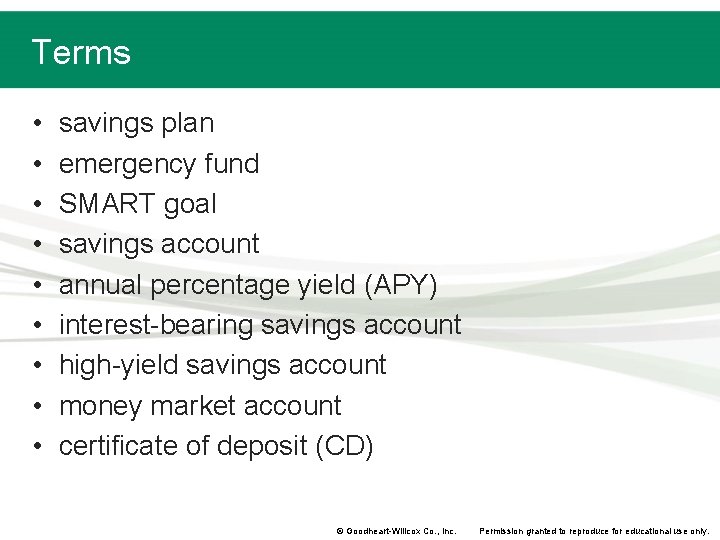
Terms • • • savings plan emergency fund SMART goal savings account annual percentage yield (APY) interest-bearing savings account high-yield savings account money market account certificate of deposit (CD) © Goodheart-Willcox Co. , Inc. Permission granted to reproduce for educational use only.
Creating a Savings Plan • Saving is setting money aside for future use • A savings plan is a strategy for using money to reach important goals © Goodheart-Willcox Co. , Inc. Permission granted to reproduce for educational use only.
Budget for Saving • • • Pay yourself first Budget for savings Use direct deposit Let your savings grow Reduce spending, increase saving © Goodheart-Willcox Co. , Inc. Permission granted to reproduce for educational use only.
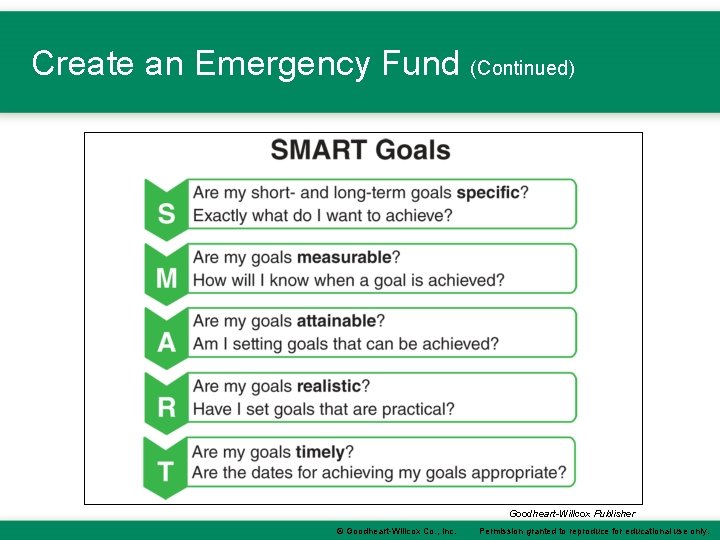
Create an Emergency Fund • Create an emergency fund – an amount of money you can access in case of an emergency • Set SMART goals for saving © Goodheart-Willcox Co. , Inc. Permission granted to reproduce for educational use only.
Create an Emergency Fund (Continued) Goodheart-Willcox Publisher © Goodheart-Willcox Co. , Inc. Permission granted to reproduce for educational use only.
Savings Products • A savings account is used to accumulate money for future use • The Truth in Savings Act requires advertising to include: – – – Minimum amount required to open the account Interest rate Annual percentage yield (APY) and the time period Minimum deposit, time requirements to earn APY Description of fees, conditions, and penalties © Goodheart-Willcox Co. , Inc. Permission granted to reproduce for educational use only.
Savings Products (Continued) • Annual percentage yield (APY) is the rate of yearly earnings from an account, including compound interest • Interest-bearing savings account is a type of demand deposit that allows for regular deposits and withdrawals with no set maturity date © Goodheart-Willcox Co. , Inc. Permission granted to reproduce for educational use only.
Discussion What is the name of the act that helps consumers compare savings products and make informed decisions? © Goodheart-Willcox Co. , Inc. Permission granted to reproduce for educational use only.
Savings Products (Continued) • Regular savings accounts pay interest, allow deposits and withdrawals, and generally offer low interest rates • Passbook savings accounts use a booklet to records deposits, withdrawals, interest earned, and current balance • Statement savings accounts use a statement that lists all deposits, withdrawals, and interest earned © Goodheart-Willcox Co. , Inc. Permission granted to reproduce for educational use only.
Savings Products (Continued) • Online-only savings accounts are provided by Internet banks • A high yield savings account pays higher interest rates than regular savings accounts and requires a higher initial deposit and higher minimum balance © Goodheart-Willcox Co. , Inc. Permission granted to reproduce for educational use only.
Savings Products (Continued) • A money market account (MMA) is a type of savings account that pays a higher interest rate than regular accounts – Requires higher minimum balance ($500–$10, 000) – Most are limited to a specified number of checks per month • A certificate of deposit (CD) is a savings account that requires a deposit of a fixed amount of money for a fixed term – Interest rates may be fixed or variable – Higher interest rates than MMAs and other savings accounts © Goodheart-Willcox Co. , Inc. Permission granted to reproduce for educational use only.
US Savings Bonds • EE Bonds issued before 2012 are in paper form and purchased at half their face value – Since January 1, 2012, these bonds are issued electronically at full face value to the penny in amounts of $25 to $10, 000 – EE bonds earn a fixed rate of interest based on market yields of treasury notes; new rates are announced every six months • I Bonds are sold at face value in amounts from $25 to $10, 000 in electronic form – I Bonds pay a fixed interest rate – I Bonds pay a semiannual inflation add-on rate based on the consumer price index (CPI) © Goodheart-Willcox Co. , Inc. Permission granted to reproduce for educational use only.
Did You Know? When you “buy” a savings bond, you are actually lending money to the federal government. © Goodheart-Willcox Co. , Inc. Permission granted to reproduce for educational use only.
Review 5. 1 • Are savings bonds insured by the FDIC? – No, they are backed by the full faith of the US government • What type of bank is able to offer free or low-cost services due to lower operating costs, since they only have to support a single computer network rather than multiple branch locations? – Online-only banks © Goodheart-Willcox Co. , Inc. Permission granted to reproduce for educational use only.
Section 5. 2 MAXIMIZING SAVINGS
Objectives • Explain how savings instruments earn interest. • List and compare alternative places, rather than a bank, to save money. © Goodheart-Willcox Co. , Inc. Permission granted to reproduce for educational use only.
Terms • • simple interest compound interest Rule of 72 tax exempt tax deferred online-only bank share account brokerage firm © Goodheart-Willcox Co. , Inc. Permission granted to reproduce for educational use only.
Earning More Interest • Simple interest is calculated only on the principal or the amount of money originally deposited • Compound interest is calculated on the money deposited, plus the interest it earns © Goodheart-Willcox Co. , Inc. Permission granted to reproduce for educational use only.
Rule of 72 • Rule of 72 is the equation used to estimate how long it will take to double an investment with a fixed interest rate • To determine the number of years in which your savings will double: • 72 ÷ interest rate = number of years • 74 ÷ 4 = 18 years to double your money at 4% interest • To find the annual interest rate needed to double your savings: • 72 ÷ number of years = interest rate • 72 ÷ 20 = 3. 6% interest to double the money in 20 years © Goodheart-Willcox Co. , Inc. Permission granted to reproduce for educational use only.
Inflation and Taxes • Inflation causes a dollar to buy less than it did before inflation • Taxes reduce the amount we are able to save – Tax exempt means that earnings are free of certain taxes, such as certain savings accounts for education – Tax deferred means that taxes on the principal or earnings are delayed until the funds are withdrawn – Some retirement savings accounts are an example © Goodheart-Willcox Co. , Inc. Permission granted to reproduce for educational use only.
Did You Know? Did you know that interest earned on your savings accounts is taxable? © Goodheart-Willcox Co. , Inc. Permission granted to reproduce for educational use only.
Alternate Places to Save • Online-only banks – Lower operating costs can mean low-cost services or higher interest rates – Be sure to verify FDIC membership • Credit Unions – Savings accounts are called share accounts – Insured by NCUA • Brokerage firms – Allow you to purchase a variety of investment products in addition to savings accounts – Accounts may not be insured by the FDIC © Goodheart-Willcox Co. , Inc. Permission granted to reproduce for educational use only.
Did You Know? Did you know that credit unions are owned by the members they serve? © Goodheart-Willcox Co. , Inc. Permission granted to reproduce for educational use only.
Review 5. 2 • What does “tax exempt” mean? – Earnings that are free of certain taxes • What does “tax deferred” mean? – Taxes on principal and/or earnings are not due until the funds are withdrawn © Goodheart-Willcox Co. , Inc. Permission granted to reproduce for educational use only.