
Chapter 5 Roles in Groups Introduction v Roles


- Slides: 8
Chapter 5 Roles in Groups
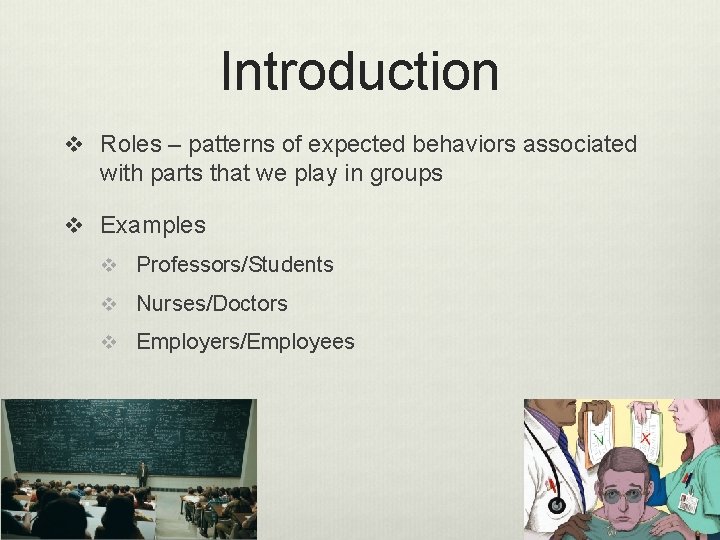
Introduction v Roles – patterns of expected behaviors associated with parts that we play in groups v Examples v Professors/Students v Nurses/Doctors v Employers/Employees
Influence of Roles v Role Status – what are the perceptions of your role? v Importance, prestige, power v Role Conflict v Having to balance/choose v How do we prioritize? v Role Reversal v Empathy
Types of Roles v Formal roles v Position assigned or designated v Informal roles v Emergence v Function, not position v Task roles v How do you contribute to getting things done?
Types of Roles v Task Roles v Contributing to task dimensions v e. g. “Information seeker, ” “Coordinator, ” “Devil’s advocate” v Maintenance Roles v Striving to promote and maintain group cohesiveness v e. g. “Harmonizer-Tension Reliever, ” “Gatekeeper. Expediter” v Disruptive Roles v Me-oriented v Diminishes productivity and cohesiveness v e. g. “Clown, ” “Cynic”
Role Adaptability v Tensions during role assignments or formations v Role flexibility v “the capacity to recognize the current requirements of the group and then enact the role-specific behaviors most appropriate in the given context” v Role fixation v “acting out of a specific role and that role alone no matter what the situation might require” v Why should group members exhibit role flexibility?
Role Emergence v “Role emergence is a relevant concern primarily to small, informal, leaderless groups without a history. ” v Members bid for a desired role and seek endorsement from other members. v Trial-and-error model v Maintenance roles tend to be viewed as lower in status. v Role specialization v Settle into role, but not trapped
Newcomers v Experiences of new members are influenced by: v Level of group development v Level of group performance v Number of members v Degree of turnover v Group’s expectations that newcomers will adopt the norms, values, and practices of the group v Hazing v Group socialization