
Chapter 5 Robbins and Judge Personality and Values
Chapter 5 Robbins and Judge Personality and Values 5 -1
PERSONALITY � � � Personality is a dynamic concept describing the growth and development of a person’s whole psychological system It looks at some aggregate whole that is greater than the sum of the parts. Defining Personality � Personality as the sum total of ways in which an individual reacts to and interacts with others. Managers can use personality tests in hiring decisions and help forecast who is best for a job. � The common means of measuring personality is � � through self-report surveys. � Observer-ratings surveys provide an independent assessment of personality. 5 -2
DETERMINANTS OF PERSONALITY � Heredity refers to those factors that were determined at conception. � The heredity approach argues that the ultimate explanation of an individual’s personality is the molecular structure of the genes, located in the chromosomes. � Popular characteristics include shy, aggressive, submissive, lazy, ambitious, loyal, and timid. These are personality traits. � Early efforts to identify the primary traits that govern behavior often resulted in long lists that were difficult to generalize from and provided little practical guidance to organizational decision makers. 5 -3
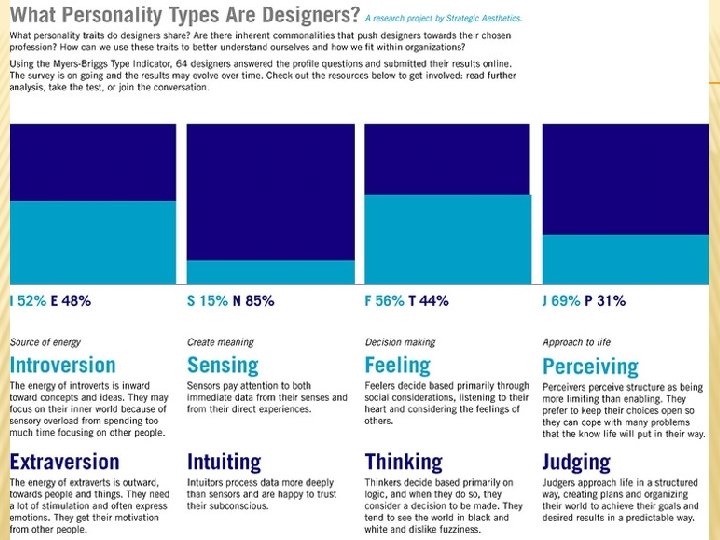
LO DESCRIBE Copyright THE© 2013 MYERS-BRIGGS TYPE Pearson Education, Inc. publishing as Prentice Hall INDICATOR PERSONALITY FRAMEWORK 2 AND ASSESS ITS STRENGTHS AND WEAKNESSES One of the most widely used personality frameworks is the Myers-Briggs Type Indicator (MBTI). � Individuals are classified as: � Extroverted or introverted (E or I). � Sensing or intuitive (S or N). � Thinking or feeling (T or F). � Perceiving or judging (P or J). � 5 -4
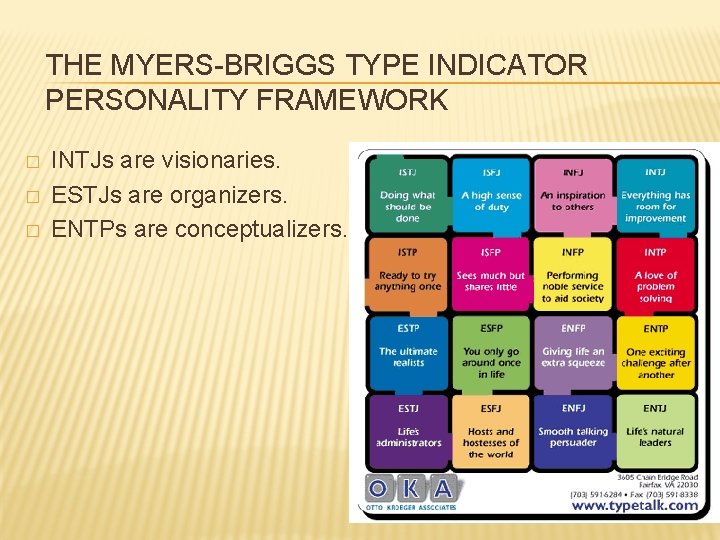
THE MYERS-BRIGGS TYPE INDICATOR PERSONALITY FRAMEWORK � � � INTJs are visionaries. ESTJs are organizers. ENTPs are conceptualizers. 5 -5
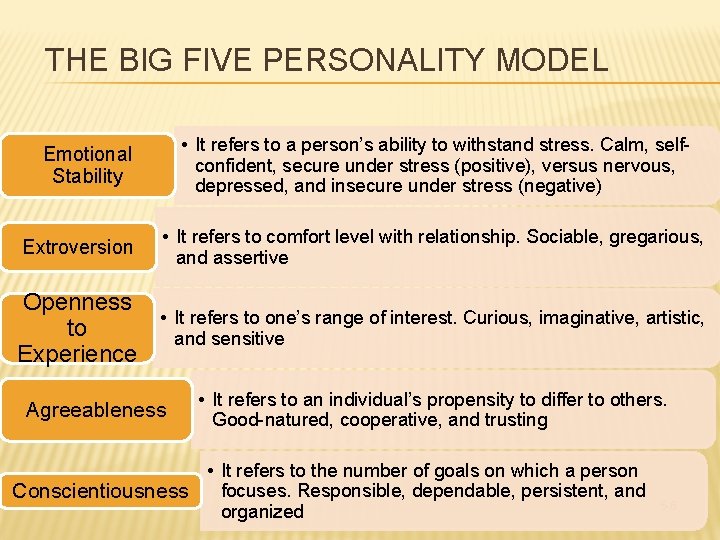
THE BIG FIVE PERSONALITY MODEL • It refers to a person’s ability to withstand stress. Calm, selfconfident, secure under stress (positive), versus nervous, depressed, and insecure under stress (negative) Emotional Stability Extroversion • It refers to comfort level with relationship. Sociable, gregarious, and assertive Openness • It refers to one’s range of interest. Curious, imaginative, artistic, to and sensitive Experience Agreeableness • It refers to an individual’s propensity to differ to others. Good-natured, cooperative, and trusting • It refers to the number of goals on which a person focuses. Responsible, dependable, persistent, and Conscientiousness organized 5 -6
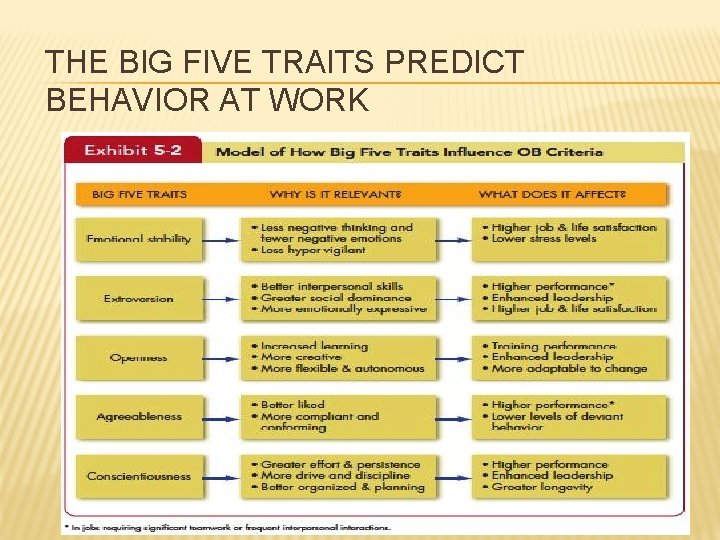
THE BIG FIVE TRAITS PREDICT BEHAVIOR AT WORK 5 -7
THE BIG FIVE TRAITS AT WORK The five factors appear in almost all crosscultural studies. � Differences are complex but seem to depend on whether countries are predominantly individualistic or collectivistic. � They appear to predict a bit better in individualistic than in collectivist cultures. � 5 -8
OTHER PERSONALITY TRAITS RELEVANT TO OB Core Self-Evaluation (Self-perspective) � Machiavellianism (Machs) � Narcissism � Self-Monitoring � Risk Taking � Type A personality � Proactive Personality � 5 -9
PERSONALITY TRAITS RELEVANT TO OB � Core Self-Evaluation � The degree to which people like or dislike themselves � People with positive core self evaluation like themselves, and see themselves as effective, capable and in control of their environment. � Positive self-evaluation leads to higher job performance. They set more ambitious goal, more committed to their goals. Get promoted more rapidly. � Machiavellianism � A pragmatic, emotionally distant power-player who believes that ends justify the means � High Machs are manipulative, win more often, and persuade more than they are persuaded. Flourish when: � Have direct interaction � Work with minimal rules and regulations � Emotions distract others 5 -10
MORE RELEVANT PERSONALITY TRAITS � � Narcissism � An arrogant, entitled, self-important person who needs excessive admiration � Tend to be selfish, exploitative and treat others as if they were inferior. � Less effective in their jobs Self-Monitoring � The ability to adjust behavior to meet external, situational factors. � Striking contradiction between public persona and private self. � Pay more attention to others behavior. � High monitors conform more and are more likely to become leaders. � Less committed to the organization, get more rapid promotion. 5 -11
MORE RELEVANT PERSONALITY TRAITS � Risk Taking � The willingness to take chances. � May be best to align propensities with job requirements. � Risk takers make faster decisions with less information. � Proactive Personality � Identifies opportunities, shows initiative, takes action, and perseveres to completion � Creates positive change in the environment 5 -12
MORE RELEVANT PERSONALITY TRAITS � Type A Personality � Aggressively involved in a chronic, incessant struggle to achieve more in less time � Impatient: always moving, walking, and eating rapidly � Strive to think or do two or more things at once � Cannot cope with leisure time � Obsessed with achievement numbers � Prized low � Type in North America but quality of the work is B people are the complete opposite 5 -13
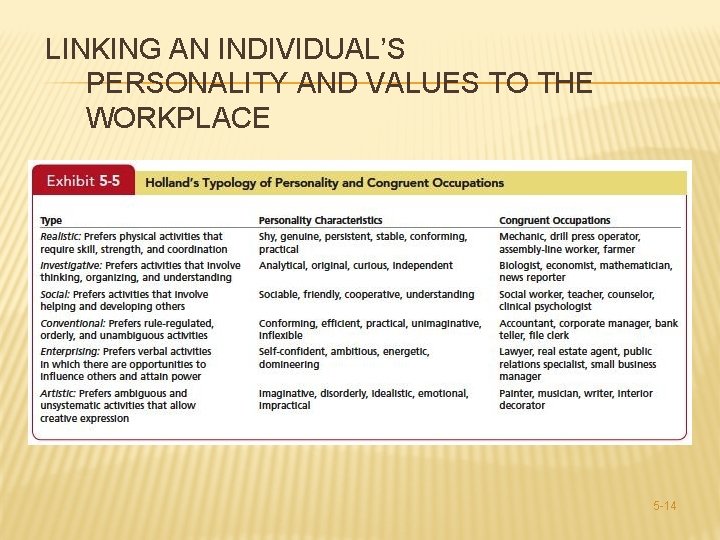
LINKING AN INDIVIDUAL’S PERSONALITY AND VALUES TO THE WORKPLACE 5 -14
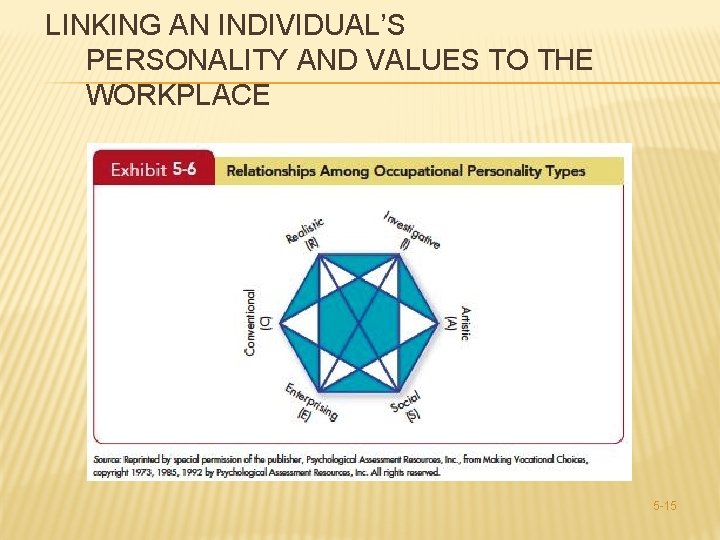
LINKING AN INDIVIDUAL’S PERSONALITY AND VALUES TO THE WORKPLACE 5 -15
LINKING AN INDIVIDUAL’S PERSONALITY AND VALUES TO THE WORKPLACE People high on extraversion fit well with aggressive and team-oriented cultures, � People high on agreeableness match up better with a supportive organizational climate than one focused on aggressiveness, � People high on openness to experience fit better in organizations that emphasize innovation rather than standardization. � 5 -16
SUMMARY AND IMPLICATIONS FOR MANAGERS � � Big Five provides a meaningful way for managers to examine personality Managers’ keys �Screening job candidates for high conscientiousness �Factors such as job demands, the degree of required interaction with others, and the organization’s culture are examples of situational variables that moderate the personality–job performance relationship. 5 -17
SUMMARY AND IMPLICATIONS FOR MANAGERS You need to evaluate the job, the work group, and the organization to determine the optimal personality fit. � Other traits, such as core self-evaluation or narcissism, may be relevant in certain situations, too. � Although the MBTI has been widely criticized, it may have a place in organizations. � 5 -18
- Slides: 18