
Chapter 5 Review Mitosis and Asexual Reproduction Chapter
- Slides: 12
Chapter 5 Review Mitosis and Asexual Reproduction
Chapter 5 – Mitosis • What is the longest stage of the cell cycle? A – interphase • What occurs during interphase? A – growth and preparation, DNA replication, protein synthesis. • What are the other two stages of the cell cycle? A – mitosis and cell division (cytokinesis) • Why does a cell divide? A – The surface area to volume ratio is small.
DNA Replication • What is the first step in DNA replication? A – DNA sides separate • What aids in separating the DNA sides? A – enzymes • What occurs in step 2 of DNA replication? A – New bases pair with the bases on the original DNA • Why is DNA replication important? A – So that when the cell divides, the new daughter cells will have all of the genetic information.
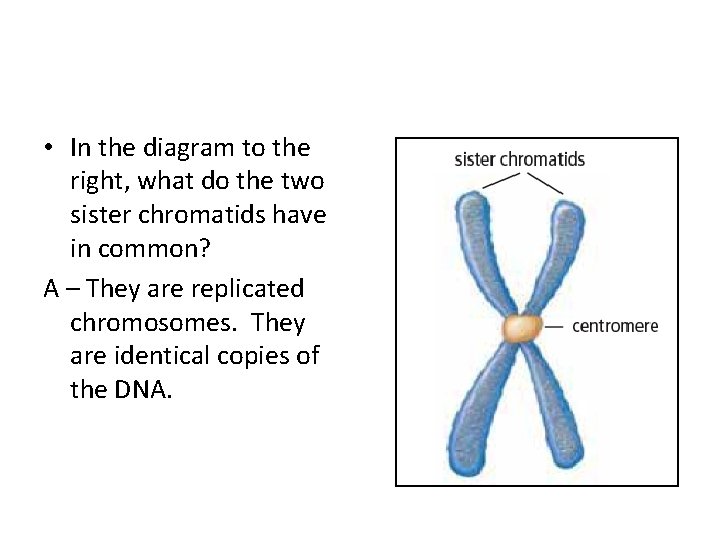
• In the diagram to the right, what do the two sister chromatids have in common? A – They are replicated chromosomes. They are identical copies of the DNA.
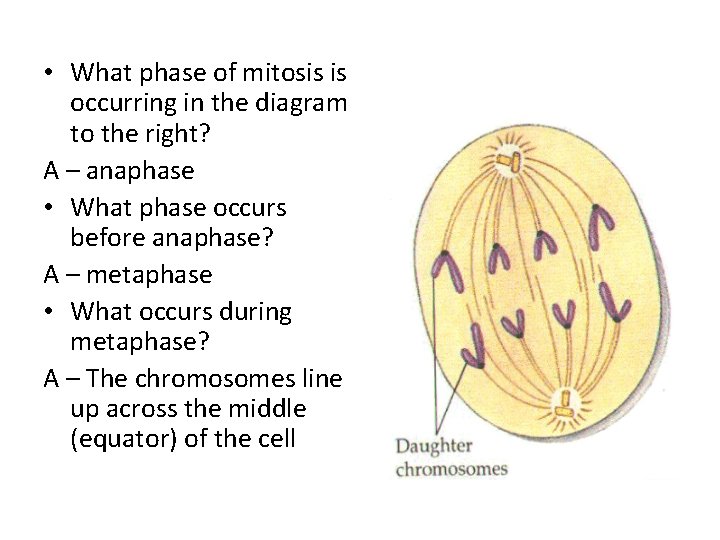
• What phase of mitosis is occurring in the diagram to the right? A – anaphase • What phase occurs before anaphase? A – metaphase • What occurs during metaphase? A – The chromosomes line up across the middle (equator) of the cell
• What is being produced during telophase of mitosis? A – two nuclei • What are two difference between mitosis/cytokinesis in plants and animals? A – Plants doen’t have centrioles and animals don’t produce a cell plate. • If you started out with 365 chromosomes in the parent cell, how many chromosomes would each of the daughter cells have? A – 365
• What is the correct order of the stages of mitosis? A – prophase, metaphase, anaphase, telophase • What is another word for cell division? A – cytokinesis • How many parents are there in asexual reproduction? A - One
Asexual Reproduction • Which of the following is not a type of asexual reproduction: spore formation, gamete formation, binary fission, budding, fragmentation, vegetative reproduction? A – gamete formation • Define clone. A - a genetically identical offspring of an single parent.
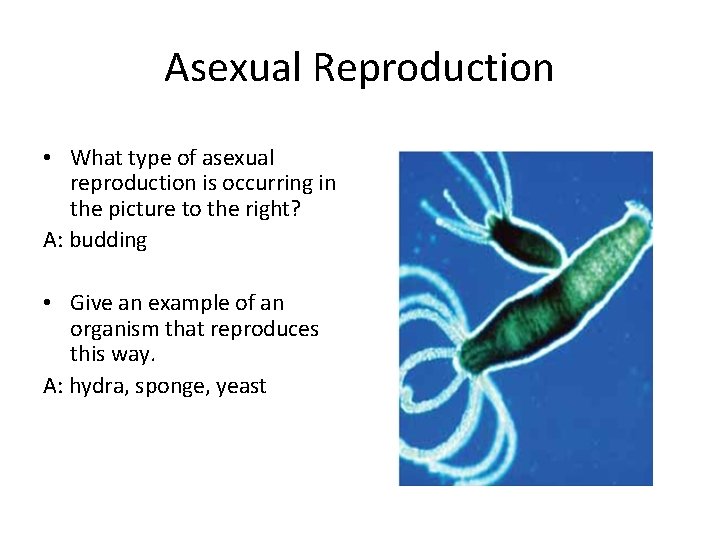
Asexual Reproduction • What type of asexual reproduction is occurring in the picture to the right? A: budding • Give an example of an organism that reproduces this way. A: hydra, sponge, yeast
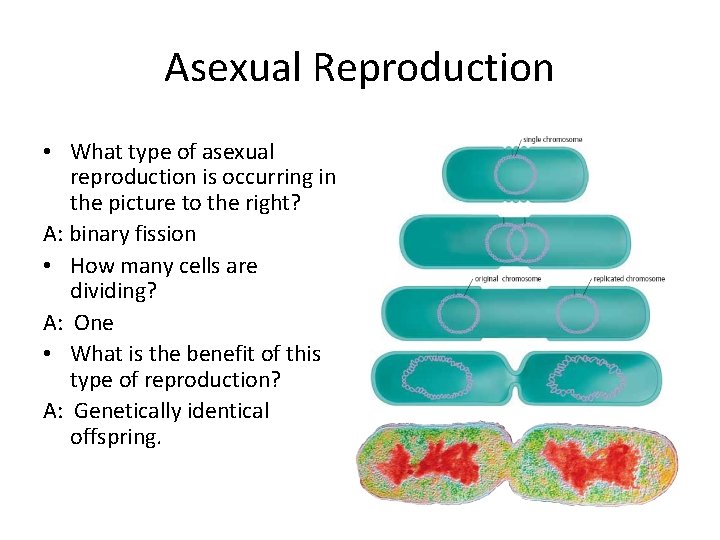
Asexual Reproduction • What type of asexual reproduction is occurring in the picture to the right? A: binary fission • How many cells are dividing? A: One • What is the benefit of this type of reproduction? A: Genetically identical offspring.
Asexual Reproduction • How do Eurasian milfoil and starfish reproduce? A – fragmentation/regeneration • A graft would be made during what type of asexual reproduction? A – vegetative reproduction. • Give an example that uses spore formation as it reproductive method. A – bread mould, mosses, ferns, fungi
What to Study continued… Chapter 5 • Stages of the cell cycle – interphase, mitosis, cytokinesis • DNA replication • Mitosis stages – what occurs at each stage • What is the purpose of mitosis • What is the end result of mitosis • Different types of asexual reproduction