
Chapter 5 Quantum Mechanics Limitations of the Bohr

Chapter 5: Quantum Mechanics Limitations of the Bohr atom necessitate a more general approach de Broglie waves –> a “new” wave equation “probability” waves classical mechanics as an approximation Wave Function Y probability amplitude cphys 351 c 5: 1
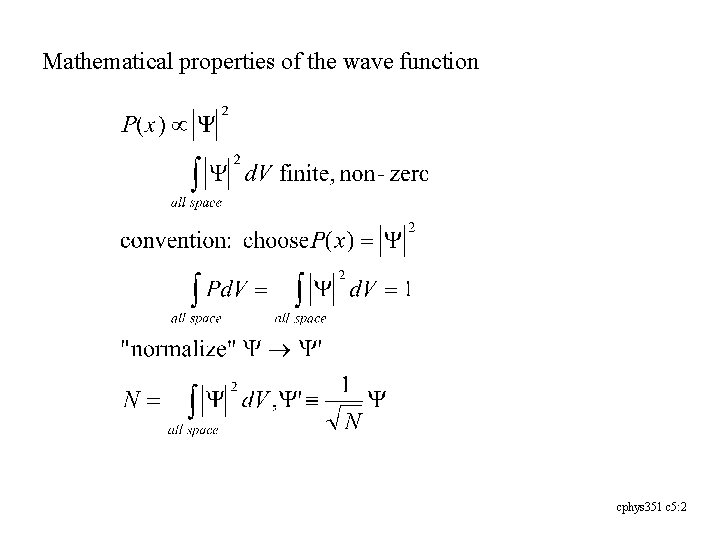
Mathematical properties of the wave function cphys 351 c 5: 2
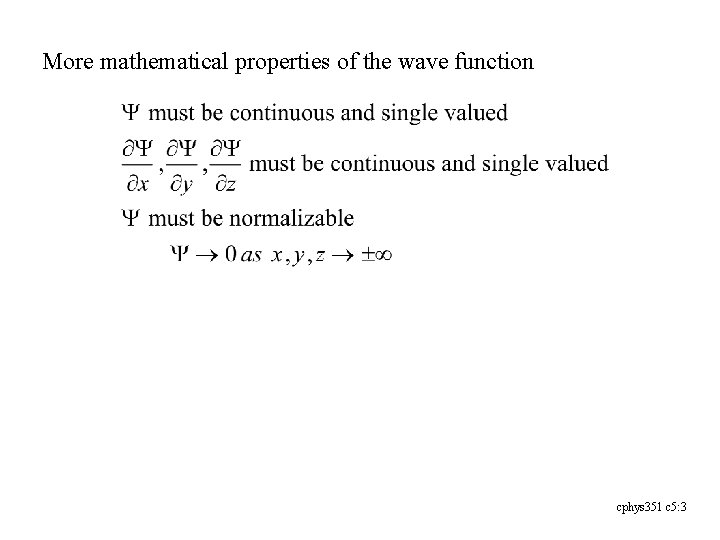
More mathematical properties of the wave function cphys 351 c 5: 3
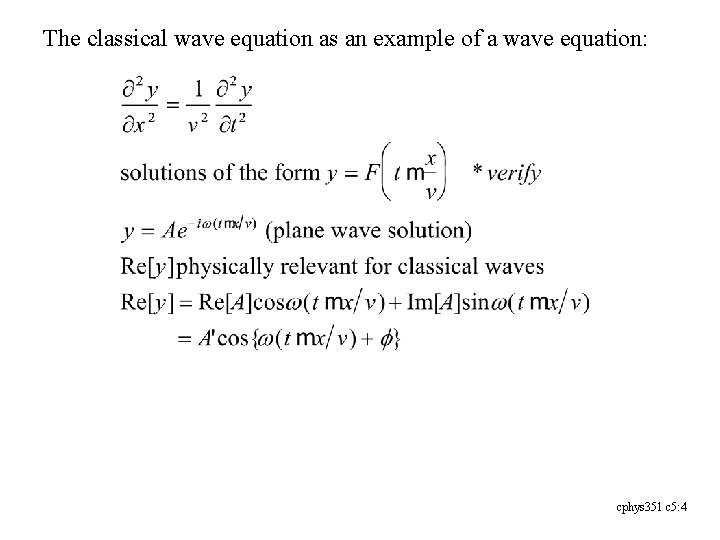
The classical wave equation as an example of a wave equation: cphys 351 c 5: 4
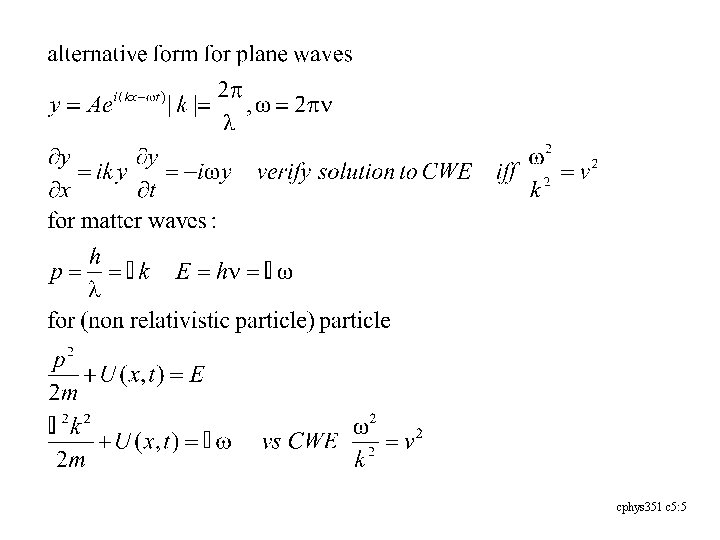
cphys 351 c 5: 5
Time dependent Schrödinger Equation linear (in Y) partial differential equation cphys 351 c 5: 6
Expectation values (average values) cphys 351 c 5: 7
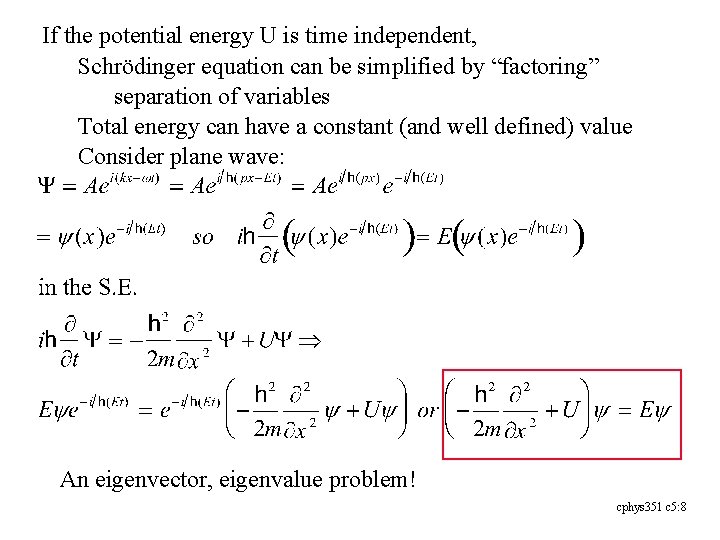
If the potential energy U is time independent, Schrödinger equation can be simplified by “factoring” separation of variables Total energy can have a constant (and well defined) value Consider plane wave: An eigenvector, eigenvalue problem! cphys 351 c 5: 8
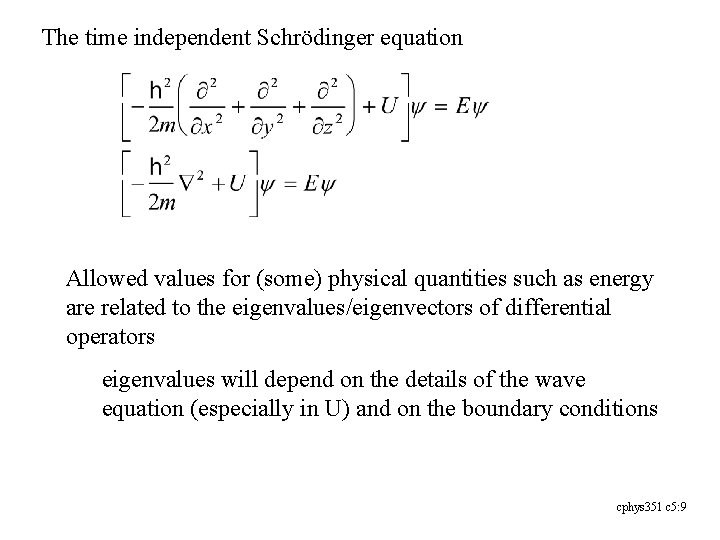
The time independent Schrödinger equation Allowed values for (some) physical quantities such as energy are related to the eigenvalues/eigenvectors of differential operators eigenvalues will depend on the details of the wave equation (especially in U) and on the boundary conditions cphys 351 c 5: 9
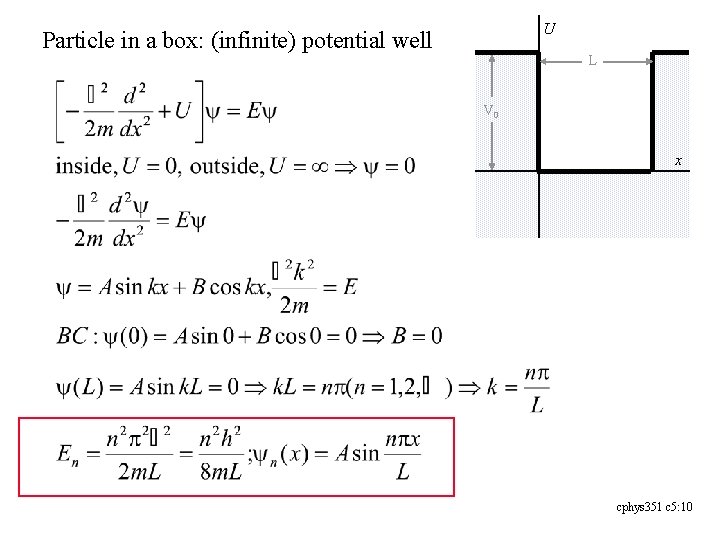
U Particle in a box: (infinite) potential well L V 0 x cphys 351 c 5: 10
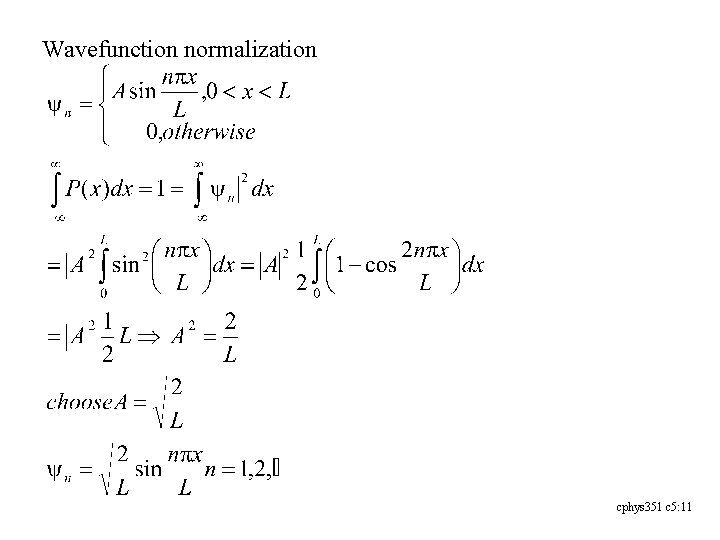
Wavefunction normalization cphys 351 c 5: 11
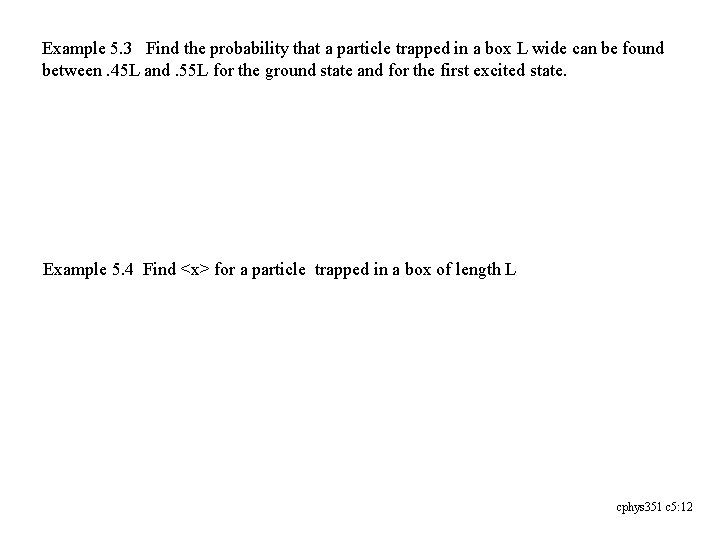
Example 5. 3 Find the probability that a particle trapped in a box L wide can be found between. 45 L and. 55 L for the ground state and for the first excited state. Example 5. 4 Find <x> for a particle trapped in a box of length L cphys 351 c 5: 12
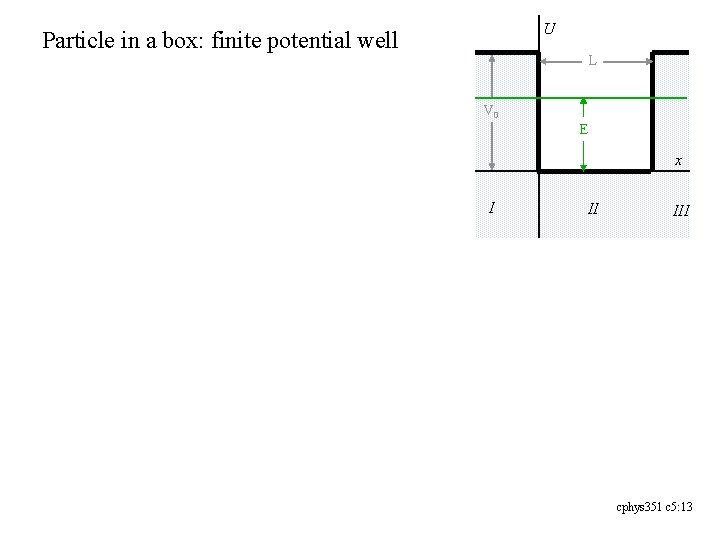
U Particle in a box: finite potential well L V 0 E x I II III cphys 351 c 5: 13
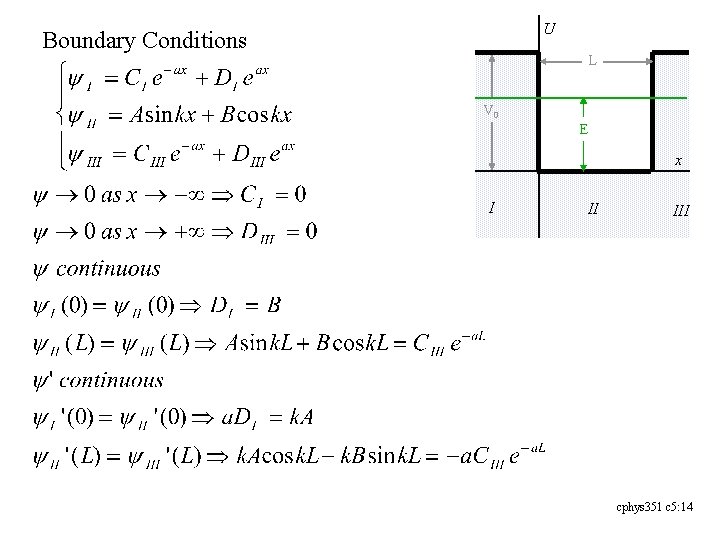
U Boundary Conditions L V 0 E x I II III cphys 351 c 5: 14

cphys 351 c 5: 15
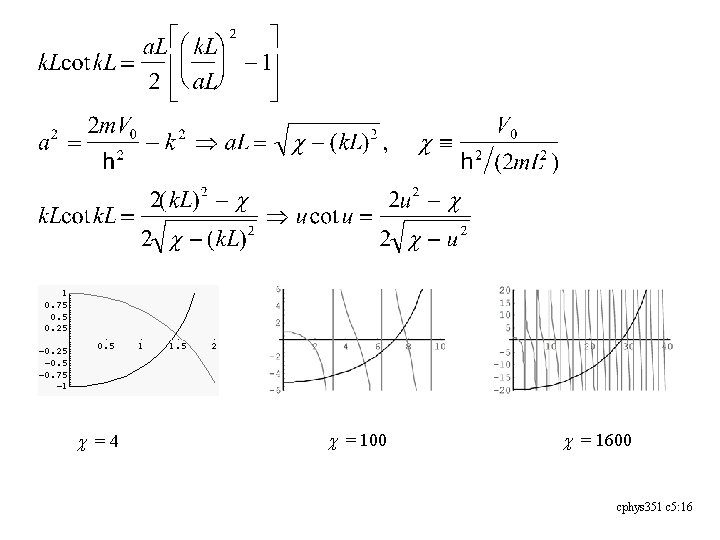
c =4 c = 100 c = 1600 cphys 351 c 5: 16
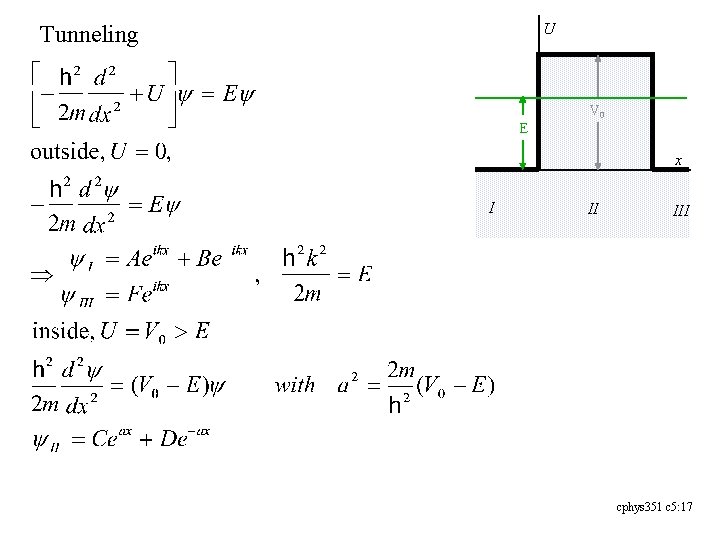
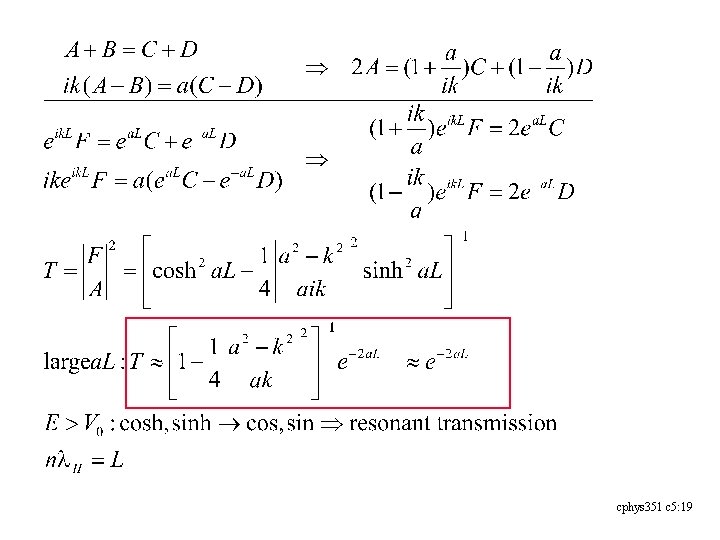
U Tunneling L V 0 E x I II III cphys 351 c 5: 17
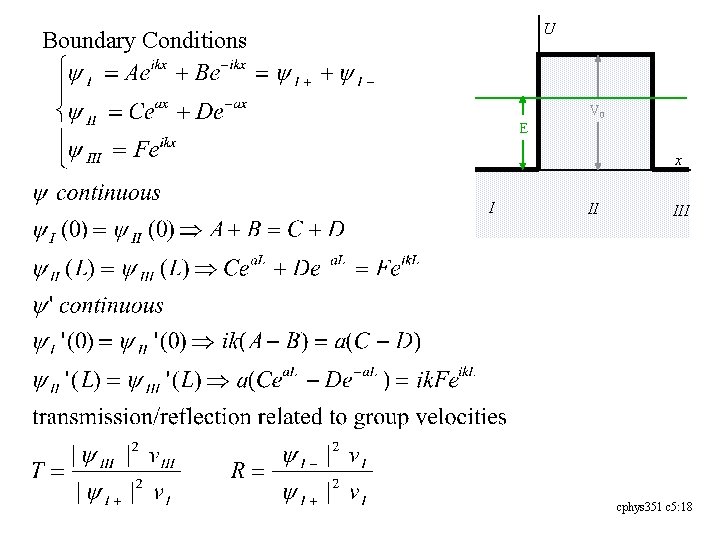
U Boundary Conditions L V 0 E x I II III cphys 351 c 5: 18
cphys 351 c 5: 19
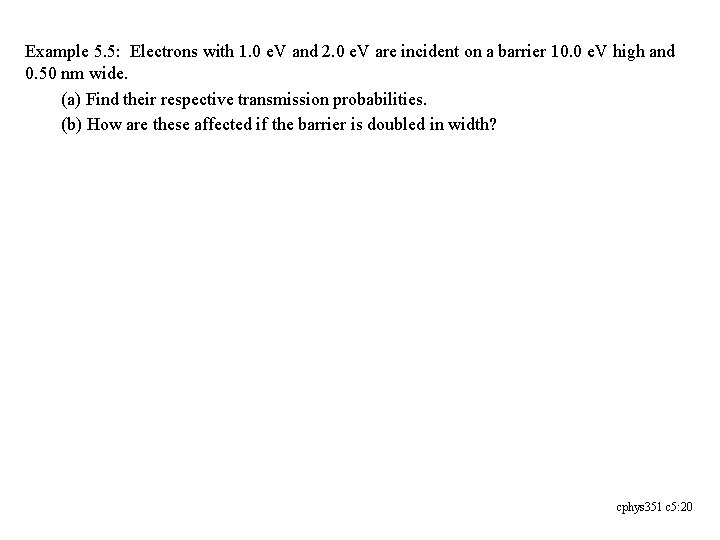
Example 5. 5: Electrons with 1. 0 e. V and 2. 0 e. V are incident on a barrier 10. 0 e. V high and 0. 50 nm wide. (a) Find their respective transmission probabilities. (b) How are these affected if the barrier is doubled in width? cphys 351 c 5: 20
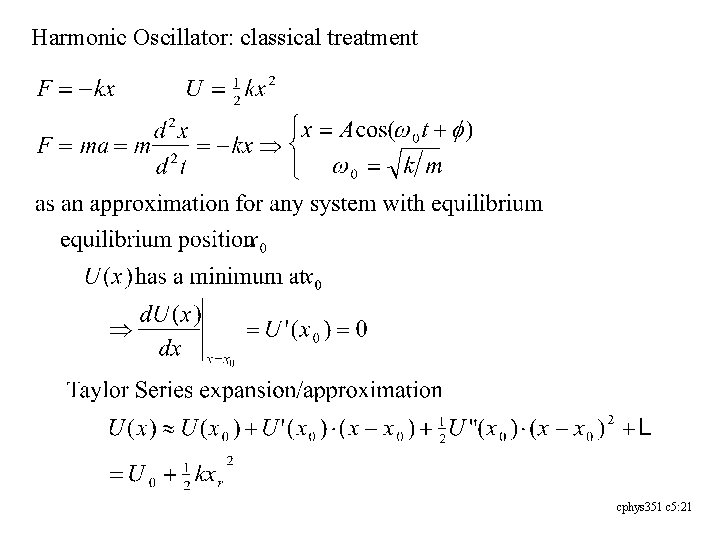
Harmonic Oscillator: classical treatment cphys 351 c 5: 21
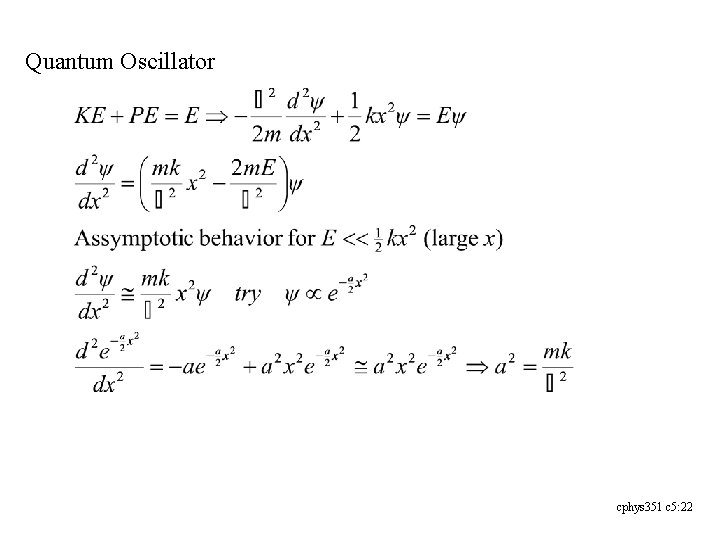
Quantum Oscillator cphys 351 c 5: 22
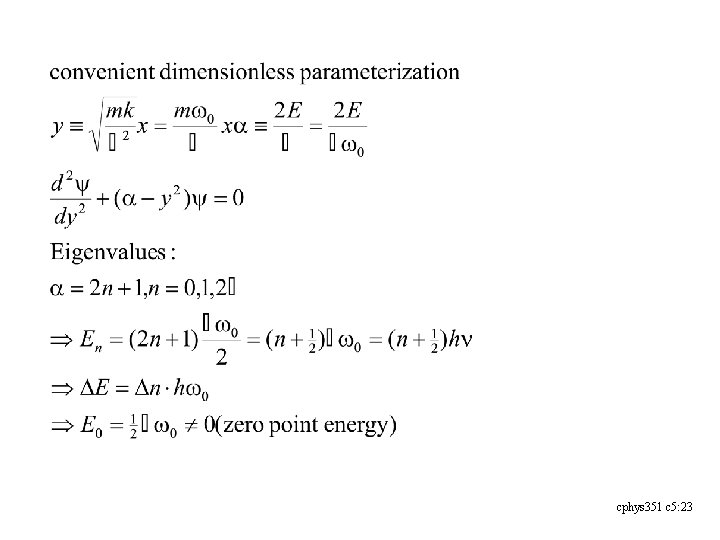
cphys 351 c 5: 23
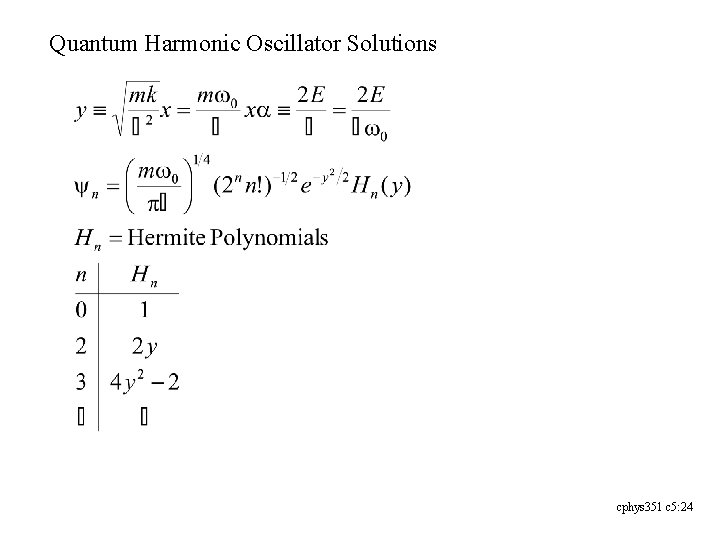
Quantum Harmonic Oscillator Solutions cphys 351 c 5: 24
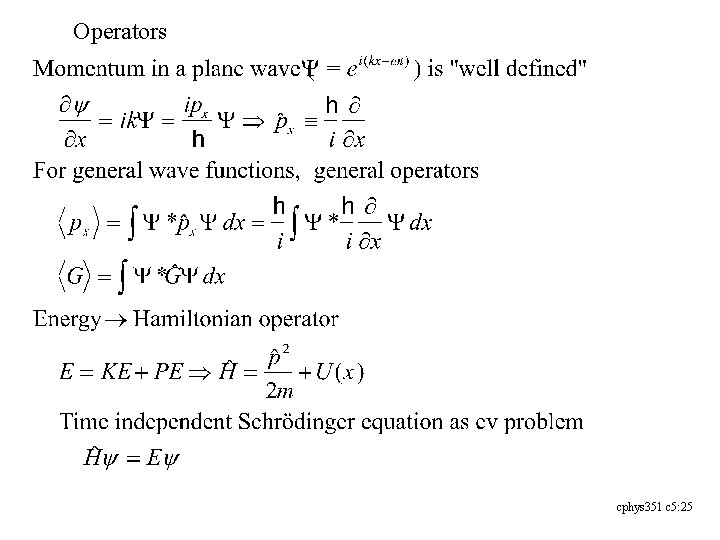
Operators cphys 351 c 5: 25
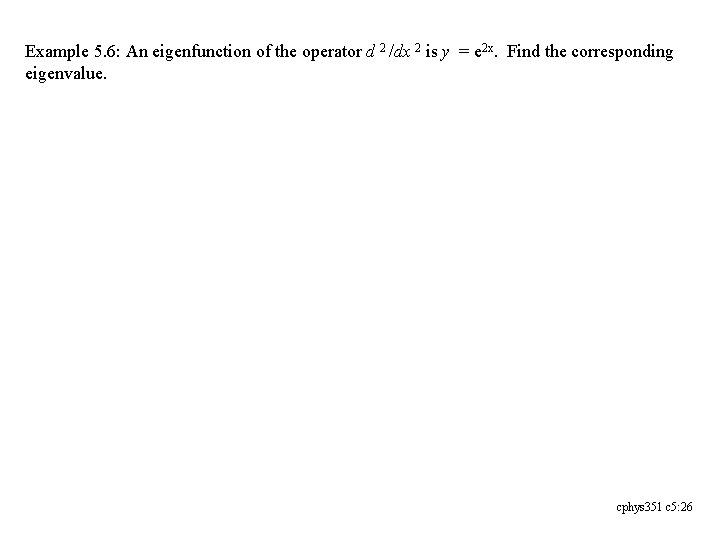
Example 5. 6: An eigenfunction of the operator d 2 /dx 2 is y = e 2 x. Find the corresponding eigenvalue. cphys 351 c 5: 26
Chapter 5 exercises: 4, 5, 6, 11, 23 cphys 351 c 5: 27
- Slides: 27