CHAPTER 5 Quadrilaterals SECTION 5 1 Properties of
- Slides: 41
CHAPTER 5 Quadrilaterals
SECTION 5 -1 Properties of Parallelograms
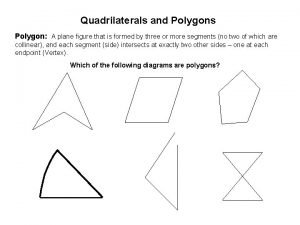
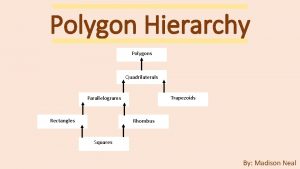
• Quadrilateral - a closed plane figure that has four sides
• Opposite sides two sides that do not share a common endpoint
• Opposite angles two angles that do not share a common side
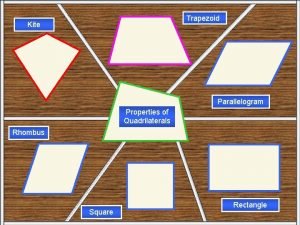
• Parallelogram - a quadrilateral with both pairs of opposite sides parallel.
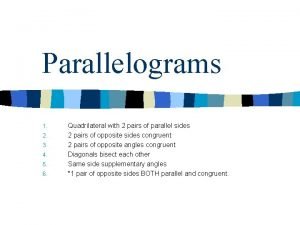
THEOREM 5 -1 • Opposite sides of a parallelogram are congruent
THEOREM 5 - 2 • Opposite angles of a parallelogram are congruent
THEOREM 5 - 3 • Diagonals of a parallelogram bisect each other
SECTION 5 -2 Ways to Prove that Quadrilaterals Are Parallelograms
THEOREM 5 - 4 • If both pairs of opposite sides of a quadrilateral are congruent, then the quadrilateral is a parallelogram.
THEOREM 5 - 5 • If one pair of opposite sides of a quadrilateral are both congruent and parallel, then the quadrilateral is a parallelogram.
THEOREM 5 - 6 • If both pairs of opposite angles of a quadrilateral are congruent, then the quadrilateral is a parallelogram.
THEOREM 5 - 7 • If the diagonals of a quadrilateral bisect each other, then the quadrilateral is a parallelogram.
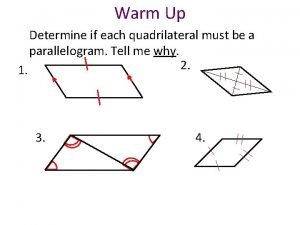
Ways to Prove that Quadrilaterals Are Parallelograms 1. Show that both pairs of opposite sides are parallel. 2. Show that both pairs of opposite sides are congruent 3. Show that one pair of opposite sides are both
Ways to Prove that Quadrilaterals Are Parallelograms 4. Show that both pairs of opposite angles are congruent. 5. Show that the diagonals bisect each other
SECTION 5 -3 Theorems Involving Parallel Lines
THEOREM 5 - 8 • If two lines are parallel, then all points on one line are equidistant from the other line.
THEOREM 5 - 9 • If three parallel lines cut off congruent segments on one transversal, then they cut off congruent segments on every
THEOREM 5 - 10 • A line that contains the midpoint of one side of a triangle and is parallel to another side passes through the midpoint of the
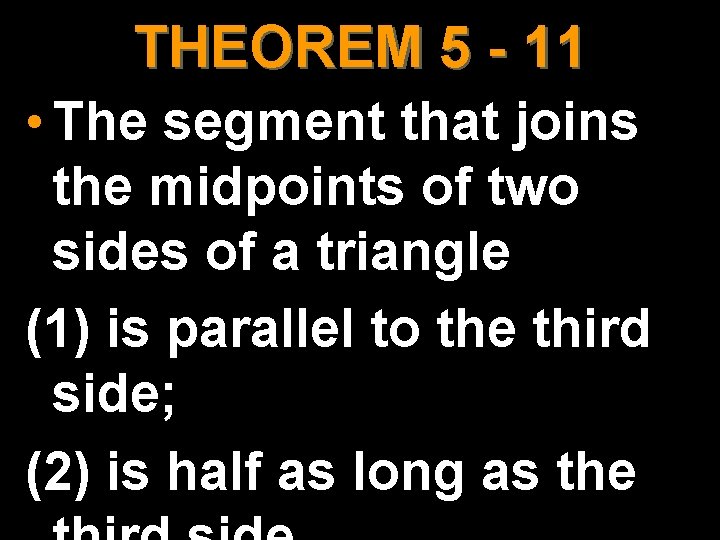
THEOREM 5 - 11 • The segment that joins the midpoints of two sides of a triangle (1) is parallel to the third side; (2) is half as long as the
SECTION 5 -4 Special Parallelograms
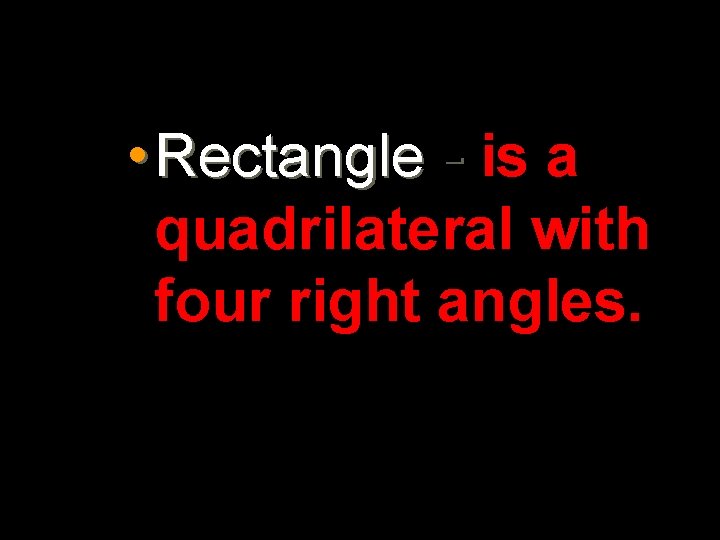
• Rectangle - is a quadrilateral with four right angles.
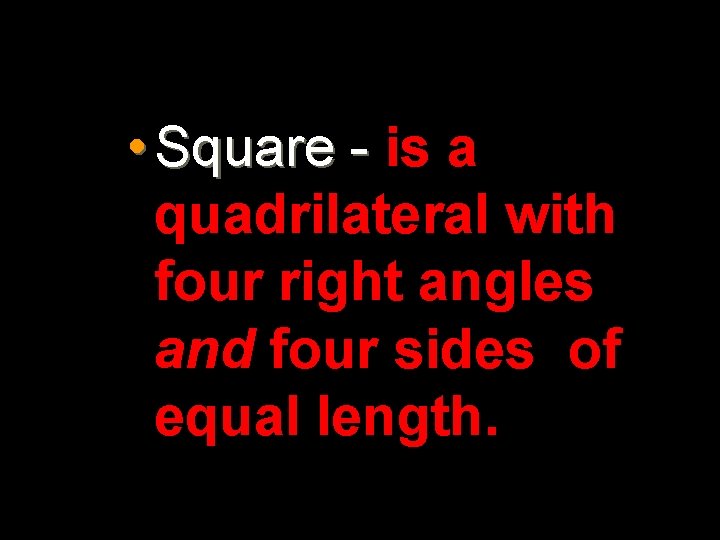
• Square - is a quadrilateral with four right angles and four sides of equal length.
• Rhombus - is a quadrilateral with four sides of equal length.
THEOREM 5 - 12 • The diagonals of a rectangle are congruent.
THEOREM 5 - 13 • The diagonals of a rhombus are perpendicular.
THEOREM 5 - 14 • Each diagonal of a rhombus bisects two angles of the rhombus
THEOREM 5 - 15 • The midpoint of the hypotenuse of a right triangle is equidistant from the three vertices
THEOREM 5 - 16 • If an angle of a parallelogram is a right angle, then the parallelogram is a rectangle.
THEOREM 5 - 17 • If two consecutive sides of a parallelogram are congruent, then the parallelogram is a
SECTION 5 -5 Trapezoids
• Trapezoid - a quadrilateral with exactly one pair of parallel sides.
• Bases - the sides that are parallel in a trapezoid.
• Legs - the nonparallel sides of a trapezoid.
• Base angles that share a base. Trapezoids have two pairs of base angles.
• Isosceles Trapezoid - a trapezoid with legs of equal length.
THEOREM 5 - 18 • Base angles of an isosceles trapezoid are congruent.
• Median - the segment that joins the midpoints of the legs.
THEOREM 5 - 19 The median of a trapezoid 1. is parallel to the bases; 2. length is equal to
• END Chapter 5