
Chapter 5 Public Choice and the Political Process
Chapter 5 Public Choice and the Political Process 1
The Supply of Public Goods Through Political Institutions n Public Choice involves decisions being made through political interaction of many persons according to pre-established rules. 2
Political Equilibrium n A political equilibrium is an agreement on the level of production of one or more public goods, given the specified rule for making the collective choice and the distribution of tax shares among individuals. 3
Tax Shares or Tax Prices n n Tax shares, sometimes called tax prices, are pre-announced levies assigned to citizens. They are a portion of the unit cost of a good proposed to be provided by government. ti = tax share to individual i ti = average cost of good 4
Individual's Choice n n Individuals make choices given their most preferred political outcomes. Each person will favor the quantity of the government-supplied good corresponding to the point at which the person’s tax share is exactly equal to the marginal benefit of the good to that person. 5
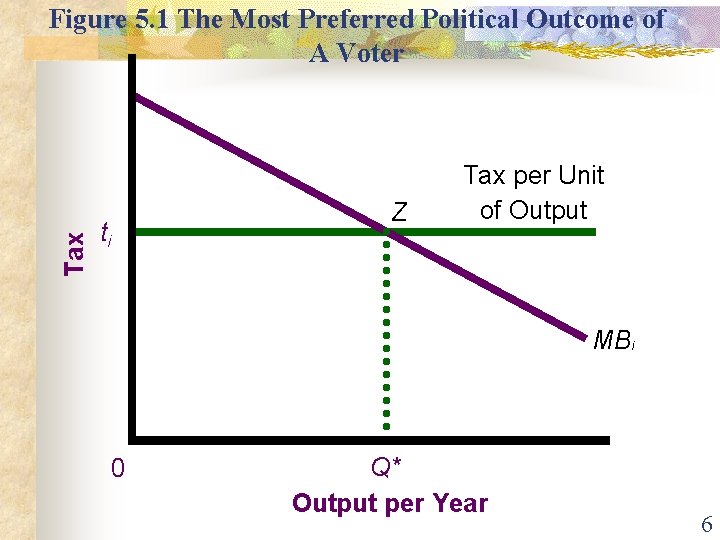
Tax Figure 5. 1 The Most Preferred Political Outcome of A Voter ti Z Tax per Unit of Output MBi 0 Q* Output per Year 6
The Choice to Vote or Not n Rational Ignorance is the idea that, to many voters, the marginal cost of obtaining information concerning an issue is greater than the marginal benefit of gaining that information. This leads the voter to fail to gather the information and then not to vote. 7
Determinants of Political Equilibrium n n n the public choice rule average and marginal costs of the public good information available on the cost and benefit the distribution of the tax shares distribution of benefits among voters 8
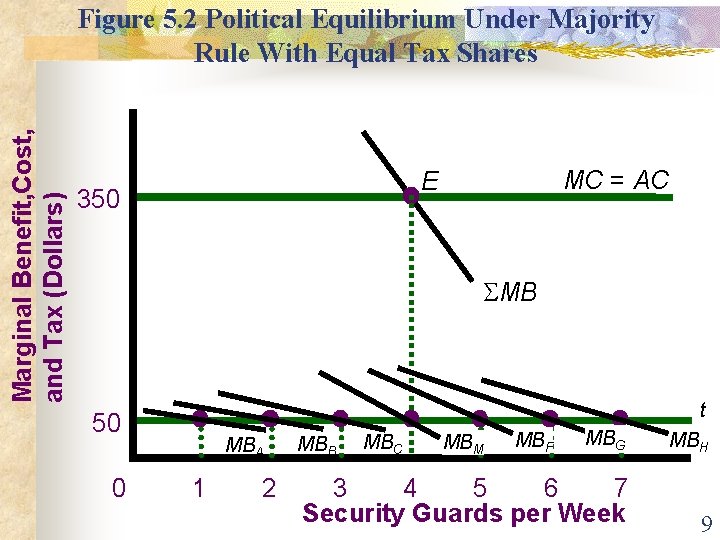
Marginal Benefit, Cost, and Tax (Dollars) Figure 5. 2 Political Equilibrium Under Majority Rule With Equal Tax Shares MC = AC E 350 MB t 50 0 MBA 1 2 MBB MBC MBM MBF MBG 3 4 5 6 7 Security Guards per Week MBH 9

Median Voter Model n The median voter model assumes that the voter whose most-preferred outcome is the median of the mostpreferred political outcomes of all those voting will become the political equilibrium. 10
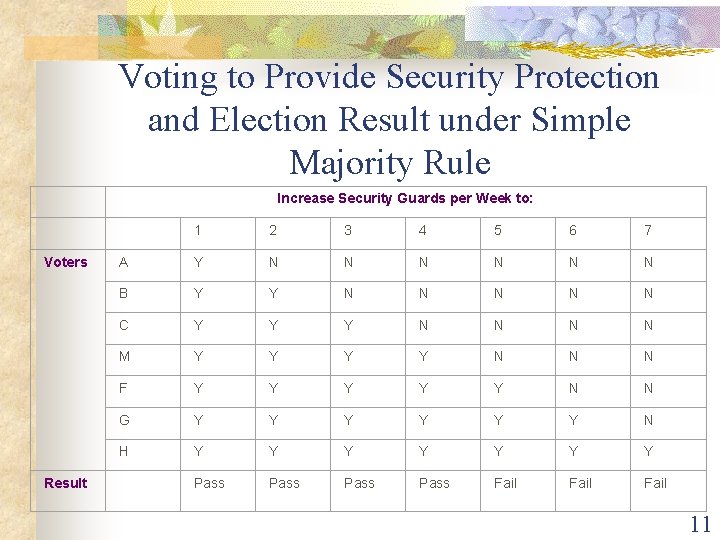
Voting to Provide Security Protection and Election Result under Simple Majority Rule Increase Security Guards per Week to: 1 2 3 4 5 6 7 Voters A Y N N N B Y Y N N N C Y Y Y N N M Y Y N N N F Y Y Y N N G Y Y Y N H Y Y Y Y Pass Fail Result 11

Implications of Median Voter Model n n Only the median voter gets his mostpreferred outcome. Others get either too little or too much. 12
Political Externalities n Political Externalities are the losses in well-being that occur when voters do not obtain their most-preferred outcomes, given their tax shares. 13

Political Transactions Costs n Political Transactions Costs are the measures of the value of time, effort, or other resources expended to reach or enforce a collective agreement. 14
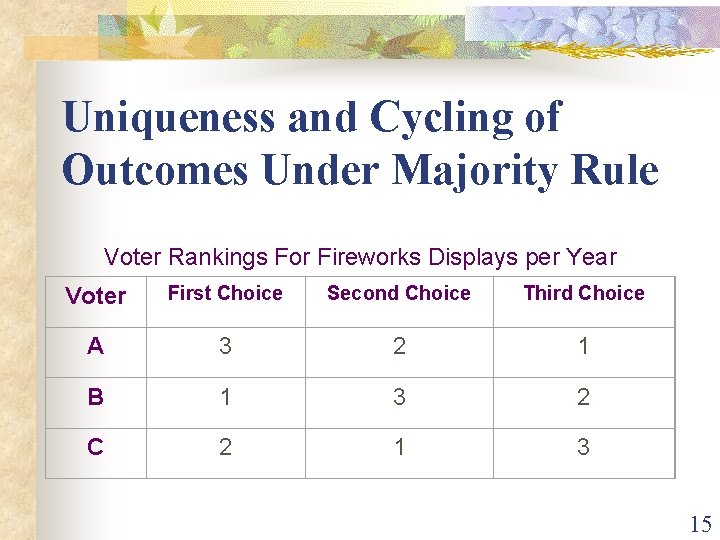
Uniqueness and Cycling of Outcomes Under Majority Rule Voter Rankings For Fireworks Displays per Year Voter First Choice Second Choice Third Choice A 3 2 1 B 1 3 2 C 2 1 3 15
Preferences n Single-peaked preferences n a unique optimal outcome exists n Multi-peaked preferences n as people move away from their most preferred outcome, they become worse off until a certain point. After that point, as they move further away from their most-preferred outcome they become better off. 16
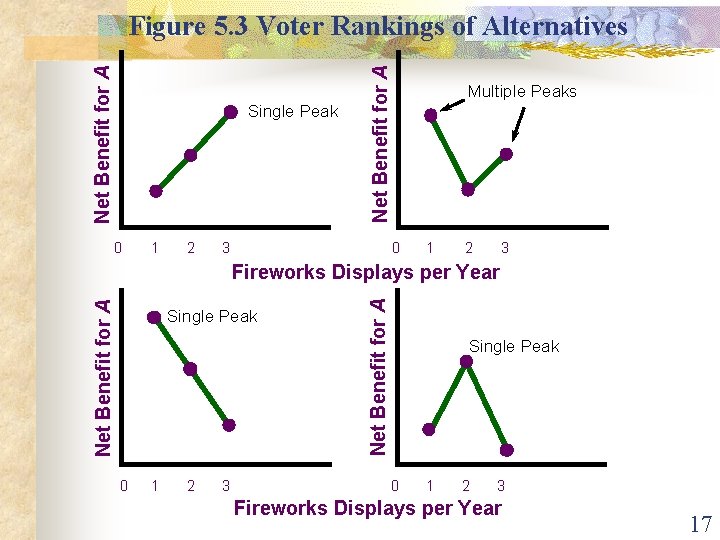
Single Peak 0 1 2 Net Benefit for A Figure 5. 3 Voter Rankings of Alternatives 3 Multiple Peaks 0 1 2 3 Single Peak 0 1 2 3 Net Benefit for A Fireworks Displays per Year Single Peak 0 1 2 3 Fireworks Displays per Year 17
Election 1: How Many Fireworks Displays per Year, 1 vs 2 n B votes for 1 A and C vote for 2 n Result 2 wins n 18
Election 2: How Many Fireworks Displays per Year, 3 vs 1 n A votes for 3 B and C vote for 1 n Result 1 wins n 19
Election 3: How Many Fireworks Displays per Year, 2 vs 3 n C votes for 2 A and B vote for 3 n Result 3 wins n 20
Pairwise Cycling n Pairwise cycling is a phenomenon in which each outcome can win a majority, depending on how it is paired on a ballot. 21
Arrow's Impossibility Theorem n It is impossible to devise a voting rule that meets a set of conditions that can guarantee a unique political equilibrium for a public choice. 22
Conditions of Arrow’s Impossibility Theorem n n n All voters have free choice; no dictator. We cannot rule out multi-peaked preferences. If all voters change their rankings of a particular alternative, the public choice that emerges must not move in the opposite direction. Public choices are not influenced by the order in which they are presented. Public choices must not be affected by the elimination or addition of alternatives to the ballot. Public choice, like all economic choices, should be transitive. 23
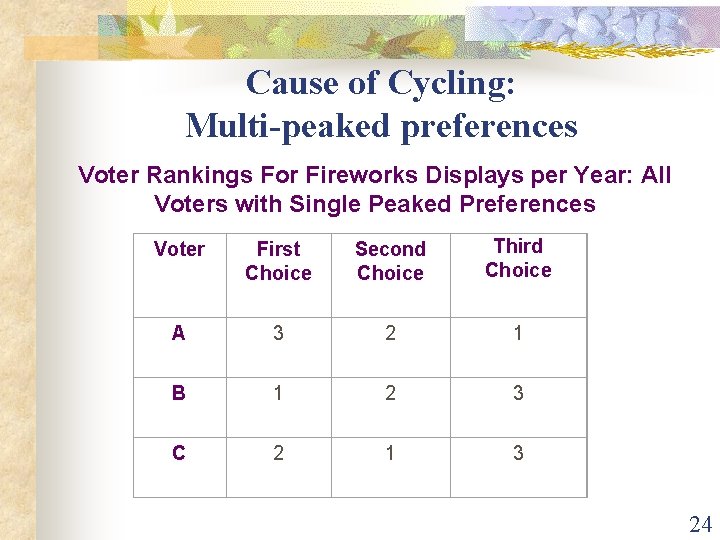
Cause of Cycling: Multi-peaked preferences Voter Rankings For Fireworks Displays per Year: All Voters with Single Peaked Preferences Voter First Choice Second Choice Third Choice A 3 2 1 B 1 2 3 C 2 1 3 24
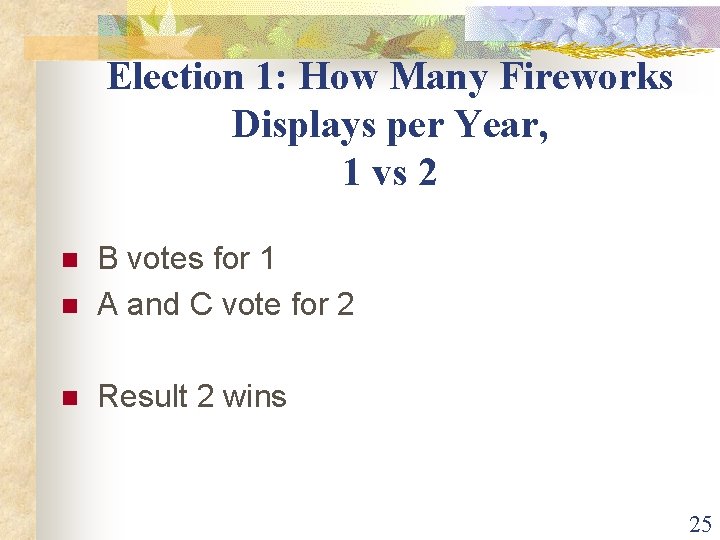
Election 1: How Many Fireworks Displays per Year, 1 vs 2 n B votes for 1 A and C vote for 2 n Result 2 wins n 25
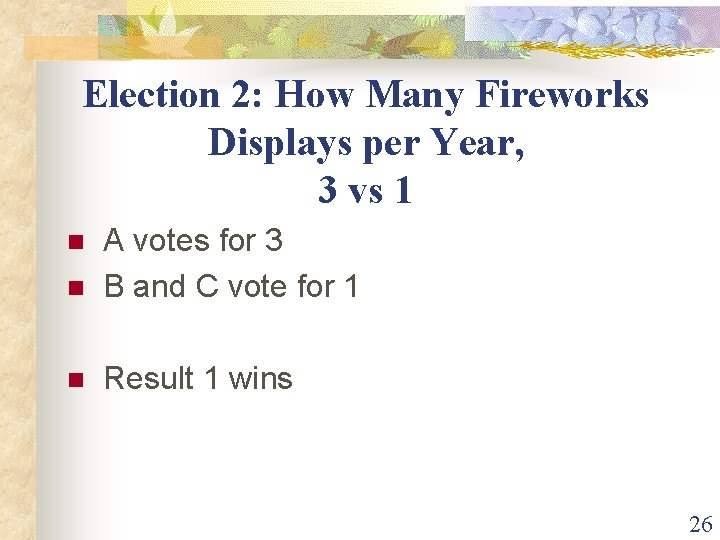
Election 2: How Many Fireworks Displays per Year, 3 vs 1 n A votes for 3 B and C vote for 1 n Result 1 wins n 26
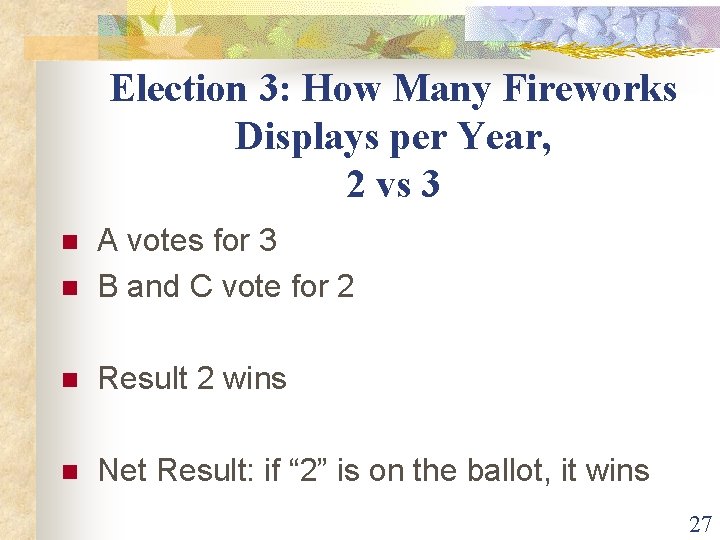
Election 3: How Many Fireworks Displays per Year, 2 vs 3 n A votes for 3 B and C vote for 2 n Result 2 wins n Net Result: if “ 2” is on the ballot, it wins n 27
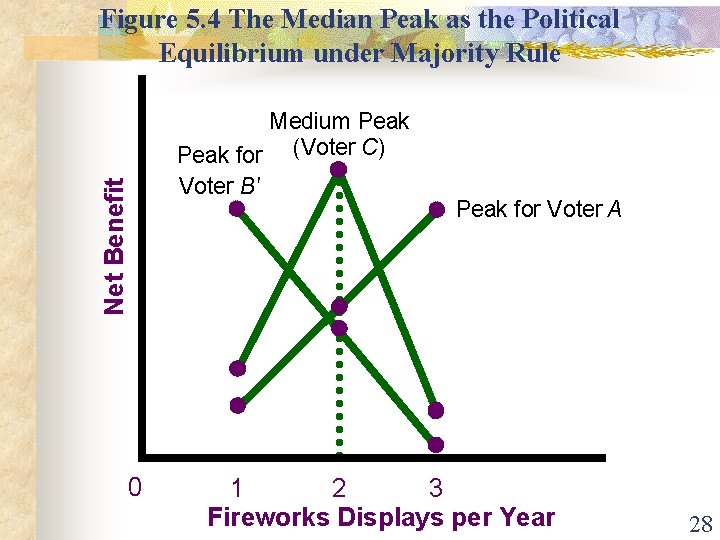
Figure 5. 4 The Median Peak as the Political Equilibrium under Majority Rule Net Benefit Medium Peak for (Voter C) 0 Voter B' Peak for Voter A 1 2 3 Fireworks Displays per Year 28
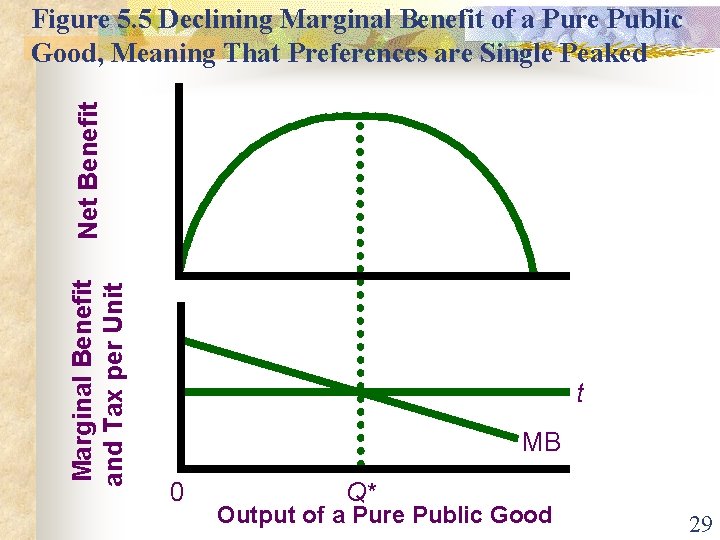
Marginal Benefit and Tax per Unit Net Benefit Figure 5. 5 Declining Marginal Benefit of a Pure Public Good, Meaning That Preferences are Single Peaked t MB 0 Q* Output of a Pure Public Good 29
Political Processes n n n Constitutions Minority Rule Majority Rule 30
Costs and Benefits of Collective Action n Benefit: decrease in political externalities n Cost: increase in political transaction costs 31
Possible Alternatives Methods n n n Unanimity Relative unanimity (2/3, 7/8 etc. ) Plurality rule (more than 3 outcomes possible) Point-count voting (enables voters to register the intensity of their preference) Instant Runoffs 32
Political Institutions in U. S. Cities n n In the United States, municipal government takes two basic forms. n City Manager Form: The city manager makes day-to-day decisions, and advises elected officials. The mayoral and council elections are typically nonpartisan. n Mayor – City Council Form: The mayor makes day-to-day decisions and elections are typically partisan. Researchers have found that relative to cities run by managers, those run by elected mayors: n n n have greater capital stock (roads, parks, police and fire stations), use relatively less labor in providing public services, spend the same amount of money. 33
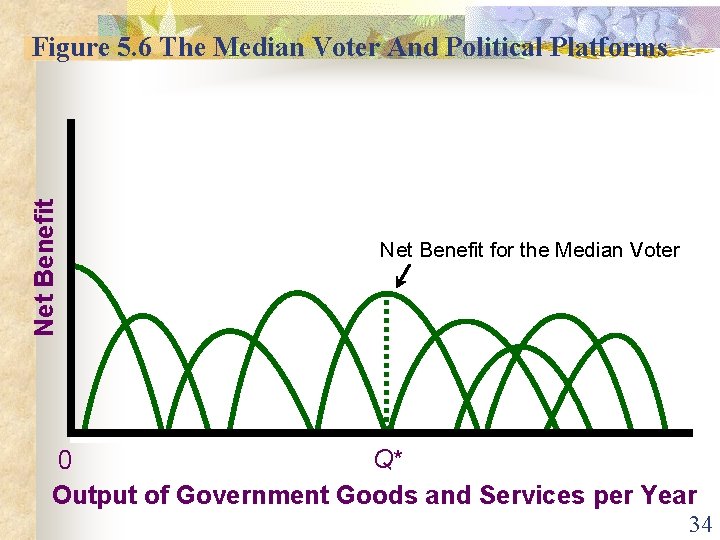
Net Benefit Figure 5. 6 The Median Voter And Political Platforms Net Benefit for the Median Voter Q* 0 Output of Government Goods and Services per Year 34
Forms of City Government and their Effects on Spending n Manager/Council Government n n Mayoral Government n n Unelected city manager makes most executive decisions, with policy recommendations by elected city council. Elected mayor makes most executive decisions. Results: n n Similar total expenditures Mayoral systems utilize more capital intensive public goods production. 35
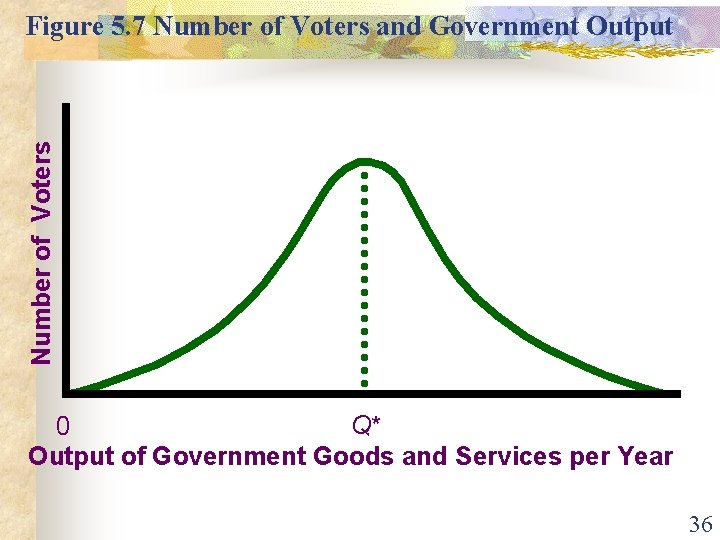
Number of Voters Figure 5. 7 Number of Voters and Government Output Q* 0 Output of Government Goods and Services per Year 36
Logrolling or Vote Trading n n Logrolling is the act of voting for something you would ordinarily vote against so that someone else will vote for something that they would ordinarily vote against. This is typically done when people care deeply about passage of their issue and less about other issues. 37
Implicit Logrolling n n Implicit logrolling occurs when political interests succeed in pairing two (or more) issues of strong interest to divergent groups on the same ballot or the same bill. The willingness of each special-interest group to vote for the combined package is a function of the relative intensity of preference on the two issues. 38
State Government Spending and the size of the Legislature n n n The theory of logrolling suggests that, as more districts are available to distribute the costs of public spending, there will be more incentives for individual legislators to engage in vote trading to expand state government spending. Researchers found a positive relationship between the size of the state Senate and spending. Spending on highways and education were most affected by the size of the legislature. 39
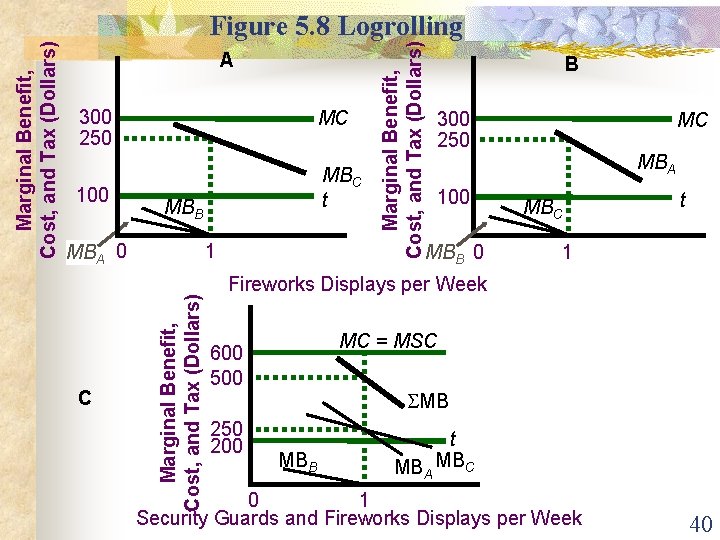
300 250 MC 100 MBC t MBB MBA 0 C 1 Marginal Benefit, Cost, and Tax (Dollars) A Marginal Benefit, Cost, and Tax (Dollars) Figure 5. 8 Logrolling B 300 250 MC MBA 100 MBB 0 MBC t 1 Fireworks Displays per Week MC = MSC 600 500 250 200 MB MBB t MBA MBC 0 1 Security Guards and Fireworks Displays per Week 40
Special Interests n n Special Interests are groups that lobby on particular issues. An example of a special interest is unions and/or steel companies lobbying for Tariffs and Import Quotas to protect their jobs or profits. Efficiency losses per job saved almost always exceed the pay of the retained worker. Estimates of the net effect run between –$9000 and –$38, 000 41
Bureaucracy and the Supply of Public Output n Officials measure their power in terms of the size of their budgets, not the efficiency of the outcomes they generate. This causes bureaucrats to have a self-interest in inefficiently high levels of government spending. 42
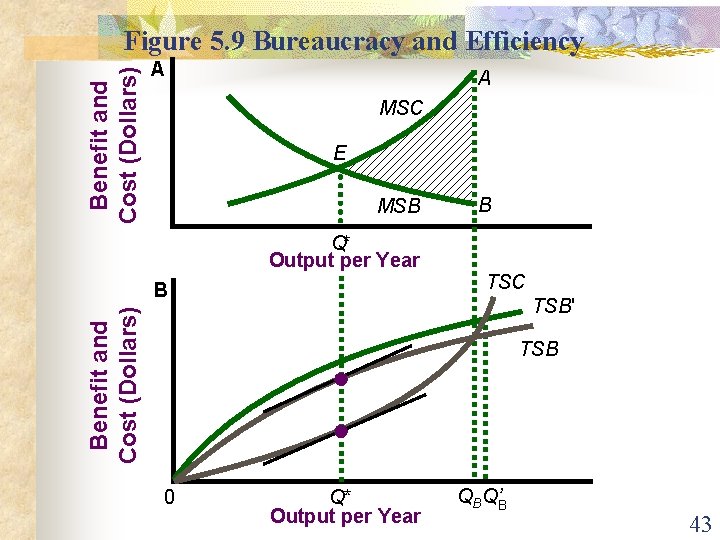
Benefit and Cost (Dollars) Figure 5. 9 Bureaucracy and Efficiency A A MSC E MSB Q* Output per Year B B TSC Benefit and Cost (Dollars) TSB' TSB 0 Q* Output per Year QB Q’B 43
- Slides: 43