
Chapter 5 Psychology of Injury Psychological attributes are
Chapter 5 Psychology of Injury

Psychological attributes are divided into two categories Personality variables n Psychosocial variables n

Personality variables n These are stable, enduring qualities of the individual n Characteristics n General personality make-up n n n Passive/aggressive Introvert/extrovert Trait anxiety n general disposition or tendency to perceive certain situations as threatening and react with anxiety response
n Locus of control n n people’s belief or lack thereof § External locus of control § little control over events in their life § Believe in destiny, luck, fate § Internal locus of control § responsible for what happens to them Self Concept n low self-concept is associated with injury because they can’t deal with stress; extreme cases – get injured to get more attention and avoid play
Seasonal Affective Disorder (SAD) n psychiatric disorder that affects the general population primarily in the winter season
Psychosocial variables n Stressful life events n n +/- events that cause change in the current behavior Injury increases with (-) variables
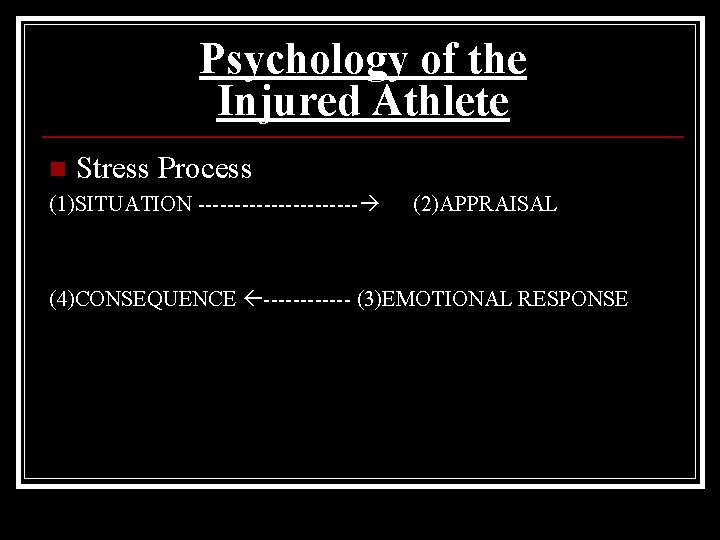
Psychology of the Injured Athlete n Stress Process (1)SITUATION ----------- (2)APPRAISAL (4)CONSEQUENCE ------ (3)EMOTIONAL RESPONSE
Stress Process n (1)SITUATION n n (2)APPRAISAL n n Appraise the situation with short and long term implications (3)EMOTIONAL RESPONSE n n Stressor – requires athlete to adapt to demands, constraints, opportunities Increase in HR, Increase BP, experience alienation (4)CONSEQUENCE n If they don’t respond (+), injury can have long term effects
Eating Disorders Some sports demand leanness because of biomechanics of the sport and society n Anorexia nervosa n n pattern of self starvation motivated by obsession with being thin
n Bulimia nervosa n n repeated bouts of binging and purging Long term problems n n esophageal inflammation Erosion of tooth enamel Hormone imbalance – amenorrhea & osteoporosis Electrolyte imbalance
Sport Psychology study of sport and exercise and mental factors influencing performance n Sport psychologists help athletes develop n n n n goals Self confidence Motivation Positive self image Strategies to cope with stress and Disappointment
Motivation internal state or condition (need/desire) that serves to activate or energize behavior and give it direction n Extrinsic motivation n external reward (money, car, food, etc) Intrinsic motivation n reward within (hard work brings success)
Goal setting identifying clearly defined, specific objectives that are measurable n One of the most powerful techniques for human motivation n
Goal setting techniques express goals positively n Set priorities n Write down goals n Keep operational goals small n Set performance not outcome goals n Set specific goals n Set goals and the right level n Set short term and long term goals n
Imagery process of reviewing and training in the mind only n Uses visualization n Helps to create, modify, or strengthen neurologic pathways that are important for coordination of muscles n Allows that athlete to pre-experience the achievement of goals n
Stress factor that causes awareness, anxiety, focus, or fear n Can be good or bad with +/- effects n Transitional stress moving from lower to higher level of a sport n
Burnout mental and physical exhaustion that causes an athlete to drop out of a sport or quit and activity that was once enjoyable n ~ 70% of kids drop out of sports by 13 years old n
Self confidence reflects athlete’s assessment of his/her selfworth n Allows athlete to take risk n Constant failure can lead to low self esteem n
- Slides: 18