
Chapter 5 Proportion and Rectangular Shapes Objectives Understand
Chapter 5 Proportion and Rectangular Shapes
Objectives • Understand proportion and use it to draw rectangular objects. • Define the horizon plane and be able to draw all the objects in a still life on the same horizon plane. • Use shading and contrast to clearly define the shape and volume of rectangular objects.
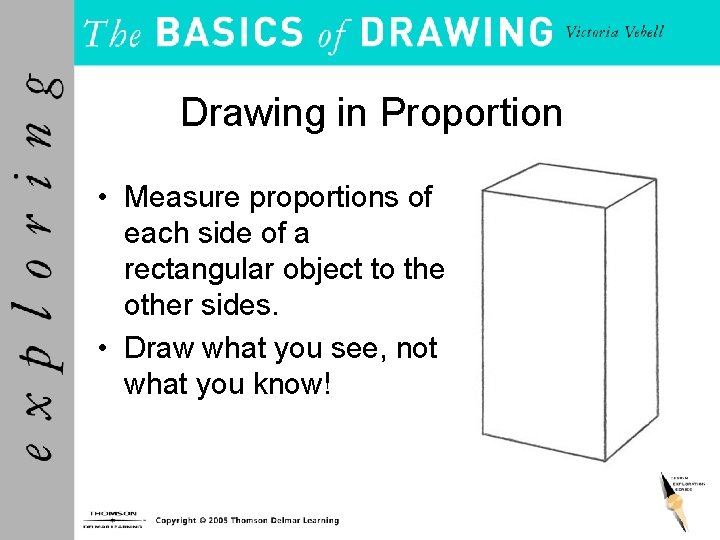
Drawing in Proportion • Measure proportions of each side of a rectangular object to the other sides. • Draw what you see, not what you know!
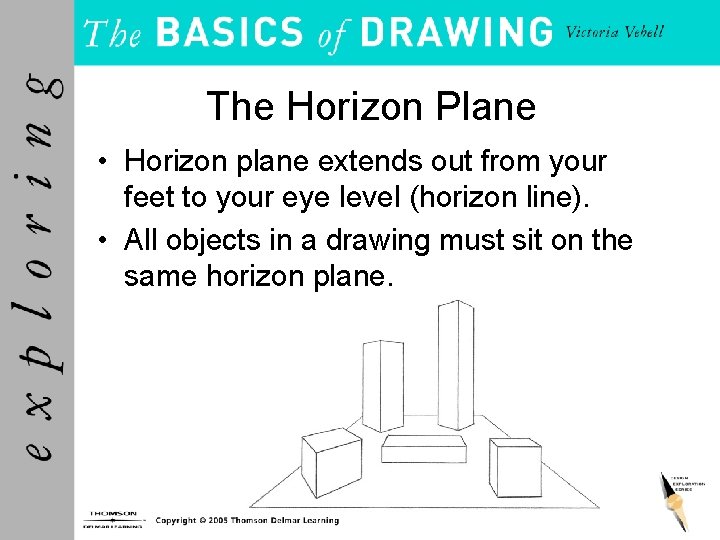
The Horizon Plane • Horizon plane extends out from your feet to your eye level (horizon line). • All objects in a drawing must sit on the same horizon plane.

Rectangular Shapes • Rectangular shapes have six sides like a cube, but the sides are not all the same size. • Determine if you see one-point or two-point perspective. • Measure the proportions of the sides.
Volume in Rectangular Shapes (1 of 2) • Render light area, highlight, and shadow areas. • Use contrast to bring nearest edges forward. • Render both cast shadows, including the dark line under the second side.

Volume in Rectangular Shapes (2 of 2)
Summary (1 of 2) • Proportion – Relationships of an object's height, width, and depth • Use sighting techniques to correct proportions among the planes of an object. • Horizon plane – Imaginary flat surface extending from feet to eye level (horizon line)
Summary (2 of 2) – Every object in a drawing must sit on the same horizon plane. • The rectangular object is a variation of the cube. – It has six sides, but they are not all equal.
- Slides: 9