
Chapter 5 Production 2004 Thomson LearningSouthWestern Production Functions







- Slides: 73
Chapter 5 Production © 2004 Thomson Learning/South-Western
Production Functions l l 2 The purpose of a firm is to turn inputs into outputs. An abstract model of production is the production function, a mathematical relationship between inputs and outputs.
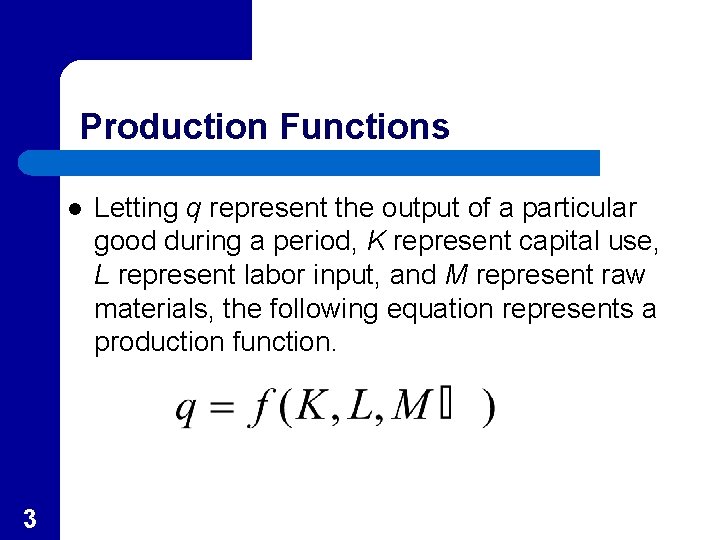
Production Functions l 3 Letting q represent the output of a particular good during a period, K represent capital use, L represent labor input, and M represent raw materials, the following equation represents a production function.
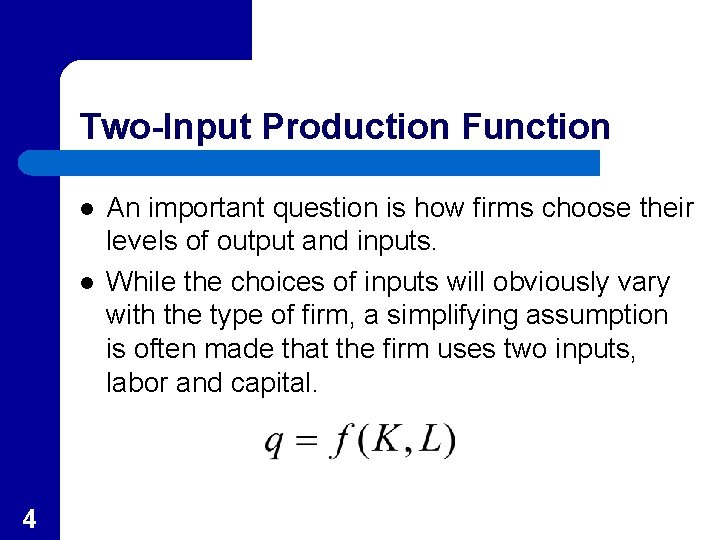
Two-Input Production Function l l 4 An important question is how firms choose their levels of output and inputs. While the choices of inputs will obviously vary with the type of firm, a simplifying assumption is often made that the firm uses two inputs, labor and capital.
Application 5. 1: Everyone is a Firm l l l 5 Looking at people as “firms can yield some interesting insights Economists have tried to estimate the amount of production that people do for themselves. Time-use studies suggest that the time people spend in home production is only slightly less than the time spent working.
Application 5. 1: Everyone is a Firm l l l 6 Some of the more straightforward things produced at home are what might be called “housing services”. The production function concept is widely used in thinking about health issues. A somewhat more far-fetched application of the home-production concept is to view families as “producers of children. ”
Marginal Product l l 7 Marginal physical productivity, or more simply, the marginal product of an input is the additional output that can be produced by adding one more unit of a particular input while holding all other inputs constant. The marginal product of labor (MPL) is the extra output obtained by employing one more unit of labor while holding the level of capital equipment constant.
Marginal Product l 8 The marginal product of capital (MPK) is the extra output obtained by using one more machine while holding the number of workers constant.
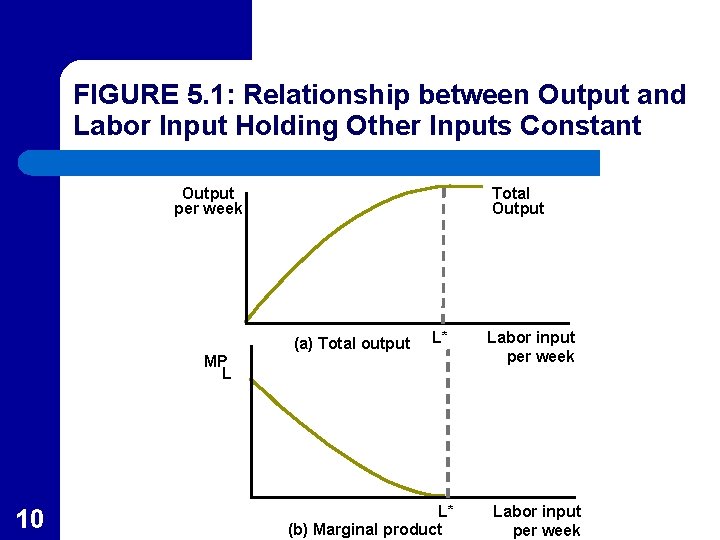
Diminishing Marginal Product l l 9 It is expected that the marginal product of an input will depend upon the level of the input used. Since, holding capital constant, production of more output is likely to eventually decline with adding more labor, it is expected that marginal product will eventually diminish as shown in Figure 5. 1.
FIGURE 5. 1: Relationship between Output and Labor Input Holding Other Inputs Constant Output per week Total Output (a) Total output L* MP L 10 L* (b) Marginal product Labor input per week
Diminishing Marginal Product l l 11 The top panel of Figure 5. 1 shows the relationship between output per week and labor input during the week as capital is held fixed. Initially, output increases rapidly as new workers are added, but eventually it diminishes as the fixed capital becomes overutilized.
Marginal Product Curve l l 12 The marginal product curve is simply the slope of the total product curve. The declining slope, as shown in panel b, shows diminishing marginal productivity.
Average Product l l 13 Average product is simply “output per worker” calculated by dividing total output by the number of workers used to produce the output. This corresponds to what many people mean when they discuss productivity, but economists emphasize the change in output reflected in the marginal product.
Appraising the Marginal Product Concept l l 14 Marginal product requires the ceteris paribus assumption that other things, such as the level of other inputs and the firm’s technical knowledge, are held constant. An alternative way, that is more realistic, is to study the entire production function for a good.
APPLICATION 5. 2: Why Do the Japanese Have a Cost Advantage in Making Cars? l l In 1979 Japan overtook the United States as the world’s largest producer of automobiles. Japan appears to have a productivity advantage. – 15 For example, workers at Honda or Toyota take about 30 hours to produce a car while workers in General Motors or Chrysler take about 45 hours.
APPLICATION 5. 2: Why Do the Japanese Have a Cost Advantage in Making Cars? – l U. S. producers tend to use more assembly lines which allows greater variability in vehicle size than in Japan. – 16 Reasons for this are not known although it does not appear to be explained by simple substitution of capital for labor. This makes it easier to use automating production, such as robots, in Japan.
APPLICATION 5. 2: Why Do the Japanese Have a Cost Advantage in Making Cars? l l 17 Also, although both U. S. and Japanese producers tend to buy many components of cars from independent suppliers, these suppliers are better integrated with the assembly firms in Japan. In addition, there appears to be more of an adversarial relationship between labor and management in the U. S. than in Japan.
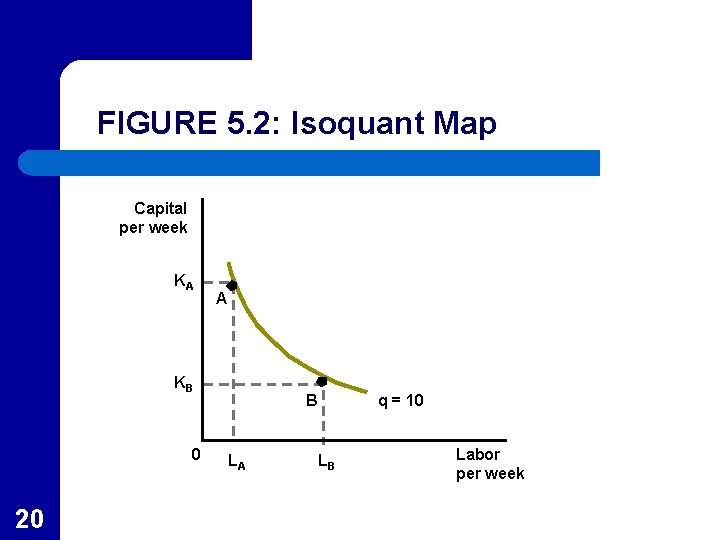
Isoquant Maps l l An isoquant is a curve that shows the various combinations of inputs that will produce the same (a particular) amount of output. An isoquant map is a contour map of a firm’s production function. – 18 All of the isoquants from a production function are part of this isoquant map.
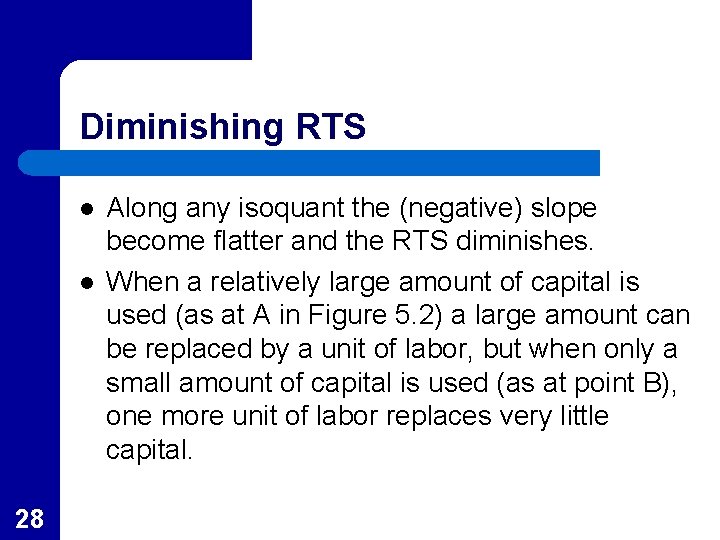
Isoquant Map l l 19 In Figure 5. 2, the firm is assumed to use the production function, q = f(K, L) to produce a single good. The curve labeled q = 10 is an isoquant that shows various combinations of labor and capital, such as points A and B, that produce exactly 10 units of output period.
FIGURE 5. 2: Isoquant Map Capital per week KA A KB 0 20 B LA q = 10 LB Labor per week
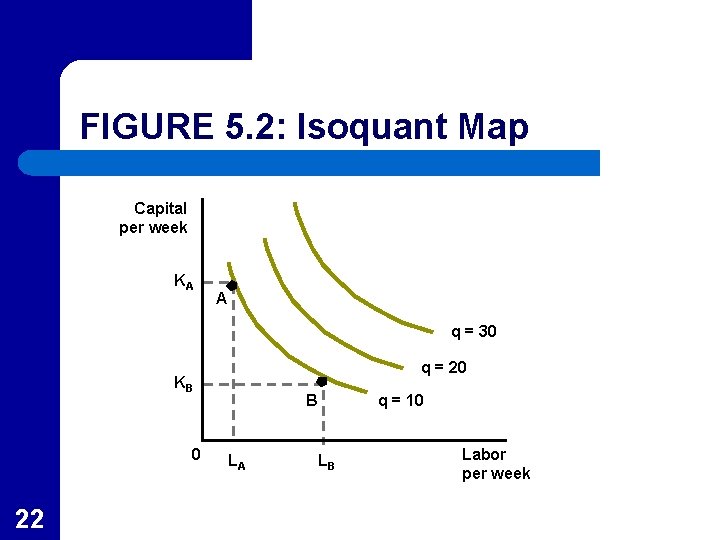
Isoquant Map l l 21 The isoquants labeled q = 20 and q = 30 represent two more of the infinite curves that represent different levels of output. Isoquants record successively higher levels of output the farther away from the origin they are in a northeasterly direction.
FIGURE 5. 2: Isoquant Map Capital per week KA A q = 30 q = 20 KB 0 22 B LA q = 10 LB Labor per week
Isoquant Map l l 23 Unlike indifference curves, the labeling of the isoquants represents something measurable, the quantity of output period. In addition to the location of the isoquants, economists are also interested in their shape.
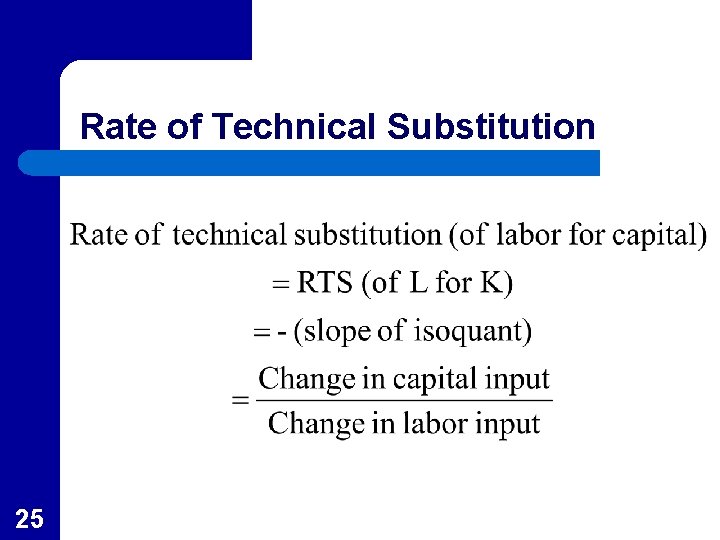
Rate of Technical Substitution l l 24 The negative of the slope of an isoquant is called the marginal rate of technical substitution (RTS), the amount by which one input can be reduced when one more unit of another input is added while holding output constant. It is the rate that capital can be reduced, holding output constant, while using one more unit of labor.
Rate of Technical Substitution 25
Rate of Technical Substitution l l 26 The particular value of this trade-off depends upon the level of output and the quantities of capital and labor being used. At A in Figure 5. 2, relatively large amounts of capital can be given up if one more unit of labor is added (large RTS), but at B only a little capital can be sacrificed when adding one more unit of labor (small RTS).
The RTS and Marginal Products l l 27 It is likely that the RTS is positive (the isoquant has a negative slope) because the firm can decrease its use of capital if one more unit of labor is employed. If increasing labor meant the having to hire more capital the marginal product of labor or capital would be negative and the firm would be unwilling to hire more of either.
Diminishing RTS l l 28 Along any isoquant the (negative) slope become flatter and the RTS diminishes. When a relatively large amount of capital is used (as at A in Figure 5. 2) a large amount can be replaced by a unit of labor, but when only a small amount of capital is used (as at point B), one more unit of labor replaces very little capital.
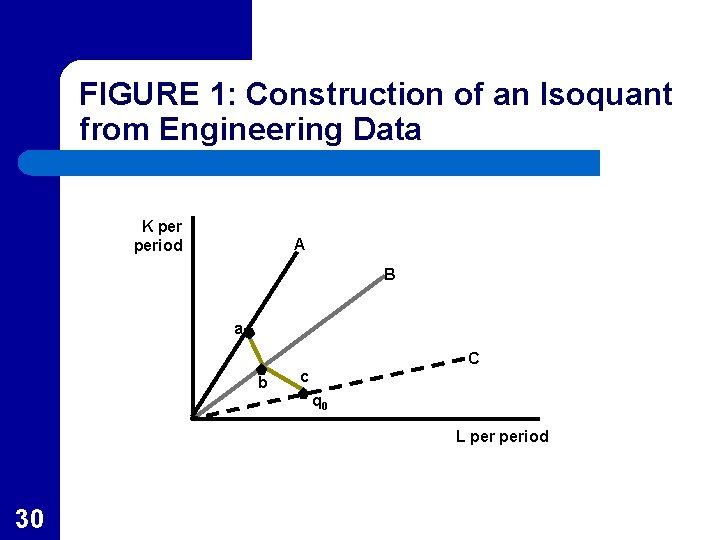
APPLICATION 5. 3: Engineering and Economics l l l 29 Engineering studies can be used to provide information about a production function. Engineers have developed three different methods (A, B, and C) to produce output. These methods are shown in Figure 1, when method A uses a greater capital labor ratio than B, and the capital labor ratio at B exceeds that at C.
FIGURE 1: Construction of an Isoquant from Engineering Data K period A B a C b c q 0 L period 30
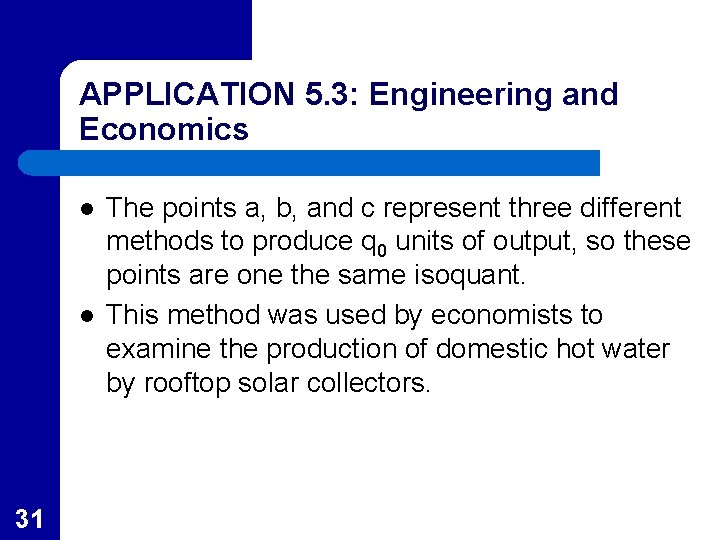
APPLICATION 5. 3: Engineering and Economics l l 31 The points a, b, and c represent three different methods to produce q 0 units of output, so these points are one the same isoquant. This method was used by economists to examine the production of domestic hot water by rooftop solar collectors.
APPLICATION 5. 3: Engineering and Economics l l 32 This method has been used to examine the extent to which energy and capital can be substituted in industrial equipment design. Economists have also found that energy and capital are sometimes complements in production, which may have caused the poor productivity of the 1970 s due to high energy costs.
Returns to Scale l l 33 Returns to scale is the rate at which output increases in response to proportional increases in all inputs. In the eighteenth century Adam Smith became aware of this concept when he studied the production of pins.
Returns to Scale l Adam Smith identified two forces that come into play when all inputs are increased. – – l 34 A doubling of inputs permits a greater “division of labor” allowing persons to specialize in the production of specific pin parts. This specialization may increase efficiency enough to more than double output. However these benefits might be reversed if firms become too large to manage.
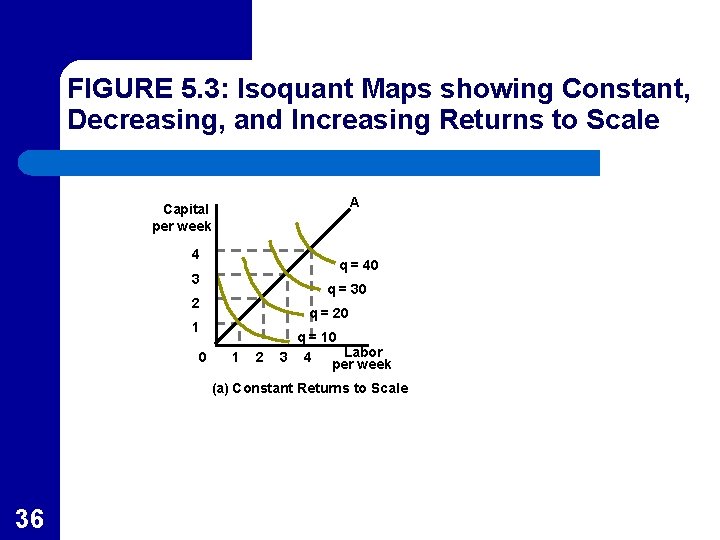
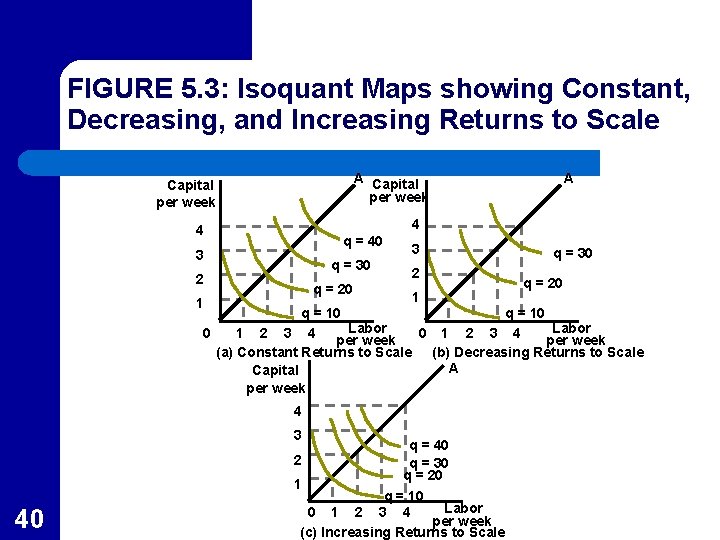
Constant Returns to Scale l A production function is said to exhibit constant returns to scale if a doubling of all inputs results in a precise doubling of output. – 35 This situation is shown in Panel (a) of Figure 5. 3.
FIGURE 5. 3: Isoquant Maps showing Constant, Decreasing, and Increasing Returns to Scale A Capital per week 4 q = 40 3 q = 30 2 q = 20 1 2 q = 10 Labor 3 4 per week (a) Constant Returns to Scale 36
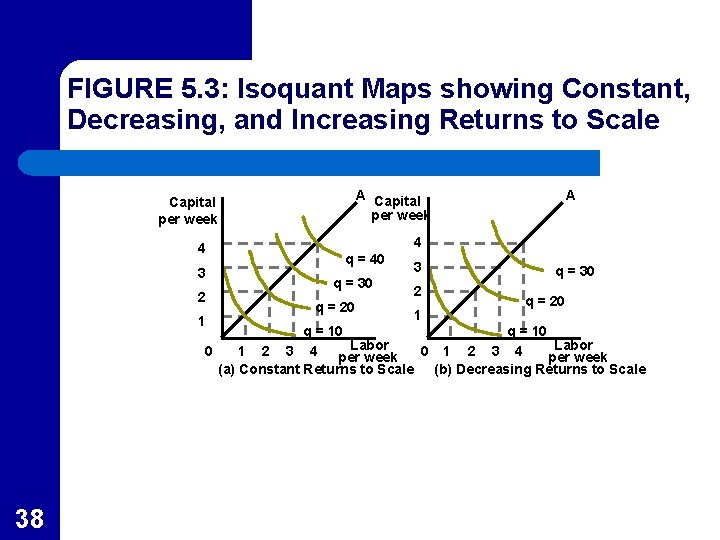
Decreasing Returns to Scale l If doubling all inputs yields less than a doubling of output, the production function is said to exhibit decreasing returns to scale. – 37 This is shown in Panel (b) of Figure 5. 3.
FIGURE 5. 3: Isoquant Maps showing Constant, Decreasing, and Increasing Returns to Scale A Capital per week 4 3 2 1 A 4 q = 40 q = 30 q = 20 3 2 1 q = 30 q = 20 q = 10 Labor 0 1 2 3 4 per 0 1 2 3 4 week per week (a) Constant Returns to Scale (b) Decreasing Returns to Scale 38
Increasing Returns to Scale l If doubling all inputs results in more than a doubling of output, the production function exhibits increasing returns to scale. – l 39 This is demonstrated in Panel (c) of Figure 5. 3. In the real world, more complicated possibilities may exist such as a production function that changes from increasing to constant to decreasing returns to scale.
FIGURE 5. 3: Isoquant Maps showing Constant, Decreasing, and Increasing Returns to Scale A Capital per week A 4 4 q = 40 3 q = 30 2 q = 20 1 3 2 1 q = 30 q = 20 q = 10 Labor 0 1 2 3 4 per 0 1 2 3 4 week per week (a) Constant Returns to Scale (b) Decreasing Returns to Scale A Capital per week 4 3 40 q = 40 2 q = 30 q = 20 1 q = 10 Labor 0 1 2 3 4 per week (c) Increasing Returns to Scale
APPLICATION 5. 4: Returns to Scale in Beer Brewing l l 41 Because beer is produced in volume (barrels per year) but capital has costs that are proportional to surface area, larger breweries were able to achieve increasing returns to scale. Economies to scale were also achieved through automated control systems in filling beer cans.
APPLICATION 5. 4: Returns to Scale in Beer Brewing l l 42 National markets may also foster economies of scale in distribution, advertising (especially television), and marketing. These factors became especially important after World War II and the number of U. S. brewing firms fell by over 90 percent between 1945 and the mid-1980 s.
APPLICATION 5. 4: Returns to Scale in Beer Brewing l l 43 The output of the industry became consolidated in a few large firms which operated very large breweries in multiple locations to reduce shipping costs. Beginning the mid-1980 s, however, smaller firms offering premium brands, provided and opening for local microbreweries.
APPLICATION 5. 4: Returns to Scale in Beer Brewing l l l 44 The 1990 s have seen a virtual explosion of new brands with odd names or local appeal. A similar event occurred in great Britain during the 1980 s with the “real ale” movements, but it was followed by small firms being absorbed by national brands. A similar absorption may be starting to take place in the United States.
Input Substitution l l 45 Another important characteristic of a production function is how easily inputs can be substituted for each other. This characteristic depends upon the slope of a given isoquant, rather than the whole isoquant map.
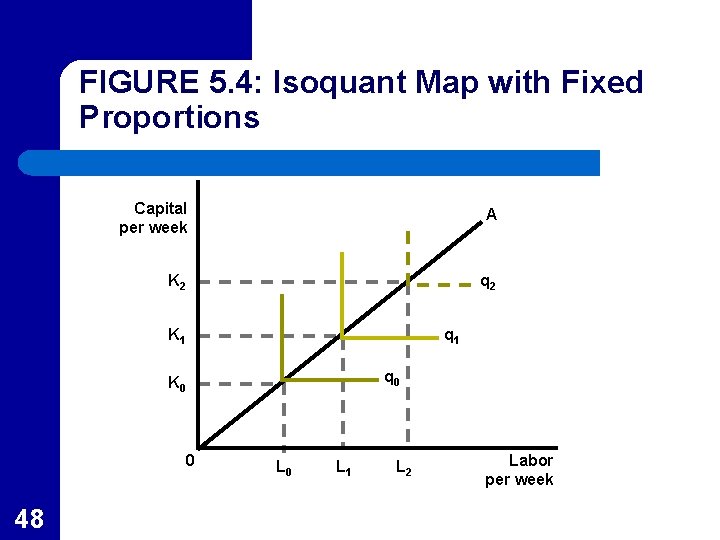
Fixed-Proportions Production Function l l l It may be the case that absolutely no substitution between inputs is possible. This case is shown in Figure 5. 4. If K 1 units of capital are used, exactly L 1 units of labor are required to produce q 1 units of output. – 46 If K 1 units of capital are used and less than L 1 units of labor are used, q 1 can not be produced.
Fixed-Proportions Production Function – – 47 If K 1 units of capital are used and more than L 1 units of labor are used, no more than q 1 units of output are produced. With K = K 1, the marginal physical product of labor is zero beyond L 1 units of labor. The q 1 isoquant is horizontal beyond L 1. Similarly, with L 1 units of labor, the marginal physical product of capital is zero beyond K 1 resulting in the vertical portion of the isoquant.
FIGURE 5. 4: Isoquant Map with Fixed Proportions Capital per week A K 2 q 2 K 1 q 0 K 0 0 48 L 0 L 1 L 2 Labor per week
Fixed-proportions Production Function l l 49 This type of production function is called a fixed-proportion production function because the inputs must be used in a fixed ratio to one another. Many machines require a fixed complement of workers so this type of production function may be relevant in the real world.
The Relevance of Input Substitutability l l 50 Over the past century the U. S. economy has shifted away from agricultural production and towards manufacturing and service industries. Economists are interested in the degree to which certain factors of production (notable labor) can be moved from agriculture into the growing industries.
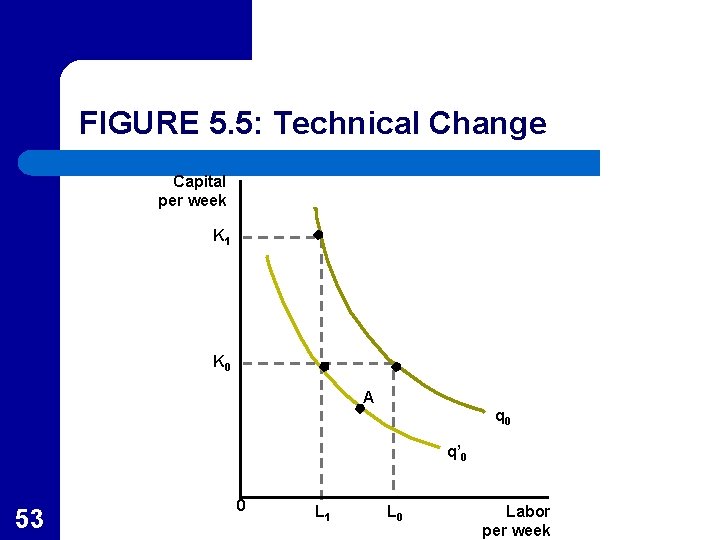
Changes in Technology l l l 51 Technical progress is a shift in the production function that allows a given output level to be produced using fewer inputs. Isoquant q 0 in Figure 5. 5, summarized the initial state of technical knowledge. K 0 and L 0 units of capital and labor respectively can produce this level of output.
Changes in Technology l l l 52 After a technology improvement, the same level of output can be produced with the same level of capital and reduced labor, L 1. The improvement in technology is represented in Figure 5. 5 by the shift of the q 0 isoquant to q’ 0. Technical progress represents a real savings in inputs.
FIGURE 5. 5: Technical Change Capital per week K 1 K 0 A q 0 q’ 0 53 0 L 1 L 0 Labor per week
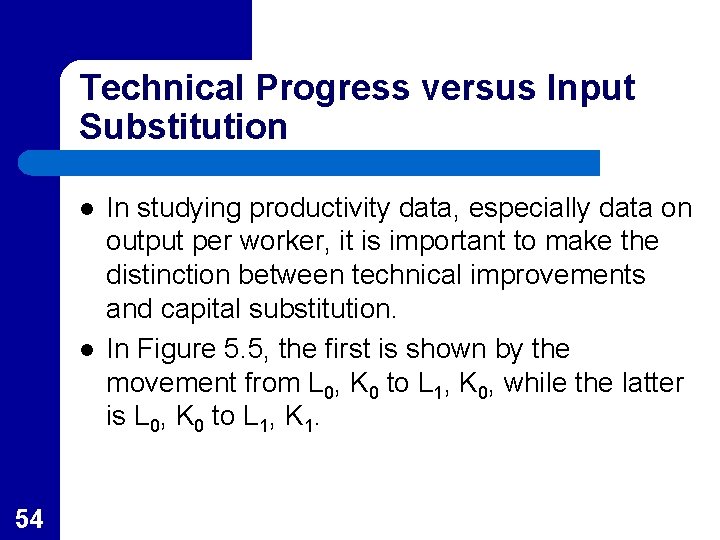
Technical Progress versus Input Substitution l l 54 In studying productivity data, especially data on output per worker, it is important to make the distinction between technical improvements and capital substitution. In Figure 5. 5, the first is shown by the movement from L 0, K 0 to L 1, K 0, while the latter is L 0, K 0 to L 1, K 1.
Technical Progress versus Input Substitution l l l 55 In both cases, output per worker would rise (q 0/L 0 to q 0/L 1) With technical progress there is a real improvement in the way things are produced. With substitution, no real improvement in the production of the good takes place.
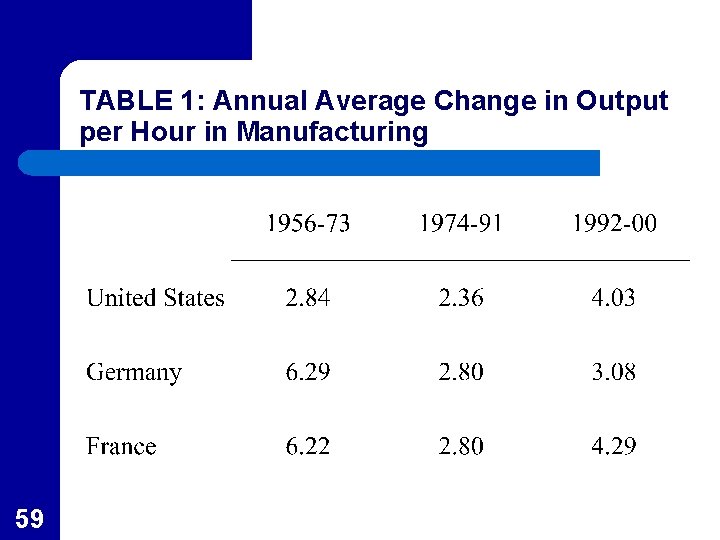
APPLICATION 5. 5: Multifactor Productivity l l l 56 Table 1 shows the rates of change in productivity for three countries measured as output per hour. While the data show declines during the 1974 to 1991 period, they still averaged over 2 percent per year. However, this measure may simply reflect simple capital-labor substitution.
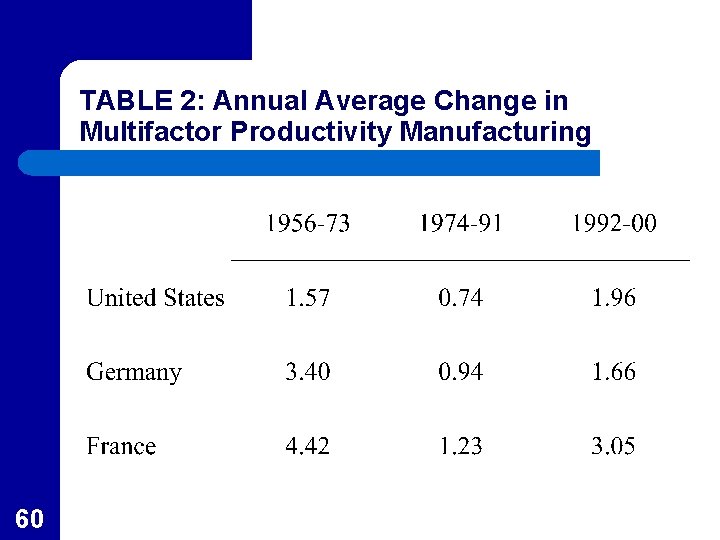
APPLICATION 5. 5: Multifactor Productivity l l 57 A measure that attempts to control for such substitution is called mutifactor productivity. As table 2 shows, the 1974 - 91 period looks much worse using the multifactor productivity measure.
APPLICATION 5. 5: Multifactor Productivity l l 58 Reasons for the decline in post 1973 productivity include rising energy prices, high rates of inflation, increasing environmental regulations, deteriorating education systems, or a general decline in the work ethic. Clearly after 1991, productivity has improved greatly.
TABLE 1: Annual Average Change in Output per Hour in Manufacturing 59
TABLE 2: Annual Average Change in Multifactor Productivity Manufacturing 60
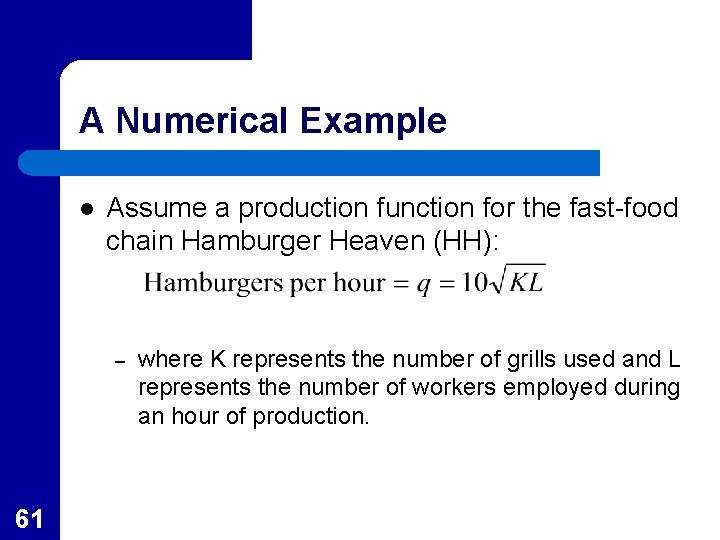
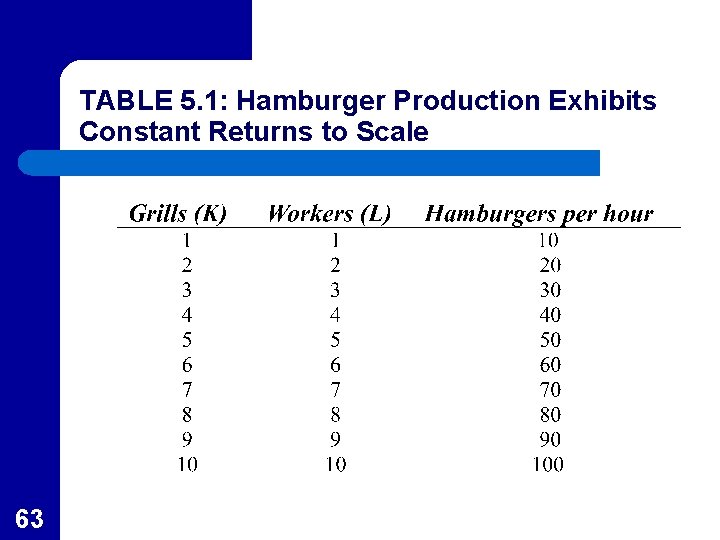
A Numerical Example l Assume a production function for the fast-food chain Hamburger Heaven (HH): – 61 where K represents the number of grills used and L represents the number of workers employed during an hour of production.
A Numerical Example l This function exhibits constant returns to scale as demonstrated in Table 5. 1. – 62 As both workers and grills are increased together, hourly hamburger output rises proportionally.
TABLE 5. 1: Hamburger Production Exhibits Constant Returns to Scale 63
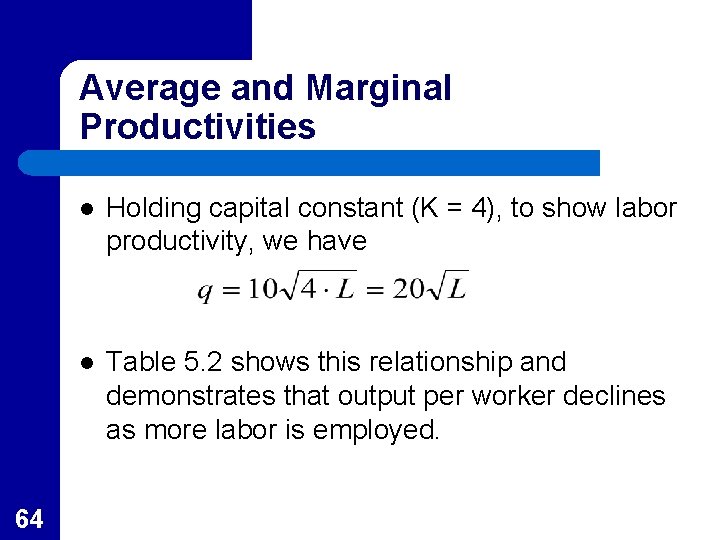
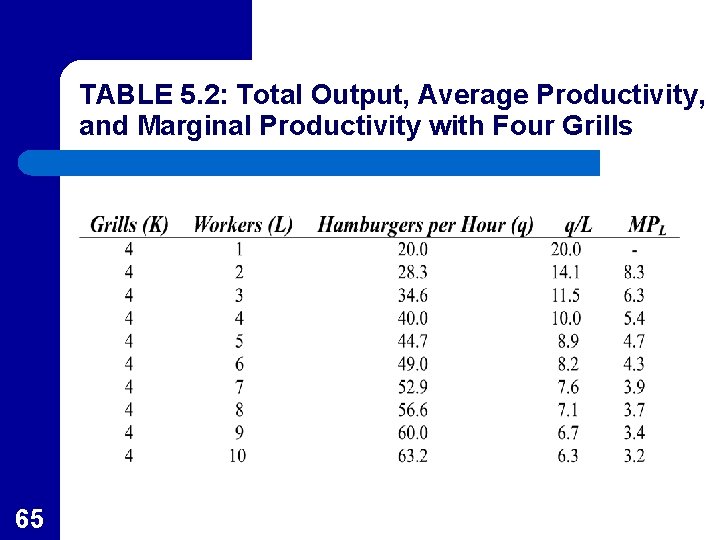
Average and Marginal Productivities 64 l Holding capital constant (K = 4), to show labor productivity, we have l Table 5. 2 shows this relationship and demonstrates that output per worker declines as more labor is employed.
TABLE 5. 2: Total Output, Average Productivity, and Marginal Productivity with Four Grills 65
Average and Marginal Productivities l l 66 Also, Table 5. 2 shows that the productivity of each additional worker hired declines. Holding one input constant yields the expected declining average and marginal productivities.
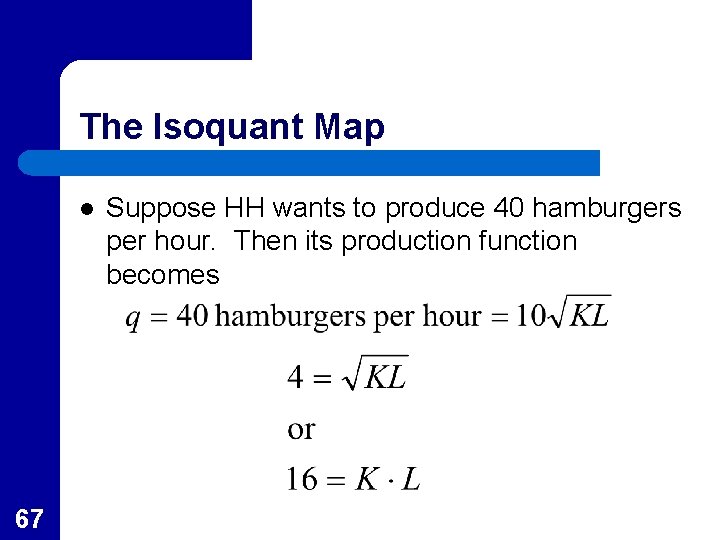
The Isoquant Map l 67 Suppose HH wants to produce 40 hamburgers per hour. Then its production function becomes
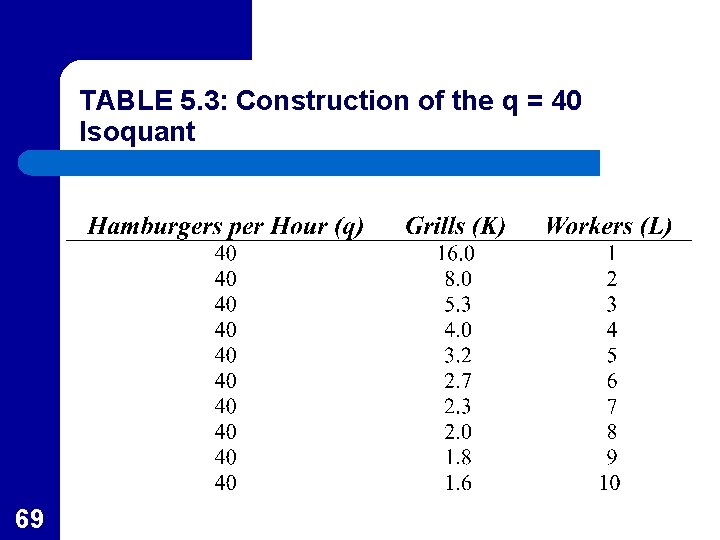
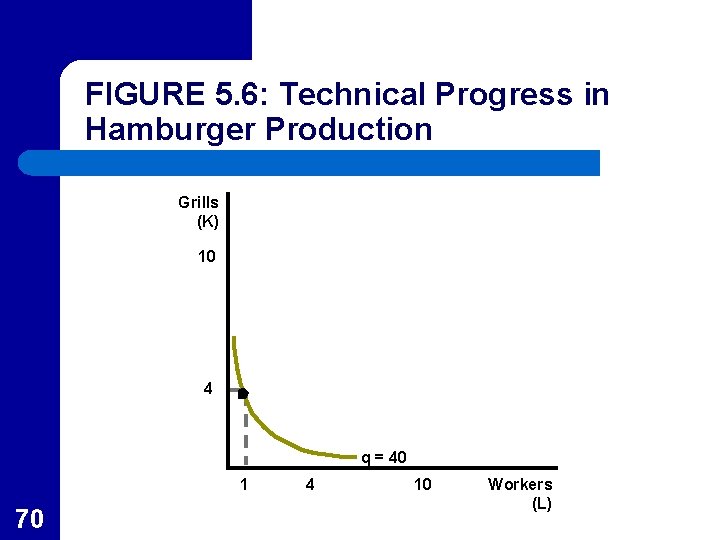
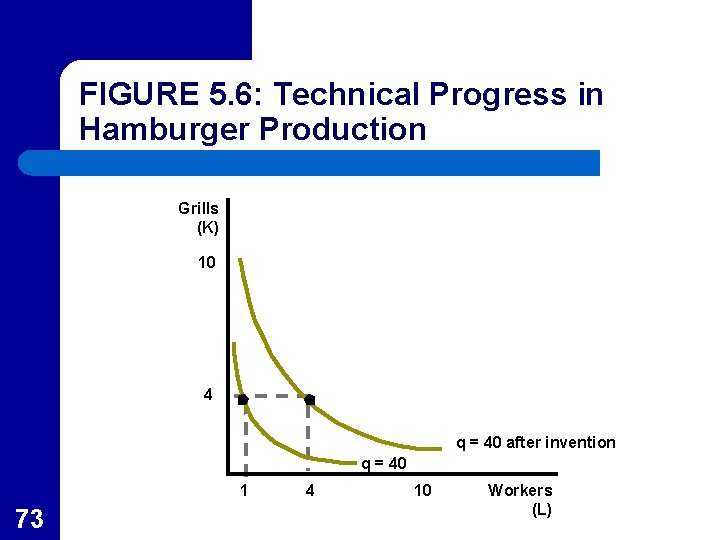
The Isoquant Map l l l 68 Table 5. 3 show several K, L combinations that satisfy this equation. All possible combinations in the “q = 40” isoquant are shown in Figure 5. 6. All other isoquants would have the same shape showing that HH has many substitution possibilities.
TABLE 5. 3: Construction of the q = 40 Isoquant 69
FIGURE 5. 6: Technical Progress in Hamburger Production Grills (K) 10 4 q = 40 1 70 4 10 Workers (L)
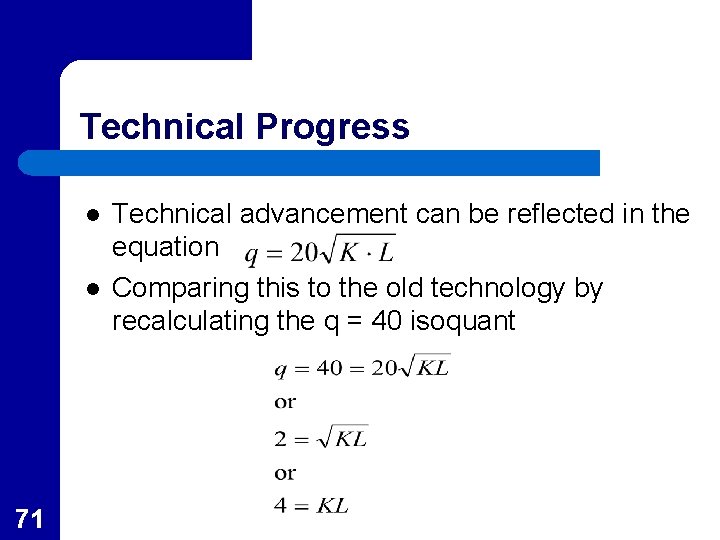
Technical Progress l l 71 Technical advancement can be reflected in the equation Comparing this to the old technology by recalculating the q = 40 isoquant
Technical Progress l l l 72 In Figure 5. 6 the new technology is the isoquant labeled “q = 40 after invention. ” With 4 grills, average productivity is now 40 hamburgers per hour per worker whereas it was 10 hamburgers per hour before the invention. This level of output per worker would have required 16 grills with the old technology.
FIGURE 5. 6: Technical Progress in Hamburger Production Grills (K) 10 4 q = 40 after invention q = 40 1 73 4 10 Workers (L)