
Chapter 5 Product and Service Costing JobOrder System
Chapter 5 Product and Service Costing: Job-Order System Hansen/Mowen, Cornerstones of Cost Management, 4 th Edition. © 2018 Cengage. All Rights Reserved. May not be scanned, copied or duplicated, or posted to a publicly accessible website, in whole or in part.

Manufacturing Firms versus Service Firms • Manufacturing firms o Combine direct materials, direct labor, and overhead to produce a new product o Produce goods that are tangible and can be inventoried and transported • Service firms o Service is characterized by its intangible nature • Not separable from the customer and cannot be inventoried Hansen/Mowen, Cornerstones of Cost Management, 4 th Edition. © 2018 Cengage. All Rights Reserved. May not be scanned, copied or duplicated, or posted to a publicly accessible website, in whole or in part.
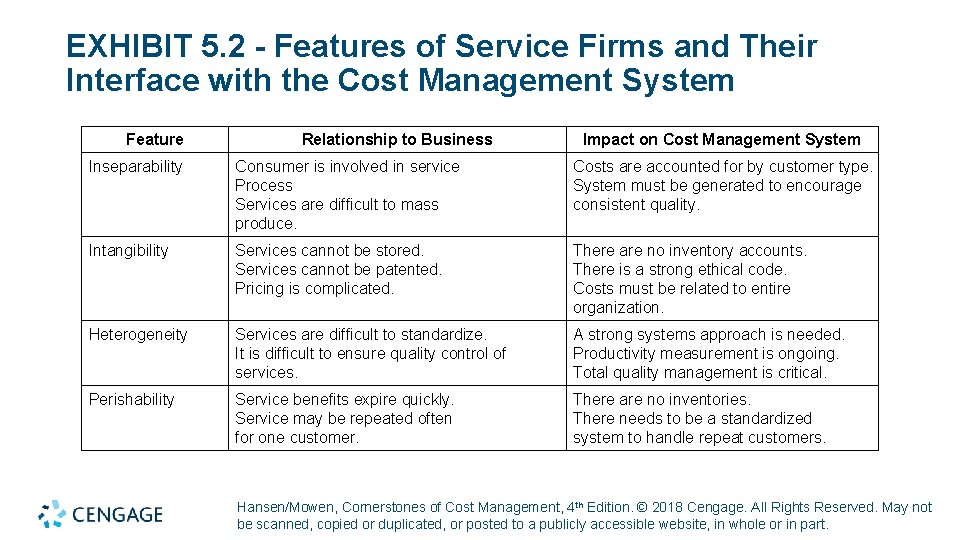
EXHIBIT 5. 2 - Features of Service Firms and Their Interface with the Cost Management System Feature Relationship to Business Impact on Cost Management System Inseparability Consumer is involved in service Process Services are difficult to mass produce. Costs are accounted for by customer type. System must be generated to encourage consistent quality. Intangibility Services cannot be stored. Services cannot be patented. Pricing is complicated. There are no inventory accounts. There is a strong ethical code. Costs must be related to entire organization. Heterogeneity Services are difficult to standardize. It is difficult to ensure quality control of services. A strong systems approach is needed. Productivity measurement is ongoing. Total quality management is critical. Perishability Service benefits expire quickly. Service may be repeated often for one customer. There are no inventories. There needs to be a standardized system to handle repeat customers. Hansen/Mowen, Cornerstones of Cost Management, 4 th Edition. © 2018 Cengage. All Rights Reserved. May not be scanned, copied or duplicated, or posted to a publicly accessible website, in whole or in part.
Ethics • Customers may perceive greater risk when buying services than products • Internal accountant should accurately report the bad news as well as the good • Manufacturers can offer warranties or product replacements • Service providers must be very careful to deliver what they promise Hansen/Mowen, Cornerstones of Cost Management, 4 th Edition. © 2018 Cengage. All Rights Reserved. May not be scanned, copied or duplicated, or posted to a publicly accessible website, in whole or in part.

Unique versus Standardized Products and Services • Degree of uniqueness affects costing methods o Job-order costing • Used for unique units with unique costs of production • Used by both service and manufacturing firms o Process-costing system • Used when units are homogeneous o Operation costing: Hybrid of job-order and process costing Hansen/Mowen, Cornerstones of Cost Management, 4 th Edition. © 2018 Cengage. All Rights Reserved. May not be scanned, copied or duplicated, or posted to a publicly accessible website, in whole or in part.
Cost Accumulation • Refers to the recognition and recording of costs • Source document: Keeps track of costs as they occur and describes a transaction o Data acquired are recorded in a database • Provides flexibility in analysis of subsets • Helps identify if relevant costs are recorded in the general ledger and posted to appropriate accounts Hansen/Mowen, Cornerstones of Cost Management, 4 th Edition. © 2018 Cengage. All Rights Reserved. May not be scanned, copied or duplicated, or posted to a publicly accessible website, in whole or in part.

Cost Measurement • Refers to classifying costs • Ways to measure costs associated with production include: o Actual costing system: Uses actual costs for direct materials, direct labor, and overhead to determine unit cost o Normal costing system: Uses actual cost of direct materials and labor but applies overhead using predetermined estimate Hansen/Mowen, Cornerstones of Cost Management, 4 th Edition. © 2018 Cengage. All Rights Reserved. May not be scanned, copied or duplicated, or posted to a publicly accessible website, in whole or in part.
Cost Assignment • Refers to association of production costs with the units produced • Costs are assigned to units of product manufactured or units of service delivered o Once costs have been accumulated, measured, and assigned, unit costs can be calculated o Unit cost equals total product cost associated with units divided by the number of units produced Hansen/Mowen, Cornerstones of Cost Management, 4 th Edition. © 2018 Cengage. All Rights Reserved. May not be scanned, copied or duplicated, or posted to a publicly accessible website, in whole or in part.
Importance of Unit Cost • Helps submit meaningful bids • Influences decisions regarding product design and new product introduction • Essential to make decisions about whether to: o Make or buy a product o Accept or reject a special order o Keep or drop a product line Hansen/Mowen, Cornerstones of Cost Management, 4 th Edition. © 2018 Cengage. All Rights Reserved. May not be scanned, copied or duplicated, or posted to a publicly accessible website, in whole or in part.
Importance of Unit Costs to Manufacturing Firms • Essential for: o Valuing inventory o Determining income and cost of goods sold o Disclosing the cost of inventories • Useful as an input for important internal decisions o Introduction of new product o Continuation of current product o Analysis of long-run processes Hansen/Mowen, Cornerstones of Cost Management, 4 th Edition. © 2018 Cengage. All Rights Reserved. May not be scanned, copied or duplicated, or posted to a publicly accessible website, in whole or in part.
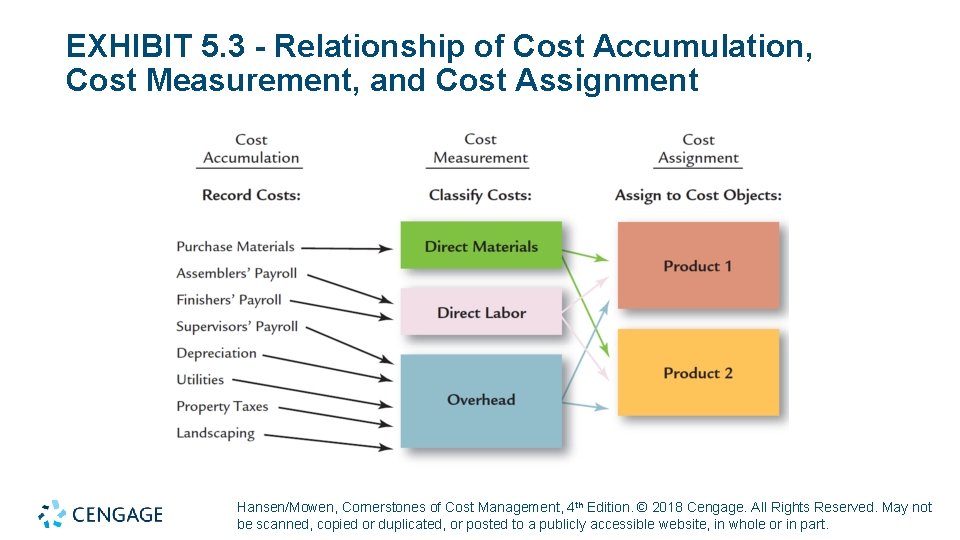
EXHIBIT 5. 3 - Relationship of Cost Accumulation, Cost Measurement, and Cost Assignment Hansen/Mowen, Cornerstones of Cost Management, 4 th Edition. © 2018 Cengage. All Rights Reserved. May not be scanned, copied or duplicated, or posted to a publicly accessible website, in whole or in part.
Production of Unit Cost Information • Both cost measurement and cost assignment are required o Normal costing is preferred because it provides information on a more timely basis o Direct materials and direct labor costs are traced to units of production o Actual costs are used since the actual costs of materials and labor are known at any point in time o Overhead is applied using a predetermined rate Hansen/Mowen, Cornerstones of Cost Management, 4 th Edition. © 2018 Cengage. All Rights Reserved. May not be scanned, copied or duplicated, or posted to a publicly accessible website, in whole or in part.
Choosing the activity level • Expected activity level o Production level the firm expects to attain for the coming year • Normal activity level o Average activity usage that a firm experiences in the long term • Theoretical activity level o Absolute maximum production activity of a manufacturing firm • Practical or ideal activity level o Maximum output that can be realized if everything operates efficiently Hansen/Mowen, Cornerstones of Cost Management, 4 th Edition. © 2018 Cengage. All Rights Reserved. May not be scanned, copied or duplicated, or posted to a publicly accessible website, in whole or in part.
Overview of the Job-order Costing System (1 of 2) • Costs are accumulated by job • Upon completion of a job, the unit cost equals total manufacturing cost divided by the number of units produced • Job-order cost sheet: Identifies each job and accumulates its manufacturing costs o Created upon receipt of a production order o Contains a job-order number that identifies the new job Hansen/Mowen, Cornerstones of Cost Management, 4 th Edition. © 2018 Cengage. All Rights Reserved. May not be scanned, copied or duplicated, or posted to a publicly accessible website, in whole or in part.
Overview of the Job-order Costing System (2 of 2) • Work-in-process inventory file: Collection of all job cost sheets • Job-order costing system must be able to identify the quantity of: o Direct materials o Direct labor o Applied manufacturing overhead Hansen/Mowen, Cornerstones of Cost Management, 4 th Edition. © 2018 Cengage. All Rights Reserved. May not be scanned, copied or duplicated, or posted to a publicly accessible website, in whole or in part.
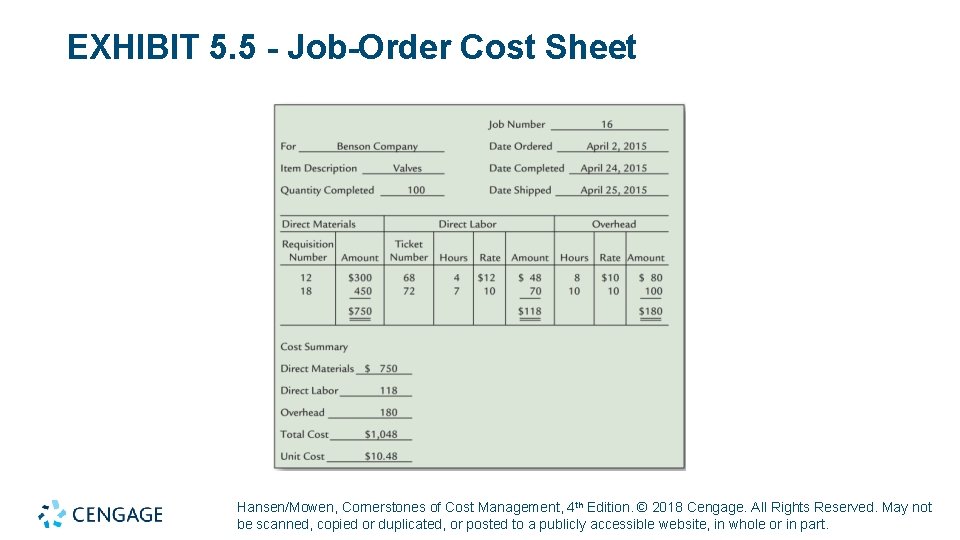
EXHIBIT 5. 5 - Job-Order Cost Sheet Hansen/Mowen, Cornerstones of Cost Management, 4 th Edition. © 2018 Cengage. All Rights Reserved. May not be scanned, copied or duplicated, or posted to a publicly accessible website, in whole or in part.
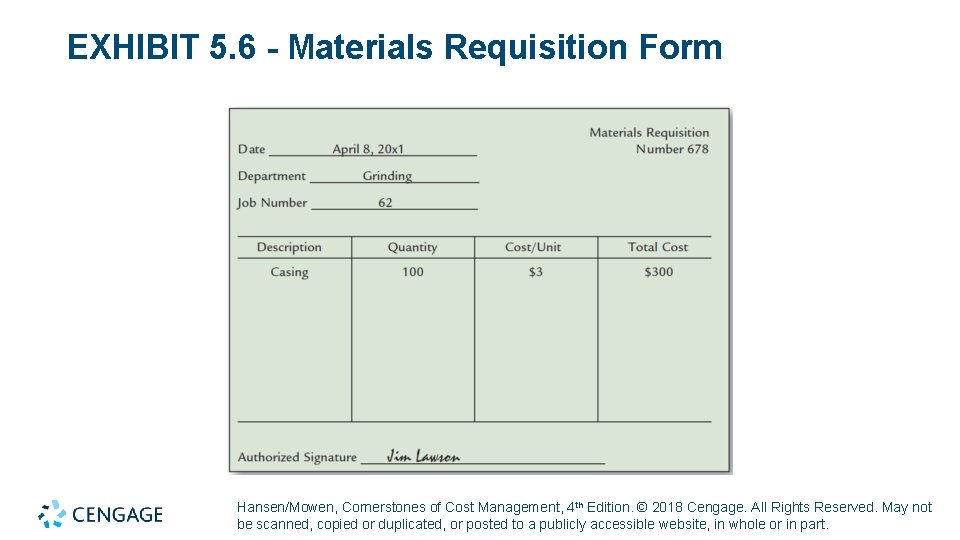
EXHIBIT 5. 6 - Materials Requisition Form Hansen/Mowen, Cornerstones of Cost Management, 4 th Edition. © 2018 Cengage. All Rights Reserved. May not be scanned, copied or duplicated, or posted to a publicly accessible website, in whole or in part.
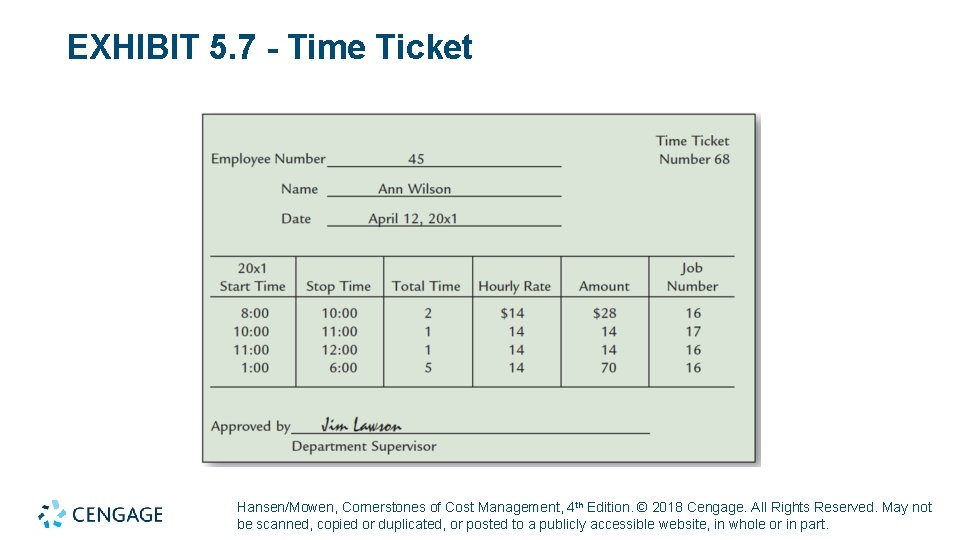
EXHIBIT 5. 7 - Time Ticket Hansen/Mowen, Cornerstones of Cost Management, 4 th Edition. © 2018 Cengage. All Rights Reserved. May not be scanned, copied or duplicated, or posted to a publicly accessible website, in whole or in part.
Overhead Application • Jobs are assigned overhead costs with a predetermined overhead rate o Direct labor hours are used as the measure to calculate overhead • When overheads are assigned based on drivers other than direct labor, the other drives must also be accounted for Hansen/Mowen, Cornerstones of Cost Management, 4 th Edition. © 2018 Cengage. All Rights Reserved. May not be scanned, copied or duplicated, or posted to a publicly accessible website, in whole or in part.
Unit Cost Calculation • Total manufacturing cost is calculated by totaling direct materials, direct labor, and overhead and summing these individual totals o Provides the cost of finished goods inventory at any point in time • If there are multiple units in a job, the grand total can be divided by the number of units produced to obtain the unit cost Hansen/Mowen, Cornerstones of Cost Management, 4 th Edition. © 2018 Cengage. All Rights Reserved. May not be scanned, copied or duplicated, or posted to a publicly accessible website, in whole or in part.
Accounting for Overhead Application • Overhead costs flow into work-in-process inventory via the predetermined overhead rate o Debited to work-in-process inventory and credited to overhead control • Main source document - Time tickets Hansen/Mowen, Cornerstones of Cost Management, 4 th Edition. © 2018 Cengage. All Rights Reserved. May not be scanned, copied or duplicated, or posted to a publicly accessible website, in whole or in part.
Accounting for Actual Overhead Costs • Actual overhead is debited to the overhead control account as it is incurred o Gives the total actual overhead costs at a given point in time o Balance in overhead control is overhead variance at a given point in time • Sources of information o Time tickets o Predetermined overhead rates based on direct labor hours Hansen/Mowen, Cornerstones of Cost Management, 4 th Edition. © 2018 Cengage. All Rights Reserved. May not be scanned, copied or duplicated, or posted to a publicly accessible website, in whole or in part.
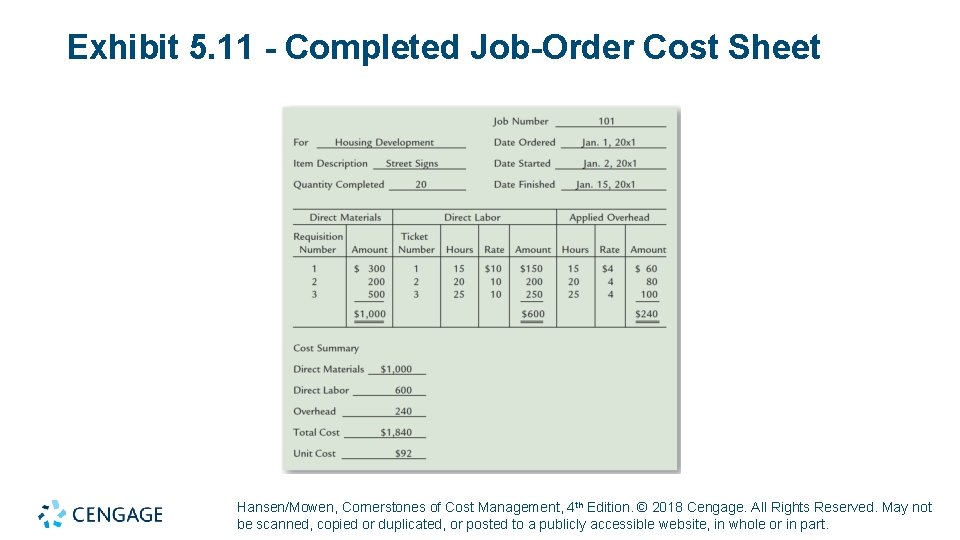
Exhibit 5. 11 - Completed Job-Order Cost Sheet Hansen/Mowen, Cornerstones of Cost Management, 4 th Edition. © 2018 Cengage. All Rights Reserved. May not be scanned, copied or duplicated, or posted to a publicly accessible website, in whole or in part.
Accounting for Finished Goods Inventory • Direct materials, direct labor, and applied manufacturing overhead are totaled for completed jobs o Yields the manufacturing cost of the job • Cost of a completed job is debited to finished goods inventory and credited to work-in-process o Finished goods inventories are carried at normal cost rather than actual cost Hansen/Mowen, Cornerstones of Cost Management, 4 th Edition. © 2018 Cengage. All Rights Reserved. May not be scanned, copied or duplicated, or posted to a publicly accessible website, in whole or in part.
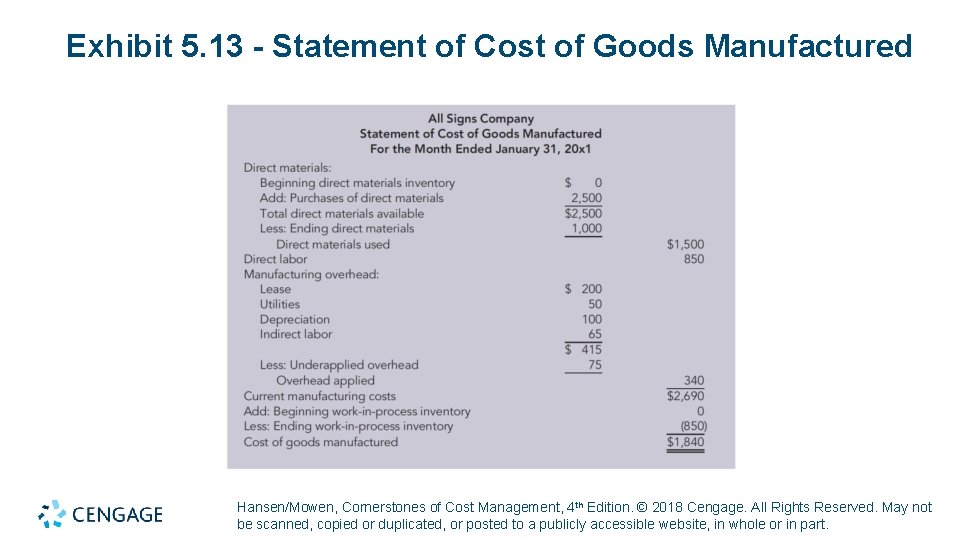
Exhibit 5. 13 - Statement of Cost of Goods Manufactured Hansen/Mowen, Cornerstones of Cost Management, 4 th Edition. © 2018 Cengage. All Rights Reserved. May not be scanned, copied or duplicated, or posted to a publicly accessible website, in whole or in part.
Overhead Variances • Usually immaterial and is therefore closed to the cost of goods sold account o Normal cost of goods sold: Cost of goods sold before adjustment for an overhead variance o Adjusted cost of goods sold: Result after adjustment for the period’s overhead variance takes place Hansen/Mowen, Cornerstones of Cost Management, 4 th Edition. © 2018 Cengage. All Rights Reserved. May not be scanned, copied or duplicated, or posted to a publicly accessible website, in whole or in part.
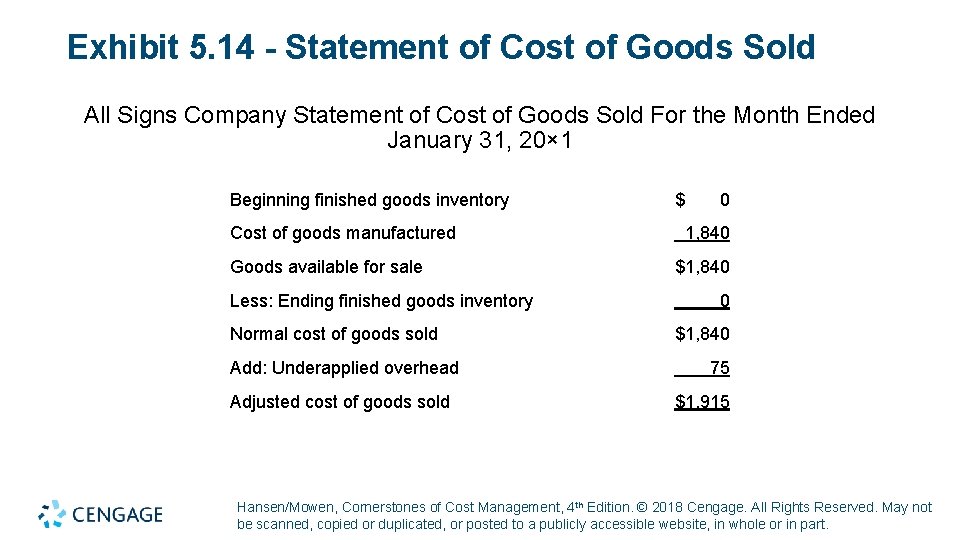
Exhibit 5. 14 - Statement of Cost of Goods Sold All Signs Company Statement of Cost of Goods Sold For the Month Ended January 31, 20× 1 Beginning finished goods inventory Cost of goods manufactured Goods available for sale Less: Ending finished goods inventory Normal cost of goods sold Add: Underapplied overhead Adjusted cost of goods sold $ 0 1, 840 $1, 840 75 $1, 915 Hansen/Mowen, Cornerstones of Cost Management, 4 th Edition. © 2018 Cengage. All Rights Reserved. May not be scanned, copied or duplicated, or posted to a publicly accessible website, in whole or in part.
Closing the Overhead Variance Account (1 of 2) • Done once at the end of a year • Variances are expected each month because of non uniform production and overhead actual costs o Over time, these costs should largely offset each other Hansen/Mowen, Cornerstones of Cost Management, 4 th Edition. © 2018 Cengage. All Rights Reserved. May not be scanned, copied or duplicated, or posted to a publicly accessible website, in whole or in part.
Closing the Overhead Variance Account (2 of 2) • Debiting Cost of Goods Sold is equal to adding the underapplied amount to the normal cost of goods sold o If overhead variance had been overapplied, Cost of Goods Sold would be credited Hansen/Mowen, Cornerstones of Cost Management, 4 th Edition. © 2018 Cengage. All Rights Reserved. May not be scanned, copied or duplicated, or posted to a publicly accessible website, in whole or in part.
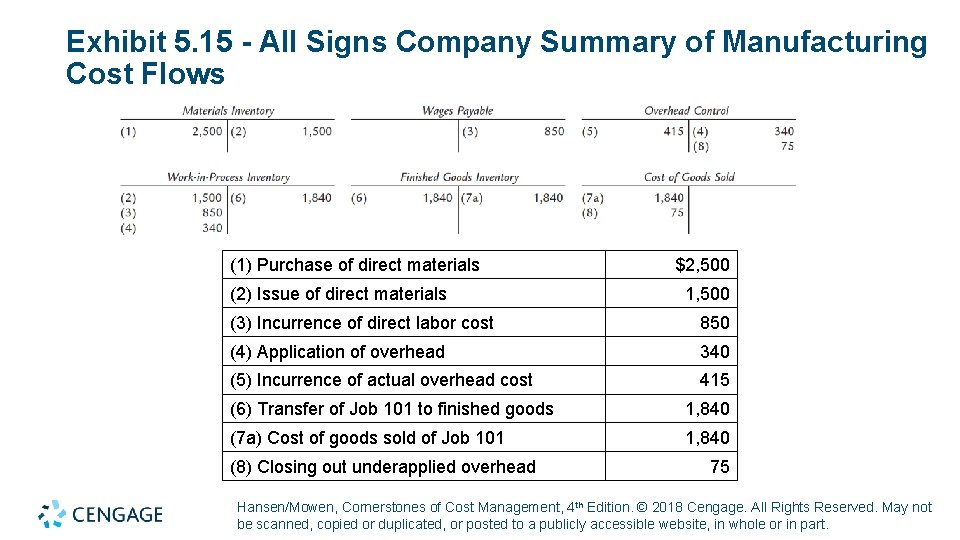
Exhibit 5. 15 - All Signs Company Summary of Manufacturing Cost Flows (1) Purchase of direct materials (2) Issue of direct materials $2, 500 1, 500 (3) Incurrence of direct labor cost 850 (4) Application of overhead 340 (5) Incurrence of actual overhead cost 415 (6) Transfer of Job 101 to finished goods 1, 840 (7 a) Cost of goods sold of Job 101 1, 840 (8) Closing out underapplied overhead 75 Hansen/Mowen, Cornerstones of Cost Management, 4 th Edition. © 2018 Cengage. All Rights Reserved. May not be scanned, copied or duplicated, or posted to a publicly accessible website, in whole or in part.
Accounting for Nonmanufacturing Costs • Nonmanufacturing costs include selling and general administrative expenses o Period costs and are never assigned to inventory accounts o Do not belong to the overhead category o Accumulated in the controlling accounts o Flow to the income statement at the end of the period Hansen/Mowen, Cornerstones of Cost Management, 4 th Edition. © 2018 Cengage. All Rights Reserved. May not be scanned, copied or duplicated, or posted to a publicly accessible website, in whole or in part.
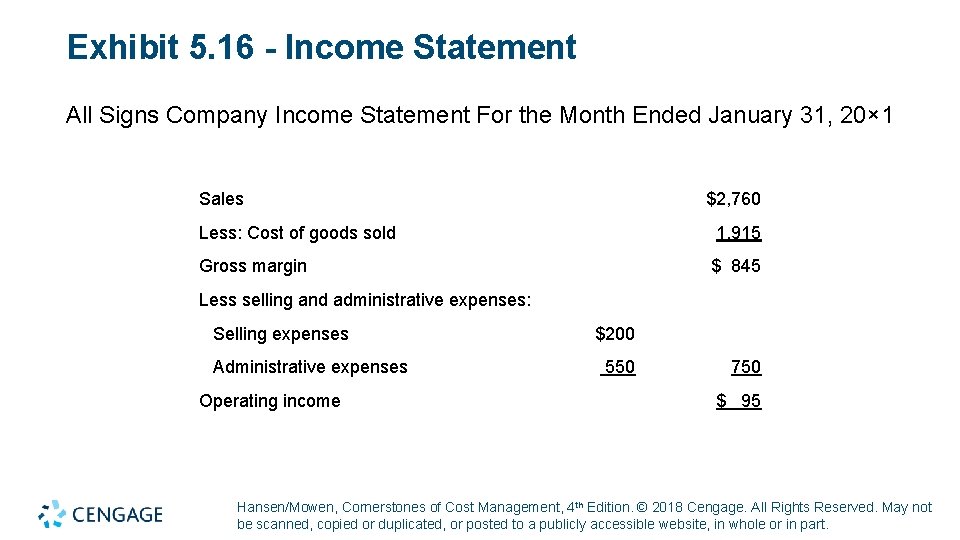
Exhibit 5. 16 - Income Statement All Signs Company Income Statement For the Month Ended January 31, 20× 1 Sales $2, 760 Less: Cost of goods sold 1, 915 Gross margin $ 845 Less selling and administrative expenses: Selling expenses Administrative expenses Operating income $200 550 750 $ 95 Hansen/Mowen, Cornerstones of Cost Management, 4 th Edition. © 2018 Cengage. All Rights Reserved. May not be scanned, copied or duplicated, or posted to a publicly accessible website, in whole or in part.
Accounting for Spoiled Units in a Traditional Job. Order Costing System • Normal spoilage: Caused because of the nature of the production process o When spoilage doesn’t result from a particular job, it is subsumed in the overhead rate and spread across all jobs through applied overhead o When spoilage is caused due to the exacting nature of the job, extra cost is added to that job’s cost • Abnormal spoilage: Unexpected and not part of normal operations o Charged to Loss from Abnormal Spoilage Hansen/Mowen, Cornerstones of Cost Management, 4 th Edition. © 2018 Cengage. All Rights Reserved. May not be scanned, copied or duplicated, or posted to a publicly accessible website, in whole or in part.
- Slides: 33