
CHAPTER 5 Probability What Are the Chances 5
CHAPTER 5 Probability: What Are the Chances? 5. 2 a Probability Rules The Practice of Statistics, 5 th Edition Starnes, Tabor, Yates, Moore Bedford Freeman Worth Publishers
Probability Rules Learning Objectives After this section, you should be able to: ü DESCRIBE a probability model for a chance process. ü USE basic probability rules, including the complement rule and the addition rule for mutually exclusive events. ü USE a two-way table or Venn diagram to MODEL a chance process and CALCULATE probabilities involving two events. ü USE the general addition rule to CALCULATE probabilities. The Practice of Statistics, 5 th Edition 2
Probability Models In Section 5. 1, we used simulation to imitate chance behavior. Fortunately, we don’t have to always rely on simulations to determine the probability of a particular outcome. Descriptions of chance behavior contain two parts: The sample space S of a chance process is the set of all possible outcomes. A probability model is a description of some chance process that consists of two parts: • a sample space S and • a probability for each outcome. The Practice of Statistics, 5 th Edition 3
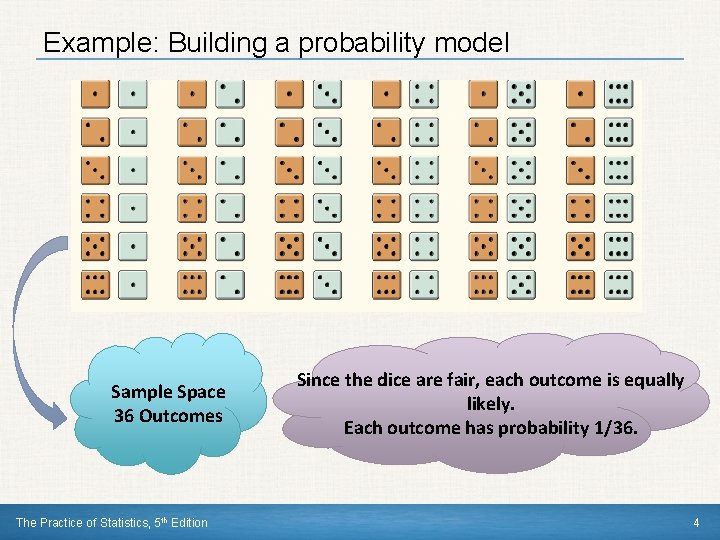
Example: Building a probability model Sample Space 36 Outcomes The Practice of Statistics, 5 th Edition Since the dice are fair, each outcome is equally likely. Each outcome has probability 1/36. 4
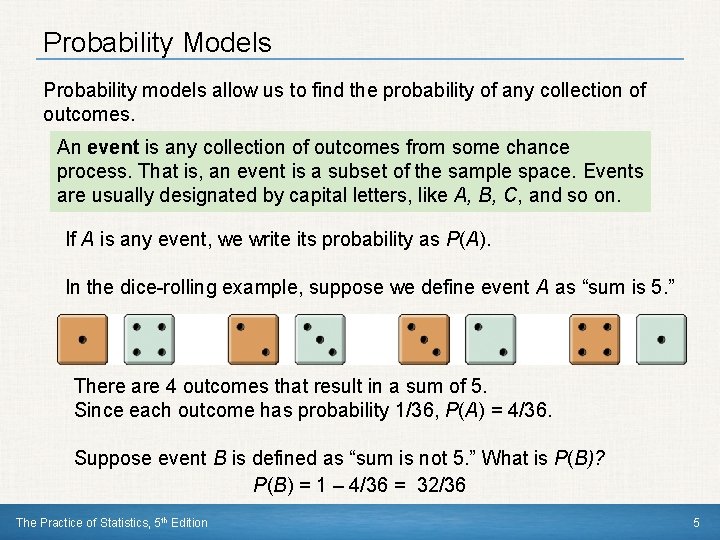
Probability Models Probability models allow us to find the probability of any collection of outcomes. An event is any collection of outcomes from some chance process. That is, an event is a subset of the sample space. Events are usually designated by capital letters, like A, B, C, and so on. If A is any event, we write its probability as P(A). In the dice-rolling example, suppose we define event A as “sum is 5. ” There are 4 outcomes that result in a sum of 5. Since each outcome has probability 1/36, P(A) = 4/36. Suppose event B is defined as “sum is not 5. ” What is P(B)? P(B) = 1 – 4/36 = 32/36 The Practice of Statistics, 5 th Edition 5
Probability Model – Flipping Coins Imagine flipping a fair coin three times. Give a probability model for this chance process. Eight possible outcomes: HHH HHT HTH HTT TTH THT THH Because the coin is fair, each of these eight outcomes will be equally likely and have probability 1/8. Let A = two or more heads B = no heads C = at least one head Find P(A), P(B), P(C), P(B or C), P(A or B) P(A) = 4/8 P(B) = 1/8 P(C) = 7/8 P(B or C) = 1/8 + 7/8 = 1 (no events in common so we can add) P(A or B) = 4/8 + 1/8 = 5/8 The Practice of Statistics, 5 th Edition 6
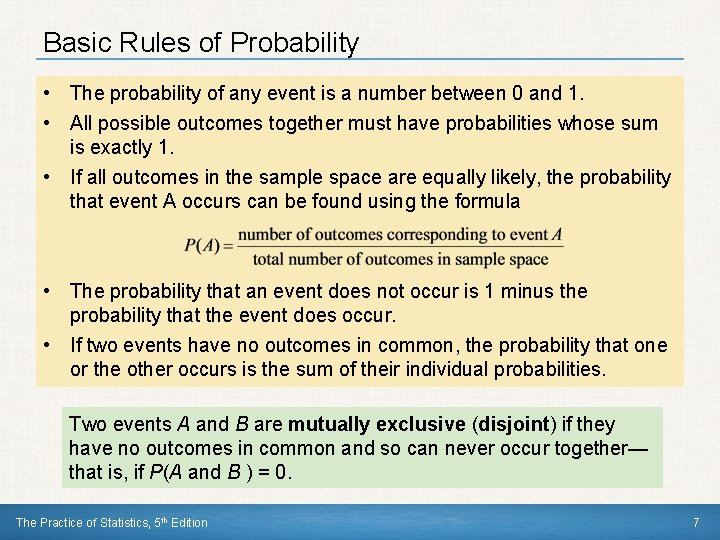
Basic Rules of Probability • The probability of any event is a number between 0 and 1. • All possible outcomes together must have probabilities whose sum is exactly 1. • If all outcomes in the sample space are equally likely, the probability that event A occurs can be found using the formula • The probability that an event does not occur is 1 minus the probability that the event does occur. • If two events have no outcomes in common, the probability that one or the other occurs is the sum of their individual probabilities. Two events A and B are mutually exclusive (disjoint) if they have no outcomes in common and so can never occur together— that is, if P(A and B ) = 0. The Practice of Statistics, 5 th Edition 7
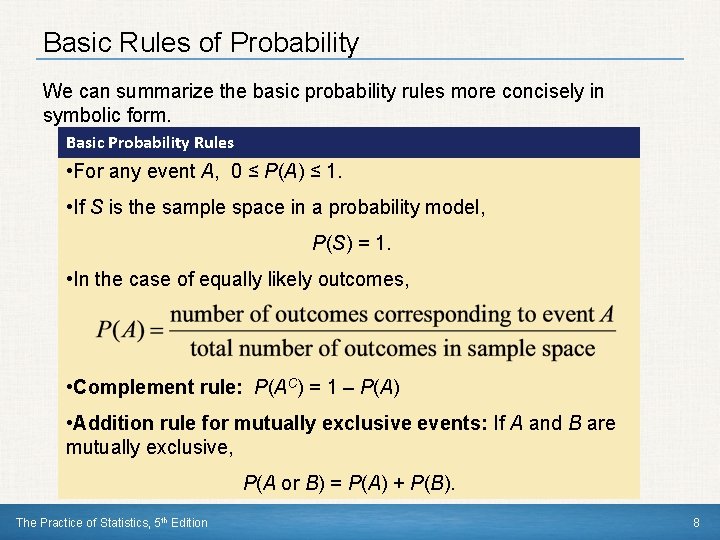
Basic Rules of Probability We can summarize the basic probability rules more concisely in symbolic form. Basic Probability Rules • For any event A, 0 ≤ P(A) ≤ 1. • If S is the sample space in a probability model, P(S) = 1. • In the case of equally likely outcomes, • Complement rule: P(AC) = 1 – P(A) • Addition rule for mutually exclusive events: If A and B are mutually exclusive, P(A or B) = P(A) + P(B). The Practice of Statistics, 5 th Edition 8
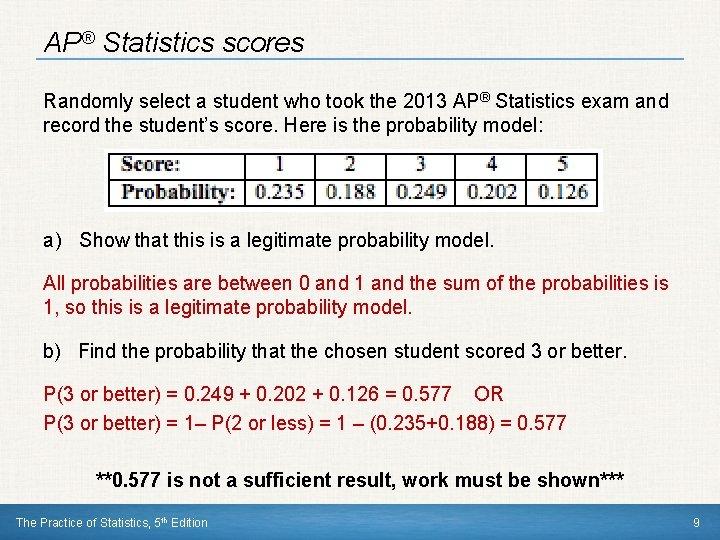
AP® Statistics scores Randomly select a student who took the 2013 AP® Statistics exam and record the student’s score. Here is the probability model: a) Show that this is a legitimate probability model. All probabilities are between 0 and 1 and the sum of the probabilities is 1, so this is a legitimate probability model. b) Find the probability that the chosen student scored 3 or better. P(3 or better) = 0. 249 + 0. 202 + 0. 126 = 0. 577 OR P(3 or better) = 1– P(2 or less) = 1 – (0. 235+0. 188) = 0. 577 **0. 577 is not a sufficient result, work must be shown*** The Practice of Statistics, 5 th Edition 9
Probability Rules Section Summary In this section, we learned how to… ü DESCRIBE a probability model for a chance process. ü USE basic probability rules, including the complement rule and the addition rule for mutually exclusive events. ü USE a two-way table or Venn diagram to MODEL a chance process and CALCULATE probabilities involving two events. ü USE the general addition rule to CALCULATE probabilities. ü Read p. 305 -308 ccc 27, 31, 32, 39, 41, 43, 45, 47 The Practice of Statistics, 5 th Edition 10
- Slides: 10