
Chapter 5 Probability Distributions Prepared by Chhay Phang
Chapter 5 Probability Distributions Prepared by Chhay Phang H/P: 012 84 01 02 E-mail: phangg 2002@yahoo. com

Chapter Blueprint
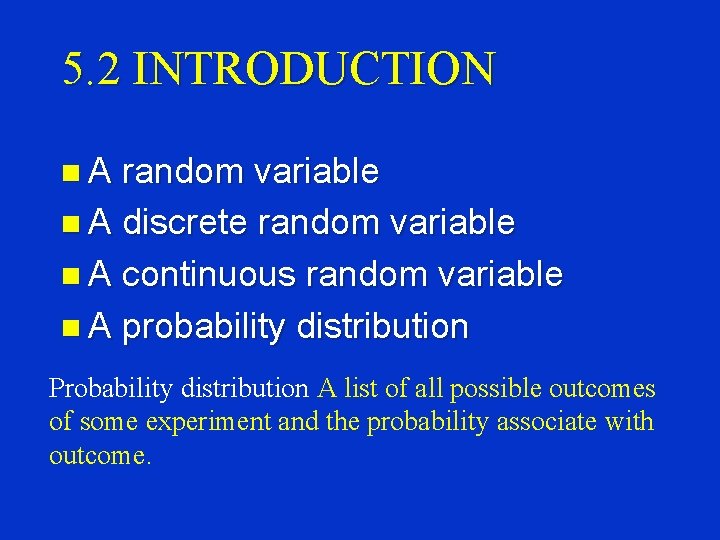
5. 2 INTRODUCTION n. A random variable n A discrete random variable n A continuous random variable n A probability distribution Probability distribution A list of all possible outcomes of some experiment and the probability associate with outcome.
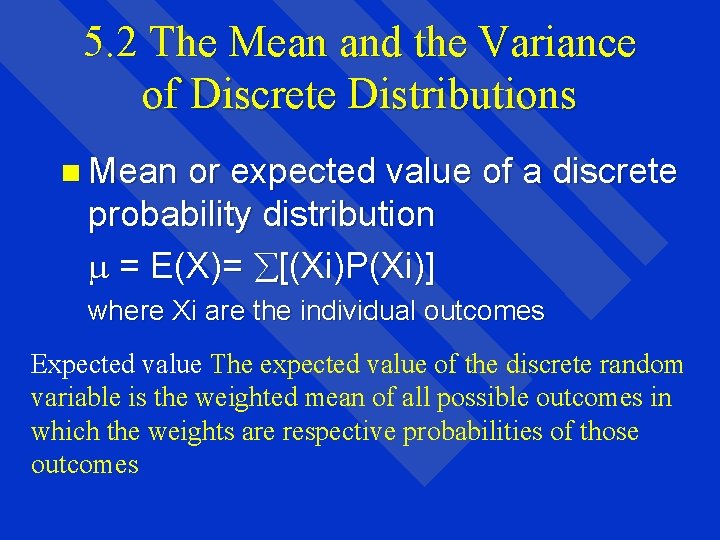
5. 2 The Mean and the Variance of Discrete Distributions n Mean or expected value of a discrete probability distribution = E(X)= [(Xi)P(Xi)] where Xi are the individual outcomes Expected value The expected value of the discrete random variable is the weighted mean of all possible outcomes in which the weights are respective probabilities of those outcomes
![n Variance of a probability distribution ^2 = [(Xi- )^2. P(Xi)] 5. 3 The](http://slidetodoc.com/presentation_image_h2/4726918c48157e7045a1adb77a608117/image-5.jpg "n Variance of a probability distribution ^2 = [(Xi- )^2. P(Xi)] 5. 3 The")
n Variance of a probability distribution ^2 = [(Xi- )^2. P(Xi)] 5. 3 The Binomial Distribution-a Discrete Distributions Binomial distribution: Jacob Bernoulli (1654 -1705) A Binomial distribution: Each trial in a binomial distribution result in one of only two mutually exclusive outcomes, one of which is identified as a success and the other as a failure. The probability of each outcome remains constant from one trail to the next.

The binomial formula A. The Mean and the Variance of a Binomial Distribution Mean E(X) = = n Variance ^2 = n (1 - )
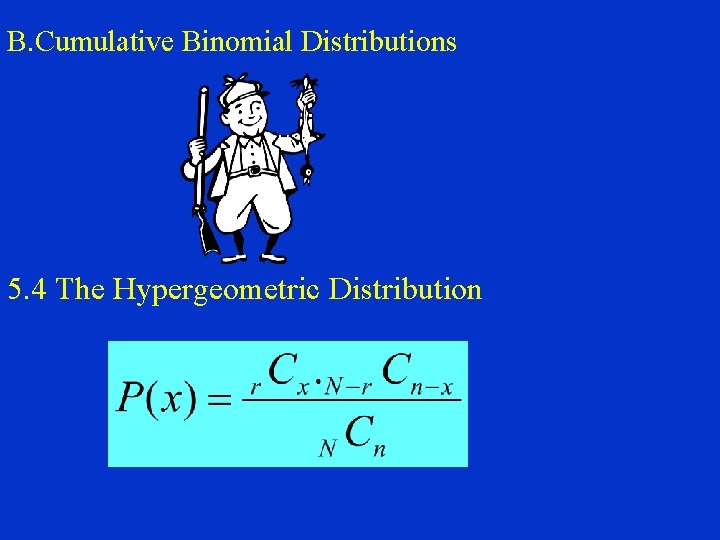
B. Cumulative Binomial Distributions 5. 4 The Hypergeometric Distribution
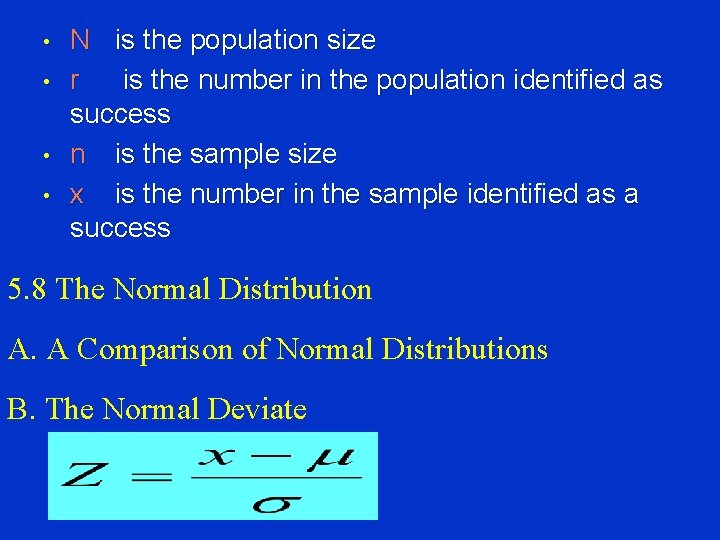
• • N is the population size r is the number in the population identified as success n is the sample size x is the number in the sample identified as a success 5. 8 The Normal Distribution A. A Comparison of Normal Distributions B. The Normal Deviate
C. Calculating Probabilities With Normal Deviate D. Calculating an X-Value from a known Probability E. Normal Approximation to the binomial distribution
5. 5 The Poisson Distribution Developed by French mathematician Simeon Poisson (1781 -1840), the Poisson Distribution measures the probability of a random event over some interval of time or space. Two assumptions are necessary for the Poisson Distribution: 1. The probability of the occurrence of the event is constant for any two interval of time or space 2. The occurrence of the event in any interval is independent of the occurrence in any other interval.
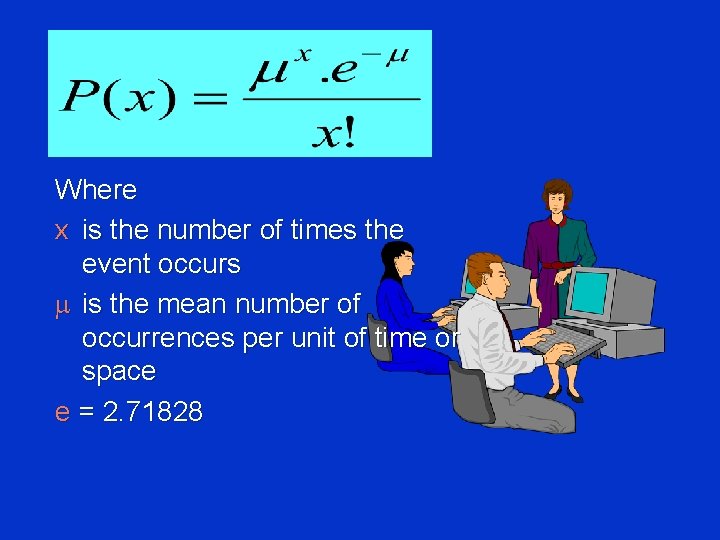
Where x is the number of times the event occurs is the mean number of occurrences per unit of time or space e = 2. 71828
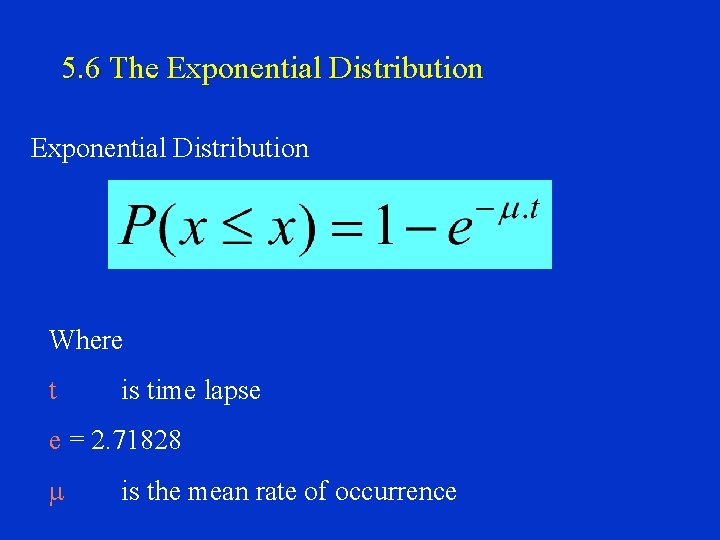
5. 6 The Exponential Distribution Where t is time lapse e = 2. 71828 is the mean rate of occurrence
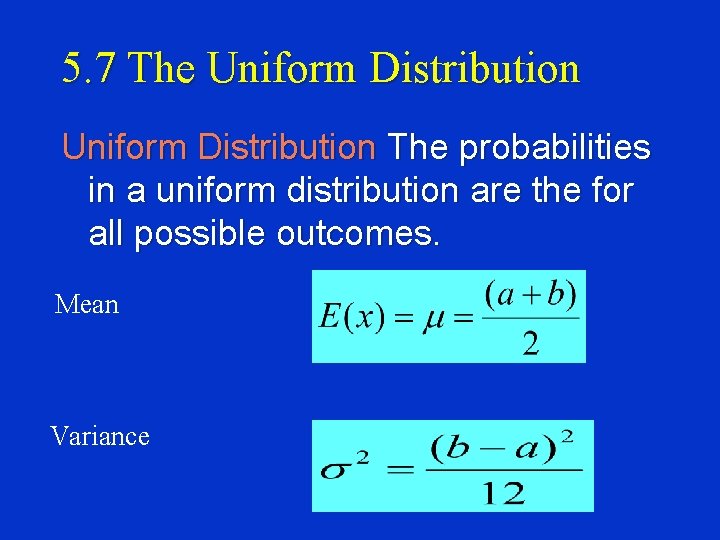
5. 7 The Uniform Distribution The probabilities in a uniform distribution are the for all possible outcomes. Mean Variance
Exercises 39, 41, 42, 43
- Slides: 14