
CHAPTER 5 PRINCIPLES OF INHERITANCE AND VARIATION Genetics
- Slides: 24
CHAPTER 5 PRINCIPLES OF INHERITANCE AND VARIATION
Genetics is the branch of biology that deals with the study of heredity and variations. Gregor Johann Mendel (1822 -1884) is known as father of genetics, because he was the first to demonstrate the mechanism of transmission of characters from one generation to he other. Inheritance is the process by which characters are passed on from parent to progeny. It is the basis of heredity. Variation is the degree by which progeny differ from their parents.
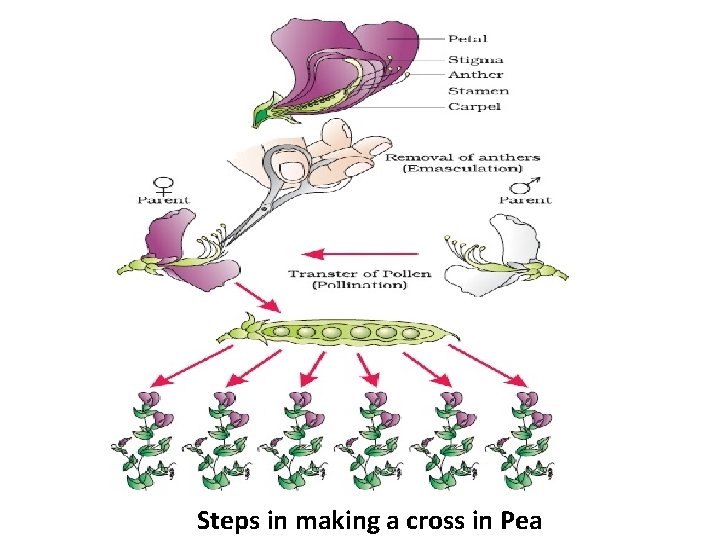
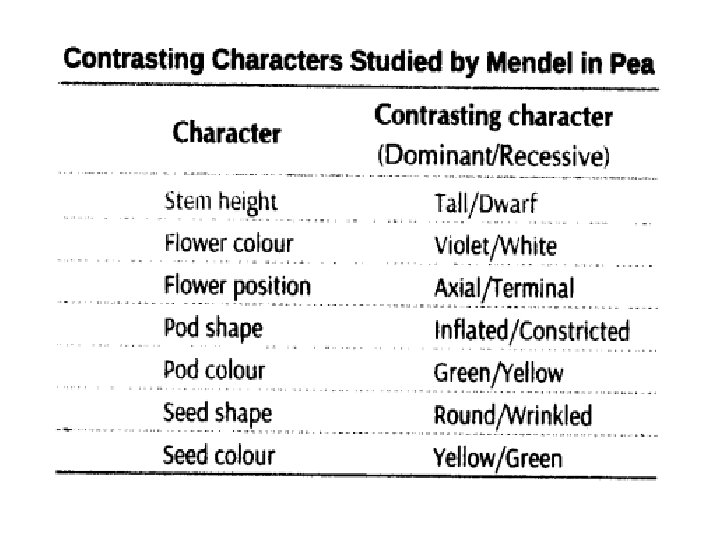
Mendel’s Law of Inheritance: • Gregor Mendel, conducted hybridisation experiments on garden peas for seven years (1856 -1863) and proposed the laws of inheritance in living organisms. During Mendel’s investigations into inheritance patterns it was for the first time that statistical analysis and mathematical logic were applied to problems in biology. • Mendel investigated characters in the garden pea plant that were manifested as two opposing traits, e. g. , tall or dwarf plants, yellow or green seeds. • Mendel conducted such artificial pollination/cross pollination experiments using several true-breeding pea lines. A truebreeding line is one that, having undergone continuous self-pollination, shows the stable trait inheritance and expression for several generations. Mendel selected 14 truebreeding pea plant varieties, as pairs
Reasons for Selection of Pea Plant • • • It is an annual plant with a short life-cycle. It has bisexual flowers. It is easy to cross pollinate. Pea has distinct contrasting characters The flowers are self-pollinating. Pea plant are easy to handle
Steps in making a cross in Pea
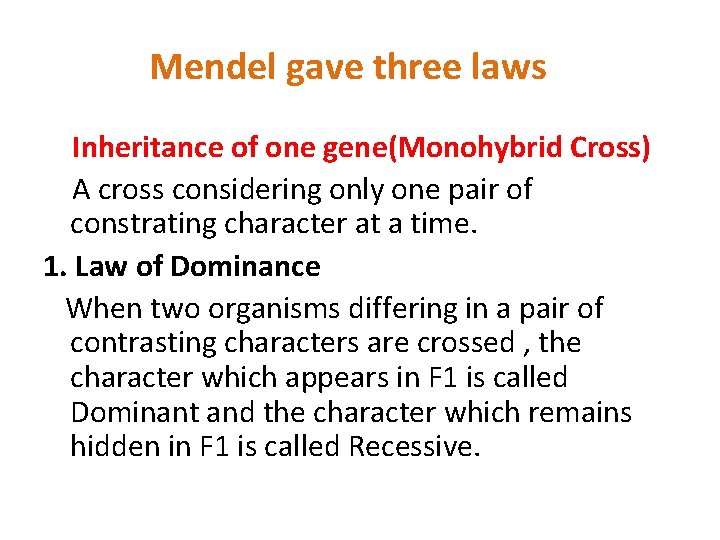
Mendel gave three laws Inheritance of one gene(Monohybrid Cross) A cross considering only one pair of constrating character at a time. 1. Law of Dominance When two organisms differing in a pair of contrasting characters are crossed , the character which appears in F 1 is called Dominant and the character which remains hidden in F 1 is called Recessive.
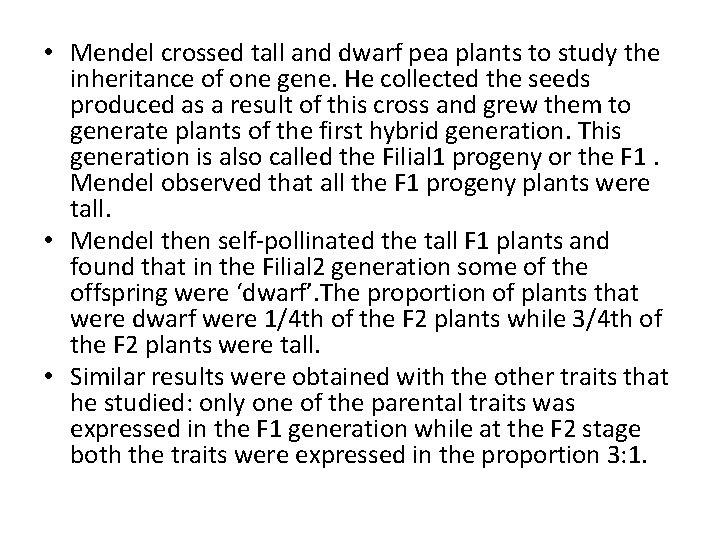
• l Mendel crossed tall and dwarf pea plants to study the inheritance of one gene. He collected the seeds produced as a result of this cross and grew them to generate plants of the first hybrid generation. This generation is also called the Filial 1 progeny or the F 1. Mendel observed that all the F 1 progeny plants were tall. • Mendel then self-pollinated the tall F 1 plants and found that in the Filial 2 generation some of the offspring were ‘dwarf’. The proportion of plants that were dwarf were 1/4 th of the F 2 plants while 3/4 th of the F 2 plants were tall. • Similar results were obtained with the other traits that he studied: only one of the parental traits was expressed in the F 1 generation while at the F 2 stage both the traits were expressed in the proportion 3: 1.
• Mendel proposed that factors were being stably passed down, unchanged, from parent to offspring through the gametes, over successive generations. Nowadays we call them as GENES. • Genes, therefore, are the units of inheritance. Genes which code for a pair of contrasting traits are known as alleles. • We use alphabetical symbols for each gene, then the capital letter is used for the trait expressed at the F 1 stage and the small alphabet for the other trait. For example, in case of the character of height, T is used for the Tall trait and t for the ‘dwarf’, and T and t are alleles of each other. • Mendel proposed that in a true breeding, tall or dwarf pea variety the allelic pair of genes for height are identical or homozygous, TT and tt, respectively. TT and tt are called the genotype of the plant while the descriptive terms tall and dwarf are the phenotype. • Hybrids containing alleles for contrasting traits are called heterozygous. K
3: 1 1: 2: 1
2. Law of Segregation • Alleles do not blends and both the characters are recovered during gametes formation as in F 2 generation. During gametes formation traits segregate (separate) from each other and passes to different gametes.
Test Cross It is the cross between F 1 hybrid and its homozygous recessive parent. Phenotypic Ratio and Genotypic Ratio is 1: 1.
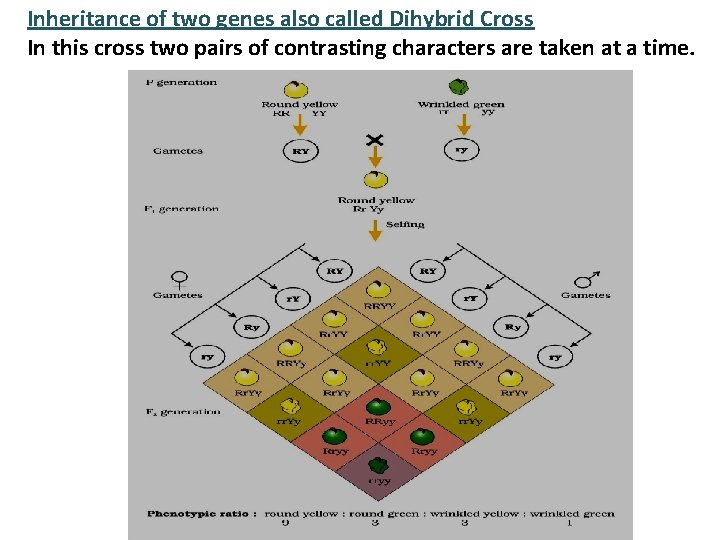
Inheritance of two genes also called Dihybrid Cross In this cross two pairs of contrasting characters are taken at a time.
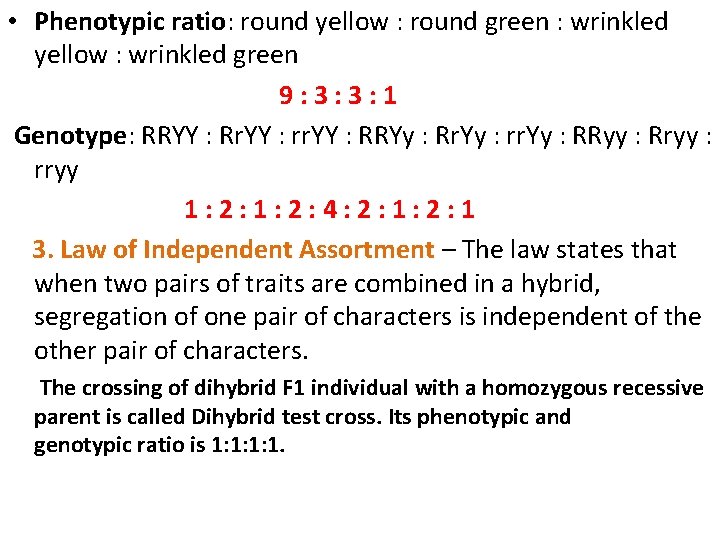
• Phenotypic ratio: round yellow : round green : wrinkled yellow : wrinkled green gg 9: 3: 3: 1 Genotype: RRYY : Rr. YY : rr. YY : RRYy : Rr. Yy : rr. Yy : RRyy : Rryy : rryy 1: 2: 4: 2: 1 3. Law of Independent Assortment – The law states that when two pairs of traits are combined in a hybrid, segregation of one pair of characters is independent of the other pair of characters. The crossing of dihybrid F 1 individual with a homozygous recessive parent is called Dihybrid test cross. Its phenotypic and genotypic ratio is 1: 1: 1: 1.
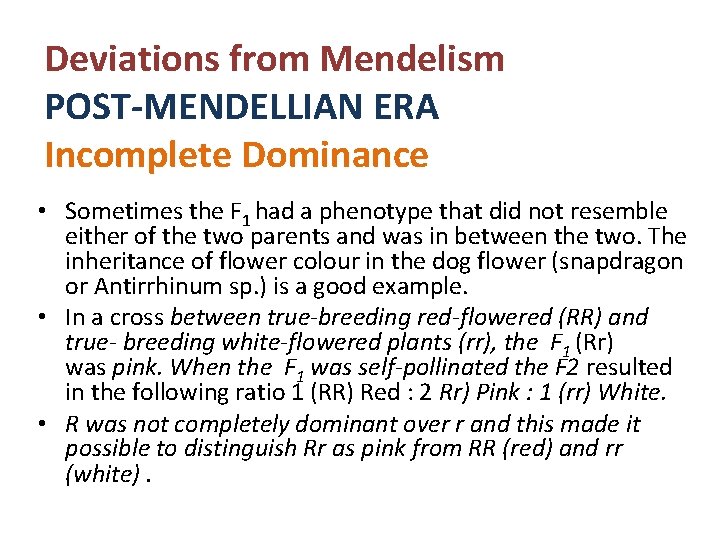
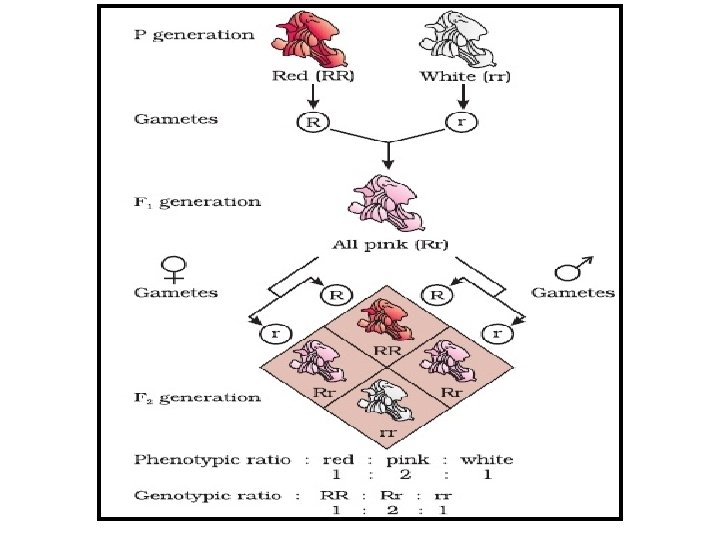
Deviations from Mendelism POST-MENDELLIAN ERA Incomplete Dominance • Sometimes the F 1 had a phenotype that did not resemble either of the two parents and was in between the two. The inheritance of flower colour in the dog flower (snapdragon or Antirrhinum sp. ) is a good example. • In a cross between true-breeding red-flowered (RR) and true- breeding white-flowered plants (rr), the F 1 (Rr) was pink. When the F 1 was self-pollinated the F 2 resulted in the following ratio 1 (RR) Red : 2 Rr) Pink : 1 (rr) White. • R was not completely dominant over r and this made it possible to distinguish Rr as pink from RR (red) and rr (white).
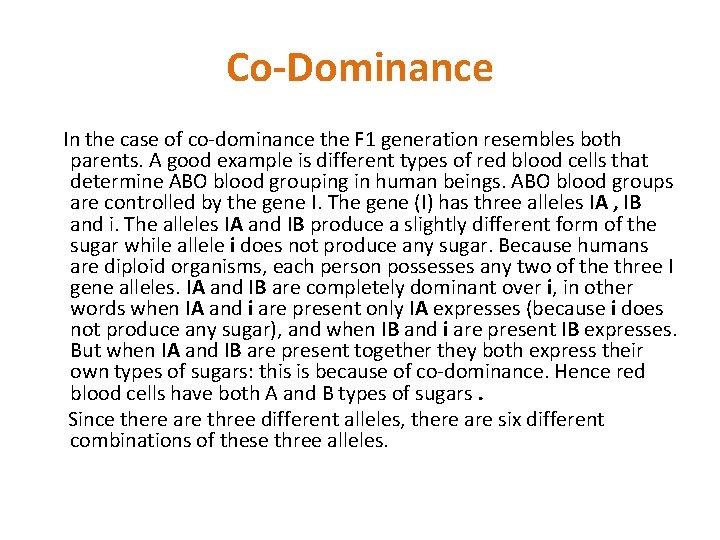
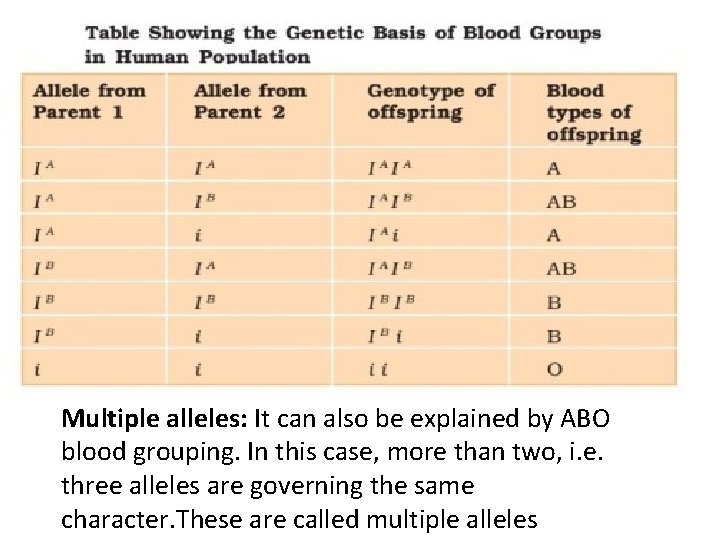
Co-Dominance In the case of co-dominance the F 1 generation resembles both parents. A good example is different types of red blood cells that determine ABO blood grouping in human beings. ABO blood groups are controlled by the gene I. The gene (I) has three alleles IA , IB and i. The alleles IA and IB produce a slightly different form of the sugar while allele i does not produce any sugar. Because humans are diploid organisms, each person possesses any two of the three I gene alleles. IA and IB are completely dominant over i, in other words when IA and i are present only IA expresses (because i does not produce any sugar), and when IB and i are present IB expresses. But when IA and IB are present together they both express their own types of sugars: this is because of co-dominance. Hence red blood cells have both A and B types of sugars. Since there are three different alleles, there are six different combinations of these three alleles.
Multiple alleles: It can also be explained by ABO blood grouping. In this case, more than two, i. e. three alleles are governing the same character. These are called multiple alleles
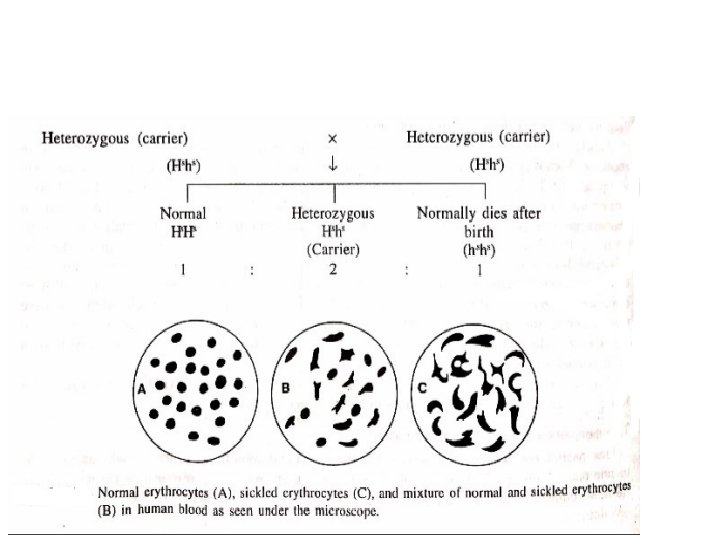
Pleiotropy • It is a phenomenon in which expression of a single gene affects several characters simultaneously. Carriers of the same genotype may possess different phenotypes. • Certain genes in homozygous condition cause lethality e. g. , sickle-cell anaemia.
• Sickle cell anaemia in man is an example of pleiotropy. This disease is expressed in recessive homozygous condition of a gene (hs). The recessive gene causes a change in the sixth amini acid of β- chain of haemoglobin causing replacement of glutamic acid by valine. The erythrocytes having this defective haemoglobin become sickle shaped once they lose oxygen and become non functional with regard to oxygenation in the blood tissue. The individuals homozygous for this defect (hshs) die immediately after birth. However, the individuals heterozygous (Hshs) for this gene show normal erythrocytes as well as sickled erythrocytes in the ratio 1: 1. Such individuals have mild anaemia and are protected against malaria because the parasite cannot live in the sickled erythrocytes. The heterozygous individuals inherit the genes for normal and defective haemoglobin. .
Chromosomal Theory of Inheritance • Chromosome theory of inheritance was proposed by Sutton and Boveri in 1902. They relate the mendelian factors with the chromosomes of the nuclei. Theory state that “The mendelian genes are located on the chromosomes and chromosomes are the carrier of the genes. The basis of theory was the similarities noted by them between the chromosome behaviour during meiosis and behaviour of the mendelian factors as given by mendel.
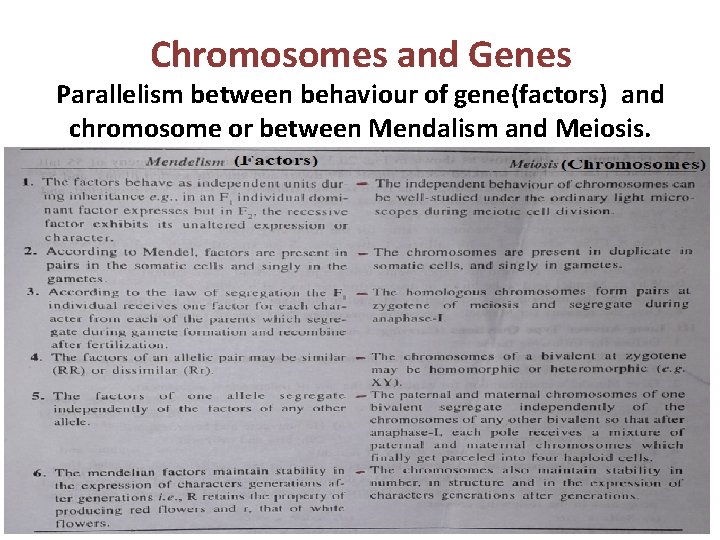
Chromosomes and Genes Parallelism between behaviour of gene(factors) and chromosome or between Mendalism and Meiosis.
. . that the behaviour of • The above chart explains chromosomes is similar to the behaviour of genes. • Morgan worked with tiny fruit flies Drosophila melanogaster and supported the chromosomal theory of inheritance.