
CHAPTER 5 Preventative and supportive techniques Preventative Support


- Slides: 22
CHAPTER 5 Preventative and supportive techniques
Preventative & Support Techniques Assessing an Injury Before any preventative or supportive technique, a proper evaluation should be completed
Preventive & Supportive Techniques Only a qualified health care professional can make recommendations concerning the application of protective techniques.
Preventive & Supportive Techniques Purpose of Taping & Wrapping With proper application, taping & wrapping techniques can be applied to: � Shorten the muscles angle of pull � Decrease joint ROM � Secure pads, bandages, and protective devices � Apply compression to aid in controlling swelling
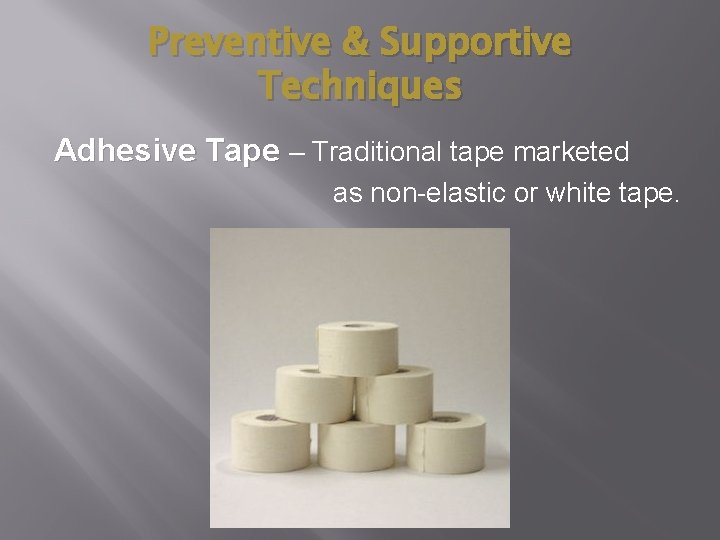
Preventive & Supportive Techniques Adhesive Tape – Traditional tape marketed as non-elastic or white tape.
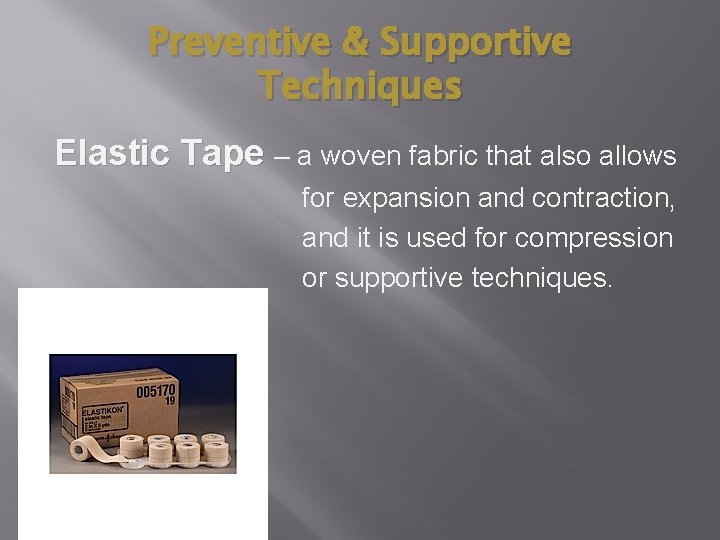
Preventive & Supportive Techniques Elastic Tape – a woven fabric that also allows for expansion and contraction, and it is used for compression or supportive techniques.
Preventive & Supportive Techniques Both adhesive tape and elastic tapes are produced in a variety of widths. Tape or Not to Tape That is the question? Positives: � Protection � Comfortable � Allows Full ROM � Follow – up Athlete
Preventive & Supportive Techniques Tape or Not to Tape That is the question? Negative: � Cost of Tape � Tape loosens with sweat and use � Weakens support structures � Need an athletic trainer to apply; may not always be available.
Preventive & Supportive Techniques Purpose of Taping & Wrapping With proper application, taping & wrapping techniques can be applied to: � Shorten the muscles angle of pull � Decrease joint ROM � Secure pads, bandages, and protective devices � Apply compression to aid in controlling swelling
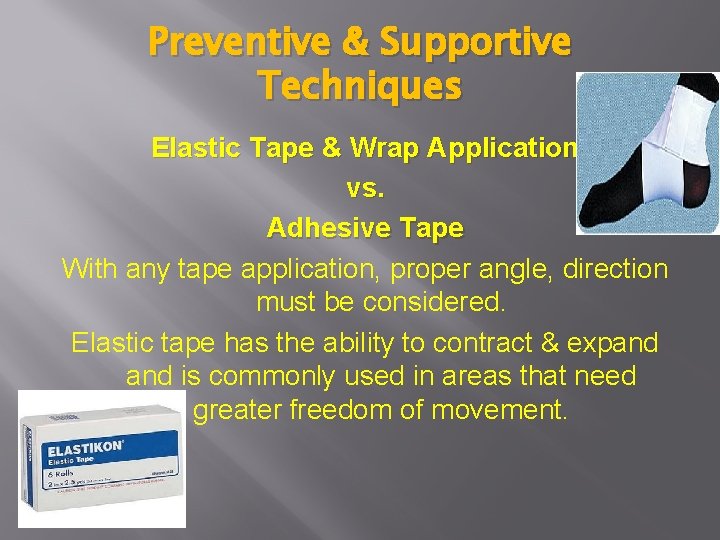
Preventive & Supportive Techniques Elastic Tape & Wrap Application vs. Adhesive Tape With any tape application, proper angle, direction must be considered. Elastic tape has the ability to contract & expand is commonly used in areas that need greater freedom of movement.
Preventive & Supportive Techniques Elastic Tape is also Comfortable & Strong. It can be placed on the body part with fewer wrinkles and at greater angles. When applying elastic tape, proper tension must be applied. Elastic wraps are used primarily used in the application of applying either compression of support.
Preventive & Supportive Techniques Taping Prep: � Removal of Hair – ensures a good foundation. � Tape � � just sticks better Cleanse the Area – make sure skin is clean & moisture free Special Consideration – allergies, infections, or open wounds. Spray Adherent Skin Lubricants – in areas of high friction. � Heel & Lace Pads on Ankle � Behind the knee (poplatiel space) � Prewrap – used to improve compliance. Hold Heel & Lace Pads. � Can compromise the stability of tape job.
Preventive & Supportive Techniques Application & Removal Although you try to describe it, you just got to do it! To tear tape, the adhesive tape is held firmly on each side of the proposed tear line. With proper tension on the tape, the free end is pulled away at an angle so that the force crosses the lines of the fabric of the backcloth at a sharp angle. The tear occurs sequentially through the backcloth. The quicker it is done, the more evenly tape edges will be torn.
Preventive & Supportive Techniques Application Some brands of tape are not meant to be cut by hand, but instead by scissors. Removal Again, obvious but not to those who are not on the field. Done with scissors or by a specially constructed cutting device. � Shark � Zipper �I you lubricate the tip it will make for easier cutting.
Preventive & Supportive Techniques Removal Seriously Now! You do have to assure the athlete that you cannot cut them � Avoid bony prominences, move scissors / “Shark” along the natural channels or areas of greatest soft tissue cushion. � Ankle – Just Posterior to the Medial Malleolus, along the Posterior Tibialis
Preventive & Supportive Techniques Elastic Wraps Ø Supportive Wraps – utilized to aid muscle function & support, reduces excessive ROM Ø Usually used for short time periods, practice or games Ø Spica Wraps – usually used around the hip or shoulder Ø Figure 8 – ankle, knee, wrist & hand joints Ø Pad/Protective Device Support – secures felt, foam pads, & protective devices.
Preventive & Supportive Techniques Compression Wraps Utilized in initial injury treatment protocol (PRICES) v Use a spiral pattern and begin distal to the injury, cross the injured joint, and finish proximal to the affected area. v Ø Removal & Re-application of compression wrap should take place every 4 hours Always be aware of specific rules for that particular sport governing body (FHSAA) has regarding tape/or wrap application.
Preventive & Supportive Techniques Braces & Special Devices Primary purpose is to prevent an injury and to protect injured area from further aggravation. Adds: ü ü Additional protection Additional Support “ Stability “ Compression Can be beneficial if used appropriately, fitted, & properly applied. Remember there also rules governing the use of braces as well.
Preventive & Supportive Techniques Common Specialty Supplies Foam: Can be adhesive or non adhesive, used with various taping procedures to increase efficacy of the technique. • Keep in Mind Proper: size, thickness, shape, & foam composition prior to application. Thermoplastic: Used to protect the injury, like contusions. Be aware of stringent rules against the use of this materials in competition.
Preventive & Supportive Techniques Common Specialty Supplies Felt: Used with the same considerations as in foam padding When constructing a special pad the following 4 criteria should be considered: 1. Meets Specific Rules 2. Performs the function it was designed for 3. Will it make the injury worse? 4. Will it void the warranty of the manufactured piece of equipment? (especially the helmet & shoulder pads)
Preventive & Supportive Techniques Tips Ø Know what body part & injury you are providing support Ø Cover sensitive parts Ø Tape from a stationary position (avoid fatigue) Ø Position body part at elbow height when possible Ø When learning use elastic wraps till you becoming proficient, then use tapes
Preventive & Supportive Techniques Tips cont. Ø Apply Proper Tension – do not cut circulation Ø Overlap tape/wrap to avoid spaces that can cause cuts & friction Ø When applying a compression always start distally and work proximately Ø When applying tape to the foot/ankle, pull tape lateral to avoid excessive tension/compression on the 5 th metatarsal area. Ø Finally PRACTICE!