
CHAPTER 5 PRESSURE 5 1 Pressure and Its
- Slides: 14
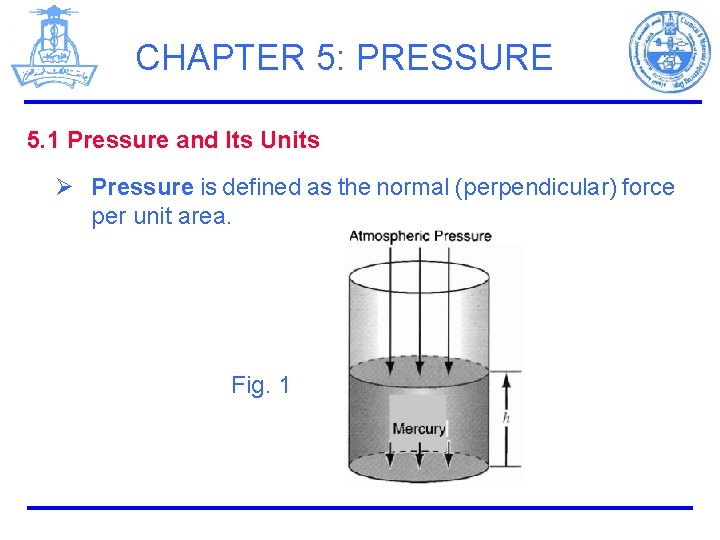
CHAPTER 5: PRESSURE 5. 1 Pressure and Its Units Ø Pressure is defined as the normal (perpendicular) force per unit area. Fig. 1
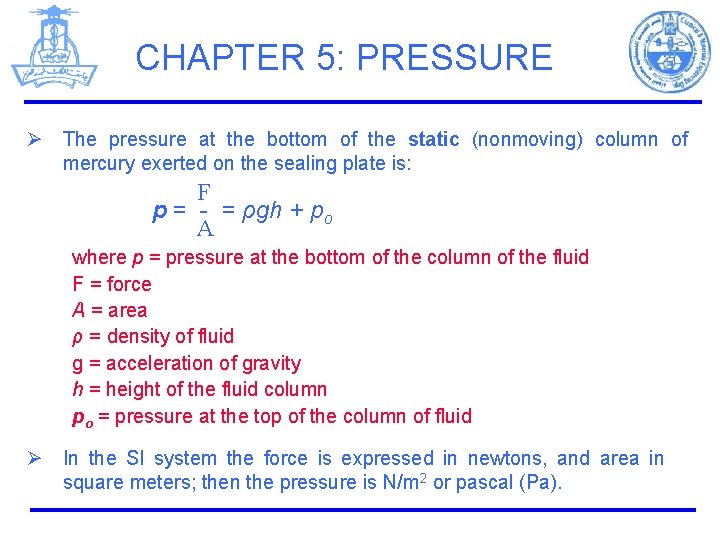
CHAPTER 5: PRESSURE Ø The pressure at the bottom of the static (nonmoving) column of mercury exerted on the sealing plate is: F p = - = ρgh + po A where p = pressure at the bottom of the column of the fluid F = force A = area ρ = density of fluid g = acceleration of gravity h = height of the fluid column po = pressure at the top of the column of fluid Ø In the SI system the force is expressed in newtons, and area in square meters; then the pressure is N/m 2 or pascal (Pa).
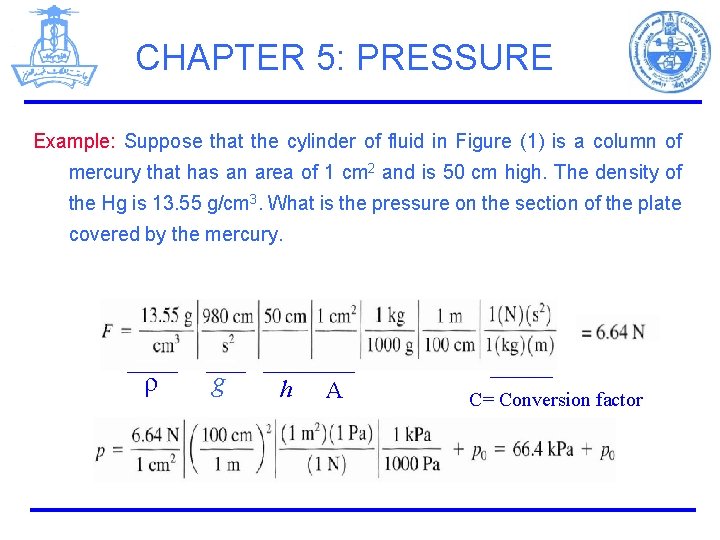
CHAPTER 5: PRESSURE Example: Suppose that the cylinder of fluid in Figure (1) is a column of mercury that has an area of 1 cm 2 and is 50 cm high. The density of the Hg is 13. 55 g/cm 3. What is the pressure on the section of the plate covered by the mercury. ρ g h A C= Conversion factor
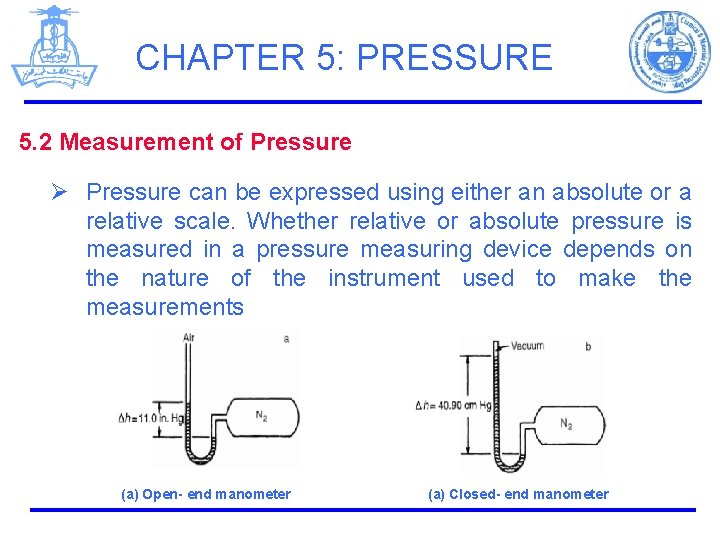
CHAPTER 5: PRESSURE 5. 2 Measurement of Pressure Ø Pressure can be expressed using either an absolute or a relative scale. Whether relative or absolute pressure is measured in a pressure measuring device depends on the nature of the instrument used to make the measurements (a) Open- end manometer (a) Closed- end manometer
CHAPTER 5: PRESSURE Ø Water and mercury are commonly used indicating fluids for manometers; the readings thus can be expressed in "inches or cm of water, " "inches or cm of mercury, “ and so on. gauge pressure + barometric pressure = absolute pressure Ø The standard atmosphere is defined as the pressure (in a standard gravitational field) equivalent to 1 atm or 760 mm Hg at 0°C or other equivalent value. Ø Atmospheric pressure is variable and must be obtained from a barometric measurement each time you need it.
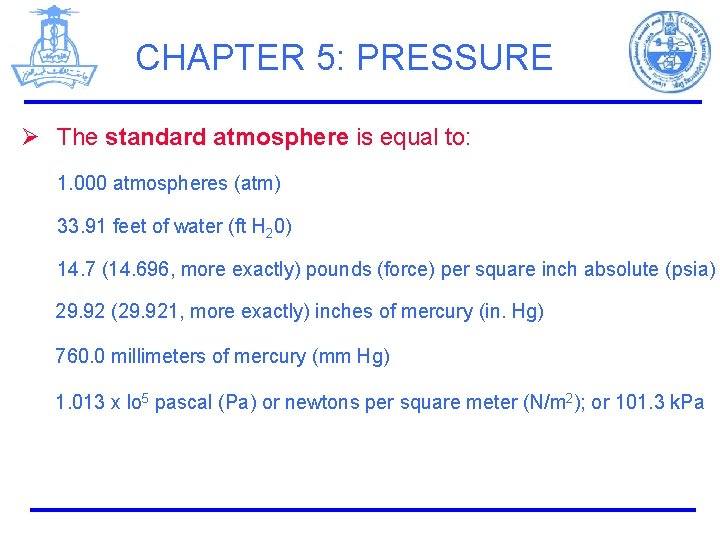
CHAPTER 5: PRESSURE Ø The standard atmosphere is equal to: 1. 000 atmospheres (atm) 33. 91 feet of water (ft H 20) 14. 7 (14. 696, more exactly) pounds (force) per square inch absolute (psia) 29. 92 (29. 921, more exactly) inches of mercury (in. Hg) 760. 0 millimeters of mercury (mm Hg) 1. 013 x lo 5 pascal (Pa) or newtons per square meter (N/m 2); or 101. 3 k. Pa
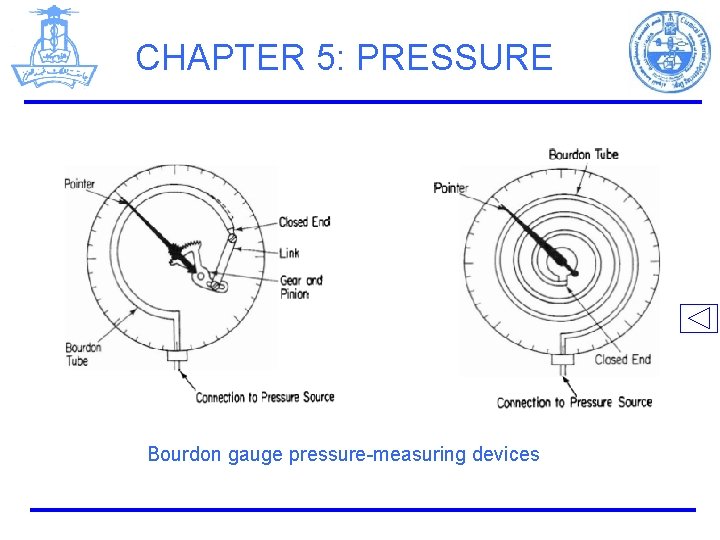
CHAPTER 5: PRESSURE Bourdon gauge pressure-measuring devices
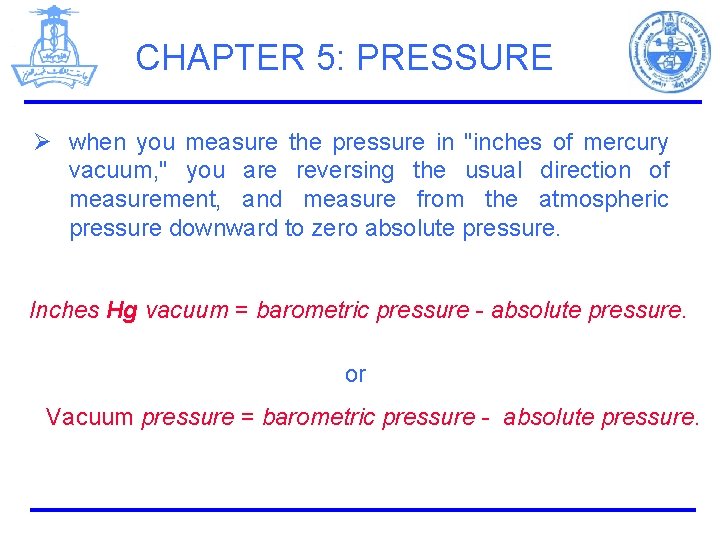
CHAPTER 5: PRESSURE Ø when you measure the pressure in "inches of mercury vacuum, " you are reversing the usual direction of measurement, and measure from the atmospheric pressure downward to zero absolute pressure. Inches Hg vacuum = barometric pressure - absolute pressure. or Vacuum pressure = barometric pressure - absolute pressure.
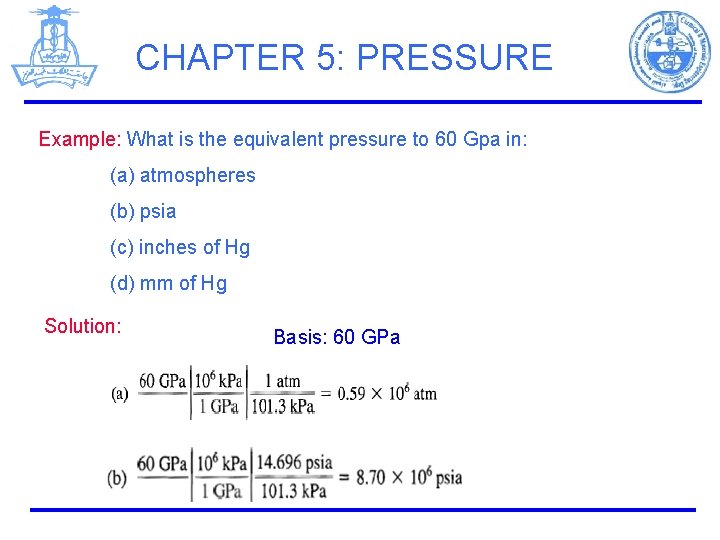
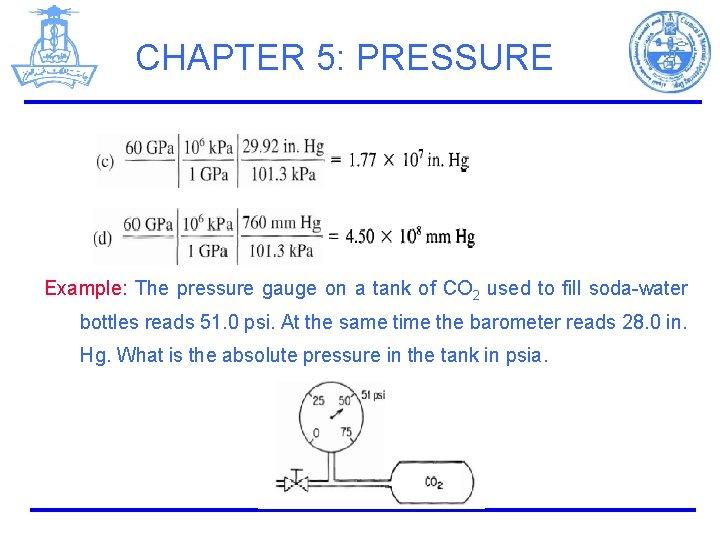
CHAPTER 5: PRESSURE Example: What is the equivalent pressure to 60 Gpa in: (a) atmospheres (b) psia (c) inches of Hg (d) mm of Hg Solution: Basis: 60 GPa
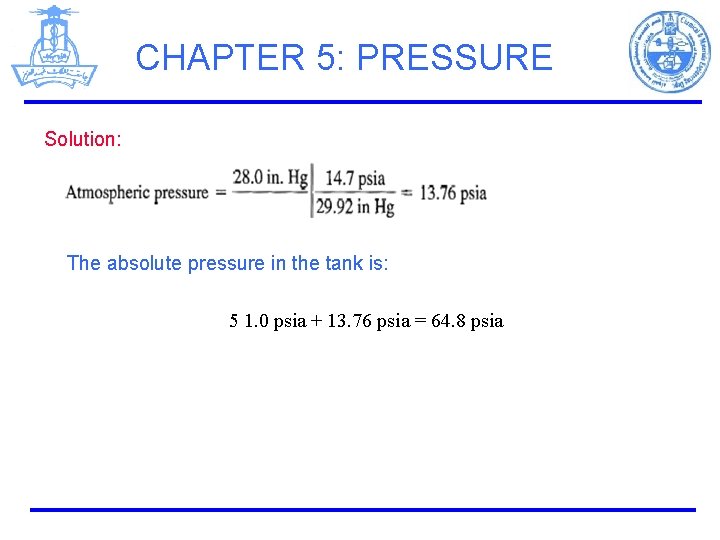
CHAPTER 5: PRESSURE Example: The pressure gauge on a tank of CO 2 used to fill soda-water bottles reads 51. 0 psi. At the same time the barometer reads 28. 0 in. Hg. What is the absolute pressure in the tank in psia.
CHAPTER 5: PRESSURE Solution: The absolute pressure in the tank is: 5 1. 0 psia + 13. 76 psia = 64. 8 psia
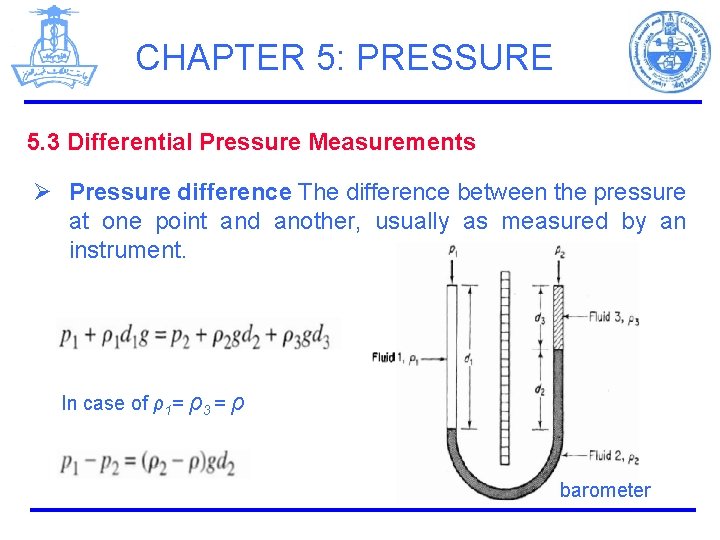
CHAPTER 5: PRESSURE 5. 3 Differential Pressure Measurements Ø Pressure difference The difference between the pressure at one point and another, usually as measured by an instrument. In case of ρ1= ρ3 = ρ barometer
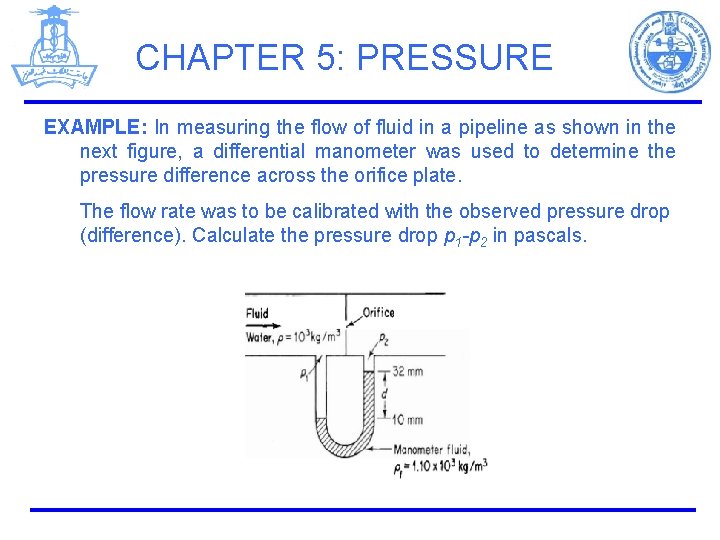
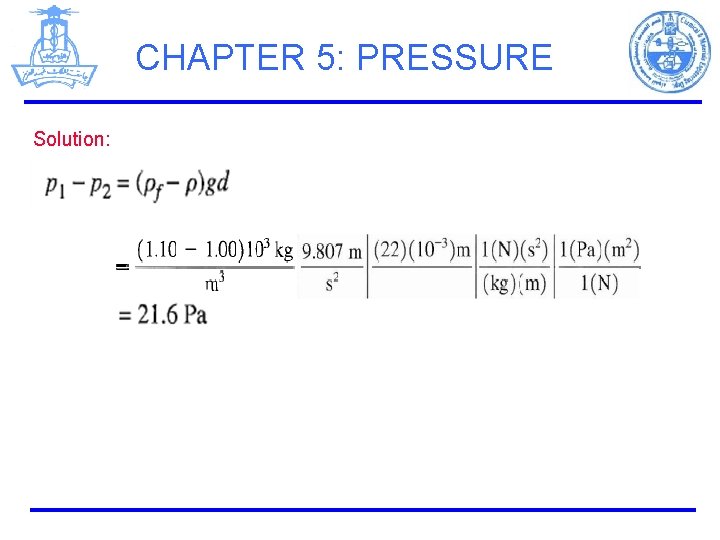
CHAPTER 5: PRESSURE EXAMPLE: In measuring the flow of fluid in a pipeline as shown in the next figure, a differential manometer was used to determine the pressure difference across the orifice plate. The flow rate was to be calibrated with the observed pressure drop (difference). Calculate the pressure drop p 1 -p 2 in pascals.
CHAPTER 5: PRESSURE Solution: