
Chapter 5 Present Worth Analysis Lecture slides to



- Slides: 17
Chapter 5 Present Worth Analysis Lecture slides to accompany Engineering Economy 7 th edition Leland Blank Anthony Tarquin 5 -1 © 2012 by Mc. Graw-Hill, New York, N. Y All Rights Reserved
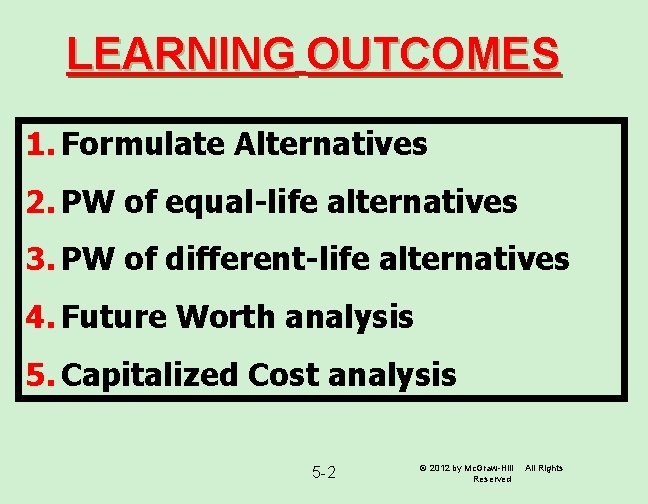
LEARNING OUTCOMES 1. Formulate Alternatives 2. PW of equal-life alternatives 3. PW of different-life alternatives 4. Future Worth analysis 5. Capitalized Cost analysis 5 -2 © 2012 by Mc. Graw-Hill Reserved All Rights
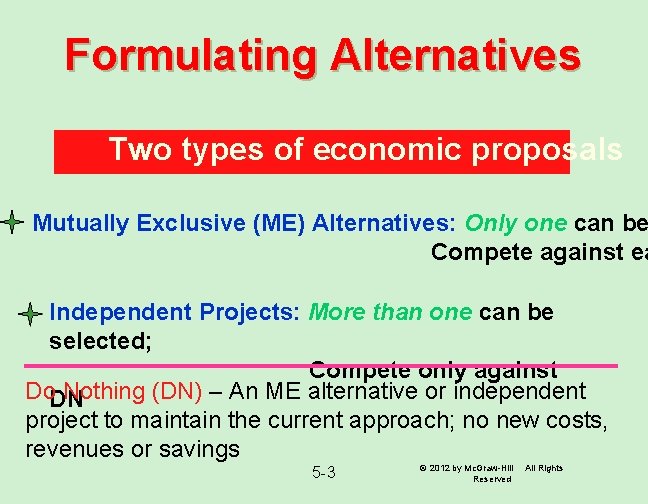
Formulating Alternatives Two types of economic proposals Mutually Exclusive (ME) Alternatives: Only one can be Compete against ea Independent Projects: More than one can be selected; Compete only against Do. DN Nothing (DN) – An ME alternative or independent project to maintain the current approach; no new costs, revenues or savings 5 -3 © 2012 by Mc. Graw-Hill Reserved All Rights
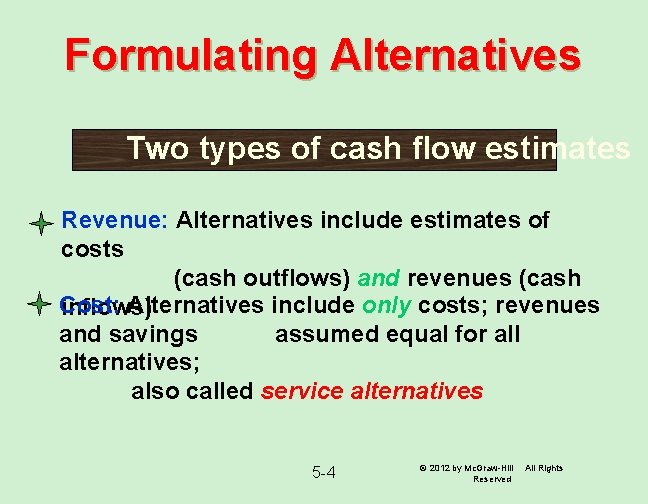
Formulating Alternatives Two types of cash flow estimates Revenue: Alternatives include estimates of costs (cash outflows) and revenues (cash Cost: Alternatives include only costs; revenues inflows) and savings assumed equal for all alternatives; also called service alternatives 5 -4 © 2012 by Mc. Graw-Hill Reserved All Rights
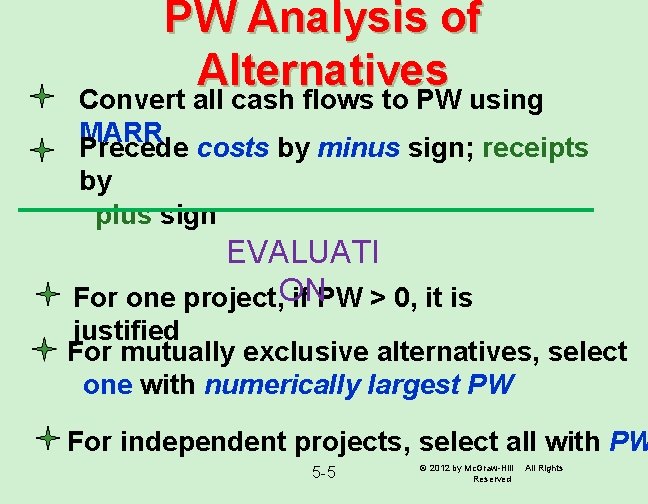
PW Analysis of Alternatives Convert all cash flows to PW using MARR Precede costs by minus sign; receipts by plus sign EVALUATI For one project, ON if PW > 0, it is justified For mutually exclusive alternatives, select one with numerically largest PW For independent projects, select all with PW 5 -5 © 2012 by Mc. Graw-Hill Reserved All Rights
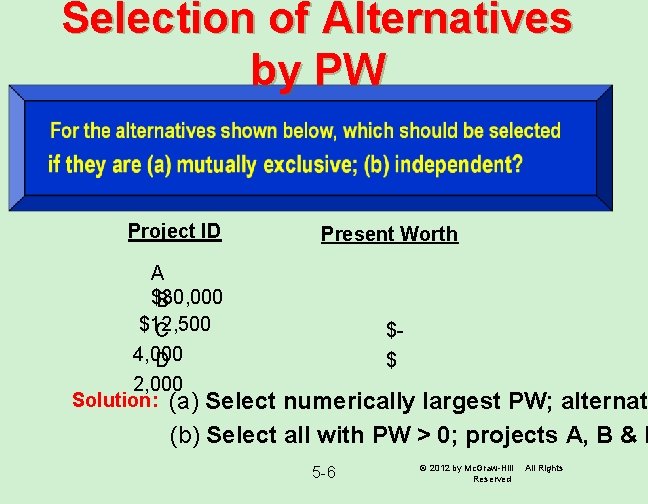
Selection of Alternatives by PW Project ID Present Worth A $30, 000 B $12, 500 C 4, 000 D 2, 000 Solution: (a) Select $$ numerically largest PW; alternati (b) Select all with PW > 0; projects A, B & D 5 -6 © 2012 by Mc. Graw-Hill Reserved All Rights
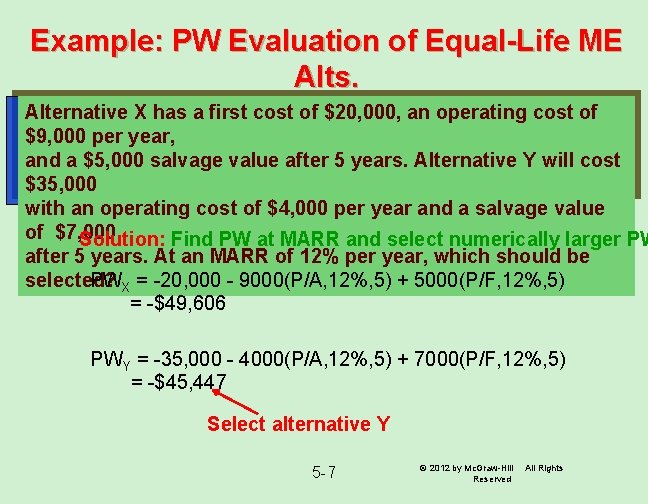
Example: PW Evaluation of Equal-Life ME Alts. Alternative X has a first cost of $20, 000, an operating cost of $9, 000 per year, and a $5, 000 salvage value after 5 years. Alternative Y will cost $35, 000 with an operating cost of $4, 000 per year and a salvage value of $7, 000 Solution: Find PW at MARR and select numerically larger PW after 5 years. At an MARR of 12% per year, which should be PWX = -20, 000 - 9000(P/A, 12%, 5) + 5000(P/F, 12%, 5) selected? = -$49, 606 PWY = -35, 000 - 4000(P/A, 12%, 5) + 7000(P/F, 12%, 5) = -$45, 447 Select alternative Y 5 -7 © 2012 by Mc. Graw-Hill Reserved All Rights
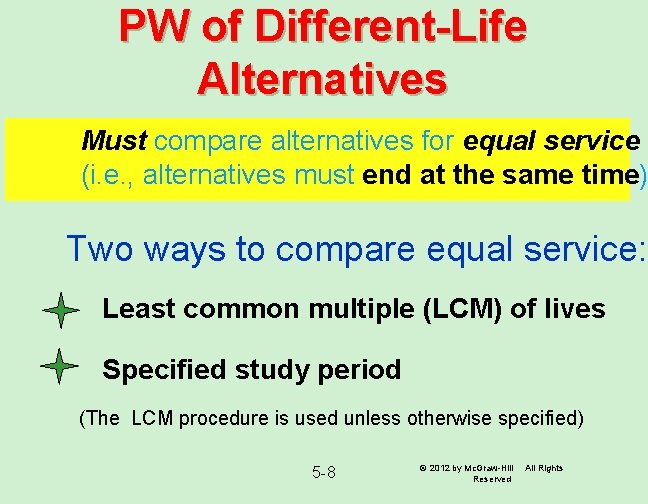
PW of Different-Life Alternatives Must compare alternatives for equal service (i. e. , alternatives must end at the same time) Two ways to compare equal service: Least common multiple (LCM) of lives Specified study period (The LCM procedure is used unless otherwise specified) 5 -8 © 2012 by Mc. Graw-Hill Reserved All Rights
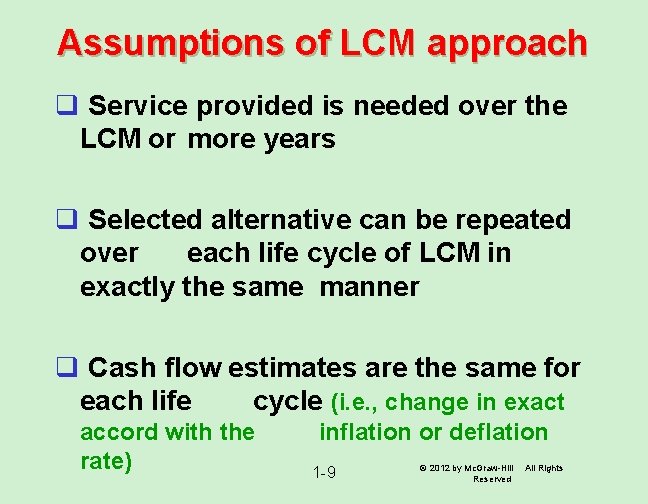
Assumptions of LCM approach q Service provided is needed over the LCM or more years q Selected alternative can be repeated over each life cycle of LCM in exactly the same manner q Cash flow estimates are the same for each life cycle (i. e. , change in exact accord with the rate) inflation or deflation 1 -9 © 2012 by Mc. Graw-Hill Reserved All Rights
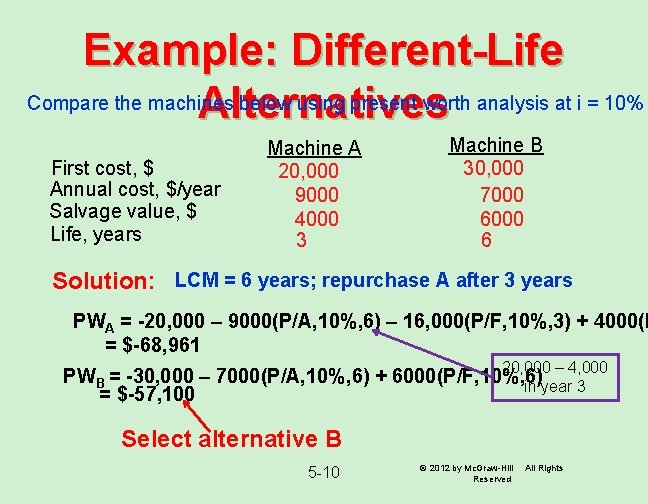
Example: Different-Life Compare the machines below using present worth analysis at i = 10% Alternatives First cost, $ Annual cost, $/year Salvage value, $ Life, years Machine A 20, 000 9000 4000 3 Machine B 30, 000 7000 6 Solution: LCM = 6 years; repurchase A after 3 years PWA = -20, 000 – 9000(P/A, 10%, 6) – 16, 000(P/F, 10%, 3) + 4000(P = $-68, 961 20, 000 – 4, 000 PWB = -30, 000 – 7000(P/A, 10%, 6) + 6000(P/F, 10%, 6) in year 3 = $-57, 100 Select alternative B 5 -10 © 2012 by Mc. Graw-Hill Reserved All Rights
PW Evaluation Using a Study Period v Once a study period is specified, all cash flows after this time are ignored v Salvage value is the estimated market value at the end of study period Short study periods are often defined by management when business goals are shortterm Study periods are commonly used in equipment replacement analysis 1 -11 © 2012 by Mc. Graw-Hill Reserved All Rights
Example: Study Period PW Compare the alternatives below using present worth analysis at i = 10% Evaluation and a 3 -year study period Machine A First cost, $ -20, 000 Annual cost, $/year -9, 000 Salvage/market value, $ 4, 000 Life, years 3 Machine B -30, 000 -7, 000 6, 000 (after 6 years 10, 000 (after 3 years 6 Solution: Study period = 3 years; disregard all estimates after 3 PWA = -20, 000 – 9000(P/A, 10%, 3) + 4000(P/F, 10%, 3) = $-39, 376 PWB = -30, 000 – 7000(P/A, 10%, 3) + 10, 000(P/F, 10%, 3) = $-39, 895 Marginally, select A; different selection than for LCM = 5 -12 © 2012 by Mc. Graw-Hill Reserved All Rights
Future Worth Analysis FW exactly like PW analysis, except calculate FW Must compare alternatives for equal service (i. e. alternatives must end at the same time) Two ways to compare equal service: Least common multiple (LCM) of lives Specified study period (The LCM procedure is used unless otherwise specified) 5 -13 © 2012 by Mc. Graw-Hill Reserved All Rights
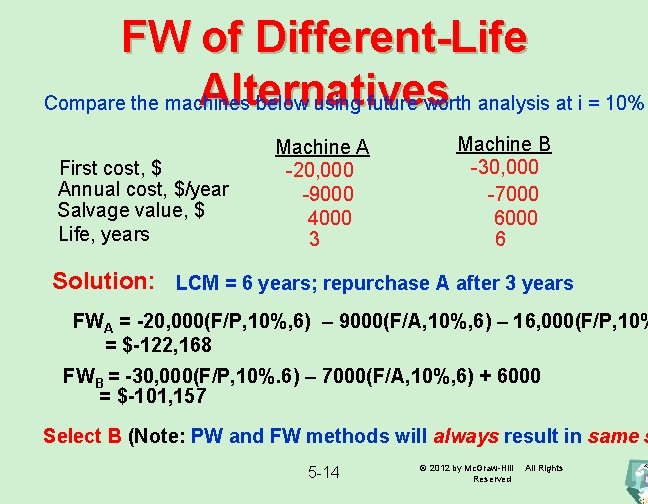
FW of Different-Life Alternatives Compare the machines below using future worth analysis at i = 10% First cost, $ Annual cost, $/year Salvage value, $ Life, years Machine A -20, 000 -9000 4000 3 Machine B -30, 000 -7000 6 Solution: LCM = 6 years; repurchase A after 3 years FWA = -20, 000(F/P, 10%, 6) – 9000(F/A, 10%, 6) – 16, 000(F/P, 10% = $-122, 168 FWB = -30, 000(F/P, 10%. 6) – 7000(F/A, 10%, 6) + 6000 = $-101, 157 Select B (Note: PW and FW methods will always result in same s 5 -14 © 2012 by Mc. Graw-Hill Reserved All Rights
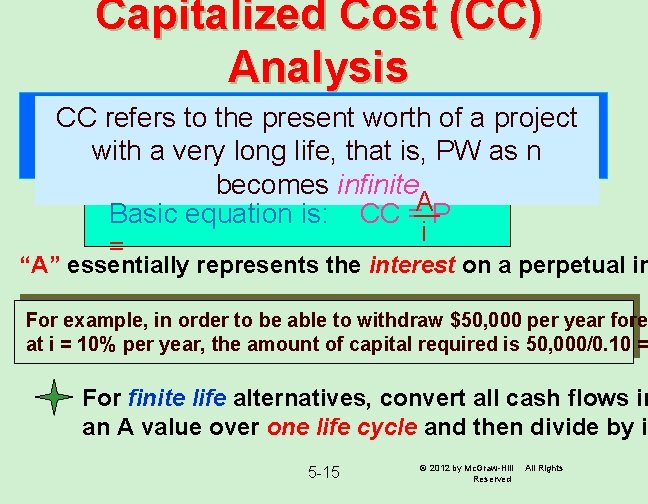
Capitalized Cost (CC) Analysis CC refers to the present worth of a project with a very long life, that is, PW as n becomes infinite Basic equation is: CC =AP i = “A” essentially represents the interest on a perpetual in For example, in order to be able to withdraw $50, 000 per year fore at i = 10% per year, the amount of capital required is 50, 000/0. 10 = For finite life alternatives, convert all cash flows in an A value over one life cycle and then divide by i 5 -15 © 2012 by Mc. Graw-Hill Reserved All Rights
Example: Capitalized Cost Compare the machines shown below on the basis of their capitalized cost. Use i = 10% per year Machine 1 Machine First 2 -20, 000 -100, 000 cost, $ Annual cost, $/year -9000 -7000 Salvage value, $ ----4000 Life, years ∞ 3 Solution: Convert machine 1 cash flows into A and then by i A 1 divide = -20, 000(A/P, 10%, 3) – 9000 + 4000(A/F, 10%, 3) = $-15, 83 CC 1 = -15, 834 / 0. 10 = $-158, 340 CC 2 = -100, 000 – 7000/ 0. 10 = $-170, 000 Select machine 1 5 -16 © 2012 by Mc. Graw-Hill Reserved All Rights
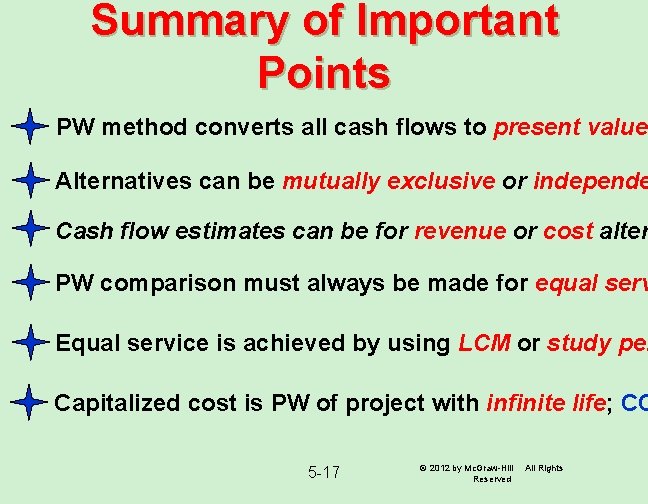
Summary of Important Points PW method converts all cash flows to present value Alternatives can be mutually exclusive or independe Cash flow estimates can be for revenue or cost alter PW comparison must always be made for equal serv Equal service is achieved by using LCM or study per Capitalized cost is PW of project with infinite life; CC 5 -17 © 2012 by Mc. Graw-Hill Reserved All Rights