
Chapter 5 Population and Resources How nature is
- Slides: 33
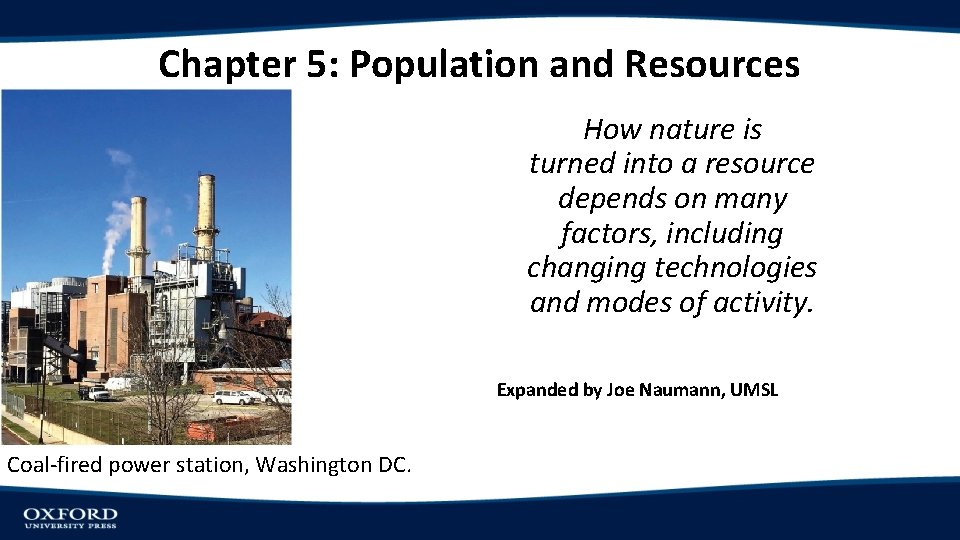
Chapter 5: Population and Resources How nature is turned into a resource depends on many factors, including changing technologies and modes of activity. Expanded by Joe Naumann, UMSL Coal-fired power station, Washington DC.
Chapter Learning Objectives • Explain how humans have come to value nature and commodified resources. • Summarize the history of global consumption and production, along with its contemporary uses and their consequences. • Recall the five laws of resource use and relate them to specific resource examples. • Outline the twentieth-century history of oil production and consumption followed by present-day changes affecting the industry. • Consider the environmental impacts and growing costs associated with the continued use of oil and gas.
Culture’s world view affects recourse use • Western Civilization (industrial • Traditional Asian, African, revolution/capitalism) Native American – Dominate nature (nature as the enemy) – GOAL: make maximum profit by whatever the means and consequences – REALITY: rape of the environment – short term gain for a few but long term loss for the many – Seek harmony with nature (nature as a friend) – GOAL: sustained yield • Slash & burn – corn, beans, squash • Traditional Chinese agriculture – REALITY: minimal environmental damage – Chinese fertile soil in continual use for 5000 years
Culture’s level of technology affects resourse use • Machine power, large fields, and chemicals greatly increase the possibility of of environmental damage – Dead soil – Erosion – Chemical runoff – Damage to animal habitats • Animal powered tools, smsller fields, & organic fertilizers much less possible environmental damage – Healthy, living soil – Minimal fertilizer runoff – Less eroeion – Less damage to animal habitats Remember that just because we can desn’t mean we should
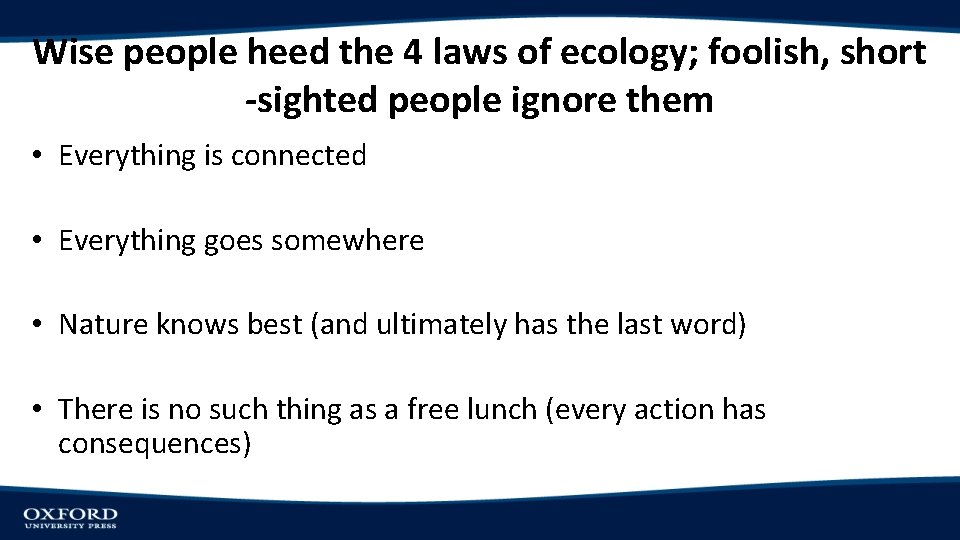
Wise people heed the 4 laws of ecology; foolish, short -sighted people ignore them • Everything is connected • Everything goes somewhere • Nature knows best (and ultimately has the last word) • There is no such thing as a free lunch (every action has consequences)
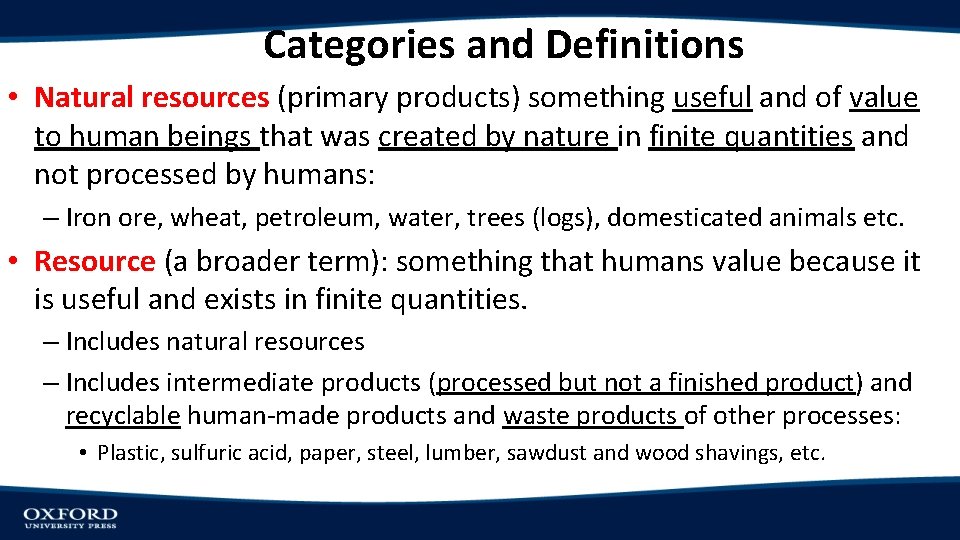
Categories and Definitions • Natural resources (primary products) something useful and of value to human beings that was created by nature in finite quantities and not processed by humans: – Iron ore, wheat, petroleum, water, trees (logs), domesticated animals etc. • Resource (a broader term): something that humans value because it is useful and exists in finite quantities. – Includes natural resources – Includes intermediate products (processed but not a finished product) and recyclable human-made products and waste products of other processes: • Plastic, sulfuric acid, paper, steel, lumber, sawdust and wood shavings, etc.
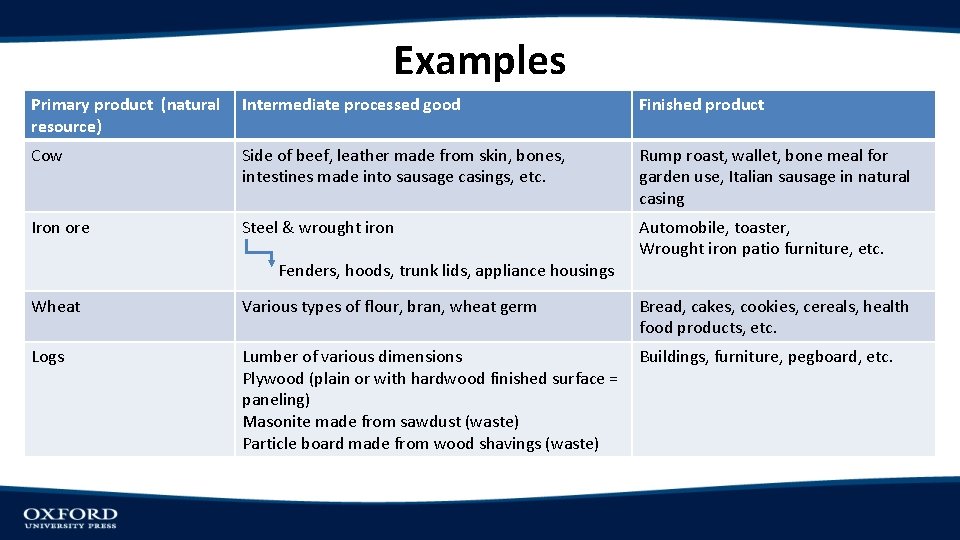
Examples Primary product (natural resource) Intermediate processed good Finished product Cow Side of beef, leather made from skin, bones, intestines made into sausage casings, etc. Rump roast, wallet, bone meal for garden use, Italian sausage in natural casing Iron ore Steel & wrought iron Automobile, toaster, Wrought iron patio furniture, etc. Fenders, hoods, trunk lids, appliance housings Wheat Various types of flour, bran, wheat germ Bread, cakes, cookies, cereals, health food products, etc. Logs Lumber of various dimensions Plywood (plain or with hardwood finished surface = paneling) Masonite made from sawdust (waste) Particle board made from wood shavings (waste) Buildings, furniture, pegboard, etc.
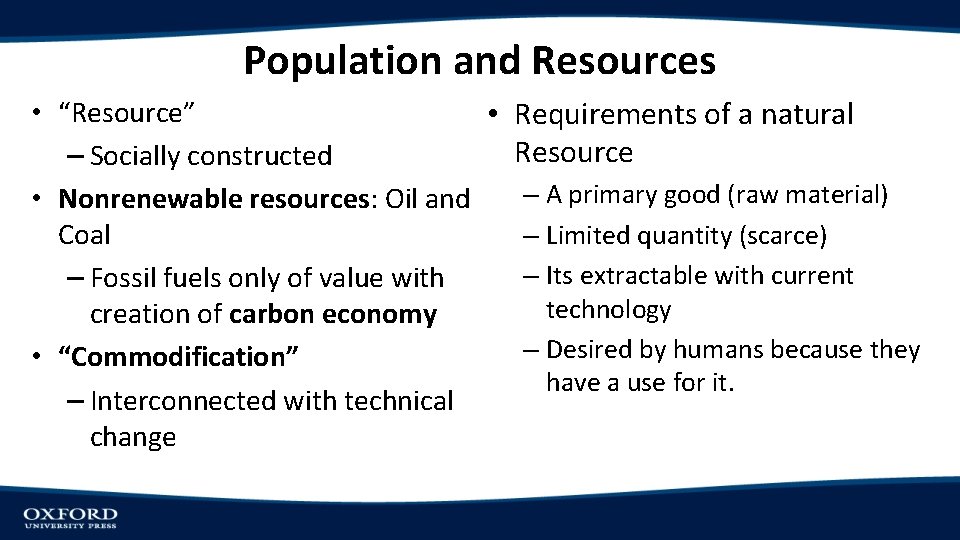
Population and Resources • “Resource” • Requirements of a natural Resource – Socially constructed – A primary good (raw material) • Nonrenewable resources: Oil and – Limited quantity (scarce) Coal – Its extractable with current – Fossil fuels only of value with technology creation of carbon economy – Desired by humans because they • “Commodification” have a use for it. – Interconnected with technical change
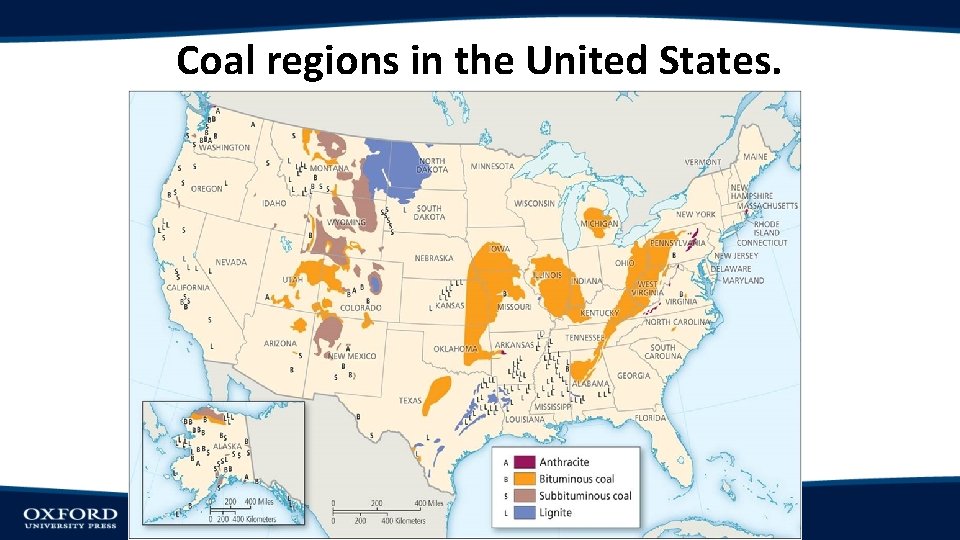
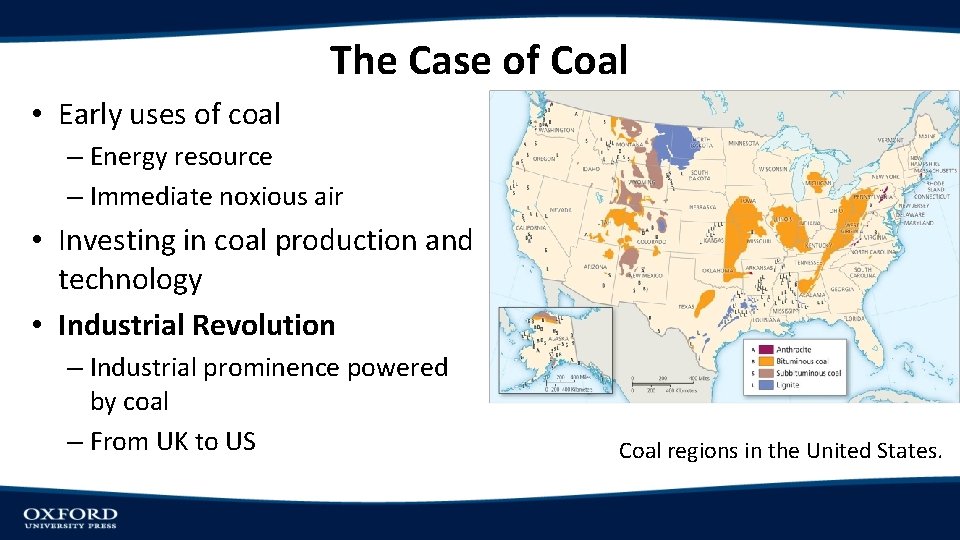
Coal regions in the United States.
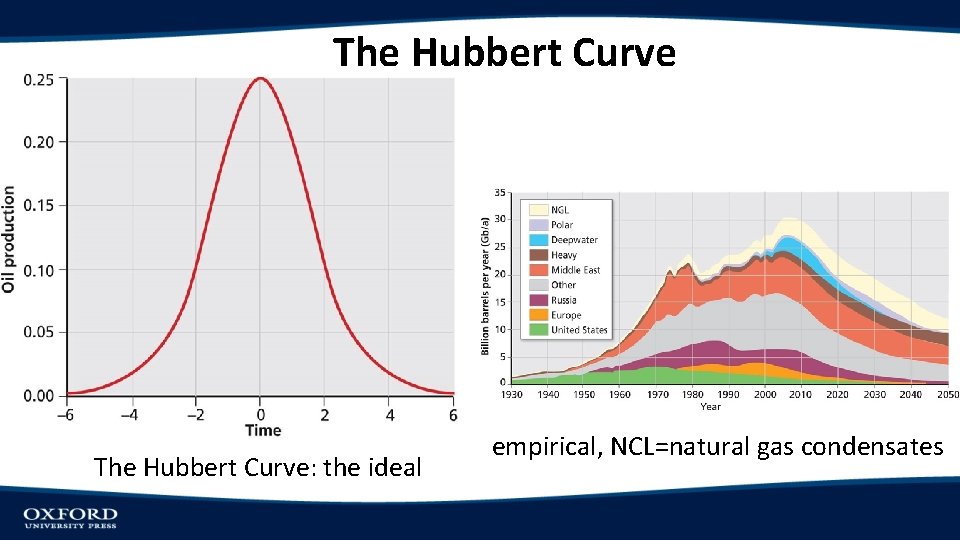
The Hubbert Curve • Hubbert Curve – Prediction of decline in US oil production – Suggest nonrenewable use rises quickly to peak production then falls off – Ideally bell-shaped, but reality not symmetrical – Future possibilities with new technologies or timing of global peaks Graphics on the next slide
The Hubbert Curve: the ideal empirical, NCL=natural gas condensates
Classifications • Nonrenewable – fossil fuels - One use and it’s “gone” – Extending the use of them (if that’s even desirable • Replaced with alternatives if that is possible • Efficiency in extraction and in the consuming of them – Maximum output per unit of input • Reusable – Nonrenewables that can be used again – eg. Metals – Include manufactured products which can be reused – glass, paper, etc. – Efficient recycling programs – Wealth from waste such as sawdust and wood shavings become particle board. (waste that used to pollute rivers become a useable product)
Classifications continued • Renewable – living things plus water and air – Efficient, wise use (conservation) • Good substitutes • Efficient use – – – Folrests – selective cutting and replanting Fishing – leave enough fish that they can breed and recover Water – clean it at the source of pollution Air – clean it at the source of pollution Farming – keep soil healthy – don’t over plant in semi=arid areas Animal husbandry – Avoid over grazing Strive for sustained use
The Case of Coal • Early uses of coal – Energy resource – Immediate noxious air • Investing in coal production and technology • Industrial Revolution – Industrial prominence powered by coal – From UK to US Coal regions in the United States.
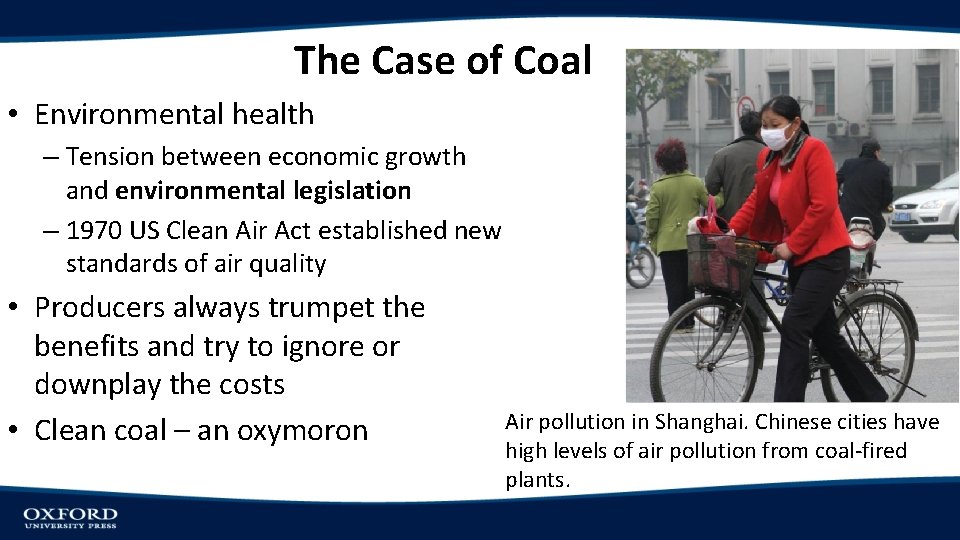
The Case of Coal • Environmental health – Tension between economic growth and environmental legislation – 1970 US Clean Air Act established new standards of air quality • Producers always trumpet the benefits and try to ignore or downplay the costs • Clean coal – an oxymoron Air pollution in Shanghai. Chinese cities have high levels of air pollution from coal-fired plants.
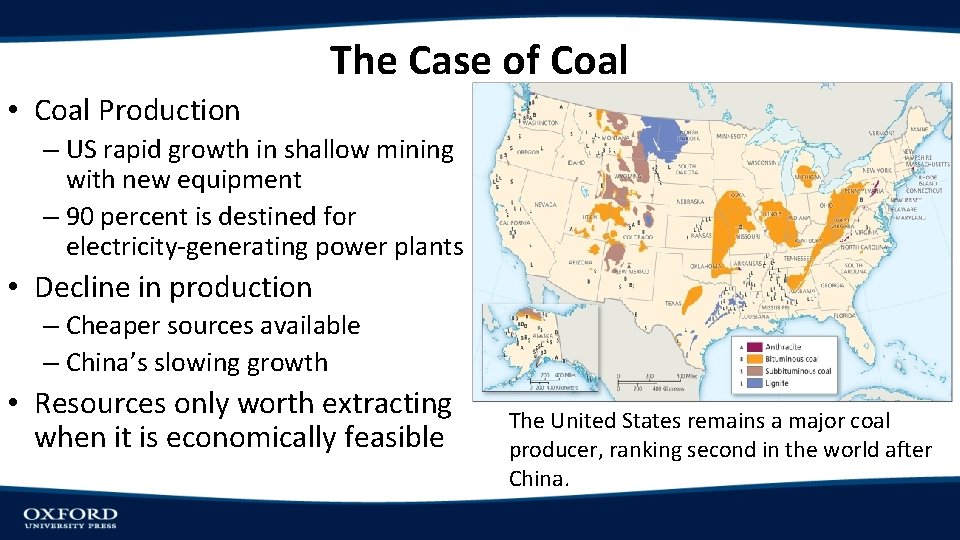
The Case of Coal • Coal Production – US rapid growth in shallow mining with new equipment – 90 percent is destined for electricity-generating power plants • Decline in production – Cheaper sources available – China’s slowing growth • Resources only worth extracting when it is economically feasible The United States remains a major coal producer, ranking second in the world after China.
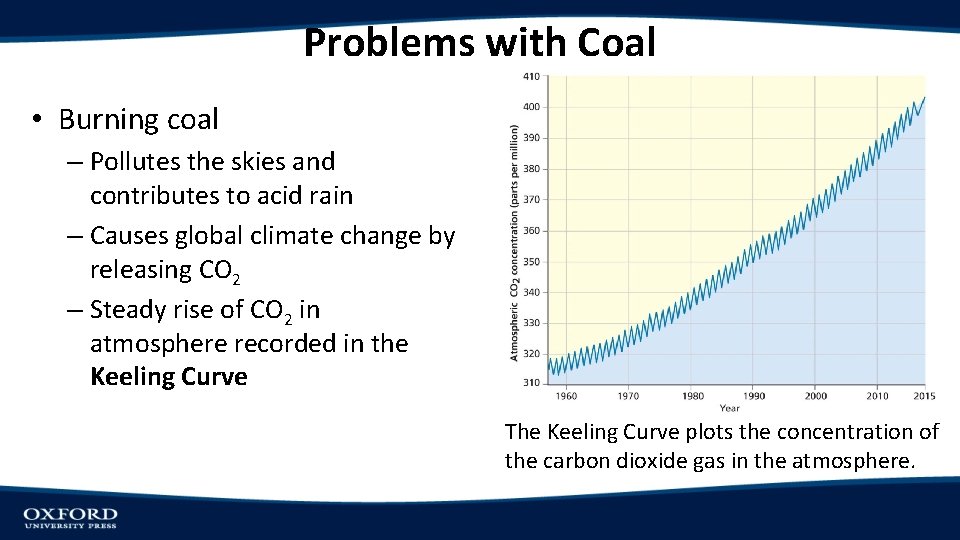
Problems with Coal • Burning coal – Pollutes the skies and contributes to acid rain – Causes global climate change by releasing CO 2 – Steady rise of CO 2 in atmosphere recorded in the Keeling Curve The Keeling Curve plots the concentration of the carbon dioxide gas in the atmosphere.
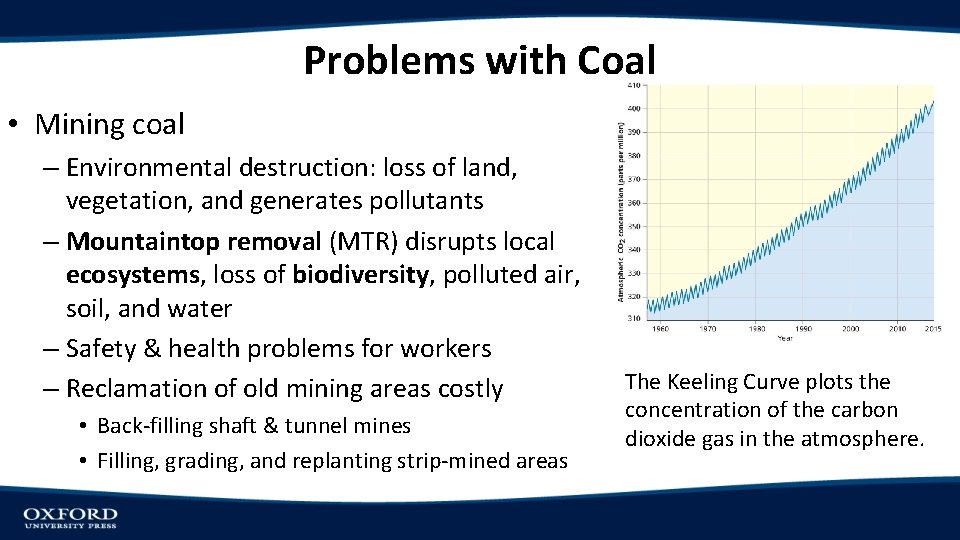
Problems with Coal • Mining coal – Environmental destruction: loss of land, vegetation, and generates pollutants – Mountaintop removal (MTR) disrupts local ecosystems, loss of biodiversity, polluted air, soil, and water – Safety & health problems for workers – Reclamation of old mining areas costly • Back-filling shaft & tunnel mines • Filling, grading, and replanting strip-mined areas The Keeling Curve plots the concentration of the carbon dioxide gas in the atmosphere.
Laws of Resource Use 1. Resources become resources because previous resources become exhausted, unavailable, depleted, or too expensive. 2. Resource use creates new geographies. 3. All resource usage tends to have wider social and political consequences. 4. All resource use has implications for public spaces and the wider community as well as for private enterprises. 5. Initiatives to regulate and diminish the negative public consequences of resource use and exploitation always come up against powerful interests that firstly deny the problem and then minimize it.
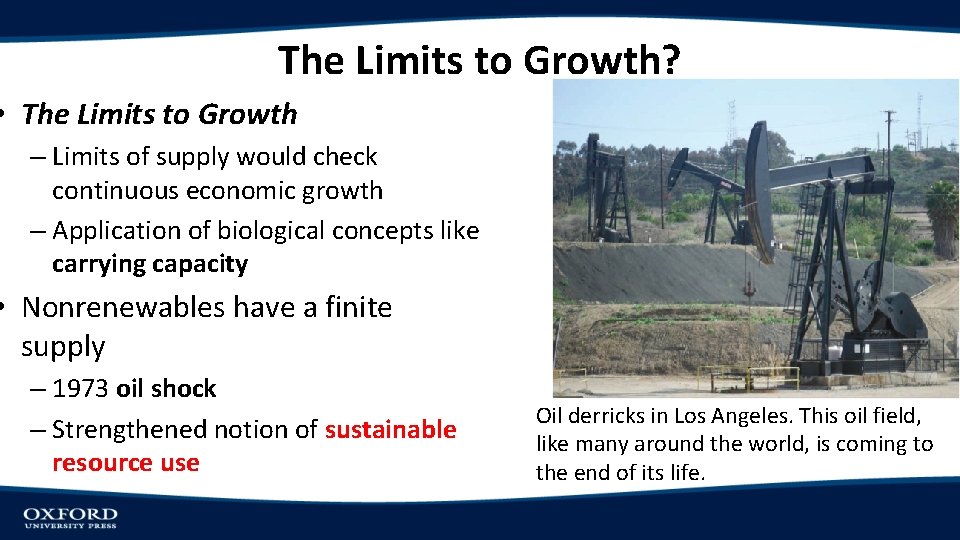
The Limits to Growth? • The Limits to Growth – Limits of supply would check continuous economic growth – Application of biological concepts like carrying capacity • Nonrenewables have a finite supply – 1973 oil shock – Strengthened notion of sustainable resource use Oil derricks in Los Angeles. This oil field, like many around the world, is coming to the end of its life.
The Case of Oil • Never-ending demand from industrialization – Demand, production, price, and oil cartels • Organization of Petroleum Exporting Countries (OPEC) used power to increase oil prices and profits • Continued demand funded oil companies’ search for new reserves – Uncertain of new oil reserves, may be at peak oil – Most of easy oil reserves have been tapped – Now in the era of tough oil reserves that are deeper, further offshore, and more expensive to access and potentially more likely to create serious ecological problems – Remember the big oil leak in the Gulf of Mexico!
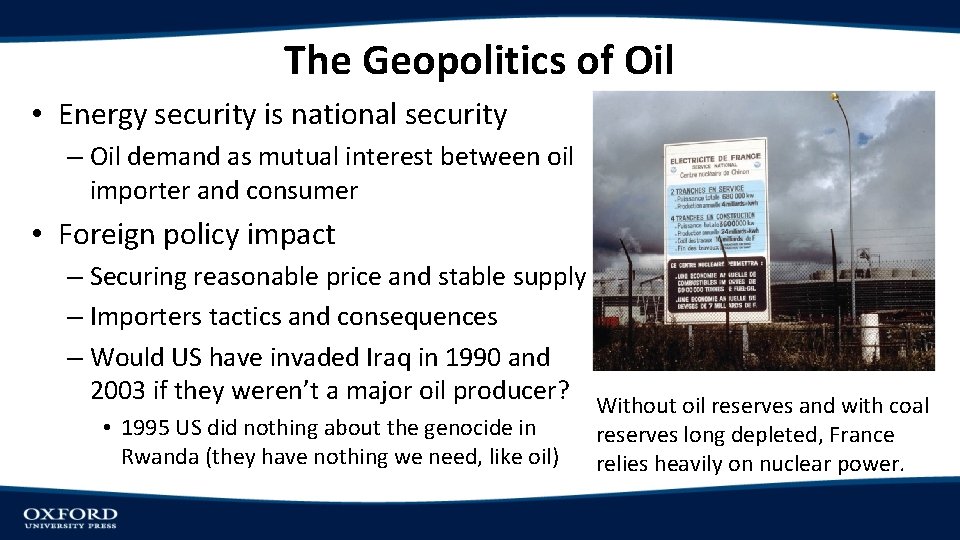
The Geopolitics of Oil • Energy security is national security – Oil demand as mutual interest between oil importer and consumer • Foreign policy impact – Securing reasonable price and stable supply – Importers tactics and consequences – Would US have invaded Iraq in 1990 and 2003 if they weren’t a major oil producer? Without oil reserves and with coal • 1995 US did nothing about the genocide in Rwanda (they have nothing we need, like oil) reserves long depleted, France relies heavily on nuclear power.
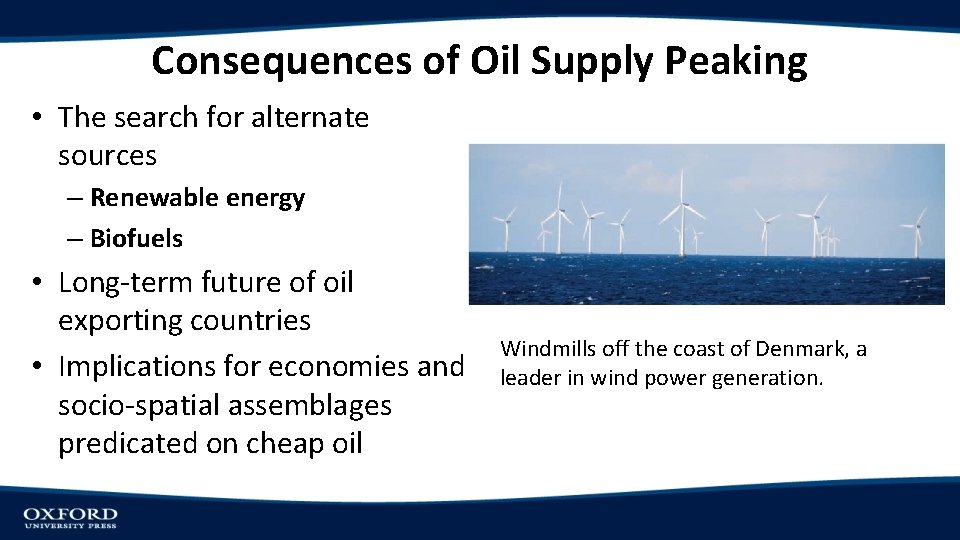
Consequences of Oil Supply Peaking • The search for alternate sources – Renewable energy – Biofuels • Long-term future of oil exporting countries • Implications for economies and socio-spatial assemblages predicated on cheap oil Windmills off the coast of Denmark, a leader in wind power generation.
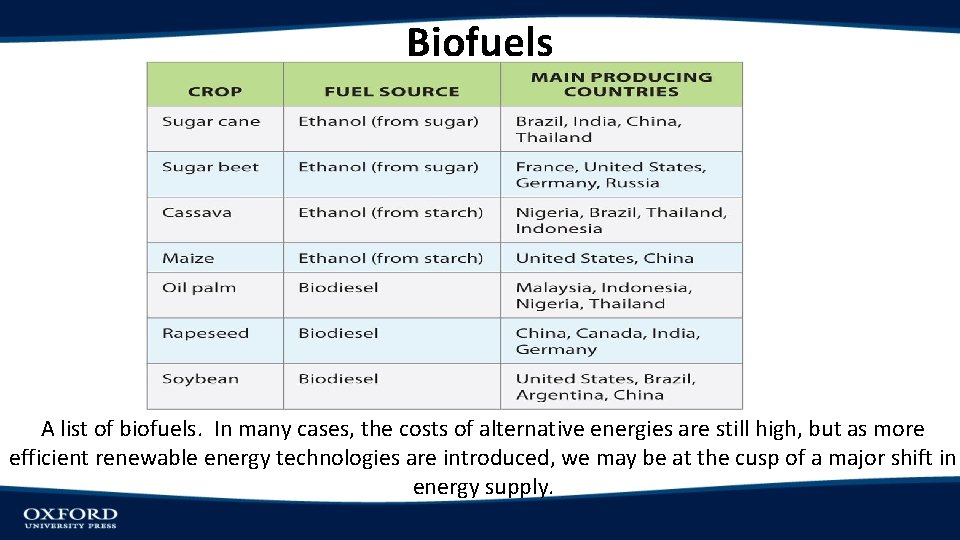
Biofuels A list of biofuels. In many cases, the costs of alternative energies are still high, but as more efficient renewable energy technologies are introduced, we may be at the cusp of a major shift in energy supply.
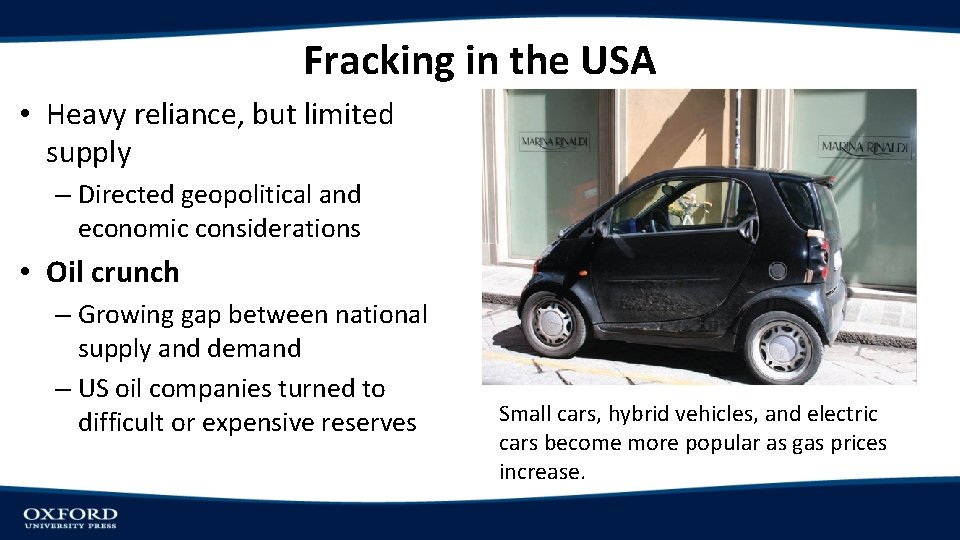
Fracking in the USA • Heavy reliance, but limited supply – Directed geopolitical and economic considerations • Oil crunch – Growing gap between national supply and demand – US oil companies turned to difficult or expensive reserves Small cars, hybrid vehicles, and electric cars become more popular as gas prices increase.
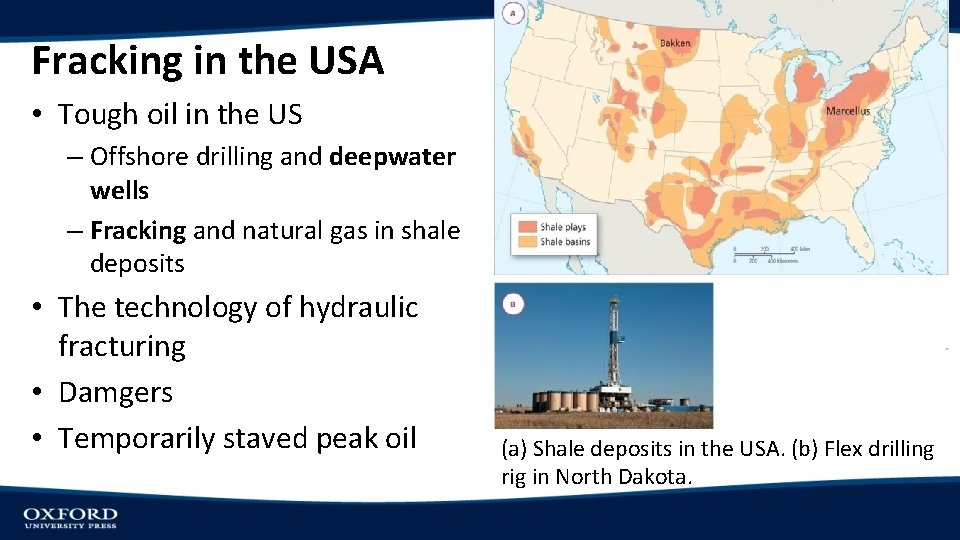
Fracking in the USA • Tough oil in the US – Offshore drilling and deepwater wells – Fracking and natural gas in shale deposits • The technology of hydraulic fracturing • Damgers • Temporarily staved peak oil (a) Shale deposits in the USA. (b) Flex drilling rig in North Dakota.
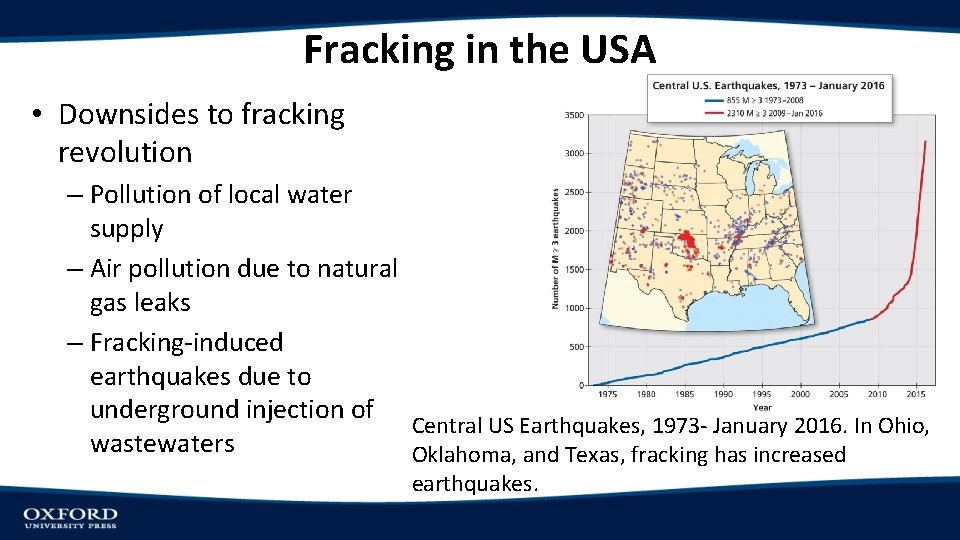
Fracking in the USA • Downsides to fracking revolution – Pollution of local water supply – Air pollution due to natural gas leaks – Fracking-induced earthquakes due to underground injection of Central US Earthquakes, 1973 - January 2016. In Ohio, wastewaters Oklahoma, and Texas, fracking has increased earthquakes.
Commodity Cartels • Commodity cartels – Primary producers join up to ensure high prices for their resource – Arise from national dissatisfaction with private companies • Success of OPEC stimulated other cartels – Depends on nature of the commodity & number of major producers • Great demand • Few or now substitutes • Non-presishables – Bargaining positions differ among cartel members
The Limits to Growth Revisited • Initial argument was misplaced – Real issue is that continued supply may create other costs and negative consequences • Ultimate law of resource use – Pay a price for what we get – Cost can be shifted from private to public, local to national, one country to another, but the world is a closed system – Costs and benefits are always exacted, even if they may be shifted across space
Chapter Summary • Realize how “nature” becomes commodity, with all social and political consequences involved in its valuation and revaluations. Translation from inert material to valuable resource occurs through process of technical change and commodification. • Resource use creates costs/benefits for private and social interests. Benefits may be privatized, the costs are often socialized. • Coal used as a resource when timber was depleted, eventually came into common enough use that it became a significant air pollutant. • Coal powered the Industrial Revolution, an important ingredient for future manufacture of iron and steel, as well as driver of world’s most successful economies. • Top coal producers in the world are, in order, China, the United States, India, the European Union, and Australia.
Chapter Summary • Major environmental concerns from use of coal: 1) burning coal pollutes the skies and causes global climate change; and 2) coal mining involves environmental destruction. • Coal burning is responsible for CO 2 emissions in Earth’s atmosphere. Increase in such greenhouse gases now has a well-established link to global climate change. • Five laws of resource use: 1) prior resources become exhausted, unavailable, depleted, or too expensive; 2) use creates new geographies; 3) usage has wider social and political impacts; 4) implications for private enterprise and wider community; 5) attempts to regulate or diminish negative public consequences always come up against powerful interests.
Chapter Summary • Most of 20 th century’s economic growth was spawned by steady, cheap, and easily available oil. As oil prices rise, alternative supplies of oil and gas turn economically feasible. • Consequences of peak oil supply include cost and difficulty of implementing alternative sources, long-term economic outlook of countries dependent on oil, and concerns for existing socio-spatial assemblages that favor oil-dependent transportation. • For traditional supplies of oil, we’ve moved from an era of easy oil, with large, easily exploitable reserves, to an age of tough oil with reserves that are deeper, further offshore, and expensive. New fields are smaller, not long-lasting; peak and decline fast.
Chapter Summary • Oil is essential lubricant of economic growth in the US. Oil crunch, gap between national supply and demand, has led to search for domestic oil reserves. • Fracking in the US has provided a new and cheap source of oil and gas. However, there are environmental costs and greater risk of earthquakes associated with fracking. • The initial limits-of-growth argument was misplaced. The real issue is not that supplies of resources will run out, but that their continued supply may create other costs and negative consequences.