
CHAPTER 5 Political Parties What is a Political
- Slides: 27
CHAPTER 5: Political Parties
What is a Political Party? A group of persons who seek to control government by winning elections to public office. What are the ones we have here? Democrat Republican Some smaller/minor ones
What Do Parties Do? They do have a purpose! “Essential to democratic government” We can list thousands of things they do make policy, leadership, forums, funding, power brokers, moderators. All of these can be covered in FIVE MAJOR FUNCTIONS
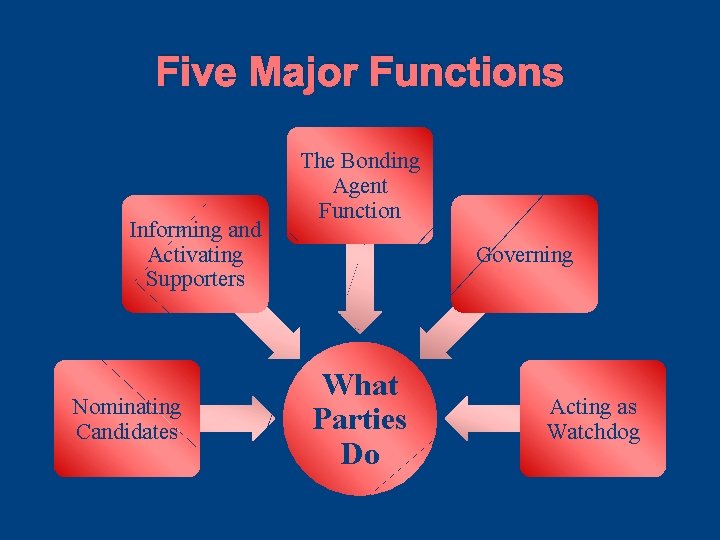
Five Major Functions Informing and Activating Supporters Nominating Candidates The Bonding Agent Function Governing What Parties Do Acting as Watchdog
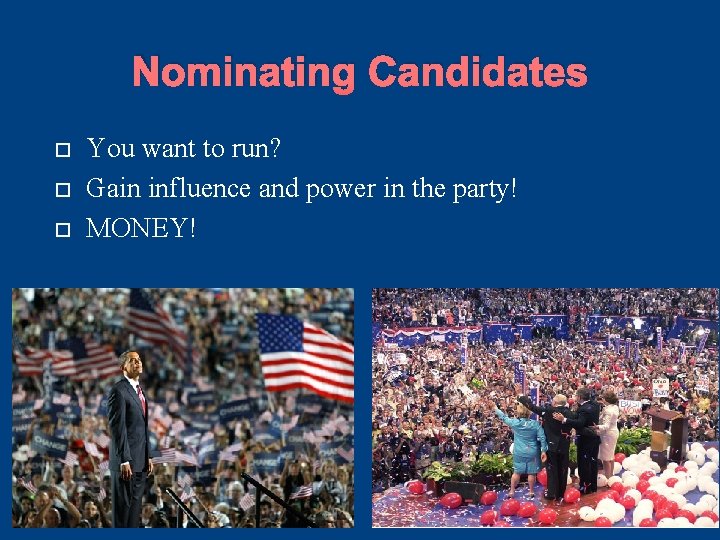
Nominating Candidates You want to run? Gain influence and power in the party! MONEY!
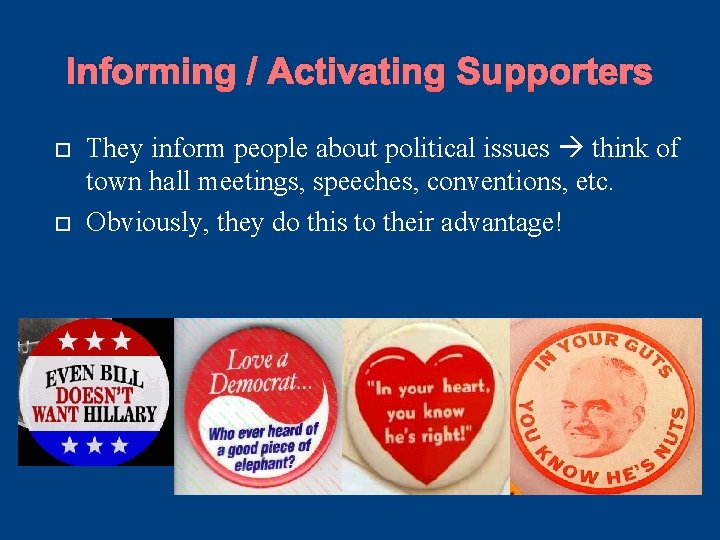
Informing / Activating Supporters They inform people about political issues think of town hall meetings, speeches, conventions, etc. Obviously, they do this to their advantage!
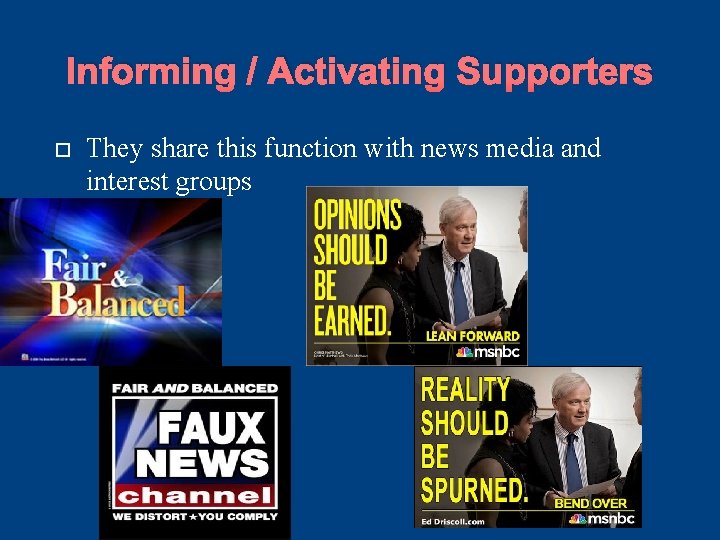
Informing / Activating Supporters They share this function with news media and interest groups
Bonding Agent Function Ensure good performance of its people QUALIFIED and GOOD CHARACTER are what they look for in people Why? Try to help them stay in power after the next ELECTION
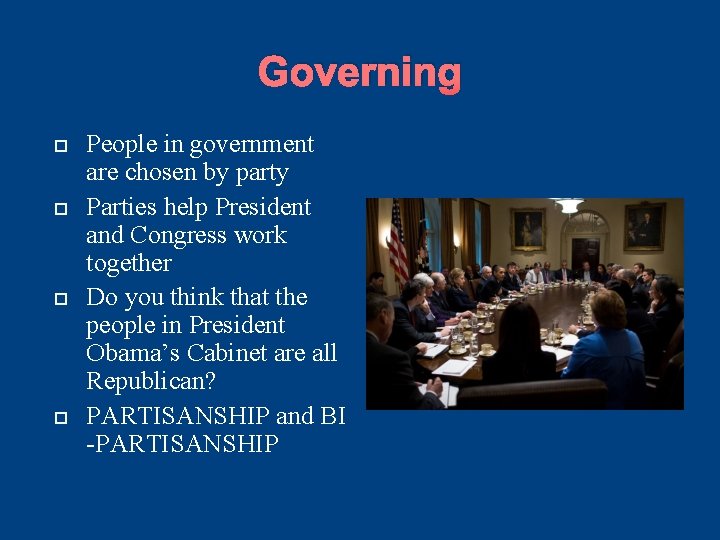
Governing People in government are chosen by party Parties help President and Congress work together Do you think that the people in President Obama’s Cabinet are all Republican? PARTISANSHIP and BI -PARTISANSHIP
Acting as Watchdog They are the babysitter especially if they are out of power “the loyal opposition” urges voters to vote against the party in power in the next election Think of the Republicans last year, blaming poor economy on Democrats in office.
“THE UNITED STATES IS A TWO-PARTY SYSTEM” What exactly does this mean?
The Two-Party System We have two BIG parties, in that they DOMINATE politics in this country: Democrats and Republicans Why did this come about?
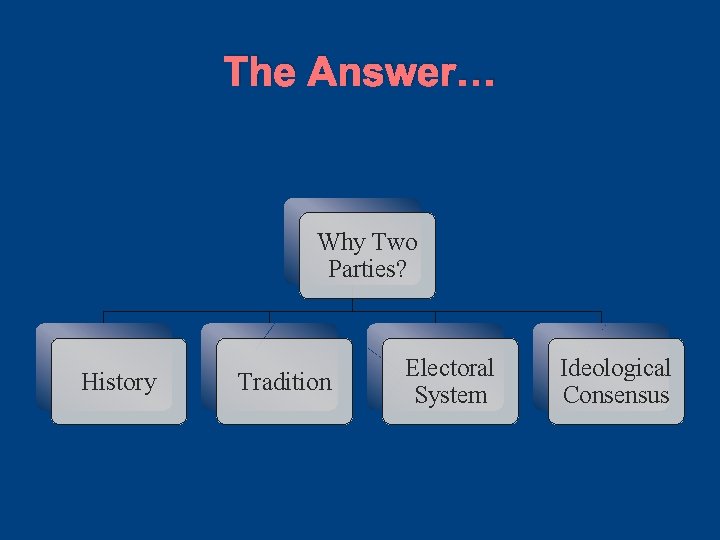
The Answer… Why Two Parties? History Tradition Electoral System Ideological Consensus
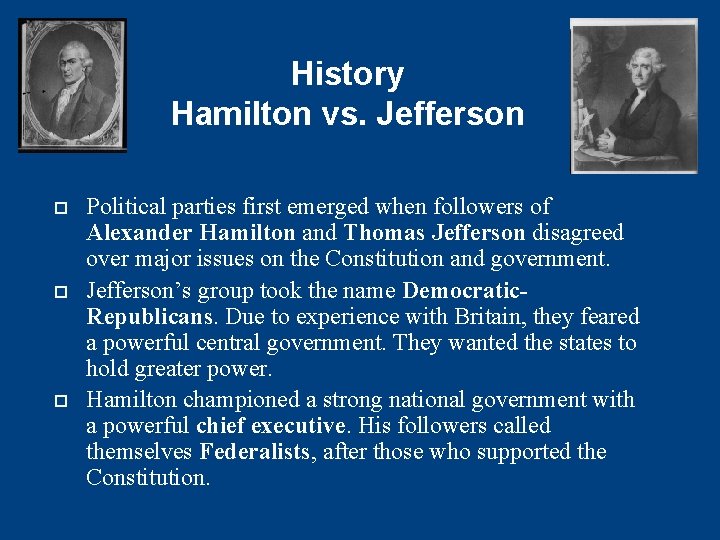
History Hamilton vs. Jefferson Political parties first emerged when followers of Alexander Hamilton and Thomas Jefferson disagreed over major issues on the Constitution and government. Jefferson’s group took the name Democratic. Republicans. Due to experience with Britain, they feared a powerful central government. They wanted the states to hold greater power. Hamilton championed a strong national government with a powerful chief executive. His followers called themselves Federalists, after those who supported the Constitution.
Force of Tradition Because it started as a two-party system “HARD HABIT TO BREAK!”
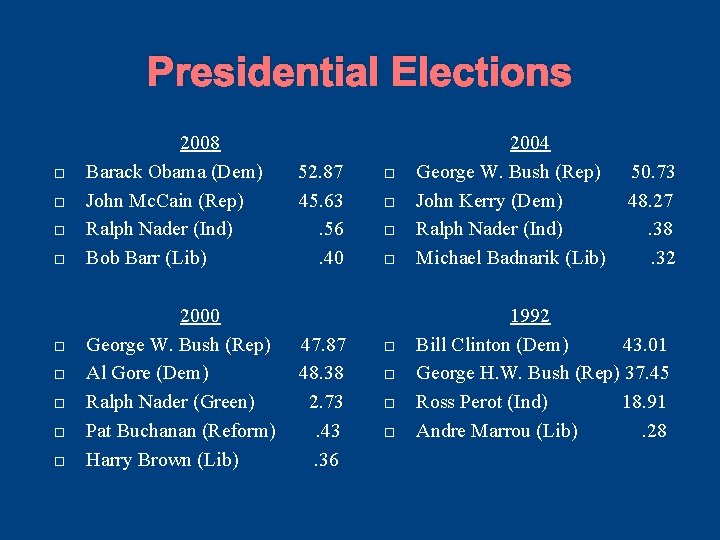
Electoral System It is difficult for third parties candidates to raise enough money to compete with the major parties. Only one candidate can win in a given district (single-member district). Usually the winner is either Democratic or Republican. Third-party candidates must show they have support by getting voter signatures to even be placed on the ballot for national office. Who controls election laws? Can anyone name a Presidential candidate who wasn’t a Republican or Democrat?
Presidential Elections 2008 Barack Obama (Dem) John Mc. Cain (Rep) Ralph Nader (Ind) Bob Barr (Lib) 2000 George W. Bush (Rep) Al Gore (Dem) Ralph Nader (Green) Pat Buchanan (Reform) Harry Brown (Lib) 52. 87 45. 63. 56. 40 47. 87 48. 38 2. 73. 43. 36 2004 George W. Bush (Rep) John Kerry (Dem) Ralph Nader (Ind) Michael Badnarik (Lib) 50. 73 48. 27. 38. 32 1992 Bill Clinton (Dem) 43. 01 George H. W. Bush (Rep) 37. 45 Ross Perot (Ind) 18. 91 Andre Marrou (Lib). 28
Ideological Consensus We are a pluralistic society, but we seek consensus on issues. Our country is lucky in that it has never had to deal with unbridgeable divisions, with the possible exception of when? Both parties want votes. As a result, parties become more moderate in their platforms, moving away from extreme positions.
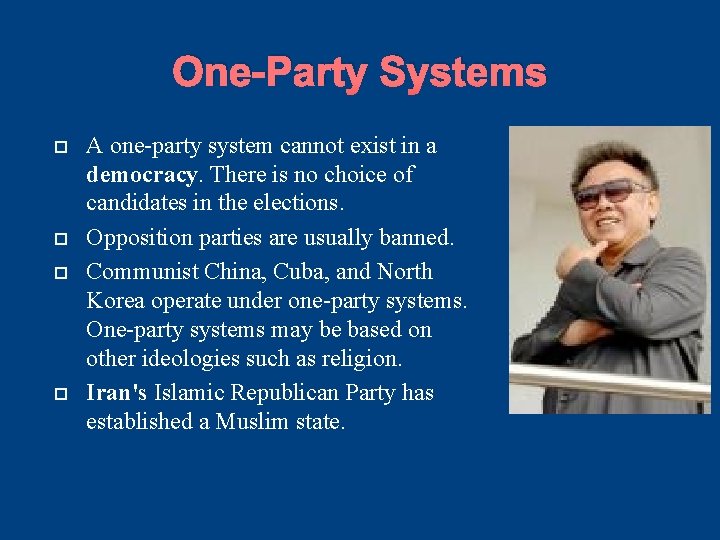
One-Party Systems A one-party system cannot exist in a democracy. There is no choice of candidates in the elections. Opposition parties are usually banned. Communist China, Cuba, and North Korea operate under one-party systems. One-party systems may be based on other ideologies such as religion. Iran's Islamic Republican Party has established a Muslim state.
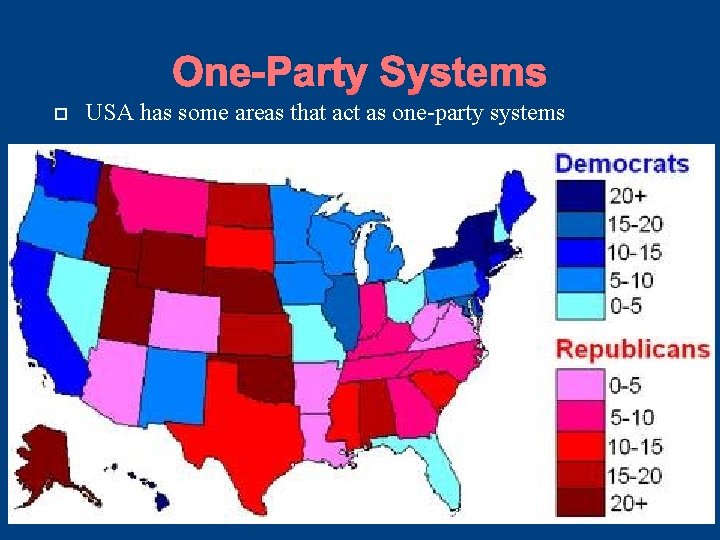
One-Party Systems USA has some areas that act as one-party systems
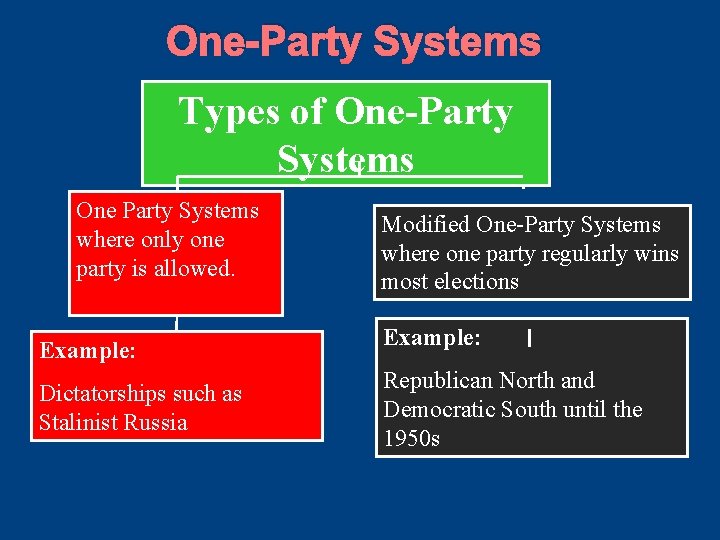
One-Party Systems Types of One-Party Systems One Party Systems where only one party is allowed. Example: Dictatorships such as Stalinist Russia Modified One-Party Systems where one party regularly wins most elections Example: Republican North and Democratic South until the 1950 s
Multiparty Systems Examples: Sweden, Canada, Germany, Italy Parties usually are much more specific in their purpose (think class, religion, ethnicity, etc. ) One party usually isn’t strong enough to win outright, so it forms a COALITION with other parties. What are some of the potential problems here?
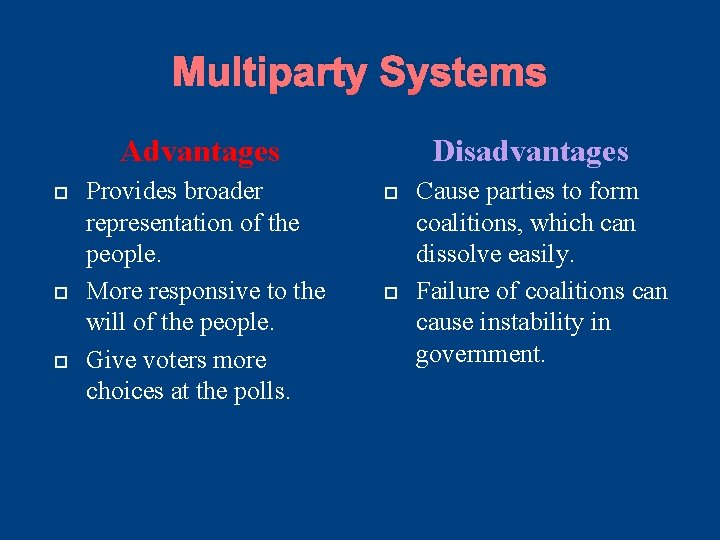
Multiparty Systems Advantages Provides broader representation of the people. More responsive to the will of the people. Give voters more choices at the polls. Disadvantages Cause parties to form coalitions, which can dissolve easily. Failure of coalitions can cause instability in government.
Coalition Activity The goal for your group is to have your bill receive a majority vote to become law. Only three bills can be passed today.
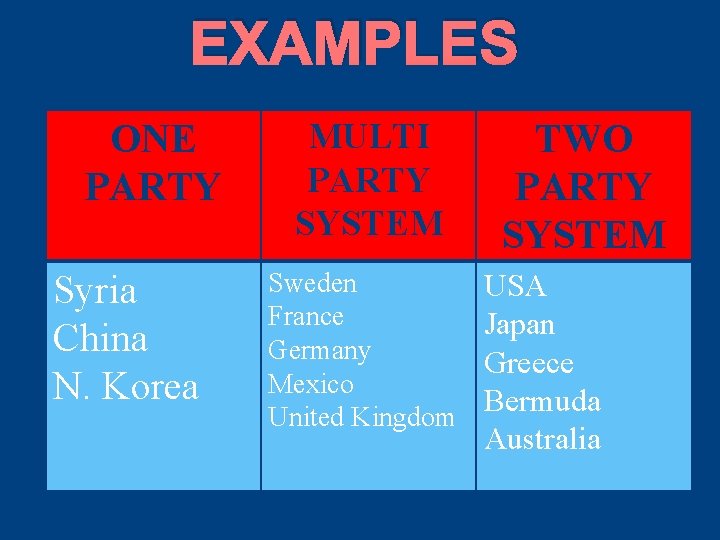
EXAMPLES ONE PARTY Syria China N. Korea MULTI PARTY SYSTEM Sweden France Germany Mexico United Kingdom TWO PARTY SYSTEM USA Japan Greece Bermuda Australia
Membership Patterns USA you join whichever you want. Parties are a cross section of society – each is really diverse. Doesn’t mean that a certain group tends to associate with one can you think of an example of this? Parents, socio-economic status play a part as well.
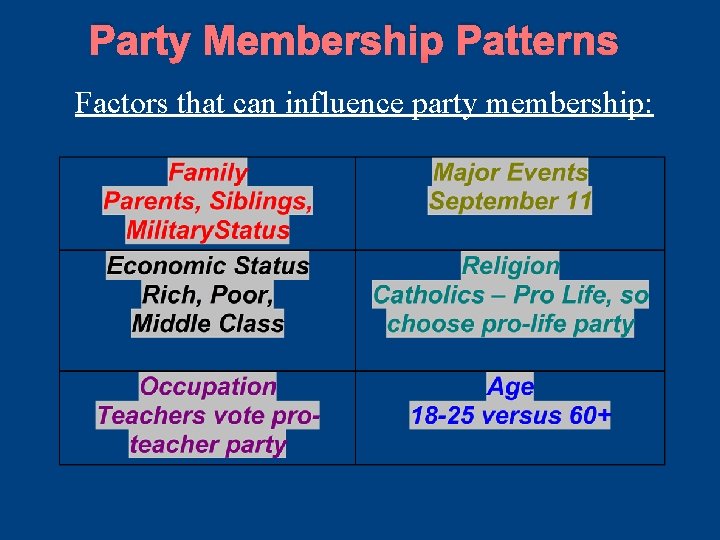
Party Membership Patterns Factors that can influence party membership: