
Chapter 5 Plant Propagation Part 2 Asexual Propagation
- Slides: 53
Chapter 5 Plant Propagation Part 2 – Asexual Propagation 1
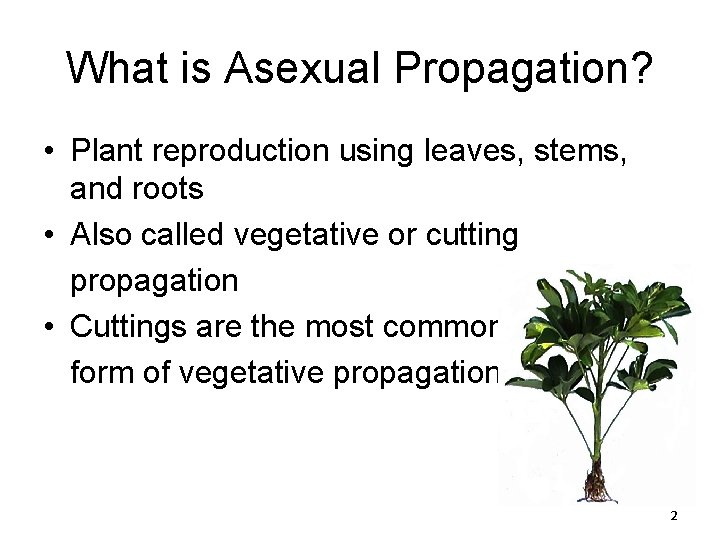
What is Asexual Propagation? • Plant reproduction using leaves, stems, and roots • Also called vegetative or cutting propagation • Cuttings are the most common form of vegetative propagation 2
Why use vegetative prop? • Offspring are clones – Genetically identical to parents – Preserves unusual and valuable plant traits that may not pass with seed • Used to reproduce plants that seldom flower or are sterile • Can be much faster than growing an equivalent plant by seed 3
VEGETATIVE PROPAGATION Cuttings • Cuttings are the most widespread vegetative propagation method. – Vegetative plant parts such as leaves, stems & roots that regenerate missing parts to form new plants. • They are cut from parent plants called stock plants. • The environment required for growing cuttings is the same as for germinating seeds: warmth, moisture, and a growing medium. 4
VEGETATIVE PROPAGATION Cuttings • Most parts used for vegetative propagation are taken from above-ground portions of the plant, and must regenerate roots. – The growing medium will determine whether roots will form, and their quality. • The main requirement is to drain quickly to admit air to the rooting area, yet retain some moisture. – There is not one superior rooting medium. • Many combinations of materials are used: – Sand part peat moss, part perlite, part vermiculite. – Pure vermiculite, pure perlite, and pure sand. 5
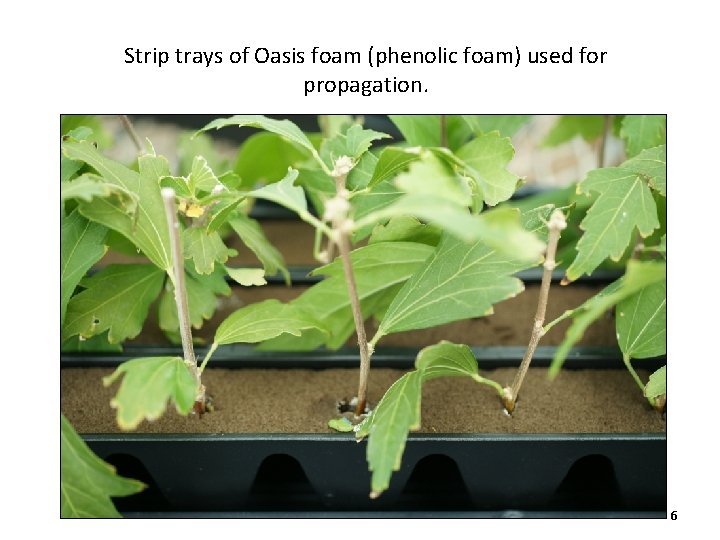
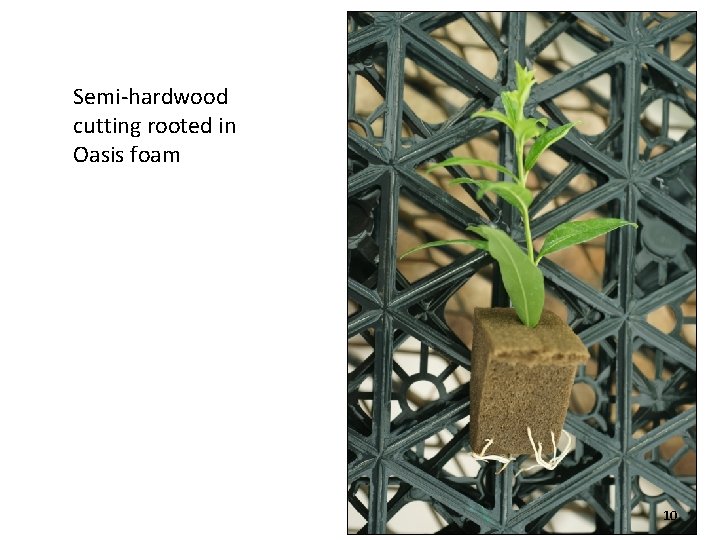
Strip trays of Oasis foam (phenolic foam) used for propagation. 6
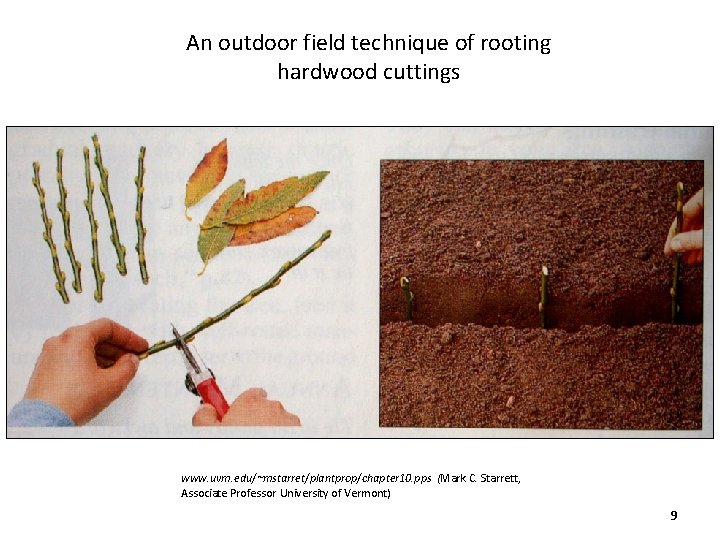
Cutting types – outdoor types • Hardwood – May be deciduous or evergreen – Taken when plants are dormant – 6 -10 inches long • Semi-hardwood – From deciduous plants in summer – Partially matured wood – 3 -6 inches long – Have leaves so must be protected from drying out 7
Cutting types - outdoor • Softwood – Taken in late spring – Most reliable type of outdoor cutting • Herbaceous – Similar to softwood cuttings but from herbaceous plants – Can be taken and rooted at any time in growing season • Root – Root pieces must be able to form adventitious buds – Only a few species – Must be taken in early spring while CHO loaded 8
An outdoor field technique of rooting hardwood cuttings www. uvm. edu/~mstarret/plantprop/chapter 10. pps (Mark C. Starrett, Associate Professor University of Vermont) 9
Semi-hardwood cutting rooted in Oasis foam 10
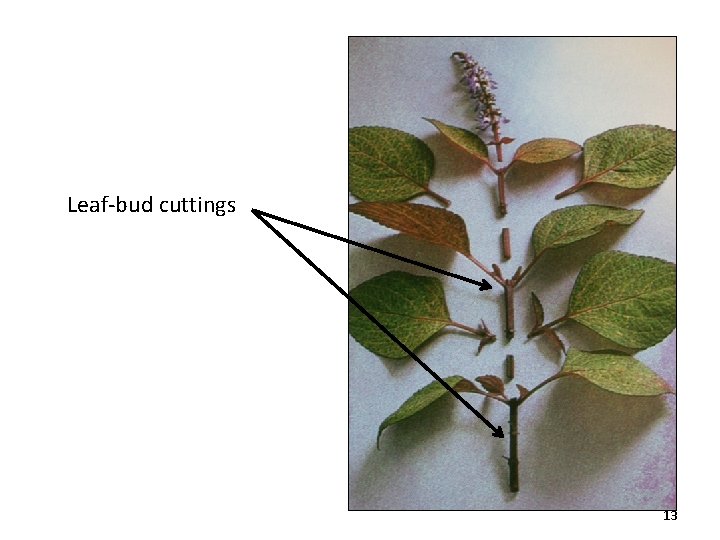
Cutting types - indoor • Stem tip cuttings – Most common type – 2 -4 inches of a growing stem • Leaf-bud – Lower stem sections with leaves - taken below tip cuttings – Slower to root and grow than tip cuttings • Stem section – Lower, leafless stem sections – 2 -3 nodes and laid horizontally in rooting bed 11
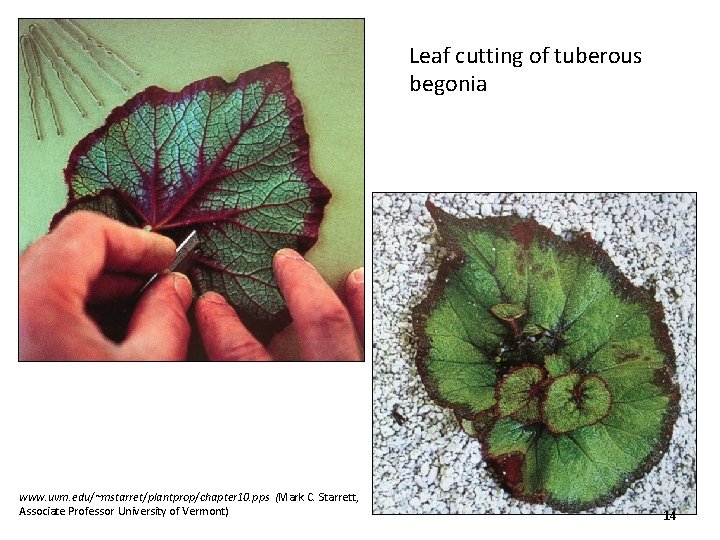
Cutting types - indoor • Leaf cuttings – May include blade and petiole – Longest time to root – Must produce roots, and buds with limited photosynthetic ability • African violet, snake plant, fibrous begonia – Propagation procedure varies by genera. 12
Leaf-bud cuttings 13
Leaf cutting of tuberous begonia www. uvm. edu/~mstarret/plantprop/chapter 10. pps (Mark C. Starrett, Associate Professor University of Vermont) 14
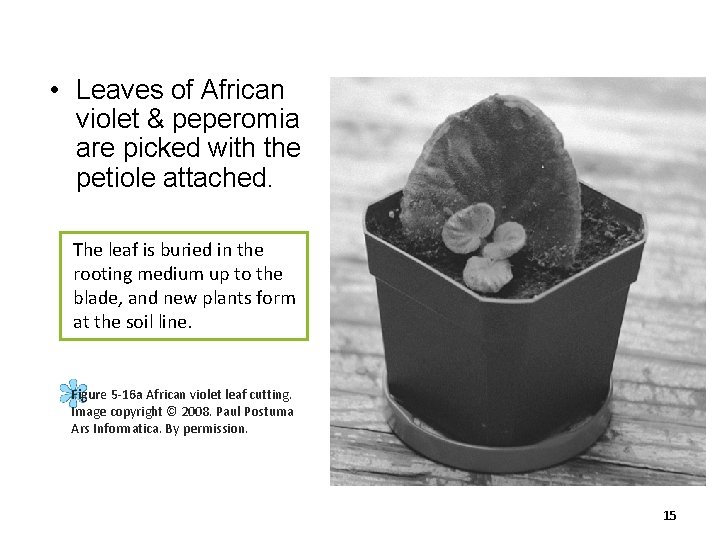
• Leaves of African violet & peperomia are picked with the petiole attached. The leaf is buried in the rooting medium up to the blade, and new plants form at the soil line. Figure 5 -16 a African violet leaf cutting. Image copyright © 2008. Paul Postuma Ars Informatica. By permission. 15
Rules for cuttings • • • No flowers or flower buds At least 1 node near the base Keep leafy cuttings moist at all times No leaves below soil line Remove fallen leaves and diseased cuttings or parts regularly • Use of a rooting hormone is recommended • Reduced light and humid conditions are required until rooting 16
Rules for Cuttings • Any leaves that will be covered after the cutting is stuck into the rooting medium should be removed. – Left on, they rot & provide a breeding ground for disease organisms. • Leaves that die and drop from the cuttings should be removed, with whole cuttings that appear dead. • A heat source at the bottom of the rooting chamber where the roots will be forming will increase the speed and success of rooting cuttings. • Use of a rooting hormone can increase rooting speed and success. 17
Rules for Cuttings • Gently tug the rooting cuttings about once per week to determine whether rooting has occurred. – If it slips out easily, no anchoring roots have formed. • The cutting should be inspected for signs of rotting and, if still healthy, can be reinserted in the medium. – If the cutting does not pull out with gentle tugging, it may have roots already. • The plastic lid can be opened partially to accustom the plants to normal humidity, and removed entirely after several days. – After 1 week, cuttings can be transplanted to pots. 18
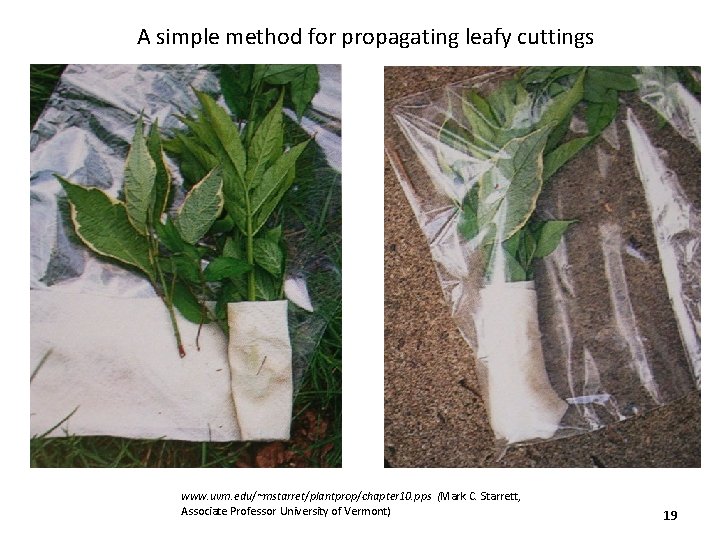
A simple method for propagating leafy cuttings www. uvm. edu/~mstarret/plantprop/chapter 10. pps (Mark C. Starrett, Associate Professor University of Vermont) 19
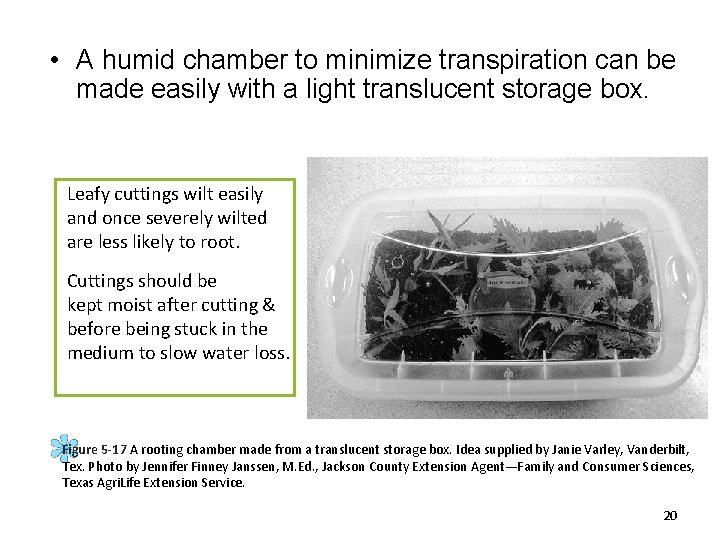
• A humid chamber to minimize transpiration can be made easily with a light translucent storage box. Leafy cuttings wilt easily and once severely wilted are less likely to root. Cuttings should be kept moist after cutting & before being stuck in the medium to slow water loss. Figure 5 -17 A rooting chamber made from a translucent storage box. Idea supplied by Janie Varley, Vanderbilt, Tex. Photo by Jennifer Finney Janssen, M. Ed. , Jackson County Extension Agent—Family and Consumer Sciences, Texas Agri. Life Extension Service. 20
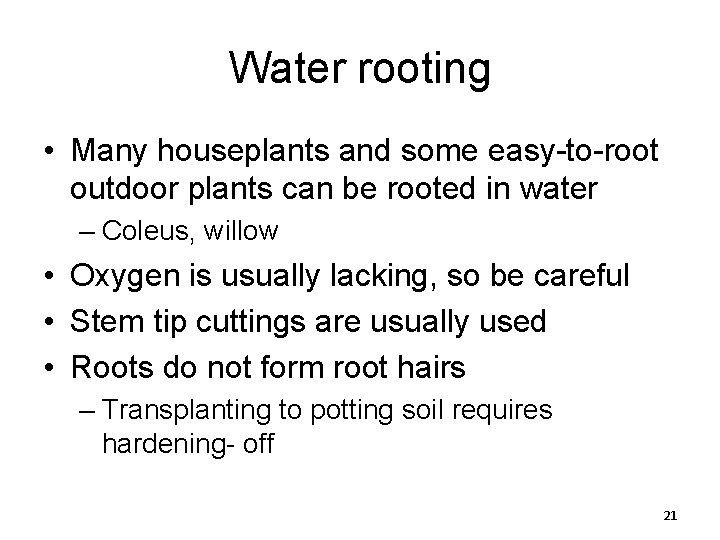
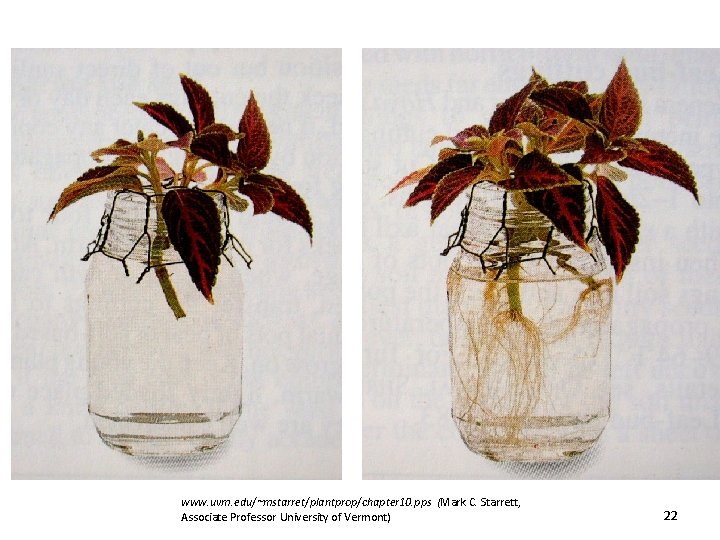
Water rooting • Many houseplants and some easy-to-root outdoor plants can be rooted in water – Coleus, willow • Oxygen is usually lacking, so be careful • Stem tip cuttings are usually used • Roots do not form root hairs – Transplanting to potting soil requires hardening- off 21
www. uvm. edu/~mstarret/plantprop/chapter 10. pps (Mark C. Starrett, Associate Professor University of Vermont) 22
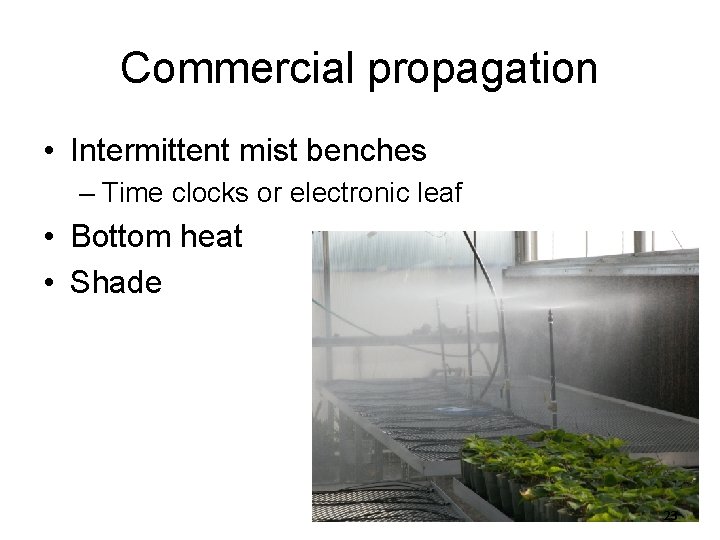
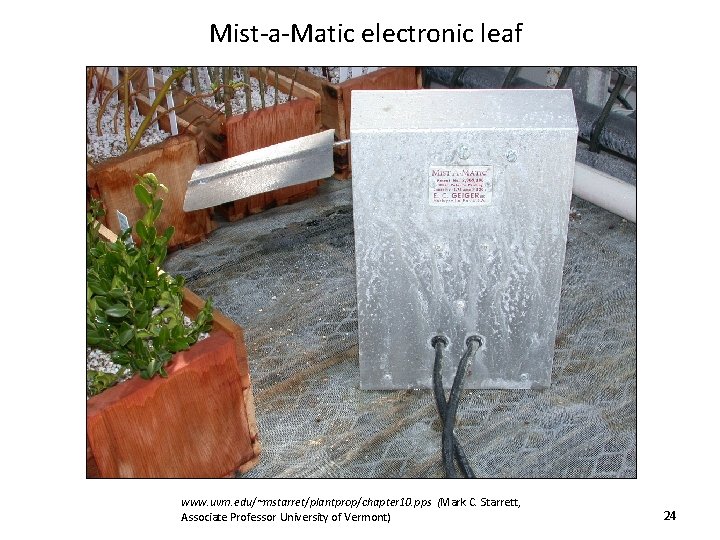
Commercial propagation • Intermittent mist benches – Time clocks or electronic leaf • Bottom heat • Shade 23
Mist-a-Matic electronic leaf www. uvm. edu/~mstarret/plantprop/chapter 10. pps (Mark C. Starrett, Associate Professor University of Vermont) 24
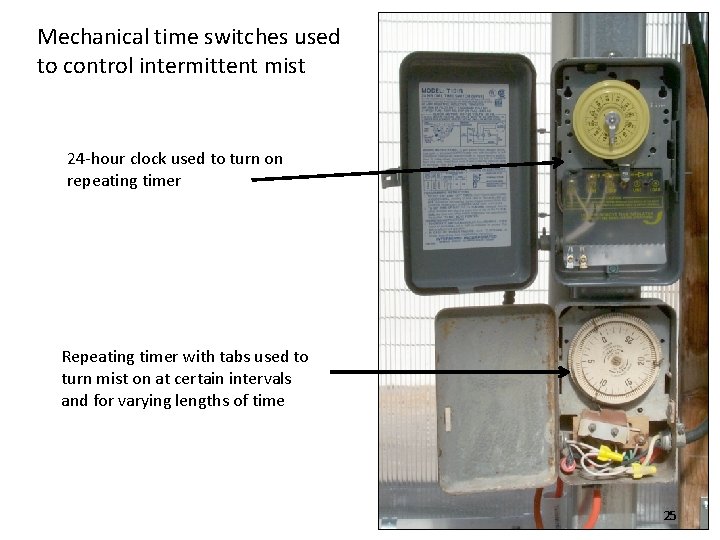
Mechanical time switches used to control intermittent mist 24 -hour clock used to turn on repeating timer Repeating timer with tabs used to turn mist on at certain intervals and for varying lengths of time 25
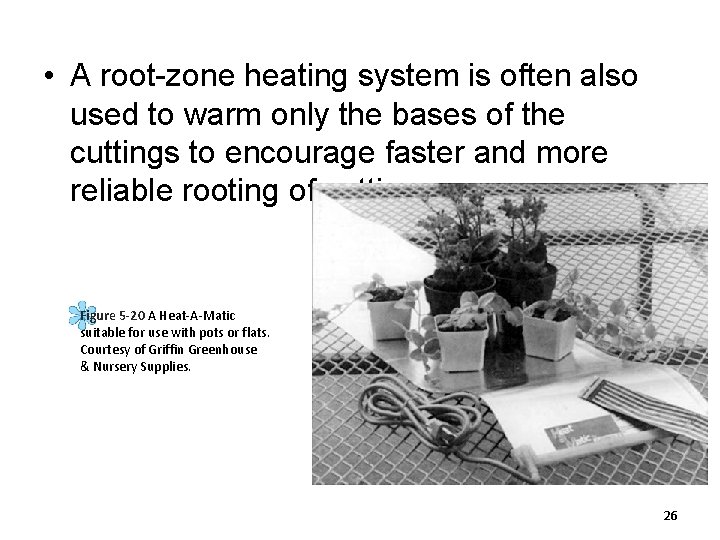
• A root-zone heating system is often also used to warm only the bases of the cuttings to encourage faster and more reliable rooting of cuttings. Figure 5 -20 A Heat-A-Matic suitable for use with pots or flats. Courtesy of Griffin Greenhouse & Nursery Supplies. 26
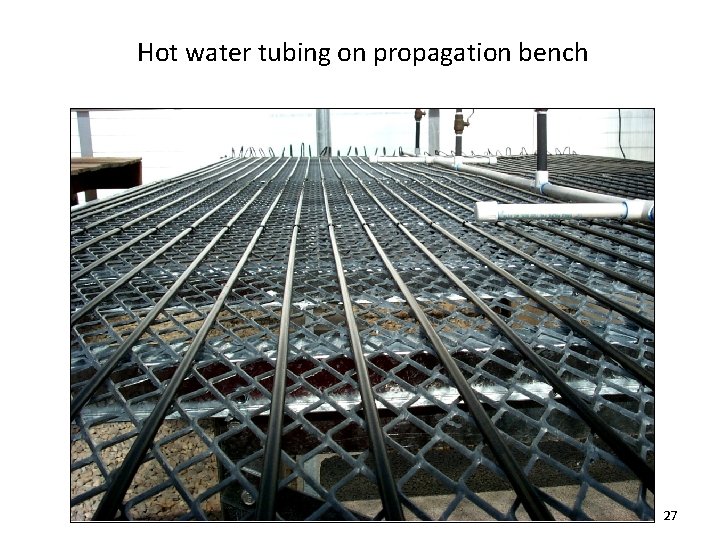
Hot water tubing on propagation bench 27
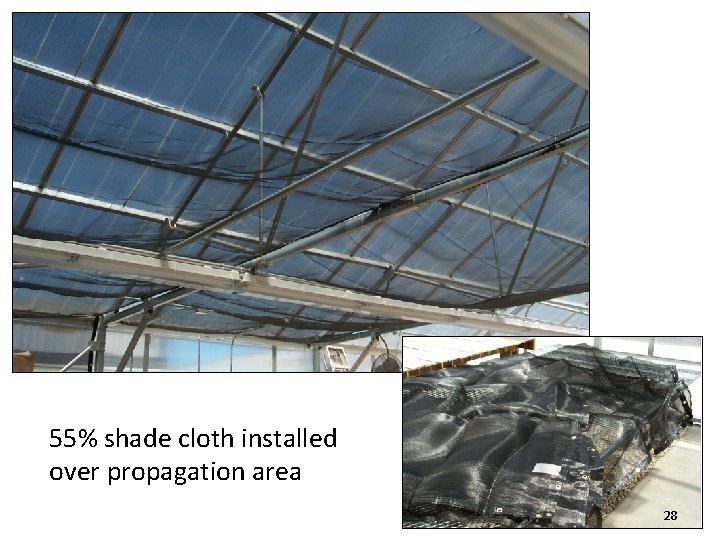
55% shade cloth installed over propagation area 28
Natural Plant Propagation • • • Crown Division Layering Rhizomes Stolons/Runners Suckers/Offsets Bulbs, Corms, Tubers 29
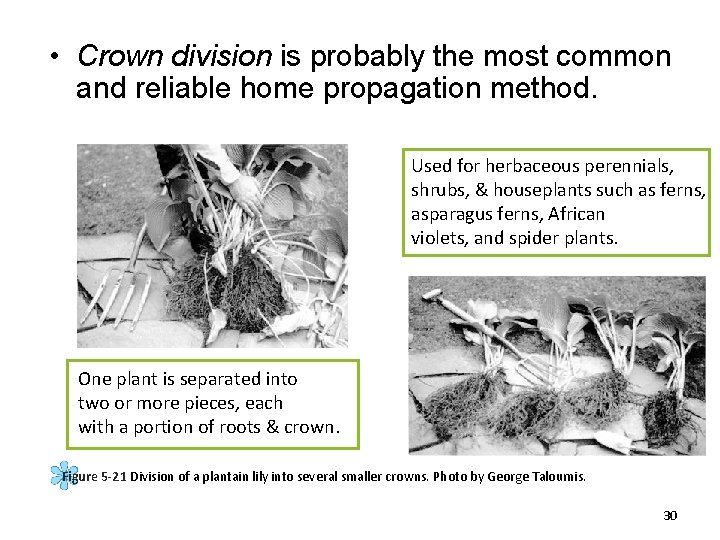
• Crown division is probably the most common and reliable home propagation method. Used for herbaceous perennials, shrubs, & houseplants such as ferns, asparagus ferns, African violets, and spider plants. One plant is separated into two or more pieces, each with a portion of roots & crown. Figure 5 -21 Division of a plantain lily into several smaller crowns. Photo by George Taloumis. 30
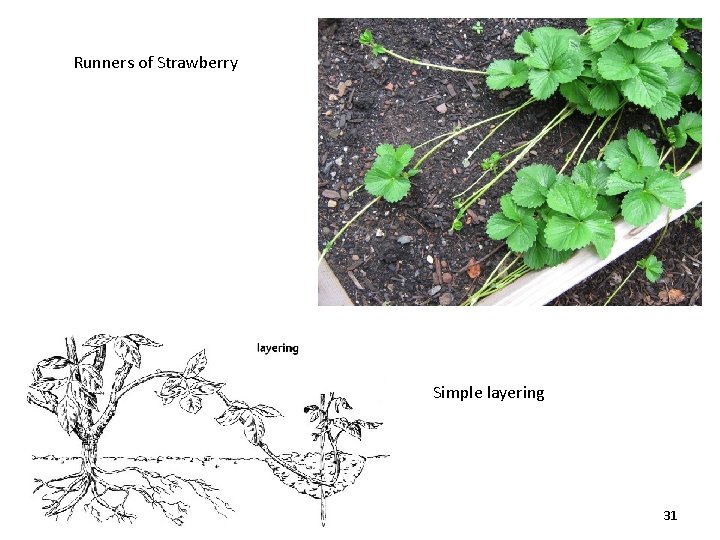
Runners of Strawberry Simple layering 31
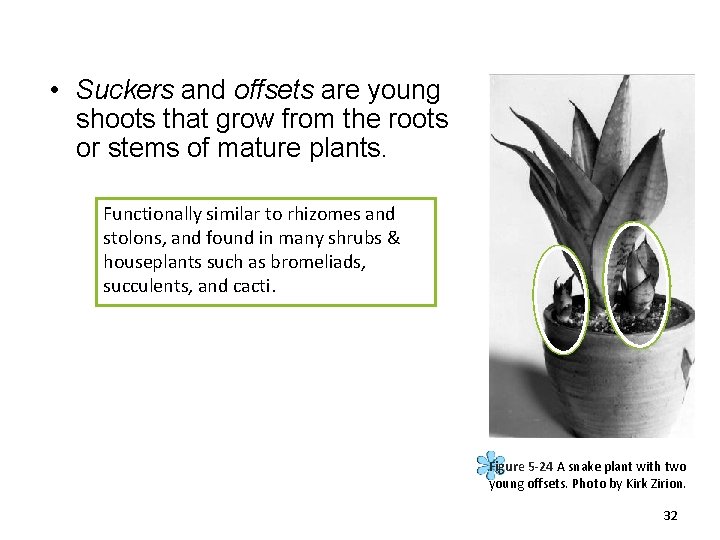
• Suckers and offsets are young shoots that grow from the roots or stems of mature plants. Functionally similar to rhizomes and stolons, and found in many shrubs & houseplants such as bromeliads, succulents, and cacti. Figure 5 -24 A snake plant with two young offsets. Photo by Kirk Zirion. 32
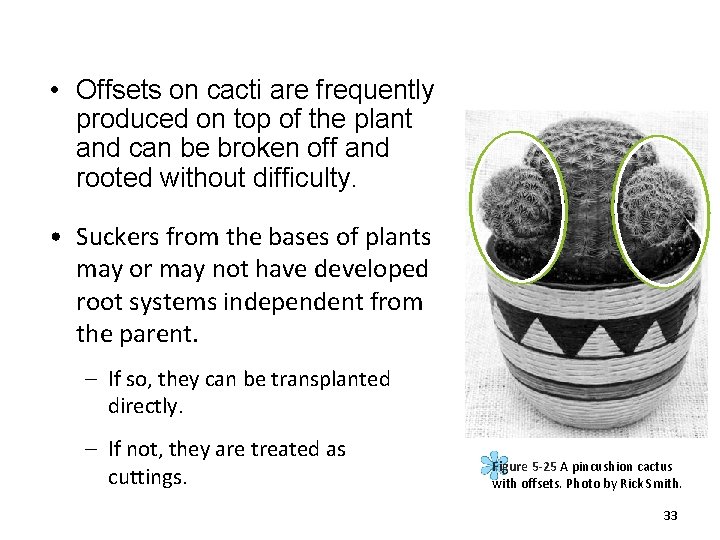
• Offsets on cacti are frequently produced on top of the plant and can be broken off and rooted without difficulty. • Suckers from the bases of plants may or may not have developed root systems independent from the parent. – If so, they can be transplanted directly. – If not, they are treated as cuttings. Figure 5 -25 A pincushion cactus with offsets. Photo by Rick Smith. 33
Storage Organs: Bulbs, Corms, and Tubers • Underground storage organs are produced by some herbaceous perennials. – A repository of stored carbohydrate, botanically, these are modified stems with nodes, buds & modified leaves. • Lilies, gladiolas, and amaryllis. 34
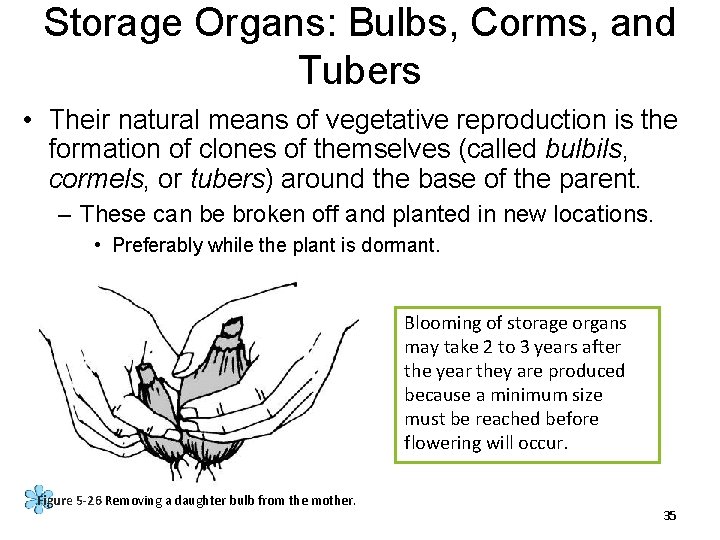
Storage Organs: Bulbs, Corms, and Tubers • Their natural means of vegetative reproduction is the formation of clones of themselves (called bulbils, cormels, or tubers) around the base of the parent. – These can be broken off and planted in new locations. • Preferably while the plant is dormant. Blooming of storage organs may take 2 to 3 years after the year they are produced because a minimum size must be reached before flowering will occur. Figure 5 -26 Removing a daughter bulb from the mother. 35
Other propagation methods • • • Air layering Grafting Budding Tissue Culture Genetic Engineering – transgenic plants – B. t. – Roundup-Ready crops 36
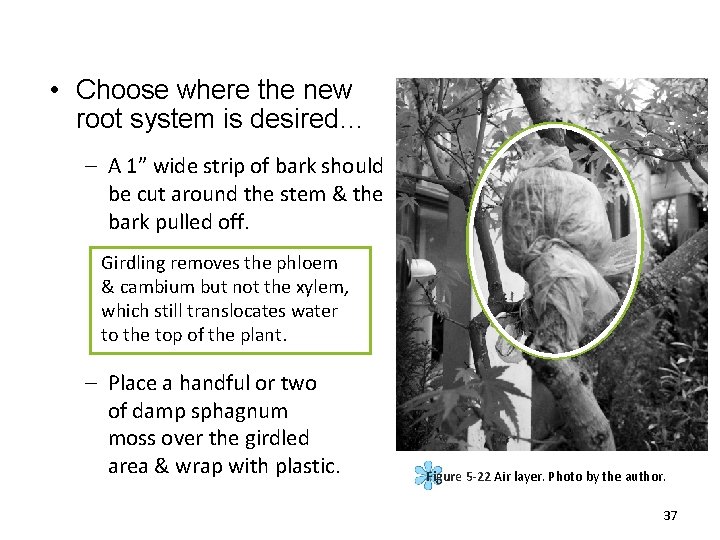
• Choose where the new root system is desired… – A 1” wide strip of bark should be cut around the stem & the bark pulled off. Girdling removes the phloem & cambium but not the xylem, which still translocates water to the top of the plant. – Place a handful or two of damp sphagnum moss over the girdled area & wrap with plastic. Figure 5 -22 Air layer. Photo by the author. 37
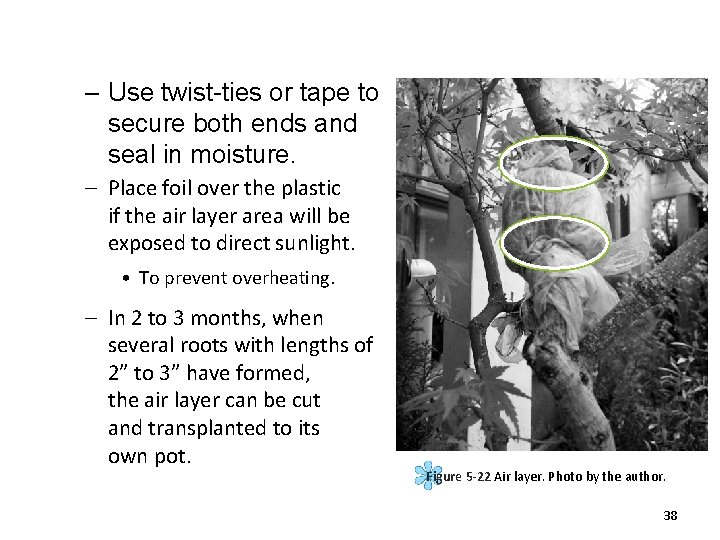
– Use twist-ties or tape to secure both ends and seal in moisture. – Place foil over the plastic if the air layer area will be exposed to direct sunlight. • To prevent overheating. – In 2 to 3 months, when several roots with lengths of 2” to 3” have formed, the air layer can be cut and transplanted to its own pot. Figure 5 -22 Air layer. Photo by the author. 38
Grafting and Budding • Grafting and budding are fairly complex methods of propagation used for reproducing valuable fruit and ornamental cultivars in nurseries. – Budding & grafting unite genetically different plants so they heal together & function as a single plant. • An amateur who wishes to try should plan ahead and consult reference books for more in-depth information. • Budding transfers a bud of one plant to another plant that will function as the root system, whereas grafting attaches a small branch to another plant. – Most frequently combining two cultivars of a species into one plant that exhibits the best features of each. 39
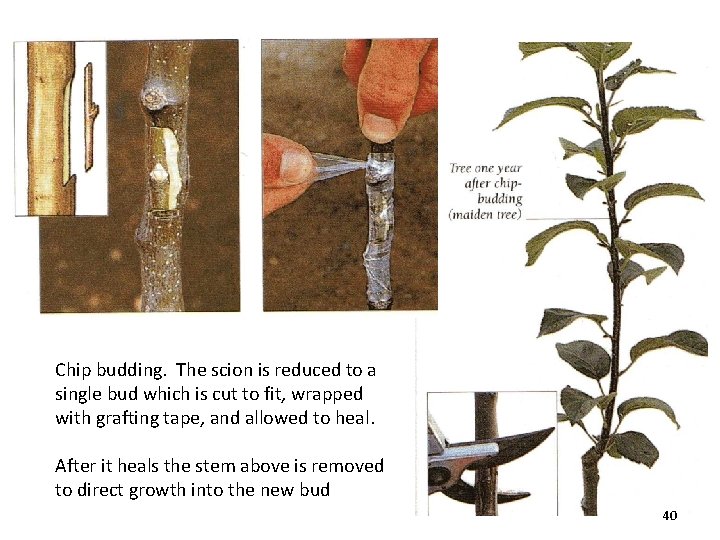
Chip budding. The scion is reduced to a single bud which is cut to fit, wrapped with grafting tape, and allowed to heal. After it heals the stem above is removed to direct growth into the new bud 40
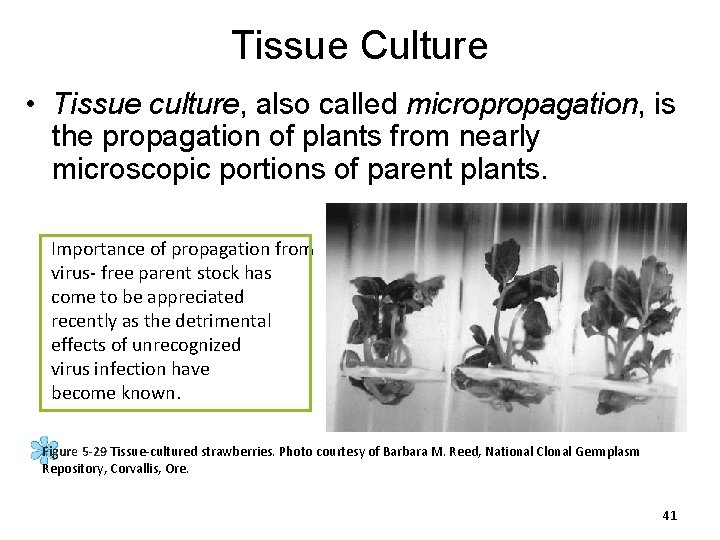
Tissue Culture • Tissue culture, also called micropropagation, is the propagation of plants from nearly microscopic portions of parent plants. Importance of propagation from virus- free parent stock has come to be appreciated recently as the detrimental effects of unrecognized virus infection have become known. Figure 5 -29 Tissue-cultured strawberries. Photo courtesy of Barbara M. Reed, National Clonal Germplasm Repository, Corvallis, Ore. 41
Tissue Culture • The technique has two distinct advantages over traditional propagation: – It enables mass production of a cultivar from an extremely limited amount of parent stock, in a relatively small area. – It enables the propagator to eliminate diseasecausing viruses from the parent material, unattainable through the use of pesticides. • And to propagate numerous virus-free offspring that are healthy and vigorous. 42
Tissue Culture • Tissue culture is not an amateur activity, because it is nearly impossible to achieve the sterile conditions necessary. • Tissue-cultured plants still in test tubes are sold in nurseries occasionally as novelty items. – Particularly orchids, which were the main plants tissue cultured for many years. • The test tube is left sealed and treated as a miniature terrarium. • When the plant outgrows the tube it sometimes can be transplanted to a pot, though the process is not always successful. 43
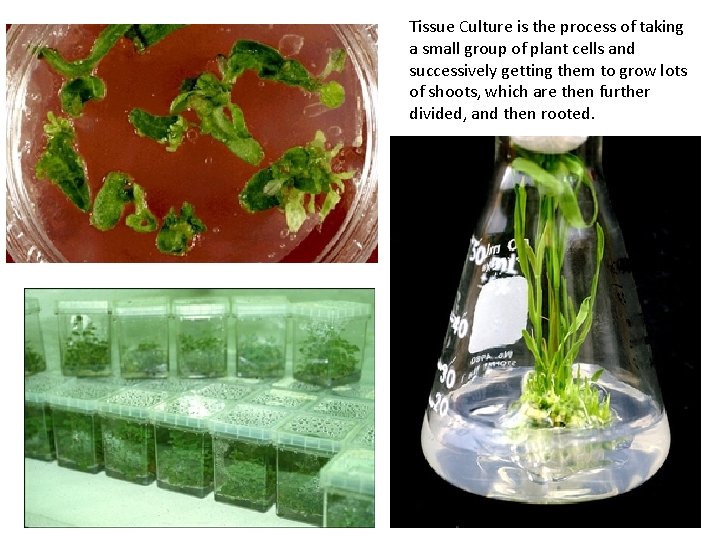
Tissue Culture is the process of taking a small group of plant cells and successively getting them to grow lots of shoots, which are then further divided, and then rooted. 44
GENETIC ENGINEERING • Genetic engineering can harness the biological machinery of bacteria and viruses to… – – Manufacture otherwise hard-to-obtain plant products. Combat genetically caused diseases. Improve tolerance of plants to adverses. Attain other similar commendable goals. • For plant improvement, it changes the genetic makeup of plants, without breeding or selection. • Its main advantage is that it makes possible the transfer of genes between completely unrelated plants or bacteria. – In rare cases, even from animals to plants. 45
COMMERCIAL APPLICATION OF GENETIC ENGINEERING • In commercial horticultural production, research has centered mainly on vegetable and fruit crop genetic engineering. – With a limited amount on flowers and other crops. • Although genetically engineered crops are in widespread cultivation, most are not horticultural. 46
COMMERCIAL APPLICATION OF GENETIC ENGINEERING • Generally, genetic engineering of horticultural crops has focused on – Imparting disease and pest resistance. – Imparting resistance to herbicides. – Extending the length of product shelf life. – Altering color. • In flowers. – Imparting cold-temperature resistance. • In strawberries and eucalyptus trees. 47
COMMERCIAL APPLICATION OF GENETIC ENGINEERING • One of the best known genetically engineered horticultural crops is the ‘Flavr Savr’ tomato. – Engineered to retain a firm texture longer than normal. • Tomatoes destined for fresh eating must be handharvested to prevent bruising. – Unlike canning tomatoes that can be harvested mechanically—a less expensive process. • Fresh tomatoes must also be transported quickly and with careful packaging. – To ensure that they arrive at the supermarket in an attractive condition, appealing to the buyer. 48
COMMERCIAL APPLICATION OF GENETIC ENGINEERING • The ‘Flavr Savr’ inhibits expression of the genetic material that causes fruit to soften when it ripens. – The softening part of ripening is slowed, although the flavor continues to develop. • This allows mechanical harvesting, increased transport time, and longer fresh shelf life in the supermarket. 49
COMMERCIAL APPLICATION OF GENETIC ENGINEERING • A second genetically engineered crop receiving widespread attention is a Thompson Seedless grape variety engineered to be virus resistant. – One of the most commonly cultivated table grapes. • Also a component of blended wines. 50
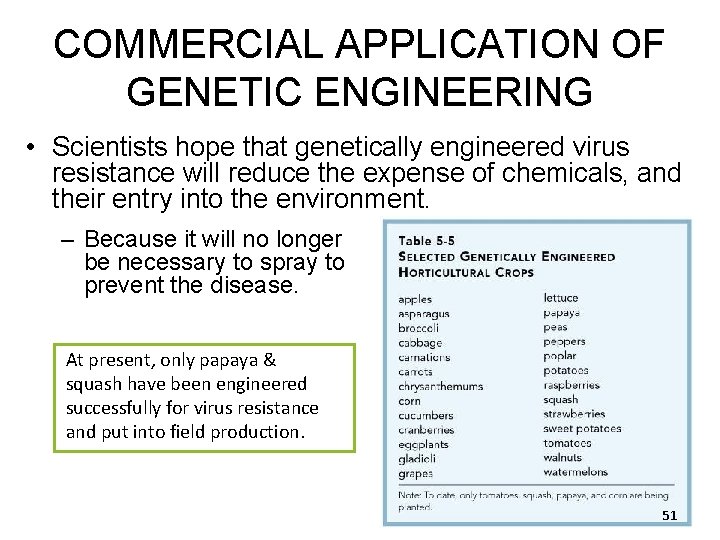
COMMERCIAL APPLICATION OF GENETIC ENGINEERING • Scientists hope that genetically engineered virus resistance will reduce the expense of chemicals, and their entry into the environment. – Because it will no longer be necessary to spray to prevent the disease. At present, only papaya & squash have been engineered successfully for virus resistance and put into field production. 51
COMMERCIAL APPLICATION OF GENETIC ENGINEERING • Some opponents of genetic engineering fear it could upset the ecosystem in unknown ways. – They feel that the accelerated pace of genetic change could inundate the environment with bizarre plants, causing an unstable ecological situation. • Some organic farmers fear a biological pesticide, which they use to control infestations of worms, will no longer be effective due to insect resistance as a result of widespread incorporation in many crops. – Bacillus thuringiensis, is the source of genetic material put into plants to cause their cells to produce an insect poison. 52
COMMERCIAL APPLICATION OF GENETIC ENGINEERING • The Environmental Protection Agency (EPA) has approved a number of genetically engineered plants. – Over 3 million acres of genetically engineered corn, cotton, and potatoes were planted in the U. S. in 1997. • A class-action suit has been filed against the EPA by thirty-one groups who charge that the EPA has been negligent in its approval of genetically engineered crops. 53