
Chapter 5 Physical Activity to Improve Health and

- Slides: 21
Chapter 5 Physical Activity to Improve Health and Wellness
What exactly is moderate physical activity? • A moderate amount of activity uses about 150 calories of energy and causes a noticeable increase in heart rate, such as when taking a brisk walk.
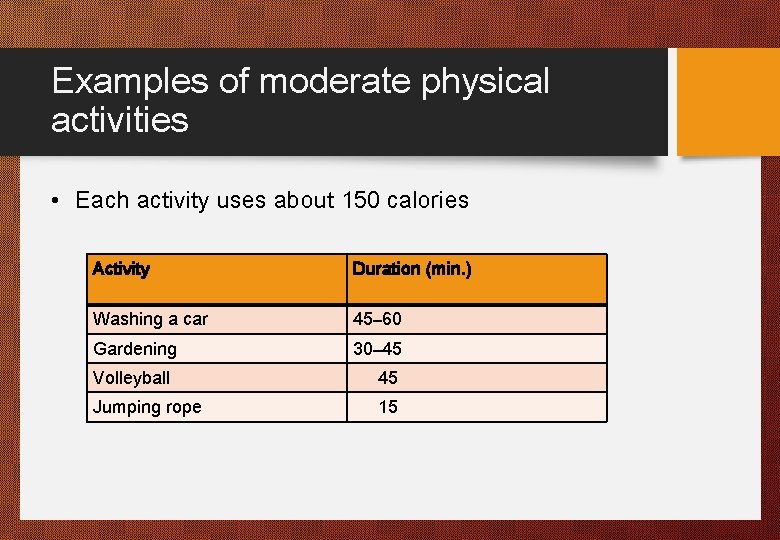
Examples of moderate physical activities • Each activity uses about 150 calories Activity Duration (min. ) Washing a car 45– 60 Gardening 30– 45 Volleyball 45 Jumping rope 15
Classifying Activity Levels • Light activity includes routine tasks associated with typical day-to-day life, such as vacuuming, walking slowly, shopping, or stretching. • Moderate activity causes your breathing and heart rate to accelerate but still allows for comfortable conversation, such as walking at 3– 4 miles per hour. • Vigorous activity elevates your heart and breathing rates considerably and has other physical effects that improve your fitness level. Some examples include jogging, hiking uphill, swimming laps, and playing most competitive sports.
Physical Activity and Exercise Recommendations for Promoting General Health (Physical Activity Guidelines Advisory Committee, 2008) • Perform moderate-intensity aerobic physical activities for at least 150 minutes per week or 75 minutes of vigorous-intensity physical activity per week. • Some examples of moderate-intensity physical activities include brisk walking, water aerobics, tennis (doubles), dancing, and cycling for less than 10 miles per hour. •
Physical Activity and Exercise Recommendations for Promoting General Health (Physical Activity Guidelines Advisory Committee, 2008) • Some examples of vigorous-intensity physical activities include jogging, power-walking, tennis (singles), jumping rope, hiking uphill, and cycling faster than 10 miles per hour. • Also, to be more active in your daily life: walk instead of driving, take the stairs instead of the elevator, and watch less television.
Recommendations to increase health benefits • Exercise at moderate intensity for 300 minutes per week or at vigorous intensity for 150 minutes per week.
Recommendations to achieve or maintain weight loss • Exercise moderately for 60– 90 minutes per day on most days of the week.
Recommendations for muscle strength and endurance • Perform resistance exercises on at least two nonconsecutive days per week. • Some examples include weight training and exercises that use body weight as resistance such as core stabilizing exercises, pull-ups, push-ups, and squats.
Recommendations for flexibility • Perform range-of-motion (stretching) exercises at least twice a week
Increasing physical activities to manage weight • The U. S. Department of Health and Human Services has also published physical activity guidelines focusing on weight management. • They recommend up to 90 minutes of physical activity per day. • They recommend that at the beginning do 30 minutes of activity per day and then try to raise the activity level further, to 60– 90 minutes per day or more.
Exercising to improve physical fitness • moderate physical activities • increasing the duration and intensity of physical activities • vigorous activities, as in a structured, systematic exercise program
Components of health-related physical fitness • • • Cardiorespiratory endurance Muscular strength Muscular endurance Flexibility Body composition
Cardiorespiratory endurance • Cardiorespiratory endurance is the ability to perform prolonged, large-muscle, dynamic exercise at moderate to high levels of intensity. • As cardiorespiratory fitness improves, related physical functions also improve. For example: The heart pumps more blood per heartbeat, blood volume increases, and blood supply to tissues improves. • Cardiorespiratory endurance can be developed through activities that involve continuous, rhythmic movements of large-muscle groups, such as walking, jogging, cycling, and aerobic dancing.
Muscular strength • Muscular strength is the amount of force a muscle can produce with a single maximum effort. • An example would being able to lift an object without undue stress or strain. • Females have lower levels of upper body strength than lower body strength. In general, females should engage in a program of regular, upper body strength development.
Muscular Endurance • Muscular endurance is the ability to resist fatigue and sustain a given level of muscle tension, to hold a muscle contraction for a long time or to contract a muscle. • Resistance training, such as weight lifting, promotes muscular strength and endurance.
Flexibility • Flexibility is the ability to move the joints through their full range of motion (ROM). • Stretching exercises can help ensure a healthy range of motion for all major joints.
Body composition • Body composition refers to the proportion of fat and fat -free mass (muscle, bone, and water) in the body. • Healthy body composition involves a high proportion of fat-free mass and an acceptably low level of body fat, adjusted for age and gender. • The best way to lose fat is through a lifestyle that includes a sensible diet and exercise. • The best way to add muscle mass is through strength training.
Skill-Related Components of Fitness • The ability to perform a particular sport or activity may depend on these six skill-related fitness components: • Speed —the ability to perform a movement in a short period of time • Power —the ability to exert force rapidly, based on a combination of strength and speed • Agility —the ability to change the position of the body quickly and accurately
Skill-Related Components of Fitness (cont. ) • Balance —the ability to maintain equilibrium while moving or while stationary • Coordination —the ability to perform motor tasks accurately and smoothly using body movements and the senses • Reaction and movement time —the ability to respond and react quickly to a stimulus
• To set a personal goal for physical activity and exercise, consider your current activity level, your health status, and your overall goals. • At the very least, strive to become more active and get 30 minutes of moderate-intensity activity at least 5 times per week.