
Chapter 5 Personality Dispositions Over Time Stability Change

Chapter 5 Personality Dispositions Over Time: Stability, Change, and Coherence
Conceptual Issues • Personality Development • Stability (& Coherence) • Change 2
What Is Personality Development? • Personality development • ________________________________________________ ________ • Focus on stability and change 3

Three Key Forms of Stability • Rank order stability • ________________________ • e. g. , people tend to maintain their positions on dominance or extraversion relative to others over time • Mean level stability • ________________________ • e. g. , the average level of liberalism or conservatism in a group remains the same over time • Personality coherence • ________________________________________________ • e. g. , an 8 -year-old may manifest his dominance by showing 4
Personality Change: Two Defining Qualities • Internal • Changes are internal to a person, ____________________________________ • Enduring • Changes are enduring over time, ___________ 5
Three Levels of Analysis • Population level • ________________________________________________ • e. g. , almost everyone in the population tends to increase in sexual motivation at puberty • e. g. , there is a general decrease in impulsive and risk-taking behaviors as people get older • Group differences level • ________________________________________________ • e. g. , men and women develop differently in their average levels of risk taking and degree in expressing empathy • Individual difference level • e. g. , Can we predict who is at risk for psychological disturbance later in life based on earlier measures of 6
Personality Coherence Over Time: The Prediction of Socially Relevant Outcomes • Personality coherence • ________________________________________________ ________ 7
Personality Coherence Over Time • Marital Stability, Marital Satisfaction, and Divorce • Longitudinal study of 300 couples from engagements in 1930 s to 1980 s • During first testing session in 1930 s, friends rated each participant’s personality on many dimensions • Three aspects of personality strongly predicted marital dissatisfaction and divorce (accounted for more than half of the predictable variance) • Husband’s neuroticism • Husband’s impulsivity • Wife’s neuroticism 8
Personality Coherence Over Time • Alcoholism and Emotional Disturbance • In a longitudinal study of 233 men, high neuroticism predicted the later development of alcoholism and/or emotional disturbance • Alcoholic men had lower impulse control scores than men with emotional disturbance • *People that score high on sensation seeking and impulsivity, and low on agreeableness and conscientiousness, tend to use and abuse substances more than their peers 9

Personality Coherence Over Time • Religiousness and Spirituality • Adolescents who scored high on conscientiousness and agreeableness were more likely to score high on religiousness later in life • Openness to experience predicted spirituality seeking in late life 10
Personality Coherence Over Time • Education, Academic Achievement, and Dropping Out • Among low SAT scorers, there is no link between impulsivity and subsequent GPA • Among high SAT scorers, high impulsive people had consistently lower GPAs than low impulsive people • High impulsive people are more likely than low impulsive people to flunk out of college • Conscientiousness is the most powerful longitudinal predictor of success in school and work • Conscientiousness of children assessed between the ages of 8 and 12 predicts academic attainment two decades later! 11
Personality Coherence Over Time • Health and Longevity • Our personality predicts how long we are likely to live • This will be discussed more in Chapter 18 – Stress, Coping, Adjustment, and Health • The most important traits conducive to living a long life are high conscientiousness, positive emotionality (extraversion), low levels of hostility, and low levels of neuroticism • See p. 149 for more extensive explanation 12
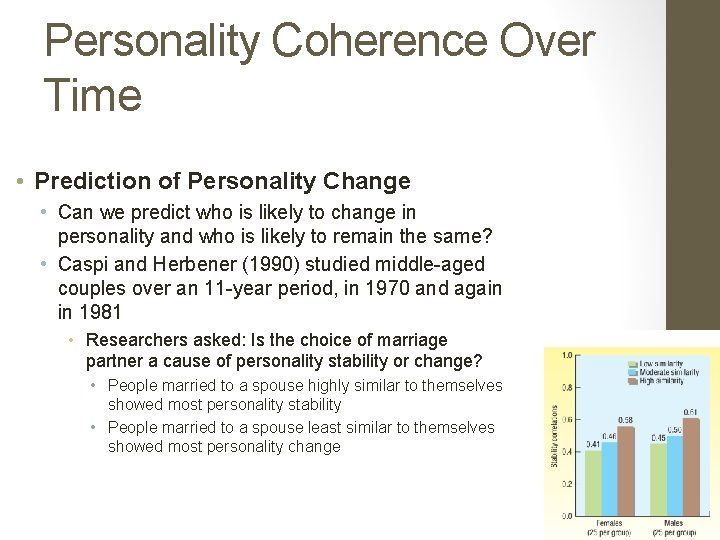
Personality Coherence Over Time • Prediction of Personality Change • Can we predict who is likely to change in personality and who is likely to remain the same? • Caspi and Herbener (1990) studied middle-aged couples over an 11 -year period, in 1970 and again in 1981 • Researchers asked: Is the choice of marriage partner a cause of personality stability or change? • People married to a spouse highly similar to themselves showed most personality stability • People married to a spouse least similar to themselves showed most personality change 13
Summary and Evaluation • Personality development is the study of both the continuities and changes in personality over time • Strong evidence for personality rank order stability over time • Personality also changes in predictable ways, sometimes in different ways for men and women • Personality also shows evidence for coherence over time 14
- Slides: 14