
Chapter 5 Perceived Freedom and Intrinsic Motivation The




- Slides: 42
Chapter 5 Perceived Freedom and Intrinsic Motivation: The Psychological Foundations of Leisure (知覺自由與內在動機: 休閒的心理學基礎 ) : 1
Translating the Essence of Leisure into Social Psychological Terms (以社會心理學的術語來闡述休閒的本質) 2
Introduction | A number of psychological theories and constructs (一些心理學理論和概念) have been developed to explain the importance of the processes of choice, control, and self-determination (解釋選擇、 控 制 、 自 我 決 定 過 程 的 重 要 性 ) for human behavior and well-being (人類行為與幸福). | Central constructs include perceived freedom (知 覺自由) and intrinsic motivation (內在動機). 3
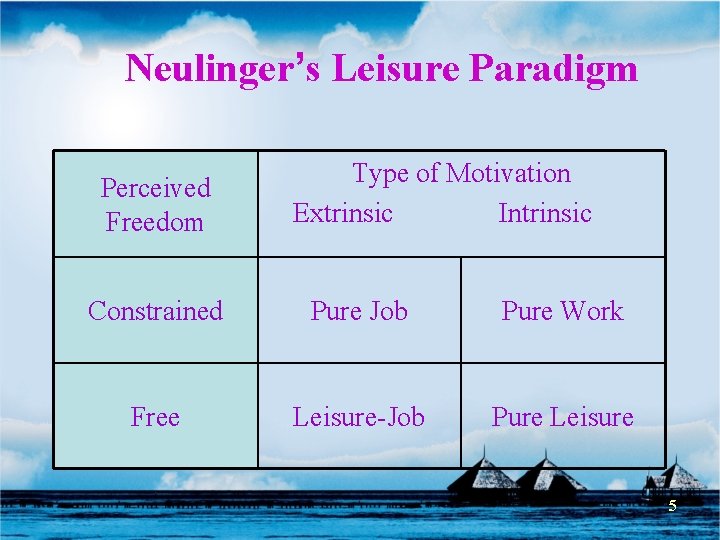
A Typology for Describing Leisure (一種描述休閒的分類系統) | Neulinger (1974) developed a typology (分類系統) that he called a leisure paradigm (範例) (see figure 5. 1). | This model, resulting from the cross-classification of the perceived freedom (知 覺 自 由 ) and intrinsic motivation (內在動機) dimensions, was concerned with identifying and , predicting when an activity or episode would be construed as some type of leisure or non-leisure by the individual participant (指出和 預測何者為休閒、何者不是休閒). 4
Neulinger’s Leisure Paradigm Perceived Freedom Type of Motivation Extrinsic Intrinsic Constrained Pure Job Pure Work Free Leisure-Job Pure Leisure 5
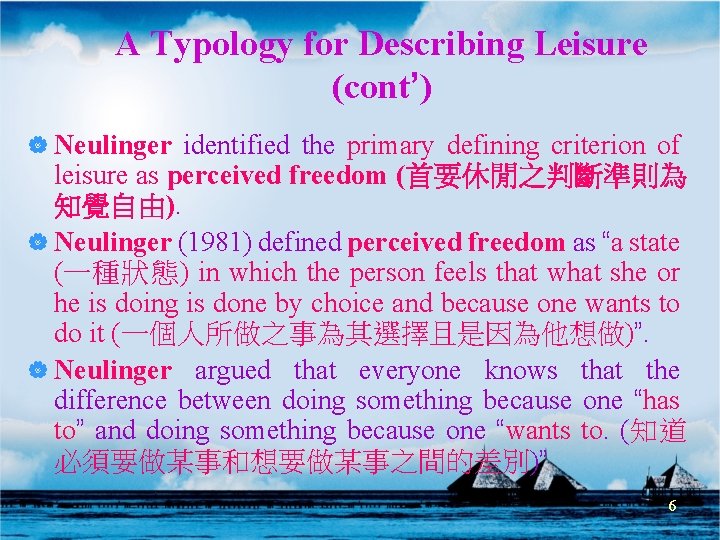
A Typology for Describing Leisure (cont’) | Neulinger identified the primary defining criterion of leisure as perceived freedom (首要休閒之判斷準則為 知覺自由). | Neulinger (1981) defined perceived freedom as “a state (一種狀態) in which the person feels that what she or he is doing is done by choice and because one wants to do it (一個人所做之事為其選擇且是因為他想做)”. | Neulinger argued that everyone knows that the difference between doing something because one “has to” and doing something because one “wants to. (知道 必須要做某事和想要做某事之間的差別)” 6
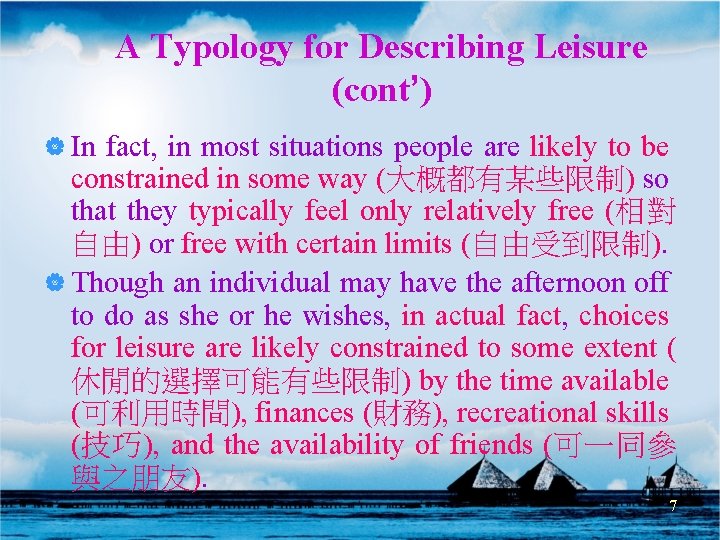
A Typology for Describing Leisure (cont’) | In fact, in most situations people are likely to be constrained in some way (大概都有某些限制) so that they typically feel only relatively free (相對 自由) or free with certain limits (自由受到限制). | Though an individual may have the afternoon off to do as she or he wishes, in actual fact, choices for leisure are likely constrained to some extent ( 休閒的選擇可能有些限制) by the time available (可利用時間), finances (財務), recreational skills (技巧), and the availability of friends (可一同參 與之朋友). 7
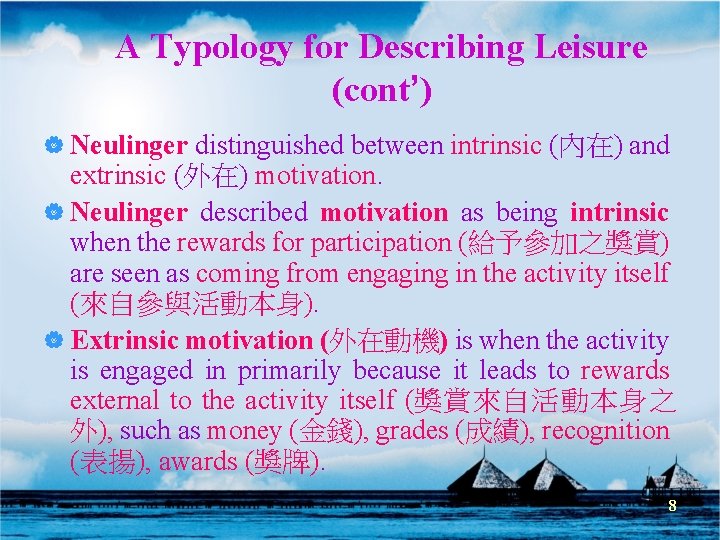
A Typology for Describing Leisure (cont’) | Neulinger distinguished between intrinsic (內在) and extrinsic (外在) motivation. | Neulinger described motivation as being intrinsic when the rewards for participation (給予參加之獎賞) are seen as coming from engaging in the activity itself (來自參與活動本身). | Extrinsic motivation (外在動機) is when the activity is engaged in primarily because it leads to rewards external to the activity itself (獎賞來自活動本身之 外), such as money (金錢), grades (成績), recognition (表揚), awards (獎牌). 8
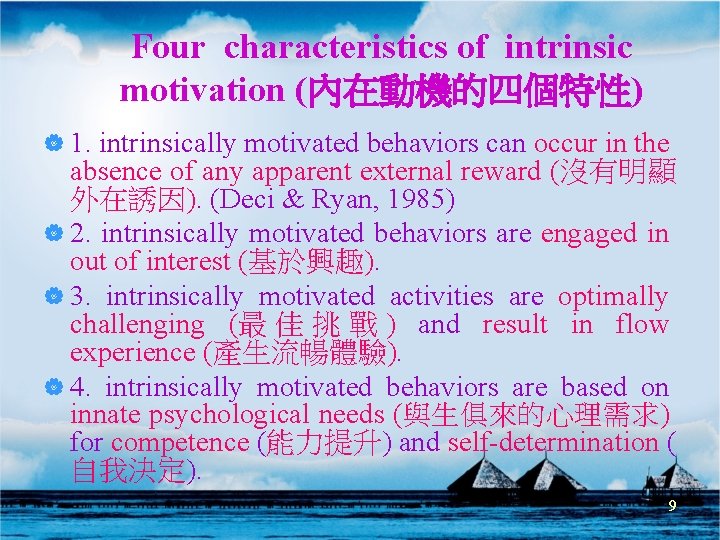
Four characteristics of intrinsic motivation (內在動機的四個特性) | 1. intrinsically motivated behaviors can occur in the absence of any apparent external reward (沒有明顯 外在誘因). (Deci & Ryan, 1985) | 2. intrinsically motivated behaviors are engaged in out of interest (基於興趣). | 3. intrinsically motivated activities are optimally challenging (最 佳 挑 戰 ) and result in flow experience (產生流暢體驗). | 4. intrinsically motivated behaviors are based on innate psychological needs (與生俱來的心理需求) for competence (能力提升) and self-determination ( 自我決定). 9
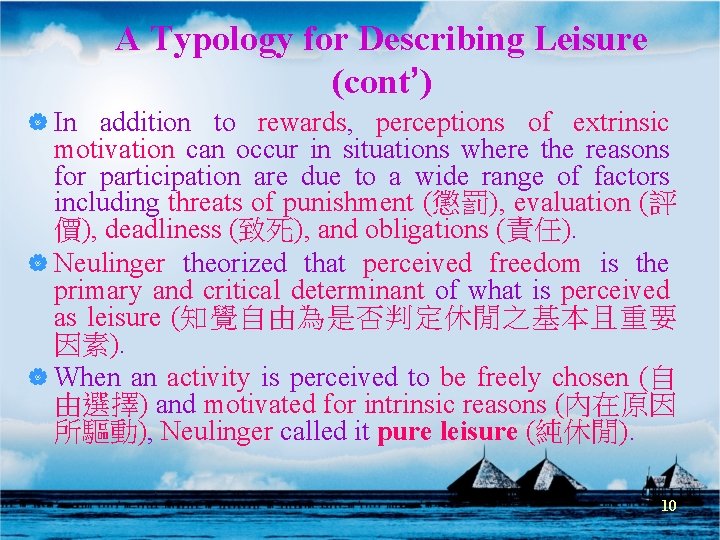
A Typology for Describing Leisure (cont’) | In addition to rewards, perceptions of extrinsic motivation can occur in situations where the reasons for participation are due to a wide range of factors including threats of punishment (懲罰), evaluation (評 價), deadliness (致死), and obligations (責任). | Neulinger theorized that perceived freedom is the primary and critical determinant of what is perceived as leisure (知覺自由為是否判定休閒之基本且重要 因素). | When an activity is perceived to be freely chosen (自 由選擇) and motivated for intrinsic reasons (內在原因 所驅動), Neulinger called it pure leisure (純休閒). 10
Perceived Freedom and Control in Life and Leisure (生活與休閒當中的知覺自由與控制) 11
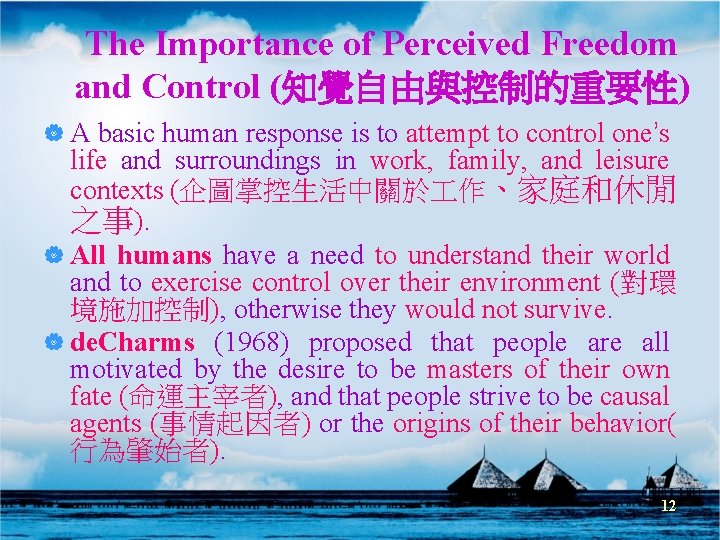
The Importance of Perceived Freedom and Control (知覺自由與控制的重要性) | A basic human response is to attempt to control one’s life and surroundings in work, family, and leisure contexts (企圖掌控生活中關於 作、家庭和休閒 之事). | All humans have a need to understand their world and to exercise control over their environment (對環 境施加控制), otherwise they would not survive. | de. Charms (1968) proposed that people are all motivated by the desire to be masters of their own fate (命運主宰者), and that people strive to be causal agents (事情起因者) or the origins of their behavior( 行為肇始者). 12
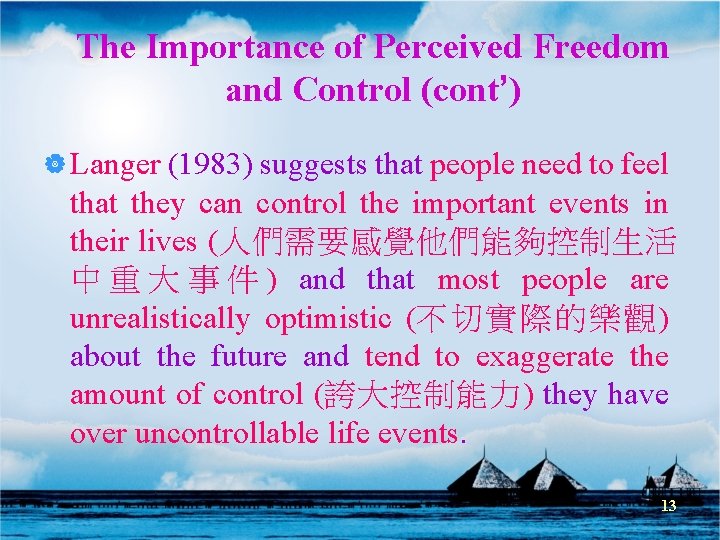
The Importance of Perceived Freedom and Control (cont’) | Langer (1983) suggests that people need to feel that they can control the important events in their lives (人們需要感覺他們能夠控制生活 中 重 大 事 件 ) and that most people are unrealistically optimistic (不切實際的樂觀) about the future and tend to exaggerate the amount of control (誇大控制能力) they have over uncontrollable life events. 13
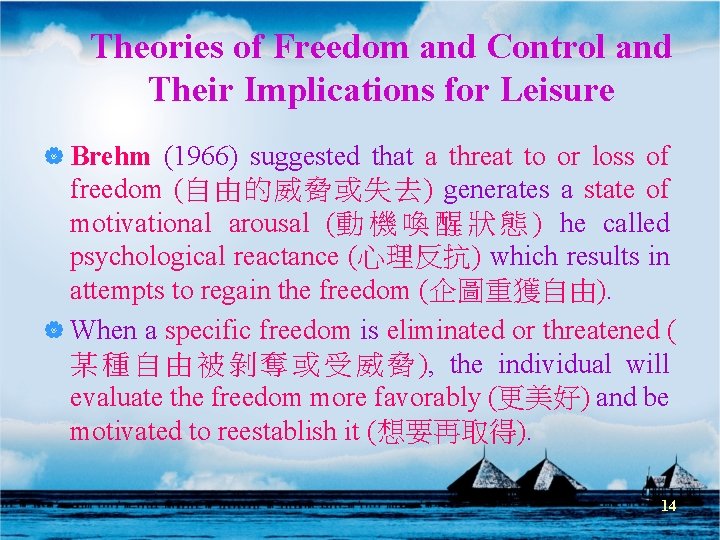
Theories of Freedom and Control and Their Implications for Leisure | Brehm (1966) suggested that a threat to or loss of freedom (自由的威脅或失去) generates a state of motivational arousal (動 機 喚 醒 狀 態 ) he called psychological reactance (心理反抗) which results in attempts to regain the freedom (企圖重獲自由). | When a specific freedom is eliminated or threatened ( 某 種 自 由 被 剝 奪 或 受 威 脅 ), the individual will evaluate the freedom more favorably (更美好) and be motivated to reestablish it (想要再取得). 14
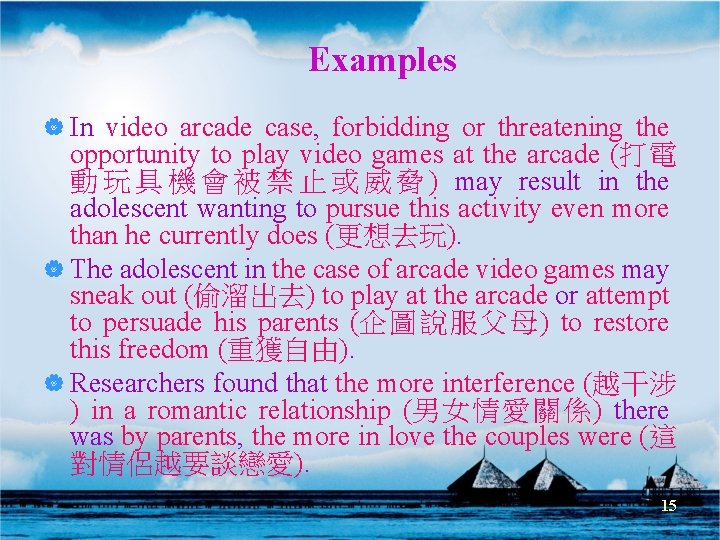
Examples | In video arcade case, forbidding or threatening the opportunity to play video games at the arcade (打電 動 玩 具 機 會 被 禁 止 或 威 脅 ) may result in the adolescent wanting to pursue this activity even more than he currently does (更想去玩). | The adolescent in the case of arcade video games may sneak out (偷溜出去) to play at the arcade or attempt to persuade his parents (企圖說服父母) to restore this freedom (重獲自由). | Researchers found that the more interference (越干涉 ) in a romantic relationship (男女情愛關係) there was by parents, the more in love the couples were (這 對情侶越要談戀愛). 15
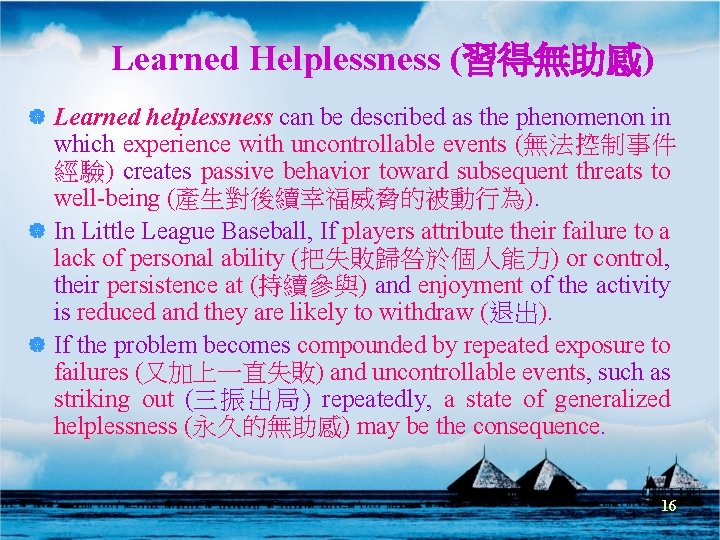
Learned Helplessness (習得無助感) | Learned helplessness can be described as the phenomenon in which experience with uncontrollable events (無法控制事件 經驗) creates passive behavior toward subsequent threats to well-being (產生對後續幸福威脅的被動行為). | In Little League Baseball, If players attribute their failure to a lack of personal ability (把失敗歸咎於個人能力) or control, their persistence at (持續參與) and enjoyment of the activity is reduced and they are likely to withdraw (退出). | If the problem becomes compounded by repeated exposure to failures (又加上一直失敗) and uncontrollable events, such as striking out (三振出局) repeatedly, a state of generalized helplessness (永久的無助感) may be the consequence. 16
Strategies to Learned Helplessness (對付習得無助的策略) | Iso-Ahola (1980) suggested that the most obvious solution to learned helplessness (對習得無助最明顯 的解決之道) would be to remove competition (去除 競爭) from leisure activities entirely. | The importance of the leisure activity in which failures are experienced can be minimized (失敗的重 要性應盡可能被忽略), and the importance of the leisure activity in which the individual is proficient can be emphasized (技術純熟的重要性應被強調) (Iso-Ahola & Mannell, 1985). 17
Self-efficacy (自我效能) | Self-efficacy is defined as a person or belief (信念) that she or he is capable of the specific behavior required to produce a desired outcome (產生所想要結 果所需要的相對應行為能力) in a given situation. | Self-efficacy judgments (自我效能的判斷) influence the degree of effort people expend and their persistence in the face of obstacles (影響面對障礙時 持續投入程度) or aversive experiences (不好的經驗 ). | Bandura suggests that perceptions of efficacy developed within one domain of people’s lives tend to generalize to other areas (從一個領域轉移至另一領 域). | This concept can be applied in therapeutic recreation (休閒遊憩治療 ). 18
The Need for a Sense of Freedom and Control (對自由和控制感覺的需要) | Generally, the need for a sense of freedom and control (自由和控制感的需求) is thought to be important or common to all people (基本而言是重要的). | However, researchers suggested that the need for freedom and control varies in strength among people as a result of socialization experience and personality ( 自由和控制感的需求因社會化和人格特質而不同). | Some people have a high need for control, whereas for others this need is much less important. 19
Intrinsic Motivation: The Need for Self. Determination, Competence, and Relatedness (自我決定、勝任能力和與人相關之需求) 20
The Nature of Intrinsic and Extrinsic Motivation (內在動機與外在動機的特質 ) | Deci (1975) theorized that people are often motivated to engage in activities because they want to demonstrate themselves that they are capable of effectively exercising control over their environments (參與活動是為展示他們有 能力控制環境). | The supremacy of extrinsic rewards for controlling behavior was challenged (外在獎賞 的優越性受質疑 ) by research with humans and animals. 21
The Danger of Rewards and Extrinsic Regulation in Leisure (休閒中犒賞和外在調節的危險性) | It is common for people to strive for external rewards. | When people are rewarded for listening to music, playing games or volunteering, their behavior can become over-justified (過度辨正), that is, they may begin to attribute their participation to extrinsic motive (將參與原因歸之於外在動機). | Research has suggested that such over-justification can be dangerous (過度辨正是危險的). 22
The Danger of Rewards and Extrinsic Regulation in Leisure (cont’) | The introduction of extrinsic rewards tend to undermine people’s experience of self-determination ( 摧 毀 自 我 決 定 之 經 驗 ) and induce a shift in perceived locus of causality (導致知覺成因源頭的 改變) from internal to external, and consequently their motivation from intrinsic to extrinsic (內在動機 變外在動機). | People come to construe their participation as due to receiving a reward (解釋其參與是為得獎賞) which reduces their interest in the activity (降低活動興趣). 23
The Danger of Rewards and Extrinsic Regulation in Leisure (cont’) | If an individual accepts money for a hobby or leisure activity (為興趣接受金錢), before he or she knows, what used to be “play” can come to feel like “work” (遊 戲將變成 作). | In general, settings that are experienced as autonomy supportive (自 主 支 持 ) (i. e. , encouraging selfdetermination and choice) have been shown to maintain or enhance intrinsic motivation (維持或促進內在動機). | However, social situations that are controlling (被社會 情境所控制) (i. e. , experienced as pressure to perform in specific way) have been found to undermine intrinsic motivation (摧毀內在動機). 24
The Danger of Rewards and Extrinsic Regulation in Leisure (cont’) | Situations where the motivation for participation is due to threats of punishment, obligations, evaluations, deadlines, and imposed goals (別人所設定的目標) can also undermine or reduce intrinsic motivation (摧毀或降低內在動機). | The broad set of factors that can create controlling conditions is called extrinsic regulation (外在調節). | The overjustification can have serious implications (嚴肅意 義 ) for how teachers (老 師 ) use rewards and extrinsic regulation of various types to improve study habits, business managers (經 理 ) use incentives to increase worker productivity, parents (父母) motivate their children, coaches encourage their players. 25
Self-Determination and Leisure in the Face of Extrinsic Regulation (自我決定與休閒面臨外在調節) | Is there no role for rewards in developing intrinsic motivation for participation in a leisure activity (獎賞是否對產生內在動機無 作用)? | If a person is not intrinsically motivated to start with (非 內 在 動 機 所 啟 動 ), then a reward cannot hurt because the behavior could not become over-justified. 26
Self-Determination and Leisure in the Face of Extrinsic Regulation (cont’) | If receiving a reward does not depend on participating in an activity (參與活動非因要得到 獎賞), then participation is likely to be seen as being under the individual’s own control and the reward perceived as a bonus (額外獎勵), rather than as a bribe (賄賂). | When the reward was seen as a bonus for participation, it had not interfered with the students’ feelings of self-determination and their intrinsic interest in the activity (不會干擾自我決 定和出自興趣的感覺). 27
Self-Determination and Leisure in the Face of Extrinsic Regulation (cont’) | Self-determination theory (自我決定論) suggests that being able to experience intrinsic interest (體驗 內在興趣) in externally controlled circumstances (被 外部情況所控制) involves internalization (內化) and integration (整合). | This process allows people to expand their sense of freedom (延伸自由感) and control over their social environments (控制社會情境) even in the face of potentially controlling factors (面臨潛在控制因素). 28
Self-Determination and Leisure in the Face of Extrinsic Regulation (cont’) | The process of internalization and integration (內化和 整合過程) is the means (方法) by which extrinsically motivated activities can become self-determined (外在 動機變為自我決定) and thus, like intrinsic motivation, provide the basis for highly satisfying leisure (提供高滿 意休閒基礎). | This perspective helps in understanding how people can find leisure in their work ( 作中發現休閒), and how activities that involve rewards, obligations and commitments (獎賞 、責任、承諾 ) can at times be experienced as leisure. 29
Self-Determination and Leisure in the Face of Extrinsic Regulation (cont’) | External regulation (外在調節) refers to behaviors that are controlled by factors clearly external to the individual (被 個 人 以 外 的 因 素 所 控 制 ), like the promise of a reward or the threat of punishment. | Introjected regulation (投射 調節) refers to activities that are motivated by internal pressures (內在壓力所 驅動) and describes a form of motivation in which actions are controlled or coerced by internal needs (行 動被內在需求所控制或威脅) other than competence, self-determination, or relatedness. 30
Introjected Regulation (投射調節 ) | It is introjected regulation that is operating when people participate because they feel they should (必須) or because they would feel guilty (罪惡感) if they did not. | For example, running during your free time (閒暇時間跑步) can be motivated by a form of introjected regulation. | People may not run out of a real and genuine interest (非出 於真正興趣而跑) (intrinsic motivation), but because they believe it is healthy to exercise (相信跑步對健康有益). They feel they should run, and they would feel guilty if they did not. 31
Integrated regulation (整合調節) | Integrated regulation is the most selfdetermined form of extrinsic motivation (外在 動機的極致自我決定形式) and results from the complete internalization and integration of extrinsic regulation (完全內化與外在調節的 整合). | The activity has become personally important and people are less likely to feel controlled by extrinsic rewards and regulation (比較不會感 覺被外在獎賞和調節所控制). 32
Integrated regulation (cont’) | With respect to running, such integrated regulation is different from that experienced by people who participate because they feel that they should exercise for health reasons (introjected regulation) or because their friends are pressuring them to do so (external regulation). | The runners also feel that their participation is highly self-determined (高度自我決定). 33
An Example | When Mannell et al. (1988) examined the differences in the types of activities (using ESM) that are classified as extrinsically and intrinsically motivated (以 內 外 動 機 分 類 ), they found some interesting differences. | Pure-job activities produced as many flow experiences (一 樣 多 的 流 暢 體 驗 ) as pure leisure. | Leisure-job activities were experienced as flow significantly more frequently than (流暢 體驗顯著多於) pure leisure activities. 34
An Example (cont’) | The pure leisure of the older adults (老年人) more frequently consisted of passive leisure activities (多 從 事 被 動 式 休 閒 ), such as relaxing, reading, watching TV, and listening to music. | Leisure-job activities were frequently more demanding activities (多付出心力的休閒 活動) such as hobbies, volunteering, caring and playing with grandchildren, and exercise. 35
An Example (cont’) | It appears that when the older adults internalized and integrated extrinsic regulation (內化和整合外 在調節) of their activities, as with the leisure-job activities, they were more likely to experience flow and enjoyment (更能體驗流暢感). | They felt self-determined (perceived freedom of choice) and yet their sense of obligation and commitment (承諾和責任感) “push (鞭策)” them into activities that were more challenging (挑戰) and demanding (付出心力) of their skills than the ones they often chose for pure leisure. 36
Fostering Freedom of Choice and Intrinsic Motivation in Leisure (促進休閒的選擇自由與內在動機) | Generally, feelings of self-determination need to be fostered by providing opportunities for choice and control. | Using rewards with care (小 心 使 用 獎 賞 ) to avoid perceptions of control and bribery. | Involving the children in the decision-making process (參 與小孩的決策過程), taking their perspective and showing care for them, not just their behavior. | Encouraging the internalization and integration of extrinsic regulation (鼓勵外在調節內化與整合) when it is part of the setting. | All the above factors contribute to the creation of an autonomy supportive environment (自主支持情境之建 立). 37
Fostering Freedom of Choice and Intrinsic Motivation in Leisure (cont’) | Leisure is an experience that is facilitated by autonomy supportive conditions (因自主支 持情況而提升) that enhance the sense of selfdetermination, competence, and relatedness ( 增強自我決定、能力感、人際關係). | Leisure can also be viewed as an autonomy supportive context itself (自主支持情境之本 身). This is the essence of leisure’s power and attraction (休閒的能力與魅力之本質). 38
The End. . . Thank You! 39
40
41
42