
Chapter 5 PeertoPeer Protocols and Data Link Layer
- Slides: 66
Chapter 5 Peer-to-Peer Protocols and Data Link Layer PART I: Peer-to-Peer Protocols and Service Models ARQ Protocols and Reliable Data Transfer Flow Control Timing Recovery TCP Reliable Stream Service & Flow Control
Chapter 5 Peer-to-Peer Protocols and Data Link Layer PART II: Data Link Controls Framing Point-to-Point Protocol High-Level Data Link Control Link Sharing Using Statistical Multiplexing
Chapter Overview Peer-to-Peer protocols: many protocols involve the interaction between two peers Service Models are discussed & examples given Detailed discussion of ARQ provides example of development of peer-to-peer protocols Flow control, TCP reliable stream, and timing recovery Data Link Layer Framing PPP & HDLC protocols Statistical multiplexing for link sharing
Chapter 5 Peer-to-Peer Protocols and Data Link Layer Peer-to-Peer Protocols and Service Models
Peer-to-Peer Protocols In order for data to travel from the source to the destination, each layer of the OSI model at the source must communicate with its peer layer at the destination. This form of communication is referred to as peer-to-peer communications/protocols During this process, the protocols of each layer exchange information, called protocol data units (PDUs).
Peer-to-Peer Protocols Data packets on a network originate at a source and then travel to a destination. Each layer depends on the service function of the OSI layer below it. To provide this service, the lower layer uses encapsulation to put the PDU from the upper layer into its data field. Then it adds whatever headers and trailers the layer needs to perform its function.
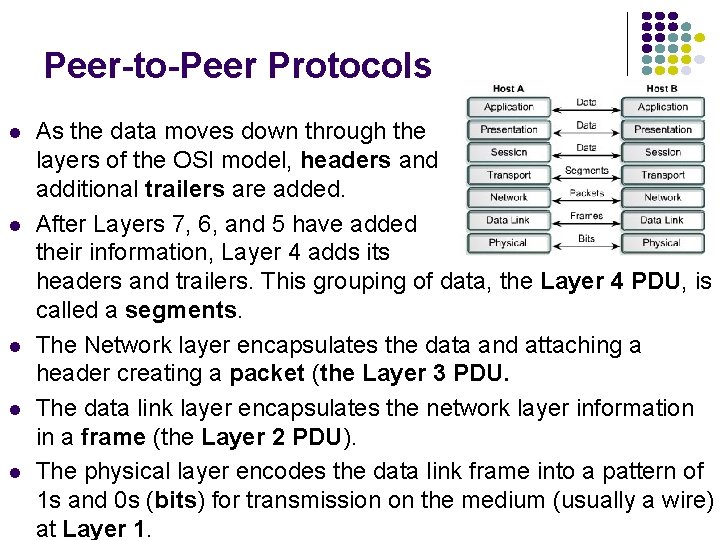
Peer-to-Peer Protocols As the data moves down through the layers of the OSI model, headers and additional trailers are added. After Layers 7, 6, and 5 have added their information, Layer 4 adds its headers and trailers. This grouping of data, the Layer 4 PDU, is called a segments. The Network layer encapsulates the data and attaching a header creating a packet (the Layer 3 PDU. The data link layer encapsulates the network layer information in a frame (the Layer 2 PDU). The physical layer encodes the data link frame into a pattern of 1 s and 0 s (bits) for transmission on the medium (usually a wire) at Layer 1.
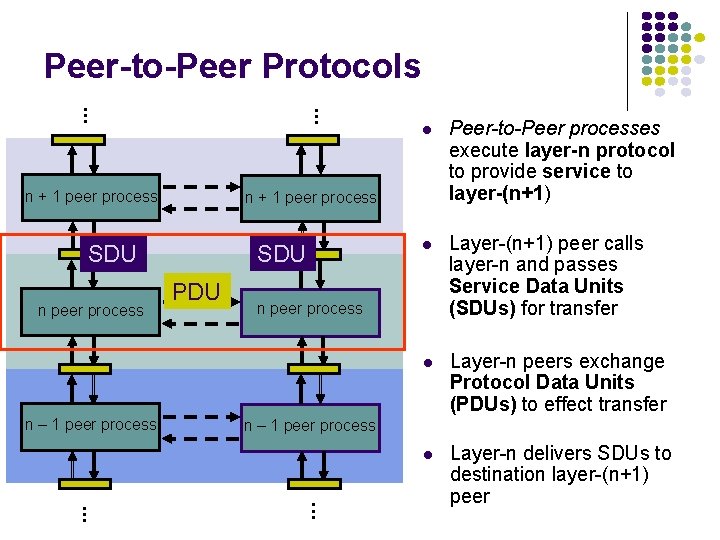
Peer-to-Peer Protocols n + 1 peer process SDU PDU Layer-(n+1) peer calls layer-n and passes Service Data Units (SDUs) for transfer Layer-n peers exchange Protocol Data Units (PDUs) to effect transfer Layer-n delivers SDUs to destination layer-(n+1) peer n peer process n – 1 peer process n – 1 peer process Peer-to-Peer processes execute layer-n protocol to provide service to layer-(n+1) n + 1 peer process SDU n peer process
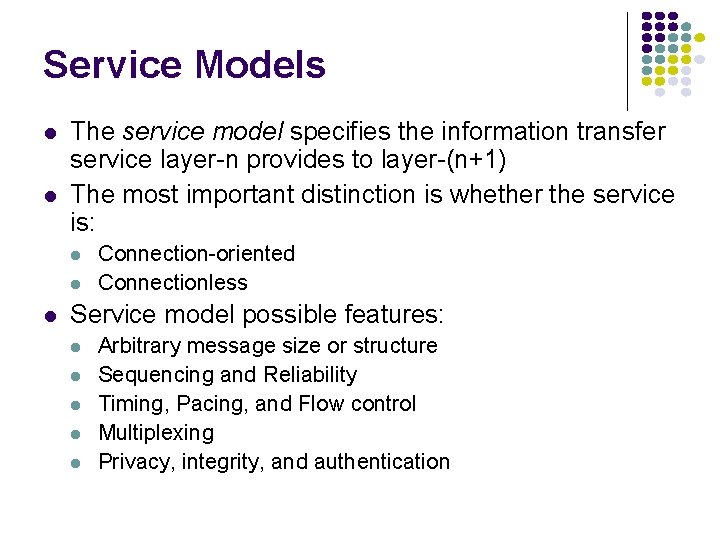
Service Models The service model specifies the information transfer service layer-n provides to layer-(n+1) The most important distinction is whether the service is: Connection-oriented Connectionless Service model possible features: Arbitrary message size or structure Sequencing and Reliability Timing, Pacing, and Flow control Multiplexing Privacy, integrity, and authentication
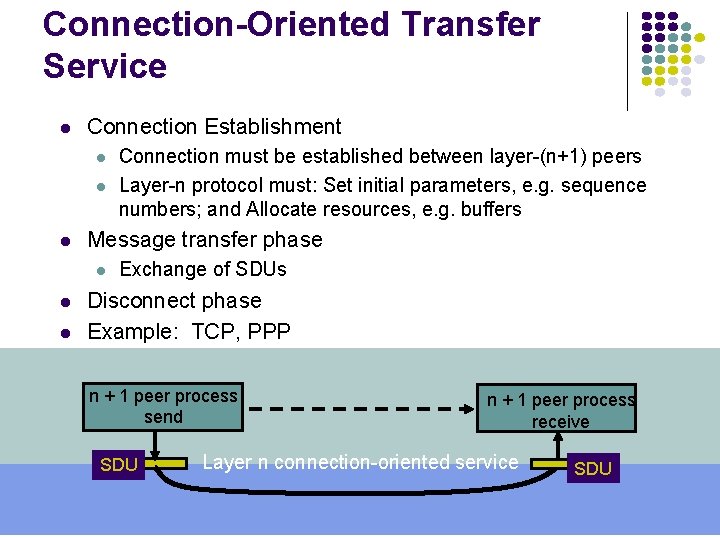
Connection-Oriented Transfer Service Connection Establishment Message transfer phase Connection must be established between layer-(n+1) peers Layer-n protocol must: Set initial parameters, e. g. sequence numbers; and Allocate resources, e. g. buffers Exchange of SDUs Disconnect phase Example: TCP, PPP n + 1 peer process send SDU n + 1 peer process receive Layer n connection-oriented service SDU
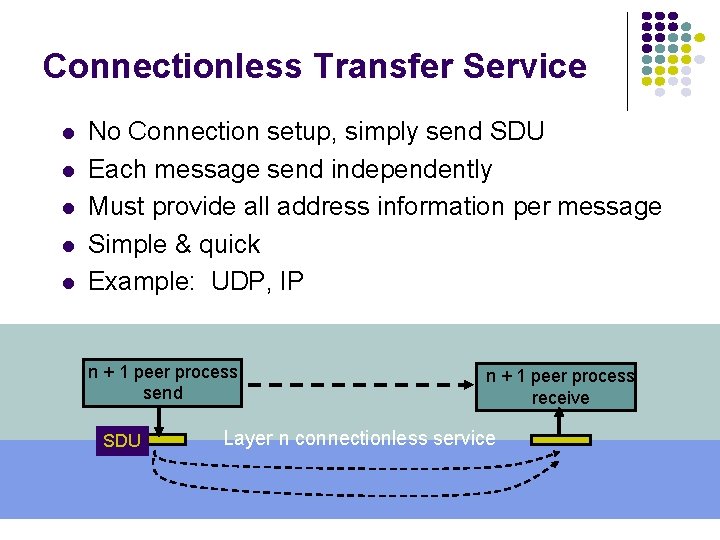
Connectionless Transfer Service No Connection setup, simply send SDU Each message send independently Must provide all address information per message Simple & quick Example: UDP, IP n + 1 peer process send SDU n + 1 peer process receive Layer n connectionless service
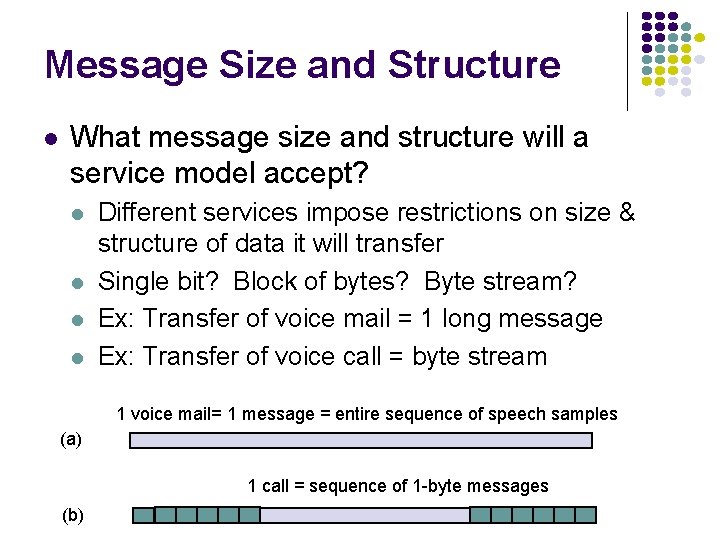
Message Size and Structure What message size and structure will a service model accept? Different services impose restrictions on size & structure of data it will transfer Single bit? Block of bytes? Byte stream? Ex: Transfer of voice mail = 1 long message Ex: Transfer of voice call = byte stream 1 voice mail= 1 message = entire sequence of speech samples (a) 1 call = sequence of 1 -byte messages (b)
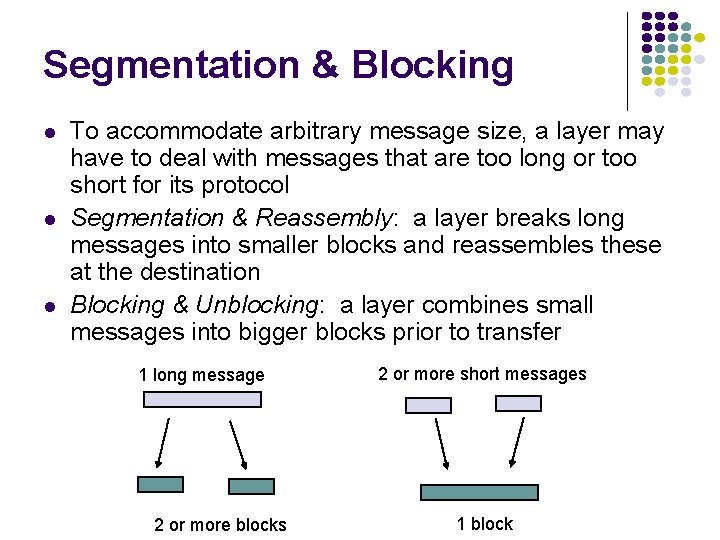
Segmentation & Blocking To accommodate arbitrary message size, a layer may have to deal with messages that are too long or too short for its protocol Segmentation & Reassembly: a layer breaks long messages into smaller blocks and reassembles these at the destination Blocking & Unblocking: a layer combines small messages into bigger blocks prior to transfer 1 long message 2 or more blocks 2 or more short messages 1 block
Reliability & Sequencing Reliability: Are messages or information stream delivered error-free and without loss or duplication? Sequencing: Are messages or information stream delivered in order? ARQ protocols combine error detection, retransmission, and sequence numbering to provide reliability & sequencing Examples: TCP and HDLC
Pacing and Flow Control Messages can be lost if receiving system does not have sufficient buffering to store arriving messages If destination layer-(n+1) does not retrieve its information fast enough, destination layer-n buffers may overflow Pacing & Flow Control provide backpressure mechanisms that control transfer according to availability of buffers at the destination Examples: TCP and HDLC
Timing Applications involving voice and video generate units of information that are related temporally Destination application must reconstruct temporal relation in voice/video units Network transfer introduces delay & jitter Timing Recovery protocols use timestamps & sequence numbering to control the delay & jitter in delivered information Examples: RTP & associated protocols in Voice over IP
Multiplexing Multiplexing enables multiple layer-(n+1) users to share a layer-n service A multiplexing tag is required to identify specific users at the destination Examples: UDP, IP
Privacy, Integrity, & Authentication Privacy: ensuring that information transferred cannot be read by others Integrity: ensuring that information is not altered during transfer Authentication: verifying that sender and/or receiver are who they claim to be Security protocols provide these services and are discussed in Chapter 11 Examples: IPSec, SSL
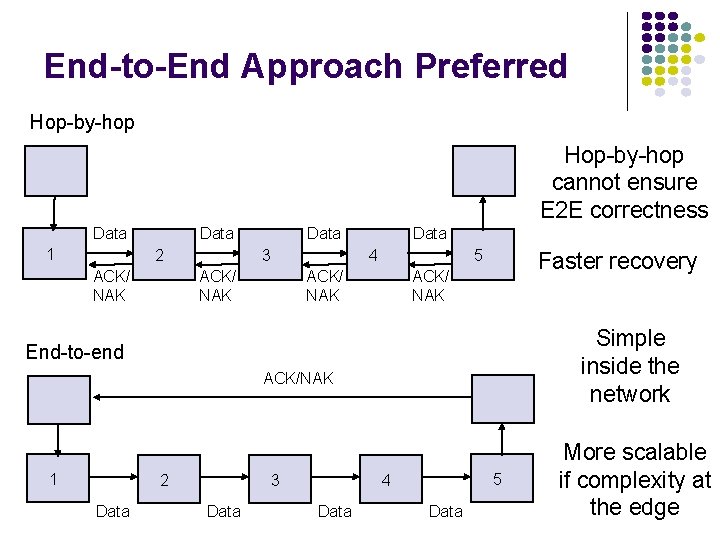
End-to-End vs. Hop-by-Hop A service feature can be provided by implementing a protocol Example: end-to-end across the network across every hop in the network Perform error control at every hop in the network or only between the source and destination? Perform flow control between every hop in the network or only between source & destination? We next consider the tradeoffs between the two approaches
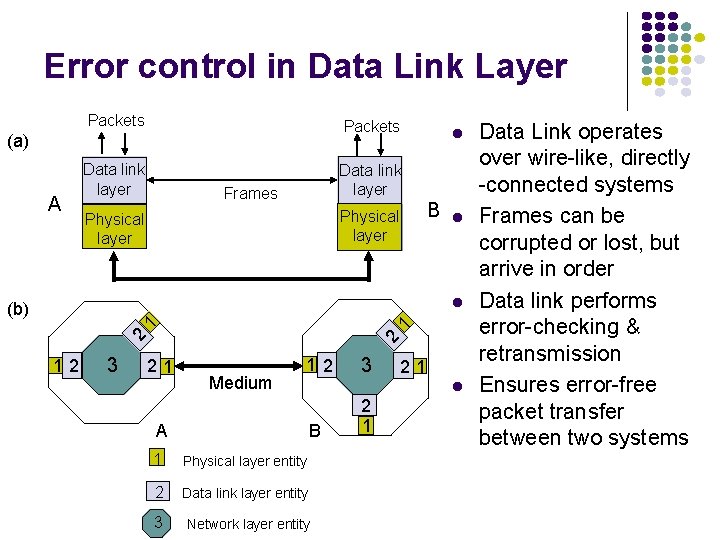
Error control in Data Link Layer Packets Data link layer (a) A Frames B Physical layer 12 3 2 2 1 1 (b) 21 Medium 12 21 B A 3 1 Physical layer entity 2 Data link layer entity 3 Network layer entity 2 1 Data Link operates over wire-like, directly -connected systems Frames can be corrupted or lost, but arrive in order Data link performs error-checking & retransmission Ensures error-free packet transfer between two systems
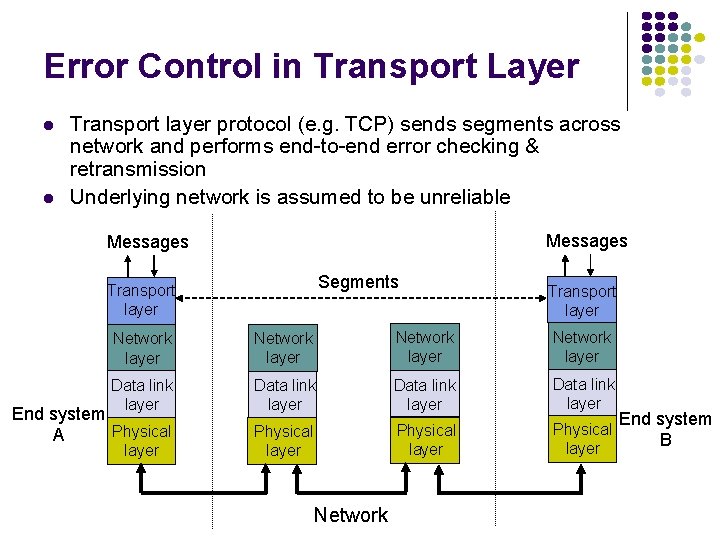
Error Control in Transport Layer Transport layer protocol (e. g. TCP) sends segments across network and performs end-to-end error checking & retransmission Underlying network is assumed to be unreliable Messages Segments Transport layer Network layer Data link layer Physical layer End system Physical A Network End system B
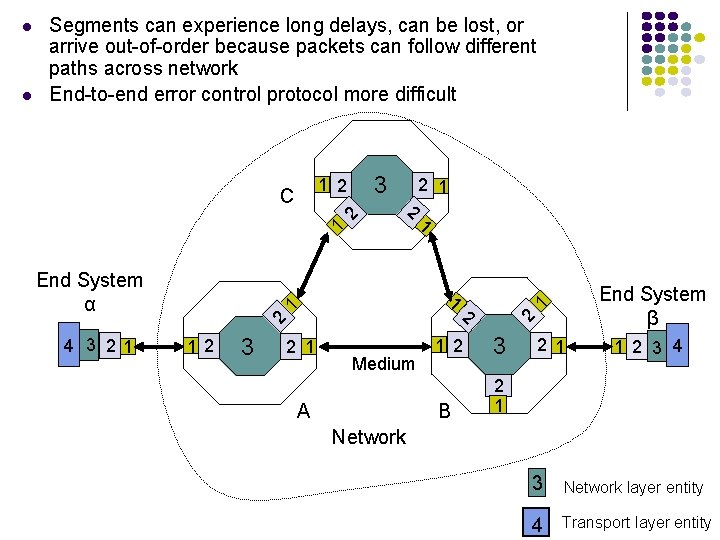
3 End System α 1 1 4 3 21 12 3 2 1 Medium A 2 End System β 1 2 2 1 2 C 1 Segments can experience long delays, can be lost, or arrive out-of-order because packets can follow different paths across network End-to-end error control protocol more difficult 2 1 2 3 B 2 1 1 2 3 4 Network 3 Network layer entity 4 Transport layer entity
End-to-End Approach Preferred Hop-by-hop cannot ensure E 2 E correctness Data 1 Data 2 ACK/ NAK Data 3 Data 4 ACK/ NAK 5 ACK/ NAK Faster recovery ACK/ NAK Simple inside the network End-to-end ACK/NAK 1 2 Data 3 Data 5 4 Data More scalable if complexity at the edge
Chapter 5 Peer-to-Peer Protocols and Data Link Layer ARQ Protocols and Reliable Data Transfer
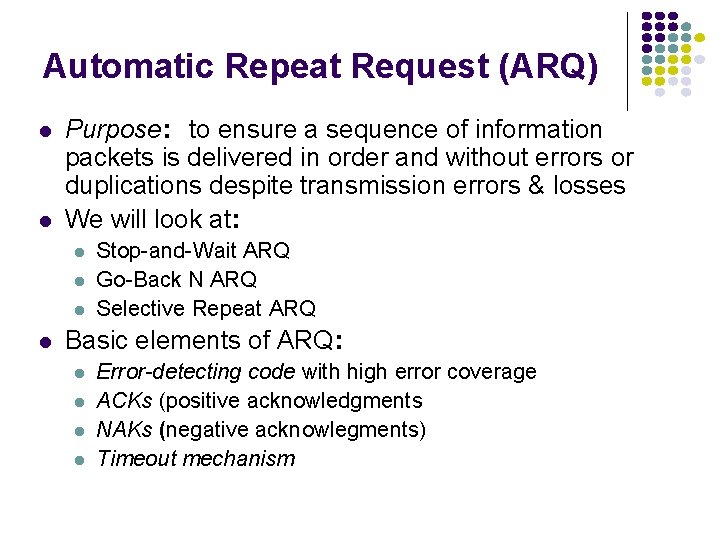
Automatic Repeat Request (ARQ) Purpose: to ensure a sequence of information packets is delivered in order and without errors or duplications despite transmission errors & losses We will look at: Stop-and-Wait ARQ Go-Back N ARQ Selective Repeat ARQ Basic elements of ARQ: Error-detecting code with high error coverage ACKs (positive acknowledgments NAKs (negative acknowlegments) Timeout mechanism
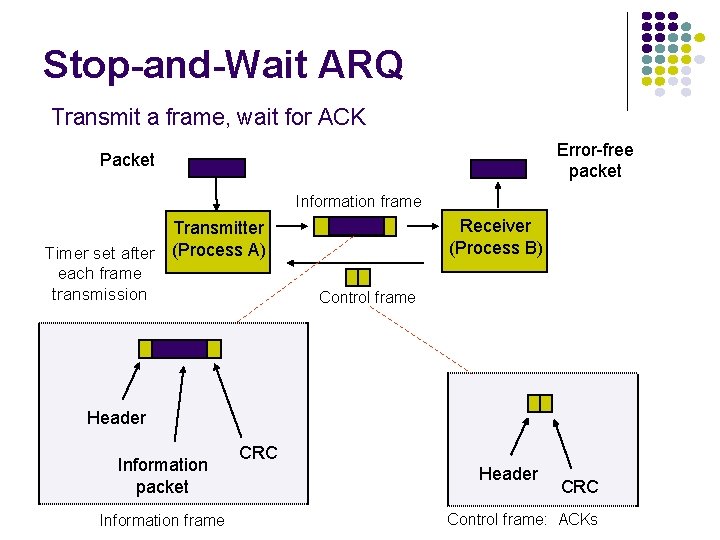
Stop-and-Wait ARQ Transmit a frame, wait for ACK Error-free packet Packet Information frame Receiver (Process B) Transmitter Timer set after (Process A) each frame transmission Control frame Header Information packet Information frame CRC Header CRC Control frame: ACKs
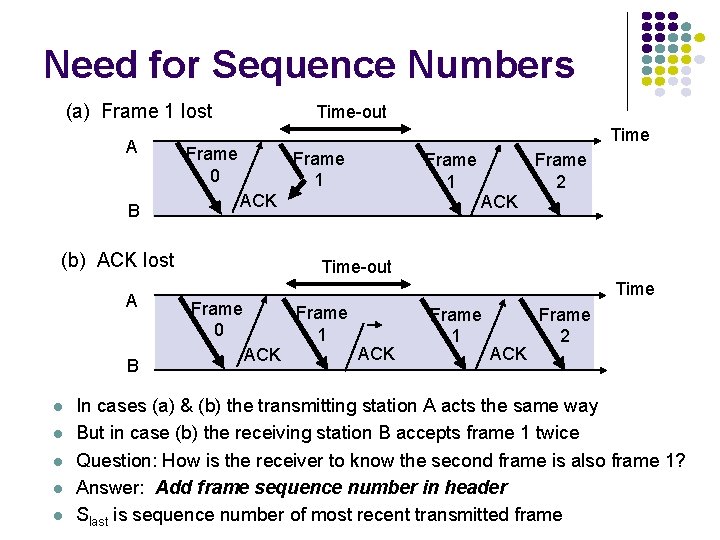
Need for Sequence Numbers (a) Frame 1 lost A B (b) ACK lost A B Time-out Frame 0 1 ACK Time Frame 1 Frame 2 ACK Time-out Frame 0 1 ACK Time Frame 1 ACK Frame 2 In cases (a) & (b) the transmitting station A acts the same way But in case (b) the receiving station B accepts frame 1 twice Question: How is the receiver to know the second frame is also frame 1? Answer: Add frame sequence number in header Slast is sequence number of most recent transmitted frame
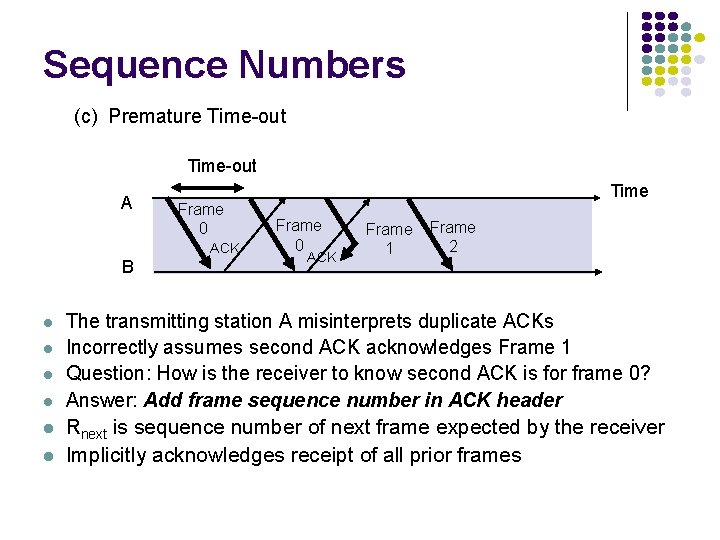
Sequence Numbers (c) Premature Time-out A Frame 0 ACK B Time Frame 0 ACK Frame 1 Frame 2 The transmitting station A misinterprets duplicate ACKs Incorrectly assumes second ACK acknowledges Frame 1 Question: How is the receiver to know second ACK is for frame 0? Answer: Add frame sequence number in ACK header Rnext is sequence number of next frame expected by the receiver Implicitly acknowledges receipt of all prior frames
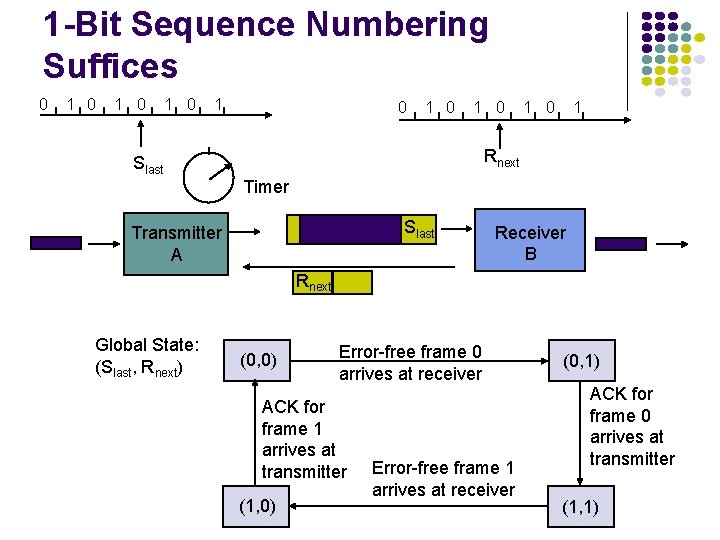
1 -Bit Sequence Numbering Suffices 0 1 0 1 Rnext Slast Timer Slast Transmitter A Receiver B Rnext Global State: (Slast, Rnext) (0, 0) Error-free frame 0 arrives at receiver ACK for frame 1 arrives at transmitter (1, 0) Error-free frame 1 arrives at receiver (0, 1) ACK for frame 0 arrives at transmitter (1, 1)
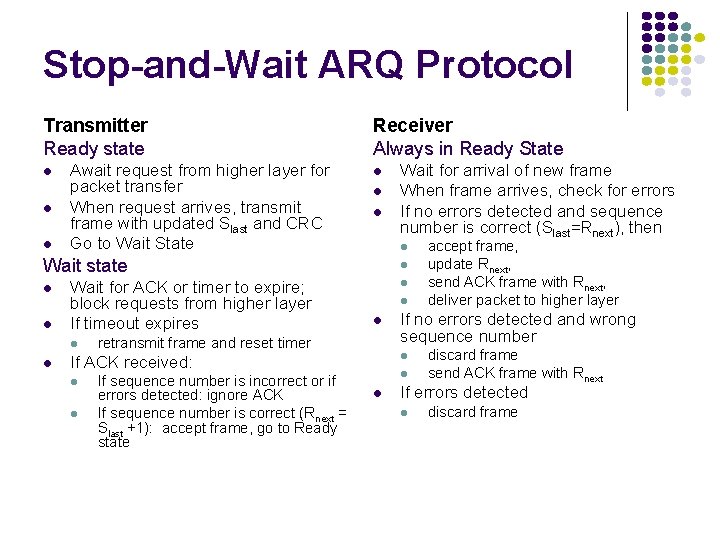
Stop-and-Wait ARQ Protocol Transmitter Ready state Await request from higher layer for packet transfer When request arrives, transmit frame with updated Slast and CRC Go to Wait State Receiver Always in Ready State Wait state Wait for ACK or timer to expire; block requests from higher layer If timeout expires retransmit frame and reset timer If sequence number is incorrect or if errors detected: ignore ACK If sequence number is correct (Rnext = Slast +1): accept frame, go to Ready state accept frame, update Rnext, send ACK frame with Rnext, deliver packet to higher layer If no errors detected and wrong sequence number If ACK received: Wait for arrival of new frame When frame arrives, check for errors If no errors detected and sequence number is correct (Slast=Rnext), then discard frame send ACK frame with Rnext If errors detected discard frame
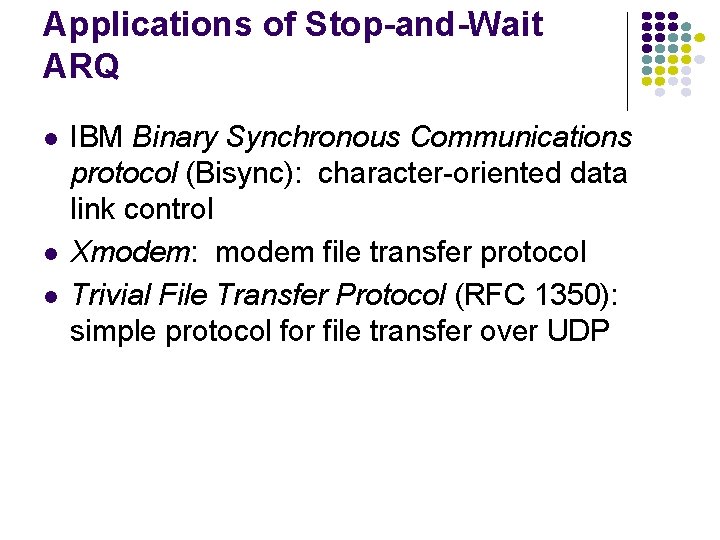
Applications of Stop-and-Wait ARQ IBM Binary Synchronous Communications protocol (Bisync): character-oriented data link control Xmodem: modem file transfer protocol Trivial File Transfer Protocol (RFC 1350): simple protocol for file transfer over UDP
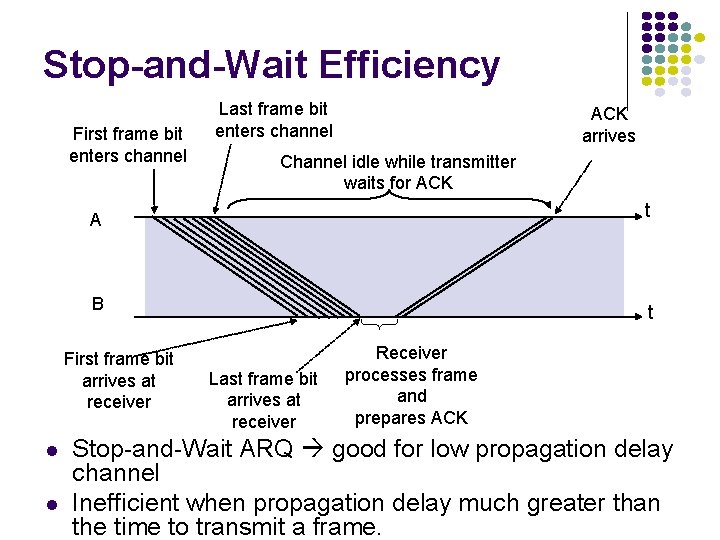
Stop-and-Wait Efficiency First frame bit enters channel Last frame bit enters channel ACK arrives Channel idle while transmitter waits for ACK t A B First frame bit arrives at receiver t Last frame bit arrives at receiver Receiver processes frame and prepares ACK Stop-and-Wait ARQ good for low propagation delay channel Inefficient when propagation delay much greater than the time to transmit a frame.
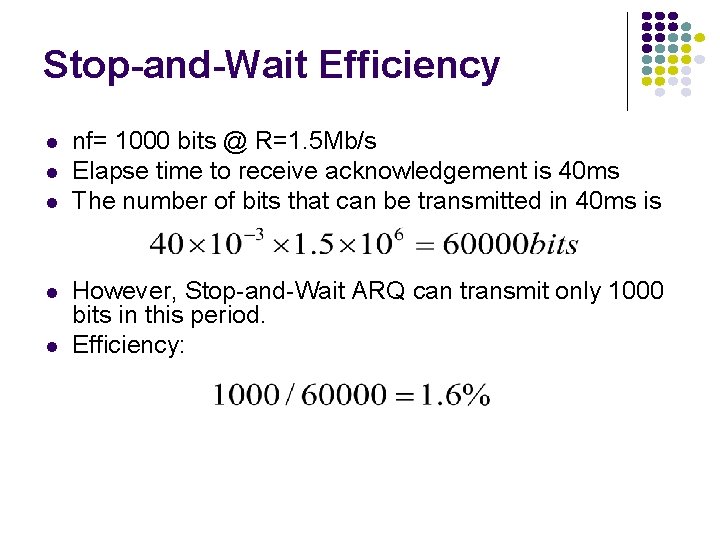
Stop-and-Wait Efficiency nf= 1000 bits @ R=1. 5 Mb/s Elapse time to receive acknowledgement is 40 ms The number of bits that can be transmitted in 40 ms is However, Stop-and-Wait ARQ can transmit only 1000 bits in this period. Efficiency:
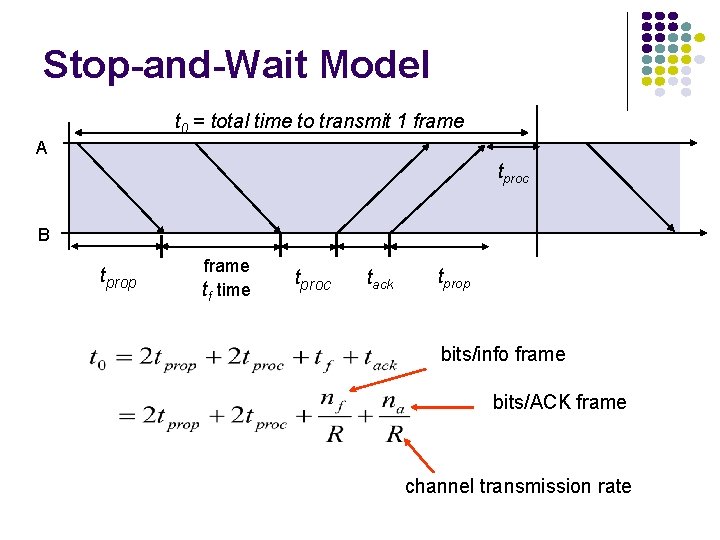
Stop-and-Wait Model t 0 = total time to transmit 1 frame A tproc B tprop frame tf time tproc tack tprop bits/info frame bits/ACK frame channel transmission rate
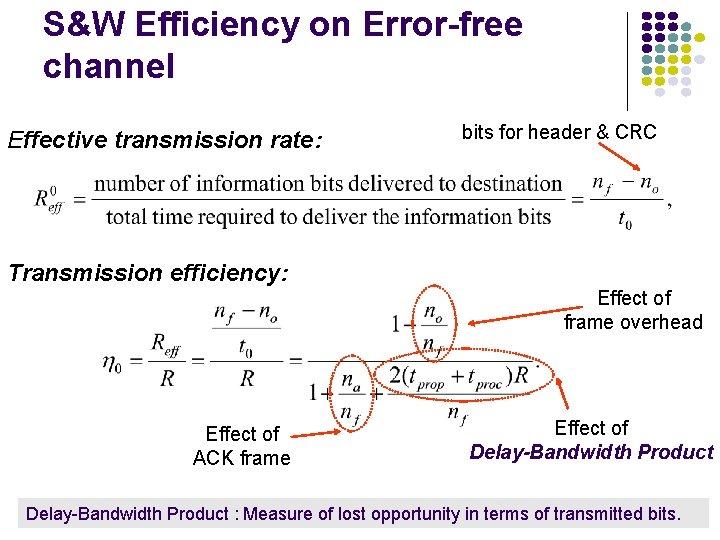
S&W Efficiency on Error-free channel Effective transmission rate: bits for header & CRC Transmission efficiency: Effect of frame overhead Effect of ACK frame Effect of Delay-Bandwidth Product : Measure of lost opportunity in terms of transmitted bits.
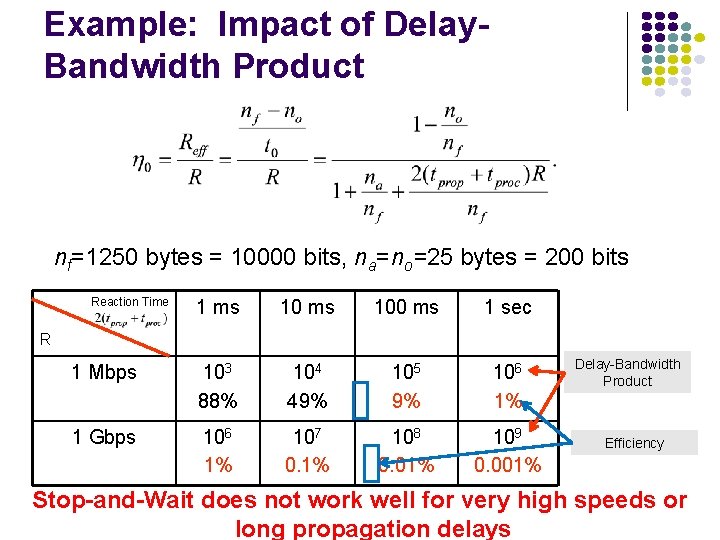
Example: Impact of Delay. Bandwidth Product nf=1250 bytes = 10000 bits, na=no=25 bytes = 200 bits Reaction Time 1 ms 100 ms 1 sec 1 Mbps 103 88% 104 49% 105 9% 106 1% 1 Gbps 106 1% 107 0. 1% 108 0. 01% 109 0. 001% R Delay-Bandwidth Product Efficiency Stop-and-Wait does not work well for very high speeds or long propagation delays
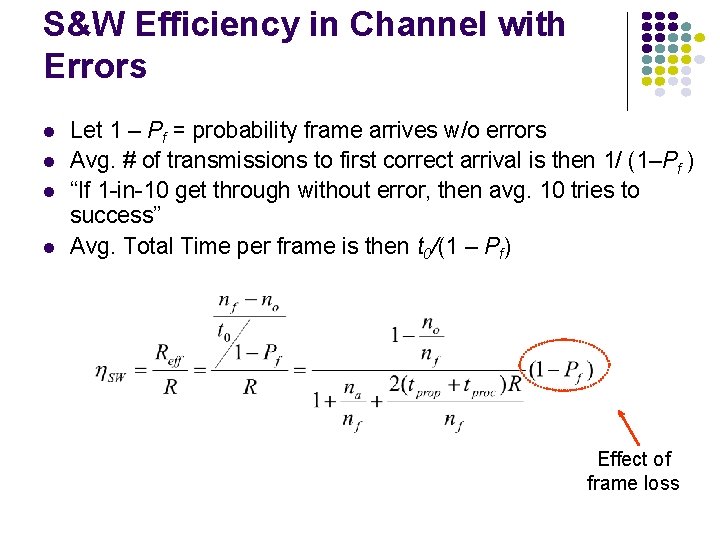
S&W Efficiency in Channel with Errors Let 1 – Pf = probability frame arrives w/o errors Avg. # of transmissions to first correct arrival is then 1/ (1–Pf ) “If 1 -in-10 get through without error, then avg. 10 tries to success” Avg. Total Time per frame is then t 0/(1 – Pf) Effect of frame loss
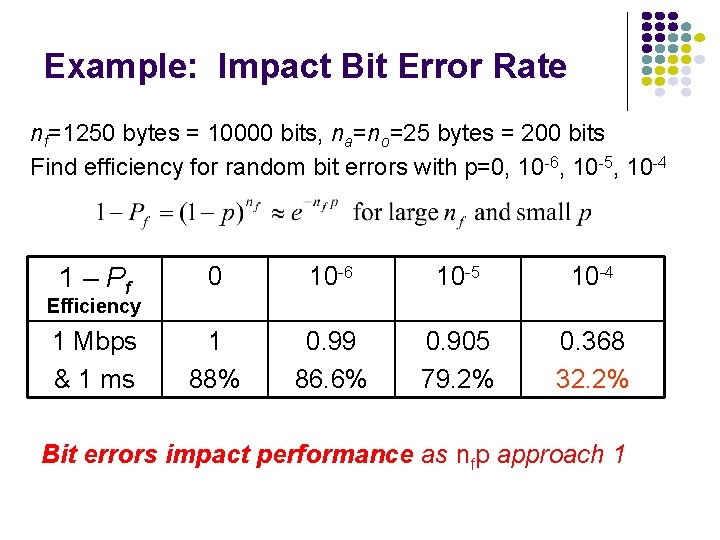
Example: Impact Bit Error Rate nf=1250 bytes = 10000 bits, na=no=25 bytes = 200 bits Find efficiency for random bit errors with p=0, 10 -6, 10 -5, 10 -4 1 – Pf 0 10 -6 10 -5 10 -4 1 Mbps & 1 ms 1 88% 0. 99 86. 6% 0. 905 79. 2% 0. 368 32. 2% Efficiency Bit errors impact performance as nfp approach 1
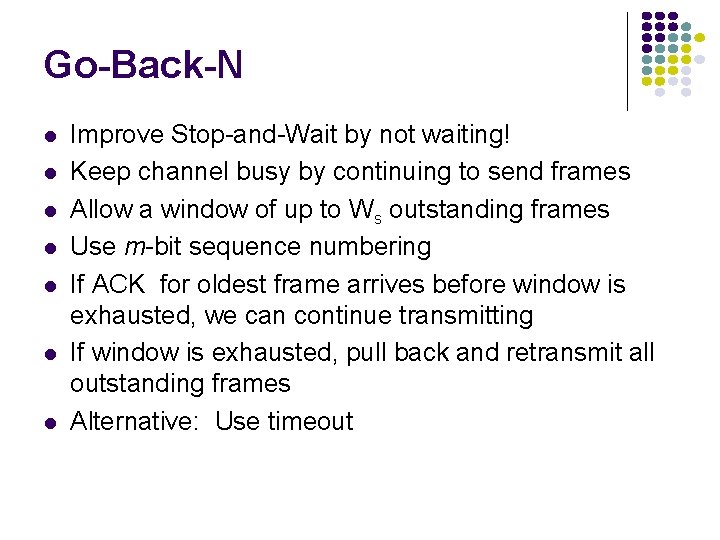
Go-Back-N Improve Stop-and-Wait by not waiting! Keep channel busy by continuing to send frames Allow a window of up to Ws outstanding frames Use m-bit sequence numbering If ACK for oldest frame arrives before window is exhausted, we can continue transmitting If window is exhausted, pull back and retransmit all outstanding frames Alternative: Use timeout
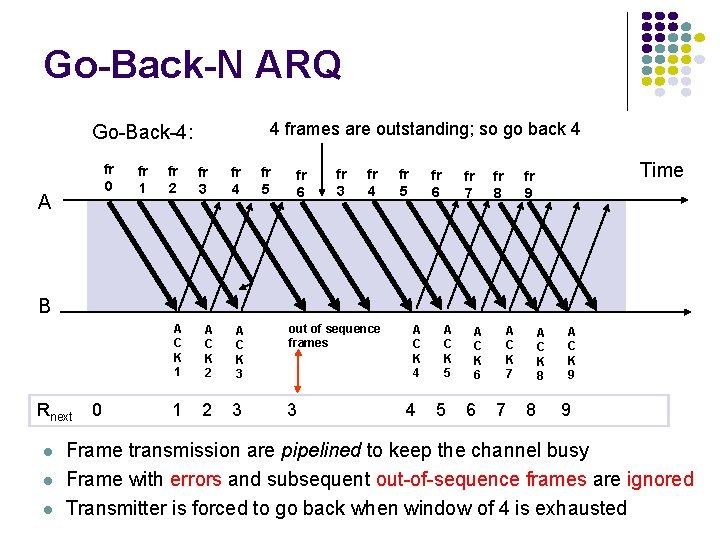
Go-Back-N ARQ 4 frames are outstanding; so go back 4 Go-Back-4: A fr 0 fr 1 fr 2 fr 3 fr 4 fr 5 fr 6 fr 7 fr 8 Time fr 9 B A C K 1 A C K 2 A C K 3 out of sequence frames A C K 4 A C K 5 A C K 6 A C K 7 A C K 8 A C K 9 Rnext 0 1 2 3 4 5 6 7 8 9 Frame transmission are pipelined to keep the channel busy Frame with errors and subsequent out-of-sequence frames are ignored Transmitter is forced to go back when window of 4 is exhausted
Window size long enough to cover round trip time Stop-and-Wait ARQ A A C K 1 Receiver is looking for Rnext=0 Four frames are outstanding; so go back 4 Go-Back-N ARQ B Time fr 1 fr 0 B A Time-out expires fr 0 fr 1 fr 2 fr 3 fr 0 fr 1 Receiver is Out-oflooking for sequence Rnext=0 frames fr 2 A C K 1 fr 3 A C K 2 fr fr 4 5 A C K 3 A C K 4 fr 6 A C K 5 Time A C K 6
Go-Back-N with Timeout Problem with Go-Back-N as presented: If frame is lost and source does not have frame to send, then window will not be exhausted and recovery will not commence Use a timeout with each frame When timeout expires, resend all outstanding frames
Go-Back-N Transmitter & Receiver Transmitter Send Window. . . Frames transmitted S last and ACKed Srecent Buffers Timer Slast+1 Receive Window Slast+Ws-1 oldest un. ACKed frame . . . Timer Srecent most recent transmission . . . Slast+Ws-1 max Seq # allowed Frames received Rnext Receiver will only accept a frame that is error-free and that has sequence number Rnext When such frame arrives Rnext is incremented by one, so the receive window slides forward by one
Sliding Window Operation Transmitter Send Window. . . Frames transmitted S last and ACKed Srecent Slast+Ws-1 Transmitter waits for error-free ACK frame with sequence number Slast When such ACK frame arrives, Slast is incremented by one, and the send window slides forward by one m-bit Sequence Numbering 2 m – 1 0 1 2 Slast send i window i + 1 i + Ws – 1
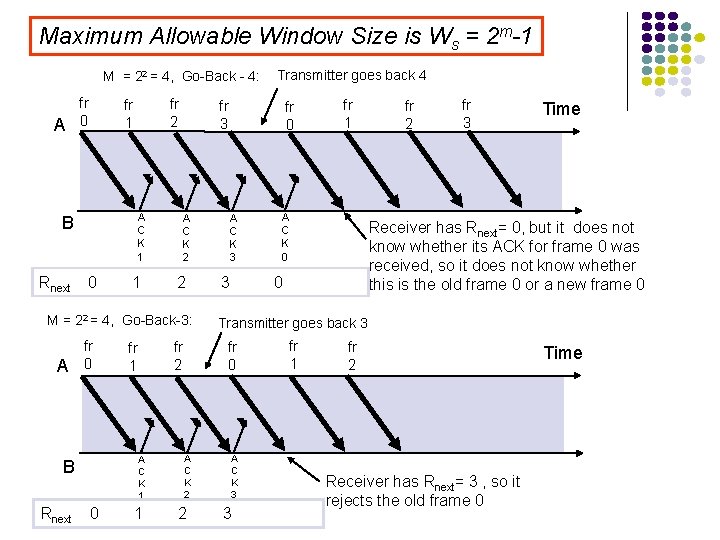
Maximum Allowable Window Size is Ws = 2 m-1 M = 22 = 4, Go-Back - 4: A fr 0 fr 2 fr 1 A C K 1 B Transmitter goes back 4 fr 3 A C K 2 fr 0 A C K 3 fr 1 A C K 0 A B fr 0 A C K 1 A C K 2 Time Transmitter goes back 3 fr 0 fr 2 fr 1 fr 3 Receiver has Rnext= 0, but it does not know whether its ACK for frame 0 was received, so it does not know whether this is the old frame 0 or a new frame 0 Rnext 0 1 2 3 0 M = 22 = 4, Go-Back-3: fr 2 A C K 3 Rnext 0 1 2 3 fr 1 fr 2 Receiver has Rnext= 3 , so it rejects the old frame 0 Time
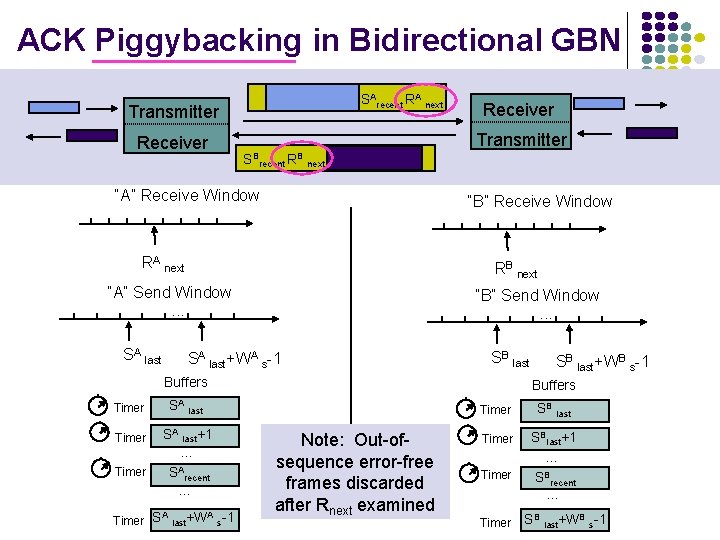
ACK Piggybacking in Bidirectional GBN SArecent RA next Transmitter Receiver Transmitter SBrecent RB next “A” Receive Window “B” Receive Window RA next RB next “A” Send Window. . . SA last Receiver “B” Send Window. . . SA last+WA s-1 SB last Buffers Timer SA last+1. . . SArecent. . . Timer A A Timer S last+W s-1 SB last+WB s-1 Buffers Note: Out-ofsequence error-free frames discarded after Rnext examined Timer SB last Timer SBlast+1. . . SBrecent. . . Timer SB last+WB s-1
Applications of Go-Back-N ARQ HDLC (High-Level Data Link Control): bitoriented data link control V. 42 modem: error control over telephone modem links
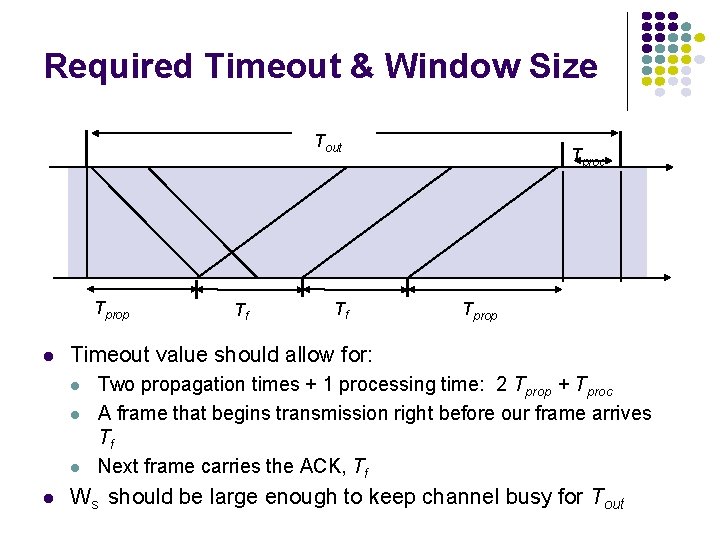
Required Timeout & Window Size Tout Tprop Tf Tprop Timeout value should allow for: Tf Tproc Two propagation times + 1 processing time: 2 Tprop + Tproc A frame that begins transmission right before our frame arrives Tf Next frame carries the ACK, Tf Ws should be large enough to keep channel busy for Tout
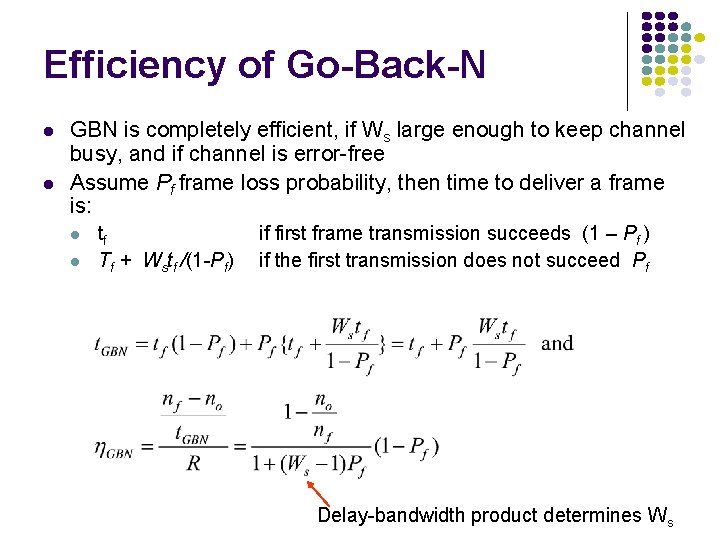
Efficiency of Go-Back-N GBN is completely efficient, if Ws large enough to keep channel busy, and if channel is error-free Assume Pf frame loss probability, then time to deliver a frame is: tf if first frame transmission succeeds (1 – Pf ) Tf + Wstf /(1 -Pf) if the first transmission does not succeed Pf Delay-bandwidth product determines Ws
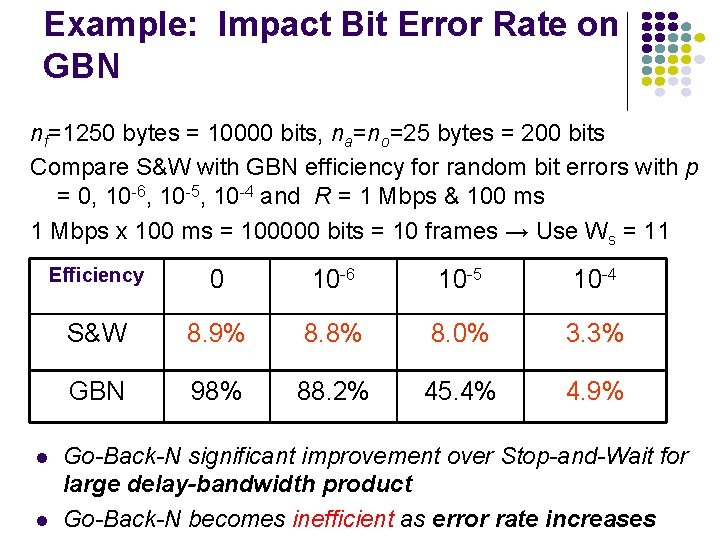
Example: Impact Bit Error Rate on GBN nf=1250 bytes = 10000 bits, na=no=25 bytes = 200 bits Compare S&W with GBN efficiency for random bit errors with p = 0, 10 -6, 10 -5, 10 -4 and R = 1 Mbps & 100 ms 1 Mbps x 100 ms = 100000 bits = 10 frames → Use Ws = 11 Efficiency 0 10 -6 10 -5 10 -4 S&W 8. 9% 8. 8% 8. 0% 3. 3% GBN 98% 88. 2% 45. 4% 4. 9% Go-Back-N significant improvement over Stop-and-Wait for large delay-bandwidth product Go-Back-N becomes inefficient as error rate increases
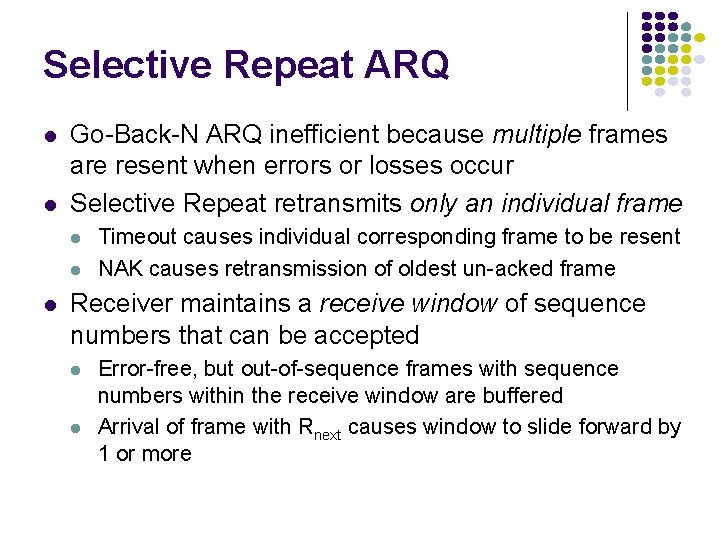
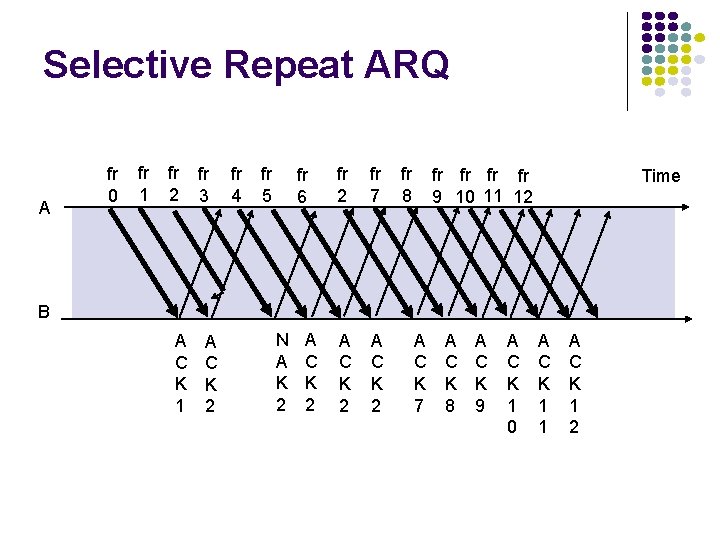
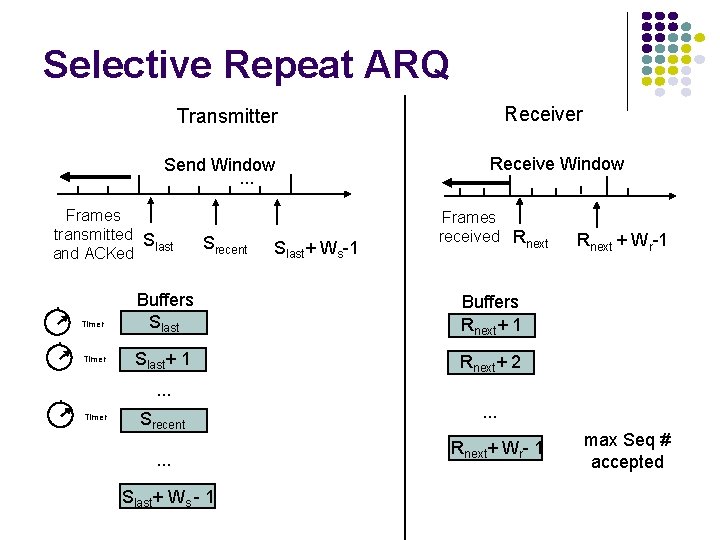
Selective Repeat ARQ Go-Back-N ARQ inefficient because multiple frames are resent when errors or losses occur Selective Repeat retransmits only an individual frame Timeout causes individual corresponding frame to be resent NAK causes retransmission of oldest un-acked frame Receiver maintains a receive window of sequence numbers that can be accepted Error-free, but out-of-sequence frames with sequence numbers within the receive window are buffered Arrival of frame with Rnext causes window to slide forward by 1 or more
Selective Repeat ARQ A fr 0 fr 1 fr 2 fr 3 fr 4 fr 5 fr 6 fr 2 fr 7 A C K 2 fr 8 fr fr 9 10 11 12 Time B A C K 1 A C K 2 N A K 2 A C K 7 A C K 8 A C K 9 A C K 1 0 A C K 1 1 A C K 1 2
Selective Repeat ARQ Receiver Transmitter Send Window. . . Frames transmitted S last and ACKed Timer Srecent Slast+ Ws-1 Receive Window Frames received Rnext Buffers Slast Buffers Rnext+ 1 Slast+ 1 Rnext+ 2 Rnext + Wr-1 . . . Timer Srecent. . . Slast+ Ws - 1 . . . Rnext+ Wr- 1 max Seq # accepted
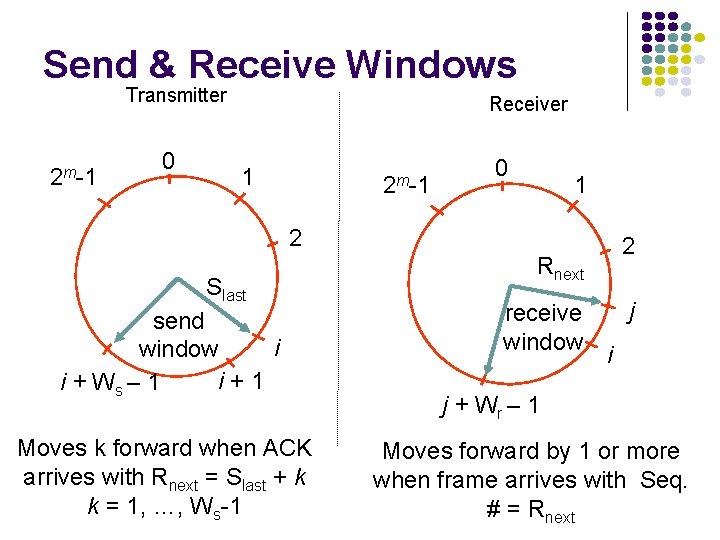
Send & Receive Windows Transmitter 2 m-1 0 Receiver 1 2 m-1 0 1 2 Slast send i window i + 1 i + Ws – 1 Moves k forward when ACK arrives with Rnext = Slast + k k = 1, …, Ws-1 2 Rnext receive window j i j + Wr – 1 Moves forward by 1 or more when frame arrives with Seq. # = Rnext
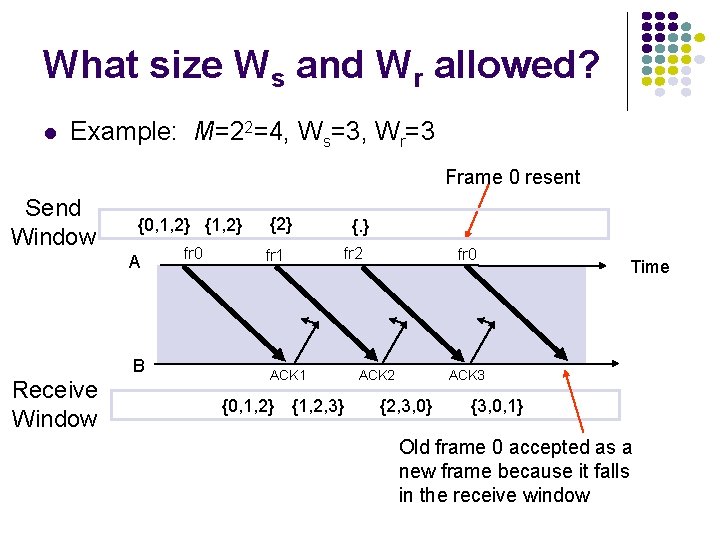
What size Ws and Wr allowed? Example: M=22=4, Ws=3, Wr=3 Frame 0 resent Send Window {0, 1, 2} {1, 2} A B Receive Window fr 0 {2} fr 1 {. } fr 2 ACK 1 {0, 1, 2} {1, 2, 3} fr 0 ACK 2 Time ACK 3 {2, 3, 0} {3, 0, 1} Old frame 0 accepted as a new frame because it falls in the receive window
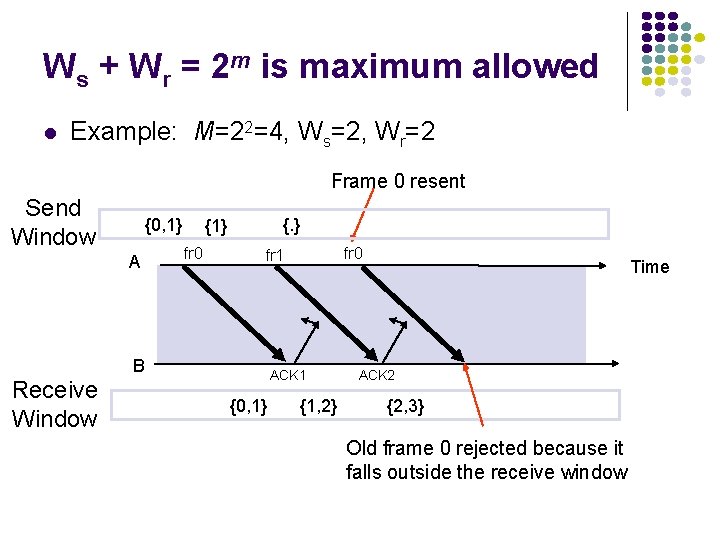
Ws + Wr = 2 m is maximum allowed Example: M=22=4, Ws=2, Wr=2 Frame 0 resent Send Window {0, 1} A {. } {1} fr 0 B Receive Window fr 0 fr 1 ACK 1 {0, 1} {1, 2} Time ACK 2 {2, 3} Old frame 0 rejected because it falls outside the receive window
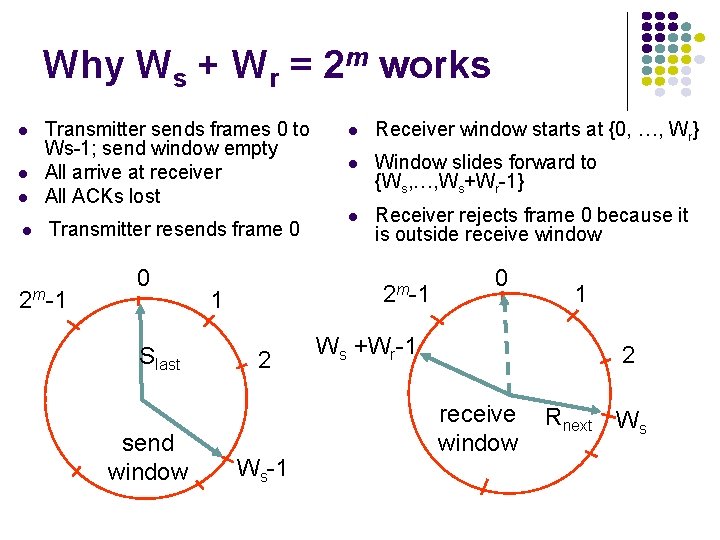
Why Ws + Wr = 2 m works Transmitter sends frames 0 to Ws-1; send window empty All arrive at receiver All ACKs lost Transmitter resends frame 0 2 m-1 0 Slast send window Receiver window starts at {0, …, Wr} Window slides forward to {Ws, …, Ws+Wr-1} Receiver rejects frame 0 because it is outside receive window 2 m-1 1 2 Ws-1 0 Ws +Wr-1 1 2 receive window Rnext Ws
Applications of Selective Repeat ARQ TCP (Transmission Control Protocol): transport layer protocol uses variation of selective repeat to provide reliable stream service Specific Connection Oriented Protocol: error control for signaling messages in ATM networks
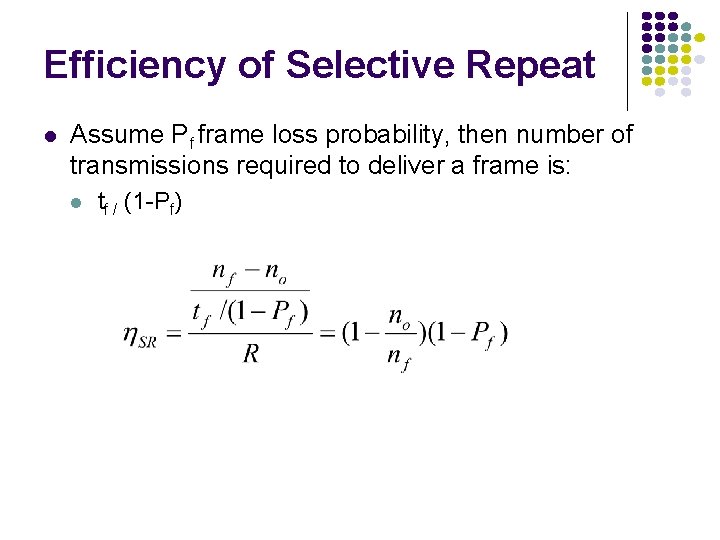
Efficiency of Selective Repeat Assume Pf frame loss probability, then number of transmissions required to deliver a frame is: tf / (1 -Pf)
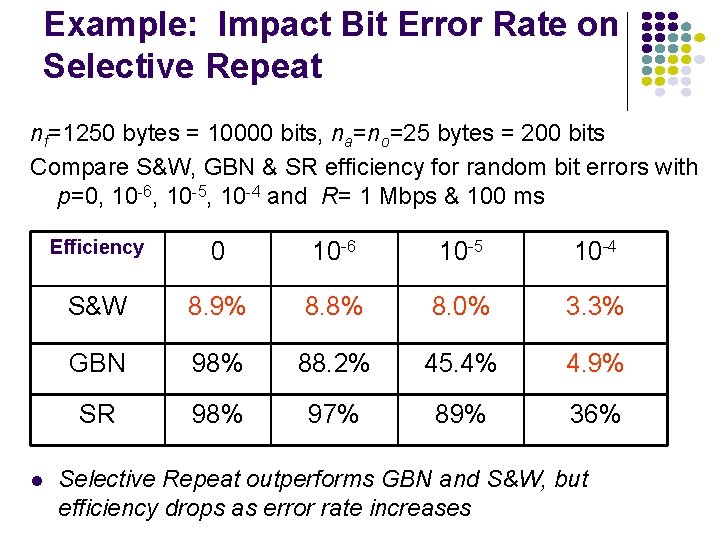
Example: Impact Bit Error Rate on Selective Repeat nf=1250 bytes = 10000 bits, na=no=25 bytes = 200 bits Compare S&W, GBN & SR efficiency for random bit errors with p=0, 10 -6, 10 -5, 10 -4 and R= 1 Mbps & 100 ms Efficiency 0 10 -6 10 -5 10 -4 S&W 8. 9% 8. 8% 8. 0% 3. 3% GBN 98% 88. 2% 45. 4% 4. 9% SR 98% 97% 89% 36% Selective Repeat outperforms GBN and S&W, but efficiency drops as error rate increases
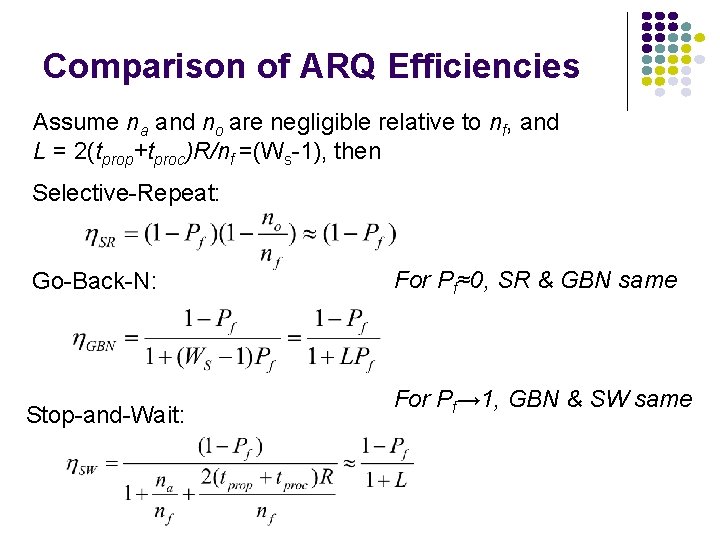
Comparison of ARQ Efficiencies Assume na and no are negligible relative to nf, and L = 2(tprop+tproc)R/nf =(Ws-1), then Selective-Repeat: Go-Back-N: For Pf≈0, SR & GBN same Stop-and-Wait: For Pf→ 1, GBN & SW same
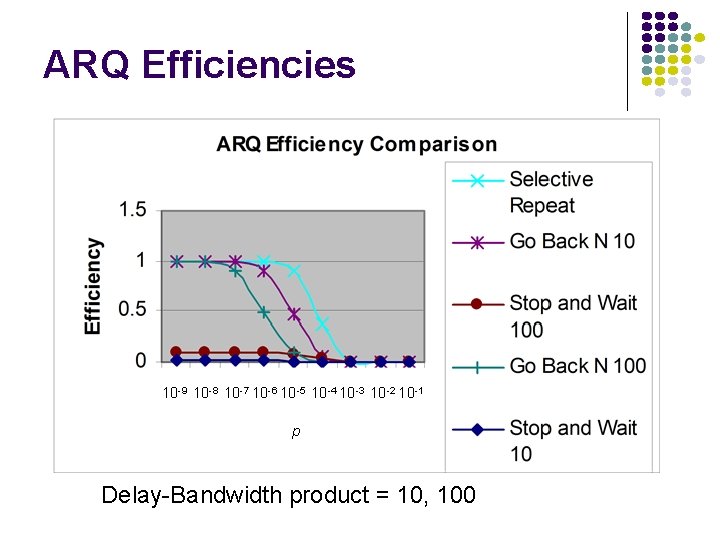
ARQ Efficiencies 10 -9 10 -8 10 -7 10 -6 10 -5 10 -4 10 -3 10 -2 10 -1 p Delay-Bandwidth product = 10, 100
Chapter 5 Peer-to-Peer Protocols and Data Link Layer Flow Control
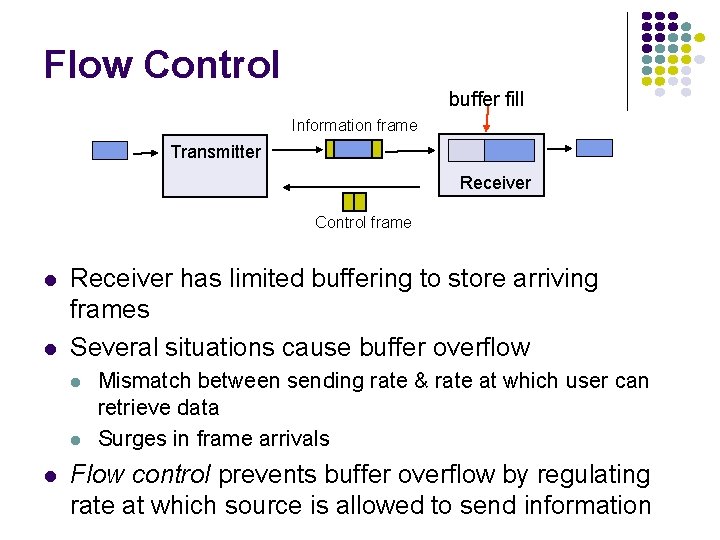
Flow Control buffer fill Information frame Transmitter Receiver Control frame Receiver has limited buffering to store arriving frames Several situations cause buffer overflow Mismatch between sending rate & rate at which user can retrieve data Surges in frame arrivals Flow control prevents buffer overflow by regulating rate at which source is allowed to send information
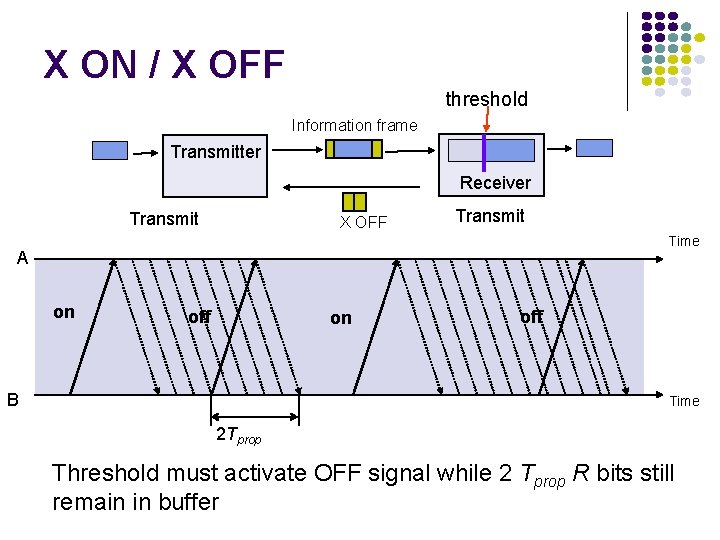
X ON / X OFF threshold Information frame Transmitter Receiver Transmit X OFF Transmit Time A on off on B off Time 2 Tprop Threshold must activate OFF signal while 2 Tprop R bits still remain in buffer
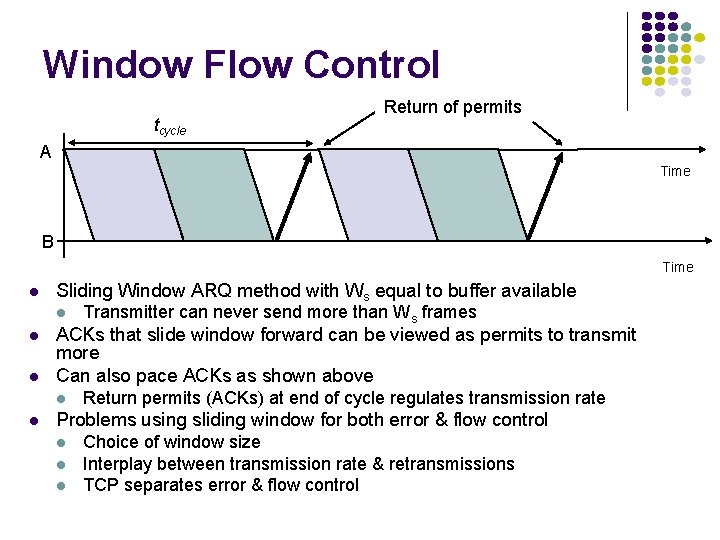
Window Flow Control tcycle Return of permits A Time B Time Sliding Window ARQ method with Ws equal to buffer available ACKs that slide window forward can be viewed as permits to transmit more Can also pace ACKs as shown above Transmitter can never send more than Ws frames Return permits (ACKs) at end of cycle regulates transmission rate Problems using sliding window for both error & flow control Choice of window size Interplay between transmission rate & retransmissions TCP separates error & flow control