
CHAPTER 5 PATTERNS OF INHERITANCE Section 5 1

- Slides: 40
CHAPTER 5 -PATTERNS OF INHERITANCE Section 5. 1 – 5. 2
LEARNING GOAL To gain a better understanding of the principals related to inheritance To learn more about genetic crosses through exploration
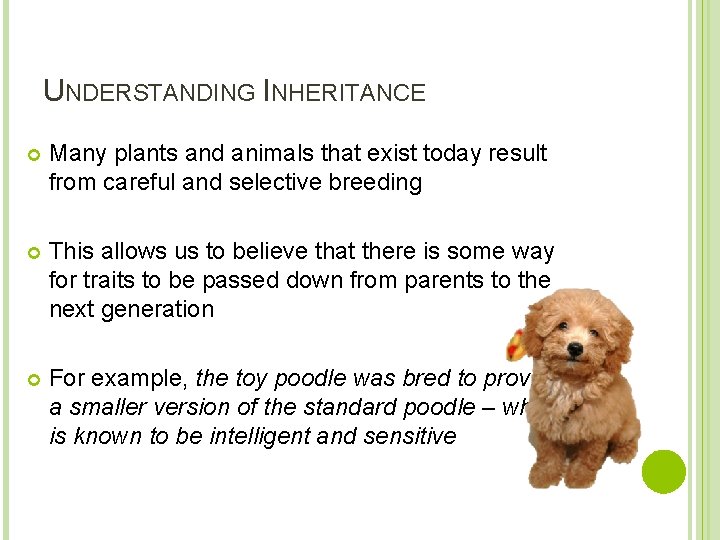
UNDERSTANDING INHERITANCE Many plants and animals that exist today result from careful and selective breeding This allows us to believe that there is some way for traits to be passed down from parents to the next generation For example, the toy poodle was bred to provide a smaller version of the standard poodle – who is known to be intelligent and sensitive
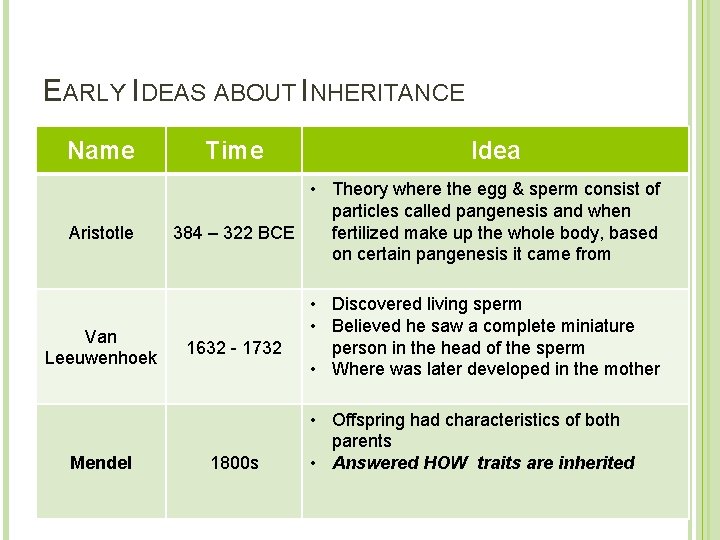
EARLY IDEAS ABOUT INHERITANCE Name Aristotle Van Leeuwenhoek Mendel Time Idea • Theory where the egg & sperm consist of particles called pangenesis and when 384 – 322 BCE fertilized make up the whole body, based on certain pangenesis it came from 1632 - 1732 1800 s • Discovered living sperm • Believed he saw a complete miniature person in the head of the sperm • Where was later developed in the mother • Offspring had characteristics of both parents • Answered HOW traits are inherited
GREGOR MENDEL’S EXPERIMENT Gregor Mendel, an Austrian Monk, first discovered how traits are passed on from one generation to the next by experimenting with pea plants Pea plants were available in many varieties and show many traits A Trait = specific characteristic / feature of an organism Ex. a pea plant’s colour of flower, seed, etc.
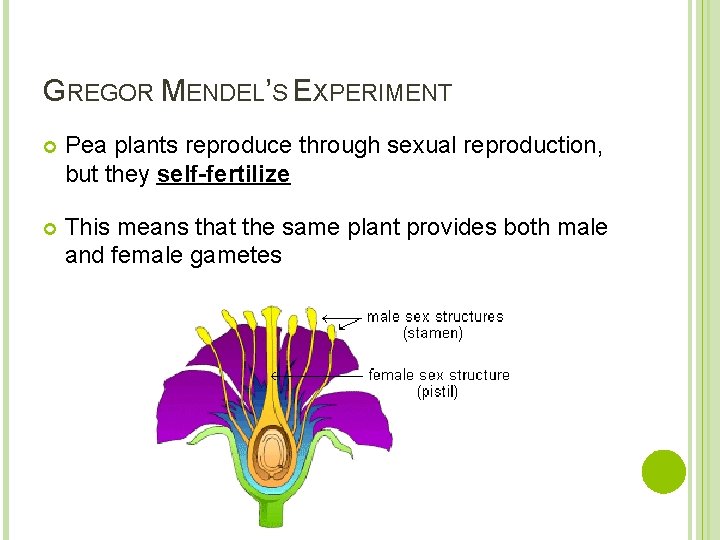
GREGOR MENDEL’S EXPERIMENT Pea plants reproduce through sexual reproduction, but they self-fertilize This means that the same plant provides both male and female gametes
GREGOR MENDEL’S EXPERIMENT Mendel used plants that self-fertilized to produce offspring with consistent traits generation after generation When this occurs = true breeding Mendel also needed to control his experiments. Mendel also discovered how pea plants could be crosspollinated by hand, by manually transferring a male gamete from the flower of 1 pea plant to the female reproductive organ of the flower in another pea plant
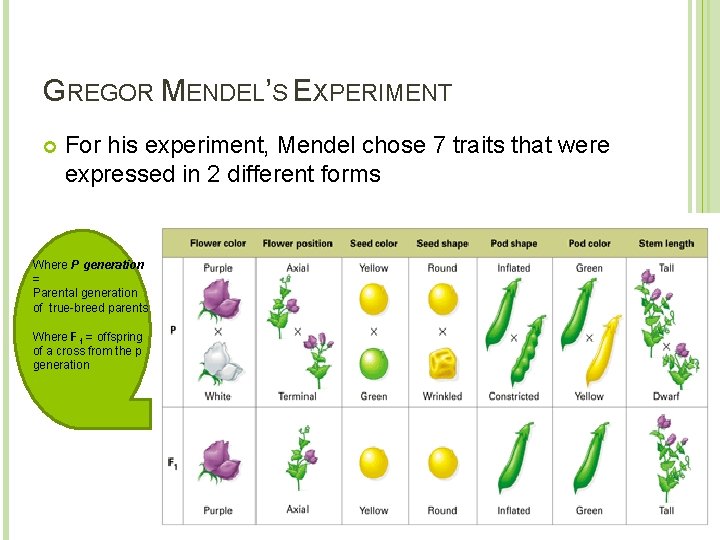
GREGOR MENDEL’S EXPERIMENT For his experiment, Mendel chose 7 traits that were expressed in 2 different forms Where P generation = Parental generation of true-breed parents Where F 1 = offspring of a cross from the p generation
GREGOR MENDEL’S EXPERIMENT Mendel started to study genetics with pea plants that had purple and white flowers Pea plants that were purple and self-fertilized to form only purple offspring = true breeding plants, likewise for any Pea plants with white flowers produced only white offspring So Mendel decided to experiment and see what would happen if he crossed a true breed of purple flowered pea plants with true breed white flowered pea plants
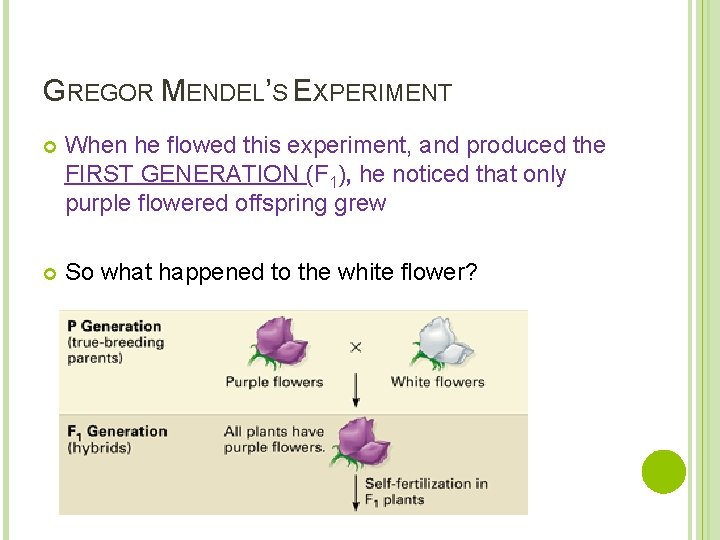
GREGOR MENDEL’S EXPERIMENT When he flowed this experiment, and produced the FIRST GENERATION (F 1), he noticed that only purple flowered offspring grew So what happened to the white flower?
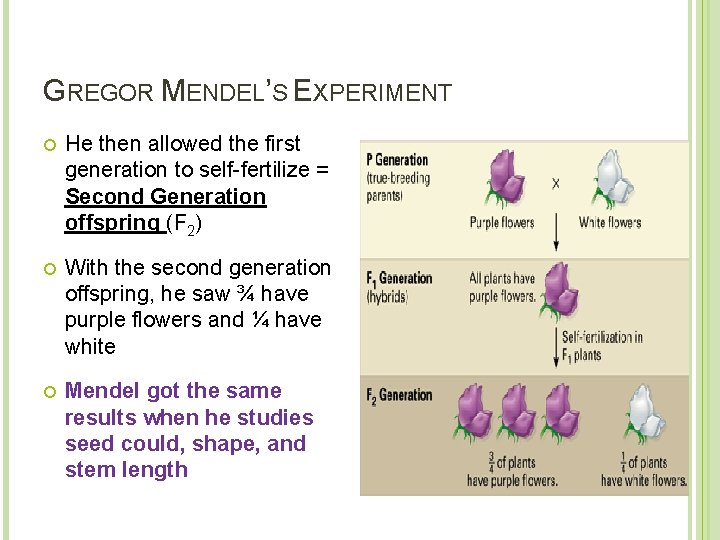
GREGOR MENDEL’S EXPERIMENT He then allowed the first generation to self-fertilize = Second Generation offspring (F 2) With the second generation offspring, he saw ¾ have purple flowers and ¼ have white Mendel got the same results when he studies seed could, shape, and stem length
GREGOR MENDEL’S EXPERIMENT To explain his observations, Mendel proposed that: 1. Each plant had 2 “factors” that act as a set of instructions for each characteristic 2. Each parent donates 1 of these factors to the offspring 3. 1 factor or trait may be dominant over the other if its present
GREGOR MENDEL’S EXPERIMENT The LAW of Segregation Mendel concluded that there must be 2 hereditary “factors” for each trait Today we call theses “factors” Alleles Recall that alleles are different forms of a gene, and that diploid organisms have 2 alleles per gene For example, each of Mendel’s pea plants have 2 alleles for seed colour
GREGOR MENDEL’S EXPERIMENT Dominant and Recessive Alleles We can use Mendel’s research from the purple and white flowered pea plants to understand why one trait can be dominant (over powering) than the other For example, Mendel discovered that more purple flowered peas were reproduced than white flowered pea plants
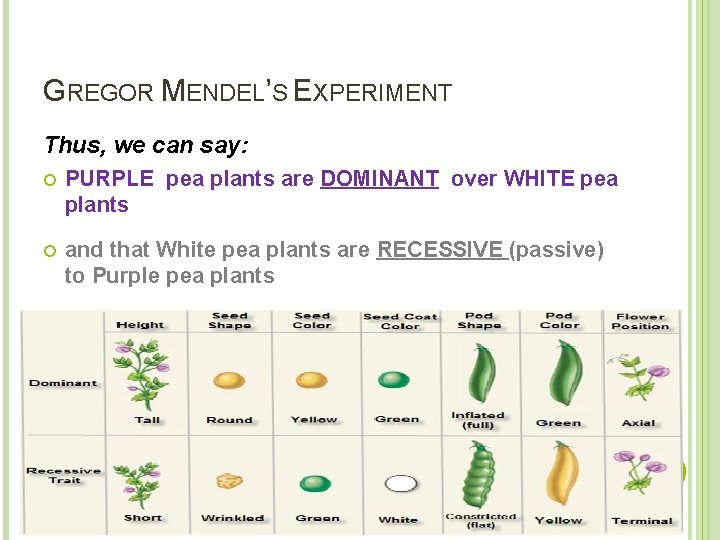
GREGOR MENDEL’S EXPERIMENT Thus, we can say: PURPLE pea plants are DOMINANT over WHITE pea plants and that White pea plants are RECESSIVE (passive) to Purple pea plants
GREGOR MENDEL’S EXPERIMENT Therefore, alleles can be dominant or recessive The presence or absence of each type of allele determines which trait is seen If someone has a dominant allele, then the trait associated with it is seen regardless if the second allele is dominant or recessive So, the only time a recessive allele would be seen is if 2 recessive alleles are put together
GREGOR MENDEL’S EXPERIMENT Scientists have come up with a system for representing alleles so that we can track their dominancy and recessiveness through multiple generations Dominant allele is seen through an upper case letter For example, purple was dominant to white flowers in pea plants in Mendel’s work, so the dominant allele for the purple flower is “P”
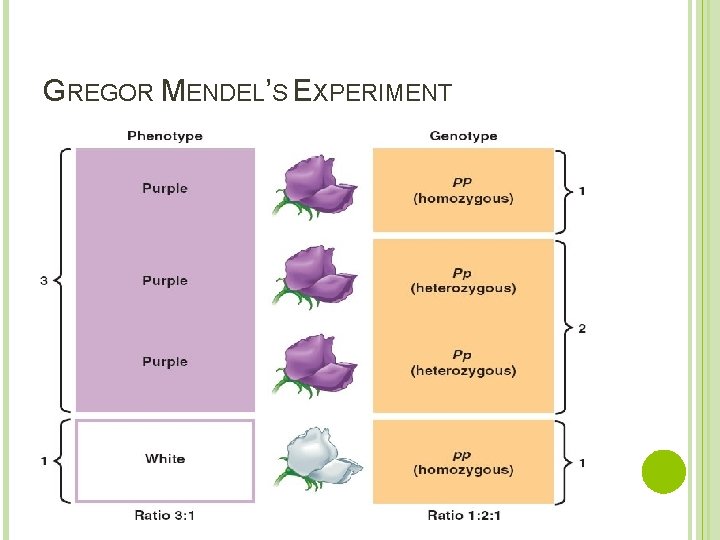
GREGOR MENDEL’S EXPERIMENT Recessive allele is seen through a lower case letter For example, white was recessive to purple flowers in pea plants in Mendel’s work, so the recessive allele for the purple flower is “p” Pairs of the Purple pea plant flowers can be PP, Pp The Pair of white pea plant flowers can only be pp
GREGOR MENDEL’S EXPERIMENT Recall, that the physical appearance of an organism does NOT indicate the alleles it has For example, some purple flowered pea plants can have alleles “PP” or “Pp” Therefore we can split this information two ways
GREGOR MENDEL’S EXPERIMENT Terminology Phenotype – the physical description of an organism’s trait. Ex – purple flower colour Genotype – the specific combination of alleles it has for a specific trait. Ex – PP, Pp, pp
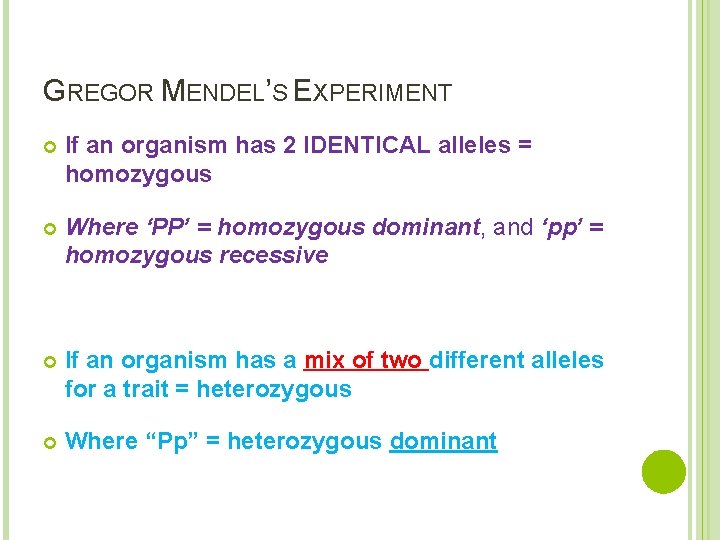
GREGOR MENDEL’S EXPERIMENT If an organism has 2 IDENTICAL alleles = homozygous Where ‘PP’ = homozygous dominant, and ‘pp’ = homozygous recessive If an organism has a mix of two different alleles for a trait = heterozygous Where “Pp” = heterozygous dominant
GREGOR MENDEL’S EXPERIMENT
CHECKING FOR UNDERSTANDING Complete the added worksheet on identifying if an organism is Dominant / Recessive Complete Questions # 1, 2, 4, 5, 6, 7, 9 (p. 207)
SECTION 5. 2 Studying Genetic Crosses
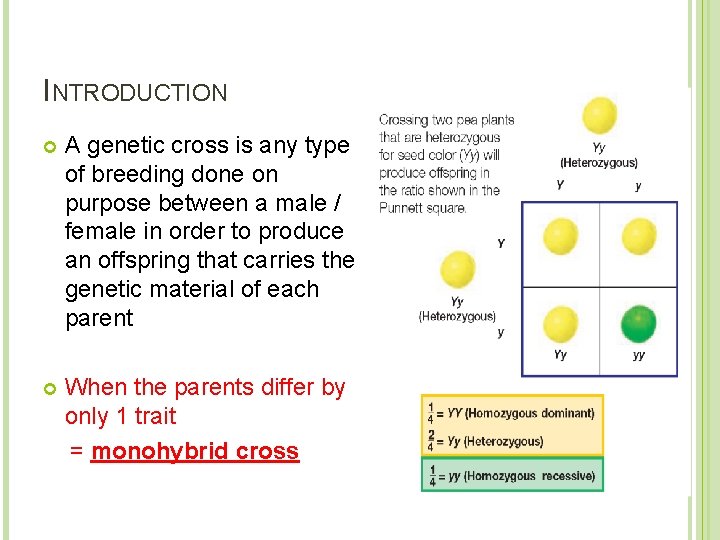
INTRODUCTION A genetic cross is any type of breeding done on purpose between a male / female in order to produce an offspring that carries the genetic material of each parent When the parents differ by only 1 trait = monohybrid cross
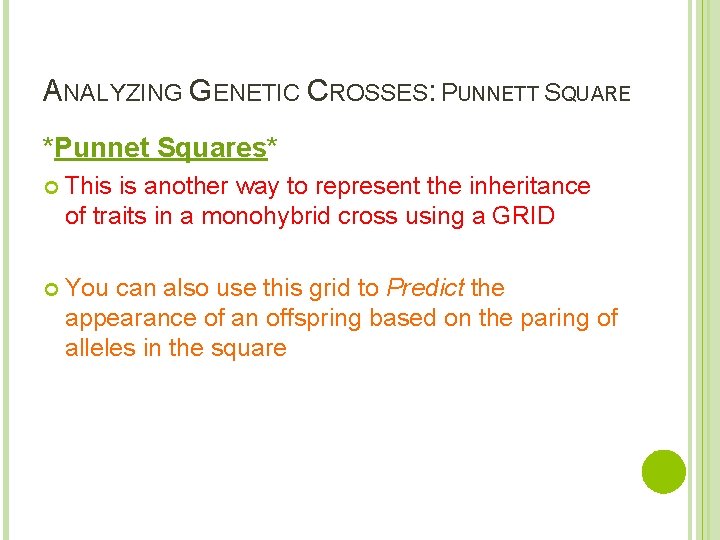
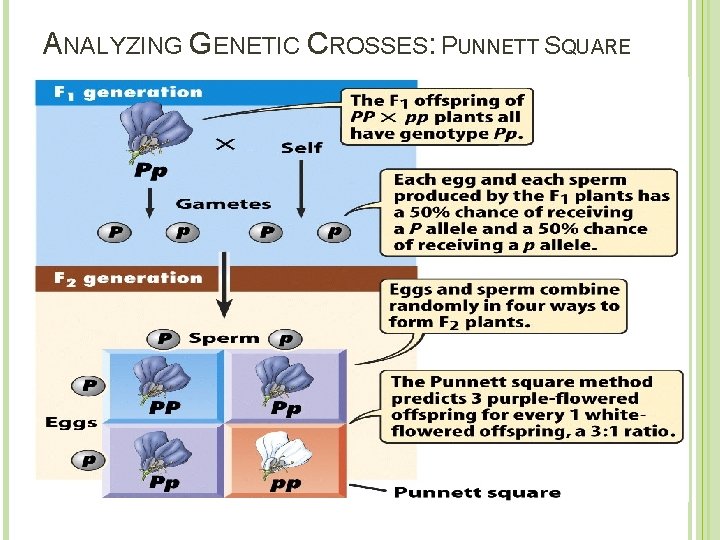
ANALYZING GENETIC CROSSES: PUNNETT SQUARE *Punnet Squares* This is another way to represent the inheritance of traits in a monohybrid cross using a GRID You can also use this grid to Predict the appearance of an offspring based on the paring of alleles in the square
ANALYZING GENETIC CROSSES: PUNNETT SQUARE
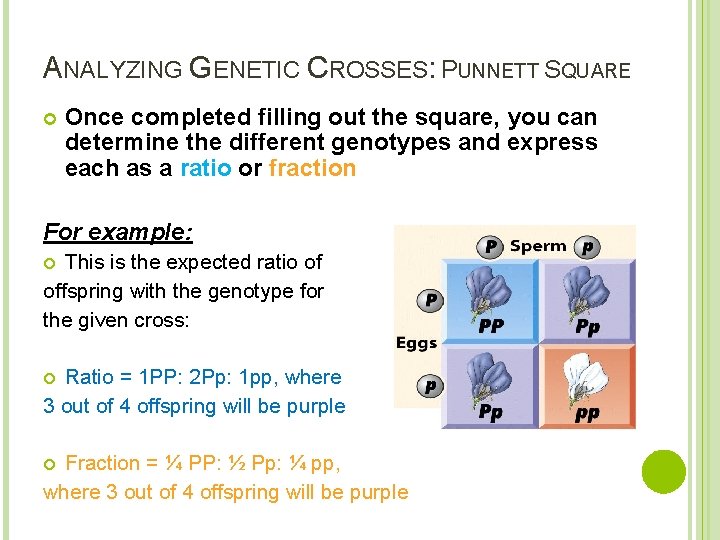
ANALYZING GENETIC CROSSES: PUNNETT SQUARE Once completed filling out the square, you can determine the different genotypes and express each as a ratio or fraction For example: This is the expected ratio of offspring with the genotype for the given cross: Ratio = 1 PP: 2 Pp: 1 pp, where 3 out of 4 offspring will be purple Fraction = ¼ PP: ½ Pp: ¼ pp, where 3 out of 4 offspring will be purple
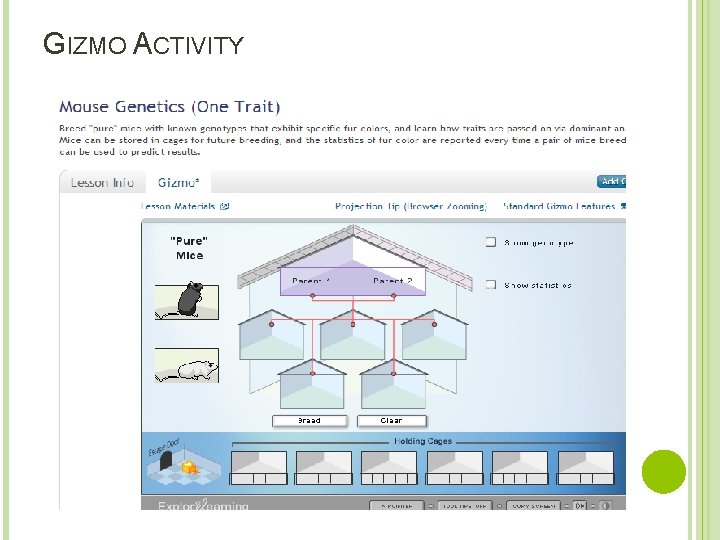
GIZMO ACTIVITY
THE EXPRESSION OF MOST GENETIC TRAITS IS COMPLEX Introduction Through his observations, Mendel discovered that the inheritance of one trait can be independent of another trait For example, pea plant seed colour had nothing to do with the inheritance of seed shape
LAW OF INDEPENDENT ASSORTMENT Thus, to better explain this phenomena, Mendel established the Law of Independent Assortment Mendel’s law states that 2 alleles for 1 gene separate independently of the alleles for other genes during gamete formation in Meiosis This means that traits are transmitted to offspring independently of one another
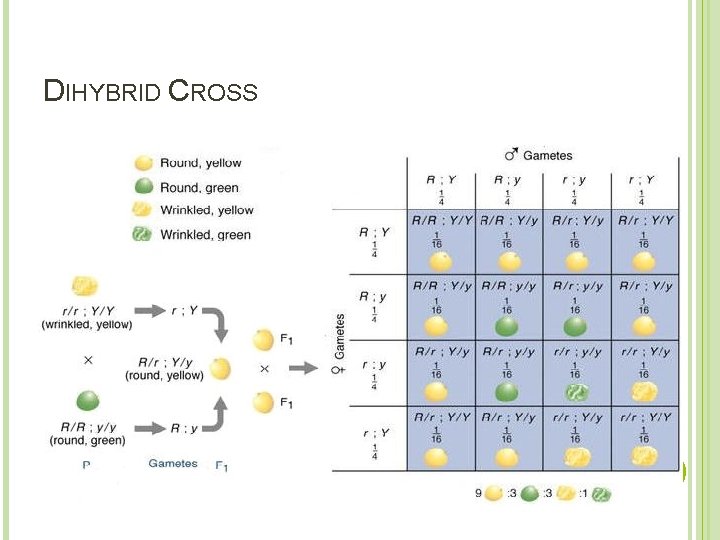
LAW OF INDEPENDENT ASSORTMENT Mendel formulated this principle after performing dihybrid crosses between plants that differed in two traits, such as seed color and pod color After these plants were allowed to self-pollinate, he noticed that the same ratio of 9: 3: 3: 1 appeared among the offspring
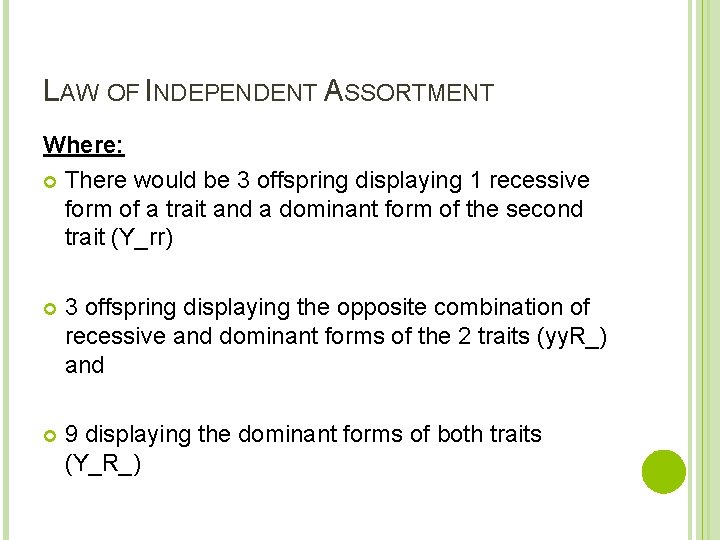
LAW OF INDEPENDENT ASSORTMENT Where: There would be 3 offspring displaying 1 recessive form of a trait and a dominant form of the second trait (Y_rr) 3 offspring displaying the opposite combination of recessive and dominant forms of the 2 traits (yy. R_) and 9 displaying the dominant forms of both traits (Y_R_)
DIHYBRID CROSS
GIZMO ACTIVITY
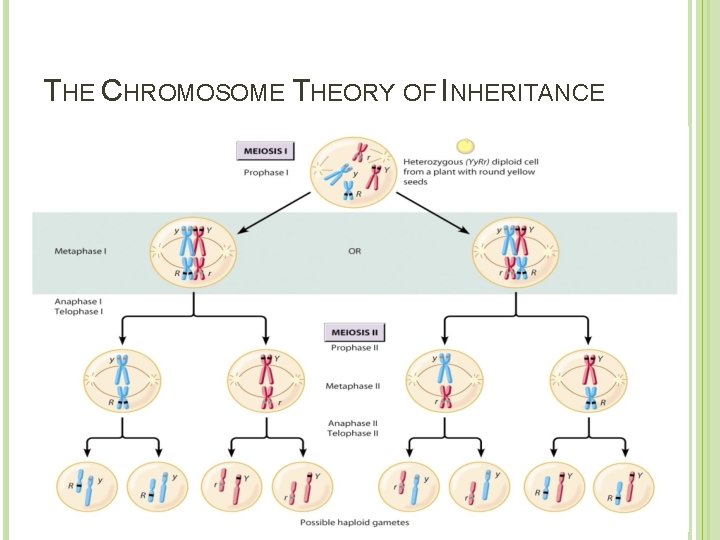
THE CHROMOSOME THEORY OF INHERITANCE When Mendel performed his pea plant experiments in the mid-1800 s, and formulated his laws of inheritance, he had no idea how the traits were passed from generation to generation The process of meiosis and the existence of chromosomes had not been discovered yet. It wasn’t until the 1900 s that scientists were able to use the information from Mendel and apply it to how chromosomes behave during meiosis
THE CHROMOSOME THEORY OF INHERITANCE Walter Sutton, a student at Columbia University, studied the behaviour of chromosomes during meiosis I and meiosis II In 1902, he realized that the behaviours of chromosomes in meiosis related to Mendel’s experiments with pea plants. Sutton later discovered how during gamete formation, alleles segregate just as homologous chromosomes do
THE CHROMOSOME THEORY OF INHERITANCE Thus, Sutton proposed that genes are carried on chromosomes This led to the “chromosome theory of inheritance” Where: genes are located on chromosomes, and chromosomes provide the basis for the segregation and independent assortment of alleles
THE CHROMOSOME THEORY OF INHERITANCE
WORK PERIOD Use this time to complete the given worksheets