
Chapter 5 Patterns of Inheritance Early Ideas of


- Slides: 13
Chapter 5: Patterns of Inheritance
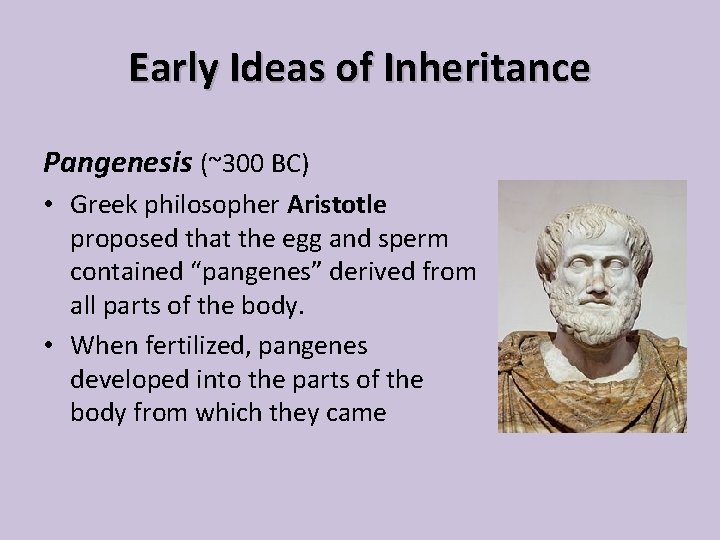
Early Ideas of Inheritance Pangenesis (~300 BC) • Greek philosopher Aristotle proposed that the egg and sperm contained “pangenes” derived from all parts of the body. • When fertilized, pangenes developed into the parts of the body from which they came
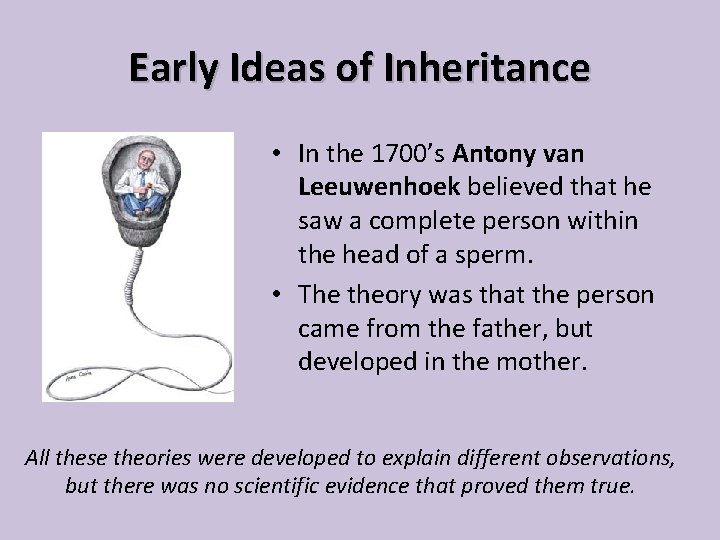
Early Ideas of Inheritance • In the 1700’s Antony van Leeuwenhoek believed that he saw a complete person within the head of a sperm. • The theory was that the person came from the father, but developed in the mother. All these theories were developed to explain different observations, but there was no scientific evidence that proved them true.
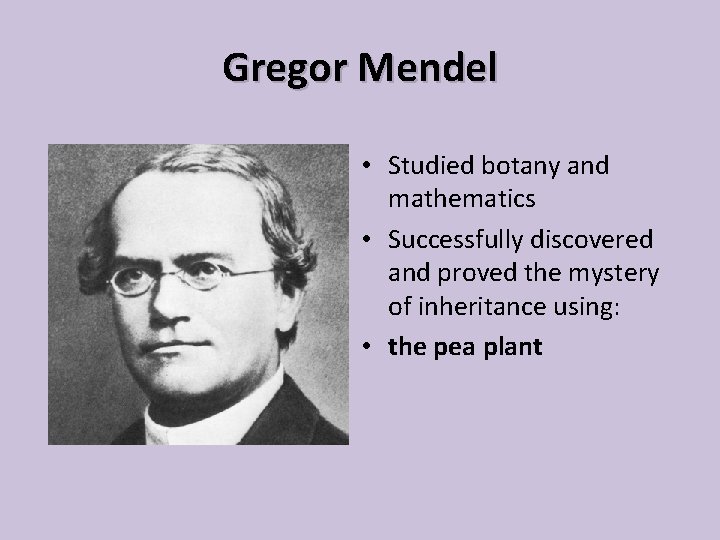
Gregor Mendel • Studied botany and mathematics • Successfully discovered and proved the mystery of inheritance using: • the pea plant
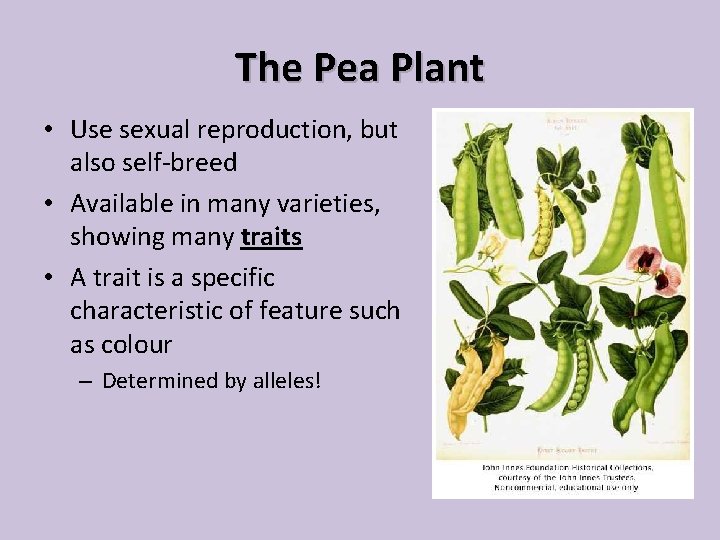
The Pea Plant • Use sexual reproduction, but also self-breed • Available in many varieties, showing many traits • A trait is a specific characteristic of feature such as colour – Determined by alleles!
Mendel’s Experiments • Mendel began each experiment with truebreeding plants – These are plants that have self-fertilized to produce offspring with identical traits each generation. • These were referred to a the parental or P generation
True-Breeding Crosses • He then took true-breeding plants with one form of a trait (e. g. yellow seeds) and crossed it with true-breeding plants with the other form of the same trait (e. g. green seeds) – A cross is the selective fertilization of female and male gametes with specific genes. – This is referred to as a monohybrid cross because what is produced is a hybrid of two parents that differ by one trait • The offspring of these crosses were called the F 1 Generation
True-Breeding Crosses Results of the monohybrid cross: P generation F 1 generation x 100% • For all of 7 traits studied, when true-breeding organisms of opposite traits were crossed, the offspring expressed only one form of the trait
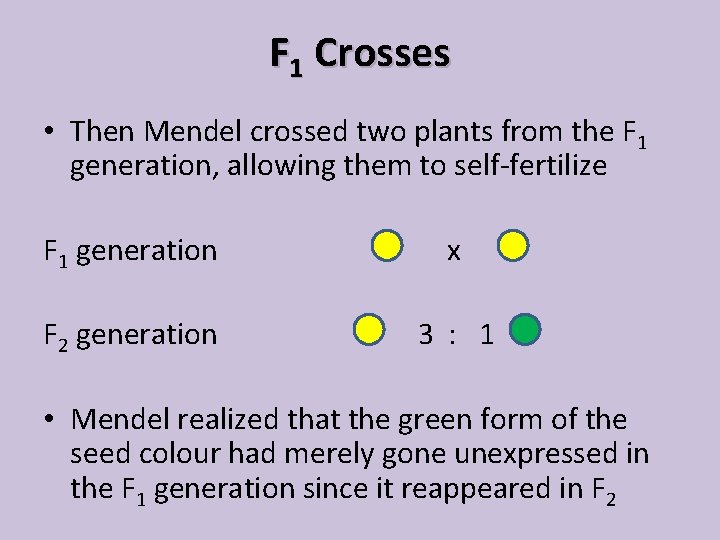
F 1 Crosses • Then Mendel crossed two plants from the F 1 generation, allowing them to self-fertilize F 1 generation x F 2 generation 3 : 1 • Mendel realized that the green form of the seed colour had merely gone unexpressed in the F 1 generation since it reappeared in F 2
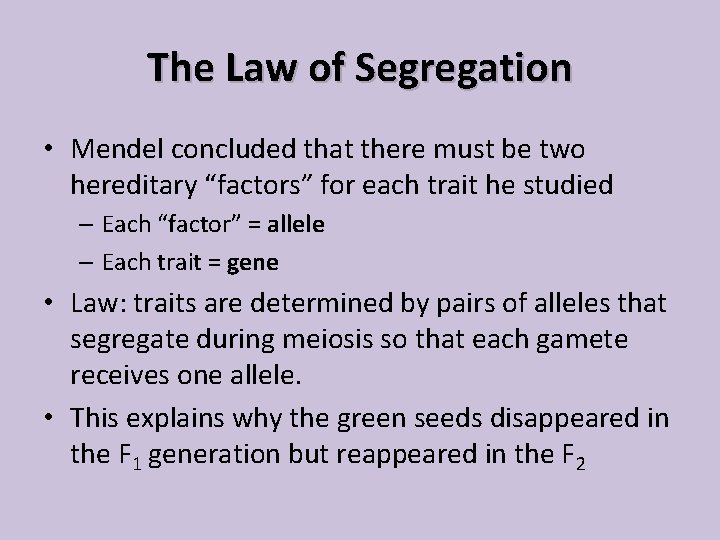
The Law of Segregation • Mendel concluded that there must be two hereditary “factors” for each trait he studied – Each “factor” = allele – Each trait = gene • Law: traits are determined by pairs of alleles that segregate during meiosis so that each gamete receives one allele. • This explains why the green seeds disappeared in the F 1 generation but reappeared in the F 2
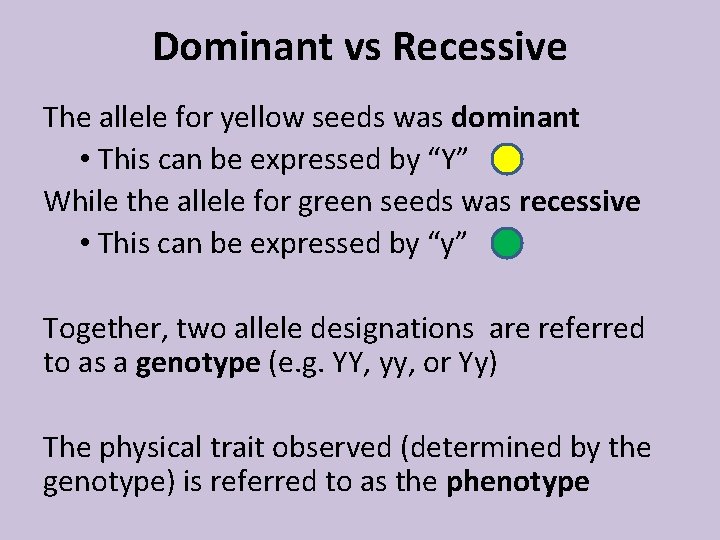
Dominant vs Recessive The allele for yellow seeds was dominant • This can be expressed by “Y” While the allele for green seeds was recessive • This can be expressed by “y” Together, two allele designations are referred to as a genotype (e. g. YY, yy, or Yy) The physical trait observed (determined by the genotype) is referred to as the phenotype
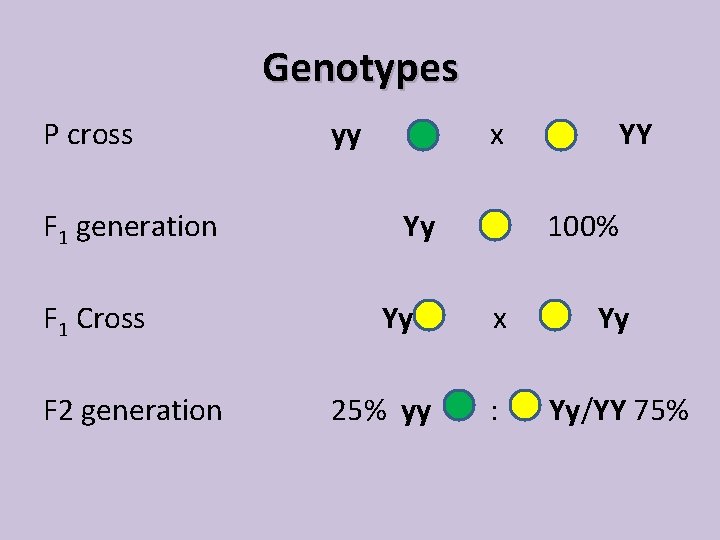
Genotypes P cross F 1 generation F 1 Cross F 2 generation yy x Yy Yy 25% yy YY 100% x Yy : Yy/YY 75%
Homework • Pg. 205 #1, 3 -6 • Pg. 207 #1 -12 (except 3 and 5)