
Chapter 5 Organizational Structure and Its Impact Learning
- Slides: 50
Chapter 5 Organizational Structure and Its Impact
Learning Objectives (1 of 2) § State why law enforcement agencies are organized in similar ways nationally § Identify the reasons why traditional organizational structure is now questioned § Describe the newer organizational strategies being implemented nationally § Explain the basic concepts of Cellular and Net-Centric organization
Learning Objectives (2 of 2) § Explain the benefits that can be derived from organizational change. § Identify the importance of the patrol officer and supervisor in contemporary law enforcement management approaches. § Define the benefits and limits of both traditional and contemporary law enforcement organizational designs. Understand the role information and communication technology plays in contemporary management theory.
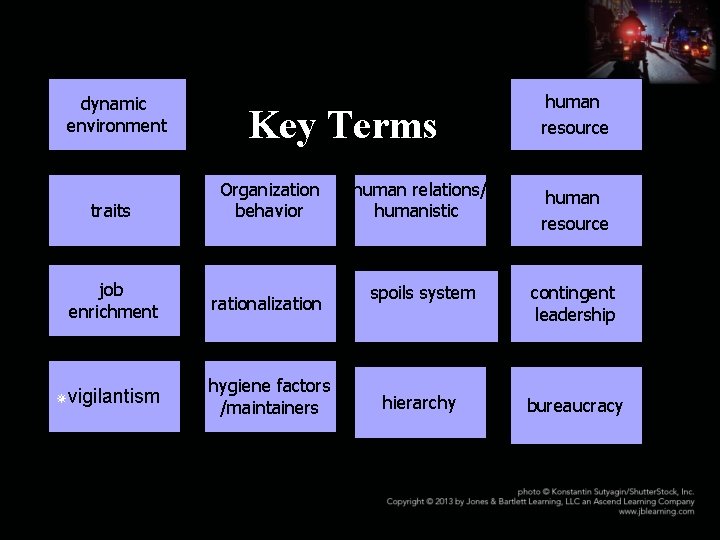
dynamic environment Key Terms traits Organization behavior job enrichment rationalization ¯vigilantism hygiene factors /maintainers human resource human relations/ humanistic human resource spoils system contingent leadership hierarchy bureaucracy
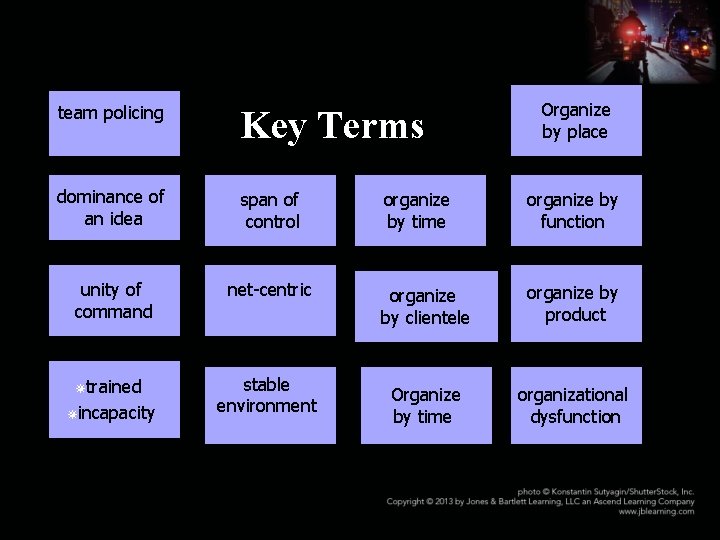
team policing Key Terms dominance of an idea span of control unity of command net-centric ¯trained ¯incapacity stable environment Organize by place organize by time organize by function organize by clientele organize by product Organize by time organizational dysfunction
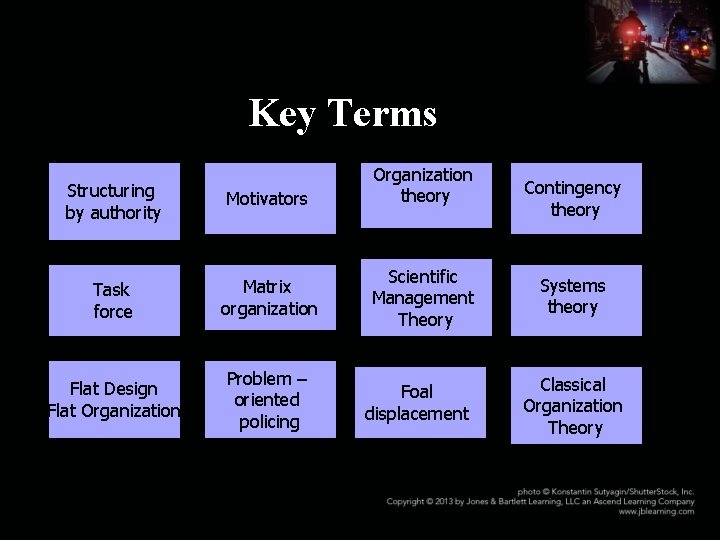
Key Terms Structuring by authority Motivators Task force Matrix organization Flat Design Flat Organization Problem – oriented policing Organization theory Scientific Management Theory Foal displacement Contingency theory Systems theory Classical Organization Theory
Organizational Theory – Its Development & Its Impact on Law Enforcement § The role an organization is expected to play dictates how it is organized § Its primary purpose and tasks help determine structure § The size of an organization is related to the way it is organized
Organizational Theory – § Two fields of theory and practice § Organization Theory: research and practice that looks at organizations from a design perspective • How an organization should be structured • How tasks should be divided • How personnel should be assigned tasks
Organizational Theory § Two fields of theory and practice (cont. ) § Organizational Behavior: § Examines how people act within an organization § § Motivation Leadership Group Dynamics Organizational Change and Development
Organizational Theory § The fields of organization theory and organizational behavior helped to give birth to the human relations and the human resource movement § Both are treated here in the context of human relations theory as a single topic
Classical Organization Theory § Examples of extensive bureaucracies exist in history: Rome, China, the Middle East § Until the Industrial Revolution little if any thought was given to organization theory § The models for organizational design were limited to military models, the Roman Catholic Church, or the newly emerging economic model of mass production
Classical Organization Theory § Growth of US Government, cities, and heavy industry brought more interest in efficiency § Progressive Movement paralleled “scientific management” of the private sector § Large-scale organizations required attention to design, tasks, and control
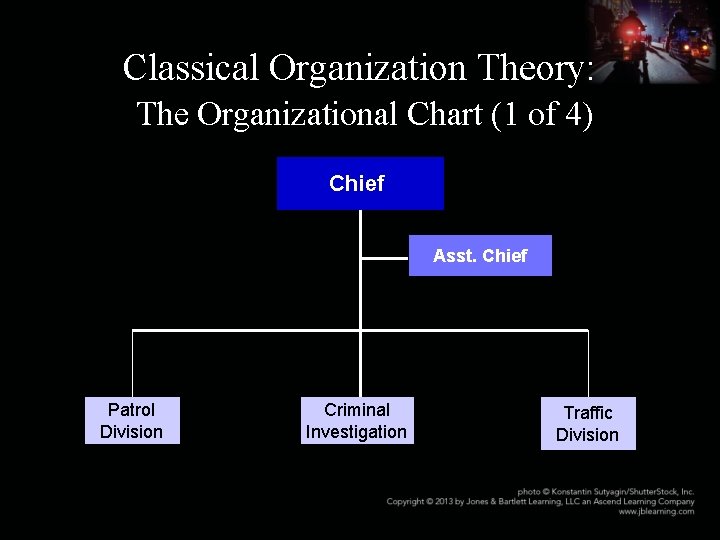
Classical Organization Theory: The Organizational Chart (1 of 4) Chief Asst. Chief Patrol Division Criminal Investigation Traffic Division
Classic Organization Theory: The Organizational Chart (2 of 4) § A table of organization shows the positions in an organization and the prescribed interaction between those positions § Each little box represents a position or a category of positions § Height on the page is a measure of status § Vertical lines represent the interaction of superiors and subordinates § Horizontal lines represent the interaction of equals
Classic Organization Theory: The Organizational Chart (3 of 4) § Any table of organization resembles any other in representing the structure of the organization to consist of positions and interactions § Positions are identified by activity and status § The title of the position on the chart ordinarily identifies its activity • Its distance from bottom or top of the chart measures its status
Classic Organization Theory: The Organizational Chart (4 of 4) § The lines that are drawn between positions indicate prescribed interaction with other positions § Most tables of organization emphasize interaction between superiors and direct subordinates • They minimize or omit interaction between equals and between widely separated positions
Max Weber § Bureaucratic theory: • Division of labor § Clear line of authority • Specialization § Unity of command • Merit and ability § Basis for hiring and promotion
Frederick Winslow Taylor § Scientific management: • Job design § Define the job § Train to tasks of that job § Hire the best trained § Promote on the same basis § Strong and clear hierarchy
Luther Gulick § Management principles: • • Span of control Unity of command Control by structuring authority (those in power) Control by dominance of idea (set of values, ideas)
Classical Organization Theory § § § § One Executive Unity Of Command Chain Of Command Short Span Of Control Merit Hire (Qualifications) Scientifically Designed Jobs Merit Promotion (Performance) Division Of Labor And Specialization § Line And Staff Functions Defined By Position
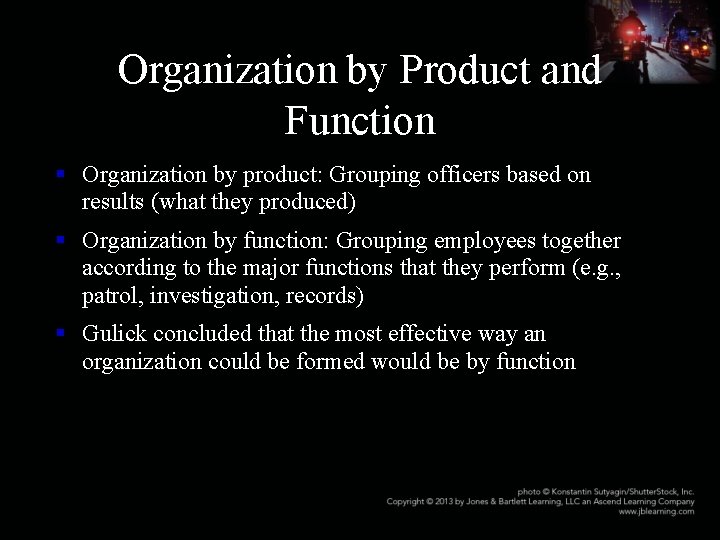
Organization by Product and Function § Organization by product: Grouping officers based on results (what they produced) § Organization by function: Grouping employees together according to the major functions that they perform (e. g. , patrol, investigation, records) § Gulick concluded that the most effective way an organization could be formed would be by function
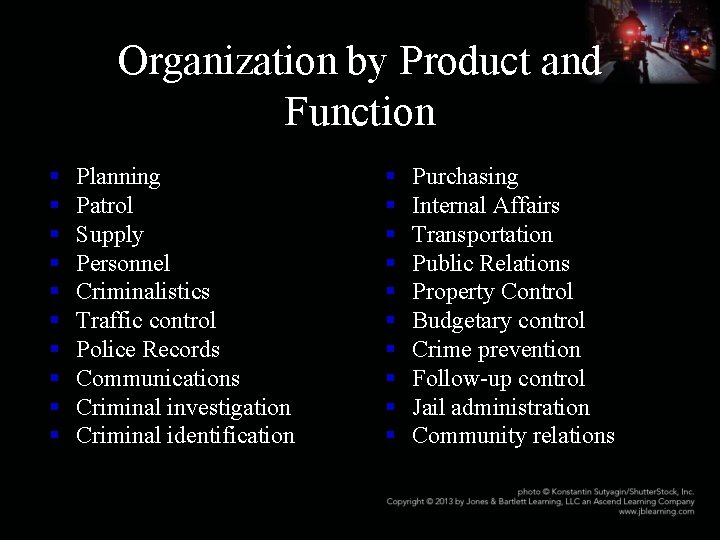
Organization by Product and Function § § § § § Planning Patrol Supply Personnel Criminalistics Traffic control Police Records Communications Criminal investigation Criminal identification § § § § § Purchasing Internal Affairs Transportation Public Relations Property Control Budgetary control Crime prevention Follow-up control Jail administration Community relations
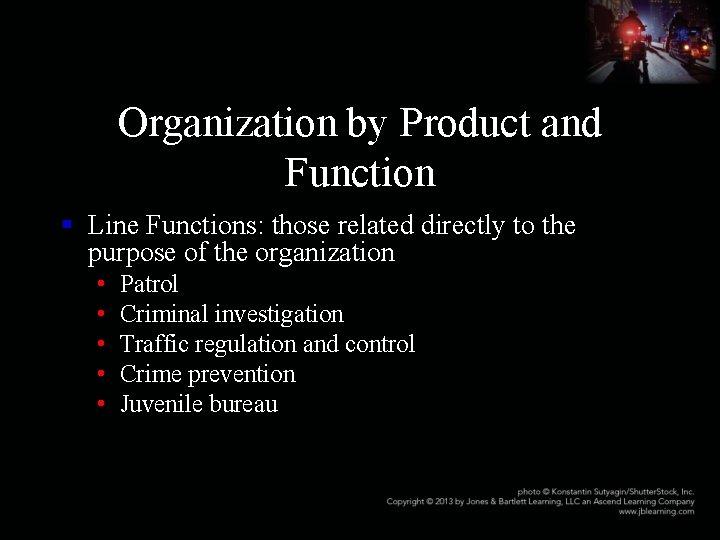
Organization by Product and Function § Line Functions: those related directly to the purpose of the organization • • • Patrol Criminal investigation Traffic regulation and control Crime prevention Juvenile bureau
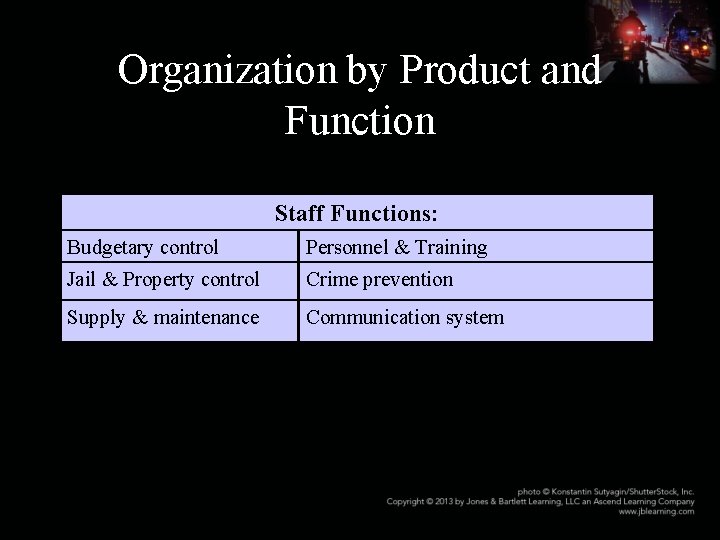
Organization by Product and Function Staff Functions: Budgetary control Personnel & Training Jail & Property control Crime prevention Supply & maintenance Communication system
Organization by Product and Function § Best applied in stable environments, not good in dynamic environments § Can lead to “goal displacement” – focus on things other than service § Can lead to “trained in capacitance” and “organizational dysfunctions”
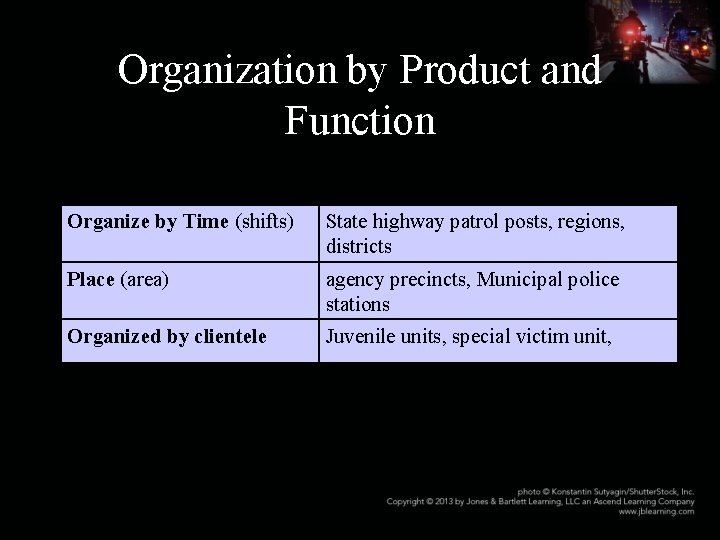
Organization by Product and Function Organize by Time (shifts) State highway patrol posts, regions, districts Place (area) agency precincts, Municipal police stations Organized by clientele Juvenile units, special victim unit,
Organization by Product and Function § The need for adaptation is based on a society’s needs and environment • Old structures in a modern society can not keep up with the demands placed on them by society • Different tasks require new ways of dealing with such needs § Better educated and well trained police do not need the same constraints placed on them as in the past
Human Relations Theory (1 of 2) § Another set of researchers and practitioners focused on people § This approach is called the human relations theory of management § Also called “humanistic theory” § Emphasized industrial psychology • Individual behavior • Group dynamics
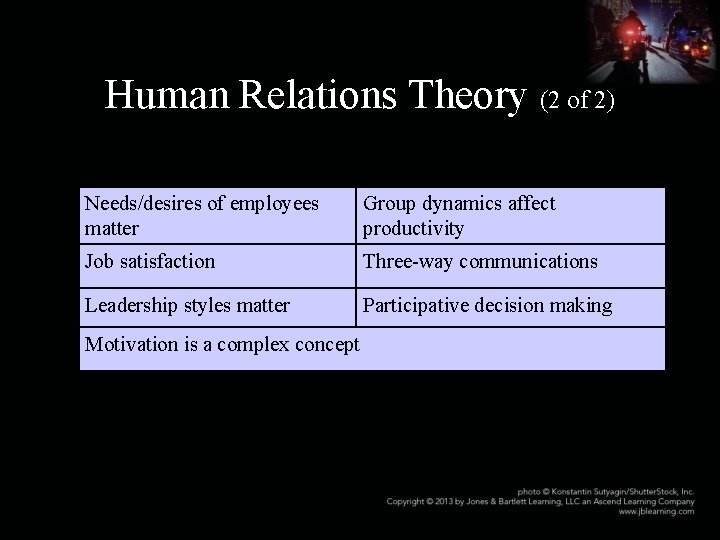
Human Relations Theory (2 of 2) Needs/desires of employees matter Group dynamics affect productivity Job satisfaction Three-way communications Leadership styles matter Participative decision making Motivation is a complex concept
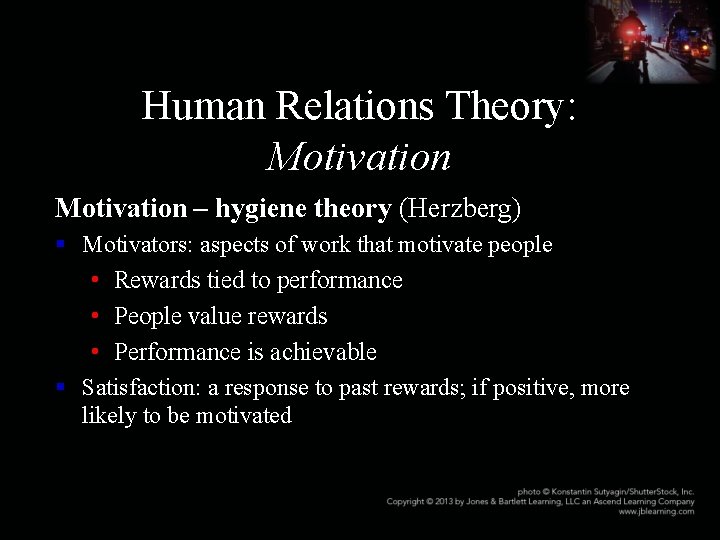
Human Relations Theory: Motivation – hygiene theory (Herzberg) § Motivators: aspects of work that motivate people • Rewards tied to performance • People value rewards • Performance is achievable § Satisfaction: a response to past rewards; if positive, more likely to be motivated
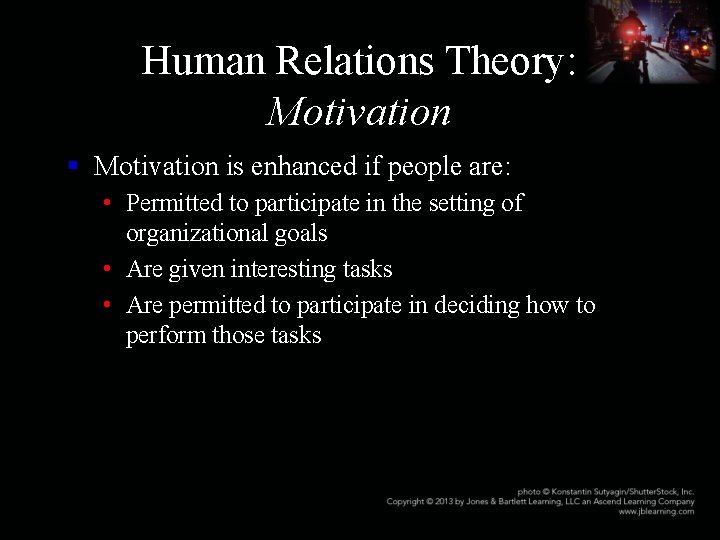
Human Relations Theory: Motivation § Motivation is enhanced if people are: • Permitted to participate in the setting of organizational goals • Are given interesting tasks • Are permitted to participate in deciding how to perform those tasks
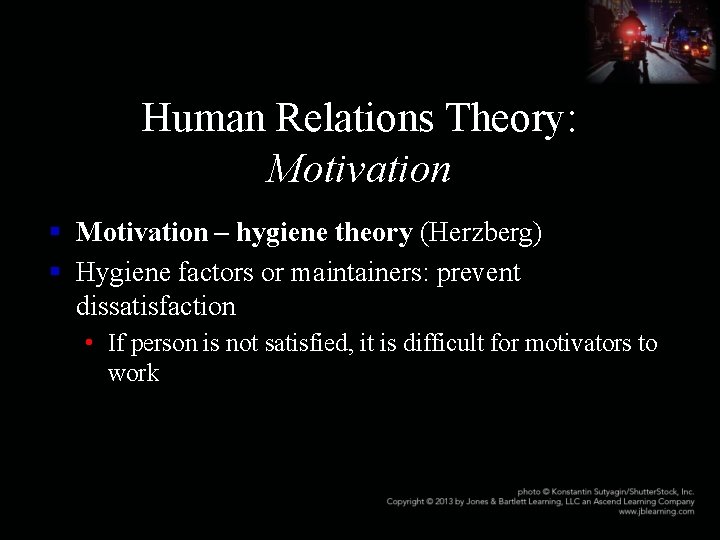
Human Relations Theory: Motivation § Motivation – hygiene theory (Herzberg) § Hygiene factors or maintainers: prevent dissatisfaction • If person is not satisfied, it is difficult for motivators to work
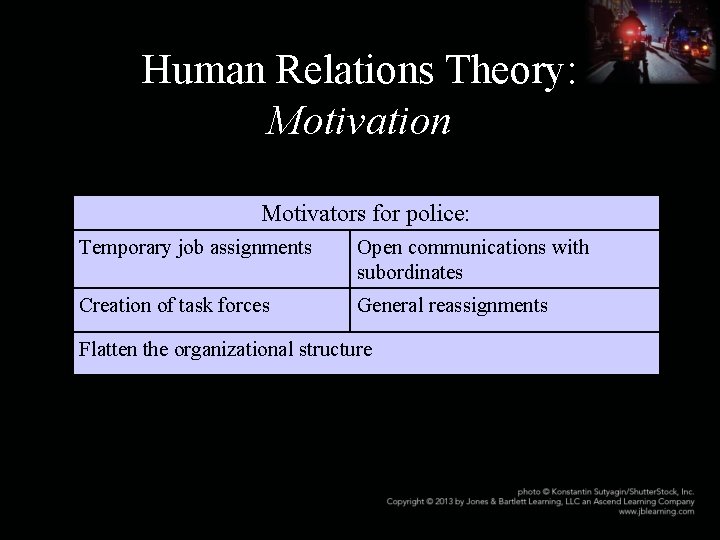
Human Relations Theory: Motivation Motivators for police: Temporary job assignments Open communications with subordinates Creation of task forces General reassignments Flatten the organizational structure
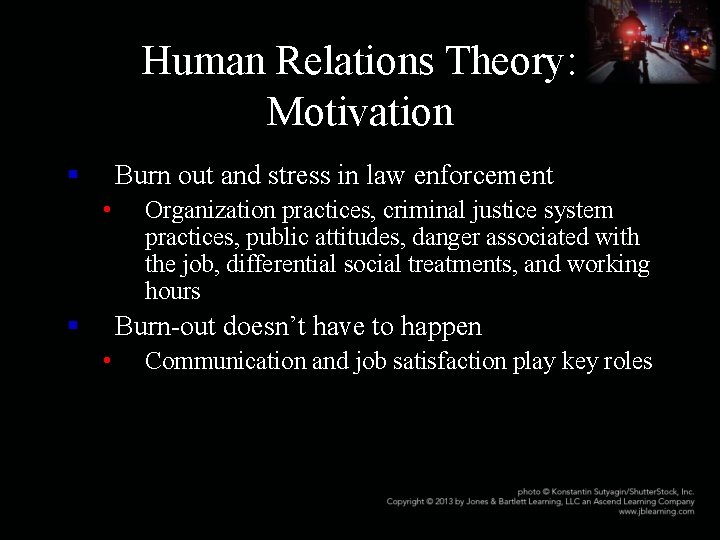
Human Relations Theory: Motivation § Burn out and stress in law enforcement • § Organization practices, criminal justice system practices, public attitudes, danger associated with the job, differential social treatments, and working hours Burn-out doesn’t have to happen • Communication and job satisfaction play key roles
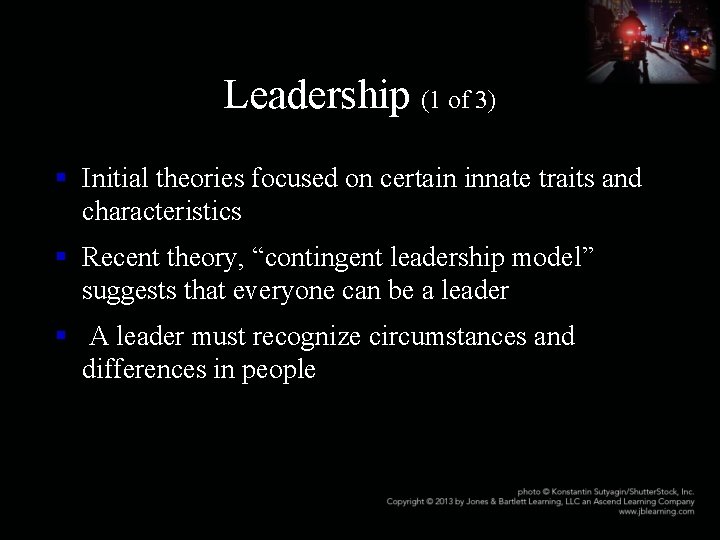
Leadership (1 of 3) § Initial theories focused on certain innate traits and characteristics § Recent theory, “contingent leadership model” suggests that everyone can be a leader § A leader must recognize circumstances and differences in people
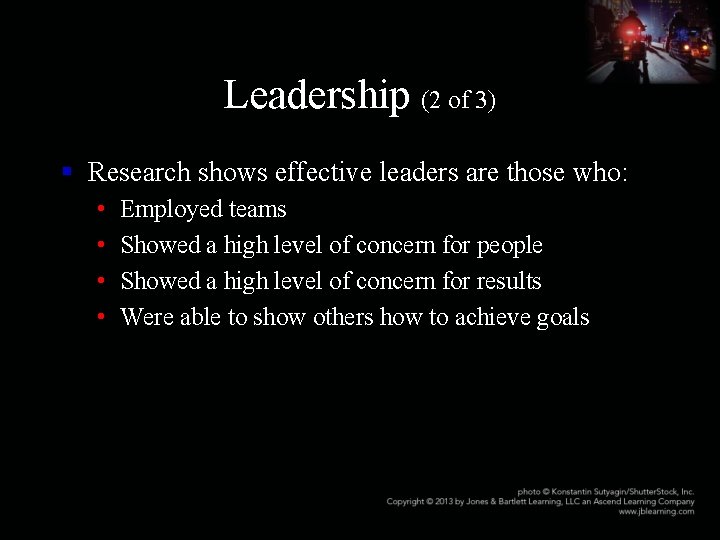
Leadership (2 of 3) § Research shows effective leaders are those who: • • Employed teams Showed a high level of concern for people Showed a high level of concern for results Were able to show others how to achieve goals
Leadership (3 of 3) § Training for leadership roles begins at patrol level § The key to leadership is viewed as: • • • Assisting Mentoring Guiding Facilitating Encouraging others
Contemporary Management Theory § The classical paramilitary hierarchy is not very adaptive to rapidly changing conditions § Do not enhance motivation, increase satisfaction, or reduce stress § Challenges of today include: • • • Complex social problems Terror threats Shifting crime patters Slipping morale Shrinking budgets
Contemporary Management Theory § Two modern approaches • Systems Theory: focus on the entire environment affecting the agency • Contingency Theory: recognizes multiple factors; no one approach is correct in all situations
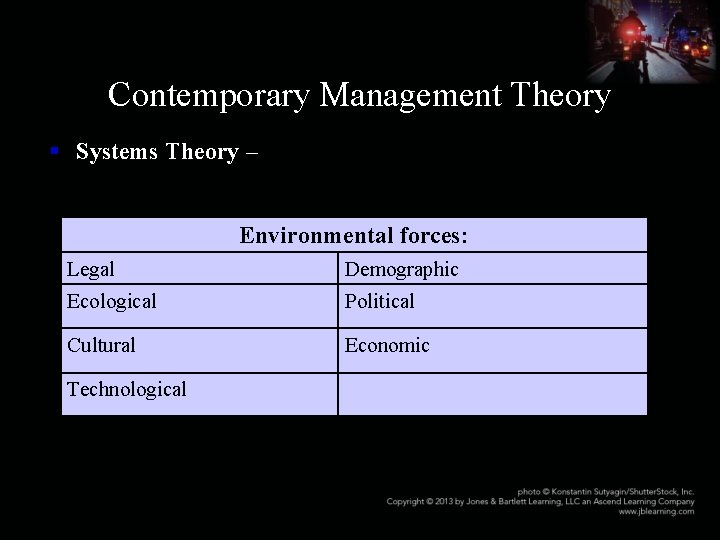
Contemporary Management Theory § Systems Theory – Environmental forces: Legal Demographic Ecological Political Cultural Economic Technological
Contemporary Management Theory § Matrix Organization • Personnel are assigned to a problem regardless of their permanent duty location • An officer can be involved in two or three matrix-based projects at one time • May report to multiple supervisors depending on the issue
Contemporary Management Theory § Other alternatives: • Task Forces/Team Policing § Similar to a matrix organization § Usually an officer is assigned to a task force on a permanent basis • Many task force operations are geared to high profile crimes § Problem-Oriented Policing (POP) § Community Policing
Contemporary Management Theory § Modern methods attempt to overcome some of the serious limitations of classical hierarchy § Differ in organizational permanence, level of discretion, and complexity of problems assigned § Each model is essentially based upon the functions that each individual performs in the organization
Contemporary Management Theory § Traditional structures are ill-designed to meet the needs of policing in the 21 st century § The challenge is to find effective and efficient designs and be flexible § One approach is to “flatten” the agency by reducing bureaucratic levels
Contemporary Management Theory § Modern day agencies are developing into flat organizations • The number of levels of organization are limited • The number of units that report to any one person or office above are limited • Span of control is broader
Contemporary Management Theory § Flat organizations cont. • Allow for flexibility, fluidity, and rapid problem response • More resources are directly under the control of management, and fewer people are required for agreement
Contemporary Management Theory § Flat organizations cont. • Decision making will be pushed down to lower levels • Employees are given more responsibility, their skill inventory increases • Mid-level positions will be pushed down as well
Contemporary Management Theory § Flat organizations – Negative Aspects • Relies heavily upon a well-trained and educated work force • It will effect the rank structure an reporting mechanisms • Requires the ability to recruit and retain individuals who have the desire and skill to become “selfstarters”
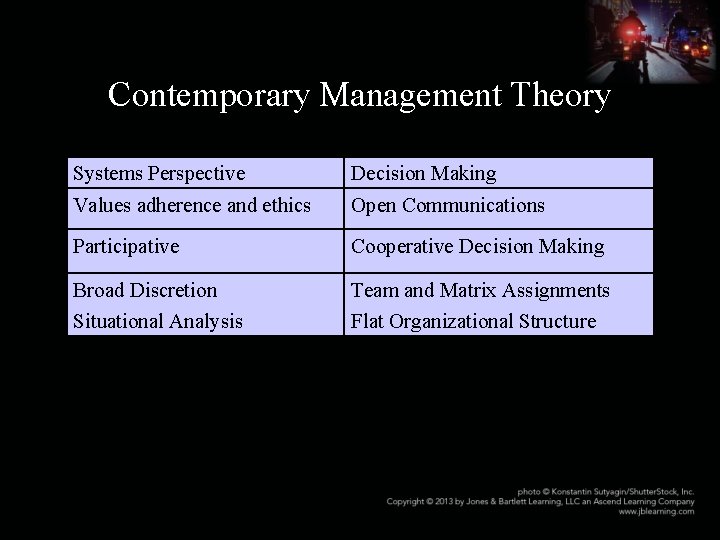
Contemporary Management Theory Systems Perspective Decision Making Values adherence and ethics Open Communications Participative Cooperative Decision Making Broad Discretion Situational Analysis Team and Matrix Assignments Flat Organizational Structure
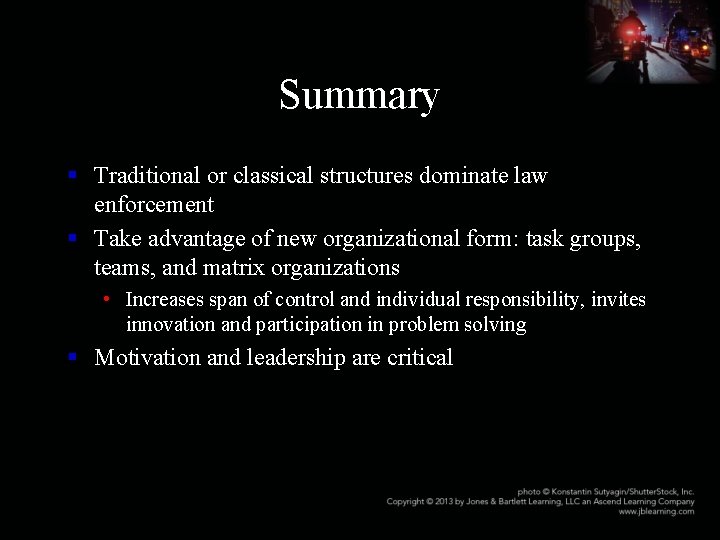
Summary § Traditional or classical structures dominate law enforcement § Take advantage of new organizational form: task groups, teams, and matrix organizations • Increases span of control and individual responsibility, invites innovation and participation in problem solving § Motivation and leadership are critical