
Chapter 5 Objectives Political Campaigns RacialEthnic Politics Women

Chapter 5: Objectives. . . . Political Campaigns. . . . Racial/Ethnic Politics. . . . Women in Politics. . . . Voting. . . . Primary, General, and Special Elections. . . .
Conducting Campaigns in the 21 st Century • Importance of the Media – More than 13. 5 million potential voters in 254 counties – Increased money necessary to reach large geographic areas – Candidates need to raise large amounts of cash at local, state, and national levels
Media • Television – Appearance and technique critical – Make use of sound bites • Radio – Older medium, not used as frequently • Internet – Low cost must be balanced with issues of the medium – Lots of access points
Media • Issues – Less focus on issues and more focus on personalities – Candidate’s public and private life remain open 24/7 – Older voters with limited access to the Internet – Resistance to spam – Blogs – Cybersquatting
Mudslide Campaigns • Mudslide campaigns – Low ethical-level campaigning with avoidance of critical public issues • Negative campaigning grew when candidate’s character grew in importance in mid-1990 s • More campaign cash may contribute to increased mudslinging
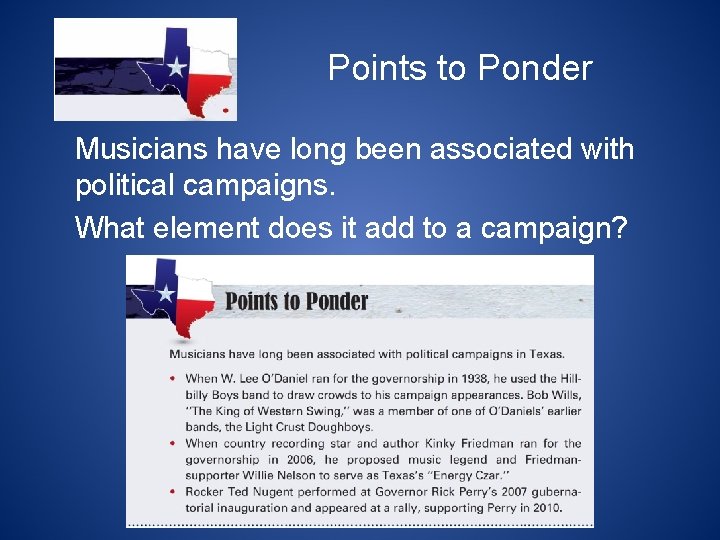
Points to Ponder Musicians have long been associated with political campaigns. What element does it add to a campaign?
Campaign Reform • Eliminating Negative Campaigning • Increasing Free Media Access – Need to pay for increased media formats has forced candidates to raise more money • Campaign Finance Reform – “Money makes the mare go” – Federal and state laws guide campaign finance – Political Action Committee (PAC)–donations
Campaign Finance Reform • Texas Campaign Finance Laws – Weak – Focus on disclosure not enforcement • Texas Ethics Commission (TEC) – Created to monitor lobbyist and candidate campaigns – All candidates and lobbyist must register with TEC – Candidates must regularly report political campaign contributions
State Campaign Finance Reform Some of the Current State Campaign Finance Requirements Excluding judicial campaigns, Texas has no laws that limit the amount of campaign contributions to a candidate. Officials of cities with more than 100, 000 population and trustees of school districts with enrollments of 5, 000 or more must disclose the sources of their income. Candidates must identify employers and occupations of people contributing $500 or more. Donations are not allowed during Legislative Session. Prohibits lawmakers from lobbying for clients before state agencies.
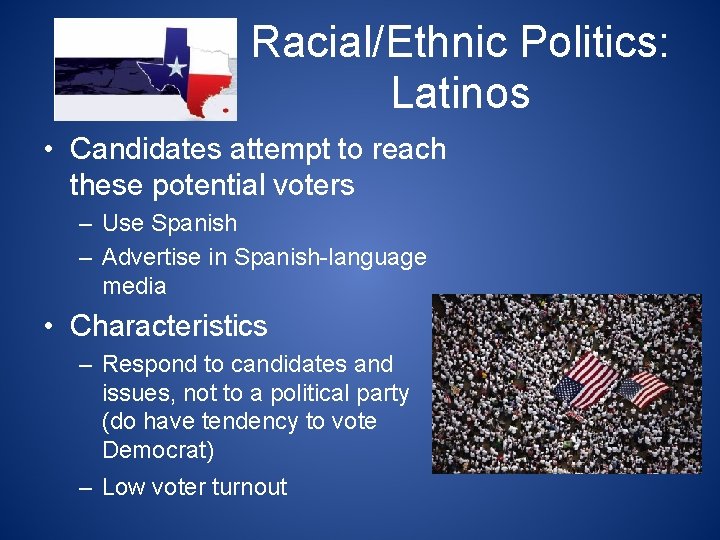
Racial/Ethnic Politics: Latinos • Candidates attempt to reach these potential voters – Use Spanish – Advertise in Spanish-language media • Characteristics – Respond to candidates and issues, not to a political party (do have tendency to vote Democrat) – Low voter turnout
Racial/Ethnic Politics: Latinos • Elected Latino Texas officials (2010) – Two statewide positions – Six U. S. Representatives from Texas – 37 legislative seats in the Texas Legislature – More than 2, 000 of the remaining 5, 200 elected positions in the state • Some Issues – Economy – Immigration – Bilingual Education
Racial/Ethnic Politics: African Americans • Constitute about 10 percent of the state’s potential voters • More than 90 percent of state’s African Americans of voting age support Democratic candidates – Tend to remain with the Democratic Party regardless of income • Elected Texas Office (2010) – – Three statewide positions Three U. S. Representative seats from Texas 16 legislative seats in the Texas Legislature More than 500 of the remaining 5, 200 elected positions in the state
Texas Women in Politics • History – Through 1990, only four women had held state-wide public office – In 1971, no women served in Texas’ congressional delegation and only two served in the Texas Legislature – In 2000, 2002, and 2006 women led all candidates on either ticket in votes received • Elected Texas Women (2010) - Four U. S. Representative seats from Texas - 44 in the Texas Legislature - First openly gay woman of major U. S. city
Texas Women in Politics • Women in Policy Making – Increased punishment for family violence and sexual abuse of children – Renewed focus on public education • Fewer women than men seek elective public office: Why? – Difficulty in raising money – Home and parental obligations – Prejudice against election of women
Universal Suffrage • Universal suffrage – Almost all citizens 18 years of age and older can vote • The U. S. Supreme Court has declared the right to vote the “preservative” of all other rights • Despite Constitutional guarantees, the road to universal suffrage did not become a reality in Texas until the mid-1960 s
Obstacles to Voting Literacy Tests • A means to prevent minority people from voting • Required prospective voters to take a test that conditioned voter registration on a person’s literacy or understanding of the U. S. Constitution • Required constitutional-interpretation or citizenship knowledge • Required by some Texas counties • Abolished with the Voting Rights Act of 1965
Obstacles to Voting • Grandfather Clause – Exempted people from educational, property, or tax requirements for voting if qualified to vote before 1867, or were descendants of such persons – Effected mainly whites and began after 1870 • 15 th Amendment (ratified in 1870) – Provided voting rights to all males regardless of race, color, or previous condition of servitude • Guinn v. United States (1915) – Declared the grandfather clause unconstitutional as a violation of 15 th amendment
Obstacles to Voting • Poll Tax – Beginning in 1902, Texas required citizens to pay a tax to become eligible to vote – Required to pay $1. 50–$1. 75 during Oct 1 to Jan 31 upon voter registration – Affected mainly poor minorities or uneducated • 24 th Amendment – To the U. S. Constitution in 1964 abolished poll tax at federal level • Harper v. Virginia State Board of Elections (1966) – The U. S. Supreme Court declared state poll taxes unconstitutional, a violation of the 14 th amendment’s Equal Protection Clause
Obstacles to Voting • White Primaries – Nominating system designed to prevent African Americans and some Mexican Americans from participating in Democratic Primaries • Smith v. Allwright (1944) – Declared white primary unconstitutional
Obstacles to Voting • Racial gerrymandering – Gerrymandering is the practice of manipulating legislative districts to underrepresent persons of a political party or group – Racial gerrymandering designed to influence representation of racial groups in districts – “Packing” – “Cracking” • Majority–Minority Districts – Shaw v. Reno (1993) • At-large Majority Districts – Dilute minority votes
Democratization of the Ballot • Federal Voting Rights Legislation • Voting Rights Act of 1965 – Abolished literacy tests – Prohibited residency requirements of more than 30 days for voting in presidential elections – Required states to provide some form of absentee ballot or early voting – Allows individuals and federal government to sue to request voting examiners
Democratization of the Ballot • Voting Rights of 1975 – Requires bilingual ballots and voting materials in qualified areas • National Voter Registration Act of 1993 – “motor voter law” • 19 th Amendment – Voting rights cannot be denied due to gender • 26 th Amendment – Minimum voting age 18
Voter Turnout • Voter Turnout – the percentage of the votingage population (VAP) casting ballots in an election • Texas’ voter turnout tends to be significantly lower than the rest of the nation Presidential Election Texas Voter Turnout (VAP) U. S. Voter Turnout (VAP) 2004 46% 55% 2008 46% 56%
Voter Turnout • Voter Eligible Population (VEP) – Measuring voter turnout based on those eligible to vote – Tends to run higher • 14% of Texas population ineligible to vote – Citizenship status (13. 8%) – Convicted felons without completed sentence (0. 2%) • VEP Texas turnout higher for 2008 – 55% • 62% VEP turnout for United States
Voter Turnout • Reasons for lower voter turnout • “Turnout Burnout” – Texas attempted to overcome this issue with two uniform elections a year • Negative campaigns • Informational cost–cost of voter information or lack of information • Transactional cost–cost of actually voting • Political socialization–how one develops political beliefs and attitudes
Who Votes • Socioeconomic Influences • Education – Educational level rises, voter turnout increases • Income – Texas ranks ninth in poverty – Lower income citizens often lack access to polls, information, and opportunity to learn • Gender – Women have higher turnout than men
Voter Qualifications • Native-born or naturalized citizen • At least 18 years of age on election day • Resident of the state and county for 30 days preceding election day • Resident of district on election day • Registered voter for at least 30 days preceding election day • Not a convicted felon (unless sentence, probation, and parole are completed) • Mentally competent
Voting Procedures • Election laws compiled in Texas Election Code • Process regulated by both state and federal government • Influenced by Texas Secretary Of State and county election officials • Voter Registration – Intended to determine in advance whether voters meet all the voter qualifications
Early Voting • Early voting at the county court house and selected locations before designated primary, special, and general elections for any reason • Vote by mail with reasons – – – Out of county on election day At least age 65 Physically disabled on election day In jail (but not a convicted felon) In the military or a dependent of military • Vote by fax if in a combat zone • Vote by electronic voting if astronaut in space
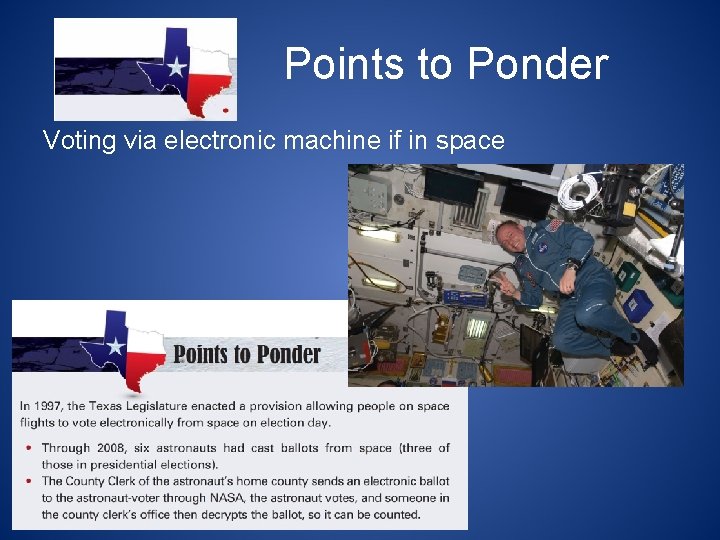
Points to Ponder Voting via electronic machine if in space
Voting Precincts • Voting Precinct – The basic geographic area for conducting elections – Each precinct contains approximately 2, 000 registered voters – 8, 500 voting precincts in Texas • Commissioners Court draws the boundaries of voting precincts and appoints election judges
Election Officials • Election Officials – Party officials conduct primary elections – County clerk or elections administrator prepares general and special election – Less than 30% of counties in Texas employ full-time elections administrator
Point/Counterpoint Online Voting to Increase Voter Turnout Arguments for Arguments Against Increased turnout with greater ease and access More informed electorate Disadvantage for those without access to technology Loss of election integrity Quickest, cheapest and most efficient administration Unlawful electioneering What do you believe?
Voting Systems • Five Voting Systems – Paper ballot – Manually operated voting machine – Optical scan (like Scantrons) – Punch-card – Direct-record electronic (or touchscreen) – Determined by County Commissioners Court
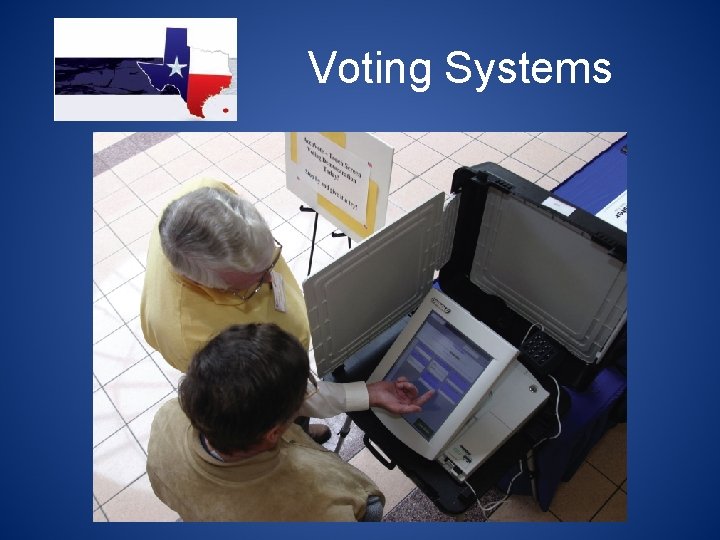
Voting Systems
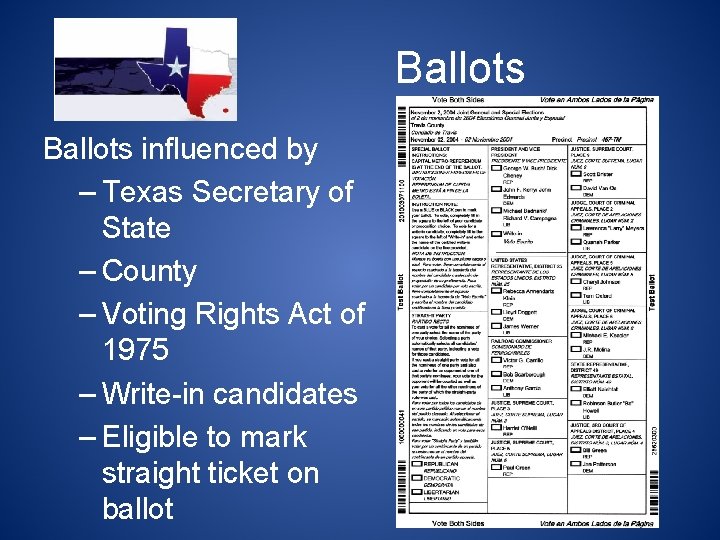
Ballots influenced by – Texas Secretary of State – County – Voting Rights Act of 1975 – Write-in candidates – Eligible to mark straight ticket on ballot
Primaries • Party Primary – Preliminary election within the party to select candidates who will run in general election • Direct Primary – Voters directly select the candidates for public office – Not used for presidential and vice presidential nominees – Nominee must receive majority (50%) of the primary vote to win nomination to general election
Primaries • Runoff Primary – Held a month after the initial primary if a candidate does not receive majority vote in primary elections – Allows voters to choose among top two nominees
Types of Primaries • Closed Primary – Voters must declare party affiliation before primary elections • Open Primary – Voters do not have to declare party affiliation before primary elections
Types of Primaries • Nonpartisan Blanket Primary – Single ballot listing all nominees regardless of party affiliation • Jungle Primary – Nonpartisan blanket primary held in Louisiana state elections – Any candidate that receives greater than 50% of vote is elected to office – If no candidate receives the majority, top two nominees, regardless of party affiliation, appear on general election
Texas Primaries • Texas practices both an open and closed primary system – Declare party affiliation on day of primary and may only vote in that party’s primary for up to a year – Can vote in runoff election if voted in that party’s primary or did not vote in primary at all • Allows for cross-over voting
Texas Primaries • Political parties whose gubernatorial candidate received 20% or more of the vote in the preceding general election must use primaries • Occurs first Tuesday in March of even years – If minor party, candidate determined through convention – Political parties administer primaries and handle nominees – Parties can choose to administer joint primaries that are administered by county
Texas Primaries • Financing Primary Elections – Approximately 30% of cost comes from filing fees of nominees. The balance of primary costs paid for by state. • Nominees may file a nominating petition containing a specified number of signatures in lieu of paying the fee
Students in Action • Kolby Flowers, candidate for Board of Trustees for the Little Cypress-Mauriceville Consolidated Independent School District (LCM CISD) • Who is he? – High school senior • What he’s done? – Created website so students, parents, and educators can discuss the issues – Student Council President • What he’s doing? – Working with students while awaiting election results
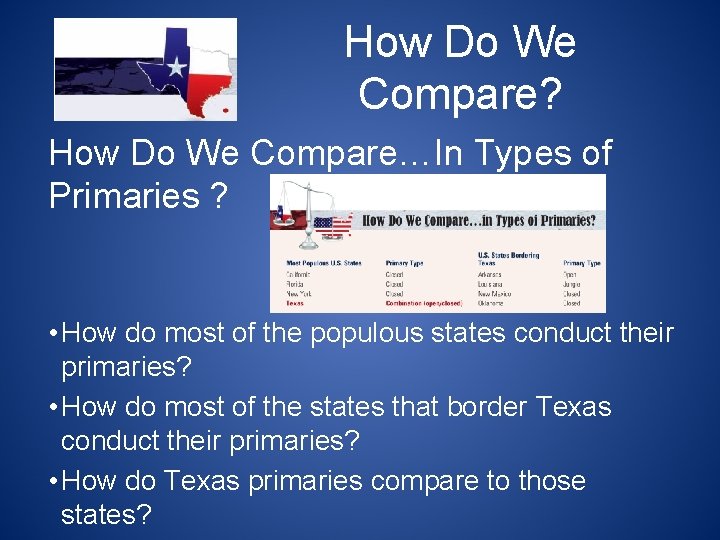
How Do We Compare? How Do We Compare…In Types of Primaries ? • How do most of the populous states conduct their primaries? • How do most of the states that border Texas conduct their primaries? • How do Texas primaries compare to those states?
General Elections • Presidential General Elections – Held every four years on the first Tuesday following the first Monday in November – Voters vote for candidate of party – Winning party selects electors for electoral college vote • Mid-term election – Gubernatorial elections are held at this time – Held every four years on the first Tuesday following the first Monday in November in between presidential elections – Winner receives plurality (most) votes
Who is on the General Election Ballot? • Winners of primary elections • Third parties, minor parties, and independent candidates must collect a large number of signatures to be eligible for general election ballot • Blank slots for write-in candidates are provided if applicable • Can vote straight ticket
- Slides: 48