
CHAPTER 5 Normalization Of Database Tables Part I

CHAPTER 5 Normalization Of Database Tables (Part I: Concept & Process)
Chapter 5: Normalization Of Database Tables 5. 0 Normalization Of Database Tables 5. 1 Database Tables And Normalization 5. 2 The Need For Normalization 5. 3 The Normalization Process 5. 4 Normalization And Database Design 5. 5 Denormalization

Chapter 5: Normalization Of Database Tables 5. 1 Database Tables And Normalization • Table is the basic building block of database design • ER Modeling, yields good table structures, but it is still possible to create poor table structures even in a good database design • How do you recognize a poor tables structure, and how do you produce good table? – Normalization • A process of evaluating and correcting table structures to minimize data redundancies, thereby reducing the possibility of data anomalies • Works through a series of stages called normal forms 3
Chapter 5: Normalization Of Database Tables 5. 1 Database Tables And Normalization • In Chapter 4, ER Modeling, we have adopted a top-down approach to database design that begins by identifying the entities and relationship • Normalization is a bottom-up approach to database design that begins by examining the relationships between attributes 4
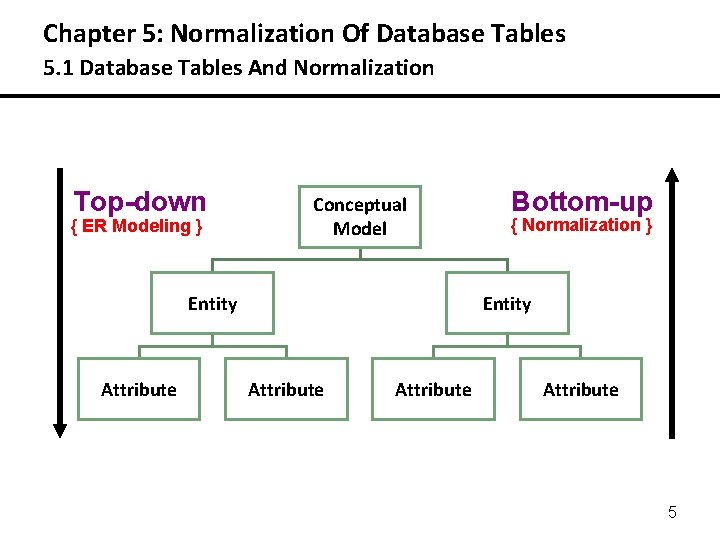
Chapter 5: Normalization Of Database Tables 5. 1 Database Tables And Normalization Top-down { ER Modeling } Conceptual Model Entity Attribute Bottom-up { Normalization } Entity Attribute 5
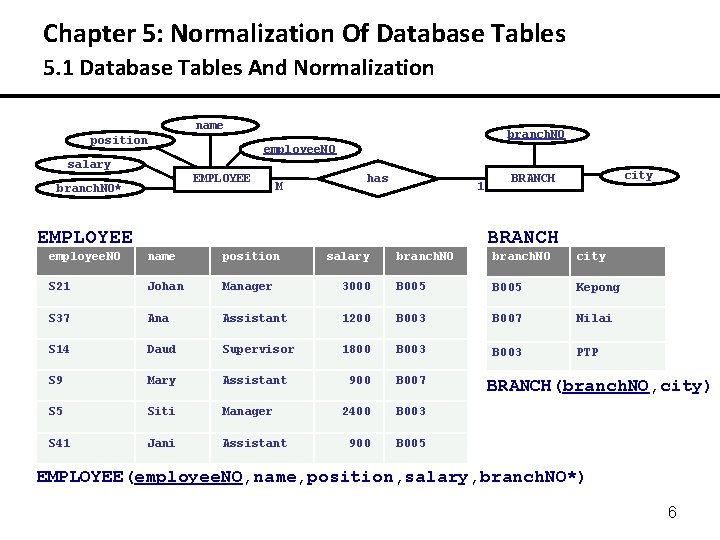
Chapter 5: Normalization Of Database Tables 5. 1 Database Tables And Normalization name position branch. NO employee. NO salary EMPLOYEE branch. NO* M has 1 EMPLOYEE city BRANCH employee. NO name position S 21 Johan Manager S 37 Ana S 14 salary branch. NO city 3000 B 005 Kepong Assistant 1200 B 003 B 007 Nilai Daud Supervisor 1800 B 003 PTP S 9 Mary Assistant 900 B 007 S 5 Siti Manager 2400 B 003 S 41 Jani Assistant 900 B 005 BRANCH(branch. NO, city) EMPLOYEE(employee. NO, name, position, salary, branch. NO*) 6
Chapter 5: Normalization Of Database Tables 5. 2 The Need For Normalization • Normalization is typically used with ER Modeling • There are two common situations in which database designers use normalization: i. Designing a new database • When designing a new database structure based on the business requirements of the end users, the database designer will construct a data model using technique such as Crow’s Foot notation ERDs • After the initial design is complete, the designer can used normalization to analyze the relationships that exist among the attributes within each entity, to determine if the structure can be improved through normalization 7

Chapter 5: Normalization Of Database Tables 5. 2 The Need For Normalization • Normalization is typically used with ER Modeling • There are two common situations in which database designers use normalization: ii. Modifying existing data structures • Sometimes database designer are asked to modify existing data structures that can be in form of flat files, spreadsheet, or older database structures • Normalization process can be used to analyze the relationship among the attributes or fields in the data structures, to improve the existing data structure in order to create an appropriate database design 8
Chapter 5: Normalization Of Database Tables 5. 2 The Need For Normalization • There for in both situations describe, the need for normalization are: • to analyze the relationship among the attributes or fields in the data structures • to improve the existing data structure in order to create an appropriate database design – Normalization • A process of evaluating and correcting table structures to minimize data redundancies, thereby reducing the possibility of data anomalies 9
Chapter 5: Normalization Of Database Tables 5. 3 The Normalization Process • When we design a database, the main objective is to create an accurate representation of data, relationship between the data, and constrains on the data that is relevant. • To achieve this objective, we have to identify suitable set of relations (table) by creating good table structure. – Normalization • A process of evaluating and correcting table structures to minimize data redundancies, thereby reducing the possibility of data anomalies • Works through a series of stages called normal forms 10
Chapter 5: Normalization Of Database Tables 5. 3 The Normalization Process • The most commonly used normal forms: • First Normal Form (1 NF) • Second Normal Form (2 NF) • Third Normal Form (3 NF) • 2 NF is better than 1 NF; 3 NF is better than 2 NF • Highest normalization is not always desirable; joint vs redundancy • For most business database design purposes, 3 NF is as high as we need to go in normalization process 11
Chapter 5: Normalization Of Database Tables 5. 3 The Normalization Process • Every normal form is based on functional dependencies between attributes in a relationship • Each relationship can be normalized into a specific form to avoid anomalies • Anomalies? • anomaly = abnormality • ideally a field value change, should be made only in a single place • Data redundancy, however, fosters an abnormal condition by forcing field value changes in many different locations • Insertion anomalies • Deletion anomalies • Modification anomalies 12
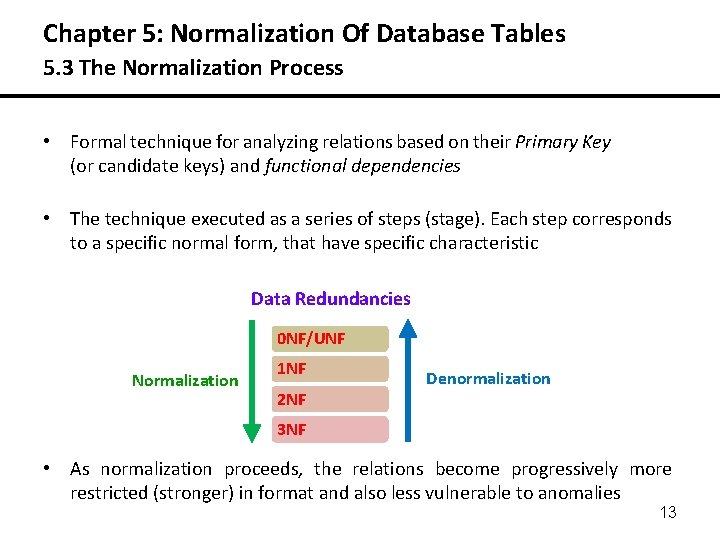
Chapter 5: Normalization Of Database Tables 5. 3 The Normalization Process • Formal technique for analyzing relations based on their Primary Key (or candidate keys) and functional dependencies • The technique executed as a series of steps (stage). Each step corresponds to a specific normal form, that have specific characteristic Data Redundancies 0 NF/UNF Normalization 1 NF 2 NF Denormalization 3 NF • As normalization proceeds, the relations become progressively more restricted (stronger) in format and also less vulnerable to anomalies 13
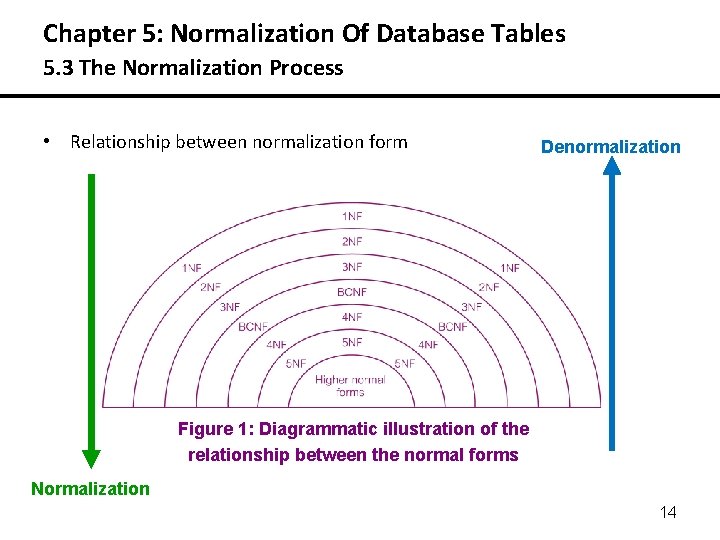
Chapter 5: Normalization Of Database Tables 5. 3 The Normalization Process • Relationship between normalization form Denormalization Figure 1: Diagrammatic illustration of the relationship between the normal forms Normalization 14
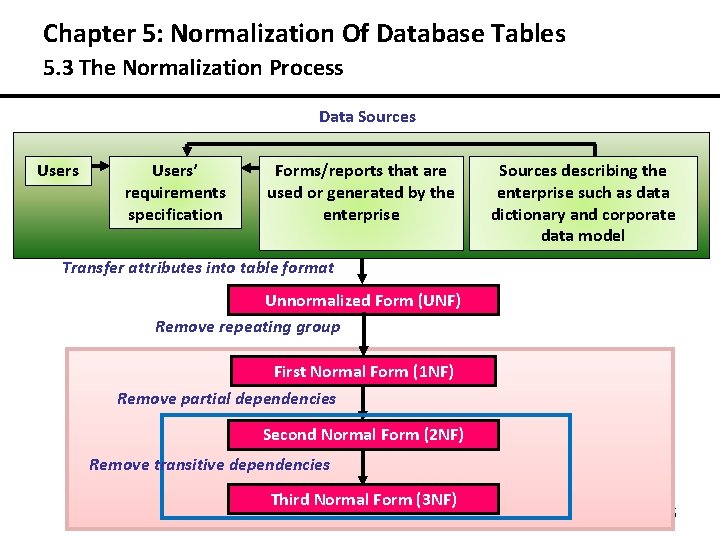
Chapter 5: Normalization Of Database Tables 5. 3 The Normalization Process Data Sources Users’ requirements specification Forms/reports that are used or generated by the enterprise Sources describing the enterprise such as data dictionary and corporate data model Transfer attributes into table format Unnormalized Form (UNF) Remove repeating group First Normal Form (1 NF) Remove partial dependencies Second Normal Form (2 NF) Remove transitive dependencies Third Normal Form (3 NF) 15
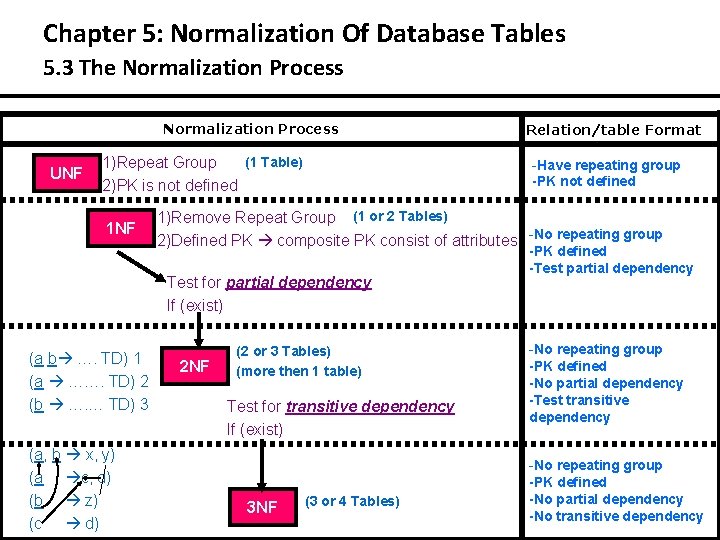
Chapter 5: Normalization Of Database Tables 5. 3 The Normalization Process UNF (1 Table) 1)Repeat Group 2)PK is not defined 1 NF -Have repeating group -PK not defined 1)Remove Repeat Group (1 or 2 Tables) 2)Defined PK composite PK consist of attributes -No repeating group Test for partial dependency If (exist) (a b …. TD) 1 (a ……. TD) 2 (b …. … TD) 3 (a, b x, y) (a c, d) (b z) (c d) Relation/table Format 2 NF (2 or 3 Tables) (more then 1 table) Test for transitive dependency If (exist) 3 NF (3 or 4 Tables) -PK defined -Test partial dependency -No repeating group -PK defined -No partial dependency -Test transitive dependency -No repeating group -PK defined -No partial dependency -No transitive dependency
Chapter 5: Normalization Of Database Tables 5. 3 The Normalization Process Functional Dependencies • An important concept associated with normalization is functional dependency which describes the relationship between attributes • In this section, you will learn about functional dependency and then focus on the particular characteristics of functional dependency that are useful for normalization 17
Chapter 5: Normalization Of Database Tables 5. 3 The Normalization Process Characteristic Of Functional Dependencies • For the discussion on functional dependency, assume that a relational schema has attributes (A, B, C, …, Z) and that the database is describe by a single universal relation called R=(A, B, C, …, Z). This assumption means that every attribute in the database has a unique name Functional dependencies: Describe the relationship between attributes in a relation. For example, if A and B are attributes of relation R, B is functionally dependent on A (denoted A B), if each value of A is associated with exactly one value of B. (A and B may each consist of one or more attributes. ) 18
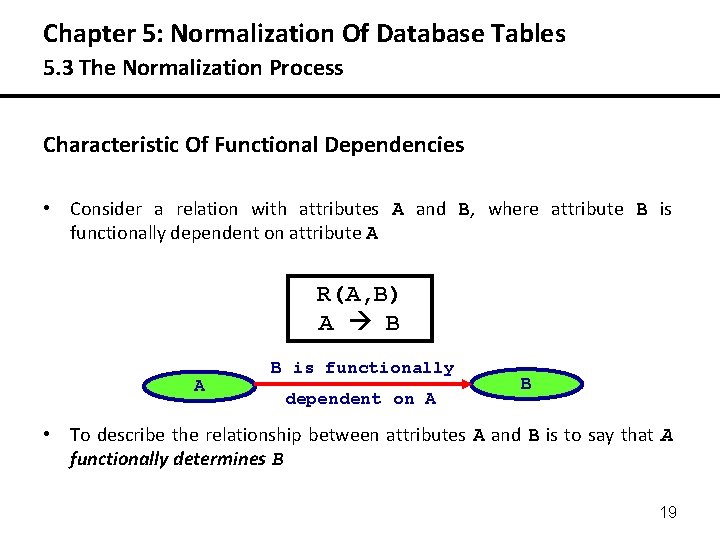
Chapter 5: Normalization Of Database Tables 5. 3 The Normalization Process Characteristic Of Functional Dependencies • Consider a relation with attributes A and B, where attribute B is functionally dependent on attribute A R(A, B) A B A B is functionally dependent on A B • To describe the relationship between attributes A and B is to say that A functionally determines B 19
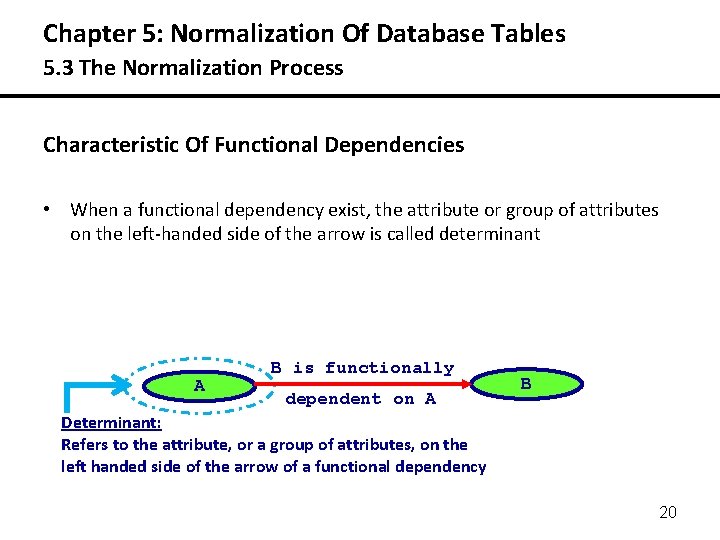
Chapter 5: Normalization Of Database Tables 5. 3 The Normalization Process Characteristic Of Functional Dependencies • When a functional dependency exist, the attribute or group of attributes on the left-handed side of the arrow is called determinant A B is functionally dependent on A B Determinant: Refers to the attribute, or a group of attributes, on the left handed side of the arrow of a functional dependency 20
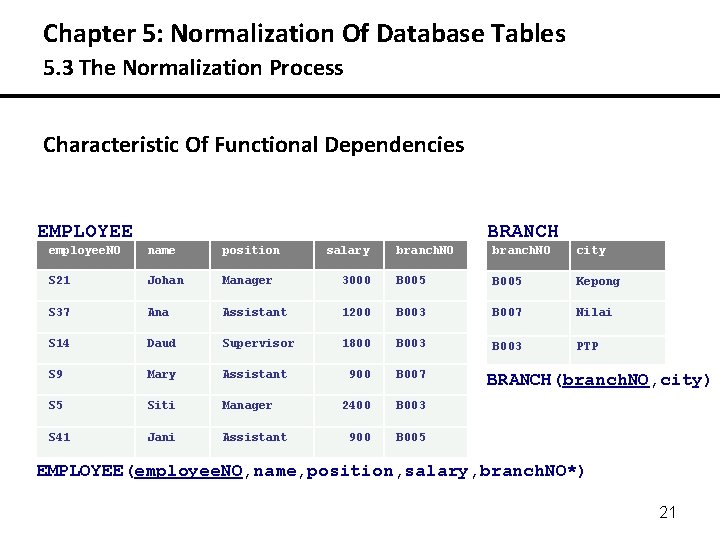
Chapter 5: Normalization Of Database Tables 5. 3 The Normalization Process Characteristic Of Functional Dependencies EMPLOYEE BRANCH employee. NO name position S 21 Johan Manager S 37 Ana S 14 salary branch. NO city 3000 B 005 Kepong Assistant 1200 B 003 B 007 Nilai Daud Supervisor 1800 B 003 PTP S 9 Mary Assistant 900 B 007 S 5 Siti Manager 2400 B 003 S 41 Jani Assistant 900 B 005 BRANCH(branch. NO, city) EMPLOYEE(employee. NO, name, position, salary, branch. NO*) 21
Chapter 5: Normalization Of Database Tables 5. 3 The Normalization Process Unnormalized Form (UNF)/(0 NF) • Unnormalized Form (UNF)/(0 NF) A table that contains one or more repeating groups To create an unnormalized table – Transform the data from the information source (e. g. form) into table format with columns and rows
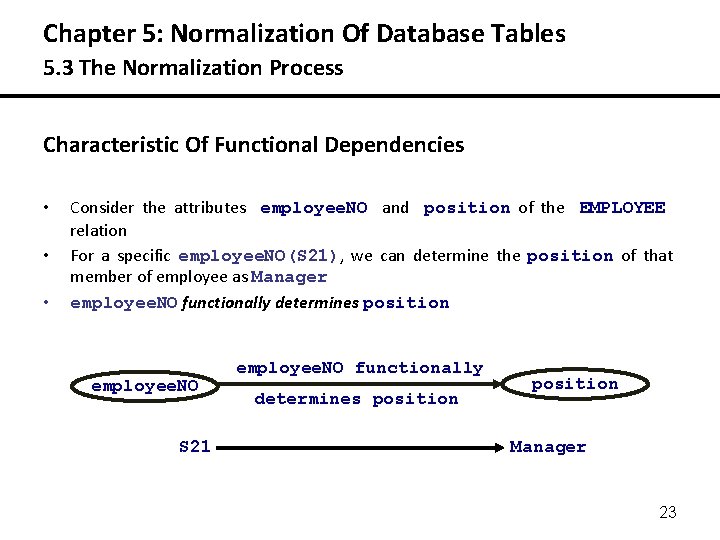
Chapter 5: Normalization Of Database Tables 5. 3 The Normalization Process Characteristic Of Functional Dependencies • • • Consider the attributes employee. NO and position of the EMPLOYEE relation For a specific employee. NO(S 21), we can determine the position of that member of employee as Manager employee. NO functionally determines position employee. NO S 21 employee. NO functionally determines position Manager 23
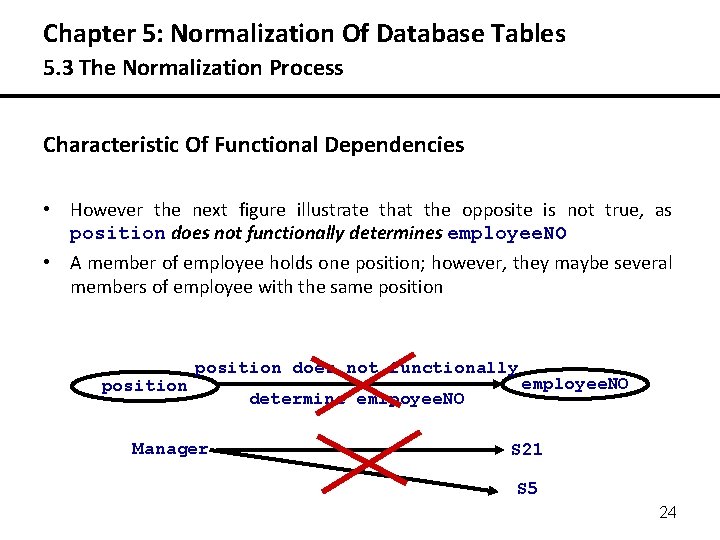
Chapter 5: Normalization Of Database Tables 5. 3 The Normalization Process Characteristic Of Functional Dependencies • However the next figure illustrate that the opposite is not true, as position does not functionally determines employee. NO • A member of employee holds one position; however, they maybe several members of employee with the same position does not functionally Manager determine emlpoyee. NO employee. NO S 21 S 5 24
Chapter 5: Normalization Of Database Tables 5. 3 The Normalization Process Characteristic Of Functional Dependencies • Functional dependency can be describe by two types: – Full functional dependency (Partial dependency) • Will be used to transform 1 NF 2 NF – Transitive dependency • Will be used to transform 2 NF 3 NF 25
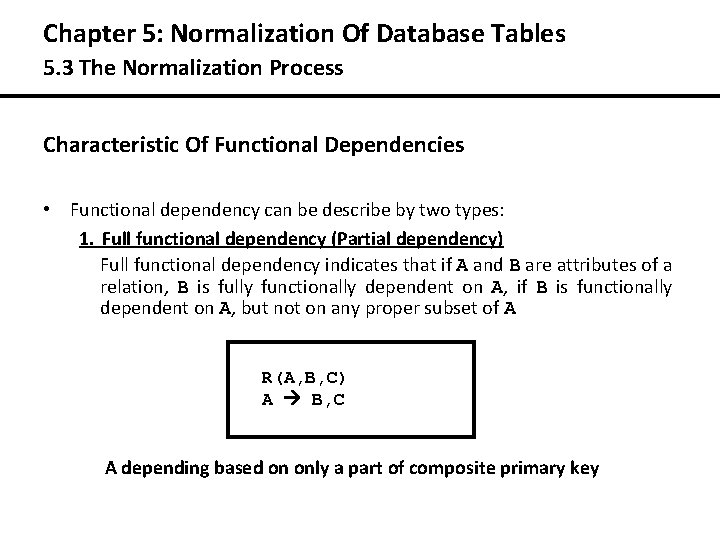
Chapter 5: Normalization Of Database Tables 5. 3 The Normalization Process Characteristic Of Functional Dependencies • Functional dependency can be describe by two types: 1. Full functional dependency (Partial dependency) Full functional dependency indicates that if A and B are attributes of a relation, B is fully functionally dependent on A, if B is functionally dependent on A, but not on any proper subset of A R(A, B, C) A B, C A depending based on only a part of composite primary key
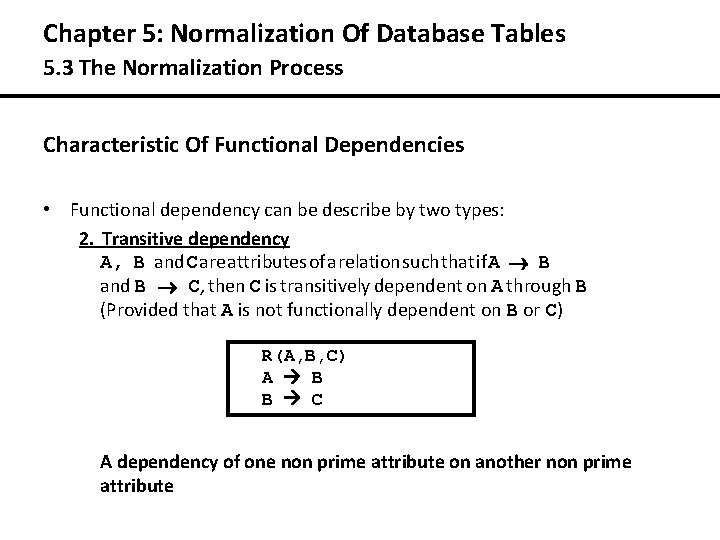
Chapter 5: Normalization Of Database Tables 5. 3 The Normalization Process Characteristic Of Functional Dependencies • Functional dependency can be describe by two types: 2. Transitive dependency A, B and C are attributes of a relation such that if A B and B C, then C is transitively dependent on A through B (Provided that A is not functionally dependent on B or C) R(A, B, C) A B B C A dependency of one non prime attribute on another non prime attribute
Chapter 5: Normalization Of Database Tables 5. 3 The Normalization Process First Normal Form (1 NF) • First Normal Form (1 NF) A relation in which the intersection of each row and column contains one and only one value A relation is in 1 NF if every attribute for every tuple have a value and domain for each attribute can not be simplified anymore
Chapter 5: Normalization Of Database Tables 5. 3 The Normalization Process Second Normal Form (2 NF) • Second Normal Form (2 NF) A relation that is in 1 NF and every non-PK attribute is fully functionally depends on the PK Based on the concept of partial dependency (dependencies' based on only a part of composite PK) 2 NF applies to relations with composite keys, that is, relations with PK composed of two or more attributes A relation with a single-attribute PK is automatically in at least 2 NF
Chapter 5: Normalization Of Database Tables 5. 3 The Normalization Process Third Normal Form (3 NF) • Third Normal Form (3 NF) A relation that is in 1 NF and 2 NF and which no non-PK attribute is transitively dependent on the PK Based on the concept of transitive dependency, where; A, B and. Careattributes ofarelationsuchthatif. A B and B C then C is transitively dependent on A through B (Provided that A is not functionally dependent on B or C) 3 NF applies to relations with transitive dependency A relation that have no transitive dependency are already in 3 NF
Chapter 5: Normalization Of Database Tables 5. 3 The Normalization Process UNF To 1 NF • Nominate an attribute or group of attributes to act as the key for the unnormalized table • Identify the repeating group(s) in the unnormalized table which repeats for the key attribute(s), remove the repeating group by – entering appropriate data into the empty columns of rows containing the repeating data • Fill the blanks by duplicating the non repeating data, where required • This approach is commonly referred to as ”flattening table” • This approach will produce redundancy in a relationship, but it can be eliminated in higher normalization process
Chapter 5: Normalization Of Database Tables 5. 3 The Normalization Process 1 NF To 2 NF • • • Identify the primary key for the 1 NF relation Identify the functional dependencies in the relation. • Draw functional dependencies diagram • Write functional dependencies in relational schema If partial dependencies exist on the primary key remove them by placing them in a new relation along with a copy of their determinant
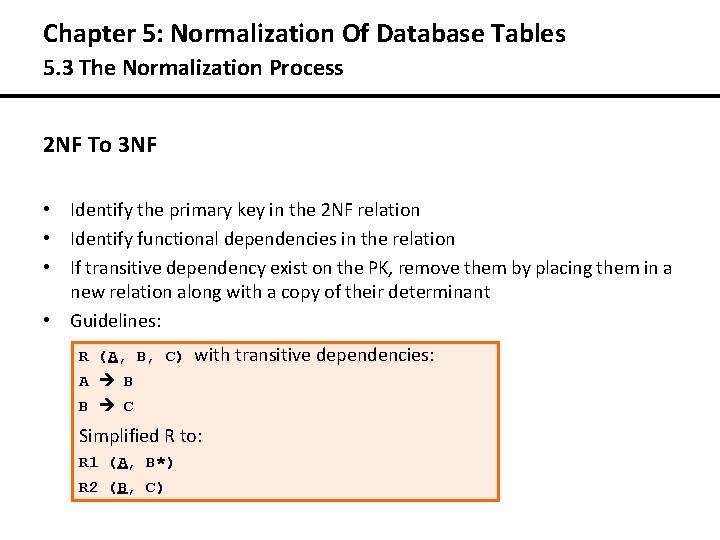
Chapter 5: Normalization Of Database Tables 5. 3 The Normalization Process 2 NF To 3 NF • Identify the primary key in the 2 NF relation • Identify functional dependencies in the relation • If transitive dependency exist on the PK, remove them by placing them in a new relation along with a copy of their determinant • Guidelines: R (A, B, C) with transitive dependencies: A B B C Simplified R to: R 1 (A, B*) R 2 (B, C)
Chapter 5: Normalization Of Database Tables 5. 4 Normalization & Database Design • Normalization should be part of the design process. • Make sure the proposed entities meet the required normal form before the table structures are created • Be aware of good design principles and procedures as well as normalization procedures • ERD: is created by interactive process, begin by identifying relevant entities, their attributes, and their relationship. ERD provides the big picture/macro view, of an organization’s data requirements & operations. • Normalization: focuses on the characteristics of specific entities: that is represents macro view of the entities within the ERD • Therefore the two techniques are used in an iterative and incremental process
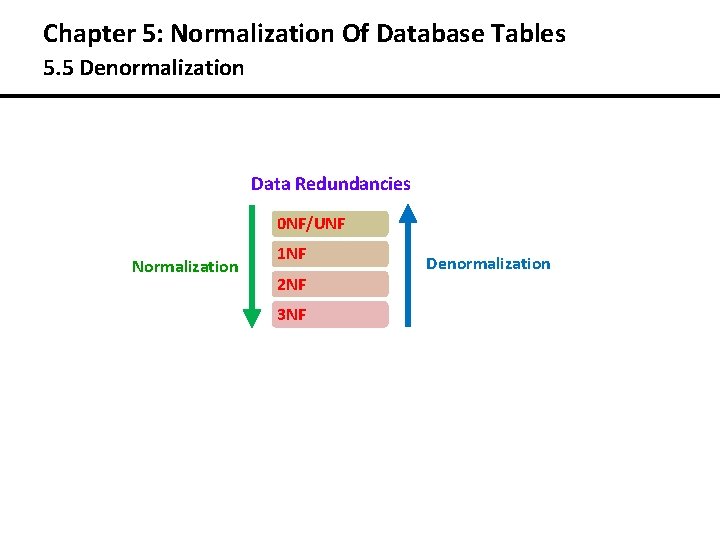
Chapter 5: Normalization Of Database Tables 5. 5 Denormalization Data Redundancies 0 NF/UNF Normalization 1 NF 2 NF 3 NF Denormalization
- Slides: 35