
Chapter 5 Nomenclature Naming Compounds 5 1 5
- Slides: 41
Chapter 5 Nomenclature
Naming Compounds 5. 1 5. 2 5. 3 5. 4 5. 5 5. 6 5. 7 Naming Compounds Naming Binary Compounds That Contain a Metal and a Nonmetal (Types I and II) Naming Binary Compounds That Contain Only Nonmetals (Type III) Naming Binary Compounds: A Review Naming Compounds That Contain Polyatomic Ions Naming Acids Writing Formulas from Names Return to TOC 2
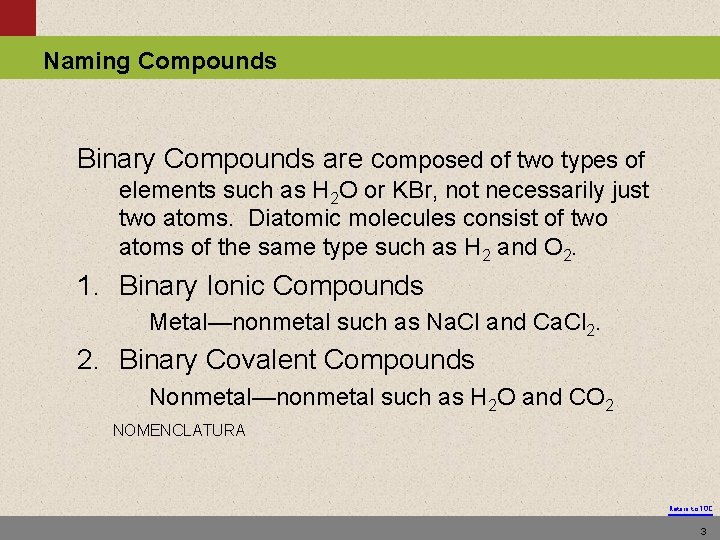
Naming Compounds Binary Compounds are composed of two types of elements such as H 2 O or KBr, not necessarily just two atoms. Diatomic molecules consist of two atoms of the same type such as H 2 and O 2. 1. Binary Ionic Compounds Metal—nonmetal such as Na. Cl and Ca. Cl 2. Binary Covalent Compounds Nonmetal—nonmetal such as H 2 O and CO 2 NOMENCLATURA Return to TOC 3
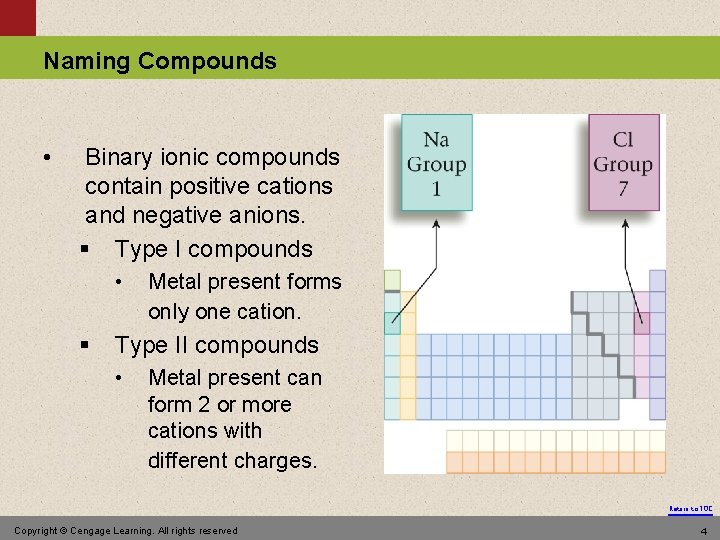
Naming Compounds • Binary ionic compounds contain positive cations and negative anions. § Type I compounds • § Metal present forms only one cation. Type II compounds • Metal present can form 2 or more cations with different charges. Return to TOC Copyright © Cengage Learning. All rights reserved 4
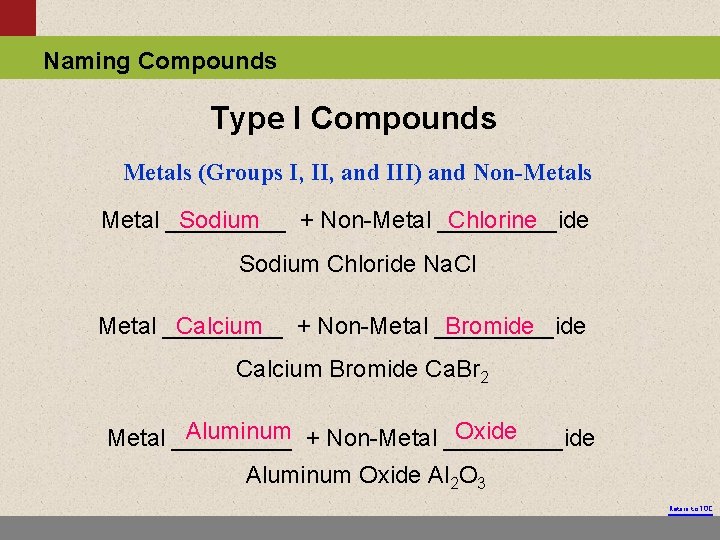
Naming Compounds Type I Compounds Metals (Groups I, II, and III) and Non-Metals Metal _____ Sodium + Non-Metal _____ide Chlorine Sodium Chloride Na. Cl Metal _____ Calcium + Non-Metal _____ide Bromide Calcium Bromide Ca. Br 2 Aluminum + Non-Metal _____ide Oxide Metal _____ Aluminum Oxide Al 2 O 3 Return to TOC
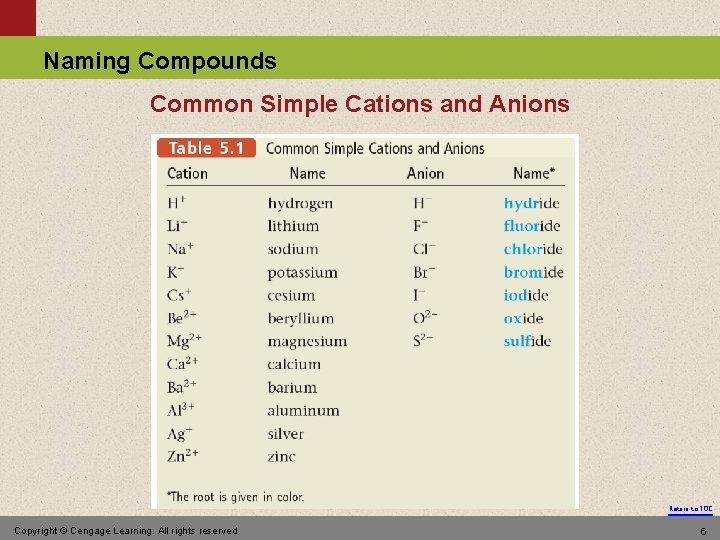
Naming Compounds Common Simple Cations and Anions Return to TOC Copyright © Cengage Learning. All rights reserved 6
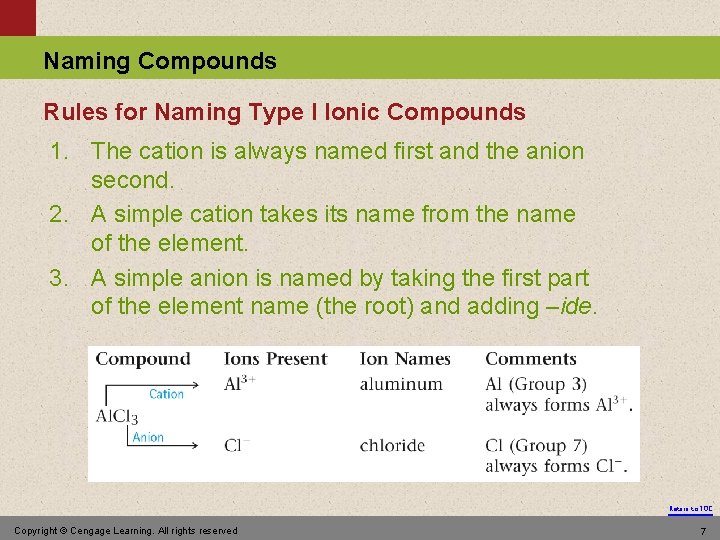
Naming Compounds Rules for Naming Type I Ionic Compounds 1. The cation is always named first and the anion second. 2. A simple cation takes its name from the name of the element. 3. A simple anion is named by taking the first part of the element name (the root) and adding –ide. Return to TOC Copyright © Cengage Learning. All rights reserved 7
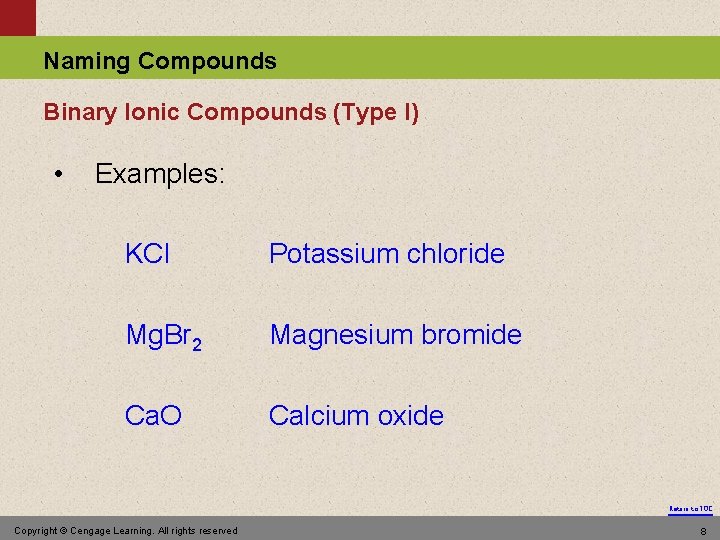
Naming Compounds Binary Ionic Compounds (Type I) • Examples: KCl Potassium chloride Mg. Br 2 Magnesium bromide Ca. O Calcium oxide Return to TOC Copyright © Cengage Learning. All rights reserved 8
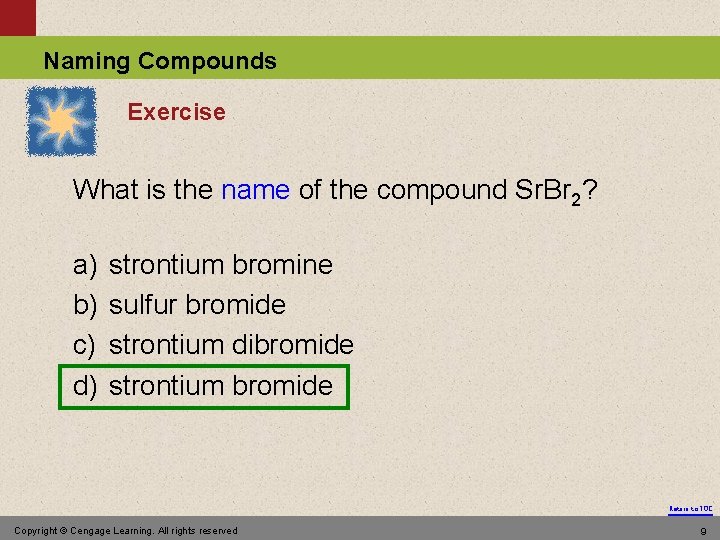
Naming Compounds Exercise What is the name of the compound Sr. Br 2? a) b) c) d) strontium bromine sulfur bromide strontium dibromide strontium bromide Return to TOC Copyright © Cengage Learning. All rights reserved 9
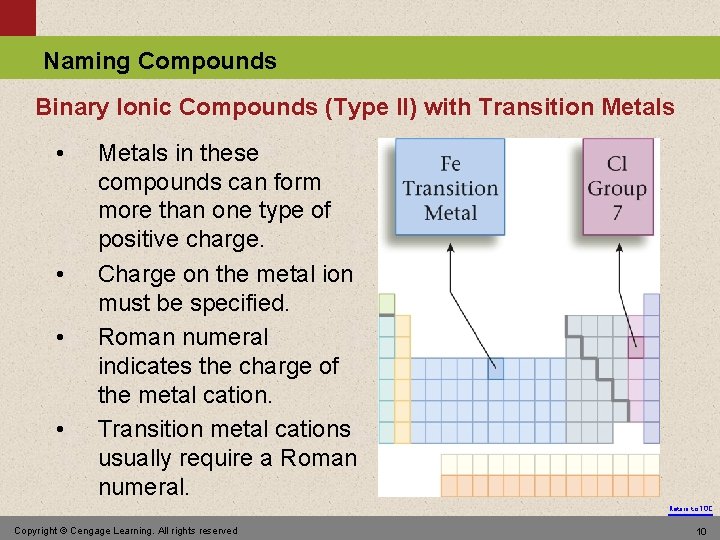
Naming Compounds Binary Ionic Compounds (Type II) with Transition Metals • • Metals in these compounds can form more than one type of positive charge. Charge on the metal ion must be specified. Roman numeral indicates the charge of the metal cation. Transition metal cations usually require a Roman numeral. Return to TOC Copyright © Cengage Learning. All rights reserved 10
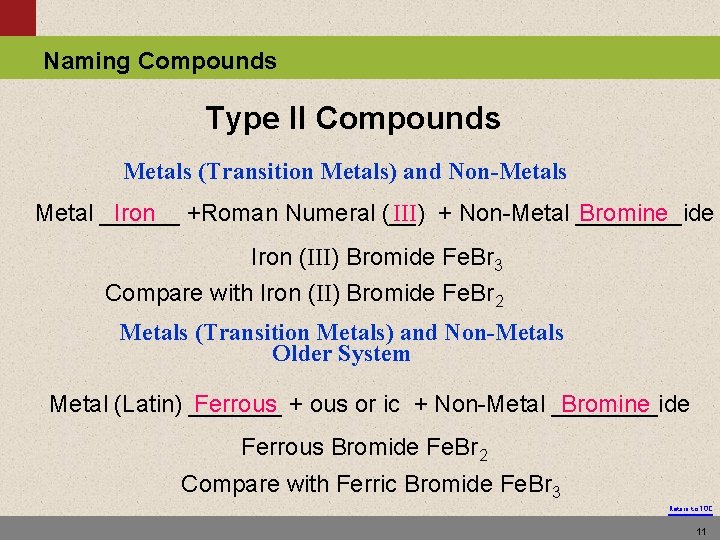
Naming Compounds Type II Compounds Metals (Transition Metals) and Non-Metals Iron +Roman Numeral (__) III + Non-Metal ____ide Bromine Metal ______ Iron (III) Bromide Fe. Br 3 Compare with Iron (II) Bromide Fe. Br 2 Metals (Transition Metals) and Non-Metals Older System Metal (Latin) _______ Ferrous + ous or ic + Non-Metal ____ide Bromine Ferrous Bromide Fe. Br 2 Compare with Ferric Bromide Fe. Br 3 Return to TOC 11
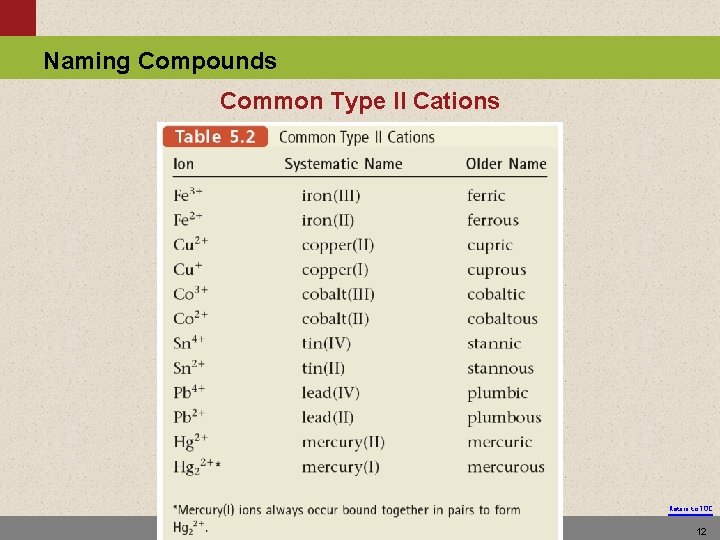
Naming Compounds Common Type II Cations Return to TOC 12
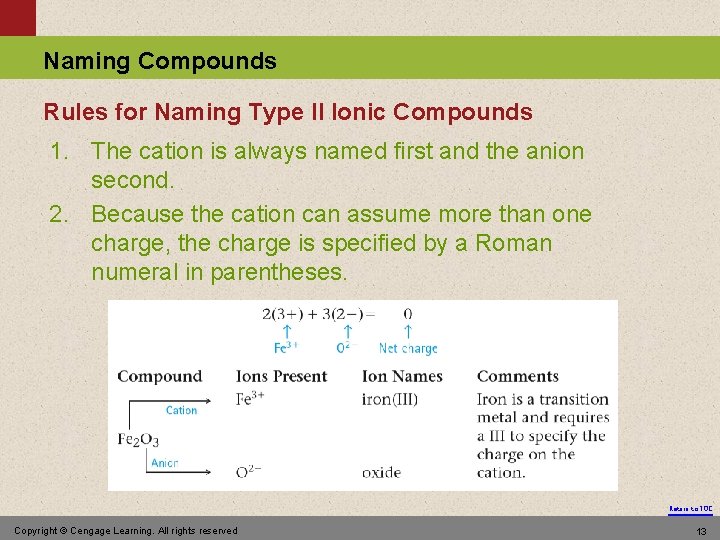
Naming Compounds Rules for Naming Type II Ionic Compounds 1. The cation is always named first and the anion second. 2. Because the cation can assume more than one charge, the charge is specified by a Roman numeral in parentheses. Return to TOC Copyright © Cengage Learning. All rights reserved 13
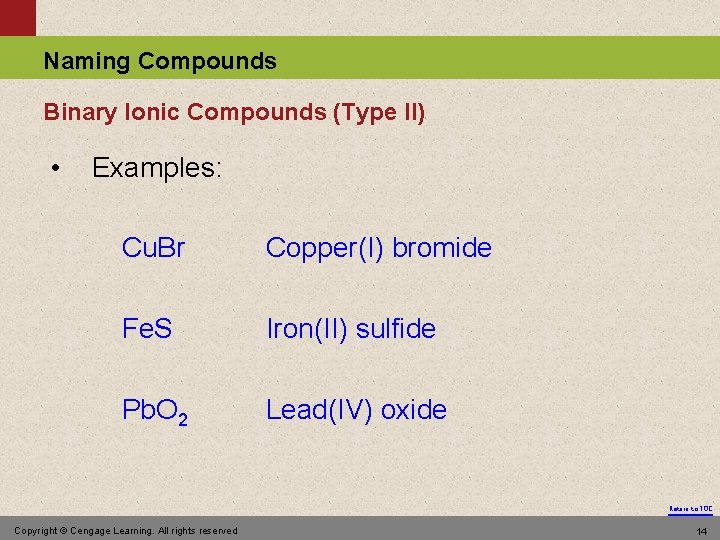
Naming Compounds Binary Ionic Compounds (Type II) • Examples: Cu. Br Copper(I) bromide Fe. S Iron(II) sulfide Pb. O 2 Lead(IV) oxide Return to TOC Copyright © Cengage Learning. All rights reserved 14
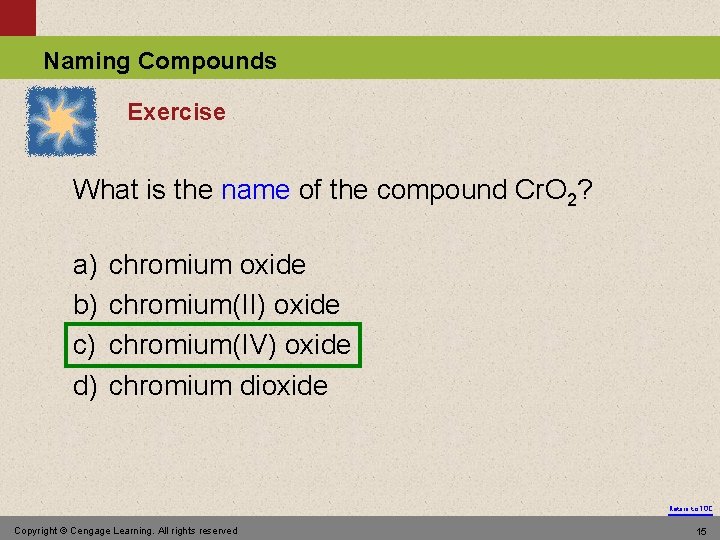
Naming Compounds Exercise What is the name of the compound Cr. O 2? a) b) c) d) chromium oxide chromium(II) oxide chromium(IV) oxide chromium dioxide Return to TOC Copyright © Cengage Learning. All rights reserved 15
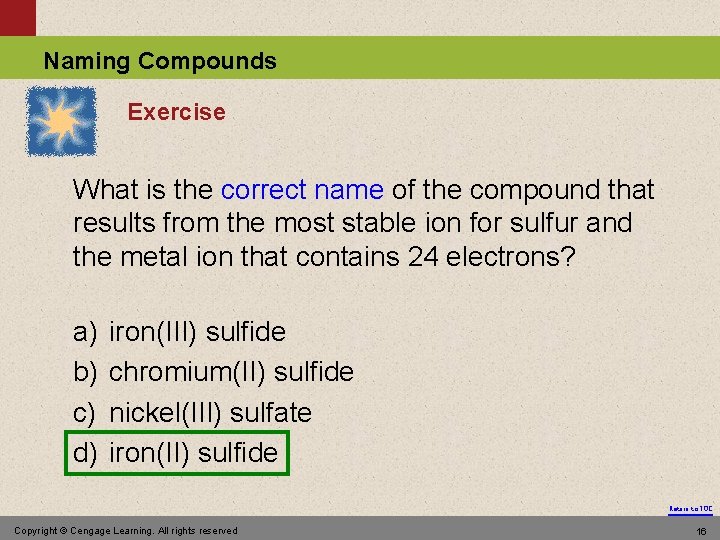
Naming Compounds Exercise What is the correct name of the compound that results from the most stable ion for sulfur and the metal ion that contains 24 electrons? a) b) c) d) iron(III) sulfide chromium(II) sulfide nickel(III) sulfate iron(II) sulfide Return to TOC Copyright © Cengage Learning. All rights reserved 16
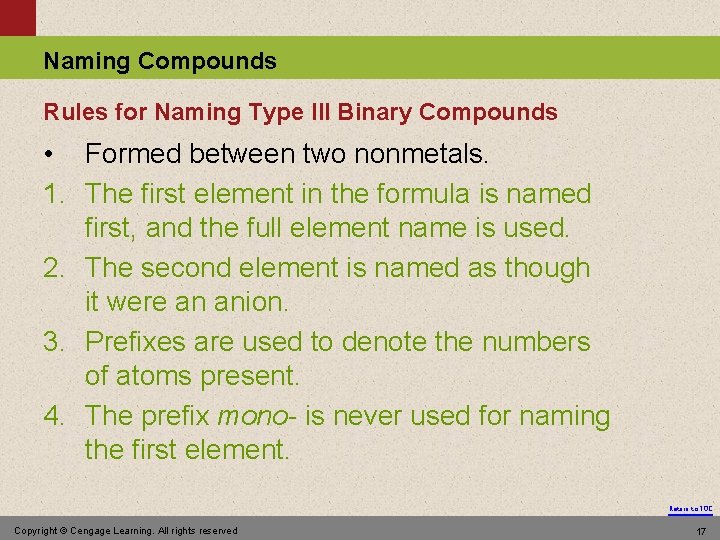
Naming Compounds Rules for Naming Type III Binary Compounds • Formed between two nonmetals. 1. The first element in the formula is named first, and the full element name is used. 2. The second element is named as though it were an anion. 3. Prefixes are used to denote the numbers of atoms present. 4. The prefix mono- is never used for naming the first element. Return to TOC Copyright © Cengage Learning. All rights reserved 17
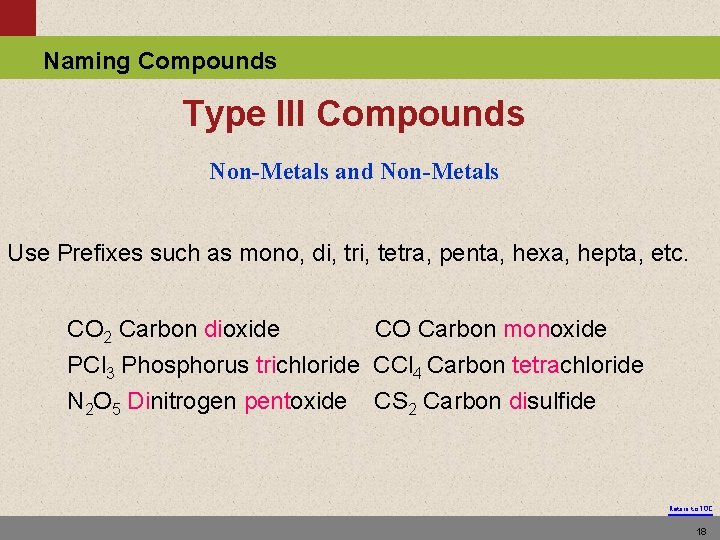
Naming Compounds Type III Compounds Non-Metals and Non-Metals Use Prefixes such as mono, di, tri, tetra, penta, hexa, hepta, etc. CO 2 Carbon dioxide CO Carbon monoxide PCl 3 Phosphorus trichloride CCl 4 Carbon tetrachloride N 2 O 5 Dinitrogen pentoxide CS 2 Carbon disulfide Return to TOC 18
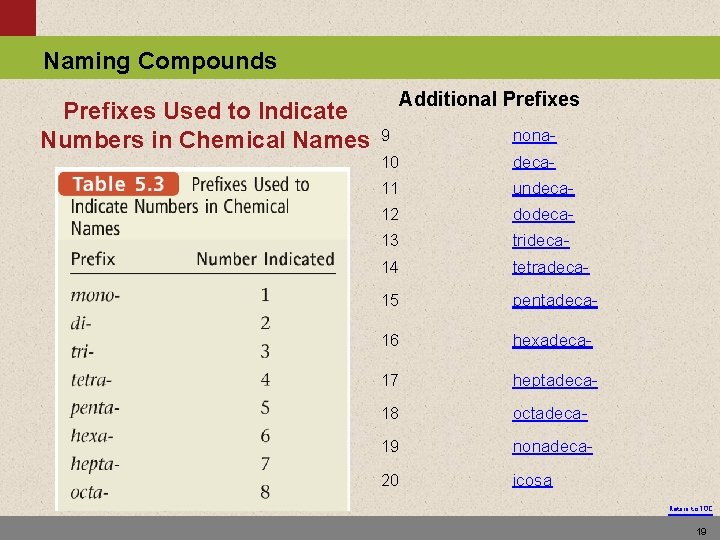
Naming Compounds Prefixes Used to Indicate Numbers in Chemical Names Additional Prefixes 9 nona- 10 deca- 11 undeca- 12 dodeca- 13 trideca- 14 tetradeca- 15 pentadeca- 16 hexadeca- 17 heptadeca- 18 octadeca- 19 nonadeca- 20 icosa Return to TOC 19
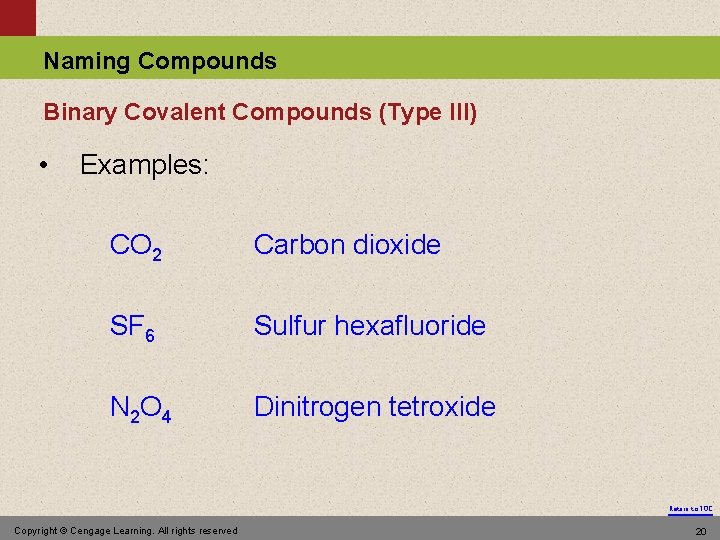
Naming Compounds Binary Covalent Compounds (Type III) • Examples: CO 2 Carbon dioxide SF 6 Sulfur hexafluoride N 2 O 4 Dinitrogen tetroxide Return to TOC Copyright © Cengage Learning. All rights reserved 20
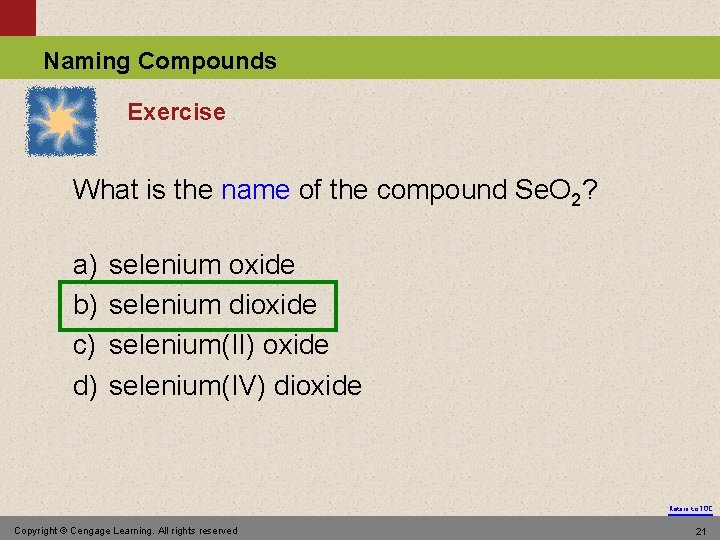
Naming Compounds Exercise What is the name of the compound Se. O 2? a) b) c) d) selenium oxide selenium dioxide selenium(II) oxide selenium(IV) dioxide Return to TOC Copyright © Cengage Learning. All rights reserved 21
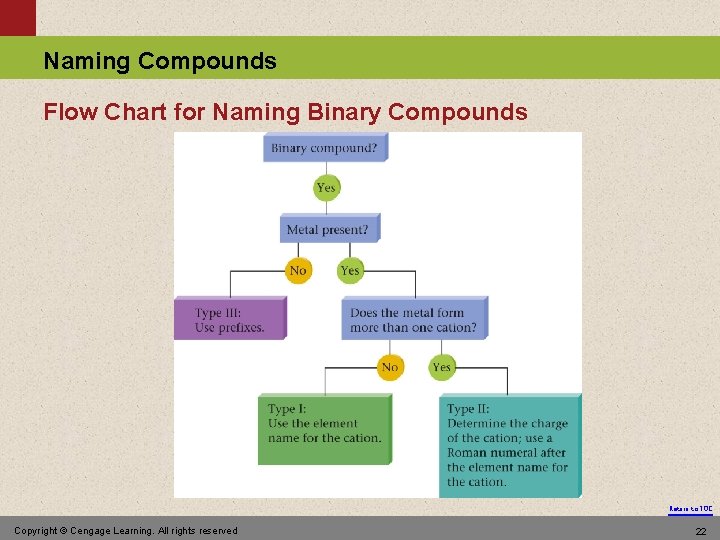
Naming Compounds Flow Chart for Naming Binary Compounds Return to TOC Copyright © Cengage Learning. All rights reserved 22
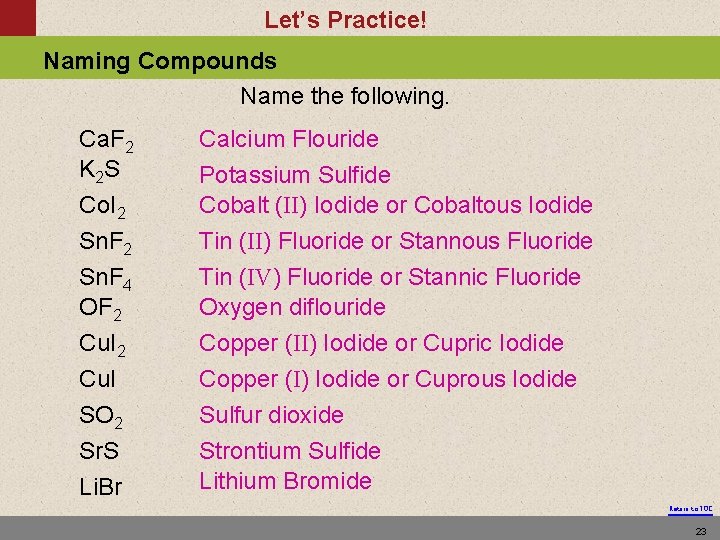
Let’s Practice! Naming Compounds Name the following. Ca. F 2 K 2 S Co. I 2 Sn. F 4 OF 2 Cu. I SO 2 Sr. S Li. Br Calcium Flouride Potassium Sulfide Cobalt (II) Iodide or Cobaltous Iodide Tin (II) Fluoride or Stannous Fluoride Tin (IV) Fluoride or Stannic Fluoride Oxygen diflouride Copper (II) Iodide or Cupric Iodide Copper (I) Iodide or Cuprous Iodide Sulfur dioxide Strontium Sulfide Lithium Bromide Return to TOC 23
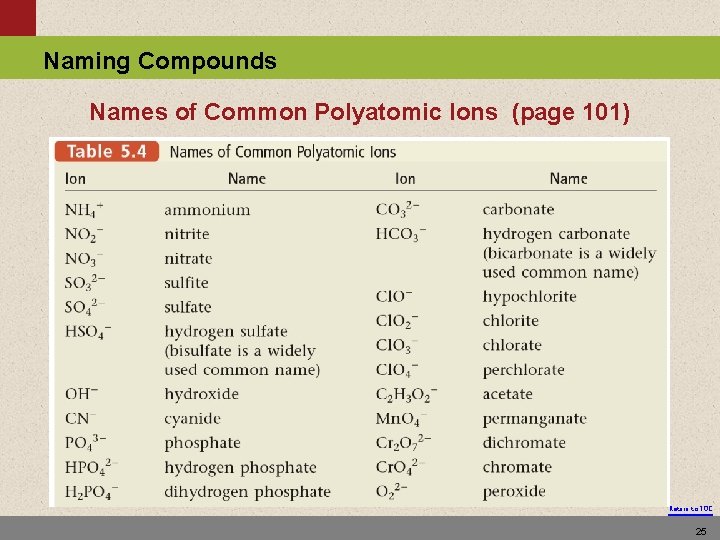
Naming Compounds • • Polyatomic ions are charged entities composed of several atoms bound together. They have special names and must be memorized. Return to TOC Copyright © Cengage Learning. All rights reserved 24
Naming Compounds Names of Common Polyatomic Ions (page 101) Return to TOC 25
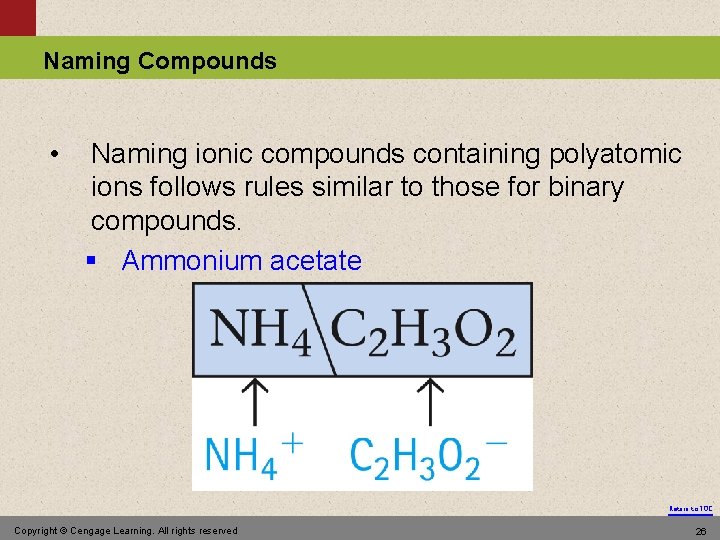
Naming Compounds • Naming ionic compounds containing polyatomic ions follows rules similar to those for binary compounds. § Ammonium acetate Return to TOC Copyright © Cengage Learning. All rights reserved 26
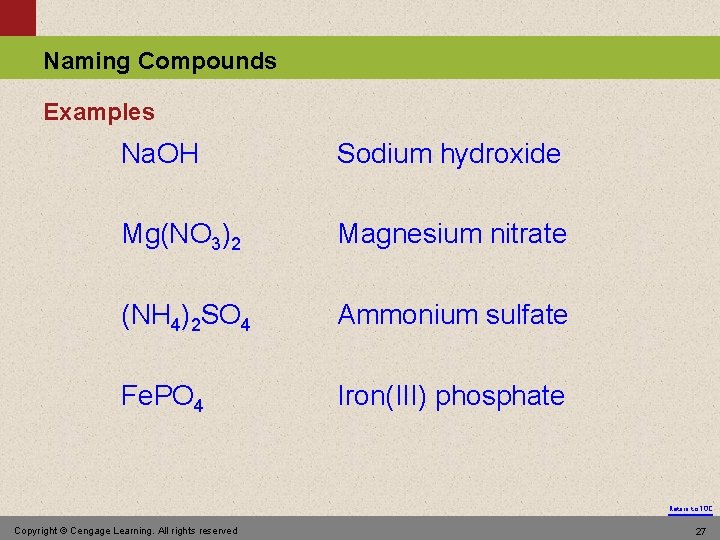
Naming Compounds Examples Na. OH Sodium hydroxide Mg(NO 3)2 Magnesium nitrate (NH 4)2 SO 4 Ammonium sulfate Fe. PO 4 Iron(III) phosphate Return to TOC Copyright © Cengage Learning. All rights reserved 27
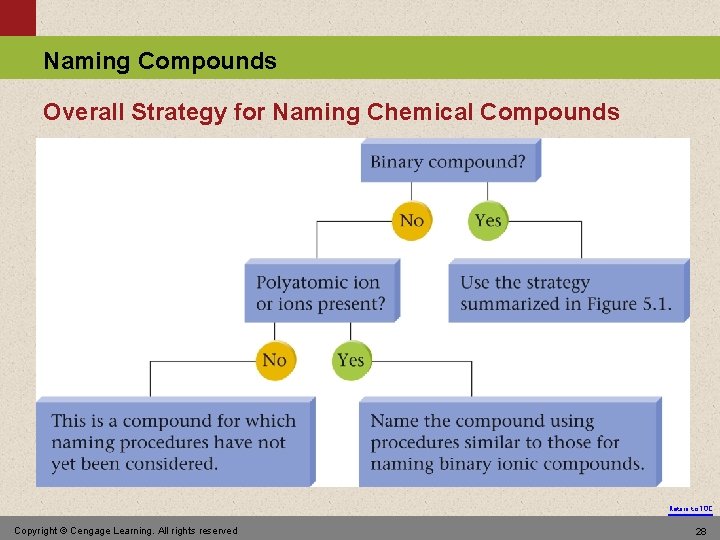
Naming Compounds Overall Strategy for Naming Chemical Compounds Return to TOC Copyright © Cengage Learning. All rights reserved 28
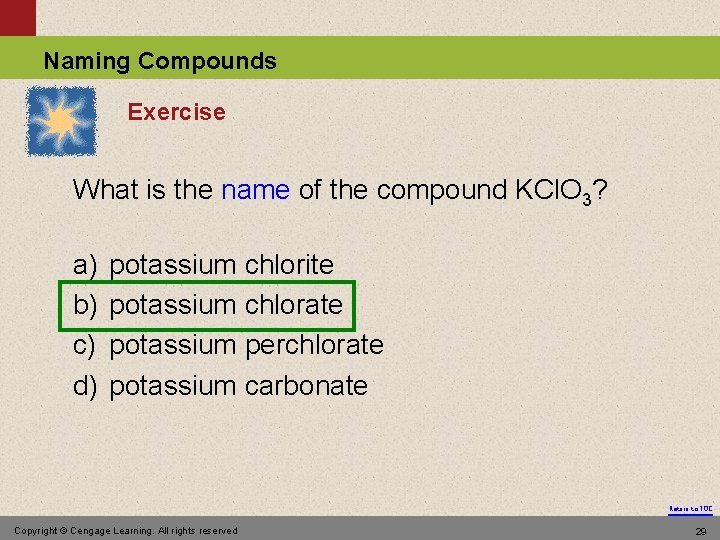
Naming Compounds Exercise What is the name of the compound KCl. O 3? a) b) c) d) potassium chlorite potassium chlorate potassium perchlorate potassium carbonate Return to TOC Copyright © Cengage Learning. All rights reserved 29
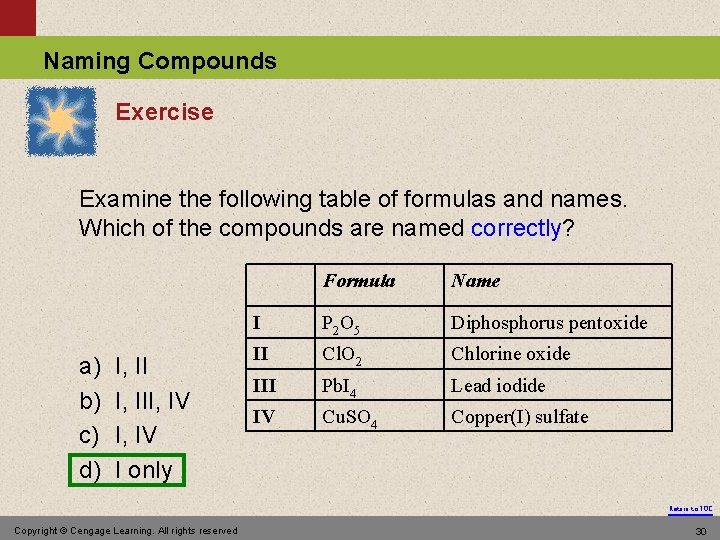
Naming Compounds Exercise Examine the following table of formulas and names. Which of the compounds are named correctly? a) b) c) d) I, III, IV I only Formula Name I P 2 O 5 Diphosphorus pentoxide II Cl. O 2 Chlorine oxide III Pb. I 4 Lead iodide IV Cu. SO 4 Copper(I) sulfate Return to TOC Copyright © Cengage Learning. All rights reserved 30
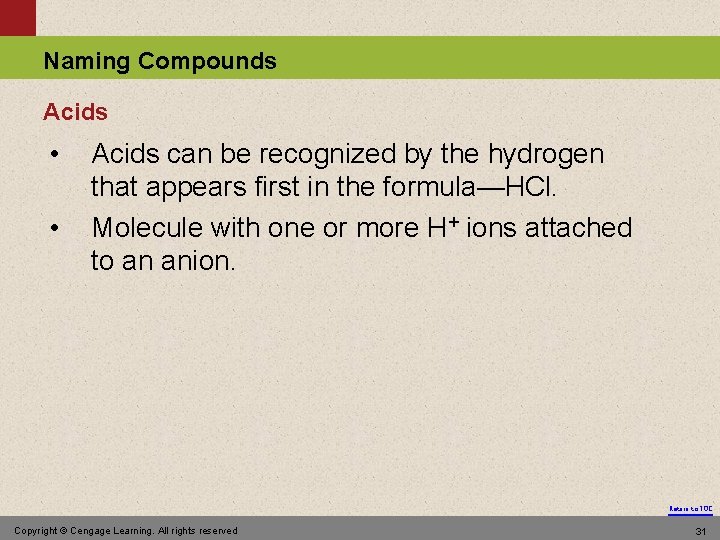
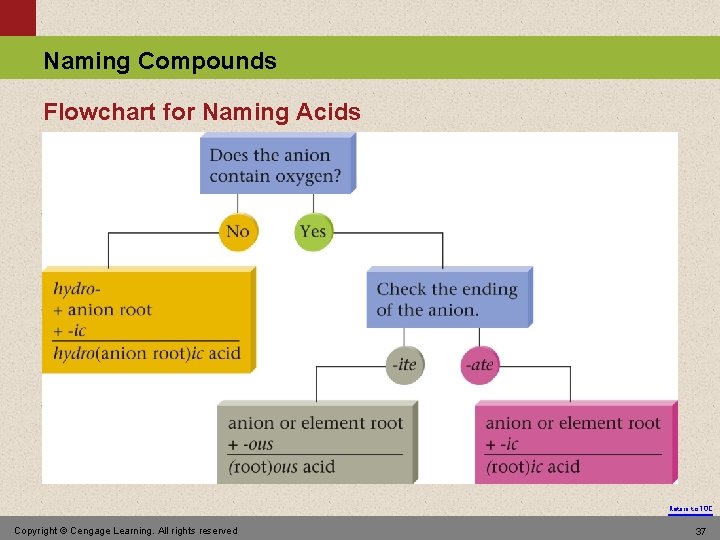
Naming Compounds Acids • • Acids can be recognized by the hydrogen that appears first in the formula—HCl. Molecule with one or more H+ ions attached to an anion. Return to TOC Copyright © Cengage Learning. All rights reserved 31
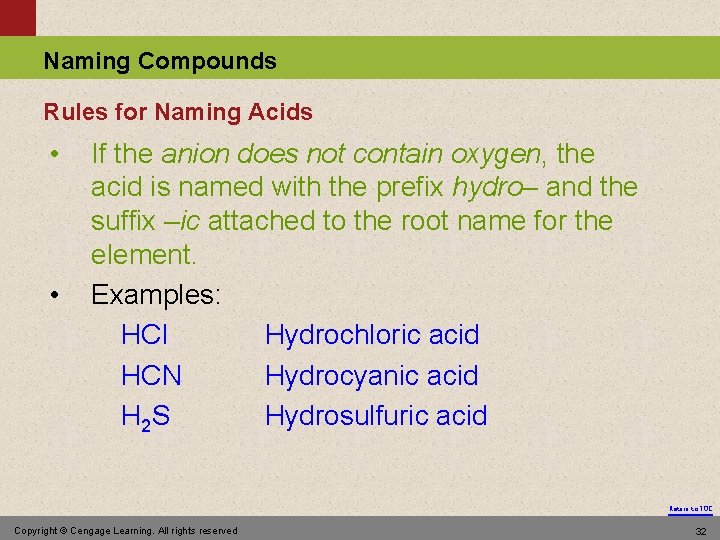
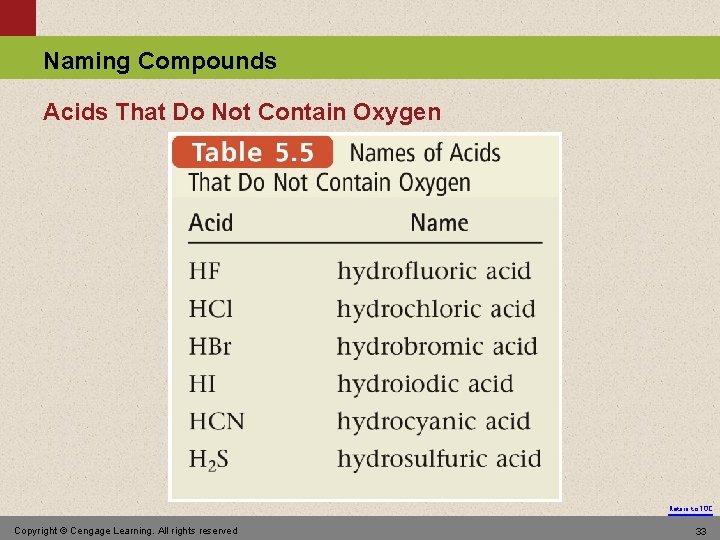
Naming Compounds Rules for Naming Acids • • If the anion does not contain oxygen, the acid is named with the prefix hydro– and the suffix –ic attached to the root name for the element. Examples: HCl Hydrochloric acid HCN Hydrocyanic acid H 2 S Hydrosulfuric acid Return to TOC Copyright © Cengage Learning. All rights reserved 32
Naming Compounds Acids That Do Not Contain Oxygen Return to TOC Copyright © Cengage Learning. All rights reserved 33
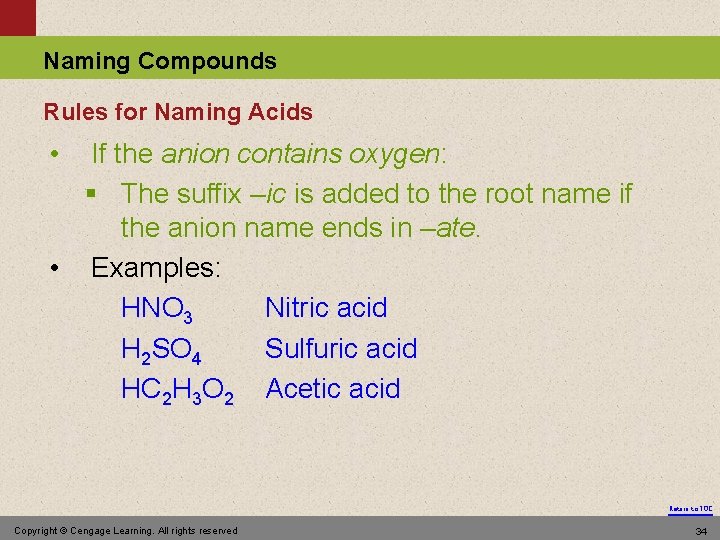
Naming Compounds Rules for Naming Acids • If the anion contains oxygen: § The suffix –ic is added to the root name if the anion name ends in –ate. • Examples: HNO 3 Nitric acid H 2 SO 4 Sulfuric acid HC 2 H 3 O 2 Acetic acid Return to TOC Copyright © Cengage Learning. All rights reserved 34
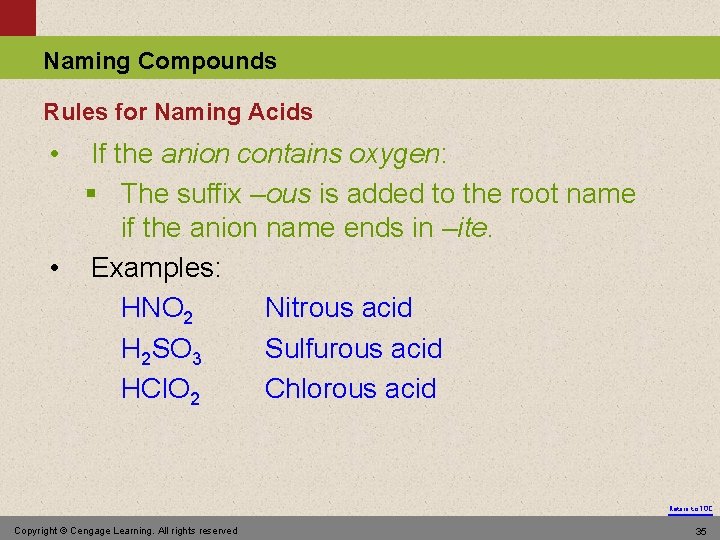
Naming Compounds Rules for Naming Acids • If the anion contains oxygen: § The suffix –ous is added to the root name if the anion name ends in –ite. • Examples: HNO 2 Nitrous acid H 2 SO 3 Sulfurous acid HCl. O 2 Chlorous acid Return to TOC Copyright © Cengage Learning. All rights reserved 35
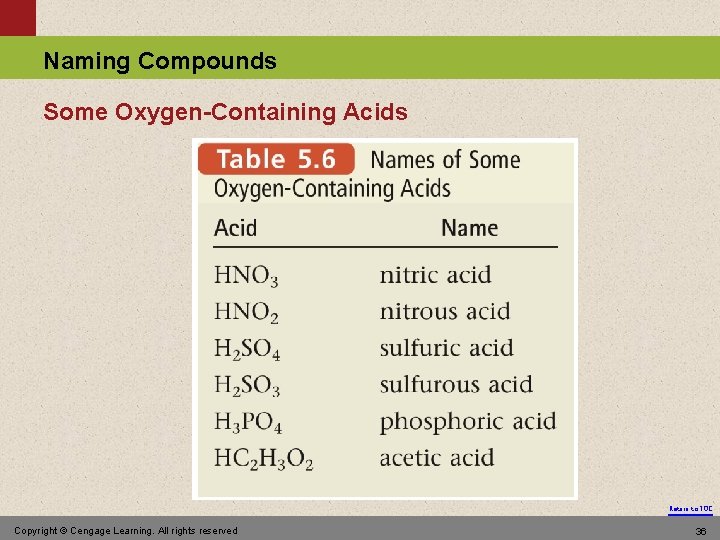
Naming Compounds Some Oxygen-Containing Acids Return to TOC Copyright © Cengage Learning. All rights reserved 36
Naming Compounds Flowchart for Naming Acids Return to TOC Copyright © Cengage Learning. All rights reserved 37
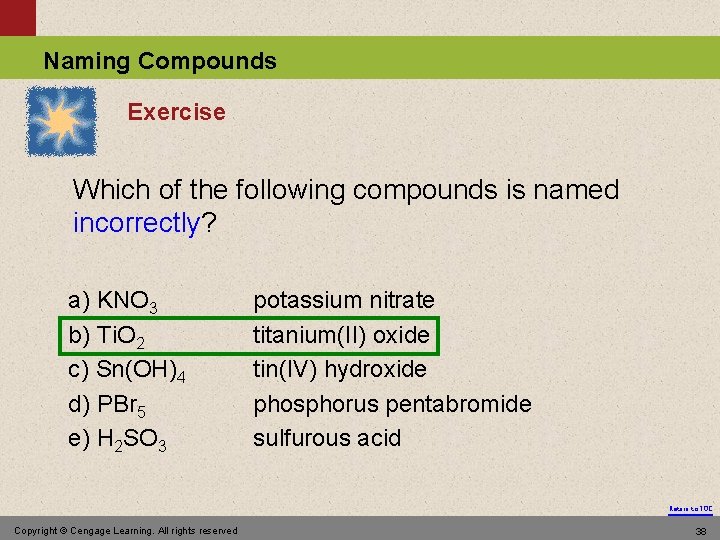
Naming Compounds Exercise Which of the following compounds is named incorrectly? a) KNO 3 b) Ti. O 2 c) Sn(OH)4 d) PBr 5 e) H 2 SO 3 potassium nitrate titanium(II) oxide tin(IV) hydroxide phosphorus pentabromide sulfurous acid Return to TOC Copyright © Cengage Learning. All rights reserved 38
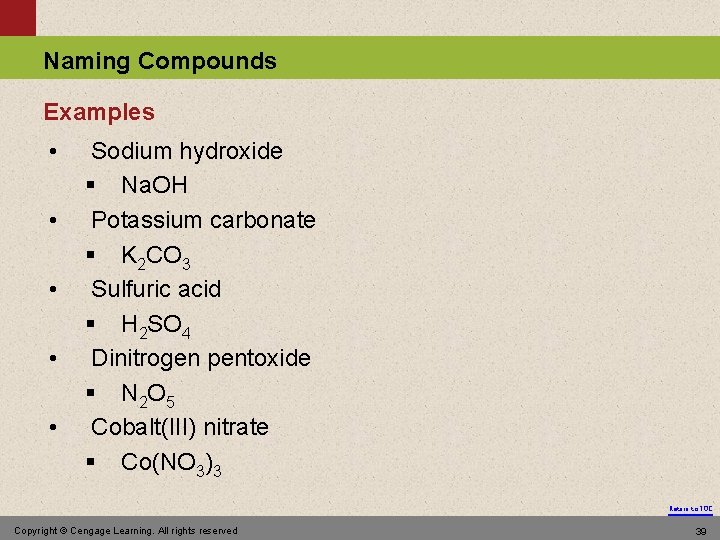
Naming Compounds Examples • • • Sodium hydroxide § Na. OH Potassium carbonate § K 2 CO 3 Sulfuric acid § H 2 SO 4 Dinitrogen pentoxide § N 2 O 5 Cobalt(III) nitrate § Co(NO 3)3 Return to TOC Copyright © Cengage Learning. All rights reserved 39
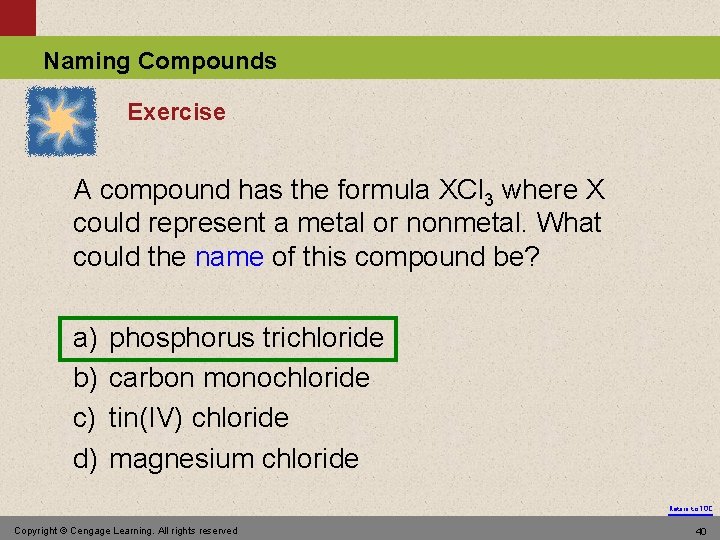
Naming Compounds Exercise A compound has the formula XCl 3 where X could represent a metal or nonmetal. What could the name of this compound be? a) b) c) d) phosphorus trichloride carbon monochloride tin(IV) chloride magnesium chloride Return to TOC Copyright © Cengage Learning. All rights reserved 40
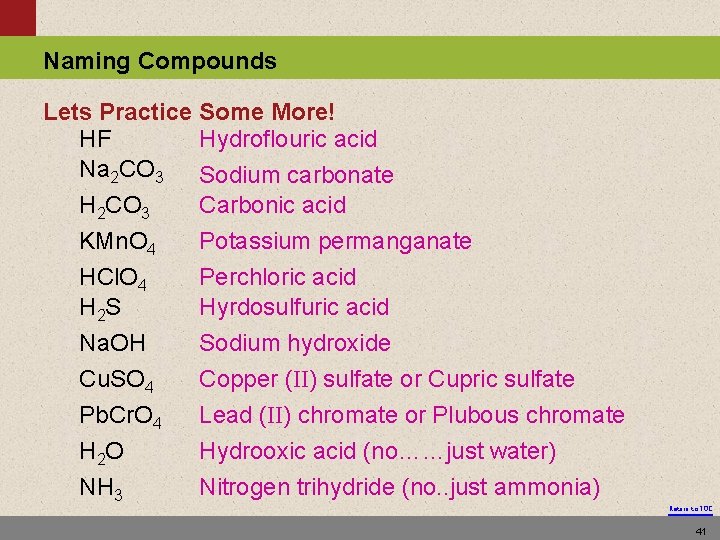
Naming Compounds Lets Practice Some More! HF Hydroflouric acid Na 2 CO 3 Sodium carbonate H 2 CO 3 Carbonic acid KMn. O 4 Potassium permanganate HCl. O 4 Perchloric acid H 2 S Hyrdosulfuric acid Na. OH Sodium hydroxide Copper (II) sulfate or Cupric sulfate Cu. SO 4 Lead (II) chromate or Plubous chromate Pb. Cr. O 4 H 2 O NH 3 Hydrooxic acid (no……just water) Nitrogen trihydride (no. . just ammonia) Return to TOC 41