
Chapter 5 Newtons Third Law of Motion For




- Slides: 26
Chapter 5 Newton’s Third Law of Motion For every “action” there is a “reaction” Physics 1 (Garcia) SJSU
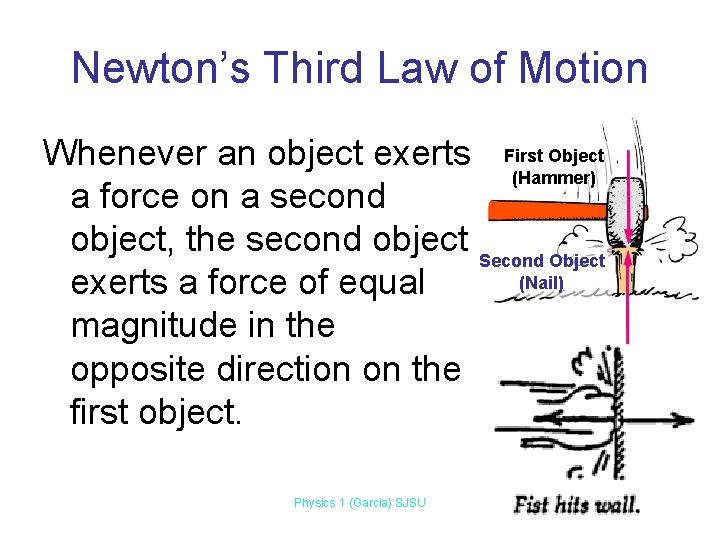
Newton’s Third Law of Motion Whenever an object exerts First Object (Hammer) a force on a second object, the second object Second Object (Nail) exerts a force of equal magnitude in the opposite direction on the first object. Physics 1 (Garcia) SJSU
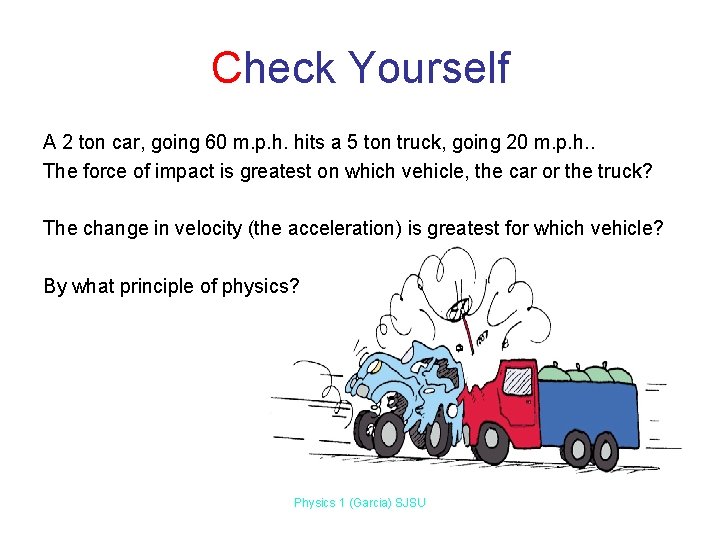
Check Yourself A 2 ton car, going 60 m. p. h. hits a 5 ton truck, going 20 m. p. h. . The force of impact is greatest on which vehicle, the car or the truck? The change in velocity (the acceleration) is greatest for which vehicle? By what principle of physics? Physics 1 (Garcia) SJSU
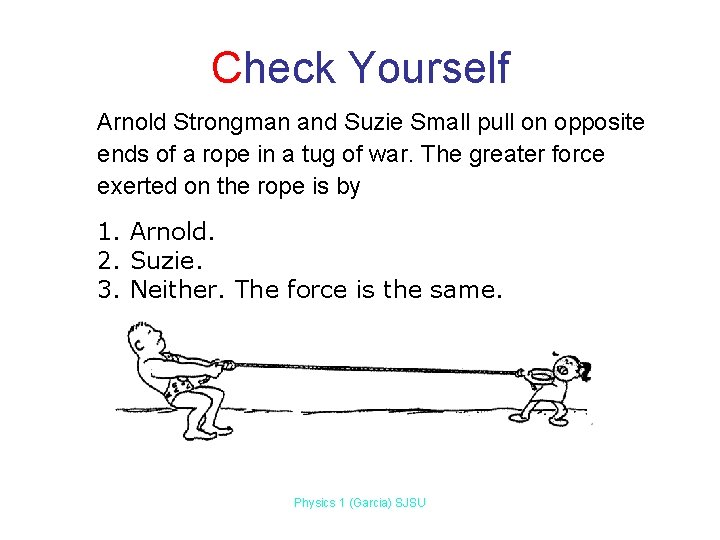
Check Yourself Arnold Strongman and Suzie Small pull on opposite ends of a rope in a tug of war. The greater force exerted on the rope is by 1. Arnold. 2. Suzie. 3. Neither. The force is the same. Physics 1 (Garcia) SJSU
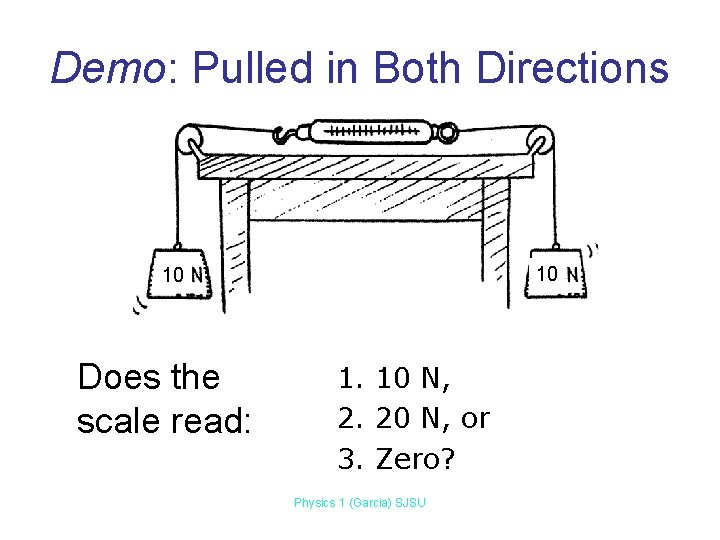
Demo: Pulled in Both Directions 10 10 Does the scale read: 1. 10 N, 2. 20 N, or 3. Zero? Physics 1 (Garcia) SJSU
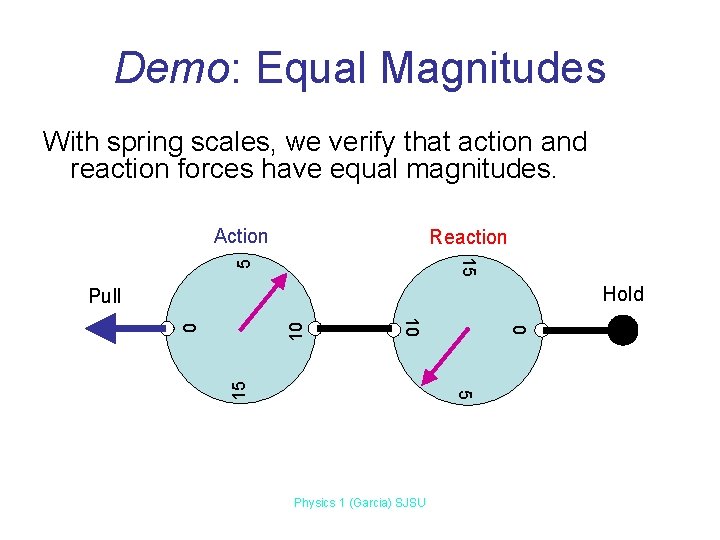
Demo: Equal Magnitudes Action Reaction 5 With spring scales, we verify that action and reaction forces have equal magnitudes. 15 Hold 5 15 0 0 10 10 Pull Physics 1 (Garcia) SJSU
Action and Reaction Common expression of 3 rd Law is, To every action there’s an equal and opposite reaction. What’s an “action”? How can reaction be “equal” and “opposite”? Physics 1 (Garcia) SJSU
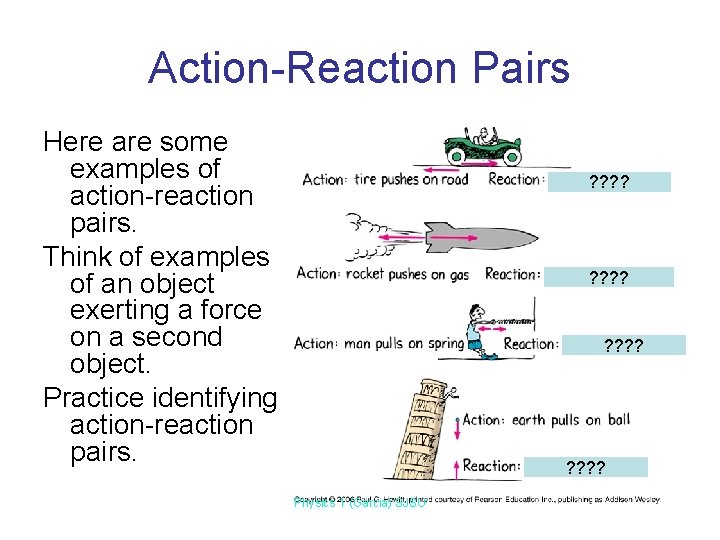
Action-Reaction Pairs Here are some examples of action-reaction pairs. Think of examples of an object exerting a force on a second object. Practice identifying action-reaction pairs. ? ? ? ? Physics 1 (Garcia) SJSU
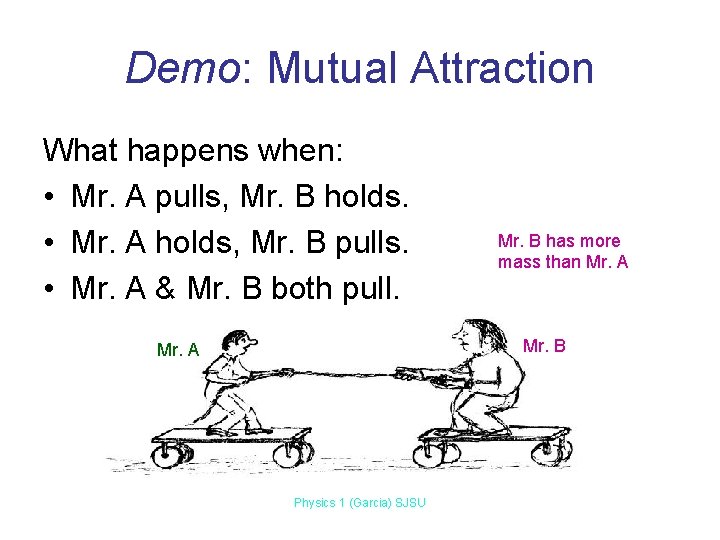
Demo: Mutual Attraction What happens when: • Mr. A pulls, Mr. B holds. • Mr. A holds, Mr. B pulls. • Mr. A & Mr. B both pull. Mr. B has more mass than Mr. A Mr. B Mr. A Physics 1 (Garcia) SJSU
Demo: Mutual Attraction (cont. ) If only Mr. A pulls on Mr. B then Mr. B accelerates. Reaction force of equal magnitude so Mr. A also moves. Who moves faster? Mr. A, Mr. B, or the same? Mr. A Reaction Action Mr. B has more mass than Mr. A Physics 1 (Garcia) SJSU
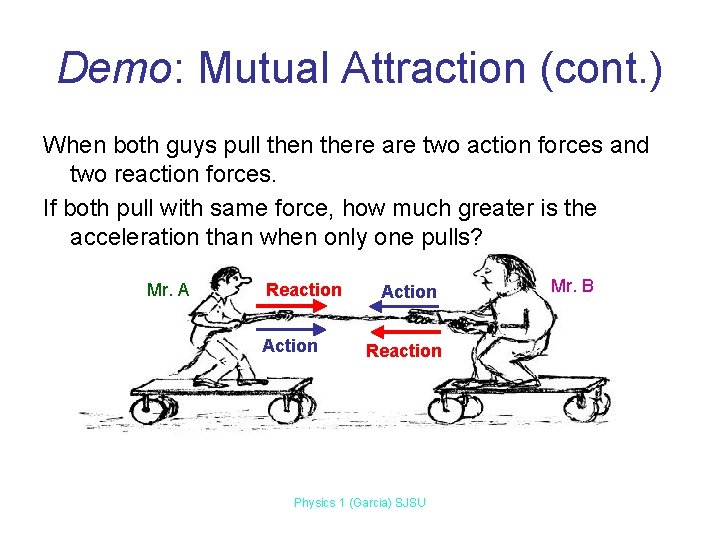
Demo: Mutual Attraction (cont. ) When both guys pull then there are two action forces and two reaction forces. If both pull with same force, how much greater is the acceleration than when only one pulls? Mr. A Reaction Action Reaction Physics 1 (Garcia) SJSU Mr. B
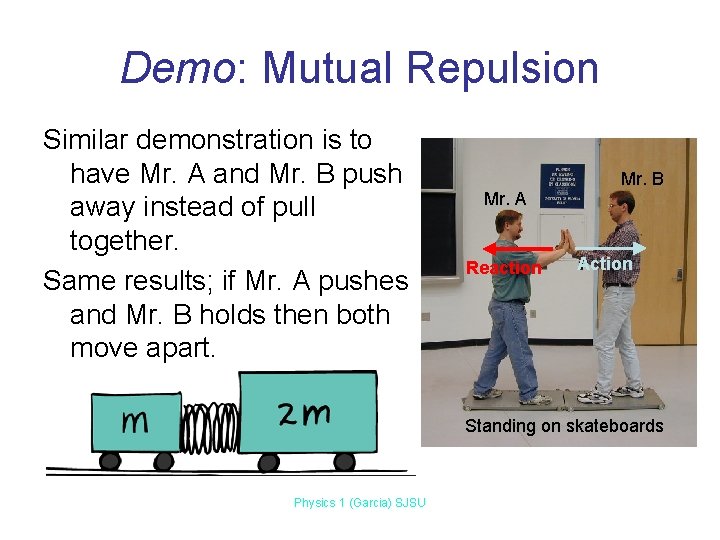
Demo: Mutual Repulsion Similar demonstration is to have Mr. A and Mr. B push away instead of pull together. Same results; if Mr. A pushes and Mr. B holds then both move apart. Mr. A Reaction Mr. B Action Standing on skateboards Physics 1 (Garcia) SJSU
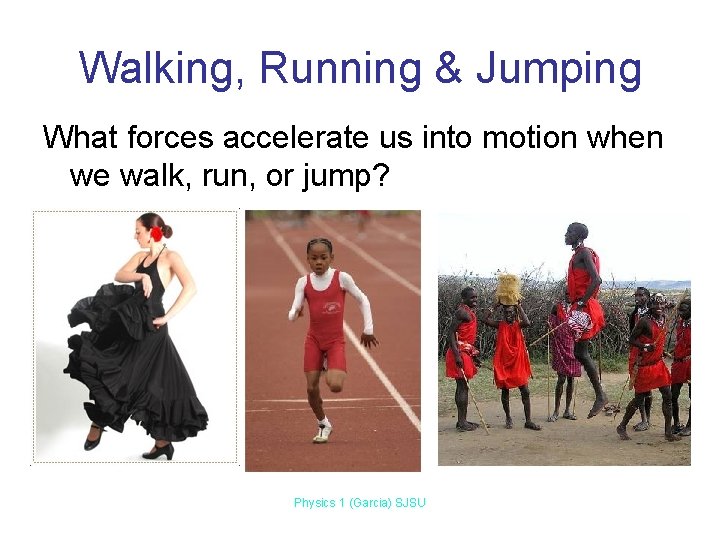
Walking, Running & Jumping What forces accelerate us into motion when we walk, run, or jump? Physics 1 (Garcia) SJSU
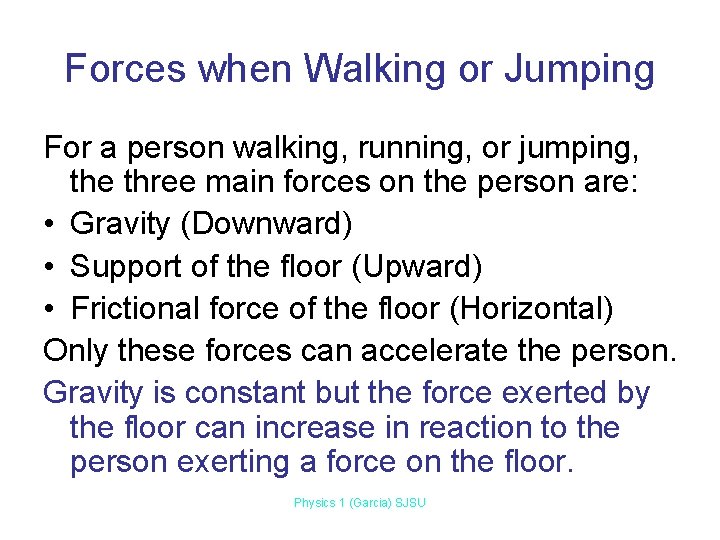
Forces when Walking or Jumping For a person walking, running, or jumping, the three main forces on the person are: • Gravity (Downward) • Support of the floor (Upward) • Frictional force of the floor (Horizontal) Only these forces can accelerate the person. Gravity is constant but the force exerted by the floor can increase in reaction to the person exerting a force on the floor. Physics 1 (Garcia) SJSU
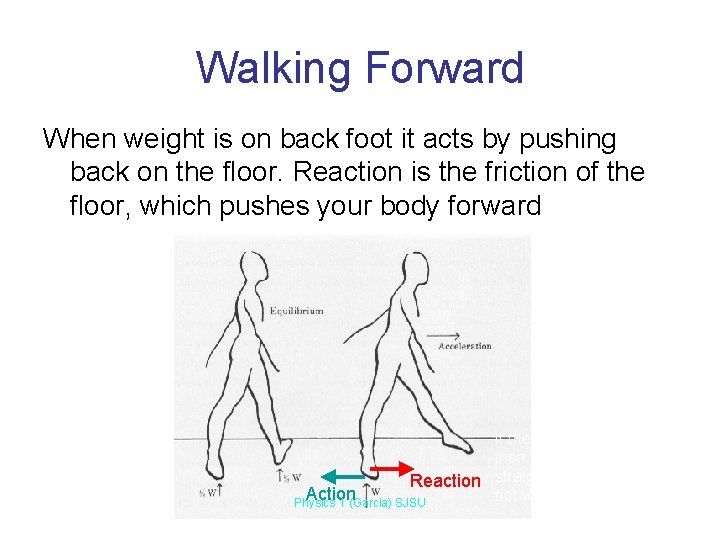
Walking Forward When weight is on back foot it acts by pushing back on the floor. Reaction is the friction of the floor, which pushes your body forward If there were no friction then dancer would fall Reaction straight down and could Action not walk forward Physics 1 (Garcia) SJSU
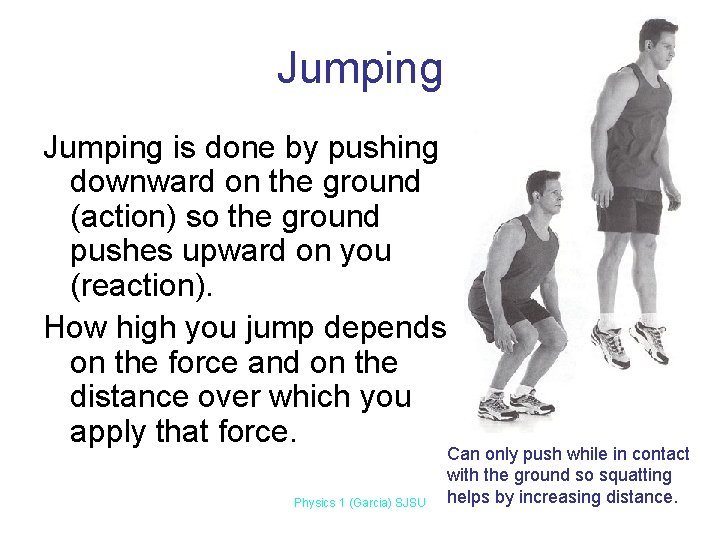
Jumping is done by pushing downward on the ground (action) so the ground pushes upward on you (reaction). How high you jump depends on the force and on the distance over which you apply that force. Physics 1 (Garcia) SJSU Can only push while in contact with the ground so squatting helps by increasing distance.
IMPORTANT!!! Action force & reaction force NEVER cancel because they act on different objects! Repeat this to yourself over and over again Physics 1 (Garcia) SJSU
Check Yourself Miss A pushes the car (action); car pushes back on her (reaction). Do these forces cancel? Miss A Action Reaction Force on Miss A is to the left; how can she move forward (to the right)? What if floor had zero friction? Reaction Action Physics 1 (Garcia) SJSU Action. Reaction Pairs
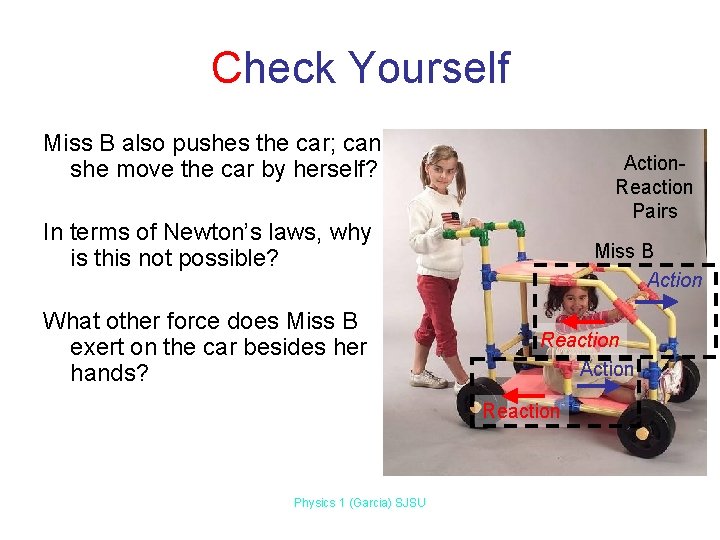
Check Yourself Miss B also pushes the car; can she move the car by herself? Action. Reaction Pairs In terms of Newton’s laws, why is this not possible? What other force does Miss B exert on the car besides her hands? Miss B Action Reaction Physics 1 (Garcia) SJSU
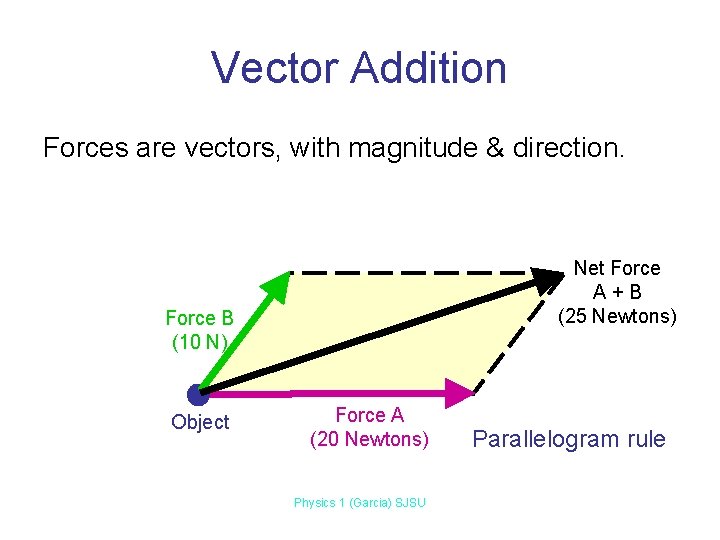
Adding Forces When two forces or more forces act in different directions, finding the net force is more complicated. Have to consider the angle for each force. Physics 1 (Garcia) SJSU
Vector Addition Forces are vectors, with magnitude & direction. Net Force A+B (25 Newtons) Force B (10 N) Object Force A (20 Newtons) Physics 1 (Garcia) SJSU Parallelogram rule
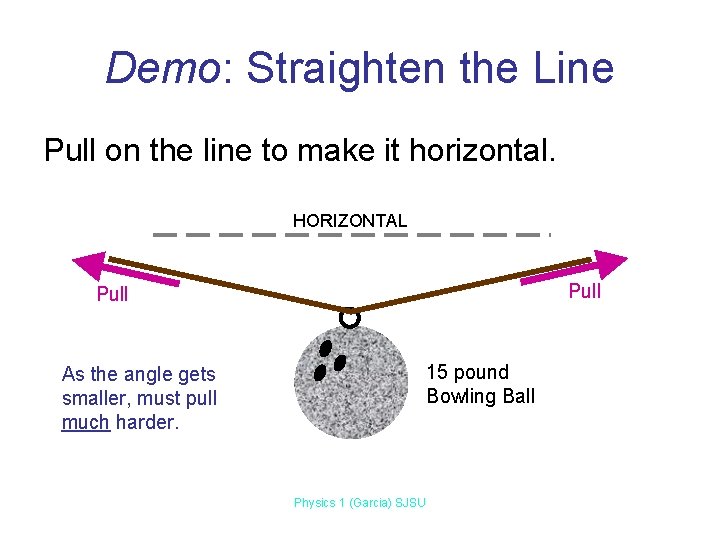
Demo: Straighten the Line Pull on the line to make it horizontal. HORIZONTAL Pull 15 pound Bowling Ball As the angle gets smaller, must pull much harder. Physics 1 (Garcia) SJSU
Demo: Straighten the Line (II) 5 N As the angle gets smaller, must pull much harder. 5 N 15 N 10 Newton Weight Physics 1 (Garcia) SJSU
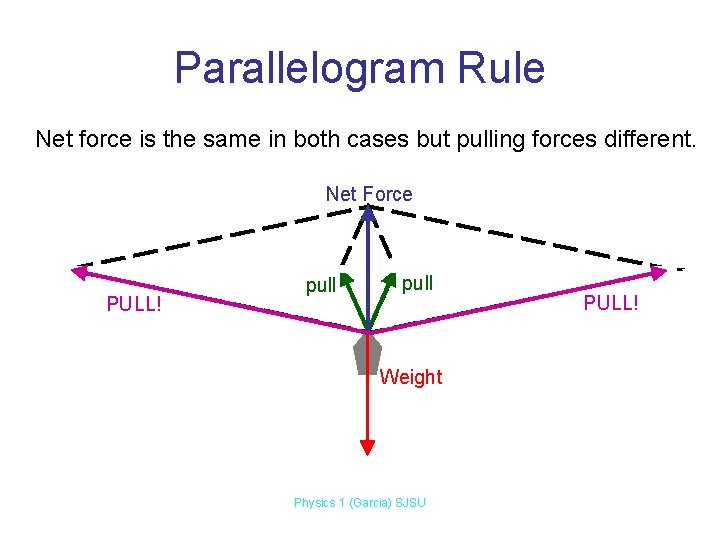
Parallelogram Rule Net force is the same in both cases but pulling forces different. Net Force PULL! pull Weight Physics 1 (Garcia) SJSU PULL!
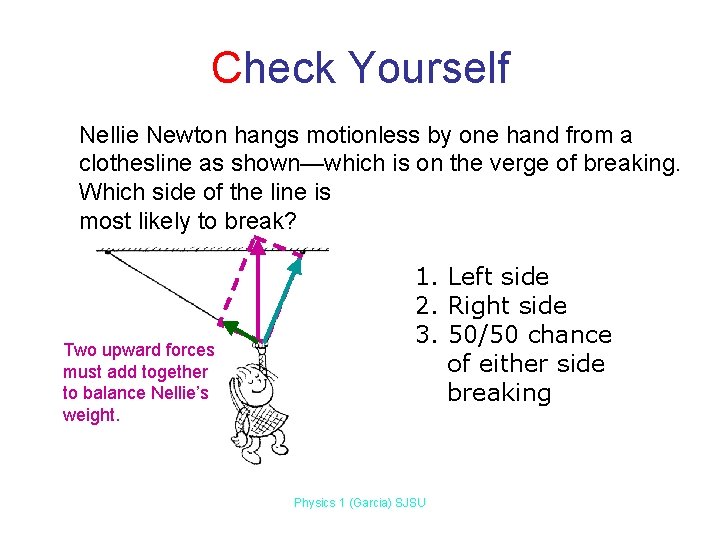
Check Yourself Nellie Newton hangs motionless by one hand from a clothesline as shown—which is on the verge of breaking. Which side of the line is most likely to break? Two upward forces must add together to balance Nellie’s weight. 1. Left side 2. Right side 3. 50/50 chance of either side breaking Physics 1 (Garcia) SJSU
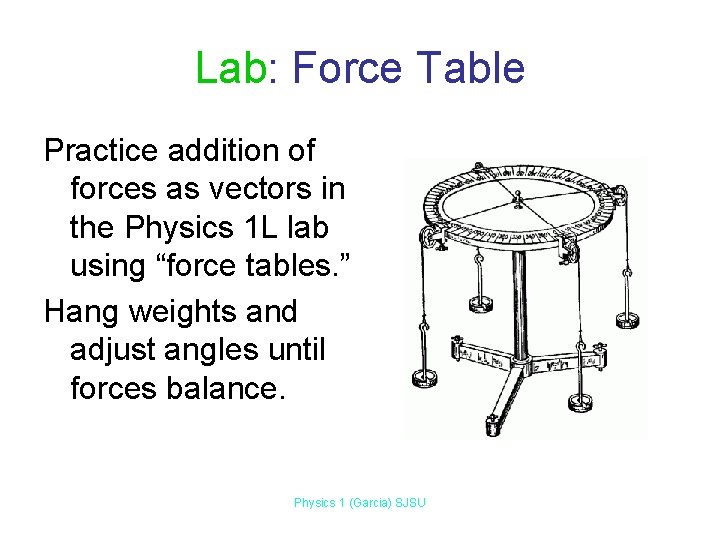
Lab: Force Table Practice addition of forces as vectors in the Physics 1 L lab using “force tables. ” Hang weights and adjust angles until forces balance. Physics 1 (Garcia) SJSU