
Chapter 5 Network Design in the Supply Chain

- Slides: 38
Chapter 5 Network Design in the Supply Chain 1
Learning Objectives 1. Understand the role of network design in a supply chain. 2. Identify factors influencing supply chain network design decisions. 3. Develop a framework for making network design decisions. 4. Use optimization for facility location and capacity allocation decisions.
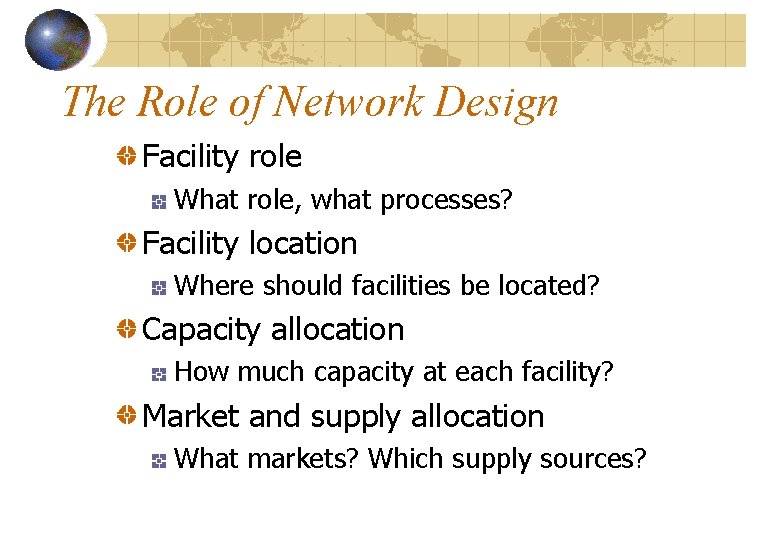
The Role of Network Design Facility role What role, what processes? Facility location Where should facilities be located? Capacity allocation How much capacity at each facility? Market and supply allocation What markets? Which supply sources?
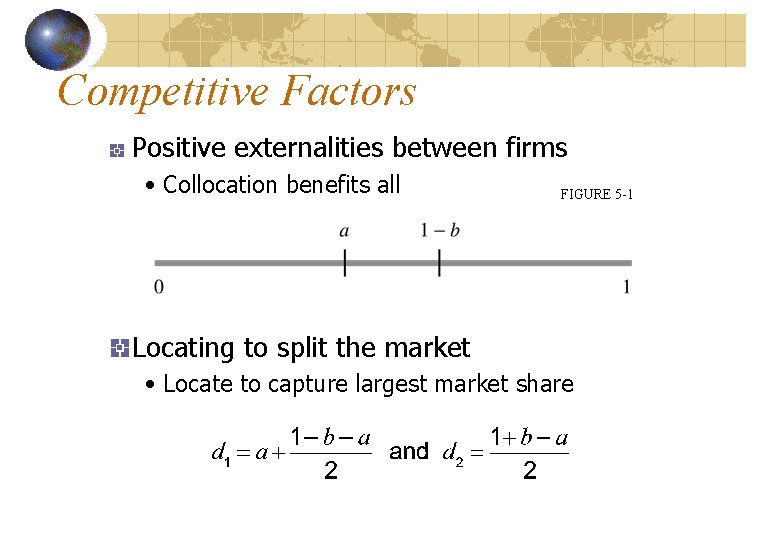
Competitive Factors Positive externalities between firms • Collocation benefits all FIGURE 5 -1 Locating to split the market • Locate to capture largest market share
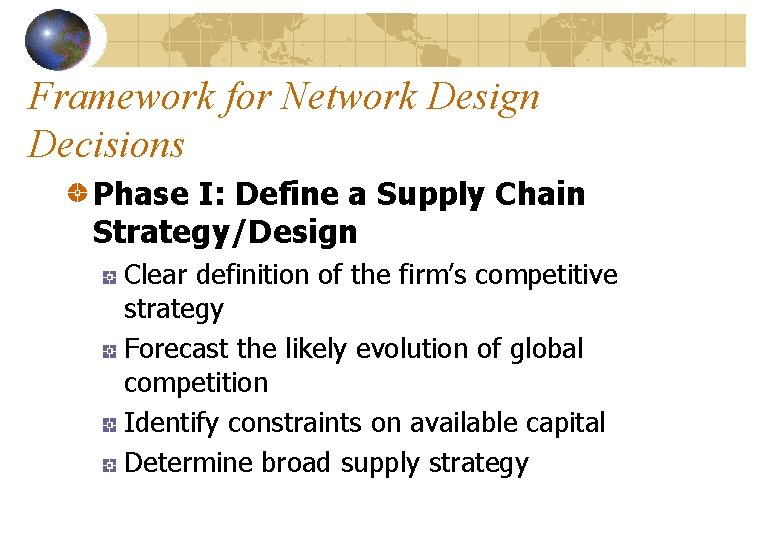
Framework for Network Design Decisions Phase I: Define a Supply Chain Strategy/Design Clear definition of the firm’s competitive strategy Forecast the likely evolution of global competition Identify constraints on available capital Determine broad supply strategy
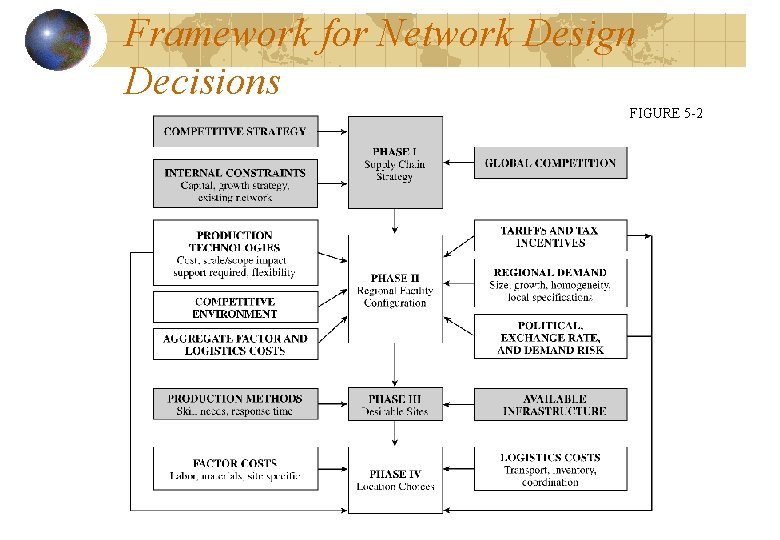
Framework for Network Design Decisions FIGURE 5 -2
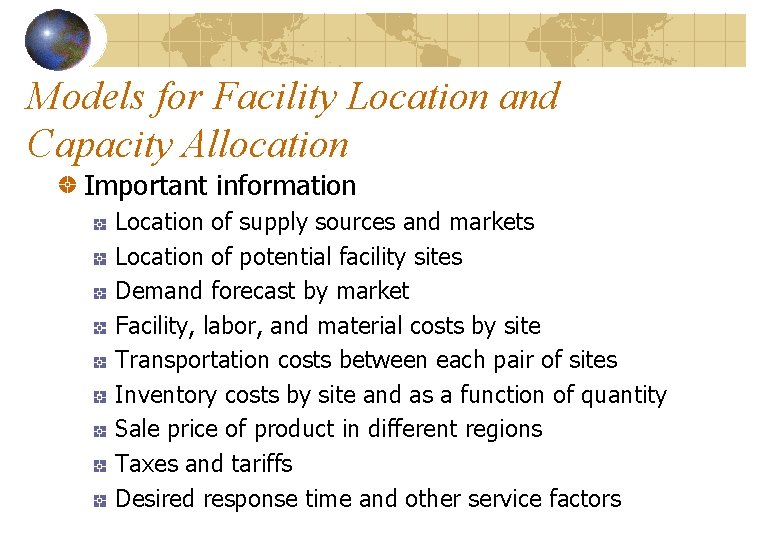
Models for Facility Location and Capacity Allocation Important information Location of supply sources and markets Location of potential facility sites Demand forecast by market Facility, labor, and material costs by site Transportation costs between each pair of sites Inventory costs by site and as a function of quantity Sale price of product in different regions Taxes and tariffs Desired response time and other service factors
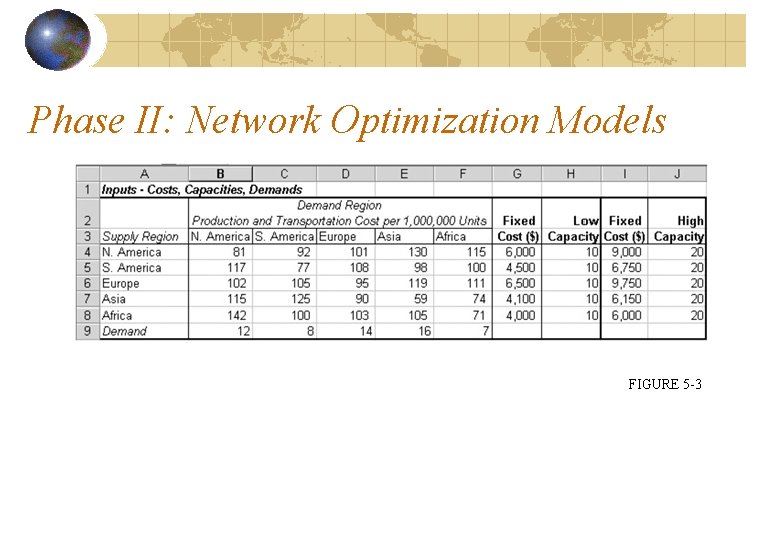
Phase II: Network Optimization Models FIGURE 5 -3
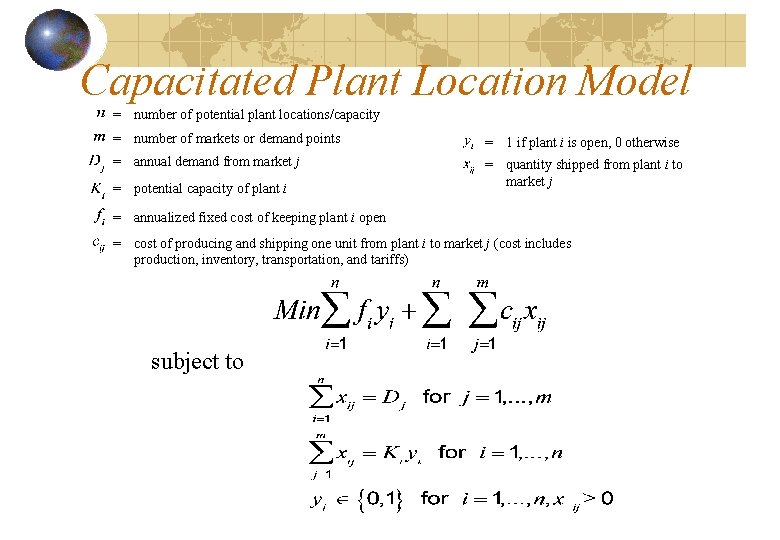
Capacitated Plant Location Model = number of potential plant locations/capacity = number of markets or demand points = 1 if plant i is open, 0 otherwise = annual demand from market j = quantity shipped from plant i to market j = potential capacity of plant i = annualized fixed cost of keeping plant i open = cost of producing and shipping one unit from plant i to market j (cost includes production, inventory, transportation, and tariffs) subject to
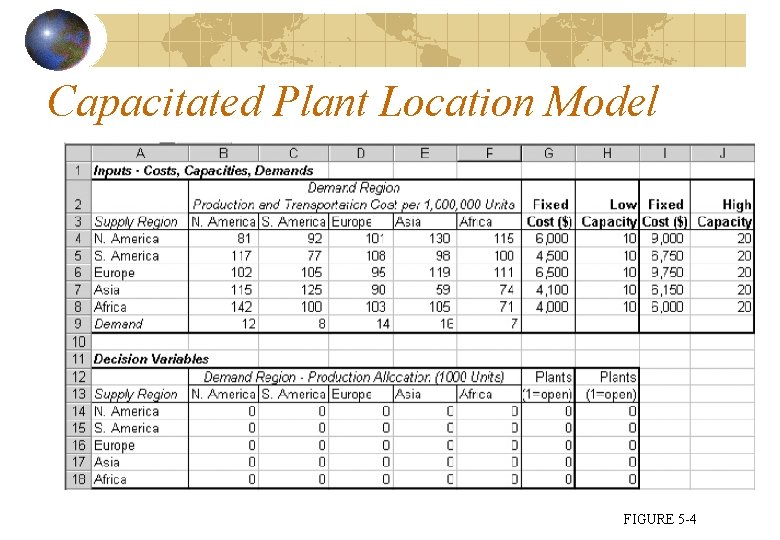
Capacitated Plant Location Model FIGURE 5 -4
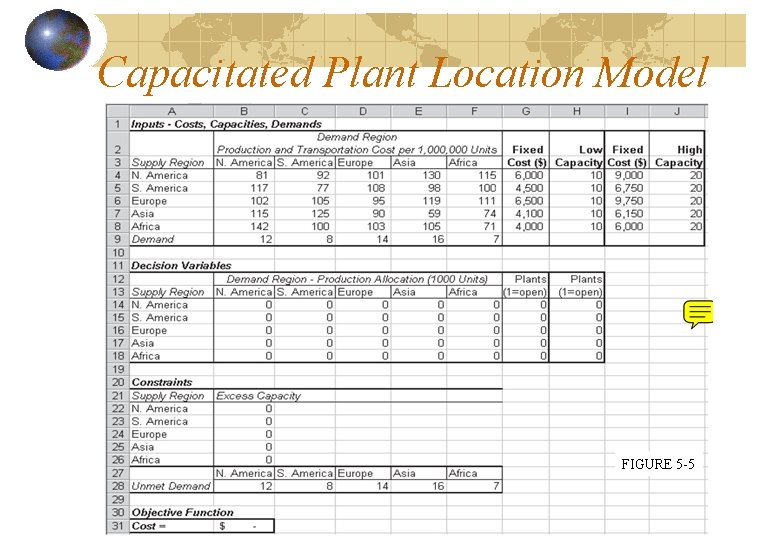
Capacitated Plant Location Model FIGURE 5 -5
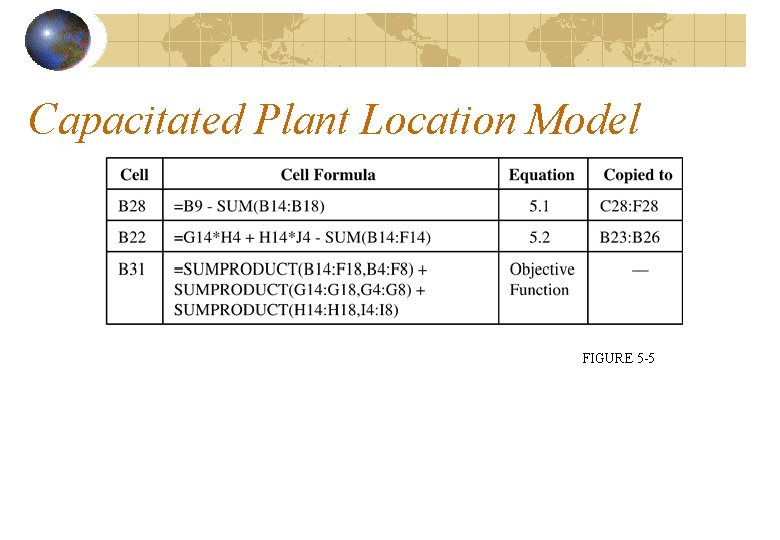
Capacitated Plant Location Model FIGURE 5 -5
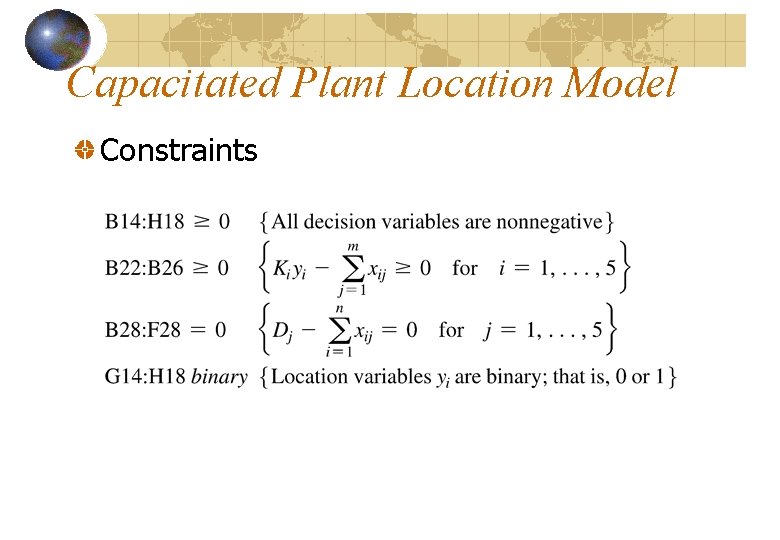
Capacitated Plant Location Model Constraints
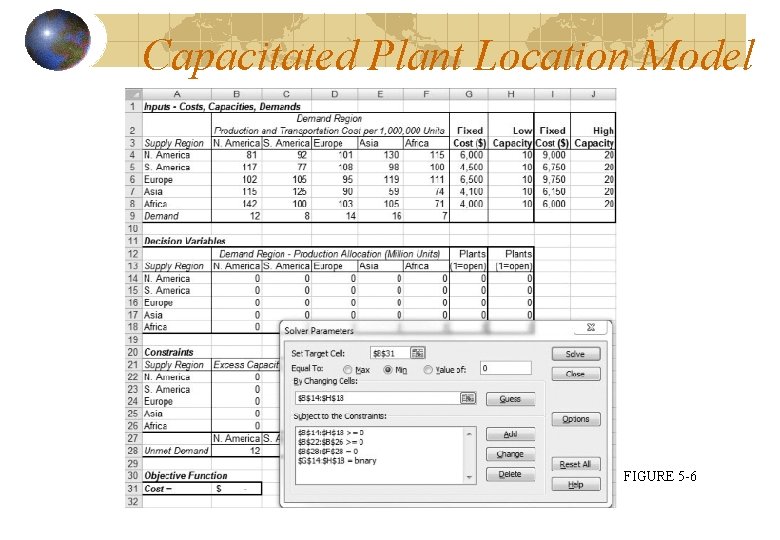
Capacitated Plant Location Model FIGURE 5 -6
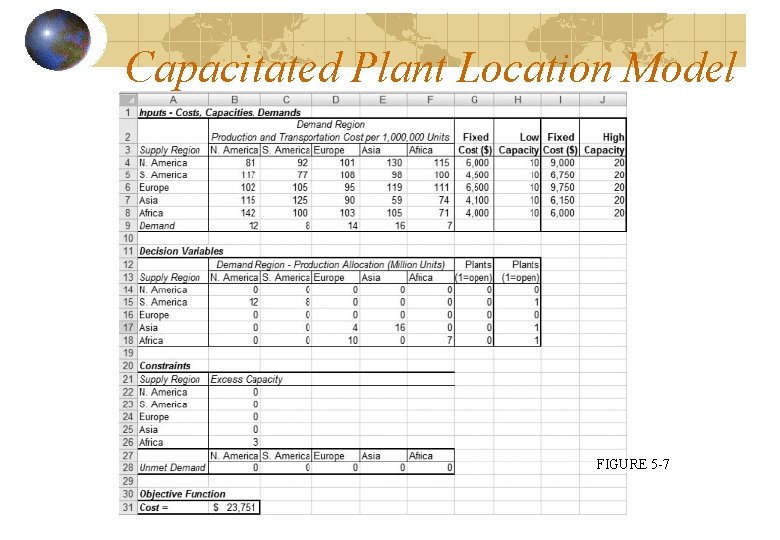
Capacitated Plant Location Model FIGURE 5 -7
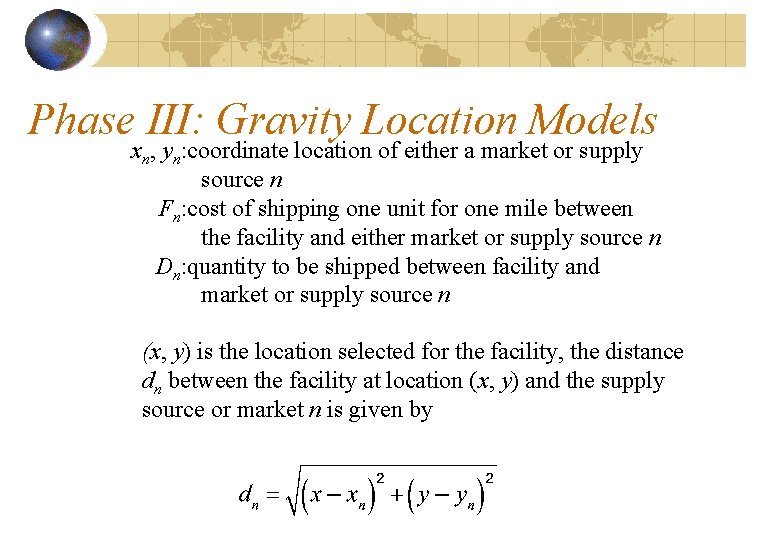
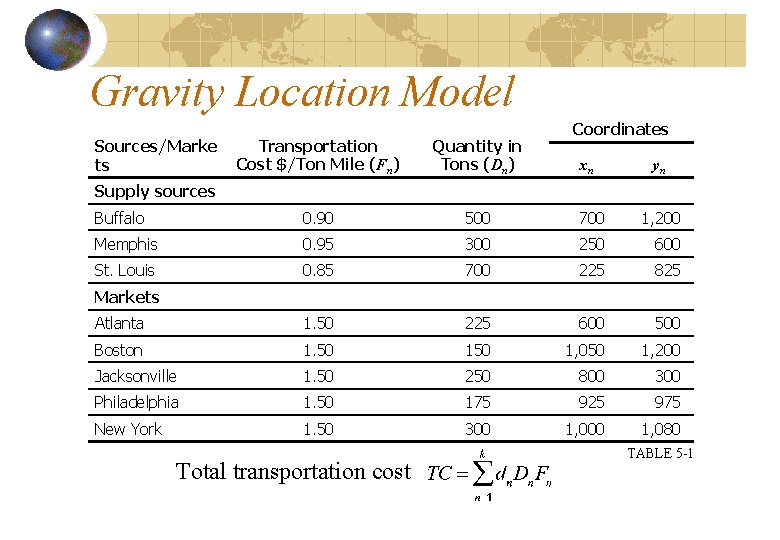
Phase III: Gravity Location Models xn, yn: coordinate location of either a market or supply source n Fn: cost of shipping one unit for one mile between the facility and either market or supply source n Dn: quantity to be shipped between facility and market or supply source n (x, y) is the location selected for the facility, the distance dn between the facility at location (x, y) and the supply source or market n is given by
Gravity Location Model Sources/Marke ts Coordinates Transportation Cost $/Ton Mile (Fn) Quantity in Tons (Dn) Buffalo 0. 90 500 700 1, 200 Memphis 0. 95 300 250 600 St. Louis 0. 85 700 225 825 Atlanta 1. 50 225 600 500 Boston 1. 50 1, 050 1, 200 Jacksonville 1. 50 250 800 300 Philadelphia 1. 50 175 925 975 New York 1. 50 300 1, 080 xn yn Supply sources Markets Total transportation cost TABLE 5 -1
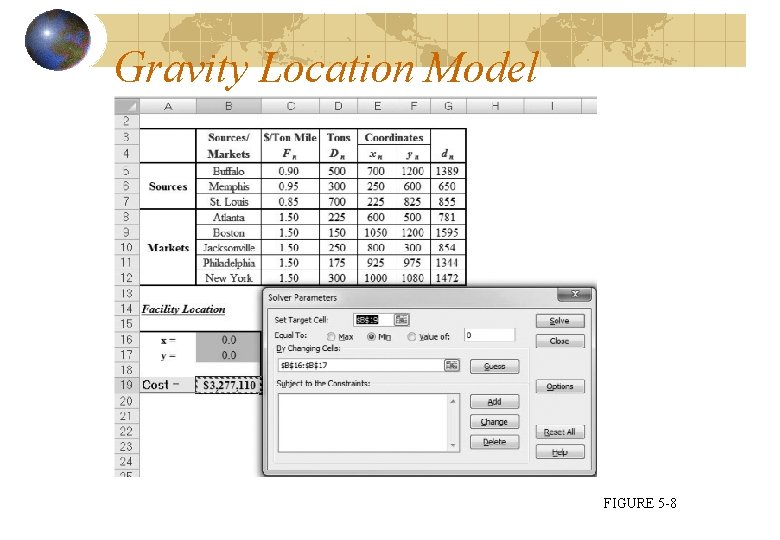
Gravity Location Model FIGURE 5 -8
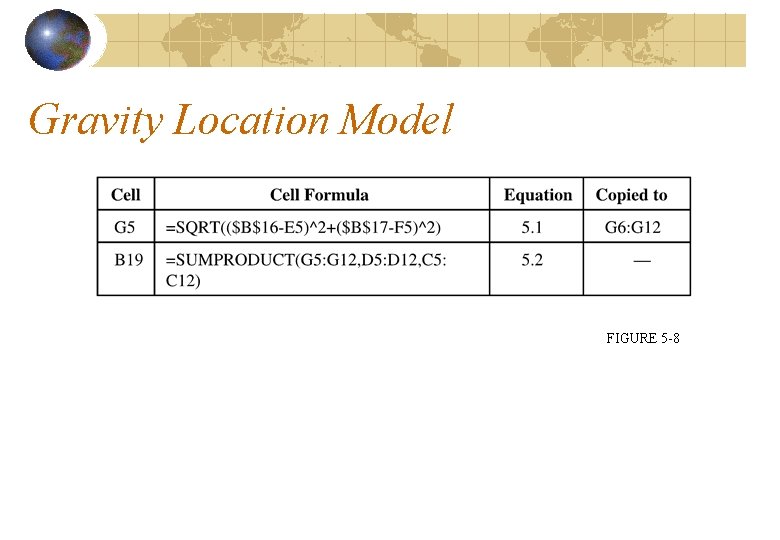
Gravity Location Model FIGURE 5 -8
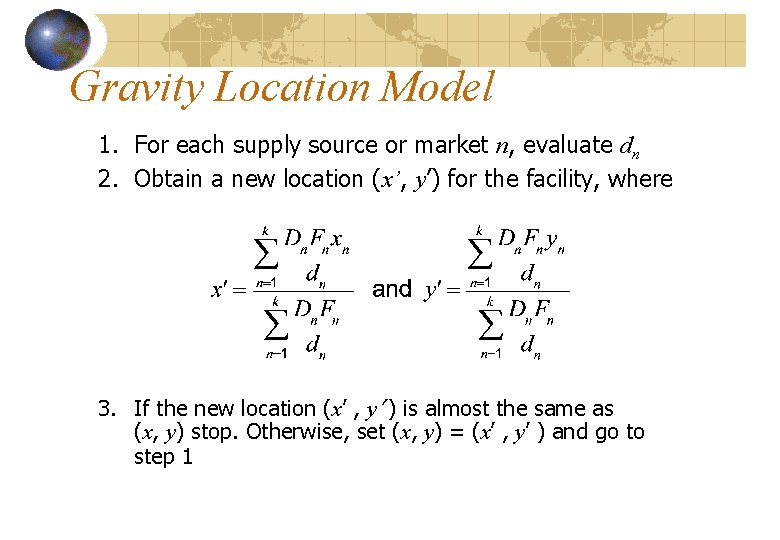
Gravity Location Model 1. For each supply source or market n, evaluate dn 2. Obtain a new location (x’, y’) for the facility, where 3. If the new location (x’ , y’ ) is almost the same as (x, y) stop. Otherwise, set (x, y) = (x’ , y’ ) and go to step 1
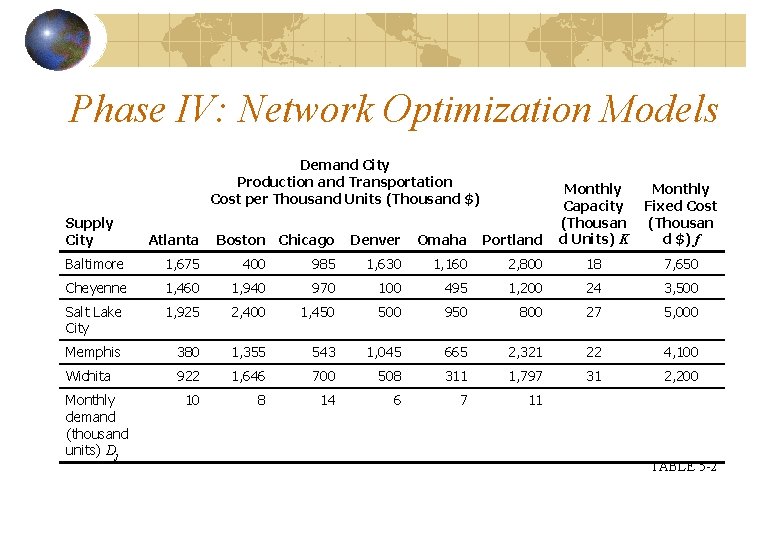
Phase IV: Network Optimization Models Demand City Production and Transportation Cost per Thousand Units (Thousand $) Supply City Atlanta Boston Chicago Denver Omaha Portland Monthly Capacity (Thousan d Units) K Monthly Fixed Cost (Thousan d $) f Baltimore 1, 675 400 985 1, 630 1, 160 2, 800 18 7, 650 Cheyenne 1, 460 1, 940 970 100 495 1, 200 24 3, 500 Salt Lake City 1, 925 2, 400 1, 450 500 950 800 27 5, 000 Memphis 380 1, 355 543 1, 045 665 2, 321 22 4, 100 Wichita 922 1, 646 700 508 311 1, 797 31 2, 200 10 8 14 6 7 11 Monthly demand (thousand units) Dj TABLE 5 -2
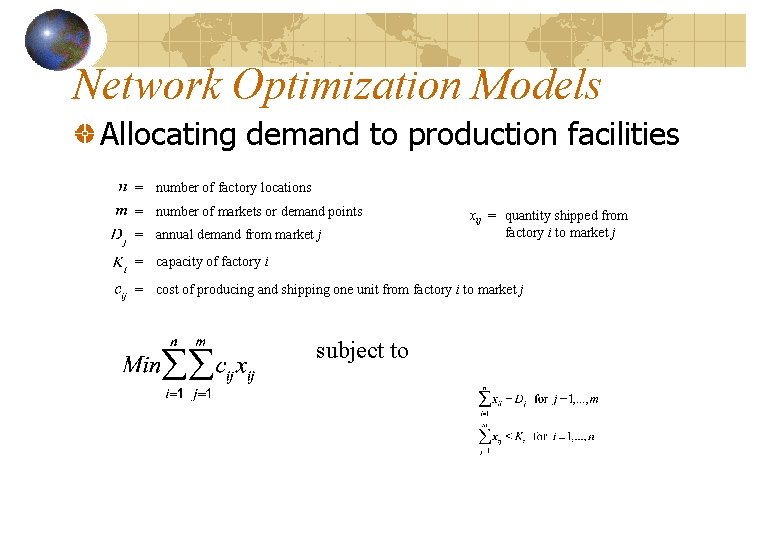
Network Optimization Models Allocating demand to production facilities = number of factory locations = number of markets or demand points = annual demand from market j xij = quantity shipped from factory i to market j = capacity of factory i = cost of producing and shipping one unit from factory i to market j subject to
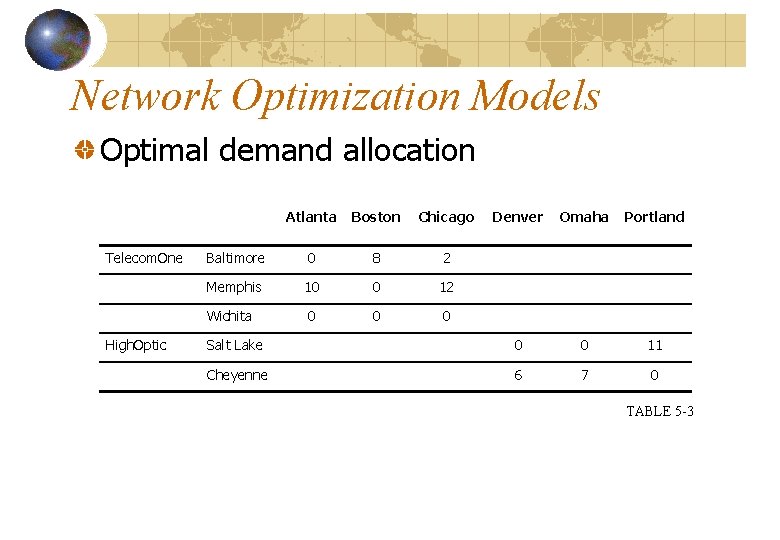
Network Optimization Models Optimal demand allocation Telecom. One High. Optic Atlanta Boston Chicago Denver Omaha Portland Baltimore 0 8 2 Memphis 10 0 12 Wichita 0 0 0 Salt Lake 0 0 11 Cheyenne 6 7 0 TABLE 5 -3
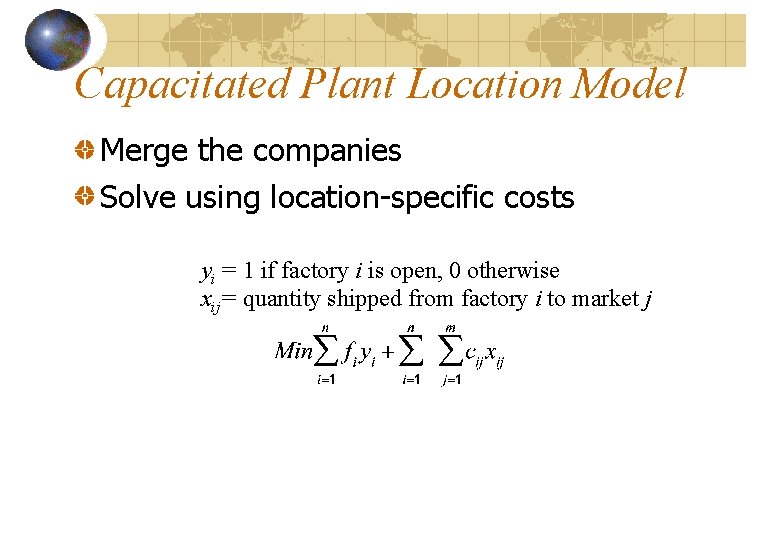
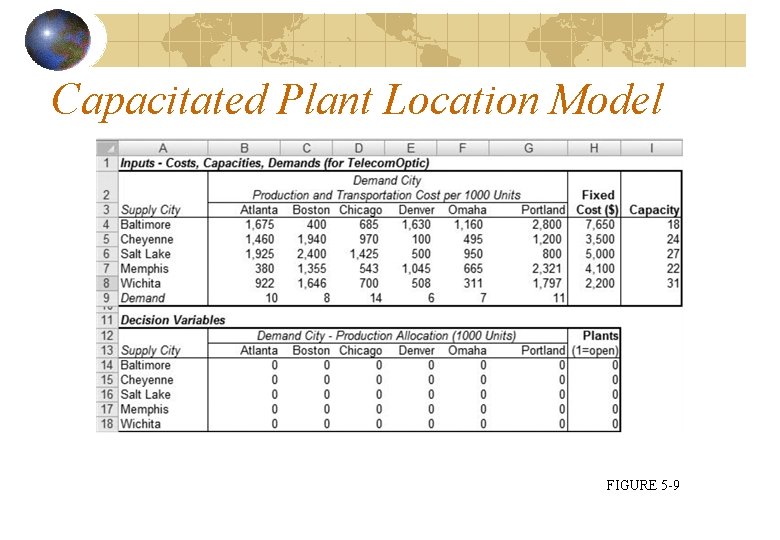
Capacitated Plant Location Model Merge the companies Solve using location-specific costs yi = 1 if factory i is open, 0 otherwise xij = quantity shipped from factory i to market j
Capacitated Plant Location Model FIGURE 5 -9
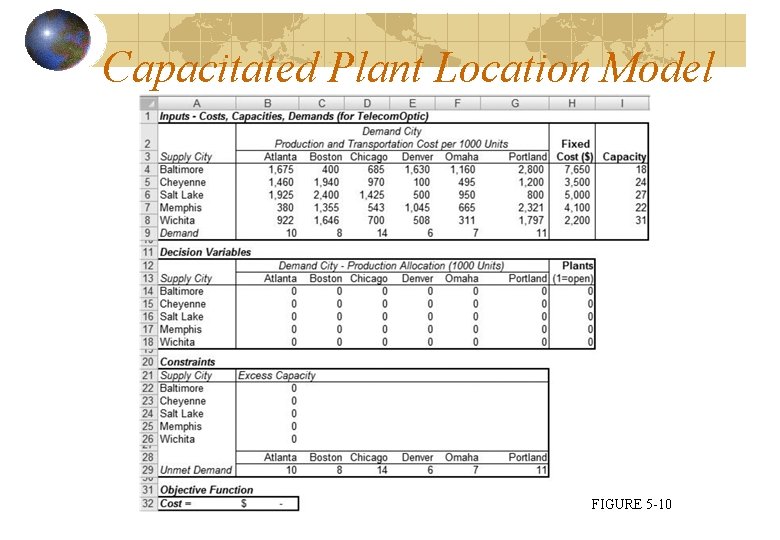
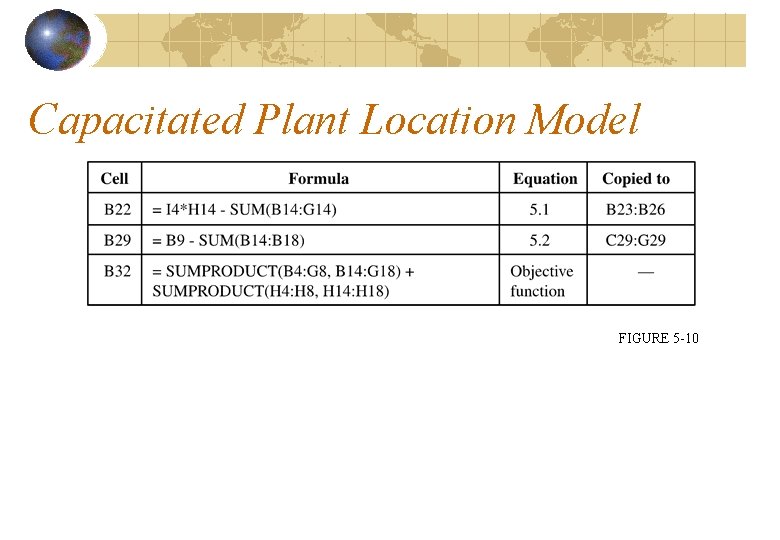
Capacitated Plant Location Model FIGURE 5 -10
Capacitated Plant Location Model FIGURE 5 -10
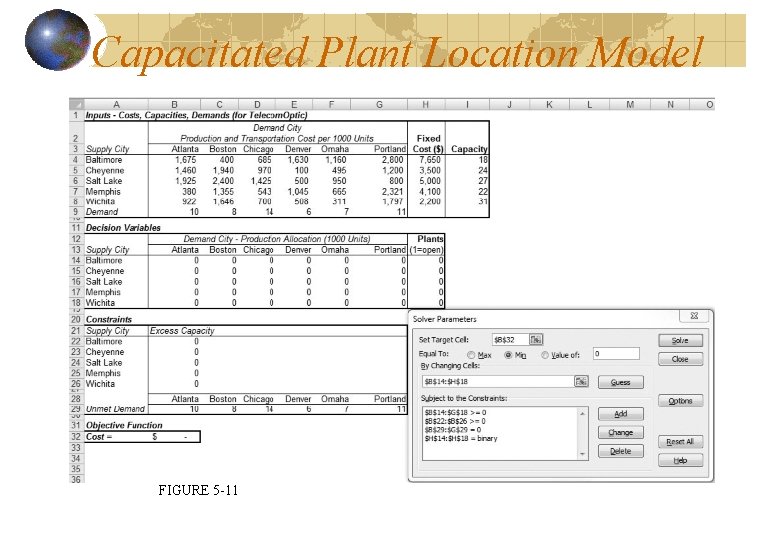
Capacitated Plant Location Model FIGURE 5 -11
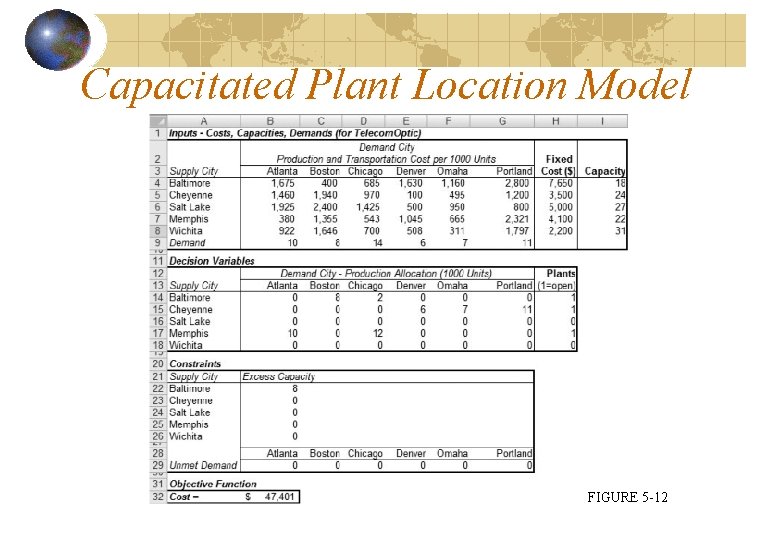
Capacitated Plant Location Model FIGURE 5 -12
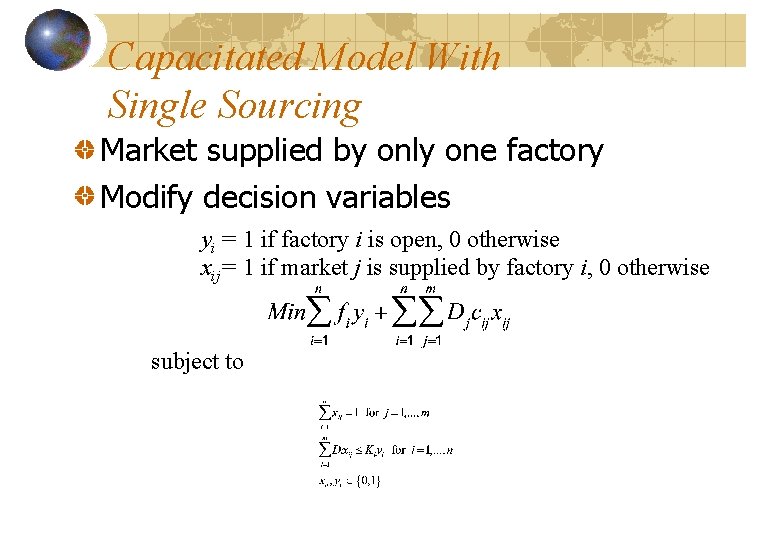
Capacitated Model With Single Sourcing Market supplied by only one factory Modify decision variables yi = 1 if factory i is open, 0 otherwise xij = 1 if market j is supplied by factory i, 0 otherwise subject to
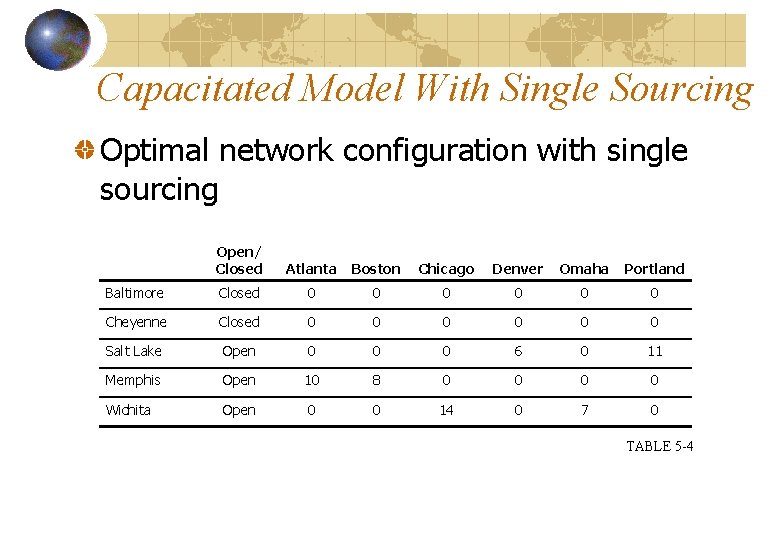
Capacitated Model With Single Sourcing Optimal network configuration with single sourcing Open/ Closed Atlanta Boston Chicago Denver Omaha Portland Baltimore Closed 0 0 0 Cheyenne Closed 0 0 0 Salt Lake Open 0 0 0 6 0 11 Memphis Open 10 8 0 0 Wichita Open 0 0 14 0 7 0 TABLE 5 -4
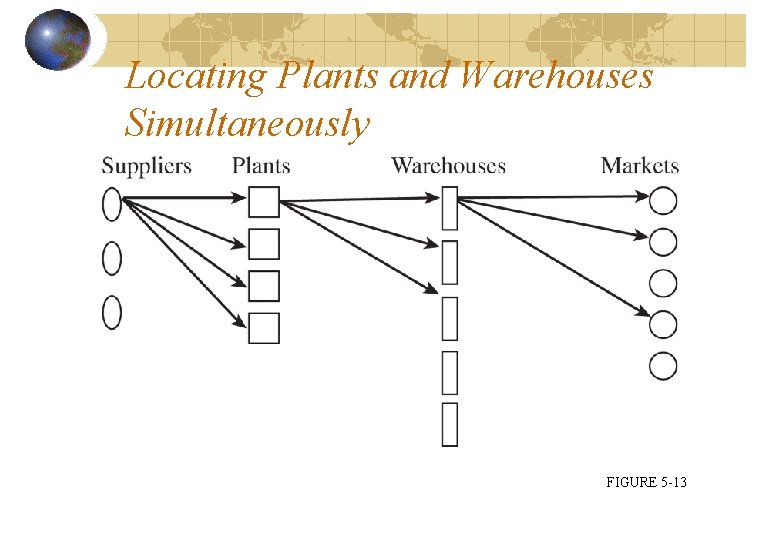
Locating Plants and Warehouses Simultaneously FIGURE 5 -13
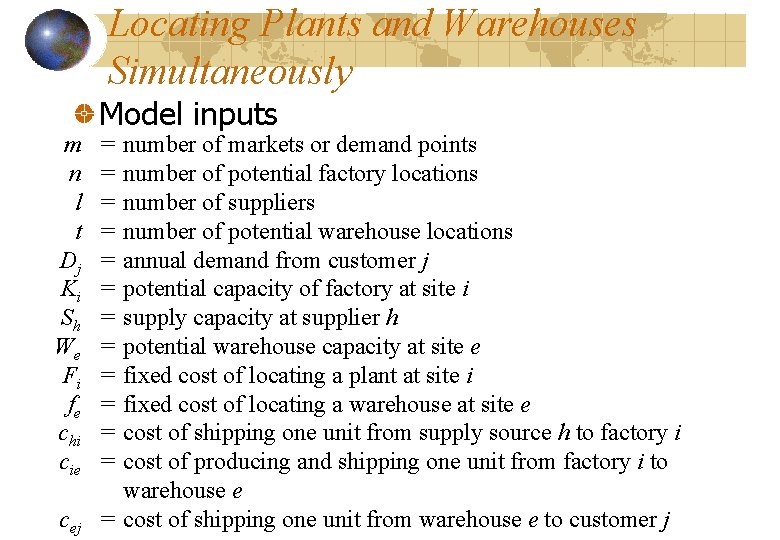
Locating Plants and Warehouses Simultaneously m n l t Dj Ki Sh We Fi fe chi cie cej Model inputs = = = number of markets or demand points number of potential factory locations number of suppliers number of potential warehouse locations annual demand from customer j potential capacity of factory at site i supply capacity at supplier h potential warehouse capacity at site e fixed cost of locating a plant at site i fixed cost of locating a warehouse at site e cost of shipping one unit from supply source h to factory i cost of producing and shipping one unit from factory i to warehouse e = cost of shipping one unit from warehouse e to customer j
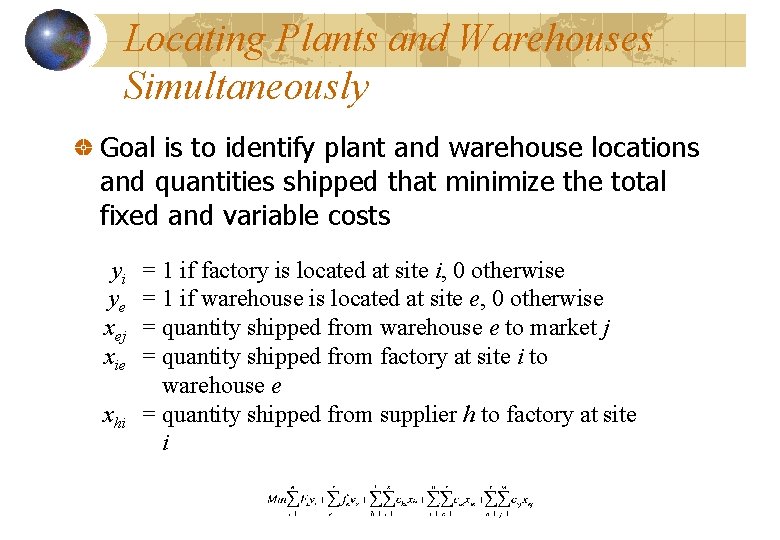
Locating Plants and Warehouses Simultaneously Goal is to identify plant and warehouse locations and quantities shipped that minimize the total fixed and variable costs yi ye xej xie xhi = 1 if factory is located at site i, 0 otherwise = 1 if warehouse is located at site e, 0 otherwise = quantity shipped from warehouse e to market j = quantity shipped from factory at site i to warehouse e = quantity shipped from supplier h to factory at site i
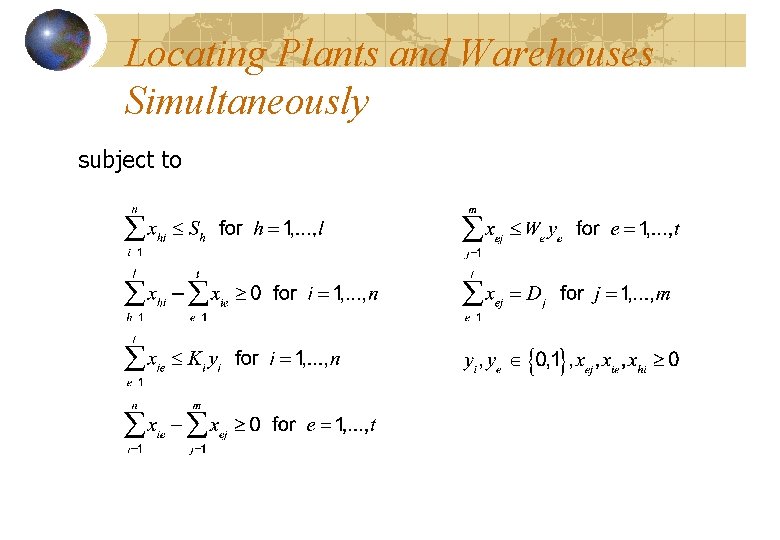
Locating Plants and Warehouses Simultaneously subject to
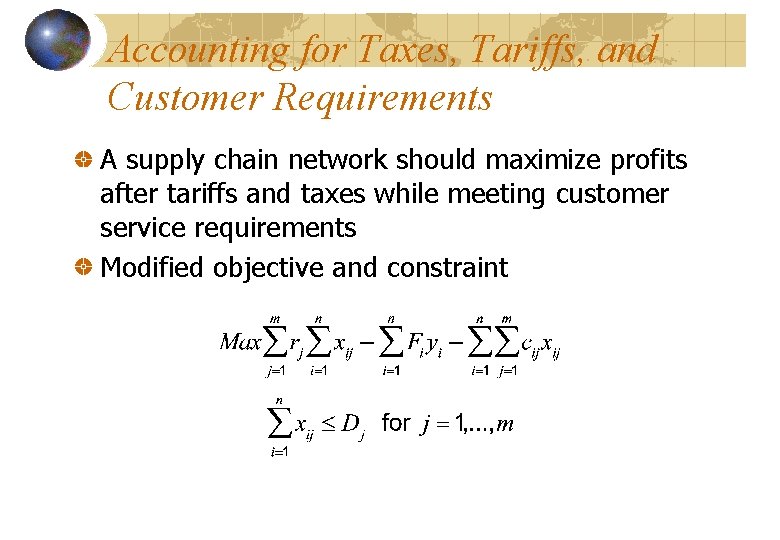
Accounting for Taxes, Tariffs, and Customer Requirements A supply chain network should maximize profits after tariffs and taxes while meeting customer service requirements Modified objective and constraint
Making Network Design Decisions In Practice Do not underestimate the life span of facilities Do not gloss over the cultural implications Do not ignore quality-of-life issues Focus on tariffs and tax incentives when locating facilities
Summary of Learning Objectives 1. Understand the role of network design in a supply chain 2. Identify factors influencing supply chain network design decisions 3. Develop a framework for making network design decisions 4. Use optimization for facility location and capacity allocation decisions