
Chapter 5 Neighborhood Processing Point processing applies a
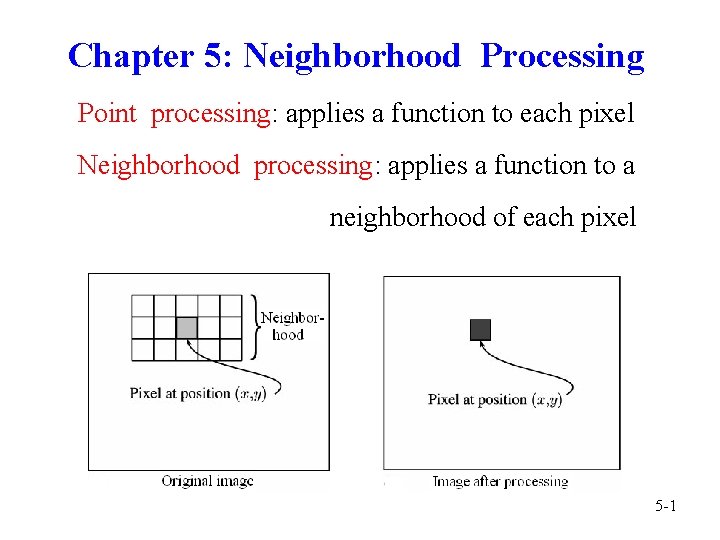
Chapter 5: Neighborhood Processing Point processing: applies a function to each pixel Neighborhood processing: applies a function to a neighborhood of each pixel 5 -1
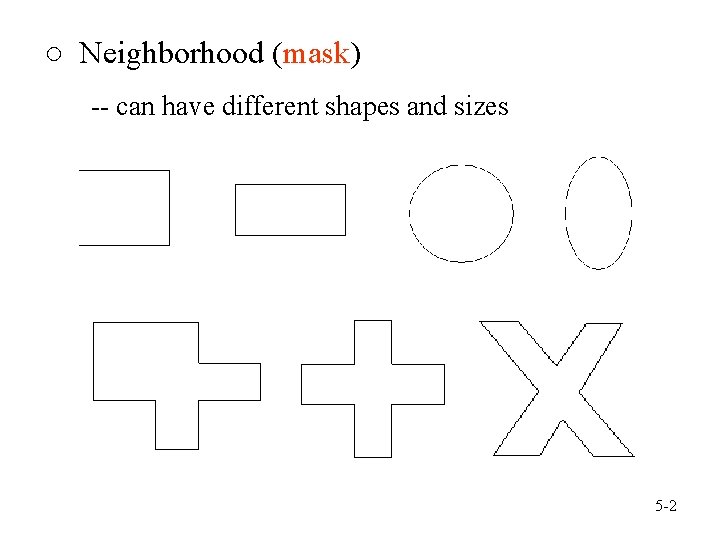
○ Neighborhood (mask) -- can have different shapes and sizes 5 -2
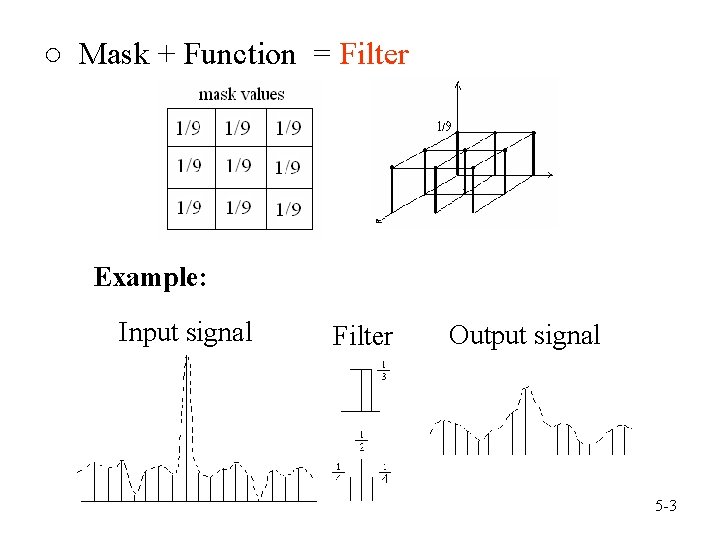
○ Mask + Function = Filter Example: Input signal Filter Output signal 5 -3
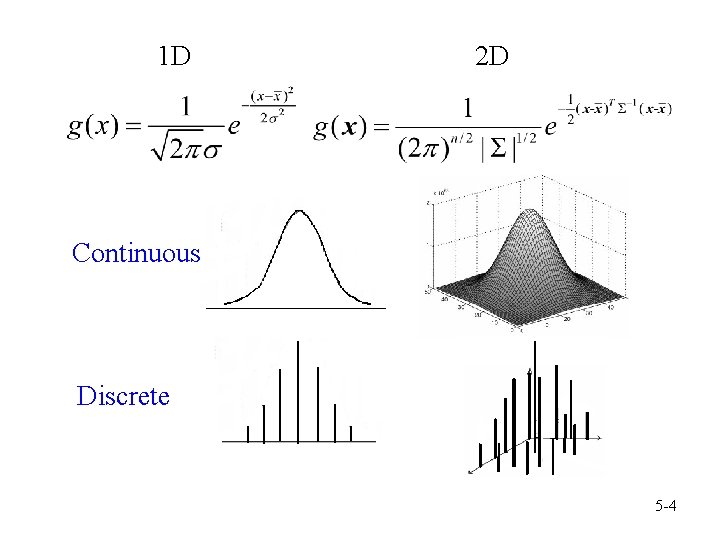
1 D 2 D Continuous Discrete 5 -4
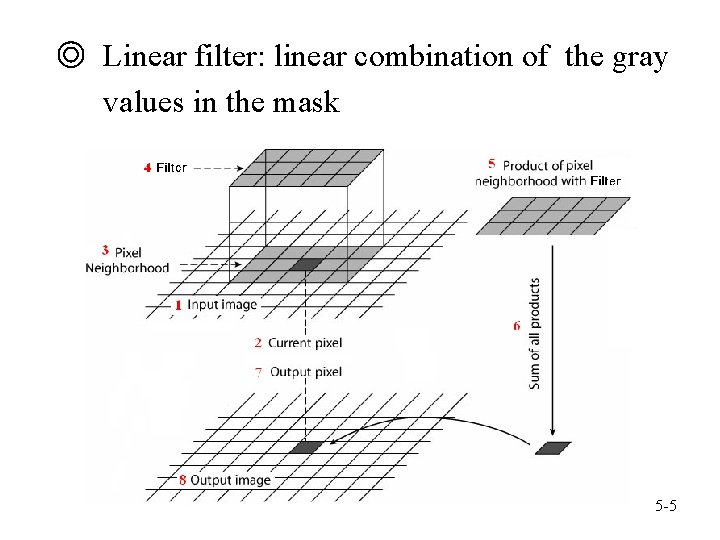
◎ Linear filter: linear combination of the gray values in the mask 5 -5
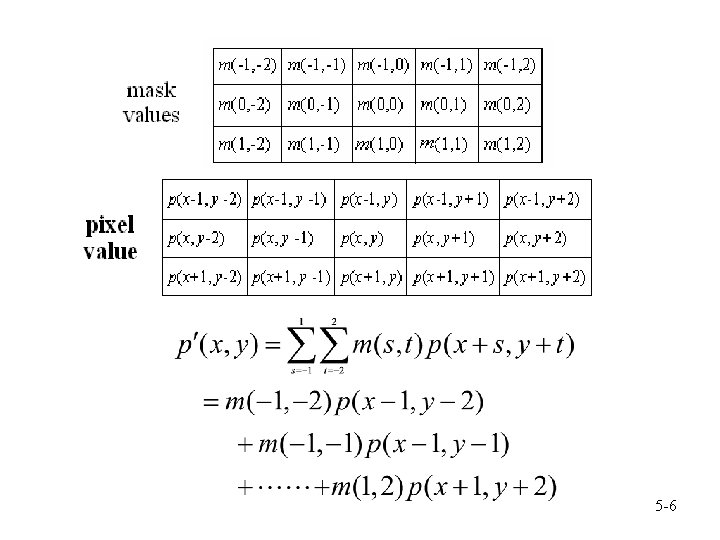
5 -6
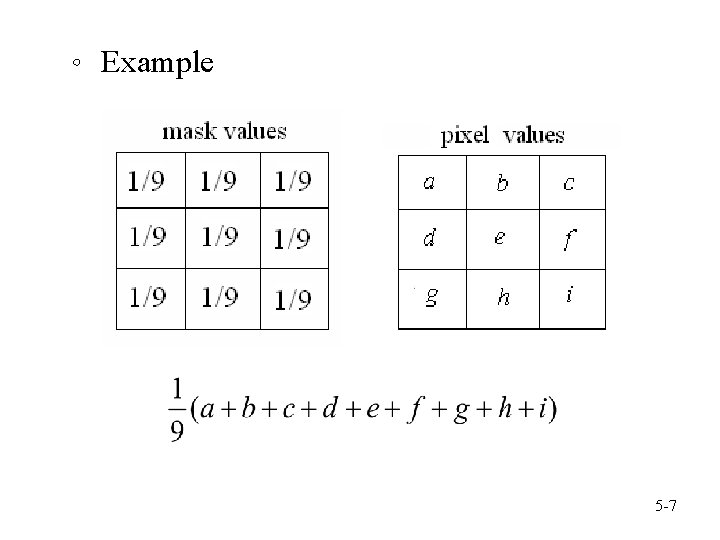
。 Example 5 -7
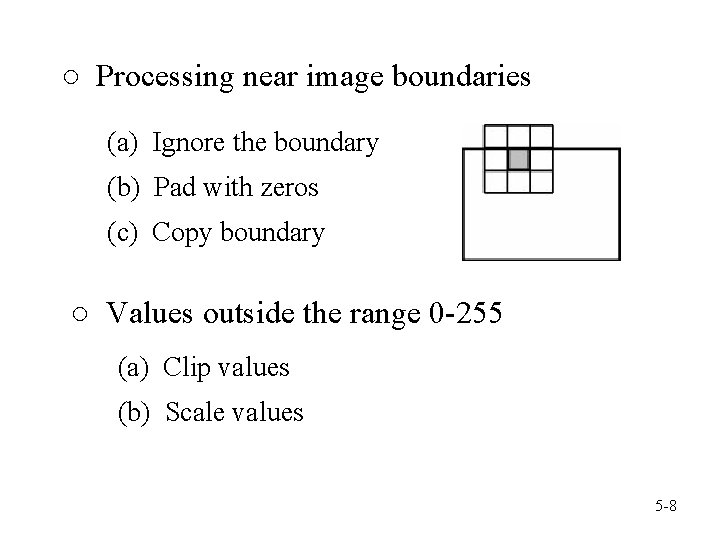
○ Processing near image boundaries (a) Ignore the boundary (b) Pad with zeros (c) Copy boundary ○ Values outside the range 0 -255 (a) Clip values (b) Scale values 5 -8
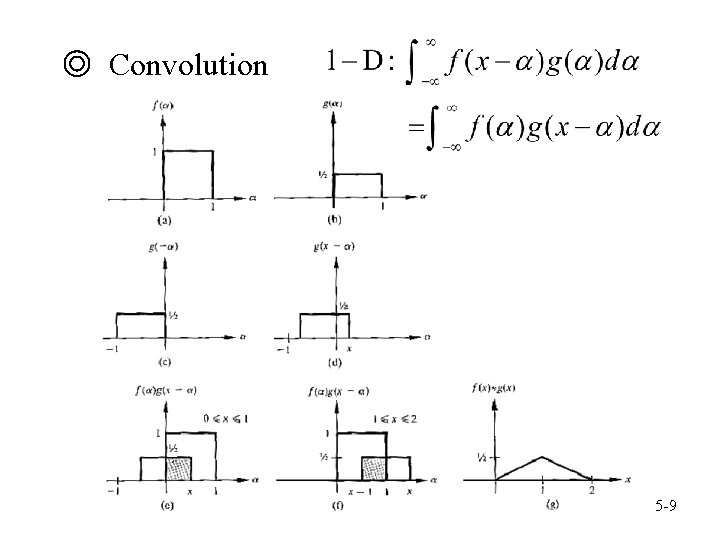
◎ Convolution 5 -9
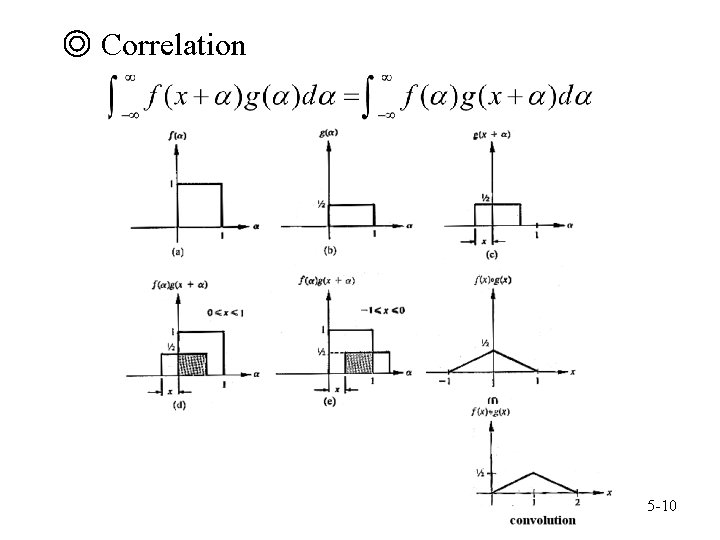
◎ Correlation 5 -10

。 Discrete Case: e. g. , A = 4, B = 5, A + B – 1 = 8, 7 -11
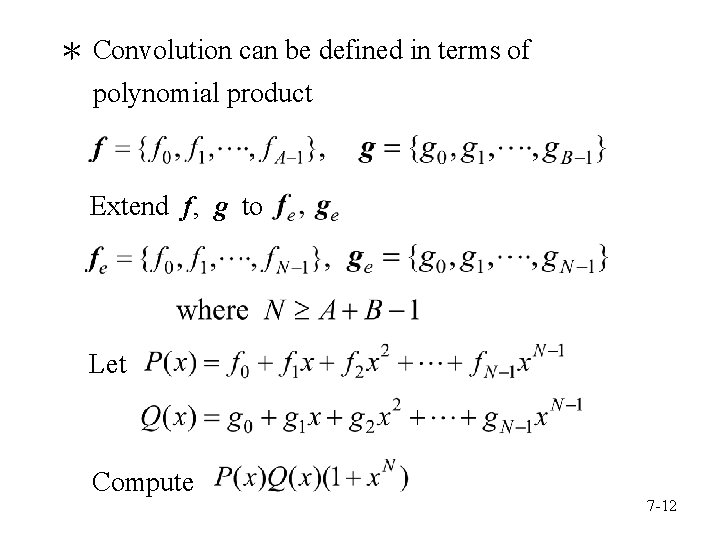
* Convolution can be defined in terms of polynomial product Extend f, g to Let Compute 7 -12
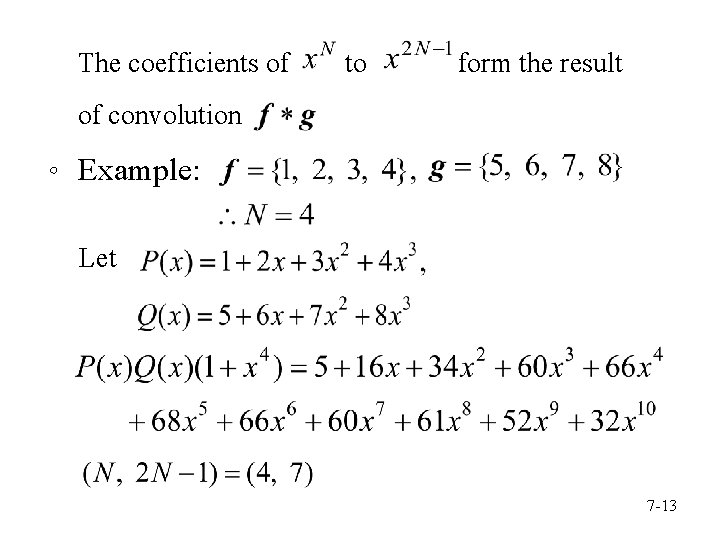
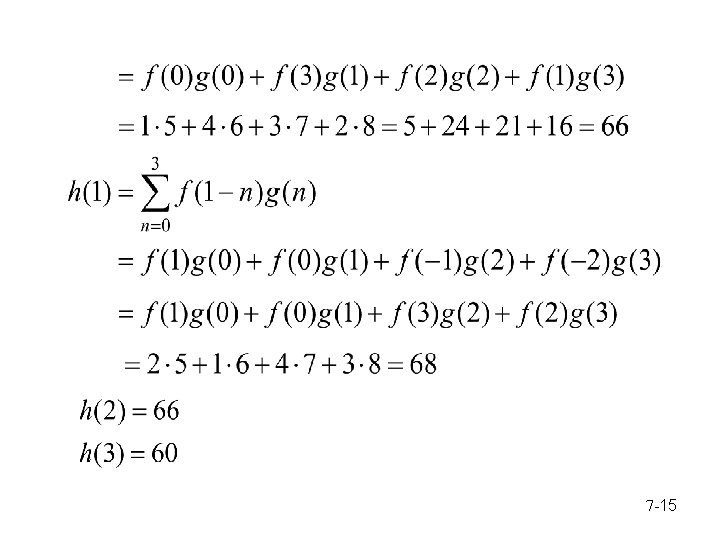
The coefficients of to form the result of convolution 。 Example: Let 7 -13
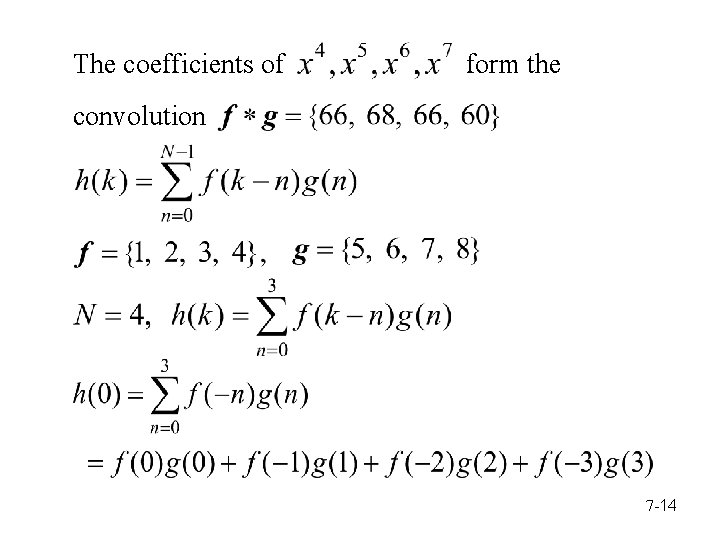
The coefficients of form the convolution 7 -14
7 -15
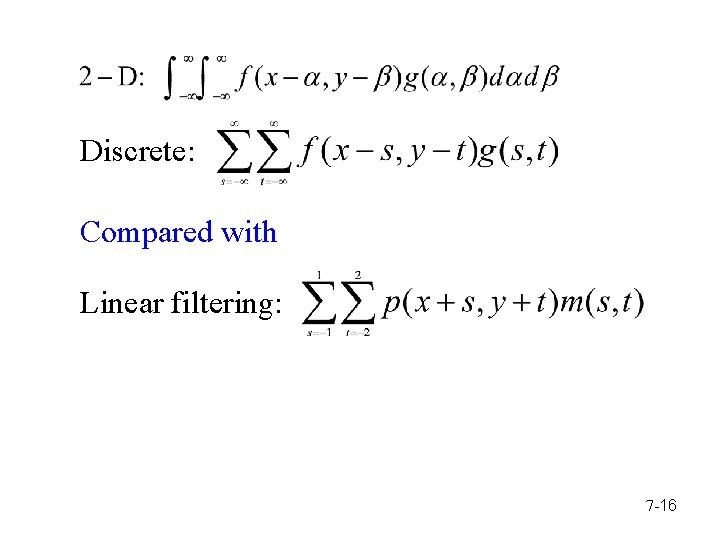
Discrete: Compared with Linear filtering: 7 -16
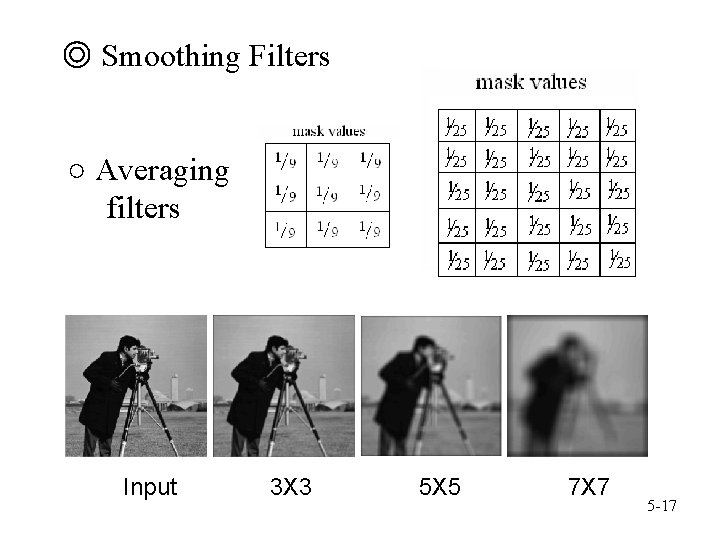
◎ Smoothing Filters ○ Averaging filters Input 3 X 3 5 X 5 7 X 7 5 -17
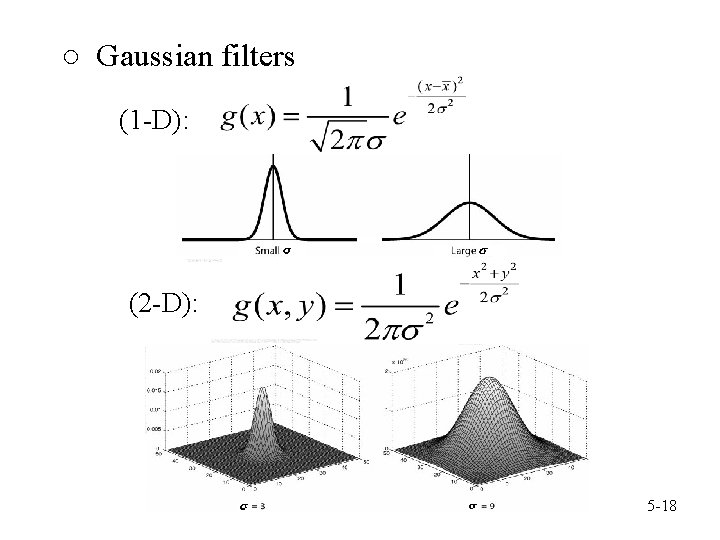
○ Gaussian filters (1 -D): (2 -D): 5 -18
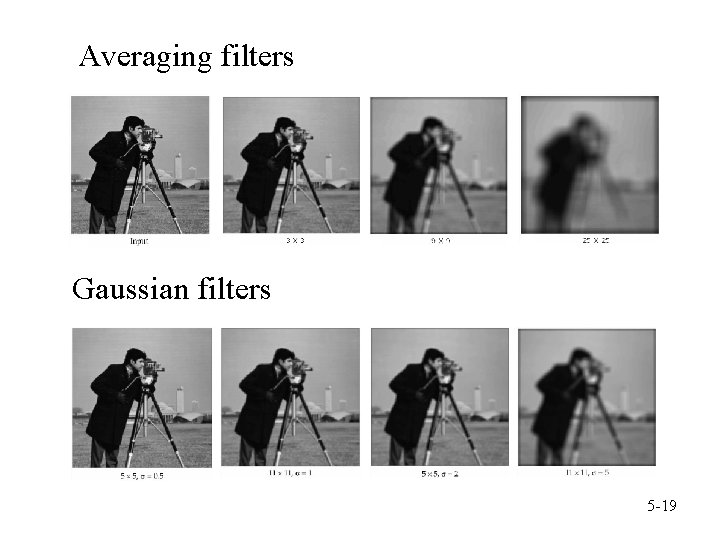
Averaging filters Gaussian filters 5 -19
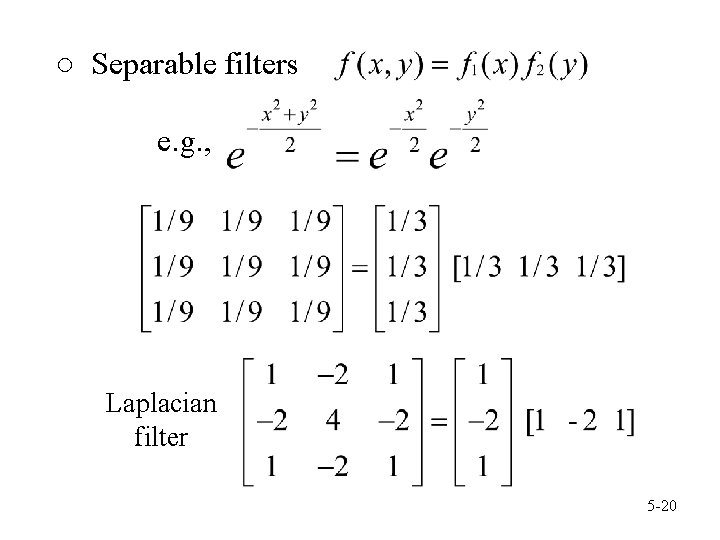
○ Separable filters e. g. , Laplacian filter 5 -20
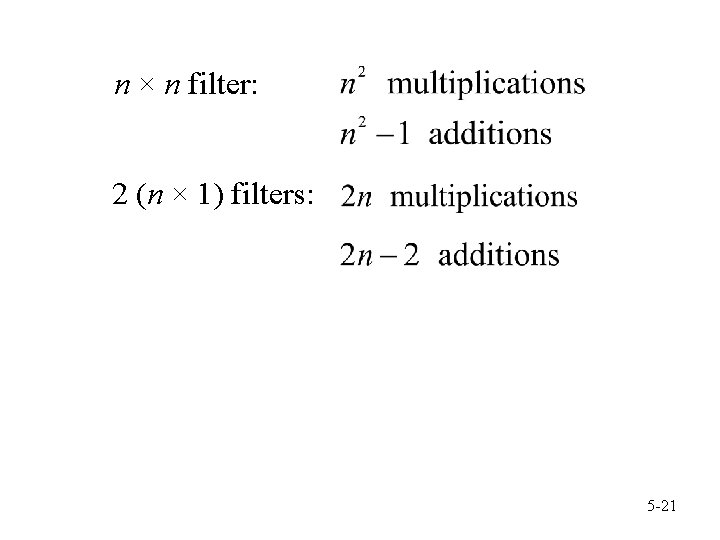
n × n filter: 2 (n × 1) filters: 5 -21
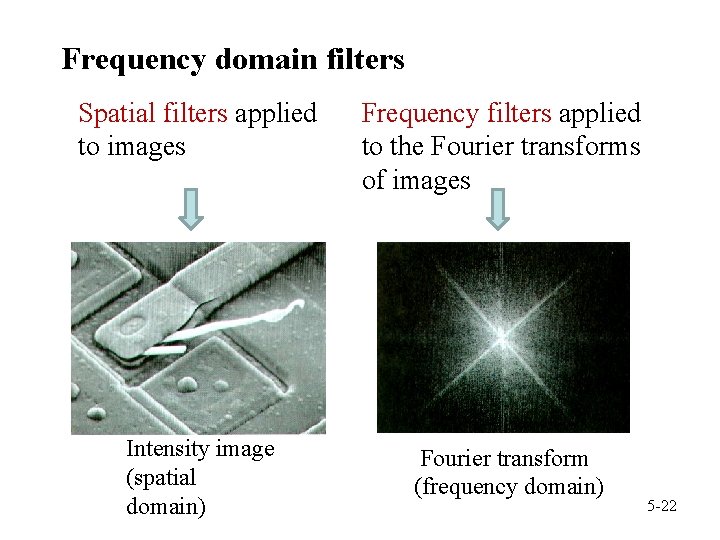
Frequency domain filters Spatial filters applied to images Intensity image (spatial domain) Frequency filters applied to the Fourier transforms of images Fourier transform (frequency domain) 5 -22
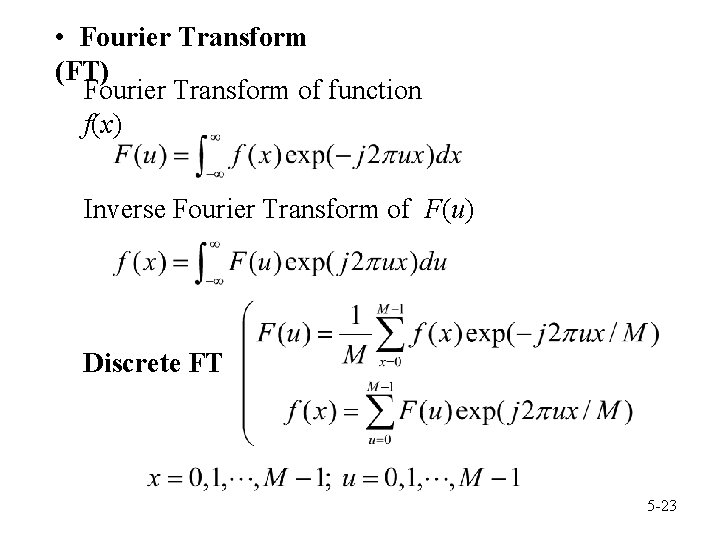
• Fourier Transform (FT) Fourier Transform of function f(x) Inverse Fourier Transform of F(u) Discrete FT 5 -23
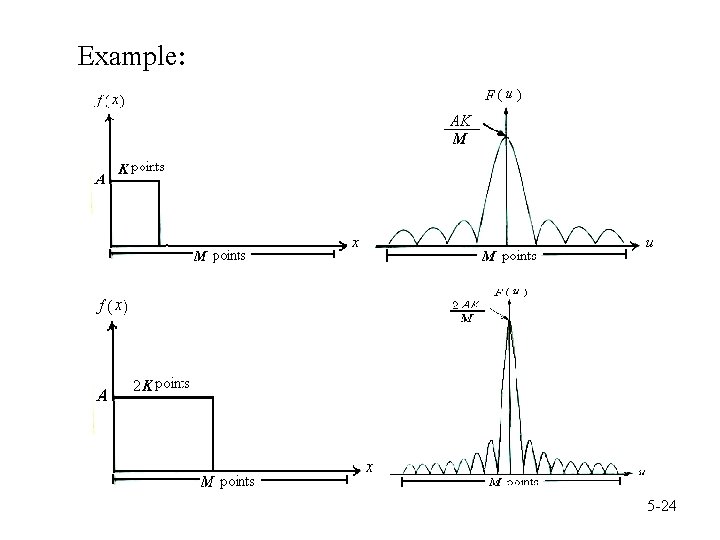
Example: 5 -24
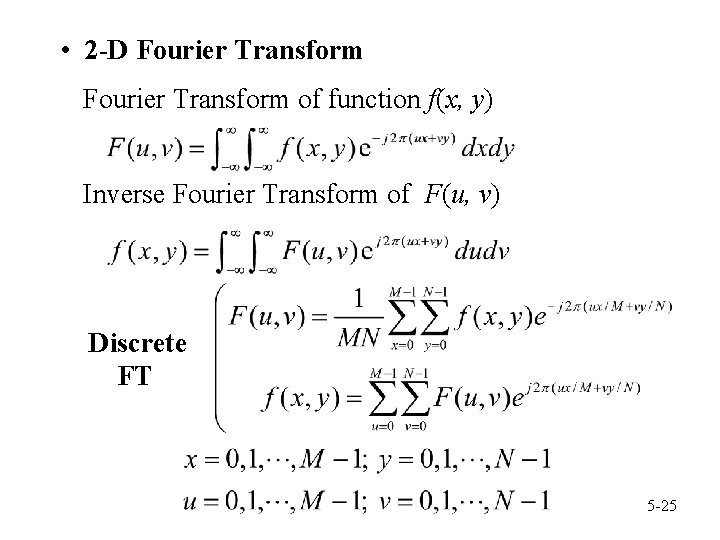
• 2 -D Fourier Transform of function f(x, y) Inverse Fourier Transform of F(u, v) Discrete FT 5 -25
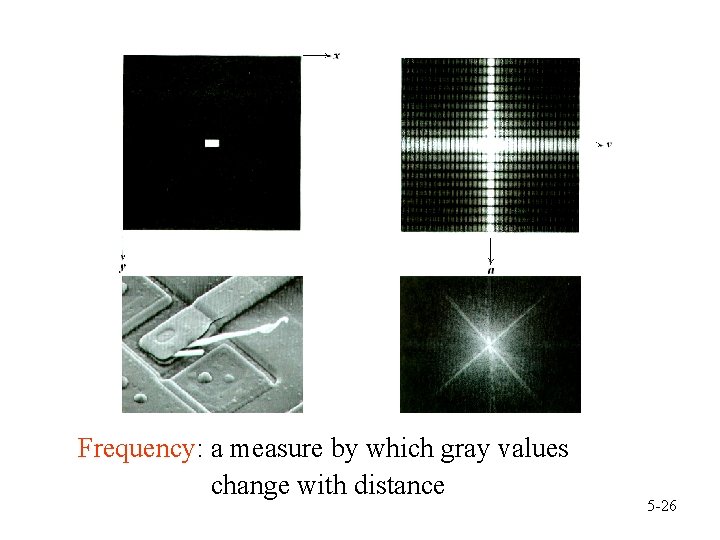
Frequency: a measure by which gray values change with distance 5 -26
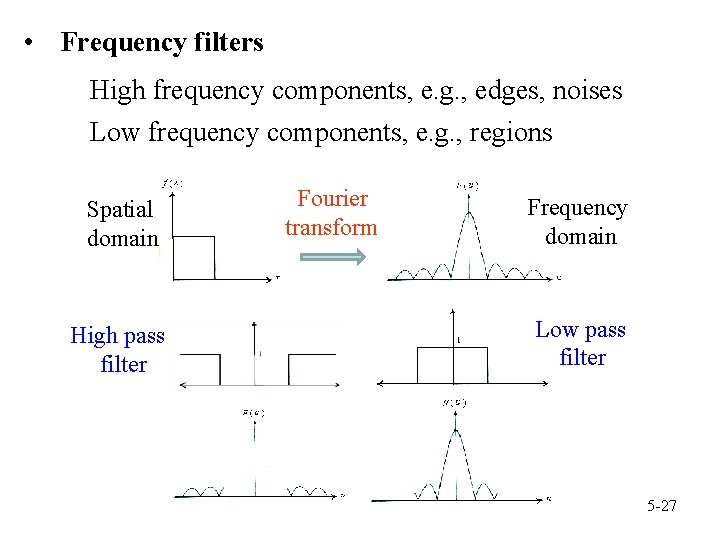
• Frequency filters High frequency components, e. g. , edges, noises Low frequency components, e. g. , regions Spatial domain High pass filter Fourier transform Frequency domain Low pass filter 5 -27
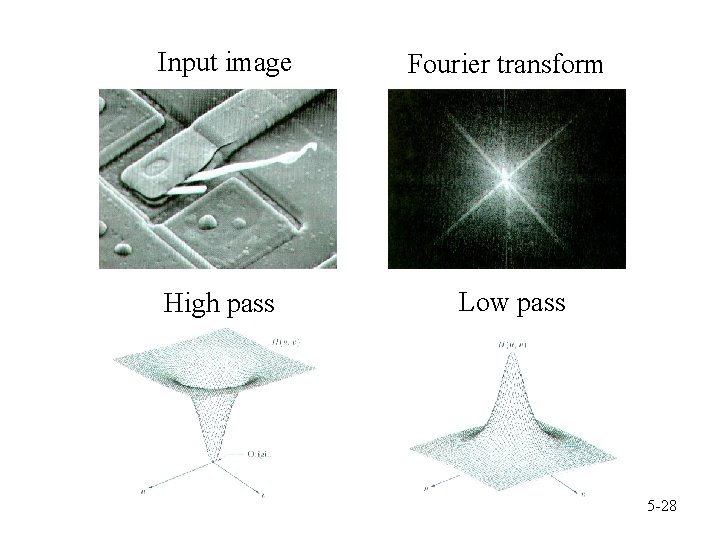
Input image Fourier transform High pass Low pass 5 -28
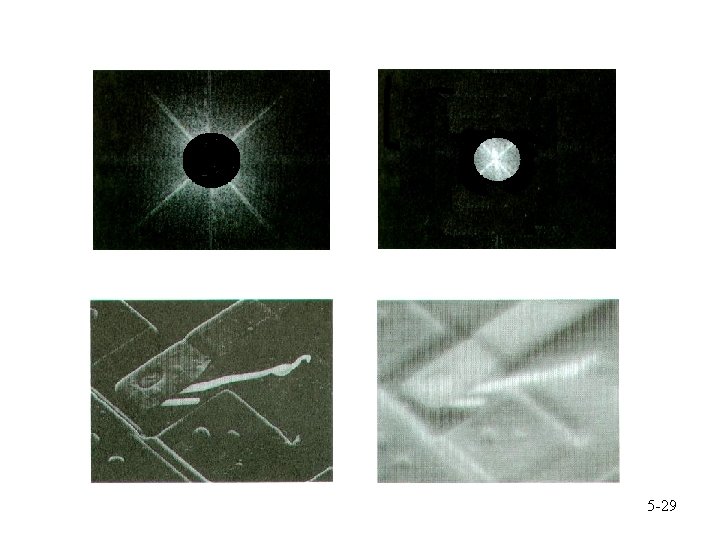
5 -29
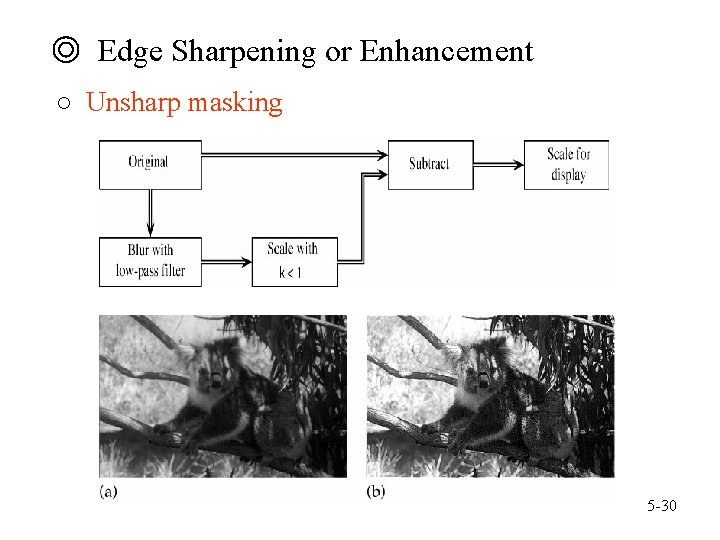
◎ Edge Sharpening or Enhancement ○ Unsharp masking 5 -30
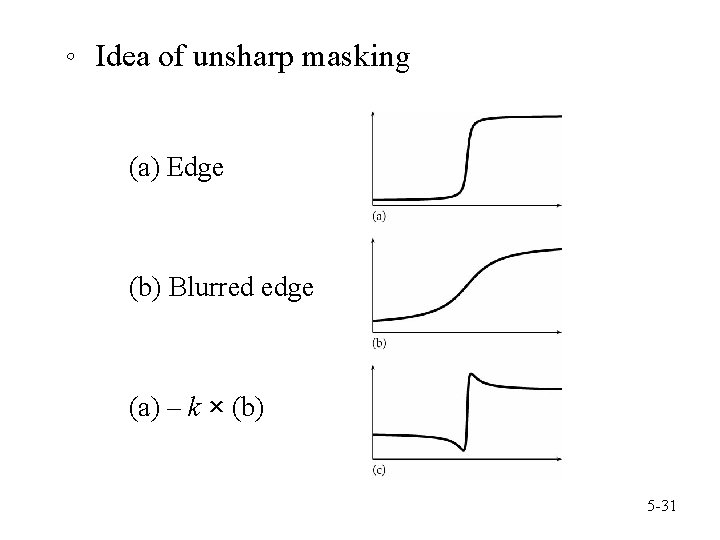
。 Idea of unsharp masking (a) Edge (b) Blurred edge (a) – k × (b) 5 -31
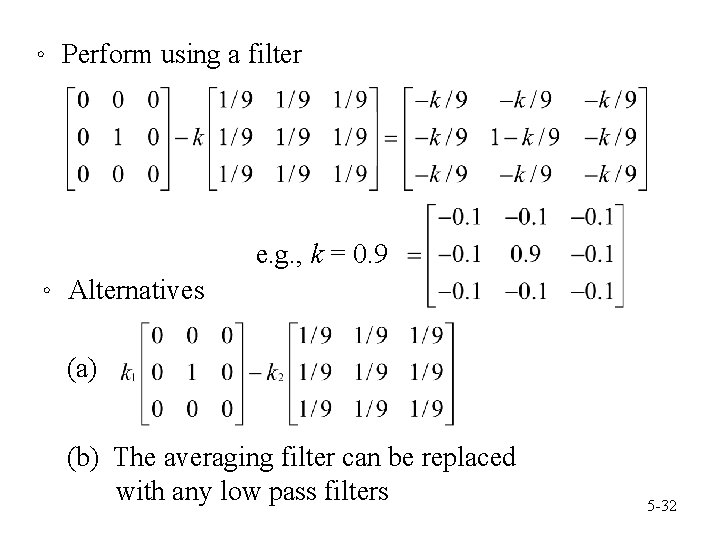
。 Perform using a filter e. g. , k = 0. 9 。 Alternatives (a) (b) The averaging filter can be replaced with any low pass filters 5 -32
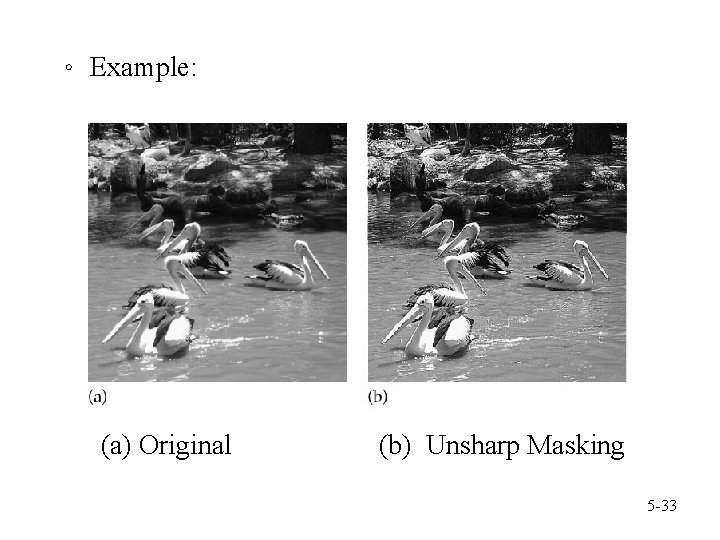
。 Example: (a) Original (b) Unsharp Masking 5 -33
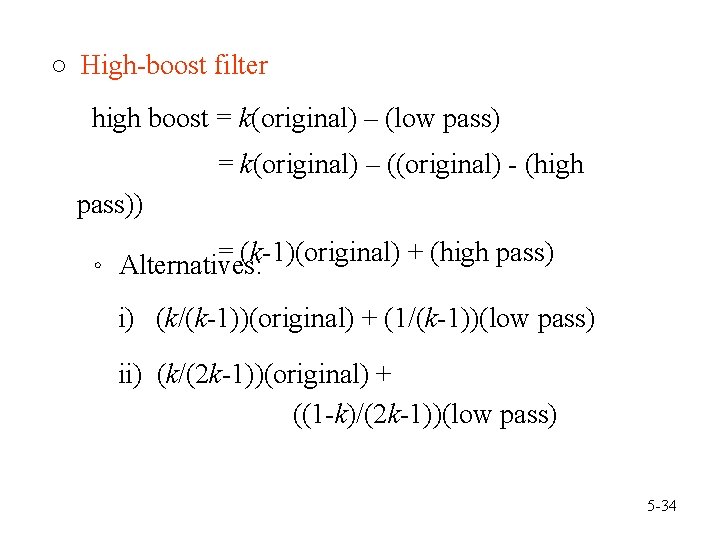
○ High-boost filter high boost = k(original) – (low pass) = k(original) – ((original) - (high pass)) = (k-1)(original) + (high pass) 。 Alternatives: i) (k/(k-1))(original) + (1/(k-1))(low pass) ii) (k/(2 k-1))(original) + ((1 -k)/(2 k-1))(low pass) 5 -34
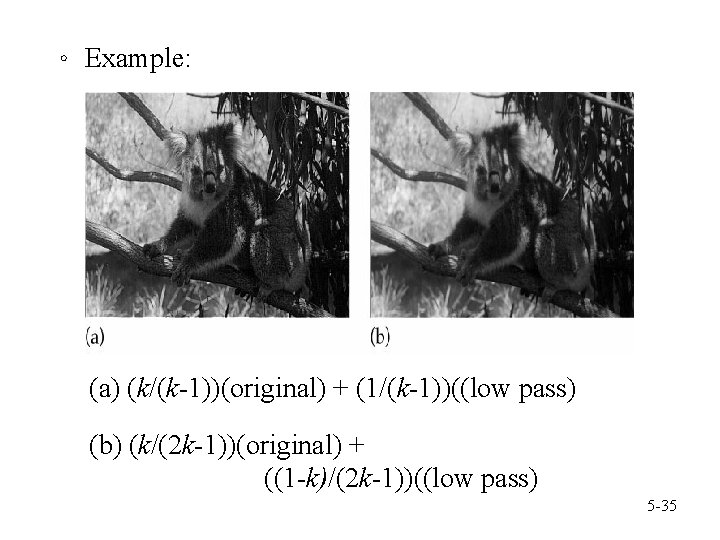
。 Example: (a) (k/(k-1))(original) + (1/(k-1))((low pass) (b) (k/(2 k-1))(original) + ((1 -k)/(2 k-1))((low pass) 5 -35
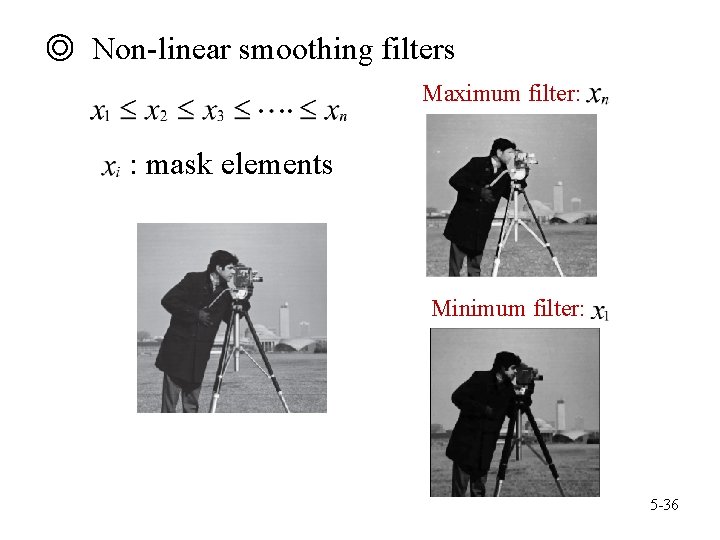
◎ Non-linear smoothing filters Maximum filter: : mask elements Minimum filter: 5 -36
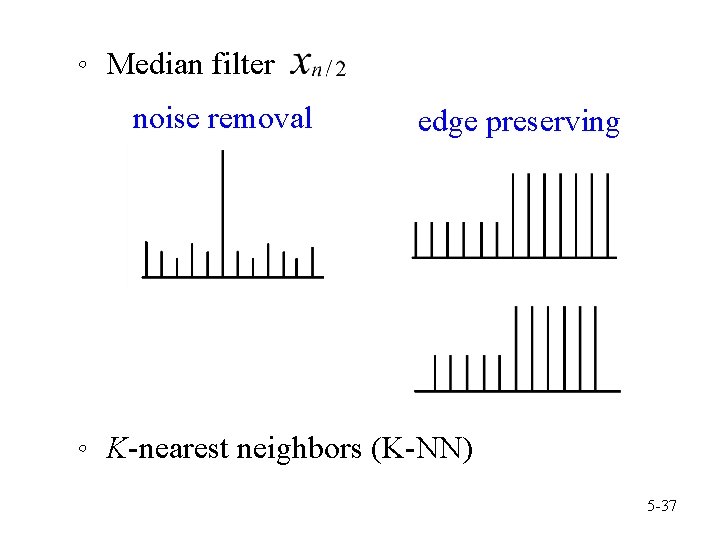
。 Median filter noise removal edge preserving 。 K-nearest neighbors (K-NN) 5 -37
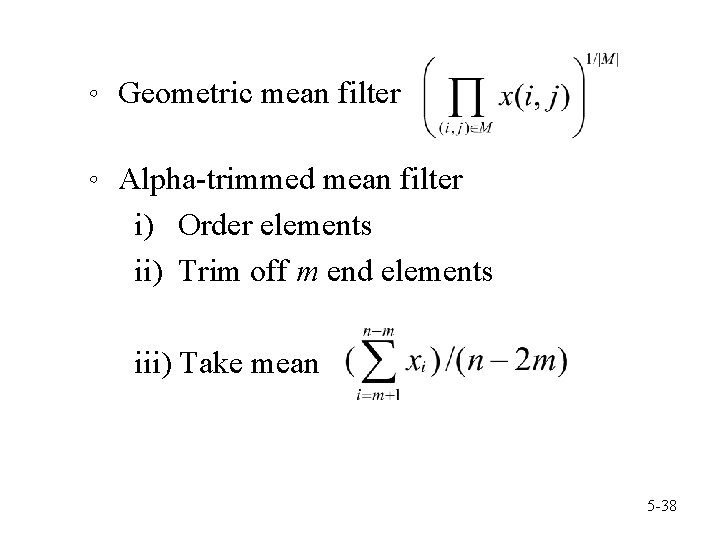
。 Geometric mean filter 。 Alpha-trimmed mean filter i) Order elements ii) Trim off m end elements iii) Take mean 5 -38
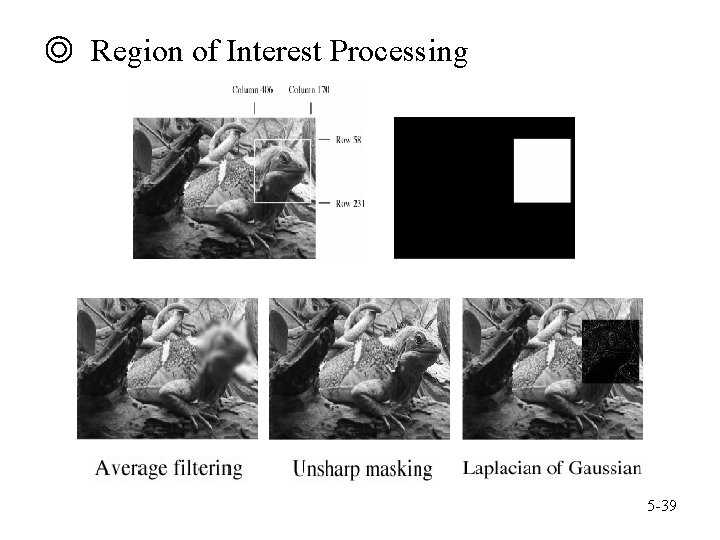
◎ Region of Interest Processing 5 -39
- Slides: 39