
Chapter 5 Multiple Discriminant Analysis Copyright 2010 Pearson
- Slides: 36
Chapter 5 Multiple Discriminant Analysis Copyright © 2010 Pearson Education, Inc. , publishing as Prentice-Hall. 5 -1
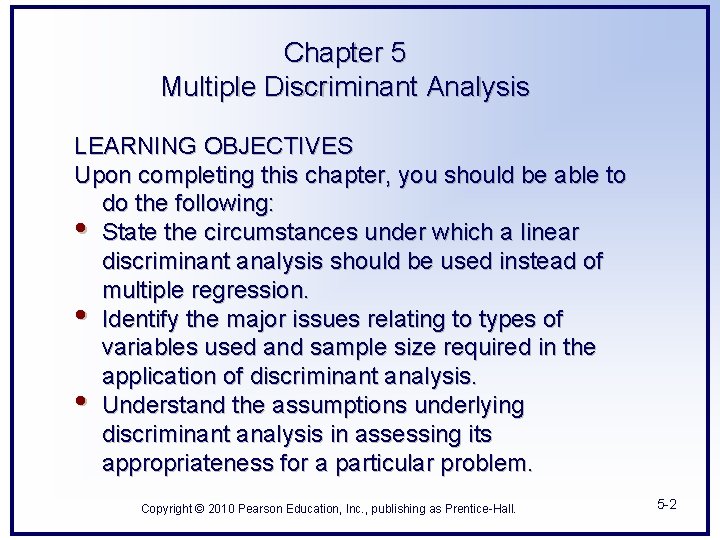
Chapter 5 Multiple Discriminant Analysis LEARNING OBJECTIVES Upon completing this chapter, you should be able to do the following: • State the circumstances under which a linear discriminant analysis should be used instead of multiple regression. • Identify the major issues relating to types of variables used and sample size required in the application of discriminant analysis. • Understand the assumptions underlying discriminant analysis in assessing its appropriateness for a particular problem. Copyright © 2010 Pearson Education, Inc. , publishing as Prentice-Hall. 5 -2
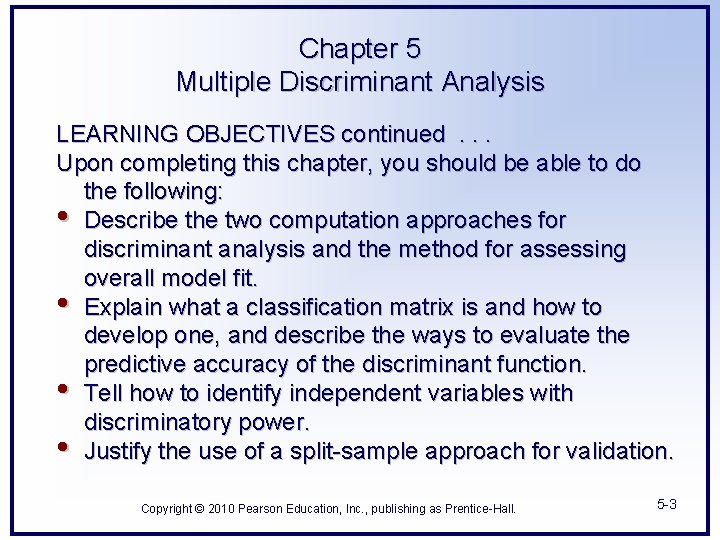
Chapter 5 Multiple Discriminant Analysis LEARNING OBJECTIVES continued. . . Upon completing this chapter, you should be able to do the following: • Describe the two computation approaches for discriminant analysis and the method for assessing overall model fit. • Explain what a classification matrix is and how to develop one, and describe the ways to evaluate the predictive accuracy of the discriminant function. • Tell how to identify independent variables with discriminatory power. • Justify the use of a split-sample approach for validation. Copyright © 2010 Pearson Education, Inc. , publishing as Prentice-Hall. 5 -3
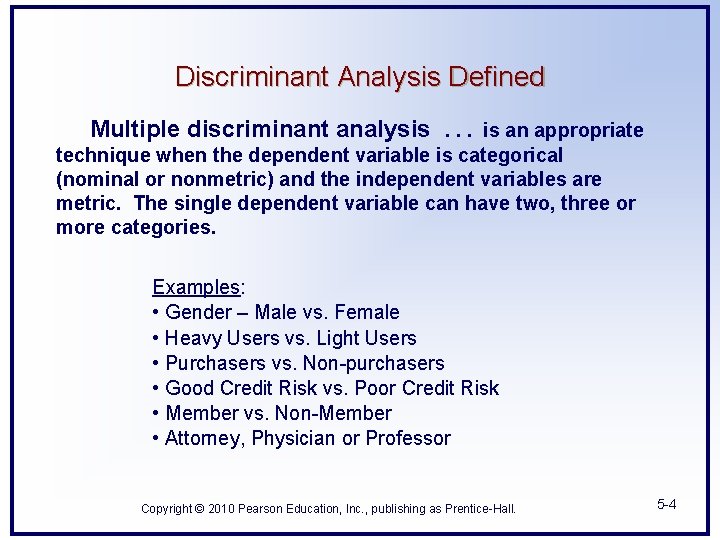
Discriminant Analysis Defined Multiple discriminant analysis. . . is an appropriate technique when the dependent variable is categorical (nominal or nonmetric) and the independent variables are metric. The single dependent variable can have two, three or more categories. Examples: • Gender – Male vs. Female • Heavy Users vs. Light Users • Purchasers vs. Non-purchasers • Good Credit Risk vs. Poor Credit Risk • Member vs. Non-Member • Attorney, Physician or Professor Copyright © 2010 Pearson Education, Inc. , publishing as Prentice-Hall. 5 -4
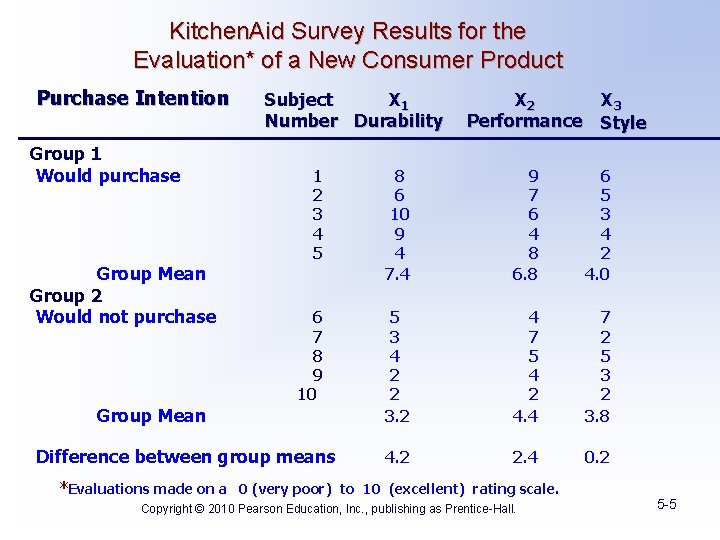
Kitchen. Aid Survey Results for the Evaluation* of a New Consumer Product Purchase Intention Group 1 Would purchase Group Mean Group 2 Would not purchase X 1 Subject Number Durability X 2 X 3 Performance Style 1 2 3 4 5 8 6 10 9 4 7. 4 9 7 6 4 8 6 5 3 4 2 4. 0 6 7 8 9 10 5 3 4 2 2 3. 2 4 7 5 4 2 4. 4 7 2 5 3 2 3. 8 4. 2 2. 4 0. 2 Group Mean Difference between group means *Evaluations made on a 0 (very poor) to 10 (excellent) rating scale. Copyright © 2010 Pearson Education, Inc. , publishing as Prentice-Hall. 5 -5
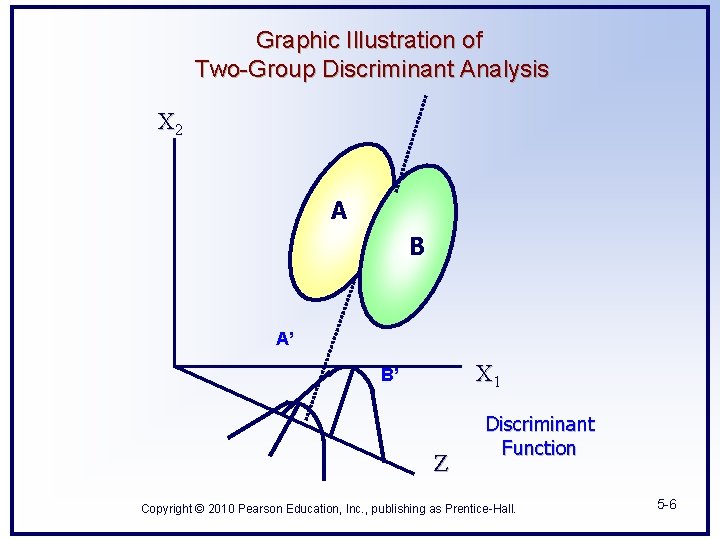
Graphic Illustration of Two-Group Discriminant Analysis X 2 A B A’ X 1 B’ Z Discriminant Function Copyright © 2010 Pearson Education, Inc. , publishing as Prentice-Hall. 5 -6
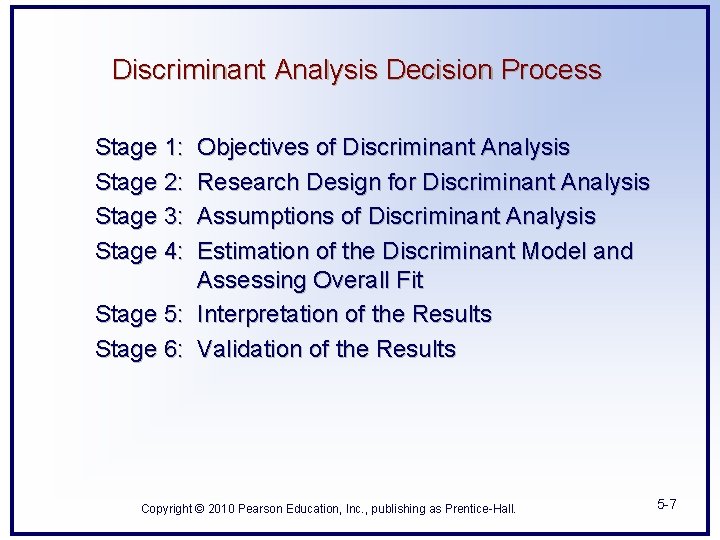
Discriminant Analysis Decision Process Stage 1: Stage 2: Stage 3: Stage 4: Objectives of Discriminant Analysis Research Design for Discriminant Analysis Assumptions of Discriminant Analysis Estimation of the Discriminant Model and Assessing Overall Fit Stage 5: Interpretation of the Results Stage 6: Validation of the Results Copyright © 2010 Pearson Education, Inc. , publishing as Prentice-Hall. 5 -7
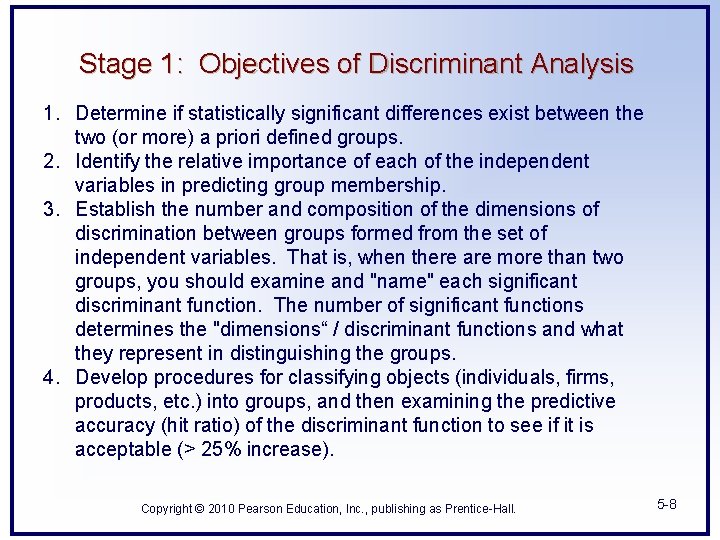
Stage 1: Objectives of Discriminant Analysis 1. Determine if statistically significant differences exist between the two (or more) a priori defined groups. 2. Identify the relative importance of each of the independent variables in predicting group membership. 3. Establish the number and composition of the dimensions of discrimination between groups formed from the set of independent variables. That is, when there are more than two groups, you should examine and "name" each significant discriminant function. The number of significant functions determines the "dimensions“ / discriminant functions and what they represent in distinguishing the groups. 4. Develop procedures for classifying objects (individuals, firms, products, etc. ) into groups, and then examining the predictive accuracy (hit ratio) of the discriminant function to see if it is acceptable (> 25% increase). Copyright © 2010 Pearson Education, Inc. , publishing as Prentice-Hall. 5 -8
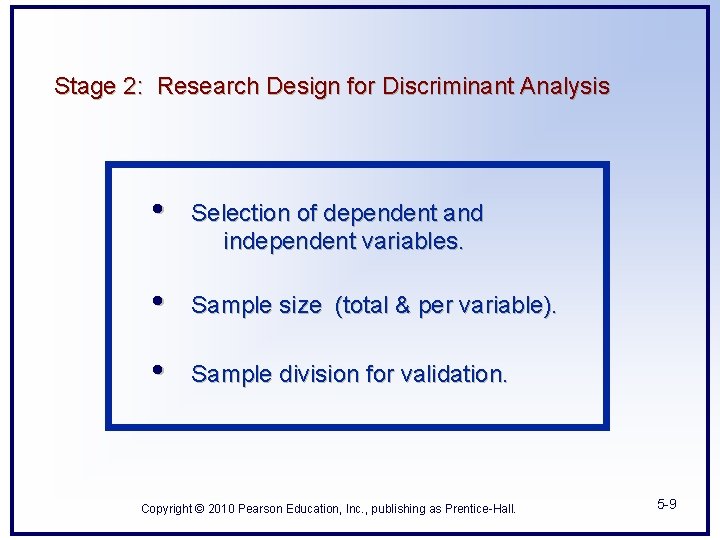
Stage 2: Research Design for Discriminant Analysis • Selection of dependent and independent variables. • Sample size (total & per variable). • Sample division for validation. Copyright © 2010 Pearson Education, Inc. , publishing as Prentice-Hall. 5 -9
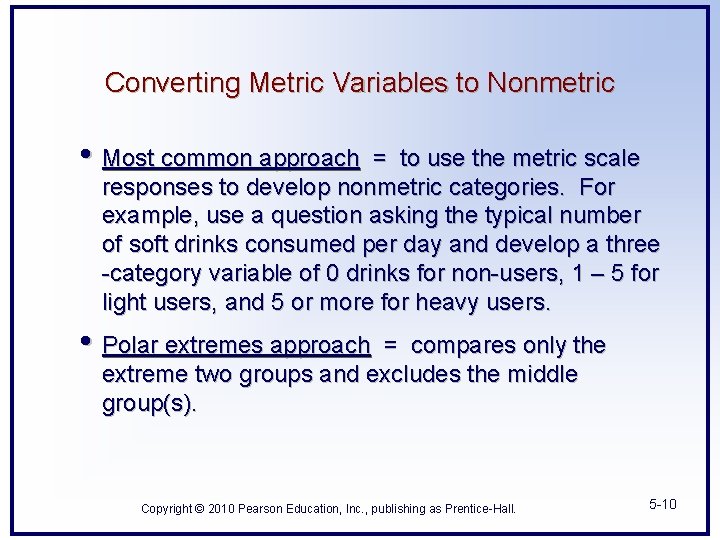
Converting Metric Variables to Nonmetric • Most common approach = to use the metric scale responses to develop nonmetric categories. For example, use a question asking the typical number of soft drinks consumed per day and develop a three -category variable of 0 drinks for non-users, 1 – 5 for light users, and 5 or more for heavy users. • Polar extremes approach = compares only the extreme two groups and excludes the middle group(s). Copyright © 2010 Pearson Education, Inc. , publishing as Prentice-Hall. 5 -10
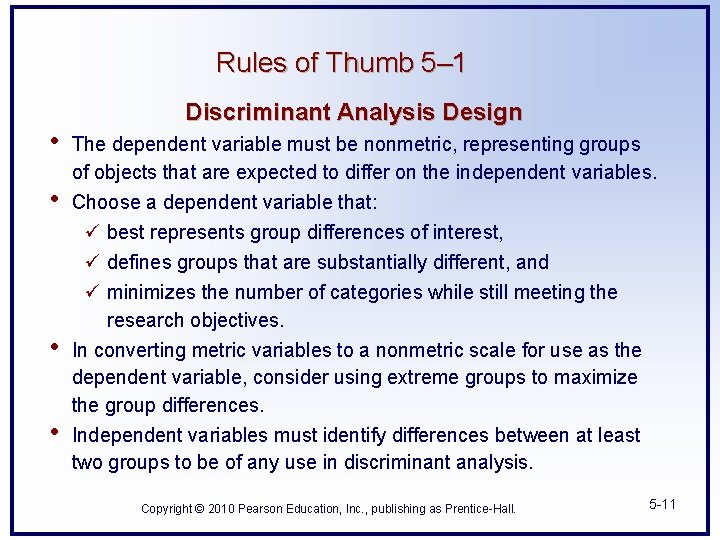
Rules of Thumb 5– 1 • • Discriminant Analysis Design The dependent variable must be nonmetric, representing groups of objects that are expected to differ on the independent variables. Choose a dependent variable that: ü best represents group differences of interest, ü defines groups that are substantially different, and ü minimizes the number of categories while still meeting the research objectives. In converting metric variables to a nonmetric scale for use as the dependent variable, consider using extreme groups to maximize the group differences. Independent variables must identify differences between at least two groups to be of any use in discriminant analysis. Copyright © 2010 Pearson Education, Inc. , publishing as Prentice-Hall. 5 -11
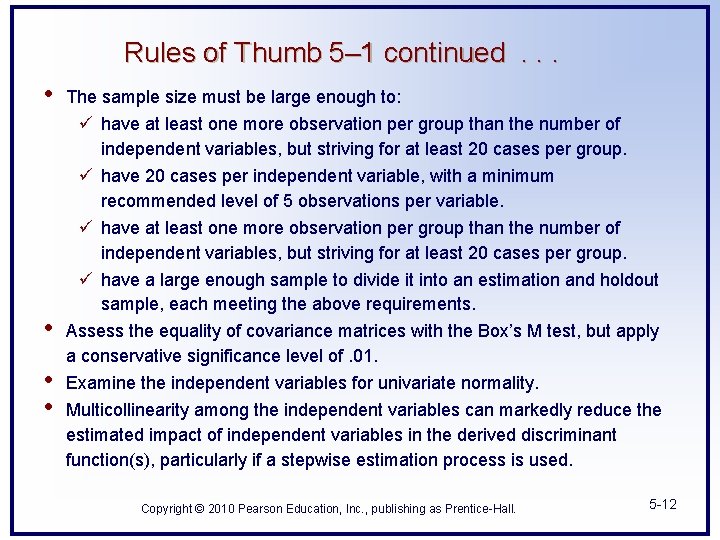
Rules of Thumb 5– 1 continued. . . • • The sample size must be large enough to: ü have at least one more observation per group than the number of independent variables, but striving for at least 20 cases per group. ü have 20 cases per independent variable, with a minimum recommended level of 5 observations per variable. ü have at least one more observation per group than the number of independent variables, but striving for at least 20 cases per group. ü have a large enough sample to divide it into an estimation and holdout sample, each meeting the above requirements. Assess the equality of covariance matrices with the Box’s M test, but apply a conservative significance level of. 01. Examine the independent variables for univariate normality. Multicollinearity among the independent variables can markedly reduce the estimated impact of independent variables in the derived discriminant function(s), particularly if a stepwise estimation process is used. Copyright © 2010 Pearson Education, Inc. , publishing as Prentice-Hall. 5 -12
Stage 3: Assumptions of Discriminant Analysis Key Assumptions • Multivariate normality of the independent variables. • Equal variance and covariance for the groups. Copyright © 2010 Pearson Education, Inc. , publishing as Prentice-Hall. 5 -13
Stage 3: Assumptions of Discriminant Analysis Other Assumptions • Minimal multicollinearity among independent variables. • • • Group sample sizes relatively equal. Linear relationships. Elimination of outliers. Copyright © 2010 Pearson Education, Inc. , publishing as Prentice-Hall. 5 -14
Stage 4: Estimation of the Discriminant Model and Assessing Overall Fit Selecting An Estimation Method. . . 1. Simultaneous Estimation – all independent variables are considered concurrently. 2. Stepwise Estimation – independent variables are entered into the discriminant function one at a time. Copyright © 2010 Pearson Education, Inc. , publishing as Prentice-Hall. 5 -15
Estimating the Discriminant Function The stepwise procedure begins with all independent variables not in the model, and selects variables for inclusion based on: • Statistically significant differences across the groups (. 05 or less required for entry), and • The largest Mahalanobis distance (D 2) between the groups. Copyright © 2010 Pearson Education, Inc. , publishing as Prentice-Hall. 5 -16
Assessing Overall Model Fit • • • Calculating discriminant Z scores for each observation, Evaluating group differences on the discriminant Z scores, and Assessing group membership prediction accuracy. Copyright © 2010 Pearson Education, Inc. , publishing as Prentice-Hall. 5 -17
Assessing Group Membership Prediction Accuracy • • Major Considerations: The statistical and practical rational for developing classification matrices, The cutting score determination, Construction of the classification matrices, and Standards for assessing classification accuracy. Copyright © 2010 Pearson Education, Inc. , publishing as Prentice-Hall. 5 -18
Rules of Thumb 5– 2 • • • Model Estimation and Model Fit Although stepwise estimation may seem “optimal” by selecting the most parsimonious set of maximally discriminating variables, beware of the impact of multicollinearity on the assessment of each variable’s discriminatory power. Overall model fit assesses the statistical significance between groups on the discriminant Z score(s), but does not assess predictive accuracy. With more than two groups, do not confine your analysis to only the statistically significant discriminant function(s), but consider if nonsignificant functions (with significance levels of up to. 3) add explanatory power. Copyright © 2010 Pearson Education, Inc. , publishing as Prentice-Hall. 5 -19
Calculating the Optimum Cutting Score Issues. . . • • Define the prior probabilities based either on the relative sample sizes of the observed groups or specified by the researcher (either assumed to be equal or with values set by the researcher), and Calculate the optimum cutting score value as a weighted average based on the assumed sizes of the groups (derived from the sample sizes). Copyright © 2010 Pearson Education, Inc. , publishing as Prentice-Hall. 5 -20
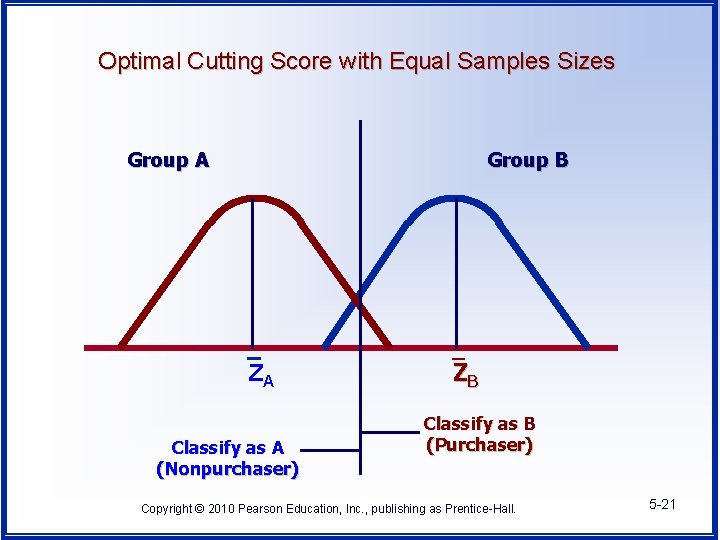
Optimal Cutting Score with Equal Samples Sizes Group A Group B _ ZA Classify as A (Nonpurchaser) _ ZB Classify as B (Purchaser) Copyright © 2010 Pearson Education, Inc. , publishing as Prentice-Hall. 5 -21
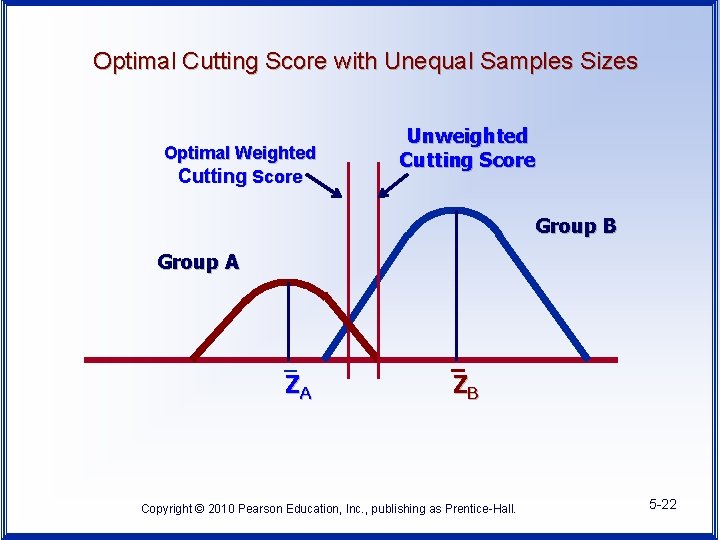
Optimal Cutting Score with Unequal Samples Sizes Optimal Weighted Cutting Score Unweighted Cutting Score Group B Group A _ ZB Copyright © 2010 Pearson Education, Inc. , publishing as Prentice-Hall. 5 -22
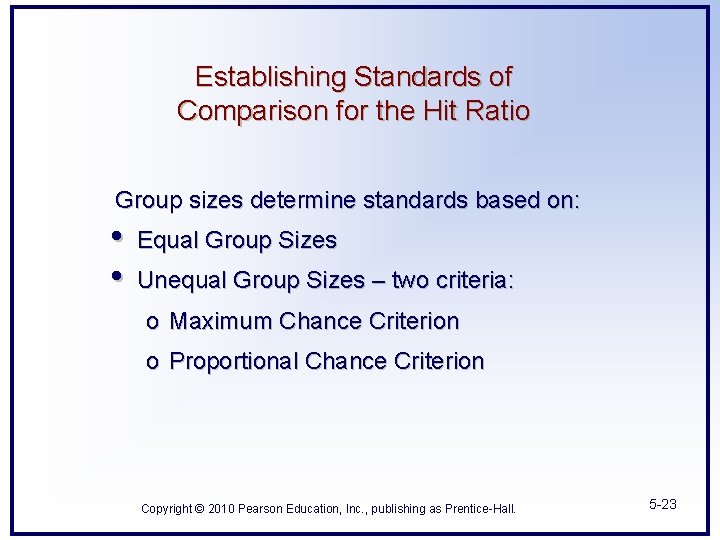
Establishing Standards of Comparison for the Hit Ratio Group sizes determine standards based on: • • Equal Group Sizes Unequal Group Sizes – two criteria: o Maximum Chance Criterion o Proportional Chance Criterion Copyright © 2010 Pearson Education, Inc. , publishing as Prentice-Hall. 5 -23
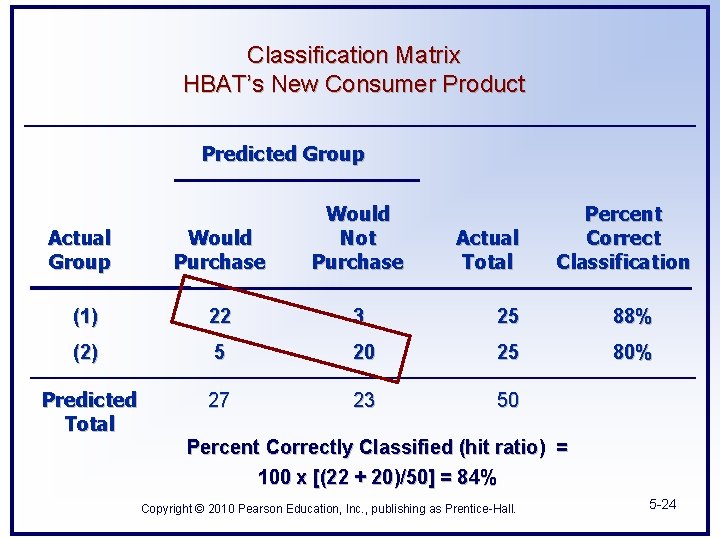
Classification Matrix HBAT’s New Consumer Product Predicted Group Actual Group Would Purchase Would Not Purchase (1) 22 3 25 88% (2) 5 20 25 80% Predicted Total 27 23 50 Actual Total Percent Correct Classification Percent Correctly Classified (hit ratio) = 100 x [(22 + 20)/50] = 84% Copyright © 2010 Pearson Education, Inc. , publishing as Prentice-Hall. 5 -24
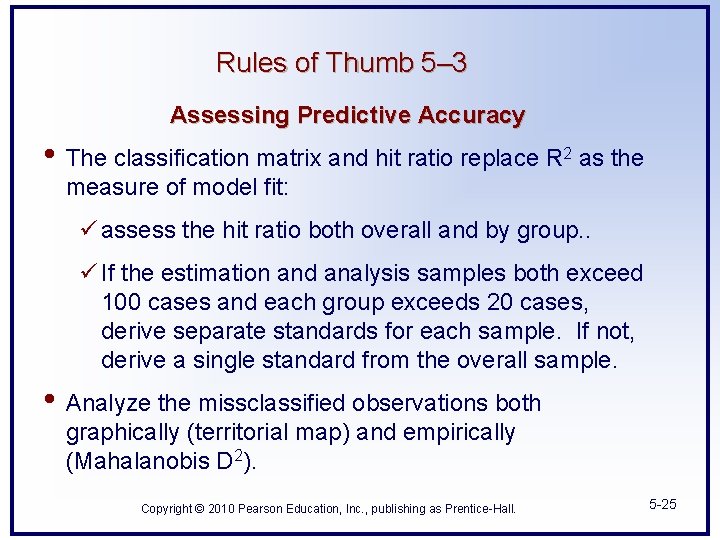
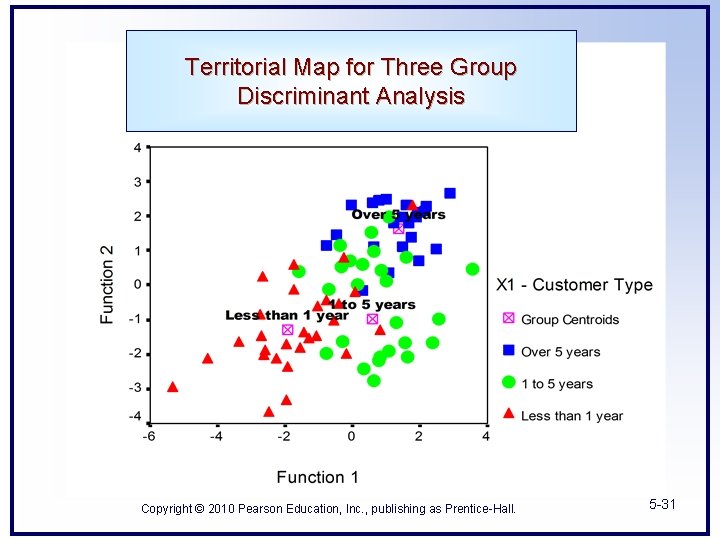
Rules of Thumb 5– 3 Assessing Predictive Accuracy • The classification matrix and hit ratio replace R 2 as the measure of model fit: ü assess the hit ratio both overall and by group. . ü If the estimation and analysis samples both exceed 100 cases and each group exceeds 20 cases, derive separate standards for each sample. If not, derive a single standard from the overall sample. • Analyze the missclassified observations both graphically (territorial map) and empirically (Mahalanobis D 2). Copyright © 2010 Pearson Education, Inc. , publishing as Prentice-Hall. 5 -25
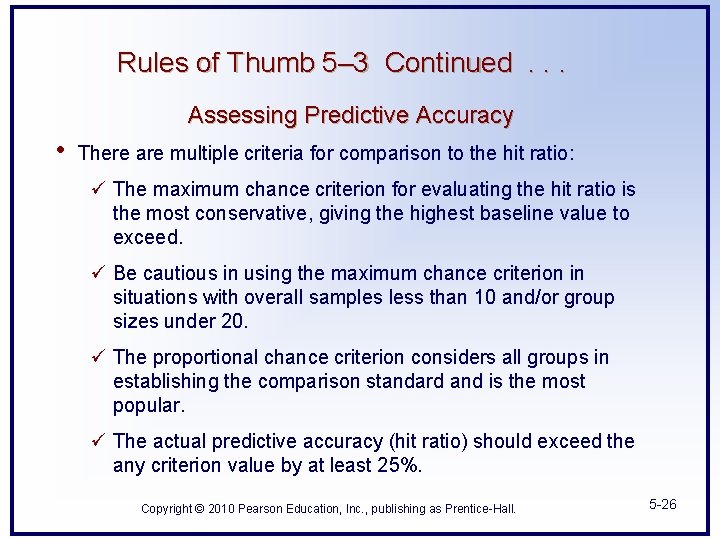
Rules of Thumb 5– 3 Continued. . . Assessing Predictive Accuracy • There are multiple criteria for comparison to the hit ratio: ü The maximum chance criterion for evaluating the hit ratio is the most conservative, giving the highest baseline value to exceed. ü Be cautious in using the maximum chance criterion in situations with overall samples less than 10 and/or group sizes under 20. ü The proportional chance criterion considers all groups in establishing the comparison standard and is the most popular. ü The actual predictive accuracy (hit ratio) should exceed the any criterion value by at least 25%. Copyright © 2010 Pearson Education, Inc. , publishing as Prentice-Hall. 5 -26
Stage 5: Interpretation of the Results Three Methods. . . 1. Standardized discriminant weights, 2. Discriminant loadings (structure correlations), and 3. Partial F values. Copyright © 2010 Pearson Education, Inc. , publishing as Prentice-Hall. 5 -27
Interpretation of the Results Two or More Functions. . . 1. Rotation of discriminant functions 2. Potency index Copyright © 2010 Pearson Education, Inc. , publishing as Prentice-Hall. 5 -28
Graphical Display of Discriminant Scores and Loadings • • Territorial Map = most common method. Vector Plot of Discriminant Loadings, preferably the rotated loadings = simplest approach. Copyright © 2010 Pearson Education, Inc. , publishing as Prentice-Hall. 5 -29
Plotting Procedure for Vectors Three Steps. . . 1. Selecting variables, 2. Stretching the vectors, and 3. Plotting the group centroids. Copyright © 2010 Pearson Education, Inc. , publishing as Prentice-Hall. 5 -30
Territorial Map for Three Group Discriminant Analysis Copyright © 2010 Pearson Education, Inc. , publishing as Prentice-Hall. 5 -31
Rules of Thumb 5– 4 Interpreting and Validating Discriminant Functions • Discriminant loadings are the preferred method to assess the contribution of each variable to a discriminant function because they are: ü a standardized measure of importance (ranging from 0 to 1). ü available for all independent variables whether used in the estimation process or not. ü unaffected by multicollinearity. • Loadings exceeding ±. 40 are considered substantive for interpretation purposes. Copyright © 2010 Pearson Education, Inc. , publishing as Prentice-Hall. 5 -32
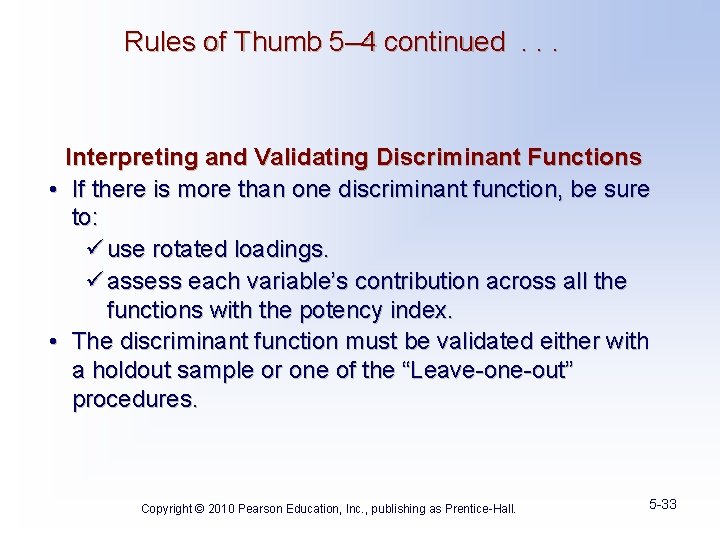
Rules of Thumb 5– 4 continued. . . Interpreting and Validating Discriminant Functions • If there is more than one discriminant function, be sure to: ü use rotated loadings. ü assess each variable’s contribution across all the functions with the potency index. • The discriminant function must be validated either with a holdout sample or one of the “Leave-one-out” procedures. Copyright © 2010 Pearson Education, Inc. , publishing as Prentice-Hall. 5 -33
Stage 6: Validation of the Results • • Utilizing a Holdout Sample Cross-Validation Copyright © 2010 Pearson Education, Inc. , publishing as Prentice-Hall. 5 -34
Discriminant Analysis Learning Checkpoint 1. When should multiple discriminant analysis be used? 2. What are the major considerations in the application of discriminant analysis? 3. Which measures are used to assess the validity of the discriminant function? 4. How should you identify variables that predict group membership well? Copyright © 2010 Pearson Education, Inc. , publishing as Prentice-Hall. 5 -35
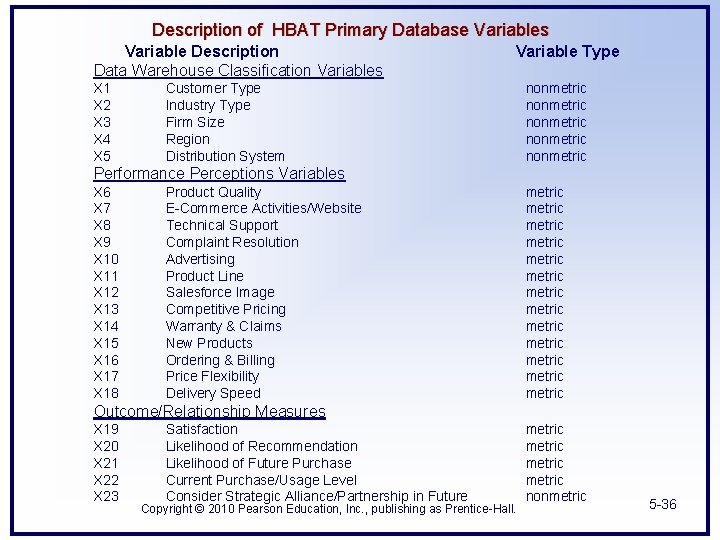
Description of HBAT Primary Database Variables Variable Description Data Warehouse Classification Variables X 1 X 2 X 3 X 4 X 5 Variable Type Customer Type Industry Type Firm Size Region Distribution System nonmetric nonmetric Performance Perceptions Variables X 6 X 7 X 8 X 9 X 10 X 11 X 12 X 13 X 14 X 15 X 16 X 17 X 18 Product Quality E-Commerce Activities/Website Technical Support Complaint Resolution Advertising Product Line Salesforce Image Competitive Pricing Warranty & Claims New Products Ordering & Billing Price Flexibility Delivery Speed metric metric metric metric Outcome/Relationship Measures X 19 X 20 X 21 X 22 X 23 Satisfaction Likelihood of Recommendation Likelihood of Future Purchase Current Purchase/Usage Level Consider Strategic Alliance/Partnership in Future Copyright © 2010 Pearson Education, Inc. , publishing as Prentice-Hall. metric nonmetric 5 -36